[
00:00:00]
[
00:00:00] Ricardo Belmar: Welcome to our new Retail Razor show, Blade to Greatness, our new standalone Retail Razor show, where we hear from a retail industry leader who shares their sharp insights and cuts of wisdom on how to excel in this dynamic and competitive field. In this series, we learn about the essential must have skills and qualities that every retail executive needs to lead their teams and their business to success.
[
00:00:30] Casey Golden: Whether we're talking about HQ or stores, we'll uncover valuable tips and advice that every retail leader can apply to their own retail career path, raising your Blade to Greatness.
[
00:00:42] Ricardo Belmar: I'm your host, Ricardo Belmar.
[
00:00:44] Casey Golden: And I'm your co host Casey Golden.
[
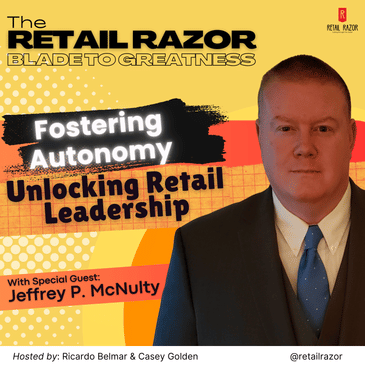
00:00:46] Casey Golden: We will speak with Jeffrey P McNulty, founder and CEO of New Retail Ethos, creator of The Ultimate Retail Course, and author of The Ultimate Retail Manual. We'll learn from his 30 years of hands-on [
00:01:00] experience as a executive leader for the Home Depot, Lowe's, Barnes and Noble, PetSmart, Shopco, Toys R Us, Publix, and Festival Foods.
[
00:01:10] Plus 18 years of experience as a retail research analyst having conducted over a thousand consultations with clients on Wall Street, hedge fund managers, equity investment partners, retailers, and entrepreneurs in the retail sector. Jeffrey has a myriad of experience, knowledge, and wisdom when it comes to retail leadership.
[
00:01:31] Ricardo Belmar: And today he's here to share with us one of the most important characteristics every retail leader needs to master, and that is the paramount importance of providing employee autonomy. Let's listen to what he has to share with us.
[
00:01:43] Casey Golden: Welcome Jeffrey.
[
00:01:45] Jeffrey McNulty: Thank you Casey and Ricardo for having me on the Retail Razor Show. It's a, it's an honor and I look forward to coming back in the future. That's a great question, Ricardo. Employee autonomy is very, very near and dear to my heart. In my bestselling book, the Ultimate Retail Manual, and in my top [
00:02:00] selling online course, the Ultimate Retail Course, I share six anchors on how retailers and businesses can create an inclusive, engaging, and rewarding culture for their employees, customers, leaders, and vendors.
[
00:02:11] The fourth anchor of the six is the extent to which employee autonomy is allowed in making decisions, developing innovative ideas, and enabling personal, personal expression within your organization. Autonomy in the retail sector at any leadership level is having the freedom of choice in making decisions with confidence from your superiors to incur mistakes.
[
00:02:31] Autonomy in the retail sector is generally considered an un unacceptable practice because of the deluge of regimented corporate structure and accountability placed upon the stores. This outdated temperament severely inhibits each store leader's ability to positively influence their environment and fully express employee's creativity and innovative ideas.
[
00:02:50] If you study the top technological organiza or technology organizations, I should say, you will find a very successful blueprint being implemented. There's no harm in cherry picking from other [
00:03:00] companies or sectors with an effective operating strategy, one of the most potent attributes the technology companies employees are understanding of autonomy's positive impact on their organization.
[
00:03:11] They encourage autonomous behavior while rewarding their teams for exemplary results. If you read their press releases, they openly a admit that many of their top revolutionary ideas come from groups of skilled associates who have full autonomy to achieve their goals. Here are some prime examples of massive, innovative ideas that came to fruition by organizations that actively support, embrace employee autonomy.
[
00:03:34] And when I thought about these, I thought, wow, I never knew these came from, from autonomous behaviors. Google developed Gmail from this Facebook developed the like button. This one really was, was interesting. Lockheed Martin created the SR-71 Blackbird, and F-22 Raptor, from employees having autonomous behavior.
[
00:03:53] And then, of course, one of the ones I'm most proud of is I was proud to be responsible for bringing Gorilla Glue to the Home Depot in [
00:04:00] 2002. And this was because I was afforded the opportunity of autonomy from my superiors. So I, I called up my, my president at the time for the Midwest Division. His name was Bill Patterson.
[
00:04:09] And I explained to him that I wanted to create a pilot program at my store in Green Bay, Wisconsin for four Gorilla Glue SKUs and presented consumer feedback to him, revenue numbers, skew penetration metrics and gross margin statistics to the mid to the entire Midwest divisional merchant teams.
[
00:04:26] They were extremely impressed and decided to roll out the SKUs to the entire Midwest division and ultimately the entire company. So as an added bonus of being on the, as for listeners of the Retail Razor Podcast, I'm at it. I'm offering a hundred dollars off discount to all listeners for the Ultimate Retail course.
[
00:04:43] All you have to do is go to the ultimate retail course.com and enter in the Code Retail Rockstar 100 off. And for any of my consulting services at New Retail Ethos, just go to new retail ethos.com.
[
00:04:54] Ricardo Belmar: Oh, well thank you for that amazing offer for our listeners, Jeffrey, and, and also I, let me also thank [
00:05:00] you for having brought Gorilla Glue, gorilla Glue into the Home Depot I, for one am a major customer.
[
00:05:05] Jeffrey McNulty: that's a tongue twister, I don't think anyone gets that right!.
[
00:05:08] Ricardo Belmar: I know. I know, right? Exactly. Exactly. It's a tongue twister. But that, that, that's a fantastic example. Honestly, that is a great example of autonomy. I love all those examples. I mean, so many things can come by just listening for a key creative idea.
[
00:05:21] Jeffrey McNulty: Yeah, I, I, I think that that's really the, the, another, another actuator that you can really motivate people with. See, a lot of times what's happening is leaders of businesses and retailers are trying to motivate, again, extrinsically, so. Increase, pay more time off, more perks. And don't keep me wrong, employees love that.
[
00:05:39] But when you go to work every day, when you get outta bed in the morning and you choose to go to work for a retailer or a business, that's a conscious choice you're making. And I used to say to myself when I was driving to work every day to work, I'd say, Jeff, who are you gonna impact today? And then driving home from work, I used to say, Jeff, who did you, who did you positively impact today?
[
00:05:58] I would go through the list of people and it would [
00:06:00] always make me feel good to know that I had impact on people. But you gotta create that environment where people want to come to work. And you know, people think, again, it's always the perks, but it's not always the perks. If you look at the technology companies, they're removing the foosball tables and the free lunches and all that because that's great, but people get get, they get used to that.
[
00:06:17] You know, they, they get used to all those extra perks and it doesn't have the same motivational impact because it, it doesn't come from inside. It doesn't tap into what I like to call heart energy. You know, I was listening to Neil Diamond, his song, Tap Into Your Heartlight, and I play that once every morning.
[
00:06:33] Believe it or not, when I'm getting ready in the morning, I put it on, on, on YouTube and I play that because I wanna make sure I'm tapping into my heartlight every day. And, and that's really, it's not, it's not really that hard to do, but you, you, you gotta really care about people. We keep talking about this, this is a repetitive pattern.
[
00:06:48] You gotta care about people, you gotta promote the right leaders who care about people. And, and you gotta really wanna see people succeed. I, I worked with a lot of leaders that if, if, if they were happy when they were succeeding, but if anybody else was [
00:07:00] succeeding, they were jealous or they were envious, and, you know, I'd be like, I'd pull 'em aside and said, listen, we're, we're all in this together.
[
00:07:06] You know, we're all connected as human beings around the world. We're all connected, we're all part of the same species. Right. And we're all, I, I wanna see everybody doing well. And the expression that I use is that we live in a wealthy, abundant, and prosperous universe where there's enough for everyone to go around.
[
00:07:21] But you gotta have leaders that generally care about this. And so one of the things I enjoyed the most about being a leader was, was creating future leaders. You know, I had a, I had a vice president come up to me one time at a walk at Home Depot, and he would say, says, what's your number one, what's your number one thing that you're responsible for?
[
00:07:36] And, and everybody started saying Customer service. I'm like, no. It's, it's, it's developing future leaders. Because If you develop future leaders, that's gonna take care of itself. Now, if you're developing future leaders and you're not a good leader, then that's a different story cuz then, you know, I worked in a lot of stores in a lot of districts where there was a lot of mini Me's running around, you know, from Austin Powers, a lot of mini Me's that were running around and they would only hire Type A personalities.
[
00:07:57] And I'm like, have you ever been in the store or [
00:08:00] district with all type A personalities, it's chaos. It's literally chaos personified. And so I made sure that when I interviewed people, I interviewed over 6,000 people throughout my career. I, I, looked at the numbers and went back and I didn't count up every single one, but that's about a, a rough estimate.
[
00:08:13] And I hired A, B, C, and D personalities because our customers are gonna be a C, a, B, C, and D personalities. And you have to learn how to, I'd have introverted people that were worried about getting promoted because they weren't extroverted or rah rah. And I'd be like, listen, you, you can do it in your own way.
[
00:08:29] Just make sure you're communicating in a way that people are resonating with. I would teach them that, you know what, when you're dealing with, with shy or quiet or introverted people, you have to alter the delivery of your message. Okay? Not, not the message itself, the delivery of your message. So maybe you watch your body language, maybe you watch your tone, you know, maybe you stand back a little bit.
[
00:08:49] You know, you don't stand so rigid, you know? And so you use your body language to communicate that, because they say body language is 70% of the communication anyway, right? So you, but you know, that was what I enjoyed [
00:09:00] the most was developing future leaders and that vice president pulled me aside after the walk and said, you know what, Jeff?
[
00:09:05] That's a perfect answer. That's a perfect answer because I never thought of it from that. Cuz most people take care of the customer, take care of the employee. Well, great leaders, if you promote the right leaders and develop in the right leaders, they're gonna do that automatically. Again, I would get the stores and districts I was responsible for on autopilot when it came to the basics.
[
00:09:22] Customer service. Inclusion, autonomy, intrapreneurship, and then all the other things naturally fell into place.
[
00:09:29] Casey Golden: Thank you so much for joining us, Jeffrey, and sharing actionable insights that retailers can do to improve the ownership . Thank you.
[
00:09:37] Jeffrey McNulty: It's my pleasure.
[
00:09:39] Casey Golden: If you've enjoyed our show, please consider giving us a five star rating and review on Apple podcasts and Goodpods. Remember to smash that subscribe button in your favorite podcast player and tune in on YouTube, so you don't miss a minute.
[
00:09:53] I'm your cohost, Casey Golden.
[
00:09:56] Ricardo Belmar: Please share your feedback with us on Twitter at Casey C Golden, Ricardo [
00:10:00] underscore Belmar, and at RetailRazor, or find us on LinkedIn, Threads, and Instagram. For the best highlights from each episode, shipped straight to your inbox, subscribe to our substack newsletter for full episode transcripts and bonus content.
[
00:10:12] I'm your host, Ricardo Belmar.
[
00:10:14] Casey Golden: Thanks for joining us.
[
00:10:16] Ricardo Belmar: Until next time, keep cutting through the clutter and stay sharp.
[
00:10:19] This is the Retail Razor Blade to Greatness.
[
00:10:22]