[
00:00:00] Ricardo Belmar: Welcome to our new Retail Razor show, Blade to Greatness, our new standalone Retail Razor show, where we hear from a retail industry leader who shares their sharp insights and cuts of wisdom on how to excel in this dynamic and competitive field. In this series, we learn about the essential must have skills and qualities that every retail executive needs to lead their teams and their business to success.
[
00:00:30] Casey Golden: Whether we're talking about HQ or stores, we'll uncover valuable tips and advice that every retail leader can apply to their own retail career path, raising your Blade to Greatness.
[
00:00:42] Ricardo Belmar: I'm your host, Ricardo Belmar.
[
00:00:44] Casey Golden: And I'm your co host Casey Golden.
[
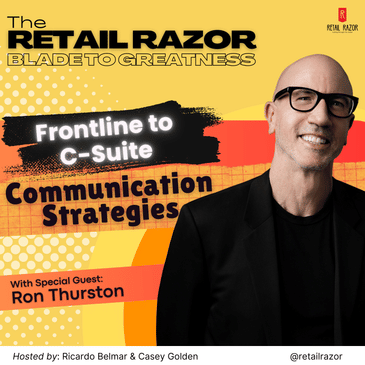
00:00:46] Casey Golden: This episode we're speaking with Ron Thurston, co-founder of Ossy, bestselling author of Retail Pride, podcast host, speaker, advisor, and board member. Ron leverages his extensive [
00:01:00] experience leading retail operations for America's most prominent brands to bring attention to the issues facing frontline workers and retail leaders today.
[
00:01:10] After releasing his first book Retail Pride and launching the Retail in America Tour and podcast, Ron has co-founded Ossy to disrupt how the retail industry hires, engages, connects retail workers with retail brands and technology providers.
[
00:01:26] Ricardo Belmar: And today he's here to talk to us about a truly important question that every retail leader needs to answer:
[
00:01:33] what can retailers do today to bridge communication from the floor to corporate.
[
00:01:38] Casey Golden: Welcome, Ron.
[
00:01:39] Ron Thurston: Awesome. Thank you. Thank you so much Casey and Ricardo. It's a pleasure to be back as always. I love being on your show. And I love this topic, when you sent the description, you know, you're right, this is, this is a topic that comes up really often from peers of mine. Those that have led stores and now lead [
00:02:00] brands. People who work in the field and sometimes have frustration with corporate and corporate that has frustration with the field. I, sit in a position today where I actually hear it from both sides, so I
[
00:02:13] where I will I do, you know, and so, you know, where I would start with this question is the same place I start every conversation, which are, I've, and I've spoken about this often on your show, is what I call the three pillars of success in retail. And, you know, they've become more around pillars of success in life, but empathy, curiosity, and focus. And so if I, I saw that question and I'd say, what could we do to bridge the gap today between corporate and stores? I'll start with on the corporate side.
[
00:02:49] The first thing I would do would be think about empathy. What, what do I imagine people in stores are feeling today? Are they, are they under [
00:03:00] pressure for sales goals?
[
00:03:01] Do they have the right inventory? Are they fearful of increase in kind of disruptive shopping activity, we'll call it, or being hurt at work. There's a lot of really important conversations that would lean into empathy. So the first thing I do is, well, how do I imagine stores are feeling today? And the follow up to that is, well, I'm gonna ask because the best thing you can do to bridge the gap is to build trust. Trust only is developed by being curious and then by acting on that information. So I think, for me, there's a lot of conversation of corporate spending more time in stores. I don't try to judge that or how much time you should spend because everyone has a lot on their plate. There's a lot of, there's a lot of things that impact someone's ability to travel or to have the budget to do so. So what I say is, whether it's a phone call, a zoom call, [
00:04:00] a store visit, whatever your forum for communication is. The best thing you can do is ask questions and be curious and say, you know what, Ricardo, like, how are you feeling today?
[
00:04:11] Like, what, what do you and your team, what are you experiencing? What are the conversations you're having? When there's no customers in the store, what do you really need to drive your business? What what tools and resources do you have today, or maybe need more of, so this kind of stream of curiosity, I think builds a great rapport and the focus, when I think about the third part of this conversation is what do you do with that information you just received? Because trust then is built to say, you know what, Ricardo, I'm so glad you shared all this with me today. What I'm gonna do is go back to my team at the office. And we're gonna go through all of this data and we're gonna come up with some strategies, and we're gonna [
00:05:00] come back to you in the next two week, two weeks and talk to you about what we can accomplish, what maybe this year, next year, and maybe the things that we can't, but keep your promise. And so what the store team does is then say, wow, I'm so glad Ron came today and listened and like heard what we had to say, didn't judge it.
[
00:05:20] That's where you use empathy because it's really quick to say, well, I don't understand why you don't get that or why you can't do this. You just need to do it. And so empathy helps you ask more questions and put your. Yourself in that place of, well, how is, how are they experiencing the world and their business and their customer and their team? What do they need to do better? How, how curious can I be and what do I do with that information for me? That, but that's how you build rapport. And, and I would say the same thing about stores. There's, I think often what I discovered when I [
00:06:00] became, a vice president of stores is there's also misinformation at the store level about what people at corporate do. And so there's this idea of, well, whether it's product, whether it's resources, whether it's payroll, whether it's operational efficiencies, maintenance. I mean, the list goes on.
[
00:06:18] Sometimes there's this judgment that happens in stores about corporate. And so you make assumptions that they can do better or should be doing more, or should be spending more money, or should be buying product differently. And my, advice or thought processes here, we'll use the same pillars and say, well how do people in in corporate, what's their experience today? And maybe there's been headcount reduction in the office, maybe there have been budget cuts, maybe there have been other things that are restricting their ability to give me the things that I may need to drive my business. So how? How do I imagine the corporate teams are feeling? And then say, [
00:07:00] be curious. Like, well, how can I ask great questions to get what I need? And the focus is how can I then deliver on the results that I'm expected to deliver with full insight into information? And where that really showed up for me is, As, as a vice president of stores and traveled as much as I possibly could, listened, I really did try to act, but sometimes it's actually going back and saying, I hear you, but we can't do that and here's why. Or and because I ran a multi-brand fashion business, every store has a list of things that they, brands that they wanna sell, sizes that they need, colors that they want. The, the product is the number one conversation always. But there, it's so complicated when you say, you start talking about brands that you can sell in certain locations. Inventory levels sell through numbers, margin [
00:08:00] conversations, kind of restrictions on merchandising. So it's becomes an education process back to the field and say, well, I, I hear you. And I'm, I'm really curious about why that needs to happen and let me just talk to you a little bit about what buying and planning and merchandising means and how that impacts your business.
[
00:08:19] So I think it's our responsibility as leaders to bridging the gap through through education and through conversation. And it's not a one size fits all. It's very much a, let's try to solve for the best of our abilities by using empathy, curiosity, and focus, on both sides.
[
00:08:40] Ricardo Belmar: Yeah. Yeah I, I, I love the way you described that , and , one of the things I'm immediately comes to my mind is, I'm listening to you, Ron, describe the process behind this. Is that really what you're doing and if I think of it as what's the outcome of this, you're actually . presenting to your, your store teams, for example, that corporate doesn't just view you as an endpoint, but [
00:09:00] that you're actually part of the business.
[
00:09:02] So it's, it's, there's that combination of what you said at the, the beginning to you're asking what their experience is, you're acknowledging what they've told you, not dismissing it because you don't think it should be that way. Right. Which I think is a, a common perception that I think stores have about corporate, that they'll just dismiss what we say, because they don't think it should be that way.
[
00:09:21] You're acknowledging it, but then you're also recognizing that whether you can or can't do something about it, you're still closing the loop and making sure that if there's a reason why you can't, you're explaining what that reason is. You're not just, again, dismissing it out of hand and saying it's not important, which just makes this team feel like they're not being heard.
[
00:09:38] Even if you did acknowledge you're also recognizing that we're trying to see what we can do about it, but maybe we can do something, maybe we can't, and if we can, wonderful. Here's how we together resolve that challenge or whatever that issue might be. And I think that is probably the, the way I look at it as, if you're a member of that store team, you come away feeling that I'm not just this, unit of labor [
00:10:00] that the brand is, is benefiting from. We're actually part of a whole, we're part of the whole business and the brand together.
[
00:10:06] Ron Thurston: And that takes great intention on both sides.
[
00:10:08] Ricardo Belmar: Mm-hmm.
[
00:10:09] Ron Thurston: It takes intention from and eliminating some of the assumptions about what people do and why they do it. And. And not judge that someone else's job is harder or easier than yours because everyone's role is important, whether it's in part-time, new hire in the store, or someone that pulls an executive position. Everyone's role is important. They just have a different, different needs at different times for the business. And so I will look at that and say, actually a new hire whose first day is on the floor today is interacting with the customer. That the customer, that the company just spent thousands of dollars marketing to, to get them to walk into the store. And that customer's experience now is determined by this person whose first day on the job [
00:11:00] is today and so whether you are the CMO of the company who just signed off on a multimillion dollar budget to drive traffic, or I'm the part-time person on my first day, the ultimate goal is that that customer has an incredible experience.
[
00:11:16] It just so happens that that customer that you just spent money on to get into the store is engaged with a new hire. And so we, we can't say one is more important because the customer could have this incredible experience and like, oh my God, I met Casey. She showed me all these things that she loves, and she told me it was her first day. And she asked for my patience while we went through the journey, but she was incredible. And I love this brand, and I can't wait to come back and see Casey again. I mean, that's a really good outcome. or, the opposite could happen. I don't need to describe that. But I think that there's, there's this sense of if you treat everyone with empathy and kindness, you recognize that everyone's role is important.
[
00:11:58] They just have different [
00:12:00] purposes.
[
00:12:00] Casey Golden: Yeah, I think acknowledging that every single person who works for you at a brand is your consumer an advocate in the community. Nobody, no matter what company people apply to work at, people typically apply to companies that they like, love, or are inspired by. And that bad experience of working there, the bad experience of communication, the bad experience of not feeling supportive, that loses you a customer, their family, their friends, It permeates that this bad experience happened with this brand, and I know because I literally work for them. They're terrible. You can't really recover from that. And I almost feel like part of like the hiring process and, and managing those teams, it is pr in a, in a lot of ways, like this is your, you have to take it super serious [
00:13:00] because, it's worse than, you know, you have all this social media and things like that, and it's just like this is a customer at the end of the day.
[
00:13:06] Ron Thurston: It's true.
[
00:13:07] I would even take that further back, Casey. It actually starts when someone's interested in working there.
[
00:13:12] Casey Golden: Yeah.
[
00:13:13] Ron Thurston: know, which is part of, you know what, we're not, we're not here to speak about Ossy, but the idea here is, you know, that their likelihood of staying with a brand actually starts before they're even hired.
[
00:13:23] When the, when, during the, journey of interviews or lack of interviews, lack of follow up or incredible follow up, all of that creates impressions that, okay, great, I get the job, but you just tortured me for a month to get here or, oh my gosh, like I, I had this, I met these great people. I can't wait for day one, and I'll go back to my example. Okay. So you, you created an experience of an interview and an onboarding that was so good that that customer that I just described, that walked in, that the company spent money on, [
00:14:00] engages with me and I have an incredible experience.
[
00:14:03] And the opposite can can be very true. So I think that I agree with you, Casey. It's, it's every touchpoint for every brand is about an experience and whatever that means for the future of a brand, that really important moments that we can't put into silos. They're all connected, they're all important, and every person in this kind of ecosystem of, of retail play really important roles.
[
00:14:34] Ricardo Belmar: Yeah. I, I think that's a great point about how, that that experience starts from the moment they're being recruited, In that hiring process. I, I hadn't thought of it until you just hearing you say it, that if the extent hiring experience. It is already tortuous , then you've just set the
[
00:14:51] Ron Thurston: I know it's strong word, but I but I, actually,
[
00:14:54] Ricardo Belmar: But, but
[
00:14:54] Ron Thurston: I hear enough candidates to know that a valid word.
[
00:14:57] Ricardo Belmar: Yeah. I I think, I think so. I'm, I'm just [
00:15:00] thinking back to even, I, I remember in some retail jobs, I had the same thing that, you know, it was not a pleasant experience to to do that. But you're right, it, it actually sets the stage for what your day one will be like before you even get to day one.
[
00:15:13] And I, I think in that sense, right, it's, it's wise for brands to think of from the marketing point of view, brands like to look at influencers, right, to promote products. But at the end of the day, they should really be thinking that, well, you, you have an entire team of influencers at your store that work day in, day out.
[
00:15:30] Because like you said earlier, the however expensive a campaign you may have run . To drive customers to go into the store, to walk through the door. Well, the very next point of influence they're gonna have is likely to be that store team member who they talk to first.
[
00:15:46] Casey Golden: Yeah, it's word of mouth is very powerful tool for marketing. And I feel that like the most, the best way to get that word of mouth marketing is literally through your employees. [
00:16:00] that is, you know, 90% of like friends and family. That they know you're happy at X brand X company, and that influences them more than a review online
[
00:16:12] Ron Thurston: Right, no, it's And, and social media just escalates that very quickly. And, you know, there are, there's a lot of TikTok and that don't paint retail in a positive light.
[
00:16:25] And some of that is, is, is deserved. And so I, I think we do have to do better. It's valuable information and it's valuable to think about, again, with empathy. How is a candidate experiencing how, what is someone's first day on the job?
[
00:16:43] And, And, when I worked at Apple, and I've mentioned this before, you know, they, they still today use a very, I. Phrase that I think leans into empathy that is, I don't know, let's find out. And it's common language for them, and it's okay to [
00:17:00] say, you know what?
[
00:17:00] I have no idea what you're talking about, but I'm gonna find the best person to solve this problem for you, or to answer your question.
[
00:17:08] And then instead of putting the pressure on you to be an expert at everything, which we do, it's okay to say, I don't know. But I'm gonna find someone that does, and we're gonna make sure that you leave this building with the best possible experience. And that may not be from me. And that is, that takes pressure off of store teams
[
00:17:30] Ricardo Belmar: mm-hmm.
[
00:17:31] Ron Thurston: And so the same. But going back to your original question, how do we bridge the gap? You bridge the gap by not expecting everyone to be an expert at everything. You bridge the gap by saying, we have incredible salespeople, but incredible salespeople are not always good at doing markdowns. Incredible salespeople, casey knows this from her other work. Great salespeople are really good with people, but they may not be the best at tasks. And you have great people who are really good at tasks, who are terrified to speak [
00:18:00] to a customer. You can have both, and that's perfectly, it's welcome, and that's how you have great hiring and
[
00:18:08] Ricardo Belmar: Mm-hmm.
[
00:18:08] Ron Thurston: that kind of idea of everyone in retail should be good at everything is, is a false narrative, I believe.
[
00:18:16] Casey Golden: yes. There are certain people who I'd never invite back to doing inventory
[
00:18:24] Ron Thurston: It would probably be me, which is, you why I was like, oh, where's food? Like who's doing the catering tonight? Everything could
[
00:18:36] Casey Golden: And it's.
[
00:18:40] Ron Thurston: see. It's the same, you know, that's why you surround yourself with great people. I had great ops people and I, they're like, Ron, you don't have to come tonight. It's fine.
[
00:18:52] Casey Golden: Yeah,
[
00:18:53] Ron Thurston: like, cool.
[
00:18:54] Ricardo Belmar: Well, I think on that super interesting note, we've come to the end of this segment. [
00:19:00]
[
00:19:00] Ron, thanks so much for joining us and sharing your insights on how to improve those lines of communication.
[
00:19:06] Ron Thurston: Thank you. Thanks Ricardo. Thank you Casey.
[
00:19:08] Casey Golden: always such a pleasure.
[
00:19:10] Ron Thurston: Always
[
00:19:11] Casey Golden: if you've enjoyed our show, please consider giving us a five star rating and review on Apple podcasts and Goodpods. Remember to smash that subscribe button in your favorite podcast player and tune in on YouTube, so you don't miss a minute.
[
00:19:25] I'm your cohost, Casey Golden.
[
00:19:27] Ricardo Belmar: Please share your feedback with us on Twitter at Casey C Golden, Ricardo underscore Belmar, and at RetailRazor, or find us on LinkedIn, Threads, and Instagram. For the best highlights from each episode, shipped straight to your inbox, subscribe to our Substack newsletter for full episode transcripts and bonus content.
[
00:19:44] I'm your host, Ricardo Belmar.
[
00:19:46] Casey Golden: Thanks for joining us.
[
00:19:47] Ricardo Belmar: Until next time, keep cutting through the clutter and stay sharp.
[
00:19:50] This is the Retail Razor Blade to Greatness.
[
00:19:54] [
00:20:00]