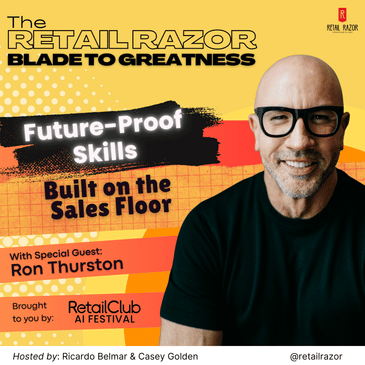



S2E9 Future-Proof Skills - Ron Thurston on the human-centric skills AI can't replace
Everyone is talking about how AI is transforming retail. Far fewer people are talking about the future-proof skills that technology will never replace, and according to Ron Thurston, almost all of these human-centric skills start on the sales floor.
In this episode of Blade to Greatness, hosts Ricardo Belmar and Casey Golden sit down with Ron Thurston, best-selling author of Retail Pride and Human Pride, former senior retail executive, and host of Frontline Fridays and Retail in America podcasts. Ron makes a compelling case that while AI may be reshaping the tools of retail, the most resilient leaders are the ones who master human-centric skills like communication, empathy, adaptability, and influence.
Ron argues there has never been a more important time to learn technology and learn how to optimize the human potential of your team at the same time. One no longer exists without the other. He shares his Connect, Reveal, Transform framework for helping every person on your team discover where they truly excel, and explains why the job description you wrote three years ago is already obsolete.
In this conversation you’ll learn
Why the single most future-proof skill in retail is learning to sell, and why you can't develop it anywhere else in the corporate world
How the sales floor builds confidence, credibility, communication skills, and the ability to handle rejection 20 times a day
The Connect, Reveal, Transform framework for optimizing the human potential of your team
Why frontline retail is the ultimate leadership training ground for future-proof skills
How Ron's "tell me your story" interview question instantly reveals a candidate's depth
What the NRF Foundation retail accelerator program is teaching the next generation of leaders
How AI can give store teams speed on operations, policies, and product look-ups so they can focus on human connection
Whether you lead a store team, a corporate function, or you're a student about to pitch for your first internship, this episode is a roadmap for building the human-centric skills that technology can't replace. Future-proof skills aren't found in a binder or a tool. They're built on the sales floor, one conversation with a stranger at a time.
👉 Stay Sharp. Lead Boldly. Stay Human.
Brought to You By RetailClub.
Join 2,000 retail leaders at RetailClub AI Festival, September 22–24 in Huntington Beach. Dive deep into how AI is reshaping retail while soaking up the sun at a fully outdoor, beachside venue. Decision-makers from retailers and brands can attend with free tickets & up to $1,250 in travel reimbursement. Learn more at https://retailclub.com/retail-razor-podcast
Subscribe and Follow
If you enjoyed this episode, please leave us a 5 star rating and review on Apple Podcasts, Spotify, or Goodpods. Subscribe on YouTube so you never miss an episode and check out the other shows in the Retail Razor Podcast Network: The Retail Razor Show, Retail Transformers, and Data Blades.
Subscribe to the Retail Razor Podcast Network: https://retailrazor.com/
Subscribe to our Newsletter: https://retailrazor.substack.com
Subscribe to our YouTube channel: https://go.retailrazor.com/utube
Guest Spotlight
Ron Thurston, https://www.linkedin.com/in/rthurston/
“Human Pride” available on Amazon: https://geni.us/humanpride
Ron Thurston is a two-time #1 bestselling author of Human Pride and Retail Pride, keynote speaker, and passionate advocate for human potential in the age of AI. Recognized as a Retail Voice by NRF, a Top 100 Retail Technology Influencer for four consecutive years, and a Top Retail Expert for six, Ron has dedicated his career to helping people and brands thrive where humanity and technology meet. Ron also hosts the podcasts Frontline Fridays and Retail in America. Recognized as one of the most thoughtful voices in the industry, Ron shares actionable insights on how clarity transforms retail leadership and empowers teams to thrive.
Music
Includes music provided by imunobeats.com, featuring Swag, Tag and Brag from the album Beat Hype, written by Heston Mimms, published by Imuno.
Transcript
S2E9 Ron Thurston - Future-Proof Skills
[00:00:00] Preview
[00:00:01] Ron Thurston: The number one thing they can learn is how to sell in a store. That's it. A couple of years and maybe even less. If you're really good at it. Get a good boss in a store of a brand. I don't really even care If you like the product, just go learn how to sell and get a great boss. It will change your life.
[00:00:20] That is not the world we live in. You can't say that the job description you wrote three years ago for this job is the same job description you should have today.
[00:00:30] There's never been a more important time to simultaneously learn about technology as learn how to optimize the human potential of your team.
[00:00:40] Okay. I sit across from a candidate too, and I would, I'm like, just tell, tell me your story. That's my question. I usually have one question. Tell me your story.
[00:00:49] I think one skill that is learned in retail, that there's nowhere else in corporate, a corporate world, that you will learn is how to [00:01:00] sell.
[00:01:00] Show Intro
[00:01:07] Ricardo Belmar: Welcome to Blade to Greatness, the podcast where retail leaders sharpen their edge one essential skill at a time as we uncover the essential traits every retail leader needs to thrive.
[00:01:17] I'm Ricardo Belmar.
[00:01:19] Casey Golden: And I'm Casey Golden.
[00:01:20] This season, we're joined by a guest each week who shines a light on a single leadership skill that every retail leader must master. And today's conversation is, of course, about the future and why the skills that will matter the most tomorrow are being built right on the sales floor today.
[00:01:41] Ricardo Belmar: Our guest is Ron Thurston, best-selling author of "Retail Pride" and "Human Pride," former senior retail executive, host of the podcast Frontline Fridays and Retail in America, and one of the most respected voices in our industry. Ron makes a powerful case that while AI may be transforming retail, [00:02:00] the most resilient leaders are the ones who master human-centric skills: communication, empathy, adaptability, and influence.
[00:02:08] Casey Golden: And he's a master because I can't even hear his name without smiling.
[00:02:11] Ricardo Belmar: That's right.
[00:02:14] Casey Golden: So you'll hear why frontline retail is the ultimate leadership training ground, the future-ready skills every leader should be building now, and how to spot and nurture high potential talent on your team.
[00:02:27] Ricardo Belmar: And Ron , doesn't just talk theory. He shares practical tips and tactics that every leader can put into action, turning every challenge into a coaching moment.
[00:02:37] Casey Golden: This episode is a roadmap for anyone who wants to future-proof their leadership and build skills that technology can't replace.
[00:02:47] Ricardo Belmar: But first, let me tell you about our Retail Razor Podcast Network sponsor, Retail Club. Join 2,000 retail leaders at the Retail Club AI Festival, September 22nd to 24th in Huntington Beach. [00:03:00] Dive deep into how AI is reshaping retail while soaking up the sun at a fully outdoor beachside venue. Decision-makers from retailers and brands can attend with free tickets and up to $1,250 in travel reimbursement. Head to retailclub.com/retail-razor-podcast to learn more and get your ticket today. Thank you to Retail Club for helping us bring you this podcast and the other shows in the Retail Razor Podcast Network.
[00:03:27] Casey Golden: Now, before we dive in, we have a quick ask for you. We love our audience. If you like our show, please show us some love and give us a five-star rating and drop a quick review on Apple Podcasts, Spotify, YouTube, or Goodpods. We super appreciate your support.
[00:03:44] Ricardo Belmar: And please, please do yourself a favor and check out the other shows in our Retail Razor Podcast Network if you haven't already The Retail Razor Show, Retail Transformers, and Data Blades. You can find them in your favorite podcast player, or visit our YouTube channel and find them all.
[00:03:59] Casey Golden: [00:04:00] Now let's get into it.
[00:04:01] Ricardo Belmar: Here's our conversation with Ron Thurston.
[00:04:04] Welcome Back, Ron Thurston!
[00:04:10] Casey Golden: Ron, welcome back to another Blade to Greatness. We're always anxiously anticipating another episode with you on the show.
[00:04:18] Ron Thurston: Thank you. Thank you, Casey. Anxiously anticipating. I love that.
[00:04:23] Casey Golden: yeah. Ricardo and I, um, yeah, we're having a mini war here over how many tongue twisters he .
[00:04:35] Ricardo Belmar: It's always, it always makes it more interesting and more fun. For every new episode.
[00:04:40] Why Human Potential Matters
[00:04:40] Ricardo Belmar: Well, Ron today, we're gonna talk about another very important concept that every retail leader should and should be aware of and seek to adopt future proofing skills that start on the sales floor.
[00:04:50] Now we've all seen all the stories and listened to all the podcasts where everyone talks about how AI is transforming retail. But the most resilient leaders tend to be the ones who [00:05:00] master human-centric skills. Tell us why this is so important for retail leaders to understand.
[00:05:06] Ron Thurston: Yeah. Thank Thanks, Ricardo. And, and I love this question because you're right, the easier part of how we think about the industry and the business is to think about the tools and the technology and the efficiencies and the optimizing technology to deliver performance and that I understand and fully appreciate, but what we're not spending enough time on is optimizing the human potential of our teams. And so I've spoke about this on your other Blade to Greatness. There's never been a more important time to simultaneously learn about technology as learn how to optimize the human potential of your team. These are the two fundamental leadership skills that everyone will need and one doesn't exist without the other anymore.
[00:05:58] If you are not [00:06:00] consciously digging into what every single person on your team excels at is proud of, brings joy to work about it, shows up and is excited to do this work. If you don't know what that is from every single person, then you're going to miss the opportunity to optimize their performance.
[00:06:19] And when teams are small, optimizing everyone and learning that. That human connection, that ability to ask great questions, to be empathetic is that skill that many people are maybe learning to do for the first time because technology has been their primary source of growth. And so now it's like, well, certainly we understand technology, but we've gotta lean even heavier now into what it means to lead through optimizing everyone's human potential.
[00:06:54] Ricardo Belmar: Mm-hmm.
[00:06:54] Casey Golden: I used to feel that this was a belief system. I [00:07:00] didn't think it was something you could teach. And over the past few years, I've really seen this as a personal development and, teaching moment. And it, I do believe that these are skills that can be taught and over time it is. It's more than just a belief system.
[00:07:23] Ron Thurston: Yeah.
[00:07:24] Casey Golden: And now I've really started to adopt the, the mindset that, it's a, it's an opportunity for development.
[00:07:32] Ron Thurston: Right.
[00:07:33] Connect Reveal Transform Framework
[00:07:34] Ron Thurston: I, and so there's there's a framework that I speak about this Casey in, in some of my, my work of Connect, Reveal, Transform. And so what you're saying is let's understand how to connect the dots of what work today is. How does that, what, what do you do every day? What's, how has technology changed your work?
[00:07:54] Let's say, let's connect all the pieces of your current role and then let's [00:08:00] through that the next phase of Reveal. So let's reveal through this work, we've connected all the dots. Let's reveal what actually you are going to excel in. Are you leaning more in. More human, empathetic curiosity, more human-centric leadership, or are you really someone that thrives in technology based, how the work is evolving so quickly?
[00:08:25] Like where, let's reveal like your, let's reveal your true strengths, and I think this actually is work that's needs to be done regularly because the work today is changing so fast that you can't actually say, well, now from now on, I'm gonna put Casey in this bucket. I'm gonna put Ricardo in this bucket.
[00:08:45] From now on, you are in you're designated as these, as these people. I think the Transform is in this constant state of evolution all the time right now, and that as business changes. The world changes, [00:09:00] technology changes. You reveal different strengths and, then it's about the transform is then let's put this together and transform a business.
[00:09:10] Transform a team, maybe you work in a different department because your skillset and you thought you were in like buying planning, but you're actually much better in a more of a creative part of that business where someone else may say, I'm actually much better using AI to understand like buying and allocation plans.
[00:09:29] I really thrive on that, not the creativity of what color we should buy. So there, there's this sense of this constant state of connect, reveal, transform of everyone on your team. And I think it's very fluid and that, but that requires great leadership and the ability to say. I want my team to... i'm optimizing their human performance, so I'm going to bring in tools that help them do that, and it's this constant [00:10:00] state of change, and that is really uncomfortable. I would say for a lot of people, there's a lot of leaders that would just say, here are the jobs, here are the job titles I'm hiring for.
[00:10:12] If you don't fill the competencies on this job description, I'm not interested in you. And it's very black and white. It's very binary and. That is not the world we live in. You can't say that the job description you wrote three years ago for this job is the same job description you should have today. It's not possible. It's not, the world has changed and the job description for a different generation might look different. So all of this is saying well, the job has shifted. How we work is different. The team size is different, so let's, let's be aware of that so that we can optimize everyone's abilities and that everyone's doing their best work.
[00:10:57] Ricardo Belmar: Yeah. Yeah.
[00:10:58] Sales Floor Builds Confidence
[00:10:58] Ricardo Belmar: Ron, you've, you've talked [00:11:00] before how frontline retail is probably the ultimate leadership training ground. If you think about what's one specific, maybe overlooked skill that's developed as part of frontline retail, that will really matter even more in this AI tool-based era.
[00:11:17] Ron Thurston: I think one skill that is learned in retail, that there's nowhere else in corporate, a corporate world, that you will learn is how to sell.
[00:11:29] You learn how to sell. And I love this ability to say, I know how to sell myself. I know how to pitch my team. I know how to build relationships in a selling environment, which is with a stranger. I can sell something to a stranger. And that builds confidence. It builds credibility. It builds your communication skills and you learn how to take defeat because people are gonna say no. So it's the emotion of the [00:12:00] sale. It's the emotion of I, I can connect, I can sell, I can take defeat, and I can move forward. And if you do that 20 times a day. Which in any store you're doing at least that many times, if I can do that and I've developed the ability to connect with a stranger and sell them something in three minutes or less, that is a skill in any corporate environment you could use to your advantage. And that the only people that have that kind of hustle are people that come from stores.
[00:12:33] Ricardo Belmar: Mm-hmm.
[00:12:34] Ron Thurston: I believe that to be true.
[00:12:36] They just don't.
[00:12:36] There's no other place where you would develop that other than kind of being an entrepreneur or pitching a business or like you're developing something, but you don't become an entrepreneur overnight.
[00:12:49] You learn how to do that. You learn how to pitch and sell your business likely because you came from an environment where you had to sell everything, and it's uncomfortable. It's scary.
[00:12:59] [00:13:00] I've had new hires that would. They're like, you put them in the front of the store and all you have to do is say hello that are terrified and go like, run and hide in the corner instead,
[00:13:09] Ricardo Belmar: Yeah, right. That's right.
[00:13:11] Ron Thurston: It's petrifying and and over time it's like, well, Don can say hello to strangers and feel and know that half of them are going to ignore me and that nobody cares that I'm saying hello to them.
[00:13:24] So you, develop this sense of confidence and what's the word? Like a shell of like, don't worry about it. So you're gonna talk on your phone and ignore me. It's cool, whatever. Like, I'm gonna go talk to this person. So you, there's this air of like, I can handle this. That only comes in retail and that, that's a skill.
[00:13:46] Retail Accelerator For Students
[00:13:46] Ron Thurston: I'm doing some work now with NRF Foundation and we have an, we're calling it a retail accelerator program. So I've got the presidents of all of the NRF clubs at universities all across the country on a [00:14:00] weekly call, and most of them are, if they're not already, they will by the time I'm done with them, work in a store.
[00:14:06] Casey Golden: Oh, I love those.
[00:14:08] Ron Thurston: yes. It's
[00:14:10] Ricardo Belmar: Love that!
[00:14:11] Ron Thurston: Of course. Uh, and we've got guest speakers and we've got, I really want this immersion into what does like a retail accelerator program look like? Why should you work in this business? And no matter what they want to do, and there's, they're in supply chain buying, planning, design, every part of this industry there are students studying these worlds. But the number one thing they can learn is how to sell in a store. That's it. A couple of years and maybe even less. If you're really good at it. Get a good boss in a store of a brand. I don't really even care If you like the product, just go learn how to sell and get a great boss. It will change your life.
[00:14:53] And they don't always believe me, I would say. 'cause it sounds really hard and it sounds pretty [00:15:00] terrifying. But if you do that, you've changed your life, you beca, think about it, you become a better candidate. All of these students are about to either get internships, they're pitching for internships, or maybe their first job. You are such a better candidate. Because you know how to sell. Because you can speak confidently about yourself and the skills that you have. So you're selling, you've learned how to sell yourself and in this kind of professional world, that requires you to be better than everybody else right now. It does and
[00:15:36] Casey Golden: and I think it also provides that like self agency. You become a better advocate for your own self throughout your life, regardless of your career.
[00:15:46] Ron Thurston: Yep.
[00:15:47] Agreed. So, that, it's a long answer to your question, Ricardo, but I'm very passionate about this topic because you can see the difference in people.
[00:15:56] Tell Me Your Story Interviews
[00:15:56] Ron Thurston: Okay. I sit across from a candidate too, and I would, you know, I don't generally like look at a resume. I'm like, just tell, tell me your story.
[00:16:03] That's my question. I usually have one question. Tell me your story. Some people can answer that question and some people are like what do you mean? I like where do I start? Tell me your story. Tell me.
[00:16:16] And if they literally we're three minutes in and they can't answer that question, I'm like, super great to meet you. Thank you. We likely will not be moving forward with your application.
[00:16:26] Ricardo Belmar: Yeah.
[00:16:26] Ron Thurston: Answer that question after you've sold in a retail store for a couple years. Lemme tell you my story.
[00:16:31] I worked here and this is what happened.
[00:16:34] Ricardo Belmar: Yeah.
[00:16:35] Ron Thurston: Like that, you've got some scars to prove that, that it makes you much more interesting.
[00:16:40] Casey Golden: Yeah.
[00:16:41] Ricardo Belmar: Yeah.
[00:16:42] AI For Store Ops Speed
[00:16:42] Casey Golden: What's one skill that AI can help improve the store team members that would serve them into future roles?
[00:16:51] Ron Thurston: Yeah I think that the efficiencies of things like processes, policies, [00:17:00]operations. When you think about the days of binders in the back room, data that was like in 14 different places, all the different reporting all the ways we communicated it, it's been really like, inconsistent. We'll just say by brand. Even by store, everyone communicates in a different way. Technology helps us ask just a question and get an answer to anything. So in kind of store ops world, you can download, upload all of that information and have it at someone's fingertips.
[00:17:35] That is life changing in a world where speed is everything. Time is everything. Customers standing in front of you wants an answer of, where's my product?
[00:17:47] If it's in another store, do they have it?
[00:17:49] What, what, how quickly can I get it? What's your policy on this? This accident just happened in the store. What do I do? I just had something happen around [00:18:00] asset protection.
[00:18:00] Now, what? If I can answer those questions in a matter of seconds instead of, oh my God, where's the, like the store operations binder? What page is that? Oh, that page is missing from the binder. Like that, that's been the life of retail for a long time. Let's solve all of those challenges with technology to give you time back for your customers. No problem, Casey let me just check here. Oh, I see. We have this and this. It's gonna happen. We can put it on your account and, and take care of it. There's, that's building loyalty and that's how you build business using great human connection that's enabled by technology.
[00:18:41] Ricardo Belmar: Yeah, that's so true. That's so true.
[00:18:43] Wrap Up And Subscribe
[00:18:57] Ricardo Belmar: Well, Ron, this has been another amazing discussion. Thanks so much for sharing your thoughts on this topic with us today. It's just so important for retail leaders to recognize these human-centric skills that so well developed in the sales floor. It can impact so many other things that they do just beyond the technology alone.
[00:18:59] Ron Thurston: [00:19:00] Thank you. Thanks so much, Ricardo and Casey.
[00:19:02] Casey Golden: It's a wrap.
[00:19:03]
[00:19:03] Show Close
[00:19:09] Casey Golden: If you enjoyed today's episode, please give us a five-star rating and review on Apple Podcasts, Spotify, or Goodpods. And don't forget to hit subscribe on your favorite podcast app or on YouTube so you never miss an episode.
[00:19:24] I'm Casey Golden.
[00:19:25] Ricardo Belmar: We'd love to hear from you. Follow us and share your feedback at Retail Razor on LinkedIn, Bluesky, Threads, and Instagram. You can also subscribe to our Substack newsletter for highlights from every episode and visit retailrazor.com for transcripts and more details about our guests.
[00:19:40] Blade to Greatness is part of the Retail Razor Podcast Network.
[00:19:43] I'm Ricardo Belmar.
[00:19:44] Casey Golden: Thanks for joining us.
[00:19:46] Ricardo Belmar: Until next time, stay sharp, lead boldly, and stay human.
[00:19:50] This is the Retail Razor Blade to Greatness.
[00:19:53]