
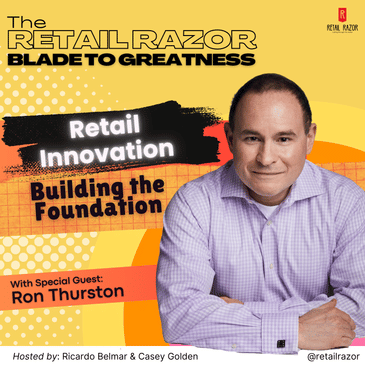



S2E2- Building the Foundation for Retail Innovation - The Hierarchy of IT Needs
In this episode of Blade to Greatness, Ricardo Belmar and Casey Golden welcome Andy Laudato, COO of The Vitamin Shoppe and author of Fostering Innovation. Andy introduces his hierarchy of IT needs, modeled after Maslow’s pyramid. Andy shows how retail leaders must first build a strong foundation before pursuing retail innovation. From keeping the lights on to creating value, Andy explains how CIOs can earn credibility, manage risk, and ultimately drive retail innovation and transformation.
What You’ll Learn in This Episode:
Why IT stability is the foundation for retail innovation
How CIOs can balance operational excellence with retail transformation goals
The importance of prioritization and clarity in project management
Practical strategies for creating value before innovating
Why data accuracy is critical for AI and analytics success
This discussion is perfect for retail executives, CIOs, IT leaders, entrepreneurs, and innovators. For those seeking practical strategies to build credibility and drive sustainable retail innovation and transformation!
👉 Stay Sharp. Lead Boldly. Stay Human.
Subscribe to the Retail Razor Podcast Network: https://retailrazor.com/
Subscribe to our Newsletter: https://retailrazor.substack.com
Subscribe to our YouTube channel: https://go.retailrazor.com/utube
Guest Spotlight:
Andy Laudato, COO, The Vitamin Shoppe
https://www.linkedin.com/in/andrewlaudato/
Author, “Fostering Innovation,” available at Amazon: https://a.co/d/d7JxrfJ
Chapters
00:00 Preview
00:49 Show Intro
02:40 Welcome Andy Laudato - Building the Foundation for Innovation
04:05 Hierarchy of IT Needs
06:29 Creating Value and Innovation
12:27 Balancing Operational Stability and Innovation
16:12 Conclusion and Final Thoughts
16:38 Show Close
Includes music provided by imunobeats.com, featuring Swag, Tag and Brag. From the album Beat Hype, written by Heston Mimms, published by Imuno.
Transcript
00:00:01 --> 00:00:03 Andy Laudato: If you can't keep the lights on, you'll spend
00:00:03 --> 00:00:04 any amount of money, right?
00:00:04 --> 00:00:08 If you can't keep the server up and the tech shows up and she wants 500 bucks
00:00:08 --> 00:00:09 an hour, you're gonna write the check.
00:00:09 --> 00:00:09 So.
00:00:10 --> 00:00:12 You gotta get it right and then you gotta get it cheap.
00:00:13 --> 00:00:16 But you lose credibility 'cause the data's wrong or it's incomplete, or
00:00:16 --> 00:00:19 you know, or even worse, people are making decisions on incorrect data or
00:00:19 --> 00:00:23 incomplete data, or you're telling your customer, oh hey Andy, I think you really
00:00:23 --> 00:00:26 need this menopause drug because I got marked as a female instead of a male.
00:00:26 --> 00:00:26 Right?
00:00:26 --> 00:00:31 So I think foundationally making sure that if you don't get your data right
00:00:31 --> 00:00:33 and you try to do the fancy stuff on top, you're gonna blow things up.
00:00:34 --> 00:00:35 Clarity about what is number one.
00:00:36 --> 00:00:39 A little exercise that I talk about is to ask all your execs to write down
00:00:39 --> 00:00:41 their top five projects in the business.
00:00:41 --> 00:00:43 They should all match perfectly.
00:00:43 --> 00:00:44 All, all of them should know.
00:00:45 --> 00:00:45 You guys are
00:00:45 --> 00:00:45 Casey Golden: How.
00:00:46 --> 00:00:47 Ricardo Belmar: yeah.
00:00:47 --> 00:00:48 Andy Laudato: Never.
00:00:48 --> 00:00:49 And then what you could do is, um,
00:00:55 --> 00:00:58 Ricardo Belmar: Welcome to Blade to Greatness, the podcast where
00:00:58 --> 00:01:02 retail leaders sharpen their edge one critical skill at a time, as
00:01:02 --> 00:01:06 we uncover the essential traits every retail leader needs to thrive.
00:01:06 --> 00:01:07 I'm Ricardo Belmar.
00:01:07 --> 00:01:08 Casey Golden: And I am Casey Golden.
00:01:09 --> 00:01:14 Each episode we're joined by a guest who brings one leadership skill into sharp
00:01:14 --> 00:01:19 focus, and today we're driving into a topic that every retail leader thinks
00:01:20 --> 00:01:22 they've mastered until things break.
00:01:23 --> 00:01:23 Ricardo Belmar: That's right.
00:01:24 --> 00:01:27 We're talking about building the real foundation of innovation,
00:01:28 --> 00:01:31 keeping the lights on, running lean, and earning the right to innovate.
00:01:31 --> 00:01:35 And who better to guide us through that than Andrew Laudato, COO of
00:01:35 --> 00:01:39 the Vitamin Shoppe and author of the book Fostering Innovation.
00:01:39 --> 00:01:43 Casey Golden: Andy's hierarchy of IT needs is like Maslow's Pyramid,
00:01:44 --> 00:01:48 but for tech leaders, if you're trying to innovate without a
00:01:48 --> 00:01:53 stable foundation, you're basically building a smart store on quicksand.
00:01:54 --> 00:01:54 Ricardo Belmar: Exactly.
00:01:55 --> 00:01:59 In this episode, Andy walks us through how retail leaders can build credibility,
00:02:00 --> 00:02:04 optimize IT spend, and create the conditions where innovation isn't just
00:02:04 --> 00:02:05 a buzzword, it's a business outcome.
00:02:06 --> 00:02:09 Casey Golden: And now just before we dive in, I have a quick ask for you.
00:02:10 --> 00:02:16 If you like our show, please give us a five star rating and drop a
00:02:16 --> 00:02:20 quick review on Apple Podcasts, Spotify, YouTube, or Goodpods.
00:02:20 --> 00:02:22 We really appreciate your support.
00:02:23 --> 00:02:25 Ricardo Belmar: And please do us a favor and check out the other
00:02:25 --> 00:02:29 shows in our Retail Razor Podcast Network, the Retail Razor Show,
00:02:29 --> 00:02:31 Retail Transformers, and Data Blades.
00:02:31 --> 00:02:34 You can find them in your favorite podcast player or visit our
00:02:34 --> 00:02:36 YouTube channel to find them all.
00:02:36 --> 00:02:37 Now, let's get into it.
00:02:37 --> 00:02:40 Here's our conversation with Andy Laudato.
00:02:46 --> 00:02:51 Casey Golden: Andy, welcome to the Blade to Greatness podcast.
00:02:52 --> 00:02:52 Andy Laudato: Thank you.
00:02:52 --> 00:02:53 Thank you so much.
00:02:53 --> 00:02:56 Ricardo Belmar: Well, you're certainly no stranger to The Retail Razor Show.
00:02:56 --> 00:02:58 Now you've joined the select number of guests that have been on the
00:02:58 --> 00:03:01 mic with us on more than one show so it's great to have you here.
00:03:01 --> 00:03:02 Andy Laudato: Thrilled to be back.
00:03:03 --> 00:03:05 Ricardo Belmar: So today you're talking with us about something we
00:03:05 --> 00:03:09 think really is a critical skill that retail leaders should master,
00:03:09 --> 00:03:11 building the foundation for innovation.
00:03:12 --> 00:03:16 . And in your book, Fostering Innovation, that we've talked about before, you
00:03:16 --> 00:03:19 mentioned a framework that you've modeled on Maslow's Hierarchy of Needs showing
00:03:20 --> 00:03:24 that innovation can only thrive when foundational IT functions are reliable.
00:03:25 --> 00:03:26 So tell us more about.
00:03:26 --> 00:03:28 How the framework works and how it helps leaders really build
00:03:28 --> 00:03:30 that foundation for innovation.
00:03:30 --> 00:03:31 Andy Laudato: Sure.
00:03:31 --> 00:03:34 Well, we all love to innovate and I think it's fair to say that in retail
00:03:34 --> 00:03:35 we all have to innovate, right?
00:03:35 --> 00:03:36 It's innovat or die.
00:03:36 --> 00:03:40 So innovation is imperative for all of us.
00:03:40 --> 00:03:44 However, so much innovation stalls out or fails.
00:03:45 --> 00:03:47 And what I've learned over the years is if you don't build your
00:03:47 --> 00:03:51 innovation on a firm foundation, it's just not gonna work for you.
00:03:51 --> 00:03:51 So.
00:03:51 --> 00:03:53 If you're gonna build a building, you know, you gotta dig a really
00:03:53 --> 00:03:55 big hole and pour concrete in it.
00:03:55 --> 00:03:58 And maybe that's not the exciting part, but if you don't do that, you're
00:03:58 --> 00:04:02 gonna have a building that's tipped over, falls apart, or never get done.
00:04:02 --> 00:04:05 So, this hierarchy is all about that.
00:04:05 --> 00:04:10 And, so when you think about technology, so for IT departments, let's just use
00:04:10 --> 00:04:12 the term KTLO, keep the lights on.
00:04:13 --> 00:04:18 And it's by far the most important job, and it's the number one
00:04:18 --> 00:04:19 most important job of a CIO.
00:04:20 --> 00:04:23 And by the way, it's what gets CIOs fired if they can't keep the lights on.
00:04:23 --> 00:04:28 And I'm talking about the registers ringing and the network staying up and the
00:04:28 --> 00:04:33 emails, emailing, you know, uh, not to be named, you know, big cloud provider had
00:04:33 --> 00:04:36 a little KTLO issue this just recently.
00:04:36 --> 00:04:38 And we all feel the pain of that.
00:04:38 --> 00:04:38 So.
00:04:39 --> 00:04:41 It's job number one is to do that.
00:04:41 --> 00:04:45 Now, you're not gonna win awards and be on the stage and be celebrated
00:04:45 --> 00:04:47 and promoted or invited to board meetings because you did that.
00:04:47 --> 00:04:51 It's the expectation of the job, but you also can't ignore it.
00:04:51 --> 00:04:58 So in order to do that it's about automation, it's about procedure, and
00:04:58 --> 00:05:01 it's really about learning and also KPIs.
00:05:02 --> 00:05:04 Whatever it is, you know, we can use uptime and having an agreement
00:05:04 --> 00:05:08 that this system's gonna be up 99.9 or a hundred percent of the time.
00:05:08 --> 00:05:10 So that's job one.
00:05:10 --> 00:05:12 That's the foundation, that's the concrete.
00:05:12 --> 00:05:15 And it's necessary but not sufficient.
00:05:15 --> 00:05:18 And so the next level of the hierarchy, and back to, you
00:05:18 --> 00:05:19 know, you mentioned Maslow.
00:05:19 --> 00:05:22 People remember this from college, but basically he said, if you're getting
00:05:22 --> 00:05:24 chased by a bear, you can't fall in love.
00:05:25 --> 00:05:25 And so.
00:05:26 --> 00:05:28 You gotta serve your safety needs.
00:05:28 --> 00:05:30 You know, you need a nice house and, you know, keep the bear out and then
00:05:30 --> 00:05:33 you gotta feed stuff and then you can move on and self-actualize and
00:05:33 --> 00:05:35 build a pyramid or whatever we do as
00:05:35 --> 00:05:35 Ricardo Belmar: Yep.
00:05:35 --> 00:05:36 Yep.
00:05:36 --> 00:05:38 Andy Laudato: That's the same exact analogy.
00:05:38 --> 00:05:42 So next up on mine is to have a lean and efficient IT department.
00:05:42 --> 00:05:45 If you can't keep the lights on, you'll spend any amount of money, right?
00:05:45 --> 00:05:48 If you can't keep the server up and the tech shows up and she wants 500 bucks
00:05:48 --> 00:05:49 an hour, you're gonna write the check.
00:05:49 --> 00:05:50 So.
00:05:50 --> 00:05:52 You gotta get it right and then you gotta get it cheap.
00:05:53 --> 00:05:55 Make it work, and then make it affordable.
00:05:55 --> 00:05:59 And the reason this is so important is it's really hard to be an IT leader and go
00:05:59 --> 00:06:03 knock on the door of your executive peers and go, oh, let's go do this or that.
00:06:03 --> 00:06:05 Let's go do a project together.
00:06:05 --> 00:06:08 If you're own house isn't in order, if you're not making your budget, you
00:06:08 --> 00:06:12 know, if you're not managing your staff and your head count and your contracts.
00:06:12 --> 00:06:14 So, get it right then get it cheap.
00:06:14 --> 00:06:18 And so the next phase up is to be a really lean, well-run machine.
00:06:18 --> 00:06:21 And a lot of the ways you do this is the same as KTLO.
00:06:21 --> 00:06:25 It's about procedure and process and a negotiation mindset and a
00:06:25 --> 00:06:26 continuous improvement mindset.
00:06:26 --> 00:06:28 Little things a lot add up.
00:06:29 --> 00:06:32 All right, so, we're moving up the hierarchy and the next
00:06:32 --> 00:06:34 level I call create value.
00:06:35 --> 00:06:37 This is a lot of what people think all IT departments do.
00:06:38 --> 00:06:42 Is they do projects to implement software and you implement
00:06:42 --> 00:06:43 software to create value, right?
00:06:43 --> 00:06:47 So it's an ROI, we're gonna automate some task and we're not gonna spend
00:06:47 --> 00:06:50 as money doing it, or we're gonna put in software to better replenish
00:06:50 --> 00:06:53 our store so we can run with less inventory and be more in stock.
00:06:54 --> 00:06:59 This is super important, creating value and the be most beautiful thing about it
00:06:59 --> 00:07:03 is that done well, you'll free up money so that you can then have money to innovate.
00:07:04 --> 00:07:08 So, anytime you can go and, and work out these things.
00:07:08 --> 00:07:11 The important thing about this is to not try to take on too many things and not
00:07:11 --> 00:07:13 to have projects that fail or overburden.
00:07:13 --> 00:07:18 So my big advice is to limit the work in process people in
00:07:18 --> 00:07:19 agile and manufacturing, lean.
00:07:19 --> 00:07:21 I always talk about whip limits.
00:07:21 --> 00:07:23 How many concurrent things are you doing?
00:07:23 --> 00:07:28 I would venture to say every IT department I ever went into in any industry
00:07:28 --> 00:07:30 always has too many projects going on.
00:07:30 --> 00:07:31 So.
00:07:31 --> 00:07:35 My advice is to say, however many you have going on, say it's 10 or
00:07:35 --> 00:07:41 50 or a hundred, make a whip limit that's about 75% to 80% of that.
00:07:41 --> 00:07:45 So in simple terms, if you're doing 10 major things and you get number
00:07:45 --> 00:07:47 one done so you have a priority.
00:07:47 --> 00:07:50 Instead of starting the next thing, take the people that just
00:07:50 --> 00:07:53 got that work done and put them on the new most important thing.
00:07:53 --> 00:07:55 The tendency might be like, we got number one done.
00:07:55 --> 00:07:57 Let's go put all these people on number 10.
00:07:57 --> 00:08:00 Well, you just took the people that were most successful in your org and
00:08:00 --> 00:08:01 put 'em on your least important thing.
00:08:02 --> 00:08:05 So having them help out on number one, we'll get that done
00:08:05 --> 00:08:06 and get that flywheel going.
00:08:06 --> 00:08:09 I think they call that crashing the project, but it's like, yeah
00:08:09 --> 00:08:10 we got some people available.
00:08:10 --> 00:08:11 Let's go.
00:08:11 --> 00:08:11 Let's get it done.
00:08:12 --> 00:08:14 Clarity about what is number one.
00:08:14 --> 00:08:18 A little exercise that I talk about is to ask all your execs to write down
00:08:18 --> 00:08:20 their top five projects in the business.
00:08:21 --> 00:08:22 They should all match perfectly.
00:08:22 --> 00:08:23 All, all of them should know.
00:08:24 --> 00:08:24 You guys are
00:08:24 --> 00:08:25 Casey Golden: How.
00:08:26 --> 00:08:26 Ricardo Belmar: yeah.
00:08:27 --> 00:08:27 Andy Laudato: Never.
00:08:27 --> 00:08:31 And then what you could do is, um, you know, you could do a standard deviation
00:08:31 --> 00:08:33 and see how, how far you're off.
00:08:33 --> 00:08:36 But, clarity on what's number one is so critical.
00:08:36 --> 00:08:39 Imagine that you get invited to two meetings at the same time.
00:08:39 --> 00:08:40 Which meeting do you go to?
00:08:40 --> 00:08:43 For me, I always know because I always take whatever project's ranked
00:08:43 --> 00:08:45 higher, it's gonna be my priority.
00:08:45 --> 00:08:45 Ricardo Belmar: Yeah.
00:08:46 --> 00:08:47 Andy Laudato: I don't care how big your company is, there'll
00:08:47 --> 00:08:48 always be some constraint.
00:08:49 --> 00:08:52 Maybe it's a DBA and you only have one, or maybe it's a creative or whatever it is.
00:08:52 --> 00:08:57 So when there's clarity on what's number one, then there's better chance that
00:08:57 --> 00:09:01 number one will be successful on time, on budget, on scope, on, on quality.
00:09:01 --> 00:09:03 All right, so we're building up the pyramid.
00:09:03 --> 00:09:07 We got keeping the lights on, figured out, running really smoothly.
00:09:07 --> 00:09:08 We're getting our projects done.
00:09:08 --> 00:09:09 They're prioritized.
00:09:09 --> 00:09:10 Everyone understands what they are.
00:09:10 --> 00:09:11 They're creating value.
00:09:11 --> 00:09:15 Finally now I get to innovate and I mean, what I just described
00:09:15 --> 00:09:16 could take years of work.
00:09:16 --> 00:09:17 So I know there's gonna be a little bit of push and pull.
00:09:17 --> 00:09:21 You can't say, oh, we'll be ready to innovate in three years, but always
00:09:21 --> 00:09:24 keeping a focus on these levels of the pyramid and shoring 'em up.
00:09:24 --> 00:09:26 Even if you're doing some innovation.
00:09:26 --> 00:09:29 And I know we'll talk more about what does innovation mean as we go, but just to be
00:09:29 --> 00:09:32 clear on the pyramid, that's what it is.
00:09:32 --> 00:09:34 The last thing I wanna say is some companies think they can
00:09:34 --> 00:09:36 separate these things out.
00:09:36 --> 00:09:40 Like, oh, we're gonna hire a, whatever the term is, back office CIO, to
00:09:40 --> 00:09:41 keep the lights on and run it.
00:09:42 --> 00:09:43 We're gonna hire someone else to innovate.
00:09:44 --> 00:09:46 I just haven't seen that model work.
00:09:46 --> 00:09:46 I just haven't.
00:09:46 --> 00:09:47 Right.
00:09:47 --> 00:09:47 It's,
00:09:47 --> 00:09:47 Ricardo Belmar: Yeah.
00:09:48 --> 00:09:48 Yeah.
00:09:48 --> 00:09:50 Andy Laudato: I really think it's important that these things are
00:09:50 --> 00:09:51 cohesive and managed together.
00:09:51 --> 00:09:52 Ricardo Belmar: Yeah.
00:09:52 --> 00:09:56 Casey Golden: you think it's very easy for somebody to find that person that
00:09:57 --> 00:10:03 has the creativity and the innovation and the pulse to innovate to be in
00:10:03 --> 00:10:10 charge of it, and also managing keeping the lights on and process and doing,
00:10:10 --> 00:10:11 being in the weeds all the time.
00:10:12 --> 00:10:13 Andy Laudato: No, it's super hard, right?
00:10:13 --> 00:10:15 That's why CIO stands for Career Is Over.
00:10:15 --> 00:10:16 You know how.
00:10:22 --> 00:10:22 Yeah, well,
00:10:22 --> 00:10:23 Ricardo Belmar: Just a little.
00:10:25 --> 00:10:26 Andy Laudato: But remember, this is a leader.
00:10:26 --> 00:10:27 We're talking about leadership.
00:10:27 --> 00:10:31 So it's a person that needs to lead all that, those activities.
00:10:31 --> 00:10:35 So the, the core skill we need here is not, I can config the server
00:10:35 --> 00:10:36 Ricardo Belmar: exactly.
00:10:36 --> 00:10:38 Andy Laudato: Run the portfolio tomorrow, and then go innovate.
00:10:38 --> 00:10:41 It's a leader that can put the right people in place and make
00:10:41 --> 00:10:44 sure they prioritize these things and they're communicating the
00:10:44 --> 00:10:45 whys to their business partners.
00:10:45 --> 00:10:46 So, yeah, I think that that's the key.
00:10:47 --> 00:10:50 To find a really solid, well balanced leader that knows
00:10:50 --> 00:10:51 how to put talent around them.
00:10:51 --> 00:10:58 Casey Golden: So what makes your hierarchy of IT needs critical for leaders today to
00:10:58 --> 00:11:04 be thinking about and to really understand before pursuing innovation in the org.
00:11:05 --> 00:11:06 Andy Laudato: I love this question.
00:11:06 --> 00:11:06 So.
00:11:06 --> 00:11:10 You'll hear CIOs bemoan they don't have a seat at the table, right?
00:11:10 --> 00:11:11 We need a seat at the table.
00:11:11 --> 00:11:13 There's even a book called A Seat at the
00:11:13 --> 00:11:13 Ricardo Belmar: Yeah.
00:11:14 --> 00:11:15 Andy Laudato: and it's like, are we in the room?
00:11:15 --> 00:11:15 Right?
00:11:15 --> 00:11:17 Are they are execs off?
00:11:17 --> 00:11:20 And I'm not just talking about the formal, the informal, right?
00:11:20 --> 00:11:24 When executives are sitting around drinking coffee, deciding is the
00:11:24 --> 00:11:26 cio, is he or she in the room?
00:11:26 --> 00:11:30 And so I think what's so important is you have to earn your way into the room.
00:11:31 --> 00:11:34 Believe me, if you're sitting in a meeting and your phone's going off
00:11:34 --> 00:11:38 like that, and oh, this is down, or that's down, or we're crashing.
00:11:38 --> 00:11:39 Or the stores, no one can check out.
00:11:39 --> 00:11:40 The lines are forming up.
00:11:41 --> 00:11:42 You're just never gonna be invited.
00:11:42 --> 00:11:46 So demanding your way into the room will never work because there's informal.
00:11:46 --> 00:11:50 Earning your way into the room by having a really well run, organized
00:11:50 --> 00:11:52 always up ecosystem is what's key.
00:11:53 --> 00:11:54 Getting your projects done on time, right?
00:11:54 --> 00:11:58 If your projects are way over budget, you can't really, you
00:11:58 --> 00:12:00 don't have credibility to sit and talk about what we should do next.
00:12:01 --> 00:12:03 Because you gotta focus on what we should do now.
00:12:04 --> 00:12:08 So the first three layers of this pyramid are almost tactical,
00:12:09 --> 00:12:10 that need to be under control.
00:12:10 --> 00:12:11 So you can be strategic.
00:12:11 --> 00:12:12 Ricardo Belmar: Yeah.
00:12:12 --> 00:12:13 It gives you that credibility.
00:12:14 --> 00:12:14 Andy Laudato: Yeah.
00:12:14 --> 00:12:15 You earn the
00:12:15 --> 00:12:16 Ricardo Belmar: have those things, right?
00:12:16 --> 00:12:16 Yeah.
00:12:16 --> 00:12:18 You've established that baseline.
00:12:18 --> 00:12:20 It's why we call it the foundation, right?
00:12:20 --> 00:12:23 Because , you can't ask to go build those other things if you don't have
00:12:23 --> 00:12:25 anything to build on that's reliable.
00:12:25 --> 00:12:26 Andy Laudato: a hundred percent.
00:12:26 --> 00:12:26 Ricardo Belmar: Yeah.
00:12:27 --> 00:12:31 So, Andy , are there any other lessons that retailers can take from
00:12:31 --> 00:12:34 your model when they're trying to balance that operational stability?
00:12:34 --> 00:12:37 'cause you, me touched on before that there's always this push behind you
00:12:38 --> 00:12:41 for innovation and transformation, even while you're trying to do all
00:12:41 --> 00:12:45 these things in the pyramid to keep the lights on and to create value.
00:12:45 --> 00:12:48 How are any special lessons on how do you strike that balance?
00:12:48 --> 00:12:49 Andy Laudato: Yeah.
00:12:49 --> 00:12:53 Especially if you're new to the CIO role or to the company,
00:12:54 --> 00:12:55 to an IT leadership role.
00:12:55 --> 00:12:57 Look for things that have low risk, high reward.
00:12:57 --> 00:12:58 Ricardo Belmar: Hmm.
00:12:58 --> 00:13:00 Andy Laudato: And so, you know, we'd love to live in that bucket
00:13:00 --> 00:13:03 that there's not a big risk here, but I'm gonna get a lot out of it.
00:13:04 --> 00:13:08 So, and the most easy example would be analytics.
00:13:08 --> 00:13:11 Because there's not a huge risk to add more analytics or to get some
00:13:11 --> 00:13:13 data or maybe glean some insights.
00:13:14 --> 00:13:16 Those are the kind of projects where you can get some credibility while you're
00:13:16 --> 00:13:18 building the foundation is to do that.
00:13:18 --> 00:13:22 Just the opposite are projects that we would call high risk, low reward.
00:13:23 --> 00:13:24 And my advice is to outsource those.
00:13:24 --> 00:13:27 I mean, with some examples like the payroll system.
00:13:27 --> 00:13:28 It's super high risk.
00:13:28 --> 00:13:30 If you don't pay people, you know you're gonna get in trouble.
00:13:30 --> 00:13:32 There's legal ramifications, they're gonna quit.
00:13:32 --> 00:13:36 But if you're amazingly perfect at payroll, nobody cares.
00:13:36 --> 00:13:37 No one's excited, right?
00:13:37 --> 00:13:40 So you don't wanna roll into a new gate and go, Hey, let's
00:13:40 --> 00:13:41 put in a new payroll system.
00:13:42 --> 00:13:46 And those are two extreme examples, but I think it's a lot of these big, big
00:13:46 --> 00:13:51 projects like an ERP implementation, I would call those high risk, high reward.
00:13:51 --> 00:13:54 And sometimes people are hard with a mandate like, oh, let's do this.
00:13:55 --> 00:13:58 I would really try to push that off until you have some more foundation work.
00:13:59 --> 00:14:04 Or if you absolutely have to do a high risk, high reward project
00:14:04 --> 00:14:07 because it's mandated or the company can't survive without it.
00:14:08 --> 00:14:09 Find a way to reduce the risk.
00:14:10 --> 00:14:10 Ricardo Belmar: Hmm.
00:14:10 --> 00:14:12 Andy Laudato: And the simple way is to break it up into manageable,
00:14:12 --> 00:14:13 manage manageable chunks,
00:14:13 --> 00:14:17 Right, To make it agile, figure out a part of it and break that up.
00:14:17 --> 00:14:20 But so the answer is, yeah, you're gonna have to do some
00:14:20 --> 00:14:21 innovative things along the way.
00:14:22 --> 00:14:25 Try to find the low hanging fruit, the high reward things.
00:14:25 --> 00:14:26 And that also adds to the credibility.
00:14:27 --> 00:14:31 And then one more thing I'll say is when we say innovation, I think we
00:14:31 --> 00:14:34 all think right now like, oh, we're thinking about ai, or some really
00:14:34 --> 00:14:37 amazing thing, or an app, or you walk in the store and it knows who you are and
00:14:38 --> 00:14:41 products fall outta the sky and landing your lap just what you never wanted.
00:14:41 --> 00:14:41 Ricardo Belmar: Right.
00:14:42 --> 00:14:44 Andy Laudato: But innovation doesn't always have to be that exciting or sexy.
00:14:44 --> 00:14:46 I mean, innovation might be to a process.
00:14:47 --> 00:14:50 It may be how you keep the lights on, it may be how you, you know, do that.
00:14:50 --> 00:14:54 So, the word innovation try to really think about that meaning.
00:14:54 --> 00:14:56 It really just means doing something different to serve a customer,
00:14:56 --> 00:14:58 is kind of how I define it.
00:14:58 --> 00:14:59 So that's
00:14:59 --> 00:15:01 Casey Golden: innovation doesn't require a press release.
00:15:01 --> 00:15:02 Andy Laudato: Yeah, exactly.
00:15:04 --> 00:15:04 Mm-hmm.
00:15:06 --> 00:15:10 Uh, for me, boring is, boring is sexy, you know, like, all right, I don't
00:15:10 --> 00:15:11 mind saving a few bucks, or doing
00:15:11 --> 00:15:11 Ricardo Belmar: Right.
00:15:12 --> 00:15:14 Andy Laudato: little bit better because you do a lot of those and they add up.
00:15:14 --> 00:15:15 Ricardo Belmar: That's right.
00:15:15 --> 00:15:15 That's right.
00:15:15 --> 00:15:16 It adds up.
00:15:16 --> 00:15:20 Casey Golden: Can you share an example where skipping a found like foundational
00:15:20 --> 00:15:23 steps, undermined innovation efforts
00:15:24 --> 00:15:26 Andy Laudato: Yeah, I mean, let's go back to the example.
00:15:26 --> 00:15:28 Casey Golden: like avoid that trap?
00:15:28 --> 00:15:28 Andy Laudato: Yeah.
00:15:28 --> 00:15:33 I mean, a lot of talk about, you know, AI without good data is gonna
00:15:33 --> 00:15:35 make you, you know, a faster mess.
00:15:35 --> 00:15:36 And I think that's an example.
00:15:36 --> 00:15:40 If you haven't built out a really robust data warehouse and it's in the cloud,
00:15:40 --> 00:15:43 and you don't have a data schema, but you're like, oh, I'm gonna put in some
00:15:43 --> 00:15:46 really fancy dashboards in every store.
00:15:46 --> 00:15:49 But you lose credibility 'cause the data's wrong or it's incomplete, or
00:15:49 --> 00:15:53 you know, or even worse, people are making decisions on incorrect data or
00:15:53 --> 00:15:57 incomplete data, or you're telling your customer, oh hey Andy, I think you really
00:15:57 --> 00:16:00 need this menopause drug because I got marked as a female instead of a male.
00:16:00 --> 00:16:00 Right?
00:16:00 --> 00:16:04 So I think foundationally making sure that if you don't get your data right
00:16:04 --> 00:16:07 and you try to do the fancy stuff on top, you're gonna blow things up.
00:16:07 --> 00:16:09 Ricardo Belmar: That's a great point, especially now with, and
00:16:09 --> 00:16:11 everyone is looking for AI to solve all of their problems.
00:16:12 --> 00:16:16 Well, Andy, this has been a, fantastic, enlightening discussion
00:16:16 --> 00:16:19 on how to go about building the foundation and love the framework.
00:16:19 --> 00:16:23 Thank you so much for highlighting this topic and putting some structure behind
00:16:23 --> 00:16:25 how leaders should approach innovation.
00:16:25 --> 00:16:27 Andy Laudato: Yeah, it's my favorite subject, so thank you.
00:16:28 --> 00:16:31 Casey Golden: Yes, as always Andy, you bring much needed
00:16:31 --> 00:16:33 clarity to these important topics.
00:16:33 --> 00:16:35 Appreciate you joining us today!
00:16:35 --> 00:16:36 Andy Laudato: You are welcome
00:16:36 --> 00:16:37 Casey Golden: Well, I'd say that that's a wrap.
00:16:44 --> 00:16:49 If you enjoy today's episode, please give us a five star rating and review
00:16:49 --> 00:16:52 on Apple Podcasts, Spotify, or Goodpods.
00:16:52 --> 00:16:57 And don't forget to hit subscribe on your favorite podcast app or on
00:16:57 --> 00:16:59 YouTube so you never miss an episode.
00:16:59 --> 00:17:00 I'm Casey Golden.
00:17:00 --> 00:17:01 Ricardo Belmar: We'd love to hear from you.
00:17:01 --> 00:17:05 Follow us and share your feedback at Retail Razor on LinkedIn,
00:17:05 --> 00:17:06 Bluesky, Threads, and Instagram.
00:17:07 --> 00:17:10 You can also subscribe to our Substack newsletter for highlights from every
00:17:10 --> 00:17:15 episode, and visit retailrazor.com for transcripts and more details
00:17:15 --> 00:17:17 about all of our amazing guests.
00:17:18 --> 00:17:21 Blade to Greatness is part of the Retail Razor Podcast Network.
00:17:21 --> 00:17:22 I'm Ricardo Belmar.
00:17:22 --> 00:17:24 Casey Golden: Thanks for joining us.
00:17:24 --> 00:17:25 Ricardo Belmar: Until next time, Stay sharp.
00:17:26 --> 00:17:26 Lead boldly.
00:17:26 --> 00:17:27 Stay human.
00:17:27 --> 00:17:30 This is The Retail Razor Blade to Greatness.