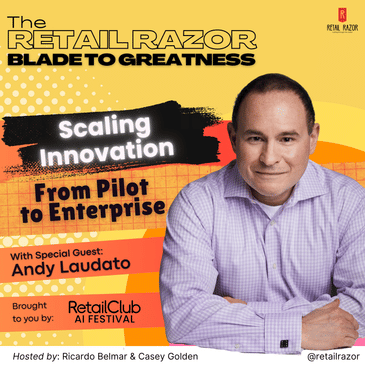



The Vitamin Shoppe’s Andy Laudato on How Retail Leaders Are Scaling Innovation Without Losing Their Culture.
Every retail leader has watched a great pilot die the moment someone says “let’s roll this out to every store.” Scaling innovation is one of the hardest skills in retail leadership. It’s exactly what we dig into this episode. This is Season 2, Episode 10.
Andy Laudato, COO of The Vitamin Shoppe and author of Fostering Innovation, returns to the show. Andy shares his playbook for scaling innovation across stores, systems, and teams. And he does it without losing what made the idea good in the first place. It’s a conversation built for retail leaders who are tired of watching good ideas stall out before they ever scale.
We talk about why so much of what passes for innovation in retail is innovation theater. Chasing the latest AI headline instead of solving a real customer problem. Andy walks us through how he defines innovation. It's doing something unique and different to serve the customer, not innovation for innovation’s sake. Why he insists on a firm operational foundation before any team starts experimenting. And how psychological safety and Agile-style retrospectives turn failed pilots into paid-for education instead of buried mistakes.
From there, we get into the real mechanics of scaling innovation in retail. The cost math that separates a $20K pilot from a $20 million rollout. The technical readiness (security, accessibility, closed captioning) that a pilot can skip but a full rollout can’t. Plus Andy’s case for “off-Broadway” testing. Proving a concept in lower-volume stores before it ever touches the flagship. We also get a look inside The Vitamin Shoppe’s own vibe-coded, AI-powered customer touchscreen. It's built for their new Manhattan flagship, as a live example of composable commerce and innovation done right. Further proof that avoiding innovation theater starts with a clear problem to solve.
What You’ll Learn.
How to build the operational foundation that has to exist before scaling innovation.
Why psychological safety, not just great ideas, determines whether innovation sticks.
The retrospective habit that turns a failed pilot into an asset instead of a taboo topic.
How to think about the true cost model of scaling innovation from 1 store to 1000.
Why testing in your toughest, lowest-visibility stores beats showing off in the flagship.
How to spot and avoid innovation theater before it derails your team’s credibility.
A real look at vibe coding and composable commerce in action at The Vitamin Shoppe.
Are you a retail executive trying to move your organization from a cool pilot to a company-wide win? Then this conversation delivers the real framework you need for scaling innovation the right way.
👉 Stay Sharp. Lead Boldly. Stay Human.
Support Our Sponsor.
Brought to You By RetailClub.
Join 2,000 retail leaders at RetailClub AI Festival, September 22–24 in Huntington Beach. Dive deep into how AI is reshaping retail while soaking up the sun at a fully outdoor, beachside venue. Decision-makers from retailers & brands can attend with free tickets & up to $1,250 in travel reimbursement. Learn more at https://retailclub.com/retail-razor-podcast
Subscribe and Follow.
If you enjoyed this episode, please leave us a 5 star rating and review on Apple Podcasts, Spotify, or Goodpods. Subscribe on YouTube so you never miss an episode. Check out the other shows in the Retail Razor Podcast Network: The Retail Razor Show, Retail Transformers, and Data Blades.
Subscribe to the Retail Razor Podcast Network: https://retailrazor.com/
Subscribe to the Retail Razor Newsletter: https://retailrazor.substack.com
Subscribe to the Retail Razor YouTube channel: https://go.retailrazor.com/utube
Guest Spotlight.
Andy Laudato, https://www.linkedin.com/in/andrewlaudato/
COO, The Vitamin Shoppe
“Fostering Innovation,” https://a.co/d/d7JxrfJ
Chapters.
00:00 Preview
00:50 Show Intro
03:28 Welcome Back Andy Laudato
03:56 What Innovation Means
05:43 Foundation and Safety
06:54 Learning From Failure
08:13 Innovation for Everyone
09:20 Vibe Coding Prototype
10:40 Scaling Beyond Pilots
11:07 Cost and Tech Readiness
14:02 Off Broadway Testing
16:06 Avoiding Innovation Theater
18:05 Show Close
About your hosts.
Helping you cut through the clutter and elevate your retail leadership skills:
Ricardo Belmar is an NRF Top Retail Voice for 2025 and a RETHINK Retail Top Retail Expert from 2021 – 2026. Thinkers 360 has named him a Top 10 Thought Leader in Retail, a Top 25 Thought Leader in AGI and Careers, a Top 50 Thought Leader in Agentic AI and Management, and a Top 100 Thought Leader in Digital Transformation and Transformation. Thinkers 360 also named him a Top Digital Voice for 2024 and 2025. He is an advisory council member at George Mason University’s Center for Retail Transformationand the Retail Cloud Alliance. He was most recently the partner marketing leader for retail & consumer goods in the Americas at Microsoft.
Casey Golden, is the North America Leader for Retail & Consumer Goods at CI&T, and CEO of Luxlock. She is a RETHINK Retail Top Retail Expert from 2023 - 2026, and Retail Cloud Alliance advisory council member. After a career on the fashion and supply chain technology side of the business, Casey is obsessed with the customer relationship between the brand and the consumer and is slaying franken-stacks and building retail tech!
Music.
Includes music provided by imunobeats.com, featuring Swag, Tag and Brag from the album Beat Hype. Written by Heston Mimms. Published by Imuno.
Transcript.
S2E10 Andy Laudato - Scaling Innovation
[00:00:00] Preview
[00:00:01] Andy Laudato: believe me, if you demo something to a group of execs, okay, it's working.
[00:00:06] Ricardo Belmar: I
[00:00:06] Andy Laudato: Okay, great, put it in every store. Oh, I need six months and I need this big check. That's gonna blow you up right there.
[00:00:12] But if you sweep it under the rug and you know the project that will not be named, and we'll never talk about that again. Not only did you fail, you failed twice 'cause you failed to learn from the mistakes.
[00:00:21] Part of it actually comes down to understanding the cost model.
[00:00:25] I try to start every meeting I go to, either out loud or in my head, is what problem are we trying to solve? What are we trying to solve? What is the problem?
[00:00:32] And is the problem like, the basket size or the AOV or conversion? But if the problem is we don't have enough AI in our company, or we haven't done anything cool, now you gotta prob, right?
[00:00:40] But to me, innovation is a little bit more straightforward and simple. It's just doing something in a unique and different way to serve a customer. Like we shouldn't just innovate for innovation's sake.
[00:00:50] Show Intro
[00:00:57] Ricardo Belmar: Welcome to Blade to Greatness, the podcast [00:01:00] where retail leaders sharpen their edge one essential skill at a time as we uncover the essential traits every retail leader needs to thrive.
[00:01:07] I'm Ricardo Belmar
[00:01:08] Casey Golden: And I'm Casey Golden.
[00:01:10] Each episode, we're joined by a guest who brings one important leadership skill into razor-sharp focus. And today, we're tackling a challenge every retail exec faces. How do you take innovation from a cool pilot to a company-wide win?
[00:01:27] Ricardo Belmar: Our guest, Andrew Laudato, COO of the Vitamin Shoppe, has a playbook for that. He's seen what works and what doesn't, when it comes to scaling innovation across stores, systems, and teams.
[00:01:39] Casey Golden: We talk about avoiding innovation theater, why testing in your toughest stores is smarter than showing off in flagships, and how to enable innovation into your core strategy rather than a test lab.
[00:01:54] Ricardo Belmar: Yeah, if you're ready to move from experiments to enterprise impact, this is the episode for [00:02:00] you.
[00:02:00] Now before we dive in with Andy, let me tell you about our amazing sponsor of the Retail Razor Podcast Network, Retail Club.
[00:02:07] Join 2,000 retail leaders at the Retail Club AI Festival, September 22nd to 24th in Huntington Beach. Dive deep into how AI is reshaping retail while soaking up the sun at a fully outdoor beachside venue. That's right, it's on the beach. Decision-makers from retailers and brands can attend with free tickets and up to $1,250 in travel reimbursement. Head to retailclub.com/retail-razor-podcast to learn more and get your ticket today.
[00:02:38] Thank you, Retail Club, for helping us bring you this podcast and all the shows in the Retail Razor Podcast Network.
[00:02:44] Casey Golden: Time's a-tickin'.
[00:02:45] We also have a quick ask for you.
[00:02:48] If you enjoyed the show, please hit us with a five-star rating and drop a short review on Apple Podcasts, Spotify, Goodpods, or wherever you're listening. And don't forget [00:03:00] to like and subscribe on our YouTube channel so you never miss an episode. It really helps us grow the show.
[00:03:05] And please check out the other shows in the Retail Razor Podcast Network, the Retail Razor Show, Retail Transformers, and Data Blades. You can find them in your favorite podcast player or visit our YouTube channel to find them all.
[00:03:19] Ricardo Belmar: Now let's get into it. Here's our conversation with Andy Laudato
[00:03:22]
[00:03:28] Welcome Back Andy Laudato
[00:03:28] Casey Golden: Andy, it's so great to welcome you back to the Blade to Greatness podcast.
[00:03:32] Andy Laudato: Thrilled to be here. Thank you, Casey.
[00:03:33] Ricardo Belmar: So Andy, today we are excited to have you back and talk with us about a critical skill retail leaders really need to master, and that's how to scale innovation from pilot to enterprise. In your book, Fostering Innovation you also talk about blending pragmatism and boldness and encouraging leaders to take risks, but you have to have guardrails, right?
[00:03:52] To protect brand, consistency, customer experience. So tell us a little bit more about this.
[00:03:56] What Innovation Means
[00:03:56] Andy Laudato: Yeah, let's start talking about defining what innovation even means. Right? So I [00:04:00] think a lot of us just think of innovation as the newest, latest technology, or nowadays it would be all about AI.
[00:04:06] But to me, innovation is a little bit more straightforward and simple. It's just doing something in a unique and different way to serve a customer. And it could be a process, it just could be that a lot of times it is tech, but understanding exactly what innovation is, is super important. And, understanding why you're doing it. Like we shouldn't just innovate for innovation's sake. Like we want to be cool, we wanna be, you know, win an award or be retail top retail expert, or whatever it is.
[00:04:32] Ricardo Belmar: Yeah.
[00:04:33] Andy Laudato: so doing something unique and different for a customer needs to be the starting point. Where I work at the vitamin shop, innovation is an ingredients, or maybe it's in a form. So it's about creatine gummies or liposomal, which are dissolved in fat and so they're more absorbed by the body.
[00:04:50] So there's technical innovation on product, which is really exciting for us, and it's a big part of who we are. On the tech side, it's just always about implementing [00:05:00] some new tech, but not for the sake of the tech, for the business. So. I always say don't try to solve a tech problem with business.
[00:05:06] And a lot of times they show up either at a show or a conference, like, here's some tech. How could you use this? And it's backwards, right?
[00:05:13] You need to start with, Hey, we wanna make that easier for our customers to shop, or easier for them to discover product, or easier for them to learn, what's important for their health.
[00:05:21] So how could we do that? Is it with an app? Is it with a beacon? Is
[00:05:25] it with, this or that? But start with the need. I think you look back in history and they're like, people that have like the Netherlands has a lot of, is it the Netherlands? Or it has all these dams and all these different places.
[00:05:34] It's necessity, drives, drives invention, I think is the saying.
[00:05:37] So that shouldn't go away. Invention shouldn't drive necessity. Like, I don't need this if I don't need it. Alright.
[00:05:43] Foundation and Safety
[00:05:45] Andy Laudato: So I think once we frame that then how do we do it? We've talked about it before. Every time you hear me talk about it, it's about making sure you have a firm foundation that you know your systems are in order and your things are running well and everybody's there and your budgets are under control. So really having that foundation to innovate from is, is [00:06:00] key. And then making sure that people have psychological safety. You hear the startup people say, fail fast. Fail fast. There's a, there's a joke. Fail fast, but not always.
[00:06:12] Ricardo Belmar: Right.
[00:06:14] Andy Laudato: But when you think about some of these stats, like one in five work or one in 10 or one in 20, every time I say something like only one in 10 work, people are like, oh, it's way worse than that. You
[00:06:21] Ricardo Belmar: Uhhuh.
[00:06:23] Andy Laudato: What was that? 90% or 95% of AI projects are failing, Right. So,
[00:06:28] Ricardo Belmar: Yeah.
[00:06:29] Andy Laudato: so you can't have a place where if somebody fails when they're trying to innovate, they're gonna lose their job or not get promoted or things like that. So. I always say that rewarding failure is easy to say, but hard to do.
[00:06:43] Casey Golden: Really hard to do.
[00:06:44] Andy Laudato: Yeah. I just blew money, or invested it, or I wasted some time, or, you get some hype. But really creating a culture where people feel safe to do those things.
[00:06:54] Learning From Failure
[00:06:54] Andy Laudato: Now, here's how I do it. We all know how much education's worth, [00:07:00] especially if you have children, you've written big checks for colleges.
[00:07:02] You know how much education costs. We've all spent a lot of money on our own school and college and learning, books and classes. So if you do something that doesn't work and you're willing to sit down and openly learn from it, then that time and effort and energy wasn't wasted. But if you sweep it under the rug and you know the project that will not be named, and we'll never talk about that again. Not only did you fail, you failed twice 'cause you failed to learn from the mistakes. So, a term we use from Agile is retrospective, where you sit down after a project and really talk through with the team what went well, what went wrong, why did we miss this? That makes it all worth it. Now you're now you've written checks for learning and now you have that knowledge and the whole team does. And doing things like that where you're openly talking about it and learning from it. That drive, that does drive the psychological safety because now the people on the team are like, okay, I'm not embarrassed that I was on that. We talked about it openly. We understood and,
[00:07:58] Ricardo Belmar: something.
[00:07:59] Andy Laudato: And what does that [00:08:00] knowledge do The next time you wanna take on something like that, either you'll know better, like, don't touch the hot stove, or, oh here's the better way to do it. Either way you're gonna be much better chance of succeeding. So I think that's super important.
[00:08:13] Innovation for Everyone
[00:08:13] Andy Laudato: And then the other thing is I don't think it's a good idea to separate people and go, you're gonna be the innovation people and you're gonna be the day-to-day teams. This is a org structure thing.
[00:08:22] I think you're better off having innovation be part of everybody's job because the people closest to the work aren't gonna know best how to do something better, different, more interesting. So that's an, that's another thing that, that I try to think about.
[00:08:35] Casey Golden: And sometimes that's like the fun part for a lot of people, or the, the place where, you can have like a, a, a brain break, right? And you get to kind of go into this other realm and have permission to spend time on it during the day or during the month or quarter. But I definitely have seen where it is very separated on who's allowed to be part of the innovation [00:09:00] conversations and who's not. It can be very discouraging and pull it a apart even more. I feel like you almost don't want them to be successful in some ways because you don't get to play in the fun part.
[00:09:16] Andy Laudato: No, that's super well said, and it's, it's very accurate of what you see going on.
[00:09:20] Vibe Coding Prototype
[00:09:20] Andy Laudato: The other thing that really is exciting is this idea of vibe coding.
[00:09:24] Ricardo Belmar: Mm-hmm.
[00:09:25] Andy Laudato: Vibe coding is using AI to write code. And so now it's making it a lot more accessible for people to do prototyping or to build something. We built something pretty quickly that way to demo and because it's not a lot of time and a lot of costs, we can allow people to go work on this and free up some time and say, yeah, why don't you go play with that? And if it doesn't work out, so.
[00:09:44] We built a customer facing touchscreen with product content blog articles, AI search. It raises all the services from vitamin shop.com, and it's gonna be up in our flagship store, a new store in Manhattan. And it was done internally with, with a lot of [00:10:00] vibe coding and a lot of reuse and really, really fun and really, really neat.
[00:10:04] And to me it just defines innovation.
[00:10:06] Casey Golden: Right.
[00:10:07] Andy Laudato: And, I'm a big fan of composable commerce and I always talk about having a big box of Legos. And when we built all that, we're like, we'll be able to build something in the future that we haven't defined yet. And now we've done it.
[00:10:18] We built basically a new UI into existing services and really, really exciting. So, so yeah, the combination of the trust, the time, the people, having everything in the right order, and then letting someone go play.
[00:10:32] Ricardo Belmar: yeah.
[00:10:32] Andy Laudato: With some new tools and, and embracing those had it worked. So it's in the
[00:10:36] 5% that did work for us.
[00:10:38] Ricardo Belmar: Oh, there you go. There you go.
[00:10:40] Scaling Beyond Pilots
[00:10:40] Ricardo Belmar: So one of the areas I see a lot of retailers struggle with is once they have that great project and they've proven it and made it work, is scaling it across the whole enterprise, right? So it's you can do something at one location, like a flagship, you can take it to 10 locations, but then what do you do when you have to take it to 500 or a thousand and really scale it out?
[00:10:59] Because that, [00:11:00] that seems to be, I always find an area where a lot of projects do fail is when they get to that scalability point. How do you approach that?
[00:11:06] Andy Laudato: No, that's a great question.
[00:11:07] Cost and Tech Readiness
[00:11:07] Andy Laudato: Part of it actually comes down to understanding the cost model. let me make up some numbers, right? Say it cost you 20 K to build something and you put it in one store. Everyone can find 20 k. But then it's like, if it's 20 K for a thousand stores, what's that math? $20 million, right?
[00:11:24] Nobody can find that.
[00:11:25] Ricardo Belmar: That's not the same thing.
[00:11:28] Andy Laudato: So understanding that before I take something on. Is it gonna scale financially?
[00:11:34] Ricardo Belmar: Mm-hmm.
[00:11:35] Andy Laudato: There are a few things that are just so expensive and you can afford to try 'em, but don't afford to try it if you can't afford to buy it. And many times if I'm working with a third party, like a startup, I have those discussions before we begin.
[00:11:48] If this works, what will you charge me to roll it out? And they don't want to have the conversation, right, because, and again, I don't mind spending a disproportionate amount for the first one,
[00:11:58] Ricardo Belmar: Mm-hmm.
[00:11:59] Andy Laudato: but it needs to be able to [00:12:00] scale. So that's important. And then there's a little balance with the tech stack.
[00:12:04] You could do rapid prototyping and get something that just won't scale technically. So either you gotta think through that and at least figure out what the it's gonna cost to build it the right way. Or just put time into your project that you're gonna have to go back and refactor it.
[00:12:21] So yeah, understanding if you need to scale it technically, understanding what that's gonna take and cost and time and money. And then have you considered all the considerations? Have you considered security and it, you know the thing I mentioned, the ADA is gonna be accessible and can somebody that visually impaired are all those things gonna be there and it's gonna have closed caption.
[00:12:41] And so all these things you need to scale. I could put something up in a pilot and not consider everything. Well, you have to consider security 'cause someone could hack one thing as much as a thousand.
[00:12:51] Ricardo Belmar: Yeah.
[00:12:51] Andy Laudato: But some of the things you don't consider to do a pilot have to be considered. And the more of those you know about upfront. The more clear you can be about it. Because believe me, if you demo something [00:13:00] to a group of execs, okay, it's working.
[00:13:04] Ricardo Belmar: I
[00:13:04] Andy Laudato: Okay, great, put it in every store. Oh, I need six months and I need this big check. That's gonna blow you up right there. So
[00:13:11] Casey Golden: I need a bigger check.
[00:13:14] Andy Laudato: there's always sticker shock. The earlier you talk about it, the easier it is
[00:13:18] Ricardo Belmar: yeah. That's
[00:13:19] Casey Golden: No, I agree. And I do feel like some things. Some things are, there's a place where you get what you pay for and there's a place where there's literally no ROI, we can't figure out how it fits in the business to help us make money. But those projects, those pilots still happen. Which I find very interesting. Like, but there's no, there's no scale or rollout strategy attached to it. It was just for this one thing. And I'm finding that we went from having one of these flagship pilots with no definition of success or how it [00:14:00] scales or goes through an all door rollout.
[00:14:02] Off Broadway Testing
[00:14:18] Casey Golden: And it was just that one moment and then none of these pilots continued and I've, I heard a rumor that you believe in bottom door testing for pilots versus flagships, and I'd love you to share your, why you think that is a more effective strategy than vice versa.
[00:14:27] Andy Laudato: Yeah. I don't think I like that term, bottom door. But we could talk about lower volume stores or, yeah.
[00:14:32] Ricardo Belmar: you go. That sounds nicer.
[00:14:33] Casey Golden: Industry people.
[00:14:38] Andy Laudato: All our stores are wonderful. Yeah. But yeah, it's, it's just about reducing the blast radius, right?
[00:14:46] So maybe you wanna try something that's less visible you can learn maybe you have a little more payroll available because, you know, the store's not as crowded or not as hectic. There's not, you know, maybe you don't wanna be in the back door of your investors and your [00:15:00] shareholders, so, you know, in their neighborhood.
[00:15:02] But yeah, I think that there's, there's a huge value of trying something off the beaten path and, and getting it right and learning. I mean, hey, let's use the New York example, right? They don't start on Broadway. They start off Broadway and get it right and get the acting. And then, so The, the right analogy for this is we'll start off Broadway and then when we're feeling really good about it, we can move it up, up to the main stage.
[00:15:25] And maybe you get a little more excitement too from this doors that feel a little bit less attention.
[00:15:30] Ricardo Belmar: Hmm. Yeah.
[00:15:32] Andy Laudato: time we have like all store meetings or regional manager meetings and we talk about something, they're all super eager to to volunteer to try things. And then I always give 'em the speech it might not work, it might break.
[00:15:45] Like who really wants to be first on the new POS? Everybody we always do until they can't ring somebody out and then an hour they're like, why can't I do this coupon or this discount? So, but yeah, everybody wants to be, but I think the lower volume off the [00:16:00] beaten pastors are more eager and more excited sometimes to get some of that attention.
[00:16:04] Ricardo Belmar: Yeah.
[00:16:05] Andy Laudato: Yeah.
[00:16:06] Ricardo Belmar: Yeah.
[00:16:06] Avoiding Innovation Theater
[00:16:06] Ricardo Belmar: So, one of the things, one last thing I wanted to ask you about, because as we've talked about how, AI is just infusing everywhere and it's what everybody wants to talk about when it comes to innovation, but how, how do you avoid the trap of just innovation theater versus real innovation?
[00:16:22] You touched on it how sometimes innovation isn't the bright, shiny thing. It's not the super sexy thing that everybody wants to do. Sometimes it can be much more powerful in the opposite extreme,
[00:16:31] Andy Laudato: I try to start every meeting I go to, either out loud or in my head, is what problem are we trying to solve? What are we trying to solve? What is the problem?
[00:16:39] And is the problem like, the basket size or the AOV or conversion? But if the problem is we don't have enough AI in our company, or we haven't done anything, cool, now you gotta prob, right?
[00:16:48] So back to what Casey said is you do these things, but why are you doing them right? Why? So, and that's the start with why, but i'm just really clear. What problem are we solving? [00:17:00] And my next question then is that measurable?
[00:17:02] Ricardo Belmar: Yeah.
[00:17:02] Andy Laudato: Just want people to like us better or we wanna be seen as more hip? Or is it, if we had this like a big pillar at the vitamin shop is expertise. People come to us to learn. So the tool we built is to bring some of that expertise and knowledge and product right to the hands of the consumer inside of a store. So we have a really clear mandate and a really clear mission and a really clear problem, and we're solving it with that innovation.
[00:17:29] So, but yeah, if you're trying to shoehorn tech into your business because it's the latest that, those are the ones that don't work.
[00:17:38] Ricardo Belmar: Yeah. Right. Well, Andy, this has been another incredible discussion, as always packed with great takeaways that hopefully everybody has been taking notes and working to their own leadership approach. I wanna thank you so much for bringing clarity to all these important topics on innovation that everybody needs to learn.
[00:17:56] Andy Laudato: Yeah, thanks for having me.
[00:17:57] Casey Golden: We look forward to having you back on the show [00:18:00] and share even more. Thanks, Andy. Well, Ricardo, Andy, this is a wrap.
[00:18:05]
[00:18:05] Show Close
[00:18:10] Casey Golden: Love this episode? Drop us a five-star rating and review on Apple Podcasts, Spotify, or Goodpods. And if you're watching on YouTube, like and subscribe before you go.
[00:18:20] I'm Casey Golden.
[00:18:21] Ricardo Belmar: Follow us on LinkedIn, Bluesky, Threads, and Instagram, and subscribe to our Substack for highlights and bonus content. For transcripts and guest info, visit retailrazor.com.
[00:18:31] I'm Ricardo Belmar.
[00:18:32] Casey Golden: Thanks for joining us on Blade to Greatness, part of the Retail Razor podcast network
[00:18:38] Ricardo Belmar: Until next time, stay sharp, lead boldly, and stay human.
[00:18:41] This is the Retail Razor: Blade to Greatness
[00:18:44]