
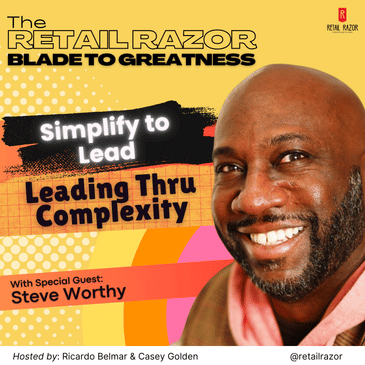



S2E6 - Simplify to Lead - Steve Worthy on simplicity, self‑awareness, and leading with conviction
In this episode of Blade to Greatness, we sit down with Steve Worthy, founder and CEO of Worthy Retail Global and host of the Retail Leadership with Steve Worthy podcast, to explore why so many retail leaders need to simplify to lead. Why do retail leaders unintentionally fall into leadership traps that sabotage clarity, confidence, and performance? Drawing from his upcoming book, Simplify to Lead , Steve breaks down the TRAPPED framework. He reveals how overthinking, perfectionism, rigid ideologies, and task‑over‑people habits quietly erode effective retail leadership.
Steve explains why simplifying your approach doesn’t mean lowering standards. It means elevating your ability to think strategically, communicate clearly, and lead with conviction. Through stories, practical examples, and his SMILE framework for approachability, Steve shows how leaders can shift from “doing everything” to leading with intention.
What You’ll Learn
Why retail leaders fall into common leadership traps
How “task over people” thinking derails retail leadership
Why perfectionism is a silent performance killer
How rigid ideologies limit team growth and innovation
The SMILE framework for becoming a more approachable leader
How to give a situation “what it costs — no more, no less”
The mindset shift from doer to strategist
Key Takeaways
Simplicity is a leadership advantage, not a compromise
Self‑awareness is the foundation of effective retail leadership
Leaders must evolve before circumstances force them to
Emotional detachment leads to clearer, faster decisions
Breaking leadership traps requires intentional practice
Are you ready to escape the leadership traps that keep even the strongest leaders stuck? This conversation will reshape how you think about retail leadership forever.
Subscribe and Follow
If you enjoyed this episode, please give us a 5‑star rating and review on Apple Podcasts, Spotify, or Goodpods. Subscribe on YouTube so you never miss an episode. Check out the other shows in the Retail Razor Podcast Network: The Retail Razor Show, Retail Transformers, and Data Blades.
Subscribe to the Retail Razor Podcast Network: https://retailrazor.com/
Subscribe to our Newsletter: https://retailrazor.substack.com
Subscribe to our YouTube channel: https://go.retailrazor.com/utube
Guest Spotlight
Steve Worthy. https://www.linkedin.com/in/steveworthy/
Founder, Worthy Global Retail. https://worthyretail.com
Host of the Retail Leadership with Steve Worthy podcast. https://worthyretail.com/podcast/
Retail is moving faster than most leaders can process. Steve Worthy teaches them how to slow down their thinking so they can speed up their results because clarity always beats chaos. Steve is the Founder and CEO of Worthy Retail Global, where he helps senior retail leaders simplify growth by focusing on clarity before action and purpose before performance. Through The Campus and The Forge Accelerator, Steve puts his leadership philosophy into practice. He helps retail leaders and founders define reality, lead with confidence, and build cultures where clarity drives results.
He also partners with Competitor IQ to add a human intelligence lens to retail and banking insights. He uses mystery shopping and research programs to connect data to how people actually behave.
Steve believes leadership is not about doing more. It is about seeing more clearly and moving people forward with confidence.
Music
Includes music provided by imunobeats.com, featuring Swag, Tag and Brag from the album Beat Hype, written by Heston Mimms, published by Imuno.
Transcript
S2E6 Steve - Simplify to Lead
[00:00:00] Preview
[00:00:01] Steve Worthy: You're trying to make things perfect and why are you trying to make things perfect in a retail environment where we know, and within 24 hours things are gonna change.
[00:00:10] Casey Golden: But we are notorious for fire drills all day.
[00:00:16] Steve Worthy: But when we start to over index on that and we start to leave the people out and start to dehumanize them and just see them as someone who's actually just needs to get these things done, they're a tool, they're an instrument.
[00:00:28] Casey Golden: You know, I was told once that doing everything will not help your career or your health.
[00:00:33] Steve Worthy: is that you have to give the situation what it costs for it. No more, no less. That takes time, that takes experience. And when you're able to do that, you're not emotionally connected to that situation.
[00:00:51] Show Intro
[00:00:51] Ricardo Belmar: Welcome to Blade to Greatness, the podcast where retail leaders sharpen their edge, one executive skill at a time. As we uncover the essential [00:01:00] traits every retail leader needs to thrive.
[00:01:02] I'm Ricardo Belmar.
[00:01:03] Casey Golden: And I am Casey Golden. Each episode we're joined by a guest who brings one transformative leadership skill into focus, and today we're joined again by Steve Worthy to explore his upcoming book, Simplify to Lead. Steve introduces us to the Trapped framework and the subtle but dangerous patterns that even the strongest leaders fall into. From perfectionism and people pleasing to avoiding tough conversations.
[00:01:32] Ricardo Belmar: But Steve doesn't just identify the traps. He shows leaders how to break free by embracing simplicity without lowering standards. Through his pillars of simplicity, he helps leaders express real opinions, handle criticism with clarity, and define the right problems before rushing to solutions.
[00:01:49] Casey Golden: And Steve's credibility here is unmatched. Right along with his energy. As founder and CEO of Worthy Retail Global, he's built a [00:02:00] reputation for teaching leaders how to slow down their thinking so they can speed up their results. His work through the Campus and the Forge Accelerator proves that clarity always beats chaos.
[00:02:12] Ricardo Belmar: I am really excited to dig into how leaders can move from trapped leadership to clear, confident decisions and why simplicity is the key to conviction.
[00:02:22] Casey Golden: Now before we dive in, just a quick ask for you, our listeners. If you like the show, why not give us a five star rating and review and drop a quick review on Apple Podcasts, Spotify, YouTube, or Good pods? Your support means everything.
[00:02:38] Ricardo Belmar: And also, why not check out the other shows in our Retail Razor Podcast Network. The original, The Retail Razor Show, plus Retail Transformers and Data Blades. You can find them in your favorite podcast player or visit our YouTube channel to find them all.
[00:02:53] Now let's jump in. Here's our latest conversation with Steve Worthy.
[00:02:58]
[00:03:03] Welcome Steve Worthy
[00:03:03] Casey Golden: Steve, welcome back to The Blade to Greatness podcast.
[00:03:08] Steve Worthy: Excited to be here. I'm excited to be here. I you know, I wish people had an opportunity to hear some of our conversations before we recorded, but that's okay.
[00:03:18] Ricardo Belmar: Maybe in the outtake reel someday.
[00:03:25] Casey Golden: You know.
[00:03:30] Ricardo Belmar: Yeah, one of these days we'll do a live one and and, and see how that goes. But it is a thrill to have you back on the show. And today you are coming to talk about something that's actually, I think from your upcoming book, Simplify to Lead, right? Why Most Leaders Are Doing Too Much. And just as the title I think implies leaders really do need to simplify what they're doing often right to be successful.
[00:03:54] So they need to avoid falling into traps as you define them in the book, that, hinder their [00:04:00] progress and overall ability to simplify. So we're saying simplify a lot. So there's obviously something implied there, but it's challenging. Right? So tell us more about, how you actually make this happen.
[00:04:09] Steve Worthy: Yeah. No, thanks. Thanks for um, talking to me about this, about this topic.
[00:04:13] Trapped Framework Overview
[00:04:16] Steve Worthy: You know, I think it, it came out of just years of coaching leaders of dealing with different leaders at certain levels, certain organizations, different cultures within the retail space, right? Every, every retailer has their own culture and way and way of doing things.
[00:04:31] But one of the things that I saw was very present and consistent was when you see a lot of leaders start to over index in certain areas, whether it is, we start talking about it from our, from our trap framework, whether it is task over people, it is their inability to identify that they have rigid ideologies about how they see things, about how they need to do things right, or excessive overthinking.
[00:04:55] These are things that. As retail leaders, I've seen [00:05:00] consistently across the board. Now when you look at, look at them at the face value, you would think that okay, they're not that big of a deal.
[00:05:07] Task Over People Trap
[00:05:07] Steve Worthy: When you think about task over people, because guess what? Stuff still has to get done. Things still have to get done.
[00:05:13] But what tends to happen in that, in that the t for for Trapped is that. When you start to over index and start to place the task and the projects over people and not understanding the role that people play within the completion of that process or that task or that initiative, that's when we start to see leaders, leaders fall apart.
[00:05:34] We understand that. We understand that things need to get done within a retail space. Those are the areas that we start to see things need to get executed on. But when we start to over index on that and we start to leave the people out and start to dehumanize them and just see them as someone who's actually just needs to get these things done, they're a tool, they're an instrument.
[00:05:54] That's when leaders fall into trouble. Those are some of the, tho that's one of the areas that I've seen leaders [00:06:00] sort of throughout the course of retail start to over index on is that task over people.
[00:06:05] Casey Golden: And it's so easy too, in retail, because there is so much that gets done across a web of ops, regardless of what your job title is. But we are notorious for fire drills all day.
[00:06:24] Steve Worthy: Yes.
[00:06:25] Casey Golden: It's a fire drill after a fire drill as soon as you get a fire put out and just like, great, it's 7:30, I can go ahead and do my day's worth of work. Because you've been putting fire drills out all day. It's like you don't even get to work until like after business hours. And I think it's just very common that you can get over indexed without even thinking about it.
[00:06:47] Steve Worthy: Yeah, and, and here's the part that is so frustrating for me sometimes is that a lot of leaders would wear that as a badge of honor.
[00:06:55] Ricardo Belmar: Hmm. Yeah.
[00:06:56] Steve Worthy: Context.
[00:06:56] From Doer To Strategist
[00:06:56] Steve Worthy: I, I get this, see it often in coaching sessions where they, they become passed over in certain roles because they are a doer and because they're an executor.
[00:07:12] And part of that is how do you help these leaders make that transition from being a task oriented leader understanding where and, and managing people and processes to moving them into a more strategic mindset. Where, and from a strategic mindset that involves people, that involves the, the ideas and asking better questions of people that that, that involves you understanding the different nuances of, of your leaders and how they actually like to get communicated with or what they're really good at.
[00:07:42] That's the transition. And so when we hear, when I hear a lot of leaders say, I get passed over. I get passed over. And we have these conversations. I see that, man, you are a task oriented person. So they're looking for a more strategic leader. So how do we help leaders slide, slide down that, that continuum, if you will, of growth [00:08:00] from a from a strategic mindset to less of a doer mindset.
[00:08:04] Casey Golden: I'm so glad you said that, like out loud. You know, I was told once that doing everything will not help your career or your health.
[00:08:12] Ricardo Belmar: Mm-hmm.
[00:08:13] Casey Golden: You know, you can't be the person everybody goes to and wear that as a badge of honor. I was one of those people.
[00:08:19] Anything.
[00:08:21] Ricardo Belmar: Yeah.
[00:08:25] Steve Worthy: Yeah, and I think the culture, I think the culture of retail, once again, it is something that, that is evolving and I think it almost becomes you, you become an anomaly when you start to think outside of that, outside of that way of like, me just being person that's gonna do everything. So I think we're starting to see some some progress, but more has to be made.
[00:08:46] Ricardo Belmar: Yeah. Yeah.
[00:08:47] Casey Golden: Would you say that that's one of the biggest trap that strong leaders fall into, or is there, is there something else?
[00:08:55] Steve Worthy: Oh, that's, I think that's one of the, that's one of the biggest ones.
[00:08:59] Rigid Ideologies Trap
[00:09:00] Steve Worthy: But I think one of the other ones that I want to, I want, I want to talk about is the, and this almost kind of goes part and parcel, but with that is this the rigid ideologies that leaders tend to have around how to do things. And how, how they see things.
[00:09:15] And here's, here's, here's the story. Here's the thing that I see all the time, is that I, I had a great leader. I loved what he used to say, and so I'm taking on that same mantra. I love how he used to talk to people. I love how he used to get things done and all these different things. And it's okay to have idols, if you will, as a, as a leader growing up, right?
[00:09:35] I have Jim Hogan, God rest his soul, one of the best leaders I've ever had. One of the things that tends to happen is that we start to develop these ways of seeing things and doing things that we continue to feel are healthy. Because they've gotten us results previously. They've provided opportunities for us to get promoted previously.
[00:09:57] We've gotten accolades from leaders [00:10:00] previously around how we see and do things. But tho that rigid ideology. When it comes up against a culture or it comes up against a team that needs to change and grow and you haven't grown with it. Oh my gosh. I, quick story. I had a leader, and this is gonna, this is in the book.
[00:10:18] I had a leader who was amazing, amazing, ready to go to the next level, all these different things. And through the course of our you know, of our, our relationship, she, she got to the point where she was ready to go to the next level. And I came into work and I had an email and she, she actually was putting in her two week notice.
[00:10:40] Ricardo Belmar: Hmm.
[00:10:41] Steve Worthy: I was like, well, why? Why are you, why are you, why are you leaving? I want to go do something else, Steve. I want to go do X, Y, and Z. And the long story of this lesson out of that, out of that story was the fact that I wasn't equipped enough to take her to the next level. I didn't realize that until after she left.[00:11:00]
[00:11:00] I didn't make that. I the connection, the fact that she needed more in order for her to grow as a leader. I had capped out as a leader. I wasn't giving any more to myself. I wasn't developing myself at that point in time. My communications style was stagnant and I, therefore, I was not able to give her what she needed, so she left.
[00:11:21] And so what we, what we see, and this go kind of goes back to where I talk about you have to change before it's necessary. Because if I would've identified that I had certain gaps, I could have worked on those things and then provided those things for her. But we see that in a lot of leaders, rigid ideology of, of seeing and doing things.
[00:11:40] It will hinder you and it'll hinder your team's growth.
[00:11:43] Ricardo Belmar: Oh, that's a, that's a great example. So if you're trying to avoid that kind of a trap, I mean, I, I'm just thinking that one of the things you, you probably have to balance right, is how do you get to that simplification you're talking about, but without actually lowering your standards at the same [00:12:00] time.
[00:12:00] Right. Because you still wanna have, I'm gonna assume you tell everyone, you still want to have the high standard that you're hoping to elevate everyone else to, while still trying to simplify. So it seems like that's gotta be a difficult balance to strike.
[00:12:11] Approachability And SMILE
[00:12:11] Steve Worthy: Yeah, and I think the best way to do that is approachability.
[00:12:15] It's, it's a hundred percent around approachability. It's a, it's a lost art. It's something that we don't talk a lot about anymore. And we, we use a framework, it's called the SMILE framework. So the, the S is for self-awareness. The M is for mindful listening.
[00:12:29] The I is for inspires trust. The L is for lead by example, and the E is for effective empathy. And so we sort of say this, that every leader smiles differently, right? So we, we wanna make sure that, this is not, while it's a framework, every leader will look at each one of them differently and they will throttle up or down based on who they are.
[00:12:49] But the main one and the first one is around self-awareness. And we talk about that. You know, we've talked, we've talked about, has spoken about this for years, right? Decades around self-awareness. [00:13:00] For me, it's not about the, the strengths and weaknesses of the person or who you are.
[00:13:05] It's about the, it's about the why. Like, why do you get upset when when Ricardo comes into the room? Why do you get upset when you're on a call and Ricardo starts to speak? What is it about Ricardo? What is it about you that you have to, you, you feel a certain way about individuals? How do you as a leader, self-awareness, truly understand like who you are and how you show up, and what are the different triggers that will make you become successful or make you not successful?
[00:13:38] So that self-awareness piece is so important.
[00:13:41] Give It What It Costs
[00:13:41] Steve Worthy: The one area that I think a lot of leaders struggle with, within self-awareness, is that they over index into providing what a situation actually needs. They will over communicate, they will over try to deliver. This is the, this is the mindset of the retail leader, right?
[00:13:59] We just talked about [00:14:00] task over task over people. We will try to give more and more and more. And what, by doing that we start to, we start to devalue who we are in the communication and conversation that we're having. I always talk about it in this context, is that you have to give the situation what it costs for it. No more, no less. That takes time, that takes experience. And when you're able to do that, you're not emotionally connected to that situation. We've all seen, and all of us have seen those meetings where someone gets bent outta shape about a certain thing 'cause they're emotionally tied to a decision that they want to get across.
[00:14:35] Guess what? That person carries that, that emotion throughout the course of the day. We see it. We see it at, we see it at lunch. Yeah. We see it, you know, when we walk past the cubicle or the, we, we walk past their, their, their, their office and they're still upset about it, right? But you, as a leader, you have left that conversation and emotionally disconnected and now you're able to move on to the next thing.
[00:14:56] So I feel that when we start talking about approachability, [00:15:00] approachability is really understanding who you are and how you're gonna show up in a certain situation.
[00:15:04] Ricardo Belmar: Yeah, that's a good example. I like that. That's a great, great approach.
[00:15:07] Avoiding Perfectionism
[00:15:14] Ricardo Belmar: So let, let me ask you one, one other one that always strikes me as something that's a bit of, of a challenge here. When you see leaders strive for what I'm gonna call maybe an excessive amount of perfectionism.
[00:15:20] Steve Worthy: Yeah.
[00:15:21] Ricardo Belmar: How do you avoid that trap?
[00:15:22] Steve Worthy: You know, I, I think perfectionism is rooted in sort of look at me. Look at me, look, look at, look at how I'm doing things. How am I able to do this in such a way that's gonna be so perfect for everybody and everybody's gonna want to know how to do it. I almost feel that the a perfectionism almost ties into a lack of self-awareness.
[00:15:46] It's because you are starting to provide, once again, more and more information. You're over-indexing, you're over providing. You're, you're trying to make things perfect and why are you trying to make things perfect in a retail environment [00:16:00] where we know, and within 24 hours things are gonna change.
[00:16:03] Right. And so how are you actually going to you know, you, you this, this perfect end cap or, or perfect process or whatever it may be. Listen to me. With an email those things can, those things can be dismantled. So I think when we start talking about perfectionism, I think it's important for the leaders to understand the inner workings of why they make a decision the way that they do, and why do they feel that it actually has to be perfect per se.
[00:16:29] And what's their definition of perfect? How do they. Learn how to throttle their emotional connection to a, an operation. Even to people within that, within that operation. Because I think part of it is how do we if we, if we, if we feel that this situation needs to be perfect, we start to think that people around us need to be perfect as well.
[00:16:51] And we start to analyze them at a, at a deeper level, oh my gosh, you know, I don't know why this person said this. I don't know why they implemented it that way. [00:17:00] And we start to get into this blaming a culture. And so I think perfectionism is rooted in the lack of self-awareness. So how do we help people and leaders become more self-aware so that they can understand it's not about being perfect, it's actually about execution. And how do you bring people along for the ride?
[00:17:16] Ricardo Belmar: Yeah.
[00:17:17] Wrap Up And Takeaways
[00:17:17] Ricardo Belmar: Well, I have to say, Steve, this has been an another nearly perfect discussion on another really insightful topic. I've no doubt that our listeners and leaders who are listening can, can put some of these ideas into practice right away. I thank you so much for highlighting such an important topic.
[00:17:35] Steve Worthy: Ah, thank you. Thank you. I'm excited. I'm excited to be here.
[00:17:38] Casey Golden: Yeah. Steve, you bring such a refreshing perspective. I'm loving these conversations. I think we still got one more left, so let's wrap this one up.
[00:17:47]
[00:17:47] Show Close
[00:17:52] Casey Golden: If you enjoyed today's episode, please give us a five star rating and review on Apple Podcasts, Spotify, or Goodpods.[00:18:00]
[00:18:00] And don't forget to hit subscribe on your favorite podcast player or on YouTube so you never miss an episode.
[00:18:07] I'm Casey Golden.
[00:18:08] Ricardo Belmar: We'd love to hear from you. Follow us and share your feedback at Retail Razor on LinkedIn, Bluesky, Threads, and Instagram.
[00:18:14] You can also subscribe to our Substack newsletter for highlights from every episode, and visit retailrazor.com for transcripts and more details about our amazing guests.
[00:18:24] Blades to Greatness is part of the Retail Razor Podcast Network.
[00:18:28] I'm Ricardo Belmar.
[00:18:29] Casey Golden: Thanks for joining us.
[00:18:31] Ricardo Belmar: Until next time, stay sharp, lead boldly, and stay human.
[00:18:35] This is The Retail Razor Blade to Greatness.
[00:18:37]