
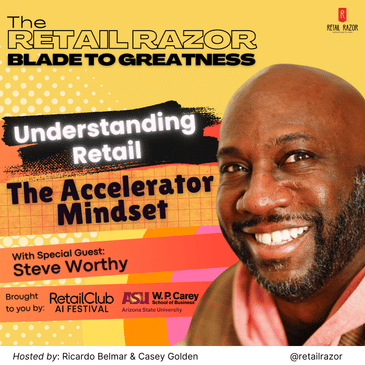



Steve Worthy on The Accelerator Mindset - founder fit, product market fit, and the question retail buyers are really asking.
Steve Worthy is back on Blade to Greatness to break down what he calls the accelerator mindset - how growth happens inside a retail business, and why the gap is almost never the product.
Steve admits honestly to Ricardo and Casey the part nobody says out loud. Retailers are cynical by default. They rarely name their real problems, because admitting a logistics failure or a buying mistake makes them look bad. So, retail tech founders walk in selling a fix for a problem the retailer won’t put on the table, the deck gets praised, and the check never comes.
The accelerator mindset is Steve's way through that. Start with founder fit and the story of why you're in retail at all. Move to product market fit as the retail buyer defines it. Then separate systemic problems from non-systemic ones, because retailers only fund the systemic ones. Gregg Steinhafel, then CEO of Target, gave Steve the test years ago in an interview: one store with a problem is not a problem, but the same problem across many stores is a conversation worth having.
What You’ll Learn.
Why good retail products fail even when the technology works.
The difference between systemic and non-systemic retail problems, and why only one of them gets funded.
What founder fit means, and why retail buyers listen for it before they listen to your pitch.
Why retailers hide their real problems from the vendors trying to solve them.
How the five whys exercise sends retail tech founders back to the drawing board.
Why the AI wave looks like the .com era to a former retail executive.
What has to be fixed inside a retailer before any vendor solution can land.
👉 Stay Sharp. Lead Boldly. Stay Human.
Support Our Sponsors.
RetailClub. Retail and brand leaders can attend RetailClub AI Festival and receive $1,750 toward travel and hotel. From the founders of Shoptalk and Groceryshop, it's three days fully outdoors in Huntington Beach, September 22 to 24, with 2,000 senior leaders working through how AI is transforming retail.
W. P. Carey School of Business, Arizona State University. ASU is a leading public research university and its W. P. Carey School of Business is the largest in the United States. AI-Enabled Supply Chain Strategy is a 3-day executive program running October 5-7, built by the #2-ranked Supply Chain Management department. The program is designed for senior leaders setting AI strategy across procurement, logistics, and operations.
Register at https://specialevents.asu.edu/878064 with ID Code retailrazorasu for $1,500 off.
Subscribe & Follow.
Retail Razor Podcast Network: https://retailrazor.com/
Newsletter: https://retailrazor.substack.com
YouTube channel: https://go.retailrazor.com/utube
Guest Spotlight.
Steve Worthy, https://www.linkedin.com/in/steveworthy/
Founder, Worthy Retail Global, https://worthyretail.com
Host of the Retail Leadership with Steve Worthy podcast. https://worthyretail.com/podcast/
Retail is moving faster than most leaders can process. Steve Worthy teaches them how to slow down their thinking so they can speed up their results because clarity always beats chaos. Steve is the Founder and CEO of Worthy Retail Global, where he helps senior retail leaders simplify growth by focusing on clarity before action and purpose before performance. Through The Campus and The Forge Accelerator, Steve puts his leadership philosophy into practice. He helps retail leaders and founders define reality, lead with confidence, and build cultures where clarity drives results.
He also partners with Competitor IQ to add a human intelligence lens to retail and banking insights. He uses mystery shopping and research programs to connect data to how people actually behave.
Steve believes leadership is not about doing more. It is about seeing more clearly and moving people forward with confidence.
Chapters.
00:00 ASU Supply Chain Executive Program
00:44 Preview
01:37 Show Intro
04:13 Welcome to the Accelerator Mindset
04:38 What Is the Accelerator Mindset in Retail?
05:11 Why Founder Fit Matters for Retail Startups
07:34 Achieving Product Market Fit in Retail
07:59 Why Good Retail Products Fail
09:13 How to Help Founders Recognize Retail Problems
10:59 The AI Hype Machine in Retail Tech
14:27 Does Anyone Actually Want Your AI Solution?
16:28 Why Retailers Hide Their Real Problems
19:16 Breaking Down Internal Silos for Retail Success
20:03 Show Close
Meet Your Hosts.
Helping you stay sharp, be bold, and transform retail:
Ricardo Belmar is an NRF Top Retail Voice for 2025 and a RETHINK Retail Top Retail Expert from 2021 – 2026. Thinkers 360 has named him a Top 10 Thought Leader in Retail, a Top 25 Thought Leader in AGI and Careers, a Top 50 Thought Leader in Agentic AIand Management, and a Top 100 Thought Leader in Digital Transformation and Transformation. Thinkers 360 also named him a Top Digital Voice for 2024 and 2025. He is an advisory council member at George Mason University’s Center for Retail Transformationand the Retail Cloud Alliance. He was most recently the partner marketing leader for retail & consumer goods in the Americas at Microsoft.
Casey Golden, is the North America Leader for Retail & Consumer Goods at CI&T, and CEO of Luxlock. She is a RETHINK Retail Top Retail Expert from 2023 - 2026, and Retail Cloud Alliance advisory council member. After a career on the fashion and supply chain technology side of the business, Casey is obsessed with the customer relationship between the brand and the consumer and is slaying franken-stacks and building retail tech!
Episode Music.
Includes music provided by imunobeats.com, featuring Swag, Tag and Brag from the album Beat Hype, written by Heston Mimms, published by Imuno.
Transcript.
S2E12 Steve Worthy & The Accelerator Mindset
[00:00:00] ASU Supply Chain Executive Program
[00:00:00] Ricardo Belmar: Okay, supply chain leaders, this one's for you. The W. P. Carey School of Business at Arizona State University is running a three-day executive program October 5th through 7th called AI-Enabled Supply Chain Strategy. It comes out of their supply chain department ranked number two in the country, and it's built for senior leaders who need a real AI strategy across procurement, logistics, and operations.
[00:00:19] You'll leave with frameworks for evaluating AI opportunities, a clear read on where companies are getting genuine competitive advantage, and a room full of peers working the same problem. Seats are going fast, so don't wait. Register using the link and the special ID code RETAILRAZORASU shown in our show notes for $1,500 off.
[00:00:37] And catch our three-part Data Blades miniseries in September with Professor Brett Duarte for a preview. Now on to the episode.
[00:00:44] Preview
[00:00:44]
[00:00:46] Steve Worthy: here's the real issue in retail is that a lot of companies, they don't really want address to address issues. Can I just be honest with you? whether it's logistical issues, whether it's in stock issues. Here's why [00:01:00] is because, it makes them look bad.
[00:01:03] There's the problems are cross-functional. And so,one, one area's not talking to the other one properly, someone's withholding information.
[00:01:10] Someone has this bent because, Ricardo's the department head and I don't like, I don't like Ricardo, so I'm not giving him any information. These are all the, these are all the human things that no one wants to deal and talk about where, which is why decisions don't get made.
[00:01:25] And I've seen that as being a gap in a lot of founders that we've had conversations with. Because they get so excited about the product. They get so excited about the service and all the different things that they're gonna offer. This is gonna change the world, Steve. I'm
[00:01:37] Show Intro
[00:01:44] Ricardo Belmar: Welcome to Blade to Greatness, the podcast where retail leaders sharpen their edge, one essential skill at a time, as we uncover the essential traits every retail leader needs to survive.
[00:01:56] I'm Ricardo Belmar.
[00:01:57] Casey Golden: And I'm Casey Golden.
[00:01:59] Each [00:02:00] episode we're joined by a guest who brings one important leadership skill into sharp focus, and today we're sitting down with Steve Worthy once again, to explore The Accelerator Mindset, a perspective shaped by decades of helping founders succeed in retail and retail adjacent industries.
[00:02:18] Ricardo Belmar: Steve knows that growth isn't just about having a great product. It's about understanding the retailer's mind, framing the right business problem and earning buy-in.
[00:02:29] Casey Golden: Through the Forge Accelerator and The Campus, Steve helps founders build clarity before chasing scale. He combines accelerator structure, leadership coaching, and private meetups to guide leaders toward building businesses that retailers will actually adopt.
[00:02:44] Ricardo Belmar: And beyond that, Steve partners with Competitor IQ to connect data with how people actually behave using mystery shopping and research programs to add a human intelligence lens to retail insights. His philosophy is simple, but powerful. [00:03:00] Leadership isn't about doing more. It's about seeing more clearly and moving people forward with confidence.
[00:03:06] Casey Golden: With Steve's help, we're excited to uncover why good products fail. What founders often misunderstand about retailers and how clarity can accelerate growth in this fast moving retail industry. Wait, did I just say fast moving retail industry? I don't think I've ever said that
[00:03:25] Ricardo Belmar: Yeah,
[00:03:29] Casey Golden: You guys know what we mean.
[00:03:33] Ricardo Belmar: But before we dive in, just one quick ask for you, our audience. If you like our show and we hope you do, why not give us a five star rating, drop a quick review, on Apple Podcasts, Spotify, YouTube, or Good pods or wherever you listen. We really appreciate your support.
[00:03:49] Casey Golden: And please check out our other shows on the Retail Razor Podcast Network, The Retail Razor Show, Retail Transformers, and Data Blades. You can find them in your favorite [00:04:00] podcast player or visit YouTube channel to find them all.
[00:04:03] Ricardo Belmar: Now let's get into it. Here's our latest conversation with Steve Worthy.
[00:04:08]
[00:04:13] Welcome to the Accelerator Mindset
[00:04:13] Casey Golden: Steve, welcome back to the Blade to Greatness podcast.
[00:04:17] Steve Worthy: All right. Let's do it. Let's do it. I'm excited!.
[00:04:20] Ricardo Belmar: Oh, I am. I am too. I'm too. It's great to have you back. and I think this time we are talking about a topic, this is super interesting to me because it's just as much, I think, for retail tech leaders and startup founders as it is retail leaders. I would say, and that's something you referred to as The Accelerator Mindset.
[00:04:38] What Is the Accelerator Mindset in Retail?
[00:04:38] Ricardo Belmar: It's really about understanding how growth really happens in a retail business. Realizing that, the gap is often not the product, but it's understanding what's in the mind of the retailer. it's something I've witnessed myself, so I'm super excited to hear you talk about, about this challenge and what leaders can do about it.
[00:04:55] Steve Worthy: Yeah, no, I'm excited. This one, we were talking off air, about like the [00:05:00] entrepreneurial journeys, that we've been on. And partly, years ago, I decided, I said, I'm just gonna allow the, the markets that also dictate where we take Worthy Retail.
[00:05:11] Why Founder Fit Matters for Retail Startups
[00:05:11] Steve Worthy: And, we opened up, The Campus, our membership community. we launched a study and then we actually, within that study we had different companies as sponsors. And part of those conversations that I was having with a lot of these sponsors were, there, they didn't really understand the importance of their messaging and also their ability to problem solve or have a defined problem within the retail space.
[00:05:35] And so we started just having these conversations with different companies and what we realized that there were a couple of things that were missing and to help them understand sort of the mind of the retailer, is that first they needed to understand founder fit. I think we all know this when we think about a product or we have a company that we're trying to, we're trying to get off the ground, or we're trying to launch, or we're trying to, we're trying to serve other people. It's important that the [00:06:00] founder understands the fit that they have within that product.
[00:06:03] And I've seen that as being a gap in a lot of founders that we've had conversations with. Because they get so excited about the product. They get so excited about the service and all the different things that they're gonna offer. This is gonna change the world, Steve. I'm like, maybe not. and so how do we help them understand around founder fit the story that they need to be able to tell and articulate of why they're actually moving into this retail space?
[00:06:28] Because retailers, here's the thing. Retailers we're very standoffish. I don't care.
[00:06:31] Ricardo Belmar: Yeah.
[00:06:32] Yeah.
[00:06:33] Steve Worthy: I, you can, we are very, if you haven't done retail, you haven't worked on front end, you dunno re retail, right? That's our mentality. And so it's it's, yeah, that's great, but you don't know my story type of deal.
[00:06:47] And so partly of that is helping them understand their founder story and how it relates to the retail world. And if they're able to do that, they're actually able to provide a lot more information. And also to provide a, so a [00:07:00] solution. The next thing is around what we talk about, and you know this as well, it's about, product market fit.
[00:07:05] Like how are they moving towards product market fit? What does that even mean for them, right? They think as, as soon as they ship the product, that it's ready, that they have an embedded network of people who are going to love their product. I gotta tell you what, it's not so much. You have to understand product market fit as it relates to the retail space, as it relates to the retail buyer, the companies who are actually gonna be buying and purchasing what this looks like for their organization, and that actually evolves over time.
[00:07:34] Achieving Product Market Fit in Retail
[00:07:34] Steve Worthy: So those are just two of the different things, and I know you have some questions that you probably wanna ask as well.
[00:07:38] Ricardo Belmar: Yeah. I'm, I'm gonna start with what's probably a tough one, but I, I. Why do good products fail when they enter retail?
[00:07:47] Steve Worthy: Yeah. Oh
[00:07:49] Ricardo Belmar: Yeah.
[00:07:50] Steve Worthy: Yeah. I think when I think about great products, that's such a great question. Why do they fail.
[00:07:59] Why Good Retail Products Fail
[00:07:59] Steve Worthy: The simplest [00:08:00] answer for me when I think about it is that. Was it truly a great product for retail or was it actually something that was offering a temporary solution to something and not something that's actually going to. What we see in retail, there are a lot of surface issues. I, I talk about it this way. I talk about systemic and non-systemic issues, right? That's how I looked at it. Every time I would walk, go into a market, I had a mindset around, listen to me, the non-systemic issues. Listen, we can fix those very quickly, but if it's a systemic issue, that means it's gonna take some time for us to fix.
[00:08:35] And I think what we tend to see sometimes a lot of the good products actually will provide a very non-systemic solution. Whether it's the glossy outsides of something. Whether it's, I know you talk a lot about retail media, right? Those are, something along those lines like, are, do we really need retail media in our stores or is it just something that's just so solving a non-systemic issue.
[00:08:56] I think if it's solving a non-systemic issue, I don't think the [00:09:00] life, the, the lifeline is going to be long, but when you start to think about retail and identifying some systemic issues, that's when some of the better products will stay and their adoption will actually become, even more so.
[00:09:12] Ricardo Belmar: That's a great point.
[00:09:13] How to Help Founders Recognize Retail Problems
[00:09:13] Ricardo Belmar: That's a great point. how do you. How do you kinda help a founder see that, because obviously when you create it, you've created something, you're in love with it, and you're convinced that you know it will solve X, Y, and Z, right? So how do you help a founder take that vision to a retailer and convince them that, first obviously knowing that they have X, Y, and Z problem, right? Other are you wasting your time talking to them. But how do you convince them that's, the, because one of the things I find is that a lot of, tech startups don't speak the language that a retailer wants to hear.
[00:09:52] Steve Worthy: Hundred percent. A hundred percent. you just answered the question right there. Partly. Partly. No, it's it's so true. It's so true. And I, this [00:10:00] is why I love what I do, right? I, this is why I left retail, the exec stuff. It's because I wasn't really able to say what I wanted to say.
[00:10:06] So now I have my own podcast. I can say whatever I wanna say, I can talk whatever it's, I wanna say. Yeah, coaching. I
[00:10:13] Casey Golden: It
[00:10:13] Steve Worthy: whatever I wanna say. Oh my gosh. Like I love,
[00:10:17] Casey Golden: I don't.
[00:10:19] Steve Worthy: it's gonna fire me. Exactly. and then working with entrepreneurs like, dude, you've already paid me. So here it is. I'm just gonna let you know. But I honestly, and it's just so very simple and it's, and I know it's, we hear it all the time, but we don't think about it, in the depth that we should.
[00:10:36] And I talk about it with leaders all the same way. Is that. Your leadership and your problem and your product needs to solve a very specific problem. You have to get very niche. I think what we tend to do with, with a lot of, a lot of founders is that they get this, the world color glasses and they, they almost create a, a problem and their product has to be the solution.
[00:10:59] The AI Hype Machine in Retail Tech
[00:10:59] Steve Worthy: can I just [00:11:00] talk about AI here for a second?
[00:11:03] Ricardo Belmar: nobody talks about that, but Sure. Go.
[00:11:07] Steve Worthy: And here's, I almost feel like AI and while it has its merit's, a hundred percent, I, I love it. I almost feel like it's almost in.com like situation where there are going to be people who are gonna be bringing products to market that are just not going to last because they haven't solved the real problems very much to the.com era, which you all you needed was a website and you would, you started making money.
[00:11:30] Guess what? The longevity of that. Not so much. I think we are in the same, we're in the same phase when it comes to ai. There are gonna be some winners, right? There's gonna be some losers. And what we've seen, I was looking at a, I was looking at a, um, a speech by this company that they're called Product School.
[00:11:46] I love them. I love them. And they were talking about, and you can quote me on this or you can look at the stats. They said that not just within the retail space, but that around 80 to 85% of AI pro, projects fail within a [00:12:00] company. And it's just, and I, but if you were to talk about the AI hype that, Ricardo, coined that phrase when we were talking like, in our interview talking about the AI hype machine, and, If you were to think about it in that context, you would think everything is going swimmingly, It's gonna, it's going great, but it's not. So the leaders have to get very clear. My goal with them is to push back as much as possible. It's almost very simple as doing a five. Why, five why's right?
[00:12:27] that, that whole thing that I paid a whole bunch of money for, for grad school to learn the fives.
[00:12:35] I literally walked them through that. They've never, a lot of founders have never done that, that exercise. And we go through that exercise and they're like, holy crap, maybe I need to pivot or maybe I need to do something different. But you have to push back your, your, this is going change the world mentality because retailers we're very cynical.
[00:12:58] We're very cynical. If it doesn't. [00:13:00] Listen to me, if it doesn't work right.
[00:13:02] Casey Golden: sold all the dreams.
[00:13:03] Steve Worthy: Yes, it gonna work very quickly. This what you, you've lost us. You've lost us because our mentality is very quick. We adapt quickly. We understand quickly. And your product, if it doesn't get and doesn't hit that number or hit it quickly, listen to me.
[00:13:17] It's not when you've lost us.
[00:13:19] So how do we help them communicate their problem? understanding the retail mind and how we think and how we actually make decisions.
[00:13:26] Casey Golden: Yeah, I think with all the ai, I'm, I've walked into a lot of conferences and every single booth is ai this, AI that, and I'm like, and I just Obviously, yeah, I'm cynical too. And so I'm like looking around and I'm just like smirking and I'm like, a whole generation is gonna learn what lipstick on a pig means now, and I'm just like, so cute. You can't just put AI
[00:13:53] Ricardo Belmar: because it used to be all about the gooey, right? Just make a pretty dashboard, redo [00:14:00] the user interface and don't change anything about the backend in retail tech, right?
[00:14:04] Casey Golden: Let's keep the 30-year-old backend, just make it, and I feel like that's like where we are with AI right now is like recycling that where take away the i ai, do you really have a business
[00:14:18] Do you have a business model? Does anybody really want this solution? Regardless of the AI or is that everything?
[00:14:27] Does Anyone Actually Want Your AI Solution?
[00:14:27] Steve Worthy: love what you just said. Does anybody really want this
[00:14:30] Ricardo Belmar: yeah.
[00:14:31] Steve Worthy: that is, that is the real true question. who really wants this? it can't be, we start take thinking about total addressable market. It can't be small, right? It can't, it, it can't be tiny. It has to be, so I remember one of the, and I'll use this as an example.
[00:14:47] I was, doing my interview with, Greg Steinhafel at the time. He was the CEO of Target. And I was, in the conversation with him. The interview process in his office, and he's told me, he said, Steve, this is how you get things [00:15:00] done within retail. If it's one store that has the problem, that's not an issue.
[00:15:03] But if you have multiple stores that are dealing with the same issues, now we can have a conversation about it. And I was just like, it was a simple. A simple, comment, but it's so true, right? When you think about retail, if it's just that one story, maybe it's a leadership issue, maybe that person just needs to do something a little bit differently.
[00:15:21] But if we're seeing a systemic issue once again across my market, wow, there's another problem that we actually need to bubble up and solve. And I think AI is really just looking at that one store.
[00:15:33] Ricardo Belmar: Yeah. Yeah.
[00:15:34] Casey Golden: Or they made something work, but like I don't. I don't mind doing a V lookup. Like it's not a big deal to me.
[00:15:44] Ricardo Belmar: Yeah.
[00:15:44] Casey Golden: I don't mind, like I'll do a couple V lookups. Like not a problem. It's really not a problem. I
[00:15:49] Ricardo Belmar: a scale issue,
[00:15:50] Casey Golden: it better
[00:15:51] and faster, but it's not really a pain point.
[00:15:55] And I think you know a lot of. A lot of founders, there's like this [00:16:00] very rude awakening when you talk to brand after brand and they just, they validate, oh my gosh, I love it, I love it.
[00:16:07] I'll totally use it.
[00:16:08] But then when you ask for the check after a hundred interviews and you're like, great, I'm gonna build it.
[00:16:15] I need a hundred thousand dollars from you. I need $50,000 from you and I'm gonna go build this thing and there's no checks.
[00:16:22] And it's but everybody said. Yes, until it included money.
[00:16:28] Why Retailers Hide Their Real Problems
[00:16:28] Steve Worthy: Yeah. here's the real issue in retail is that a lot of companies, they, they don't want to, they don't really want address to address issues. Can I just be honest with you? whether it's logistical issues, whether it's in stock issues. Here's why is because, it makes them look bad.
[00:16:47] It will make you look bad if I have to and I have to talk about the fact that I do have a massive logistical issue within, with, within my company. If I have to say that I got my in stocks [00:17:00] processed wrong, my buyers, purchased incorrectly this year, or, I'm not hiring properly or I'm not training properly interior, a lot of companies do not want to talk about.
[00:17:11] Their issues. So if you mirror the fact that a lot of companies, you were talking about data stacks, a lot of companies don't even understand where their data stacks are or, or how to organize them and categorize them. And I'm just, this, I'm speaking freely here. And I think if you combine that reality of, I, I'm gonna keep everything in house.
[00:17:32] With the fact that you've got people who want to provide a solution, I don't necessarily think it's going to work because if I can't tell you that I truly have a problem right then I don't necessarily want your want your solution to identify the issue that I don't want anybody else to know about.
[00:17:49] Ricardo Belmar: yeah,
[00:17:50] Steve Worthy: yeah. To, to your point to your point, it's yes, I can say yes. Oh my gosh, this is great. this deck looks amazing. I, I love this conversation, but when it comes to write the check, [00:18:00] that's when I'm really telling you I got a problem.
[00:18:02] I'm not sure a lot of companies are willing and ready to do that with retail
[00:18:05] Ricardo Belmar: Yeah. Is that, is that what. How do I wanna phrase that? I'm just thinking, everything we've talked about speaks really directly to what the founders and the stars from the tech side of should understand. But if you're talking to the retailer now on this same topic, is the key piece of advice is it just recognize that you have a problem?
[00:18:26] Steve Worthy: Yeah. And the depth of that problem and the depth of that problem, because there are, there, there are, it's, it's very seldom that you have a problem within the retail space, and it's just one, and it's just one department.
[00:18:36] There's the problems are cross-functional. And so,one, one area's not talking to the other one properly, someone's withholding information.
[00:18:43] Someone has this bent because, Ricardo's the department head and I don't like, I don't like Ricardo, so I'm not giving him any information. These are all the, these are all the human things that no one wants to deal and talk about where, which is why decisions don't get made. And so [00:19:00]companies have to fix their culture and their inner workings and understanding how they need to address and solve problems before they can even go to someone with a, asking for a solution.
[00:19:11] Because it's functional. So I think that's, I think that's where we, where companies need to
[00:19:16] Ricardo Belmar: Yeah.
[00:19:16] Breaking Down Internal Silos for Retail Success
[00:19:16] Ricardo Belmar: Yeah. It's amazing how often it all comes back to breaking down internal silos, right? Yeah. Well, Steve, this has been yet another incredibly fascinating and, energetic discussion on such an important topic. And I know we can always counter on you to bring some amazing takeaways, for everybody who's listening.
[00:19:36] So thank you so much again for bringing such clarity to, to this topic.
[00:19:39] Steve Worthy: Oh, man, I'm super excited and, I love the fact that both of you are, in that entrepreneurial, space too. And ev everything I'm saying, you like shaking your heads, you get it. And, it's, it's cool to be able to, have these conversations with you guys, so I appreciate it.
[00:19:52] Casey Golden: thank you, and as always, Steve, we look forward to having you back on the show to share even more in future episodes.
[00:19:59] Steve Worthy: You [00:20:00] got it. You got it. Just say when.
[00:20:01] Casey Golden: This one's a wrap.
[00:20:03]
[00:20:03] Show Close
[00:20:09] Casey Golden: If you enjoyed today's episode, please give us a five star rating and review on Apple Podcasts, Spotify, or Good pods.
[00:20:16] And don't forget to hit subscribe on your favorite podcast player or on YouTube so you never miss an episode.
[00:20:23] I'm Casey Golden.
[00:20:25] Ricardo Belmar: We'd love to hear from you. Follow us and share your feedback at Retail Razor on LinkedIn, Blue Sky, Threads, and Instagram.
[00:20:31] You can also subscribe to our Substack newsletter for highlights from every episode, and visit retailrazor.com for transcripts and more details about our amazing guests.
[00:20:41] Blades to Greatness is part of the Retail Razor Podcast Network.
[00:20:45] I'm Ricardo Belmar.
[00:20:46] Casey Golden: Thanks for joining us.
[00:20:47] Ricardo Belmar: Until next time, stay sharp, lead boldly, and stay human.
[00:20:51] This is The Retail Razor Blade to Greatness.
[00:20:53]
[00:20:53]