


S1:E4 Speed, Convenience, and Choices: Self-Checkout Perspectives
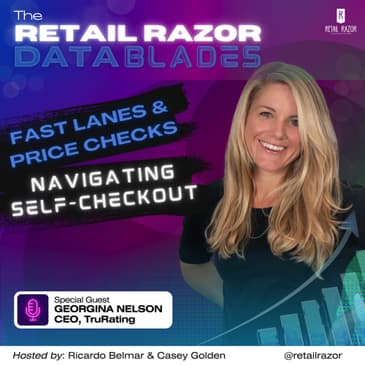
In this episode of Retail Razor: Data Blades, hosts Ricardo Belmar and Casey Golden are joined by Georgina Nelson, CEO of TruRating, to explore consumer sentiments on self-checkout systems. TruRating, known for gathering real-time shopper feedback, reveals that speed and convenience are top priorities for 65% of shoppers using self-checkout. Together, the team examines how retailers can enhance this final stage of the shopping experience and the potential for in-store experimentation to improve customer satisfaction. The team also touches on the future of self-checkout, including the possibility of ads with retail media and the importance of customer feedback.
Subscribe to our Newsletter: https://retailrazor.substack.com
Subscribe to our YouTube channel: https://bit.ly/RRShowYouTube
(00:00) Show Intro
(01:12) Georgina Nelson - Consumer Sentiment Towards Self-Checkout
(08:01) Show Close
Meet your hosts, helping you cut through the clutter in retail & retail tech:
Ricardo Belmar is an NRF Top Retail Voices for 2025 and a RETHINK Retail Top Retail Expert from 2021 – 2025. Thinkers 360has named him a Top 10 Retail Thought Leader, Top 50 Management Thought Leader, Top 100 Digital Transformation Thought Leader, and a Top Digital Voice for 2024. He is an advisory council member at George Mason University’s Center for Retail Transformation, and is the director partner marketing for retail & consumer goods at Microsoft.
Casey Golden, is the CEO of Luxlock, a RETHINK Retail Top Retail Expert from 2023 - 2025, and Retail Cloud Alliance advisory council member. Obsessed with the customer relationship between the brand and the consumer. After a career on the fashion and supply chain technology side of the business, now slaying franken-stacks and building retail tech!
Includes music provided by imunobeats.com, featuring Tech Lore from the album Beat Hype, written by Heston Mimms, published by Imuno.
- [00:06:01] - Retail Revolution: The Era of Experimentation
Welcome to our new Retail Razor Show, DataBlades, our new standalone Retail Razor
Show, where we talk real world numbers andslice through measurable consumer insights
based on research at the point of sale.
And bringing us that slicing and dicing ofdata is Georgina Nelson, CEO of TruRating.
TruRating helps retailers heardirectly from validated shoppers
daily, and recently had a majormilestone of half a billion responses.
Retailers using TruRating average an80 percent response rate on questions
asked, made possible by asking a singlerotating question directly on the POS
pinpad, making it a seamless part ofthe shopper's checkout experience.
TruRating also works with theirretail partners to develop consumer
insights reports by running questionson an industry topic or theme.
These anonymous responses are linked tometrics such as basket size and repeat
visits to produce industry changinginsights like the ones Georgina will share
with us today and raise our data blades.
I'm your host, Ricardo Belmar.
And I'm your cohost, Casey Golden.
Welcome Georgina.
Thank you both.
It's great to be here today.
So today Retail Razor Data Bladestopic is all about consumer
sentiment towards self checkout.
Georgina, tell us more.
So, imagine you've spent a reasonableamount of time picking out your perfect
items, navigating through the aisles, andfinally arriving at the checkout counter,
and that's when the magic or the mayhemhappens, and it's really in those last
few moments of that shopping experiencethat can, yeah, make or break your view.
So, while checking out youroptions in many retailers now, are,
uh, self checkout and or cashier.
So which do you choose and why?
And at Tru Rating, that's what wereally wanted to get under the skin of.
And that question sparked our research oncustomer sentiment towards self checkout.
So we asked, what do you likebest about self checkout?
65 percent of shoppersanswered less wait time.
20 percent that they can check theprices and 15 percent answered that
they can scan at their own pace.
It sounds like a no brainer, but thebiggest perk that consumers really
value when it comes to self checkoutis, it's the speed and that convenience.
It's about that swift andseamless transaction and that
final sprint to the finish line.
So it's vital that retailers reallypull out all the stops to actually
ensure that they're delivering onthat and that this point of the
consumer journey is quick and smooth
Well, this is a really interestingone to me because I have to say, if
I were the consumer answering thequestion, I probably would have looked
for the choice that says nothingreally, because I'm not personally
a fan of most self checkout systems.
But it's interesting that you found thatspeed was the number one choice because
that's probably my complaint about selfcheckout systems that don't work well.
It's because they didn't letme get through checkout faster
because something went wrong.
And somehow I always seem to have theability to find that one item in the
store that as soon as you get to the selfcheckout, this just has no way to scan.
It doesn't work.
And until you get someone to come byand reset the system or do something
through it, it will not let you check out.
And of course that's the oppositeof speed and convenience, right?
Yeah, very true.
Mm
Yeah.
I mean, I'm never a big proponentproponent of transferring work from
paid employees to unpaid customers ortaking a smile away when I had a chance
to make somebody smile before they walkout the door, but this is nothing new.
It's never going to go away.
It's really about how we adaptself checkout into our customer
journey and our customer experience.
Self checkout dates all the wayback to the Piggly Wiggly with
the self serve first self servicesupermarket back in the 1900s.
So, however we look at it, it'sbeen here, it's going to stay.
But really understanding howcustomers are using it and how
brands can adjust, I think.
It's a really key point into reallyasking customers what they think about it.
Are they enjoying it?
Do they like it?
of stores I've heard are almost, Ithink I heard some type of stat that
like, 55 percent of all sales lastyear went through a self checkout.
That's a big number.
It's a big number.
It wasn't me.
Well, so I, I'm also curiousabout the, the, the second number,
Georgina, you gave the 20 percentthat said they could check prices.
So I have to think if, if I'm theretailer and I'm hearing you report
these insights back to them, is thatmaking me think that, maybe I need to
have that ability to check prices atmaybe at scattered throughout the store.
To me, my best example is Target, right?
Target has all these checks, pricecheck stations all over the store where
you can just go and scan something.
If all you need to know is check theprice, I would think that if, I mean,
that's one fifth of your responsesare saying, I just, I, I liked it,
but I could check the prices first.
So I assume that means if I'm one ofthose shoppers and I didn't know the
price, I didn't realize that was going tobe, maybe I decided not to buy that item
when I got to the self checkout and Isuppose from a, mentality perspective that
probably makes that customer feel better.
They can just put it aside and thenhaving had to have done that with the
cashier and then felt like they'retelling the cashier, Oh, I'm sorry.
I didn't mean to buy that.
Can you not put, notinclude that in my purchase?
It's a little more awkward that way.
So I could see how that would be anappeal, but I'm curious, do you do you
think retailers would use that kindof information then say, Oh, maybe I
need to do something else in the store.
Now that I know 20 percent of mycustomers want this information.
Yeah, we've definitely it'sthe time of experimentation.
I think for a lot of retail, it's likeinnovation is, is on an all time high.
And with, especially with TruRating,we can, do AB tests rolling something
new out in stores A and keepingstore B constant, and seeing how
that impacts customer experience.
how much they pay andhow often they return.
And, when we have shared some ofthis self checkout, research, some of
it's pretty, can be pretty damning,customer experience can plummet often.
And so it's really to a retailer.
Okay, so when we, when we know that that'sa risk, what can we do to try and, support
the customer at that last point in thejourney and make it a better experience?
So we've worked with retailers,testing out, assisted self checkout.
So, employing someone with the, yeah,the mandate to stand at those banks,
smile, make sure consumers can findthat barcode that they know how to scan.
And yeah, and that'sbeen really beneficial.
And they've seen the uptick incustomer experience down to that.
That A B testing I can see very valuable.
I have a feeling that we are goingto see more advertisements at
self checkout in the near future.
It'll be much more common thatwe're going to have to watch an
ad before we can swipe our card.
And I think Tru Rating willbe providing some critical
data on that sentiment change.
You cannot wait to feed back
with your views on that.
Yeah.
I hope every single retailer that isplanning on putting ads on those screens
is already a Tru Rating customer.
Exactly.
And if not, there's still time.
Call me.
There is still time.
This is great, Georgina.
Thank you so much for joining ustoday's Retail Razor Data Blades.
Thank you so much.
It's been an absolute pleasure andI look forward to the next one.
If you enjoyed our show, please considergiving us a five star rating and
review on Apple podcasts and Goodpods.
Remember to smash that subscribe buttonin your favorite podcast player and tune
in on YouTube so you don't miss a minute.
I'm your cohost, Casey Golden.
Please share your feedback withus on Twitter at Casey C Golden,
Ricardo underscore Belmar, andat RetailRazor, or find us on
LinkedIn, Threads, and Instagram.
For the best highlights from each episodeshipped straight to your inbox, subscribe
to our Substack newsletter for fullepisode transcripts and bonus content.
I'm your host, Ricardo Belmar.
Thanks for joining us.
Until next time, keep cuttingthrough the clutter and stay sharp.
This is the Retail Razor Data Blades.