


S1:E2 Economic Waves: How Price Hikes Transform Shopping Trends
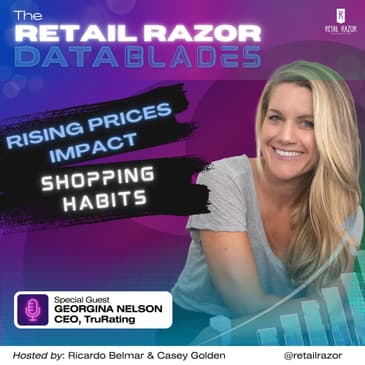
Welcome to another Retail Razor: Data Blades episode, where we explore real-world numbers and consumer insights with Georgina Nelson, CEO of TruRating. We discuss how rising prices are affecting shopper behavior. Georgina shares data showing significant changes: 63% of U.S. consumers are driving less due to high gas prices, 60% are cooking more at home, and 74% are using shopping lists—reflecting increased spending discipline. We also explore how retailers can turn these challenges into opportunities by enhancing customer experience and building loyalty. Hosted by Ricardo Belmar and Casey Golden, tune in for valuable insights and strategies to navigate the current economic landscape.
Subscribe to our Newsletter: https://retailrazor.substack.com
Subscribe to our YouTube channel: https://bit.ly/RRShowYouTube
(00:00) Show Intro
(01:12) Georgina Nelson - How Rising Prices Are Impacting Shopping Habits
(05:43) Show Close
Meet your hosts, helping you cut through the clutter in retail & retail tech:
Ricardo Belmar is an NRF Top Retail Voices for 2025 and a RETHINK Retail Top Retail Expert from 2021 – 2025. Thinkers 360has named him a Top 10 Retail Thought Leader, Top 50 Management Thought Leader, Top 100 Digital Transformation Thought Leader, and a Top Digital Voice for 2024. He is an advisory council member at George Mason University’s Center for Retail Transformation, and is the director partner marketing for retail & consumer goods at Microsoft.
Casey Golden, is the CEO of Luxlock, a RETHINK Retail Top Retail Expert from 2023 - 2025, and Retail Cloud Alliance advisory council member. Obsessed with the customer relationship between the brand and the consumer. After a career on the fashion and supply chain technology side of the business, now slaying franken-stacks and building retail tech!
Includes music provided by imunobeats.com, featuring Tech Lore from the album Beat Hype, written by Heston Mimms, published by Imuno.
- [00:03:22] - Turning Economic Challenges into Opportunities
Welcome to our new Retail Razor Show, DataBlades, our new standalone Retail Razor
Show, where we talk real world numbers andslice through measurable consumer insights
based on research at the point of sale.
And bringing us that slicing and dicing ofdata is Georgina Nelson, CEO of TruRating.
TruRating helps retailers heardirectly from validated shoppers
daily, and recently had a majormilestone of half a billion responses.
Retailers using TruRating average an80 percent response rate on questions
asked, made possible by asking a singlerotating question directly on the POS
pinpad, making it a seamless part ofthe shopper's checkout experience.
TruRating also works with theirretail partners to develop consumer
insights reports by running questionson an industry topic or theme.
These anonymous responses are linked tometrics such as basket size and repeat
visits to produce industry changinginsights like the ones Georgina will share
with us today and raise our data blades.
I'm your host, Ricardo Belmar.
And I'm your cohost, Casey Golden.
Welcome Georgina.
Thank you so much for having me.
So today's Retail Razor DataBlade segment is how rising prices
are impacting shopper habits.
Georgina, give us the data.
Well, last time we chatted, we discussedhow over 81 percent of consumers who we
polled across our markets, and that wasover 170,000 shoppers, had been noticing
, the pinch on the cost of living.
So 81 percent were noticing,but then we thought, how is that
actually impacting behavior?
Now, what changes are peoplemaking in light of that and how
is that affecting retailers?
So we asked whether people weredriving less or more as a result.
And we found that 63 percent of consumersin the U. S. said they were driving
less because of the rising gas prices.
We also found out that 60 percent werecooking more at home, so eating out
less, and 74 percent were using a list.
When they went shopping which is a bigincrease on the previous times, which
we've asked that and academic researchshows that generally consumers spend 15
percent less when they have a list, it'sthat that discipline and keeping to it.
Interesting.
Yes.
, so it, it's reallybecome clear to us that.
There's, when it comes downto discretionary spend, big
ticket items, consumers aredefinitely being more careful.
They're shopping around more,they're making less frequent trips.
When they're going by public transport,and that means that the retailers
who are in urban areas where, wherethere's a great public transport
network aren't at such a disadvantage.
So Georgina, I know retailersand consumers alike have been
feeling the burden of inflationfor quite a few months now.
I'm certainly shopping around more andbeing a lot more considerate about where
I choose to spend my hard earned dollars.
Is it pretty much all doom and gloomuntil inflation winds down, or is
there some upside here for retailers?
I think that's a definite upside.
When you think of that consumershopping around, that opens
a whole world of opportunity.
You've got new consumers comingthrough your door and you've got
a chance to, to woo and turn them.
And so, this is a great, yeah, agreat opportunity to win new loyalty
with incredible customer experience,targeted marketing and comms and
Yeah, and build that loyalty fan base.
And I think there's something tosay when in any type of recession or
inflation or any type of point whenthe economy is taking that pinch, those
consumers that continue to shop withyou, they're really top of mind as the
brand is really top of mind for them.
I mean, it's, it's.
Pretty important as you go into likea different economy to see where
those customers end up fleshingout overall, I would assume.
yeah.
Yeah a hundred percent and I thinkIt's around understanding, what
makes that, that customer loyal?
What are they, what are theyaffiliating with your brand?
What products are they purchasing andreally getting into that deeper level
of, of customer insight and analytics.
I think, as we look to how a lot of ourretailers are fighting the inflation
, and the pinch on wallet spend, it'sreally focusing down on, as I said,
that element of customer experience,but training, the, the store cashier
to actually be a brand ambassador.
How can they promote recommendations?
How can they promote upsell and evensimple things we found that, like, such
as asking a customer their name in someof these, fashion environments, etc.
When that consultative sale reallyhelps, we've seen that drive
average basket spend by over 30%.
Wow.
Likewise, if a customer makes a, if,if a cashier makes a recommendation.
So, all these.
All these simple things which aretailer can, can take and train
the teams and then see the, see theimpact down at a store level are key.
Well, it all comes back tothat experience, doesn't it?
Well, there we have another editionof the Retail Razor Data Blades.
I'm listening for the coolsegment music right now.
If you enjoyed our show, please considergiving us a five star rating and
review on Apple podcasts and Goodpods.
Remember to smash that subscribe buttonin your favorite podcast player and tune
in on YouTube, so you don't miss a minute.
I'm your cohost, Casey Golden.
Please share your feedback withus on Twitter at Casey C Golden,
Ricardo underscore Belmar, andat RetailRazor, or find us on
LinkedIn, Threads, and Instagram.
For the best highlights from each episodeshipped straight to your inbox, subscribe
to our Substack newsletter for fullepisode transcripts and bonus content.
I'm your host, Ricardo Belmar.
Thanks for joining us.
Until next time, keep cuttingthrough the clutter and stay sharp.
This is the Retail Razor Data Blades.