


S1:E6 The Power of Knowledgeable Store Teams
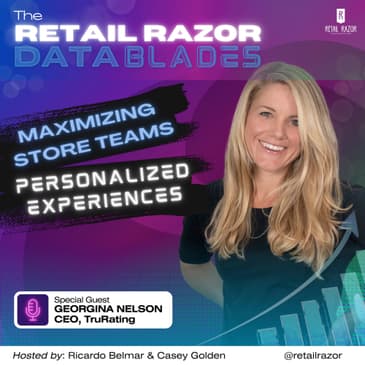
In the final episode to Season 1 of the Retail Razor: Data Blades, hosts Ricardo Belmar and Casey Golden welcome Georgina Nelson, CEO of TruRating. Georgina discusses the significant impact well-informed store teams have on retail performance. Highlighting a global sporting goods retailer's success, Georgina reveals that 90% of shoppers acknowledged receiving multiple product options from staff, leading to a 27% increase in average shopper spend. The conversation emphasizes the importance of personalized customer interactions, cross-selling, upselling, and the tangible benefits of sales and product training. Insights are derived from TruRating’s innovative approach to gathering customer feedback directly at the point of sale, showing how it supports retailers in enhancing store performance and creating holistic shopping experiences.
Subscribe to our Newsletter: https://retailrazor.substack.com
Subscribe to our YouTube channel: https://bit.ly/RRShowYouTube
(00:00) Show Intro
(01:12) Georgina Nelson - The Strategic Advantage of Well-Informed Store Teams
(09:40) Show Close
Meet your hosts, helping you cut through the clutter in retail & retail tech:
Ricardo Belmar is an NRF Top Retail Voices for 2025 and a RETHINK Retail Top Retail Expert from 2021 – 2025. Thinkers 360has named him a Top 10 Retail Thought Leader, Top 50 Management Thought Leader, Top 100 Digital Transformation Thought Leader, and a Top Digital Voice for 2024. He is an advisory council member at George Mason University’s Center for Retail Transformation, and is the director partner marketing for retail & consumer goods at Microsoft.
Casey Golden, is the CEO of Luxlock, a RETHINK Retail Top Retail Expert from 2023 - 2025, and Retail Cloud Alliance advisory council member. Obsessed with the customer relationship between the brand and the consumer. After a career on the fashion and supply chain technology side of the business, now slaying franken-stacks and building retail tech!
Includes music provided by imunobeats.com, featuring Tech Lore from the album Beat Hype, written by Heston Mimms, published by Imuno.
- [00:06:56] - The secret to retail success? Customer data!
Welcome to our new Retail Razor Show, DataBlades, our new standalone Retail Razor
Show, where we talk real world numbers andslice through measurable consumer insights
based on research at the point of sale.
And bringing us that slicing and dicing ofdata is Georgina Nelson, CEO of TruRating.
TruRating helps retailers heardirectly from validated shoppers
daily, and recently had a majormilestone of half a billion responses.
Retailers using TruRating average an80 percent response rate on questions
asked, made possible by asking a singlerotating question directly on the POS
pinpad, making it a seamless part ofthe shopper's checkout experience.
TruRating also works with theirretail partners to develop consumer
insights reports by running questionson an industry topic or theme.
These anonymous responses are linked tometrics such as basket size and repeat
visits to produce industry changinginsights like the ones Georgina will share
with us today and raise our data blades.
I'm your host, Ricardo Belmar.
And I'm your cohost, Casey Golden.
Welcome Georgina.
Thank you, thrilled to behere with you both today
So today's Retail Razor Data Bladestopic is - the strategic advantage
of well informed store teams.
Georgina, let's dive in.
Thank you.
So I thought I'd touch today onthe success story of one of our
retail clients, who is a globalsporting goods retailer, which for
me highlights a real fundamentalprinciple in retail, basically the
advantage of well informed store teams.
So in their stores, shopperswere asked, did the staff give
you several product options?
So on average, across all of their stores,90 percent of shoppers answered yes.
And the result which they sawwas an impressive 27 percent
increase in average shopper spend.
And so essentially, yeah, what this reallytells us is well informed store teams have
the ability to, you know, offer customersa real diverse range of product choices
based on the needs of each shopper.
And ultimately this creates aatmosphere of personalization.
So shoppers really feelthat their preferences are
generally understood and valued.
So store teams can suggestcomplimentary products through
cross selling, or they can nudgecustomers, like, to more expensive
premium options through upselling.
And so, we found that when customersfeel that a store team really understands
their needs and offers these tailoredsuggestions, yet they are ultimately
more likely to consider additionalitems and higher end alternatives.
And so, ultimately, that leads to higheroverall purchase values, and that's
what we saw with our sports retailer.
And yeah, ultimately, it's not justall about, the bottom line and sales,
you know, really an informed storeteam can create that holistic shopping
experience, which we all love and which,when we walk into a store and speak
to a store associate, we really feelresonates with us as a brand and, in this
competitive retail landscape, I reallybelieve that this type of personalized
approach sets retailers apart.
It's been so difficult forstore teams to get that type of
information to corporate, right?
Store managers know how oftenthat they're talking to customers.
Sales associates, theyfeel that they have impact.
into the sales.
They know that they've cross sold.
They know that they've been helpingcustomers all day, but this is just
such a great way to prove on thetransaction level that these, these
sales associates are increasing sales.
They're increasing AUR.
They literally are partof the bottom line.
So I think this is just very, veryexciting to see because so rarely
is that type of a question, inmy opinion, Make it to corporate.
And in such a nice definitive way, right?
I think I really love this
There's no gray area.
Yeah, exactly.
It's not, it's not gray, right?
It's very clear what the impact is.
And I mean, we've always sort of, had, Iguess I have to call it a cliche, right?
That when everyone says all those,your frontline store teams are
the face of your retail brand.
And so many retail executives will saythat, but they say it loosely without
really having something to back it up.
And this provides that proof point thatsays, no, there is an absolute tangible
Impact to having that well informed team.
And I think this trickles back.
If I'm the retailer seeing this point,this should be telling me, Oh, well, that
means my store team, they must've beennot only are they well informed, that
means they've done the training, right?
So maybe this speaks to the effectivenessof sales training that we've had and
product training that we've had becausethere was a measurable sales increase
from customers that had interaction,engagement, with that staff member.
So it's another, it's yet anothervalidation point that says maybe it
does make sense after all that weinvest in those store team members, to
help make them better at what they do.
And it is reflectedback in our sales data.
exactly.
I think, you know, what's, what's reallyimportant is once you see this kind of
stat at a, at a higher level, Actually,it's about drilling it down to what
is happening on each of those stores.
So when we talk about that overallaverage, 90%, which is phenomenal,
when we actually get down to itin all our retailers, as you'll
expect, there's got execution gaps.
There's some stores which areexecuting on that strategy really well.
and others which are lagging behind.
And you can even see the difference,you know, when the, when the store
manager is on their off day, forexample, these things can lapse.
And so it's really, putting into thehands of the, of the regional managers,
even the store managers themselves,all the way up to corporate, the
view of how that strategy has beenexecuted at a store level across,
you know, across the course of a day.
And so, You can say to a particularstore, we can see that we're losing,
X amount of revenue because simplyyour teams aren't doing the upsell.
They're not looking at cross sellopportunities and, yeah, and we
need to give you some more coachingto get, get you up to speed.
Yeah.
I would even challenge that a storethat would have 90 percent yes, would
probably have less turnover and probablyhave a great team, you know, if it
was 90%, no, you probably have a veryhigh turnover and your store manager
is not engaging your associates andthey're not really a cohesive team.
I mean, this could into several otherlike divisions, to really communicate
how is like a nice little health check,
Yeah, exactly.
And, you know, when we speak to, whenwe speak to managers within retail,
I think so much, previously, they're,they're managing on gut, it's my gut
sense that this team, we've got problems,you've got issues, maybe, and, and
having customers, all your customersbeing essentially a mystery shopper
and providing, providing this data justtakes the emotion and the heat out of it.
It's like everyone, look, thisis what our customers are saying.
We're all aligned.
This is, you know, let's take action.
And it means the store teams cantrust the data and corporate trust
the data and that means everyone'saligned on action, actionability.
oh my gosh, I was broughtback like deja vu there.
I just had a flashback of like, ohmy god I have a secret shop coming
in this quarter Ha ha ha ha day I wasjust like, oh my god, is that them?
Is that them?
I remember those moments.
Now it happens at every single checkout
Well, and isn't there also a factor hereabout tracking customer repeat visits?
I know that the questions are doneanonymously, but because you are mapping
against point of sale data, right?
I'm assuming there's an ability youcan help a retailer track this as
a lifetime customer value metric
Yeah, exactly.
So, you know, not only is therethat, I'm going to spend more in the
moment, you're persuading me to getthe, those more expensive trainers,
for example, but that impact of thatpersonalization and that consultative
sale means I'm more likely to come back.
So yeah, that's definitely whatwe, what we look at as well.
It's very interesting, I can't saythat Ricardo and I wouldn't have
a blast digging in and slicingand dicing that data Now Now
It just sounds like a good time
Well, I would love to come and sharemany other insights with you on what
we're, what we're hearing from shoppersall over the U S anytime you would like.
There's like you said earlier thereis so much happening with consumer
behavior right now across so manydifferent generations shopping
right now at the same time We'rethis having the consumer insights
essentially coming in in real time.
It's just really really such agood move for retailers to make sure
that like they have a pulse and theyactivate a pulse on any given moment.
Yeah, I couldn't, couldn't agree morethan, keeping current on the wave of
consumer, consumer change and sentiment.
So we're happy on the be journey.
Well, that does it for anotheredition of Retail Razor Blades.
Thank you, Georgina.
Thank you so much for having me.
If you enjoyed our show, please considergiving us a five star rating and
review on Apple podcasts and Goodpods.
Remember to smash that subscribe buttonin your favorite podcast player and tune
in on YouTube so you don't miss a minute.
I'm your cohost, Casey Golden.
Please share your feedback withus on Twitter at Casey C Golden,
Ricardo underscore Belmar, andat RetailRazor, or find us on
LinkedIn, Threads, and Instagram.
For the best highlights from each episodeshipped straight to your inbox, subscribe
to our Substack newsletter for fullepisode transcripts and bonus content.
I'm your host, Ricardo Belmar.
Thanks for joining us.
Until next time, keep cuttingthrough the clutter and stay sharp.
This is the Retail Razor Data Blades.