


S1:E5 Revolutionizing the Checkout: How Choice Impacts Purchase Behavior
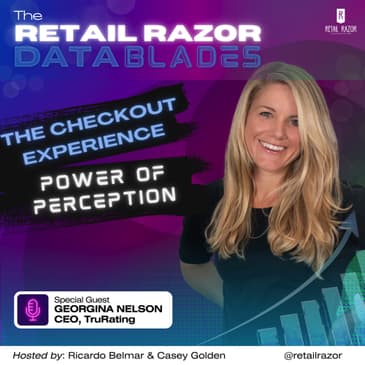
In this episode of the Retail Razor Show: Data Blades, hosts Ricardo Belmar and Casey Golden are joined by Georgina Nelson, CEO of TruRating, to explore the essential role of consumer choice during the checkout experience. Georgina shares insights gathered from over 14,000 customers across the US, UK, and Australia about their preferences for self-checkout versus manned cashiers. The discussion reveals that while convenience stores see a higher preference for self-checkout, segments like apparel still lean towards manned cashiers due to the nature of the shopping experience. Additionally, data indicates that perception of limited checkout options can lead consumers to spend significantly less. We highlight the importance of retailers investing in offering choices to avoid dips in transaction values and improve customer satisfaction. We also look at practical approaches for retailers to balance between technology and human assistance at checkout, ensuring an optimized customer journey!
Subscribe to our Newsletter: https://retailrazor.substack.com
Subscribe to our YouTube channel: https://bit.ly/RRShowYouTube
(00:00) Show Intro
(01:12) Georgina Nelson - Perception of Choice is Essential During the Checkout Experience
(09:13) Show Close
Meet your hosts, helping you cut through the clutter in retail & retail tech:
Ricardo Belmar is an NRF Top Retail Voices for 2025 and a RETHINK Retail Top Retail Expert from 2021 – 2025. Thinkers 360has named him a Top 10 Retail Thought Leader, Top 50 Management Thought Leader, Top 100 Digital Transformation Thought Leader, and a Top Digital Voice for 2024. He is an advisory council member at George Mason University’s Center for Retail Transformation, and is the director partner marketing for retail & consumer goods at Microsoft.
Casey Golden, is the CEO of Luxlock, a RETHINK Retail Top Retail Expert from 2023 - 2025, and Retail Cloud Alliance advisory council member. Obsessed with the customer relationship between the brand and the consumer. After a career on the fashion and supply chain technology side of the business, now slaying franken-stacks and building retail tech!
Includes music provided by imunobeats.com, featuring Tech Lore from the album Beat Hype, written by Heston Mimms, published by Imuno.
- [00:02:51] - Why Forced Self-Checkout Cuts Spending by 29%
Welcome to our new Retail Razor Show, DataBlades, our new standalone Retail Razor
Show, where we talk real world numbers andslice through measurable consumer insights
based on research at the point of sale.
And bringing us that slicing and dicing ofdata is Georgina Nelson, CEO of TruRating.
TruRating helps retailers heardirectly from validated shoppers
daily, and recently had a majormilestone of half a billion responses.
Retailers using TruRating average an 80percent response rate on questions asked,
made possible by asking a single rotatingquestion directly on the POS pinpad.
Making it a seamless part of theshopper's checkout experience.
TruRating also works with theirretail partners to develop consumer
insights reports by running questionson an industry topic or theme.
These anonymous responses are linked tometrics such as basket size and repeat
visits to produce industry changinginsights like the ones Georgina will share
with us today and raise our data blades.
I'm your host, Ricardo Belmar.
And I'm your cohost, Casey Golden.
Welcome Georgina.
Thank you, it's good to be here today.
So today's Retail Razor DataBlades topic is all about how 'the
perception of choice is essentialduring the checkout experience.'
Please do tell us more Georgina.
So, earlier this year we askedover 14, 000 customers across the
US, UK and Australia what theirviews were of self checkout as they
shopped across a variety of stores.
And it was really interesting,basically appetite for self checkout
versus manned tills seem to reallybe affected and be impacted by
what sector you're shopping in.
So in the convenience sector, customersgenerally prefer to self checkout.
Obviously the convenienceand the speed being king.
But in apparel, where a consultative salewithin a store associate is more likely.
That fell to only 29 percent of customerssaying they'd ever prefer self checkout.
And as speed was clearly key, it'sinteresting to look at the number of
products which were in the basket.
Ultimately, there seems to be athreshold of if there are more than
three items in the basket, consumerswill look for that manned till.
And... Interestingly, in this step,which I'm sure we can all sympathize
with, one in five customers report facingchallenges with the ease of self-checkout
Oh, there's Ricardo.
That's me.
I'm that one
ha, ha.
What, what we also found, which, again,I think is, is really interesting, is
the option of whether there is a mannedtill or self checkout is really key.
When customers perceive thatself checkout is their only path.
They end up spending 29 percent less.
So, basically, if you feel that you'rebeing forced to use self checkout, your
shopping patterns actually change, and,when, while that looks such a, such a big
number, when I think to my own experience,if I can see it's only self checkout,
I'll just leave buying that bottle of wineto when I walk past the office later on.
I cannot be bothered to, yeah, forthe bell to ring, wait for a store
associate who doesn't obviously believethat I am under 21, I mean, who would?
ha, ha, ha, and yeah.
And so, I think retailers recognizingthat investing in that choice is
key to ensure that there is no dipin that average transaction spend.
Well, as we were joking about, Ithink I can definitely attest to that
because I immediately thought to, my,one of my, I would say probably least
favorite self checkout experiences areat home improvement stores, which seems
to be the trend now that they almostexclusively want you to use self checkout
and very rarely have anyone manning acheckout area unless it's for returns
or some other customer service area.
And, and I think that does factor inbecause I'll usually decide, well, if
fine, that's okay, because I'm onlygoing to buy one or two things anyway.
And so I'm only going tocarry those one or two things.
No matter how awkward those items may be,which they often are at a home improvement
store, I'll figure out how to get throughthe self checkout and hopefully not,
cause all the alarms to go off and we'llhave to wait for someone to come and fix
it because it wouldn't scan the item.
But yeah, that I, I would definitelyfeel as a consumer that I'm not likely
to buy a lot of things knowing that Ihave to go through that self checkout.
Also too, I think I use selfcheckout when I'm only buying a
couple things in general period.
So like it might also, there's, whoknows like that, that could definitely
skew the data at a home improvement.
I'm not going to go througha, buy a whole bunch of lumber
and a whole bunch of things.
And then go through self checkout.
I'm not lifting all that stuff.
You just put it in your cart.
Or heavier products, right?
So, you, there has to be a mix of both.
I don't think that we cango 100 percent one way.
It does change perception.
I kind of, I don't like the idea of it.
So it's just kind of like, thebrand's no longer relating to my DNA.
Cause they're now doing rolling somethingout that I don't believe in, but at
the same time being able to get thisinformation from the customers, like
essentially real time, I, I see thatit would be much more beneficial to
the decision makers on how they'remaking technology decisions, changes,
rolling it out across more locations.
I think it really is a criticalpoint where retailers have to
just ask questions to consumers.
Yeah.
Thank you, Casey!
I couldn't, I couldn't agree more.
Consumers are changing sorapidly, innovation, technology,
and store is changing rapidly.
And, for those, those two thingsto be in two step, it's, it's
key to be getting real time, upto date customer sentiment data.
And as you said, just simply, simplyask them, and then you're not operating
and making decisions in the dark,which can come to bite you later.
It's interesting is, and I think Costco isone example of retailer doing this, the,
the trend of, having, not obviously not amanned self checkout area, but having at
least one staff member standing by rightnear the self checkout area for those
moments when something does go wrong.
So they can quickly go over and help.
And I think, in the past selfcheckout was always presented as a
labor solution for retailers, right?
In the sense that, you would havefewer people staffing the checkout
area yet still have a good enoughprocess that it would provide.
A good experience for customerswhen they check out without
incurring any losses or anything.
But one person manning multipleself checkouts versus a one to one
correspondence to a manned checkout areais still a labor savings, I suppose.
But I, I I'm kind of curious, when youare working with the retailer, Georgina,
you have this kind of survey done andthey're looking at data like this.
What, what's a typical thing that you,so just to reach out and say, you know
what, how would you follow up with this?
Is the normal thing that happens thata retailer says, we've learned this
is a really interesting result andoutcome from this question we asked.
Now I want to go and ask adifferent question, and kind of
correlate the two to see what kindof insight they can come up with.
Or, do you usually see somethinglike this where it's a very
discrete kind of question.
They just want that answer andthen they're going to go off and
take actions against that result.
What, what do you find isthe more common approach?
Yeah, I think, asking a raft ofquestions to be able to, dig, dig deep.
But also just being able tolook at all the contextual data,
which you have around that.
So while on the face of it, it seemsvery simple Oh, it's just a, it's just a
question, because of our integration withthe POS, we can see, while all anonymous,
we can see what someone, the productswhich they bought, we can see how often
they return and how much they spent.
And so, if you're looking at your, yourexample of a home improvement store,
actually being able to work with theretailer to say, yeah, it's it is.
In the, when people are buyinghuge planks of, of wood, that's
when they have the most poorestexperience on the self checkout.
So maybe it's about, the ease of thatremote scanner or, or whatever it is, or,
yeah, really understanding that basket,that shopping basket mission and yeah,
and the profile of those consumers.
And so, You can take those insights andwhether that's yeah different investments
in technology or training, like yousaid, having an assisted, assisted
checkout, but, does it, do they standat the front and shepherd you to yeah,
shepherd you to the self checkout?
Do they help you scan the first item?
It's these kinds of things, which we'reworking with our retailers to test,
the AB test and really get that optimumconsumer journey and customer experience.
that makes sense.
Oh, that makes a lot of sense.
Well, that will do it for anotheredition of the Retail Razor Data Blades.
Georgina, thank you somuch for joining us.
It's been an absolute pleasure.
Thank you both.
If you enjoyed our show, please considergiving us a five star rating and
review on Apple podcasts and Goodpods.
Remember to smash that subscribe buttonin your favorite podcast player and tune
in on YouTube so you don't miss a minute.
I'm your cohost, Casey Golden.
Please share your feedback withus on Twitter at Casey C Golden,
Ricardo underscore Belmar, andat RetailRazor, or find us on
LinkedIn, Threads, and Instagram.
For the best highlights from each episodeshipped straight to your inbox, subscribe
to our Substack newsletter for fullepisode transcripts and bonus content.
I'm your host, Ricardo Belmar.
Thanks for joining us.
Until next time, keep cuttingthrough the clutter and stay sharp.
This is the Retail Razor Data Blades.