
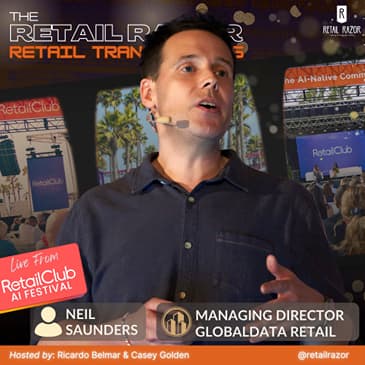



GlobalData's Neil Saunders on where AI in retail pays off today, and why AI job cuts would take over a trillion dollars out of consumer spending if they were reality.
Fifteen million US jobs lost to AI? That's one of GlobalData's best-case scenarios if the doom and gloom scenarios were to play out. Neil Saunders traced what that would do at the checkout: a 7 to 8% hit to overall consumer spending, over a trillion dollars, and a bigger drop than retail saw in the 2008 financial crisis. In fact, it wouldn’t even be close. So, is it a real-world scenario? Or is it just performative fiction?
Recorded live and in person at RetailClub AI Festival in Huntington Beach, this episode of Retail Transformers sits down with Neil Saunders, Managing Director of GlobalData Retail (and our favorite store photographer). Ricardo Belmar and Casey Golden ask Neil where AI in retail is paying off today, how it can help store teams, and what happens to consumer spending if AI job cuts go too deep, too fast.
What You'll Learn in This Episode:
Why route planning and inventory allocation are the win-win sweet spot for AI in retail, and how Amazon lowered its cost to serve while speeding up delivery.
How Best Buy uses AI to pick which store fills an online order, and why that means fewer stockouts and fewer markdowns.
Where chatbots work for shoppers ("Where is my stuff?") and where customers still want a person.
How store teams use AI to check a planogram with a photo, and how Lowe's associates find the right part from a customer's purchase history.
Why the in-store AI that works is suggestive and associate-initiated, and why nobody on the sales floor wants AI talking in their ear.
Neil's math on AI job cuts: 15 million jobs, a 7 to 8% drop in consumer spending, and a middle case of 30% - plus what’s real versus what’s not.
The layoff trap: how cuts that make sense for one company can push the whole sector into a loss.
The two reasons home improvement lags online, and how AI fixes the second one (jump to 13:11).
Neil frames the AI jobs cut math as a risk the industry hasn't thought through and that analysis tells you whether the threat is real or not. If AI job cuts happen everywhere at once, demand falls with them. If you're deciding where AI in retail belongs in next year's budget, start with this one.
This Episode is Brought to You By:
Retail Agent Con - November 17, 2026
Explore how AI agents fit into retail work at Retail Agent Con, a live virtual event on November 17, 2026, from 11 a.m. to 3 p.m. Eastern, produced by IHL Group with ClearSight AI.
Join retail leaders like Glenn Allison of Tractor Supply, Scott Saeger of David’s Bridal and Justin Emig of Artisan Lane Furniture, Dr. Janet Sherlock on the organizational changes required for agents and humans to work together, analysts like Greg Buzek and Jerry Sheldon of IHL Group and Retail Razor’s Ricardo Belmar, for practical conversations about agents in merchandising, order management, inventory control, store systems, and more.
Retailers attend free, sponsorships and individual tickets are available as well.
Learn more at www.retailagentcon.com.
Subscribe & Follow.
Don't forget to like, comment, and subscribe to The Retail Razor: Retail Transformers for more episodes featuring retail innovators, disruptors, and bold thinkers reshaping commerce.
Subscribe to the Retail Razor Podcast Network: https://retailrazor.com/
Subscribe to our Newsletter: https://retailrazor.substack.com
Subscribe to our YouTube channel: https://go.retailrazor.com/utube
About Our Guest.
Neil Saunders. https://www.linkedin.com/in/neilretail/
Managing Director. GlobalData Retail. https://www.globaldata.com/
Neil is Managing Director of GlobalData’s retail division. In this role he oversees the development of the company’s proposition and its research output. He also works with major clients to help them understand the retail, shopper and market landscape – advising them on how best to develop, evolve and implement business strategies.
Prior to GlobalData, Neil founded the retail research firm Conlumino which was subsequently acquired by GlobalData. And prior to that Neil worked for the John Lewis Partnership where he was involved, among other things, in the planning and relocation of new stores, the development of the ecommerce business, and the creation of technical and information systems.
Chapters.
(00:00) 15 Million Jobs Lost to AI? The Retail Reality Check
(00:57) Live From RetailClub: Meet Retail's Favorite Store Photographer
(04:16) Welcome, Neil Saunders!
(04:51) Where AI Is Really Paying Off for Retailers Today
(07:05) The Win-Win AI Sweet Spot: Amazon and Best Buy
(07:53) The Uber Effect: Why Customers Expect Everything Now
(11:00) AI on the Sales Floor: Planograms, Lowe's and No Earpieces
(16:15) The 15 Million AI Job Cuts Warning: Worse Than 2008
(17:37) The Layoff Trap: Cut Too Deep and You Cut Out Your Customers
(19:46) Why Shoppers Still Crave Humans, Not Bots
(22:30) Stay Sharp, Be Bold: Keep Transforming Retail
Meet Your Hosts.
Helping you stay sharp, be bold, and transform retail:
Ricardo Belmar is an NRF Top Retail Voice for 2025 and a RETHINK Retail Top Retail Expert from 2021 – 2026. Thinkers 360 has named him a Top 10 Thought Leader in Retail, a Top 25 Thought Leader in AGI and Careers, a Top 50 Thought Leader in Agentic AIand Management, and a Top 100 Thought Leader in Digital Transformation and Transformation. Thinkers 360 also named him a Top Digital Voice for 2024 and 2025. He is an advisory council member at George Mason University’s Center for Retail Transformationand the Retail Cloud Alliance. He was most recently the partner marketing leader for retail & consumer goods in the Americas at Microsoft.
Casey Golden, is the North America Leader for Retail & Consumer Goods at CI&T, and CEO of Luxlock. She is a RETHINK Retail Top Retail Expert from 2023 - 2026, and Retail Cloud Alliance advisory council member. After a career on the fashion and supply chain technology side of the business, Casey is obsessed with the customer relationship between the brand and the consumer and is slaying franken-stacks and building retail tech!
Episode Music.
Includes music provided by imunobeats.com, featuring Tropikool, from the album Future Beats 2, plus Virtual Apology and New Styles, from the album Shimmer Pop, written by Heston Mimms, published by Imuno.
Highlight Clips.
[00:16:15] - Yeah. So I I think it's a really interesting point because I think everyone is talking about job cuts with AI. And if you just…
[00:07:04] - Well, think from our point of view, one of the things we're saying is try to focus on things that benefit the customer and…
[00:20:47] - And I think sometimes even e commerce itself, let alone agentic commerce, doesn't generate that same feeling. You might buy the…
Transcript.
S2E11 Neil Saunders
[00:00:00] 15 Million Jobs Lost to AI? The Retail Reality Check
[00:00:01] Casey Golden: 15 million jobs in the US lost to AI, and that's, that's the best case scenario
[00:00:10] Ricardo Belmar: Neil Saunders of GlobalData followed that number all the way to the checkout. Take those paychecks out of the economy and consumer spending drops 7 to 8%. That's over a trillion dollars if you're doing the math, a deeper hit than the 2008 financial crisis, and it wouldn't even be close. But is it even possible, let alone likely to happen?
[00:00:31] Casey Golden: In this episode of Retail Transformers, recorded live and in person from RetailClub Festival, Neil shows us where AI is paying off for retailers today, and why cutting your way to profit by reducing your workforce could cut your customers out, too
[00:00:52] Ricardo Belmar: Stay with us and hear Neil set the record straight on what's real versus what's not
[00:00:57] Live From RetailClub: Meet Retail's Favorite Store Photographer
[00:01:05] Ricardo Belmar: Welcome to Retail Transformers, candid conversations with the visionaries shaping the future of commerce.
[00:01:11] I'm Ricardo Belmar
[00:01:13] Casey Golden: And I'm Casey Golden.
[00:01:14] Welcome back, Retail Razor fans. This is the podcast where we cut through the clutter to bring you the sharpest insights from the leaders disrupting retail, careers, and transforming the future of retailing
[00:01:26] Ricardo Belmar: This is season two, episode 11, and it continues our live and in-person series from the RetailClub AI Festival in Huntington Beach. This time, we sat down with our good friend Neil Saunders, managing director of GlobalData's retail division
[00:01:42] Casey Golden: Also known as our favorite store photographer, who I am stoked that I finally got to meet in person. Uh, retailers don't always love those photos, but I, like, live for them. Um, somebody has to shine a light on the mess the beauty[00:02:00]
[00:02:00] Ricardo Belmar: Exactly. And Neal gave one of the most talked about sessions at Retail Club. So we started with where agentic AI is really paying off today, route planning, inventory allocation, Best Buy using AI to decide which store should fulfill an online order. Neal calls it the sweet spot where the retailer and the customer both win
[00:02:20] Casey Golden: Then we get into AI for store teams, from checking a planogram with a photo to helping a Lowe's associate find the right part, and why nobody on the sales floor wants AI talking in their ear
[00:02:37] Ricardo Belmar: And we dig into the most controversial numbers from Neil's session that everyone was talking about. What happens to consumer spending if AI job cuts go too deep too fast? The best case is worse than the 2008 global financial crisis. The middle case is a 30% drop. But is that even a real possibility, or is it just performative fiction?
[00:02:59] Now before we dive [00:03:00] in, I want to tell you about the next event the Retail Razor Podcast Network will be part of, Retail Agent Con, on Tuesday, November 17th from 11:00 AM to 3:00 PM Eastern. Join me and more than 540 of your retail peers at Retail Agent Con, a live virtual event from our friends at IHL Group with ClearSight AI.
[00:03:19] It's an honest look at what AI agents are really doing today across merchandising, order management, inventory, and store operations. Which wins are real, and what has to change in your org chart to make them stick? You'll hear from retail leaders like Glenn Allison of Tractor Supply, Scot Sager of David's Bridal, and Justin Ewig of Artisan Lane Furniture, plus Dr.
[00:03:40] Janet Sherlock on getting agents and people working together, IHL's Greg Buzek and Jerry Sheldon, and yours truly too. Registration is free for retailers at retailagentcon.com. And technology providers, good news, sponsorships are still available. That's four hours of real world insight you [00:04:00] can use heading into NRF's big show.
[00:04:02] Be sure and register today. Thanks to Retail Agent Con for helping to bring you this episode of Retail Transformers.
[00:04:09] Casey Golden: Now let's welcome Neil Saunders, managing director of GlobalData's retail division to Retail Transformers
[00:04:16] Welcome, Neil Saunders!
[00:04:16]
[00:04:21] Ricardo Belmar: And we are back live at Retail Club, and this time we have our good friend Neil Saunders from GlobalData.
[00:04:29] Casey Golden: our favorite photographer.
[00:04:30] Ricardo Belmar: Our favorite photographer. That's right, our favorite store photographer- Stores ... at Stores. Yes, we love those, all those series of stores.
[00:04:35] Maybe some of the retailers don't as much,
[00:04:36] Neil Saunders: They don't.
[00:04:38] Ricardo Belmar: they
[00:04:38] Casey Golden: But you are doing God's work. It is so important.
[00:04:41] Neil Saunders: I think so. It's shining a light- I agree. I agree. on the mess in
[00:04:42] Ricardo Belmar: agree. Absolutely. Absolutely. so this is the first time on the show, so welcome. It is, thank you. Yeah. Yeah, welcome. We've been looking forward to having you on for a while.
[00:04:51] Where AI Is Really Paying Off for Retailers Today
[00:04:51] Ricardo Belmar: So we thought we'd talk a little bit about, you had a really interesting session here at Retail Club yesterday- Yes ... talking about what's happening in AI. So we thought maybe just to kick off, what- tell us a little bit [00:05:00] about what you're seeing retailers successfully do with agentic AI. Where are they really seeing benefit today?
[00:05:05] Neil Saunders: Yeah, sure. I think retailers are still in an experimental phase. Mm-hmm. They're still testing what can be done and what works, and that's a good thing. I think where we're seeing a lot of success at the moment is in some of the very routine things. route planning is one example. I think they're really leaning into that, especially if they're digital.
[00:05:27] they can plan routes and plan the kind of logistics aspect of that much better and far tighter using AI. Mm-hmm. And I think that is a very tangible example of how it doesn't replace the humans obviously doing the delivery, but it does make everything much more efficient and ultimately more profitable.
[00:05:47] And it's even, in that space, very small incremental gains. But of course, if you're doing it on scale- Mm-hmm ... every single day across the whole of the US, those small incremental gains really add up. Yeah. Right. So I [00:06:00] think we're seeing a lot of success, in, in that space. I also think we're starting to see some success in the, consumer-facing side- with chatbots, and I think that's really interesting because I think consumers both love and hate chatbots. Right.
[00:06:14] Right.
[00:06:14] Yeah.
[00:06:14] Casey Golden: Yeah.
[00:06:14] Ricardo Belmar: And
[00:06:15] Casey Golden: I mean, it's kinda cringe when you say chatbot. I mean- I, it it, it is. I, I have a visceral reaction
[00:06:20] Neil Saunders: Yeah.
[00:06:21] It is. Yeah. And I think most consumers do, and that's saying the challenge is working out where can you put this, where does it work.
[00:06:27] Ricardo Belmar: Right.
[00:06:28] Neil Saunders: And I think what retailers are finding is it works for simple queries where consumers want a quick answer. "Where is my stuff?" When will it be delivered?" "What was my last order?" These kind of very basic things- they just don't need to speak to humans for.
[00:06:43] Ricardo Belmar: mm-hmm.
[00:06:43] Neil Saunders: But to your point, Casey, as soon as it comes to anything more involved, they want to speak to a human.
[00:06:50] So that's interesting to me because it has a role- but it doesn't have a complete role, and you need to find where the boundaries are
[00:06:56] Ricardo Belmar: Yeah. Where, where are some of the areas-- When you have retailers talk to [00:07:00] you about this, what, what are the kinds of recommendations you're making for where they should focus on first?
[00:07:04] Neil Saunders: Well, I think
[00:07:05] The Win-Win AI Sweet Spot: Amazon and Best Buy
[00:07:05] Neil Saunders: from our point of view, one of the things we're saying is try to focus on things that benefit the customer and benefit you. That's, that's the sweet spot where there's a win-win. And like the logistics and the route planning is a win-win. It's better for the retailer, it's better for the customer.
[00:07:21] And you'll find things like using AI to allocate inventory, and Amazon's done a lot of this. And what they've been able to do is reduce their cost to serve because they've got the product in the right place, and they can forecast where the product should go across the country based on what customers will need.
[00:07:40] So it's cheaper for them. But of course, the great thing is it's faster for the customer because the inventory is in the right place, so they can do the overnight, one-day, sub-one-day delivery-
[00:07:52] Casey Golden: know-
[00:07:52] love it
[00:07:53] The Uber Effect: Why Customers Expect Everything Now
[00:07:53] Casey Golden: I have been very much impacted by that.
[00:07:56] You know how when we h- we have to wait, [00:08:00] seven minutes for an Uber these days?
[00:08:01] Neil Saunders: Yes.
[00:08:03] Casey Golden: We were like,
[00:08:04] Ricardo Belmar: only seven minutes?
[00:08:05] Like seven
[00:08:06] seven minutes. I used to be able to have an Uber, two minutes every single time, right? And I think Amazon is definitely... Like, I just had to wait almost two weeks for a package from a brand.
[00:08:17] Wow. And I'm like- Wow ... "What are you doing? Are... It's already sewn." but then when I am shopping on Amazon, I'm very annoyed that everything is not same day or next day. I'm very annoyed. Yeah. Or that one color is and the other color is not.
[00:08:36] Neil Saunders: Yes. Right. one size
[00:08:37] Ricardo Belmar: Yes.
[00:08:38] Casey Golden: and
[00:08:38] Ricardo Belmar: whatever sizing
[00:08:39] Casey Golden: not.
[00:08:39] Yes. Right? And we are... I, I feel so bad for brands and retailers where this expectation, ki- I call it, the Uber effect, is, like- literally, like- Yeah ...
[00:08:53] my expectations have changed where I'm like, "Why am I waiting over a week for a pair of AG jeans?" right. Like, [00:09:00] we're in the same continent here.
[00:09:02] Like, what are we, what are we doing?
[00:09:04] Right.
[00:09:04] I think, I'm pretty sure you're uptown.
[00:09:07] Would somebody
[00:09:08] Ricardo Belmar: put them in an Uber?
[00:09:11] Neil Saunders: But I think that's an inter- I mean, I agree, I think the bar has been raised.
[00:09:15] Yeah. But I think that's very interesting because, if you look at a retailer like Best Buy, one of the areas I think they're using AI is to help them make decisions about how to fulfill. Yeah. And to your point, sometimes it's like, hey, the best option for you in this instance is to fulfill from a store.
[00:09:32] Right. It's not to take it from the DC, it's not to put it through the usual route. It's to take it from a store, and actually take it from this store because this store has excess inventory and it isn't gonna sell down in the next few days. Now, those calculations before AI would be, at scale, they'd be impossible
[00:09:49] But now AI can route those decisions, and actually it increases the efficiency. And then you think of the knock-on effect, 'cause you haven't taken it from a store where inventory is low and there may be a demand for it. [00:10:00] You don't get out of stocks. Exactly. You can sell more overall
[00:10:01] Ricardo Belmar: Exactly. Yeah. Yeah.
[00:10:02] Casey Golden: You don't mark- and less markdowns. and
[00:10:04] Ricardo Belmar: less markdowns.
[00:10:04] Neil Saunders: E exactly.
[00:10:05] Less
[00:10:05] Casey Golden: especially- Right? 'Cause
[00:10:05] Ricardo Belmar: especially
[00:10:06] Casey Golden: lot, we're
[00:10:06] not doing a lot of, transfers anymore these days, right?
[00:10:09] Neil Saunders: exactly.
[00:10:10] Casey Golden: sticking where it is- Yeah.
[00:10:11] I agree ... most of the time, and, it's just gonna be marked down.
[00:10:14] Neil Saunders: It is. And, and I love that because I think those are the things, and this is where we say to focus.
[00:10:18] It's win-win. Mm-hmm. The retailer wins- right ... but the customer Customer wins, yeah. And that, that is... You don't always find that, but that's
[00:10:25] Ricardo Belmar: real
[00:10:25] Neil Saunders: real
[00:10:26] Ricardo Belmar: spot.
[00:10:26] Yeah. One, I think the interesting thing there is y- th- there's a tendency for everyone to think, I, I see this in retail, that either there's an internal benefit or there's a customer benefit. Yes. But that's a great example where you're actually getting the win on both sides of it- You do. Exactly ... in a, in a way that the A- AI is good at.
[00:10:42] Neil Saunders: it is and sometimes it doesn't work out like that, and sometimes it's fine to just do a customer thing or fine to do- Yeah ... an internal thing. But I think if you're looking for the low-hanging fruit- Mm-hmm
[00:10:51] it is often found in that sweet spot- ... where you can find benefits on both sides. 'Cause you have to take the customer with you-
[00:10:57] Ricardo Belmar: Mm-hmm
[00:10:57] Neil Saunders: as well benefit internally ...
[00:10:59] Ricardo Belmar: Right. All [00:11:00] right.
[00:11:00] AI on the Sales Floor: Planograms, Lowe's and No Earpieces
[00:11:01] Ricardo Belmar: What are you seeing as far as, retailers using AI to help store teams?
[00:11:04] Neil Saunders: So I think that's really interesting one, and I think there's a number of areas where we see it being deployed at the moment.
[00:11:10] Some of it is around the basics. So, a lot of retailers would previously have had big merchandising manuals, big process manuals. It's very difficult for shop floor staff to digest that. So some of them are delivering them through things like chatbots. So, you can ask AI, "Oh, what should we do in this situation?"
[00:11:31] Obviously, it references that. Some of them have even got things where, obviously, you have a planogram. You can take a picture of what you've done in store, and you can ask AI and say, "Hey, look, does this match the planogram? Is it up to standard?"
[00:11:43] And AI will pull out things- Mm-hmm ... that that perhaps aren't- and give you suggestions of how to remerchandise.
[00:11:47] So I love things like that. I think that they're tools that help the associates- ... and they cut down on, on time. And the other thing I think that's really interesting, though, again, is the customer thing. where you have a [00:12:00] customer who maybe shops across all these different channels,
[00:12:02] Ricardo Belmar: Yeah
[00:12:03] Neil Saunders: store staff are in store. The customer comes up and asks a question. I think Lowe's is using this to a degree. And they'll say, "Hey, I bought this kind of widget thing," 'cause Lowe's sells lots of very complicated things that, are very home improvement focused.. what's the part that goes with it? Well, obviously, it's a very specific question, and the first thing is like, "Well, okay, what, what is the thing that you've bought that you need the part for?" But of course, with AI, they can go on, they can look at the customer's past purchase history, and they can actually ask AI and say, "Look, I've got this customer. Here's the order number, whatever, from online. What is the part?"
[00:12:38] And it just cuts down on all of that
[00:12:40] Casey Golden: Otherwise, you end up like me and just start super gluing everything to fix it
[00:12:43] Neil Saunders: Well, that's the alternative, ...the
[00:12:45] Casey Golden: just a bunch of super glue
[00:12:46] Neil Saunders: But does does it work though
[00:12:48] Casey Golden: Not really, not for long. Not really.
[00:12:50] Right?
[00:12:51] I'm I need this doohickey to, keep an closet shut that's like accordion- ... because, the dog learned how to get into it, and we're not [00:13:00] having Prada in his mouth ever again. But how- And I'm like- Yeah ... but I need a little doohickey to do this, and it has to measure this.
[00:13:06] What do I put here?
[00:13:07] Neil Saunders: but
[00:13:09] Casey Golden: Yes.
[00:13:10] Ricardo Belmar: It's Right.
[00:13:11] Neil Saunders: But I think this is actually a very interesting point because one of the things when you look at the data and you look at the e-commerce penetration, obviously we all know in grocery it's been quite low compared to other sectors, but the other sector traditionally where it's very low is home improvement.
[00:13:25] And when you dig into the reason, there's two reasons for it. One of them is because people often need things very quickly, like if you're doing a job, you need it straightaway. So a lot of people will just go to the store, get it, come back. I mean, you can resolve that with fast delivery. But the other reason, Casey, is the thing that you said, people actually sometimes do not know what they want.
[00:13:43] They like, "I have this and a doohickey that I need and i'm not sure even what it's called."
[00:13:47] Casey Golden: I you're the
[00:13:48] Neil Saunders: is I don't know what it is ... you can't search online. But of course, with AI, and this isn't so much a store-based AI as a customer, but you can take a photo of it and say, "Well, what's the kind of thing I need to do this? and you'll go, " oh-
[00:13:59] Ricardo Belmar: Yeah, I've done that. Yeah ...
[00:13:59] Neil Saunders: it's [00:14:00] an O-ring, and it's this size."
[00:14:01] And it's like, ahhhhhh, now I know!
[00:14:02] Ricardo Belmar: Yeah
[00:14:03] Casey Golden: And and then what does it look like?
[00:14:04] I'm like, I don't even know what it looks like. Like, what am I looking for?
[00:14:07] So, it's been...
[00:14:08] Neil Saunders: yeah.
[00:14:08] Casey Golden: I've used it for home improvement a lot lately
[00:14:11] Neil Saunders: That's good ...
[00:14:11] Casey Golden: 'cause I've been puppy-proofing.
[00:14:14] Neil Saunders: You don't want to use superglue around a puppy as well. That's not good.
[00:14:16] Casey Golden: No! Not at all! and I do not wanna super glue my closet door shut.
[00:14:21] That's not happening either
[00:14:23] Neil Saunders: that's good point.
[00:14:23] no, I think it's very interesting on, on ways... I mean, a lot of, there was a lot of talk initially on getting AI in the ear set of the sales associates and somebody who's worked on the floor.
[00:14:36] Casey Golden: No, thank you. No. I'm not interested in that user application at all. No. Get out of my ear. There has to be better way. Yes. especially if you're talking to a customer. So I think that- Yeah ... the ones you mentioned, much more realistic.
[00:14:50] Definitely has a higher ROI
[00:14:51] Ricardo Belmar: Yeah. Well, even, even those, like the ones I've seen that I like are the ones where it's the associate initiating, right? It's not like anything listening to you. Yeah. Yeah. It's like it's ready and available on demand [00:15:00] if an associate prompts the question- Yes ... and then gets an answer. Yes. That to me makes a lot more sense than just constantly handing, talking to them-
[00:15:06] Neil Saunders: Yes
[00:15:06] Ricardo Belmar: and giving them instruction.
[00:15:07] Neil Saunders: Yeah, and I think that's right because I think, like the ones with the visual merchandise, the planograms, it's more suggestive, it's not prescriptive. Yeah. It's not like- Yeah ...Hey, you, need to move this two inches to the left." Mm-hmm. That's annoying for an associate.
[00:15:20] well, doesn't kind
[00:15:22] Ricardo Belmar: like
[00:15:22] Neil Saunders: on my It's almost exactly.
[00:15:23] Ricardo Belmar: Whereas
[00:15:24] Neil Saunders: if you can use it just to help, and-
[00:15:27] know, and it... The thing is as well, of course, it depends on the level of expertise. A new associate's gonna need to lean on it more.
[00:15:32] Yeah. Someone that's been there for 20 years working in store-
[00:15:35] Right ...
[00:15:35] they, they, they don't need this basic advice. Mm-hmm. So I think that's a great point. it's, it's there to assist. It's not it's not there to replace or prescribe.
[00:15:43] Ricardo Belmar: Right. Yeah.
[00:15:44] Casey Golden: So you had one of my favorite presentations so far, opening remarks, and let's just touch on it since we have you here.
[00:15:53] you really spoke about, AI's impact to, one, our consumer market- [00:16:00] and workforce displacement and I think that this is something that everybody needs to hit a rewind, track down this video, because the stats are frightening. Yes. And there's a lot of opportunity in there also. Yes. And I'd love if you could just touch on it.
[00:16:15] The 15 Million Job Warning: Worse Than 2008
[00:16:15] Neil Saunders: Yeah, so I, I think it's a really interesting point because I think everyone is talking about job cuts with AI, and if you just look at that in isolation, there are some quite scary stats. I think a number that we put up yesterday as one of the best case scenarios was that we could lose 15 million jobs from the US economy.
[00:16:34] The problem is when you trace that through, if those jobs are lost and they're not replaced, then you're taking money, you're sucking money out of the consumer economy. And from just those 15 million, that equates to a hit of about 7 to 8% on overall consumer spending
[00:16:52] Mm-hmm. Now, the problem with that
[00:16:53] Casey Golden: which was in billions
[00:16:55] Neil Saunders: oh, it's in trillions, over trillion wiped off consumer spending. Yeah. [00:17:00] And now the thing is with that, a 7% reduction, we've never seen the likes. Even during the twenty o-eight crisis, the world finance-
[00:17:07] Ricardo Belmar: Right,
[00:17:08] Neil Saunders: we did not get that level of decline
[00:17:09] Ricardo Belmar: Yeah ...
[00:17:09] Neil Saunders: in overall consumer. We got some, but it was no where near level.
[00:17:13] Wasn't
[00:17:14] Casey Golden: And, and brands shut
[00:17:15] down, stores clo-
[00:17:16] Neil Saunders: Exactly ...
[00:17:17] Casey Golden: closed
[00:17:17] Neil Saunders: Yeah You saw how
[00:17:18] Ricardo Belmar: how right.
[00:17:19] Neil Saunders: So this is catastrophic, and that's the best case scenario. If you go to the middle case, you're talking about a 30% reduction in overall consumer spending.
[00:17:27] Now that, that's kind of apocalyptic.
[00:17:30] We, I don't like the word retail apocalypse-
[00:17:32] Ricardo Belmar: Yeah. No, yeah. Right ... but that would, that would
[00:17:33] Casey Golden: be
[00:17:33] Ricardo Belmar: one. would qualify
[00:17:34] Casey Golden: That would- be
[00:17:35] Neil Saunders: That, and I think
[00:17:37] The Layoff Trap: Cut Too Deep and You Cut Out Your Customers
[00:17:37] Neil Saunders: the interesting thing is i- individually, of course, it makes sense for companies to cut. Of course it does, it's efficient. You can get more on the bottom line. You can argue whether it's right or not, but- it does make sense. The problem is if everyone cuts and they do so over the same time period, suddenly what you'll find is, yes, initially your top line will remain the same and your bottom line will go up, but
[00:17:58] But over time, your top line [00:18:00] is gonna dip.
[00:18:00] Casey Golden: Yeah.
[00:18:01] Neil Saunders: ...Because there isn't the demand there. Right. And suddenly, because your model is set up to service a certain level of demand and you're not servicing it, you'll eventually push yourself or the sector as a whole, into a loss. Right. And then it's like a catch 22. It's a real trap that the economy could fall into.
[00:18:17] I mean, I don't think it's necessarily absolutely what's gonna happen. Mm-hmm. But it is one of these things that hasn't been thought through.
[00:18:24] Yeah. And it, it's an interesting dilemma that we could get ourselves into.
[00:18:28] Casey Golden: Yeah. I think, I always say that your employees are your initial, your, like- top customers and, biggest brand advocates. Yeah.
[00:18:36] Ricardo Belmar: Mm-hmm.
[00:18:37] Casey Golden: And so, your cust- your, your staff should be shopping with you.
[00:18:41] Their fa- friends and family should be
[00:18:43] Neil Saunders: Yes.
[00:18:44] Casey Golden: you. Yes, they should. And,
[00:18:44] Ricardo Belmar: Yeah
[00:18:45] Casey Golden: I think that's one of the things is before you start cutting, is you have a way to build more brand affinity. Yes. Make sure that, you know, you're taking care of ... your staff is shopping with you. Yes ... retailers [00:19:00] employ a lot of bodies, you know, that have a lot of friends- Right. Right ... and have, have a lot of community impact. And I think that there's a lot of ways that we can just rather than doubling down on our, our customer base on who we're emailing a million and a half emails to each hour every day or, every, every week- to look at how you can build a more sustainable, like- ecosystem around your brand that have firsthand experience.
[00:19:28] Neil Saunders: Yes.
[00:19:28] Casey Golden: You know.
[00:19:29] Neil Saunders: Well, I, and I
[00:19:30] Casey Golden: kind of pad a little bit. Yeah.
[00:19:33] No. If you're not gonna do the massive layoff, really pad some of this because ... nobody's working for your brand because they hate the brand.
[00:19:39] Neil Saunders: Yeah.
[00:19:39] Casey Golden: And I think that's something to, continually ... remember, is theylove you enough to work for you.
[00:19:44] Neil Saunders: Yeah. Yes.
[00:19:46] But
[00:19:46] Why Shoppers Still Crave Humans, Not Bots
[00:19:46] Neil Saunders: it's also, I think, the counterpoint to a lot of the doom and gloom that just because AI can replace jobs doesn't mean to say it will replace all of them. because consumers like humans in retail. You go into a boutique. You [00:20:00] like to have a conversation with the people there
[00:20:01] Casey Golden: Oh my God. I had the best experience buying these jeans last week.
[00:20:06] And they're s- way too expensive, but I had had the best time in the shop.
[00:20:12] It was so great I couldn't say no ...
[00:20:14] Neil Saunders: would would an AI bot have given you as good an experience in the shop
[00:20:18] Casey Golden: Never. But I'm also a snob, and so, you go- Know your audience. I'm not the audience, but I love that experience. Yeah. But it was so nice just to have it.
[00:20:26] Neil Saunders: Yes..
[00:20:27] Casey Golden: Because I... it, it is becoming a little bit more far and few between- when you get that experience, and I just had a blast. And I was like, " oh my God, I can't believe," I literally was like, "I can't believe I'm doing this on a pair of jeans" and, laid my card down. But I'm like, "I just had a great time, and I love them."
[00:20:43] Neil Saunders: And it justifies the value, and then you feel
[00:20:44] Casey Golden: it justified
[00:20:45] Neil Saunders: the
[00:20:45] Casey Golden: home bad it.
[00:20:46] Neil Saunders: Yeah, exactly. Yes, you feel good about it. Yeah. And I think sometimes even e-commerce itself, let alone agentic commerce, doesn't generate that same feeling.
[00:20:53] You might buy the things and be pleased with the product, but you don't feel like you've had value in the experience, and then you might [00:21:00] have post-purchase regret. So I think the human side is so important in a whole lot of ways, and I think the problem with a lot of, tech-focused firms that are in the AI space is sometimes they forget that human bit.
[00:21:15] I mean, the technology is great. Yeah. Right. It's exciting,
[00:21:18] Ricardo Belmar: sure
[00:21:18] Neil Saunders: it can do so much. But it's-- I think the best solutions are where it's blended.
[00:21:22] Mm-hmm. It's and/or, it's... well ... it's it's, both
[00:21:26] Ricardo Belmar: Yeah. Be- Yeah. Yeah. Not like anything else in the technology pieces, like putting it in a new process and how you start, it's, it's supposed to be additive, right?
[00:21:34] Yes.
[00:21:34] It's supposed to be making things better and improving the experience, not replacing it- Yes -with something else because I, I honestly think it's as simple as if your goal is to replace it, then what are you really replacing, right?
[00:21:44] Yes.
[00:21:44] Ask yourself what are you replacing- Yes ... because ultimately you're just gonna replace customers.
[00:21:47] That means you're not gonna make any more revenue- Yes ... out of it at the end of the day, and that's counter to what your goal was, so.
[00:21:53] Neil Saunders: I mean, the technology should improve something if it's replacing it, it should make it tangibly better for the customer. And sometimes it does do that..
[00:21:59] Right. Right. And and that's, [00:22:00] that's just fine.
[00:22:01] But sometimes it perhaps doesn't, yeah ...and then- -you - need to have a, a think about it.
[00:22:06] Ricardo Belmar: Yeah.
[00:22:07] Casey Golden: Thank you so much for joining us and-
[00:22:09] Neil Saunders: Thank you, thank you
[00:22:10] Casey Golden: squeezing us in. I I know it wasn't just because we have the shade and a nice breeze
[00:22:14] Neil Saunders: It was actually, that.
[00:22:16] I didn't like to say no, it's
[00:22:20] Ricardo Belmar: Well thanks again, Neil. Appreciate it.
[00:22:21] Neil Saunders: Thank you, no, thank you much, both. Thanks.
[00:22:25]
[00:22:30] Stay Sharp, Be Bold: Keep Transforming Retail
[00:22:30] Casey Golden: That was an epic episode. You don't even have to tell me. Drop us a five-star rating and review on Apple Podcasts, Spotify, or Goodpods. And if you're watching us on YouTube, like and subscribe before you go. I'm Casey Golden
[00:22:44] Ricardo Belmar: Follow us on LinkedIn, Bluesky, Threads, and Instagram, and subscribe to our Substack for highlights and bonus content. For transcripts and guest info, visit retailrazor.com. I'm Ricardo Belmar
[00:22:56] Casey Golden: Thanks for joining us on Retail Transformers, part [00:23:00] of the Retail Razor Podcast Network
[00:23:02] Ricardo Belmar: Until next time, stay sharp, be bold, and keep transforming retail.
[00:23:06] This is the Retail Razor: Retail Transformers!