
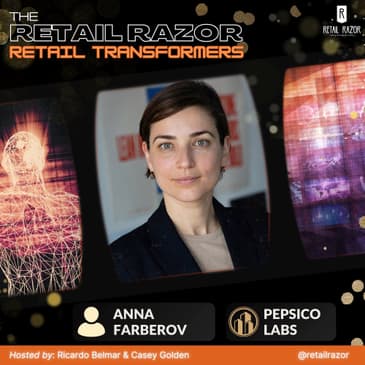



S1E4 - From Pilot to Scale: How Anna Farberov Drives Startup Innovation at PepsiCo Labs
In this episode of the Retail Transformers Podcast, hosts Ricardo Belmar and Casey Golden talk with Anna Farberov, GM of PepsiCo Labs, about how one of the world’s largest CPG companies scales startup innovation from pilot to enterprise-wide transformation.
Anna shares her journey from finance and strategy into corporate innovation leadership, revealing how PepsiCo Labs built a structured playbook for startup partnerships that achieves a remarkable 50% success rate. She explains how to avoid innovation theater, define clear KPIs for pilots, and separate AI hype from real agentic AI solutions that deliver measurable ROI.
You’ll learn:
How PepsiCo Labs partners with startups to solve real-world challenges
Why KPIs and clear business cases are critical for scaling innovation
Navigating the dynamics of corporate vs. startup innovation cultures
How to identify AI hype vs. real solutions in startup pitches
Why integrating multiple startups is often key to solving complex problems like digital twins
What makes a startup pitch stand out—and what founders should avoid
Whether you’re a startup founder, a corporate innovator, or curious about retail and CPG innovation, this episode offers actionable insights from one of the industry’s leading voices.
Don’t forget to like, comment, and subscribe for more episodes featuring leaders transforming retail, technology, and innovation.
Subscribe to the Retail Razor Podcast Network: https://bit.ly/RRPNweb
Subscribe to our Newsletter: https://retailrazor.substack.com
Subscribe to our YouTube channel: https://bit.ly/RRShowYouTube
Guest info:
Anna Farberov, GM, PepsiCo Labs. https://www.linkedin.com/in/anna-farberov/
Anna leads PepsiCo’s global engagement with technology companies - from emerging disruptors to the world’s largest enterprises. She partners with senior executives to identify, test, and scale solutions that are reshaping how PepsiCo operates across data, AI, manufacturing, supply chain, and logistics. Her work accelerates growth and drives transformation across one of the world’s largest consumer goods companies.
Anna brings a unique blend of expertise in strategy, finance, commercial execution, and venturing. Earlier in her career, she led commercial initiatives across consumer, customer, and marketing functions, including new product launches, go-to-market design, and demand creation. She also built a foundation in finance at Procter & Gamble, holding roles in operations, commerce, and strategic planning.
Prior to PepsiCo, Anna was a senior executive at Israel’s largest holdings company, where she led corporate strategy, investments, and the development of new growth platforms. This background in strategy and venturing now informs her work at PepsiCo Labs, where she builds models that connect corporate scale with technological disruption.
A frequent speaker at global conferences, Anna shares perspectives on how leaders can harness technology ecosystems, bridge business and innovation, and lead organizations with clarity and impact in times of rapid change.
Chapters:
(00:00) Previews
(01:03) Show Intro
(05:06) Welcome Anna Farberov
(07:02) Challenges and Risks in Innovation
(09:27) Building a Systematic Playbook
(11:41) The Importance of Clear KPIs
(13:04) Navigating Corporate and Startup Dynamics
(17:50) Secrets to Successful Innovation
(20:46) What Makes a Startup Stand Out
(25:17) Avoid Insulting Your Audience
(26:19) Relevance of AI in Startups
(27:18) Identifying Real AI Solutions
(29:52) Integrating Multiple Startups
(31:45) Future of Innovation and Technology
(33:35) Balancing Innovation and Business Operations
(36:46) Avoiding Innovation Theater
(41:10) Advice for Future Innovators
(44:45) Show Close
Meet your hosts, helping you cut through the clutter in retail & retail tech:
Ricardo Belmar is an NRF Top Retail Voices for 2025 and a RETHINK Retail Top Retail Expert from 2021 – 2025. Thinkers 360 has named him a Top 10 Retail, Top 50 Management, & Top 100 Digital Transformation Thought Leader, and a Top Digital Voice for 2024. He is an advisory council member at George Mason University’s Center for Retail Transformation, and most recently was the partner marketing leader for retail & consumer goods in the Americas at Microsoft.
Casey Golden, is the CEO of Luxlock, a RETHINK Retail Top Retail Expert from 2023 - 2025, and Retail Cloud Alliance advisory council member. Obsessed with the customer relationship between the brand and the consumer. Once immersed in fashion & supply chain tech, now slaying Franken-stacks & building retail tech! Currently, Casey is the North America Leader for Retail & Consumer Goods at CI&T.
Includes music provided by imunobeats.com, featuring Tropikool, from the album Future Beats 2, plus Virtual Apology and New Styles, from the album Shimmer Pop, written by Heston Mimms, published by Imuno.
Highlight Clips
[00:33:24] - I think the winners are not necessarily the biggest ones. They'll be the fastest learners. And the speed of adoption is the new…
Transcript
S1E4 Retail Transformers - Anna Farberov
Anna Farberov:00:00:02
the winners are not necessarily the biggest ones.
They'll the fastest learners and the speed of adoption is the competitive advantage.
Casey Golden:00:00:09
I can't tell you how many pitches I've opened, and the
very first slide is just insulting the brand that they're like morons.
And that they found the perfect solution.
I'm like, not a good way to say hi.
Anna Farberov:00:00:23
I thrive at discomfort and ambiguity.
So innovation is where I feel at home.
I love fear and excitement and I'm kind of, I'm a, an adrenaline junkie, but
less of, jumping from airplanes and motorbikes more in, in my small universe.
So I love diving into the defense.
It's, love building planes in the air.
That's where I am the best.
Casey Golden:00:00:45
I mean, people are going to jail for this stuff, right?
Um, that these startups like created something fake.
It didn't exist.
Now with AI, like this is even truer of the case, where so much
is theoretical, there is no, there are no proof points for them to
prove, you know, in so many aspects.
Ricardo Belmar:00:01:12
Welcome back to another episode of The Retail Razor: Retail
Transformers podcast, where we bring you candid conversations with the people
reshaping the world of commerce, the crazy ones, the misfits, the rebels,
and sometimes the round pegs in the square holes, but most often the bold
thinkers that see things differently and drive the industry forward.
I'm Ricardo Belmar.
Casey Golden:00:01:33
And I'm Casey Golden.
Welcome Retail Razor Fans to the show where we spotlight the leaders,
innovators, and the disruptors reshaping the future of retail.
Ricardo Belmar:00:01:43
If you're passionate about innovation, leadership, and
the future of commerce, Retail Transformers is the podcast for you.
Casey Golden:00:01:49
Today we're diving into the world of corporate innovation and startup
collaboration with someone who has been at the forefront of driving transformation
at one of the world's biggest brands.
Ricardo Belmar:00:02:02
Our guest is Anna Farberov, General Manager of PepsiCo Labs.
She leads PepsiCo's global engagement with technology companies
from emerging disruptors to the world's largest enterprises.
She partners with senior executives to identify test and scale solutions
that are reshaping how PepsiCo operates across data, AI, manufacturing,
supply chain, and logistics.
Her work accelerates growth and drives transformation across one of the world's
largest consumer goods companies.
Casey Golden:00:02:31
Anna's journey is fascinating, bringing a unique blend
of expertise in strategy, finance, commercial execution, and venture.
Starting in finance and strategy before moving into innovation.
And today she's helping PepsiCo operate more like a startup,
while still leveraging the scale of a global enterprise.
We'll talk about her career path, where she led commercial initiatives across
consumer and marketing functions, including new product launches, go
to market design and demand creation.
She also built a foundation in finance at Proctor and Gamble, holding roles
in ops, commerce, and planning.
Ricardo Belmar:00:03:15
And equally exciting, we will explore her approach to
embedding innovation into a company's DNA and what makes a startup stand
out when pitching to a global brand.
How to avoid the trap of innovation theater, and why the pace of
change in retail means companies need to rethink their operating
models to stay competitive.
Anna has just such an amazing career that there's so much we can learn here.
Is there any doubt she's truly one of our retail transformers?
Casey Golden:00:03:42
No.
I mean, whether you're a retail executive or a CPG leader, or a
startup founder, anyone passionate about transformation, you're going to
walk away with practical insights and inspiration from Anna's experience.
Ricardo Belmar:00:03:57
But before we dive in, one quick favor.
If you're enjoying the show, we hope you are.
Why not hit us with a five star rating and drop a short review on
Apple Podcasts, Spotify, Goodpods, or wherever you're listening,
Casey Golden:00:04:07
And don't forget to like and subscribe to our YouTube
channel, so you never miss an episode.
I mean, who doesn't wanna watch us on their big screen tv?
Right?
Ricardo Belmar:00:04:17
Of course, of course.
And also why not take a few minutes to check out the other shows in the Retail
Razor Podcast Network, The Retail Razor Show, Blade to Greatness, and Data blades.
You'll find them all in your favorite podcast app or
together on our YouTube channel.
Trust us.
It'll be time well spent.
Casey Golden:00:04:34
Now let's jump into our amazing conversation with Anna Farberov,
General Manager of Pepsi PepsiCo Labs.
Ricardo Belmar:00:04:46
I see you just did that in the final intro, so I wouldn't
get a chance to use my favorite line about more than meets the eye.
Casey Golden:00:04:51
Oh goodness, I'm actually getting memes in
my LinkedIn DMs about that!
Ricardo!!
Ricardo Belmar:00:05:07
Anna, welcome to the Retail Transformers podcast.
It is so exciting to have you on the show.
Really been looking forward to this now since we met at Retail Club
and have been following all of your thoughtful posts on LinkedIn and
such a a, a rich career history.
I, can't wait to jump into this.
Anna Farberov:00:05:22
Thank you.
Thank you both for having me.
I'm super excited.
Loved our chat by the beach in, in beautiful Huntington Beach,
so looking forward to continuing.
Casey Golden:00:05:29
Yeah, this is fantastic.
The conversation is going to be fascinating.
I am so glad to have the opportunity, opportunity to speak with you.
Leading innovation at a global CPG powerhouse, like PepsiCo, you have
such a fascinating career path.
Ricardo Belmar:00:05:44
So, so let's dive in.
And, and I guess let's start by digging into that, that unique career journey.
You, you actually started your career in finance, if I'm not mistaken, in
strategy before really moving into this innovation space that you're in now.
So what, what drew you to this space?
How has that kind of background shaped the way you lead PepsiCo Labs today?
Anna Farberov:00:06:03
That's, yeah, you're, you're right.
And it's actually very interesting because the first decade of my
career was highly structured, right?
Finance strategy, clear playbooks, defined KPIs while my second
decade was everything but right.
Investment innovation was very much the opposite of that.
It's a big leap.
There's no definition.
A plane in the air.
There's no clear, beginning, middle, or end.
No clear career path as well.
If you come from like a finance, it's very, you know where you're gonna
be in 3, 4, 5 years from now while innovation, everything's kind of open
which is, by the way, I mean, I love it.
I think finance gives you so much discipline and great foundation
for anything in the future because it forces you to drill
down into value, into numbers.
You can't be fluff.
Which can be a soft spot for innovation.
So I loved it.
I mean, bottom line, I think that was the perfect foundation.
And I am, I, I don't need clear guidance.
I thrive at discomfort and ambiguity.
So innovation is where I feel at home.
I.
Ricardo Belmar:00:07:00
Yeah.
I love, love hearing that.
Love hearing that.
So if you, if you look back, are, are there, are there some pivotal
moments or maybe risks at, throughout your career that prepared you for
this, this dive into innovation?
At a global brand like PepsiCo?
Anna Farberov:00:07:14
when we started labs, it was a very big leap of faith because
honestly, innovation, everything's a risk.
Our guidance at the time basically was go figure out how should PepsiCo
partner with the, the tech ecosystem with the emerging solutions, but make
sure that you drive real impact and you stay clear of corporate lipstick.
Right.
So that was, a very big white paper.
A lot of flexibility to shape that.
So that was, fantastic for me, but no structure, not a good fit for
somebody that really needs guidance.
Ricardo Belmar:00:07:47
I guess
Anna Farberov:00:07:47
but it was, you know, it was unstructured by design.
Exactly.
It was unstructured by design and that's why it made it both, uncomfortable
and incredible at the same time.
Ricardo Belmar:00:07:57
Yeah.
Yeah.
Gives you room to create.
Anna Farberov:00:07:59
Exactly.
Yeah.
And I love building.
Casey Golden:00:08:02
You've described yourself as having a healthy
dissatisfaction for the status quo.
How does this mindset influence your leadership style and
even career decisions?
Anna Farberov:00:08:14
So, like I said, I thrive at discomfort and I get bored very easily
and that's probably my A DHD, which has benefits, but then also a few kind
of bags that I need to carry with me.
So I love fear and excitement and I'm kind of, I'm a, an adrenaline junkie,
but less of, jumping from airplanes and motorbikes more in, in my small universe.
So I love diving into the defense.
It's, love building planes in the air.
That's where I am the best.
I'm at my best when there's a lot of pressure.
There's deadlines and I'm accountable.
I need to know that I'm accountable to deliver something, and that's what I,
and I love building team of accountable people around me and empowering them.
I get personally frustrated when things are inefficient.
I can, sometimes it sends me down rabbit holes but in the business context, it
helps me, I'm very mission oriented.
I want to fix what is not broken, and if something doesn't make sense to me,
it will not leave me until I solve it.
And so I try to channel that into useful things and not just frustration.
Yeah.
Ricardo Belmar:00:09:21
I, I guess this maybe speak in more into this,
this kind of seeking structure.
I guess I'll, I'll, I'll call it from what you were just saying.
So, so you've really put together a, I would say a structured methodology
for how you work with and engage with startups as you seek out different
innovations and, apply them to different business challenges, why do you feel
it was important to build a systematic playbook and structure around that
process to help you work through it?
Anna Farberov:00:09:47
So I think when we started labs it was 80% art and 20% process.
We didn't know anything.
It was pure kind of instinct, hustle, a lot of learning.
Speaking to people, listening to their experience, to their advice.
Learning from anybody who did that in the past, anybody in the ecosystem building
relationship, we made a ton of mistakes.
I think our first year was a lot because every time you need to uncover something,
it's one step forward, two steps back.
But that's how.
You can build a playbook.
Ricardo Belmar:00:10:14
Mm-hmm.
Anna Farberov:00:10:15
We've built incredible relationships along the way and
we found a way to make it work.
So I think over time now, it flipped.
Once we had that playbook, it flipped to 80% process, 20%
art, which is where it is today.
To scale something in a big company, it has to be structured to move
fast and bring the business along.
It has to be structured.
So I think kind of that's the flip side of, think of it as we were the
startup within a Fortune 50 company.
We had to pivot a lot in the beginning.
We had to scramble.
It was two people in the garage.
But then when we had the product, it was all structure and very rigorous execution
and scale, and that is what needed to move fast in a big company, so from,
you know, doing one program, we expanded to doing six, eight, ten of them a year
because it was a very clear playbook.
Ricardo Belmar:00:11:01
Yeah, that, that ability to, to move fast and with the kind of
velocity, I think becomes so important.
And when we've talked about innovation on our show before with others, one of the
themes you always see come up is that, you're, you're going into it, in some ways
with the realization that some number of projects are, are not going to work, and
that's almost baked into the definition of trying to be innovative, is knowing
that not everything will succeed as long as you learn from the ones that fail just
as much as from the ones that succeed.
So you can roll into the next one and make it more successful.
Does that factor into how you built the playbook as, as well, and to
help you keep iterating to make it better and, and to, to get you to
where you flipped it to that 80 20.
Anna Farberov:00:11:41
Yes.
I think failure is baked in by design, like you said.
We always say, about half will succeed even less, which is fine
as long as you fail quickly.
Because the worst thing that can happen is you drag a failure because sometimes big
companies don't know how to shut it down.
So, and I think it all goes to the KPIs that you've defined.
You need to have very clear definition of the need, and then what are
the KPIs and trying to influence.
And if you're not hitting them in your pilot, in your initial assessment,
sometimes you find a solution, you find a problem, you start diving into an initial
business case and it's just not there.
And that's where you need to cut the cord.
Sometimes you go into pilot and it doesn't work.
So you can either throw more money at the problem or invest more time, or you
can say, well, you know what we've tried.
Maybe it's not the right time.
Maybe you know, it's not the right solution.
Maybe the maturity is not there.
But as long as you know what are very clear KPIs, it makes it
easier to adjust and to shut down things that are not working, and
it's not an emotional decision.
Because each of those projects is somebody's baby, somebody's
invested a lot of time.
There's a team around each pilot.
So you want to recognize that team, but then not let them,
drag this down endlessly.
So I think objectivity helps.
Casey Golden:00:12:57
There's a lot of fear when companies.
approach startups or think about working with them.
There's a lot of fear of working with startups.
So many, being from on the startup side, having corporate experience
vice versa and like being on different sides of the business.
These comp, these startups are building for companies, right?
And, and have, a certain level of experience to create some type
of a product to solve something.
And I do find it really interesting how structured that chaos is in a startup
because everybody has their lanes.
I find it much easier to work in a startup because you see it, you
own it, it's broken, you fix it.
Anna Farberov:00:13:41
Yep.
Casey Golden:00:13:43
Then when you're going into more corporate, where
you just have to do things that don't make sense or that there's a
better way, but you can't change it.
And it is a little bit more difficult to work in that environment if you
are somebody that you know, has the passion for innovation, can see from
point A to point B to Z in your being able to organize multiple startups
within a corporate organization.
I mean, that is, organizing chaos.
And I feel like the chaos part is so good because being able not to follow processes
just for the sake of following processes, is such a much better situation for a
company to be in, to be leveraging these other types of, and pieces of innovation.
In your LinkedIn series of posts, you're, you outline steps like defining needs,
scouting a hundred plus startups, and then narrowing it down to a handful of pilots.
Which of those stages tend to be the most challenging?
I mean, you have to say no a lot.
Anna Farberov:00:14:50
That... that is true.
But it's better to say no in the beginning than 10 dates in after they've
invested the time and be transparent into the why the no is coming.
Uh, and not just gonna, but I think to your question, I think defining
the need is always the hardest part.
If you frame the problem right, the solution will pick itself.
There are great solutions out there.
There's a lot of startups.
Um, there's a lot of big tech companies.
The real challenge is aligning takes 10 stakeholders on what really
matters, what KPIs will move the needle in a company like PepsiCo.
And then how do you prove that ROI in an undisputable way?
Because you don't want to get stuck in, in the, pilot valley of death.
That's not why we're here for, that wastes everybody's time.
So if you've defined, this is a big problem that the company will prioritize.
Here are the business KPIs that we are trying to change or influence.
This is how much impact will matter, which means that the budget
owner will sign the check and this is how we're gonna prove it.
If you align all of it.
And this is what we're trying to do upfront, and I think that is part
of why startups love us because we are not, not a nice word, them.
We are very transparent and if what they're influencing is not measurable,
it might be a great solution.
But if we can measure it, it doesn't matter.
Ricardo Belmar:00:16:14
Yeah.
Casey Golden:00:16:15
Yeah.
Nobody wants to be stuck in, in like deals that go nowhere, right?
Anna Farberov:00:16:21
Exactly.
Casey Golden:00:16:22
that die.
There's, there's graveyards of pilots where they were never even
given a chance, but because it
Anna Farberov:00:16:27
And it happens a lot.
Casey Golden:00:16:28
partnership, right?
And having that clarity.
Anna Farberov:00:16:31
Yeah.
And it happens a lot because people get genuinely excited about technology
and they, they want this to work.
Ricardo Belmar:00:16:37
Right.
Anna Farberov:00:16:38
But sometimes it's not enough.
You need to have the right decision makers.
You need to have the right approach.
You need to have the right alignment on what matters to the company.
And in a big company, it has to be a big number.
Sometime if you solve for 1 million, but then that will be number 150
on my list of priorities for next year, then I will not get to that.
Let's be realistic.
So it has to be something that moves the needle in a quantifiable way.
Ricardo Belmar:00:17:01
Yeah.
And, and sometimes those solutions just, have an ability to claim,
to make something better, but if better isn't always good enough.
You, you, you can come close, but if you're not hitting, if you know what
your target is, and I, I think to your point, you've defined that upfront,
then you have to know if you can hit it.
And if you're not, then you're just wasting everyone's time if
you have no chance of hitting it.
Anna Farberov:00:17:21
Exactly, and that's a difference.
That's what brings, a brilliant idea to a solid business case.
And that's what we're trying to do.
So building a solid business case is part of our process because
this is how decisions are made.
And, and, good ideas are, are good ideas, but you can't them to the bank.
Casey Golden:00:17:36
Many, many companies struggle with this, the
innovation theater and like all of these pilots that never scale.
I mean, I joke with Ricardo all the time that like, we're just
like surrounded by vaporware,
Ricardo Belmar:00:17:50
Yeah.
Casey Golden:00:17:51
What's the secret to moving from pilot to real transformation
inside of a company as large as PepsiCo?
I've seen so many fail.
From companies that are quarter of the size of PepsiCo and they
can't even get it pulled off.
What's your secret?
Anna Farberov:00:18:13
Like, I think if we take two steps back, we said some
will fail, so there's no promise.
You go in knowing we, with our playbook, are able to increase the chances.
That's why we're at a 50% success rate, which is incredible because when you
think of, VC numbers, they're much lower.
Because we do a lot of rigorous due diligence upfront on the business case,
on the technology, on the product fit, on maturity, on scalability, et cetera.
That's how we're able to increase our success rate to 50%.
I think looking at, I mean, if you've passed the hurdles, you have a defined
business case, you have the right stakeholders, you have defined KPIs, you
can quantify your impact and prove it.
I think it comes to the partnership and working with the right
companies and the right founders.
And from my experience, the founders who make it are the ones who listen,
who adjust on the spot, who are open to co-creation and who are able to
be creative because let's be honest.
big Big companies cannot be flexible.
PepsiCo will not change its cloud infrastructure or the
way it treats data for anybody,
Ricardo Belmar:00:19:20
Right.
Anna Farberov:00:19:21
so the startup will need to adjust.
Ricardo Belmar:00:19:24
Mm-hmm.
Anna Farberov:00:19:25
And while we all love package solutions, many of those,
especially if they're emerging need adjustment and they need some treatment
and they need some unique development, and a lot of time is spent on piping the
data and building APIs and being able to structure the data in a way that makes
sense because it's never as it's seems and when you go deeper and you look
under the hood, you uncover everything.
So I think that having that flexibility and being open to
changes, being open to feedback.
I think most founders are great and they're open to listening from experts.
I think they all need to remember if they speak to a PepsiCo engineer or a PepsiCo
line operator, they speak to somebody who's been living this for 20, 30 years.
They are the experts.
There's no better industry insight that they will get except for this person.
Like, really, this is so,
Ricardo Belmar:00:20:16
Yeah.
Anna Farberov:00:20:17
Few founders, can be defensive, but I think most of them
are really open to getting, it's like, it's gold, it's golden knowledge.
This is as tribal essential knowledge as it gets.
Um, so I think the ones who succeed are the ones who are open to listening,
to working with us, to pivoting and to understanding that there's only so
much change a big company can make.
And the expectation is for the small company to be more agile.
Ricardo Belmar:00:20:44
Mm-hmm.
Yeah, no, that makes sense.
So knowing how many different startups you've interacted with throughout
this process, what really makes a startup stand out to you when you hear
their pitch at, at that early stage?
And maybe the better question is if I flip that around, is there something
that in, in your view, startups should just never say in a pitch?
Because that just will immediately tell you, this is the wrong founder
or the wrong person to work with.
Anna Farberov:00:21:12
I think having good understanding of the problem.
Ricardo Belmar:00:21:17
Mm-hmm.
Anna Farberov:00:21:17
Nothing generic works.
So if we see.
If we hear a pitch from an expert and not from a sales person, that
gives so much more credibility.
If it is somebody, and sometimes we're working at, very specific niche topics,
if we're talking about equipment reliability or motor reliability, or
we're talking about network design or things that are very specific, so generic
and broad, let's say supply chain or CPG expertise will not necessarily be up.
You need to be able to talk about like the technical specs
and go, be ready to go deeper.
And I think the, the founders that have, or the teams that have that
industry experience will be able to elevate the conversation beyond a
regular kind of, you know, sales deck.
And of course, everything right prior, right.
Be open, listen.
Be flexible.
Goes without saying.
I think that should probably be in the playbook of any founder
or any kind of founding team.
But I think experience and knowing what you're talking
about in a non generic way..
Ricardo Belmar:00:22:22
So, lemme just one quick follow up.
I, I think for that, so at the Retail Club event that we, we were all at
I, I sat in, in one discussion table at one of the breakfasts that was
with a number of startup founders.
And one of the topics that kept coming up is, some of the founders would ask
like, how do you contain, in a sense, this exuberance you have when you're
presenting it to want to say that the, whatever the problem is that you're
solving is so good, they want to jump into, here's where we're going.
Which, which sort of sets an expectation that you've almost already solved that
problem and they're ready to pitch you on the next thing they're going to solve as
their solution grows and grows and grows.
And I'm curious, like, when you hear that, do, do you, do you just have
the urge to get them, tell 'em to just stop right there and stop talking
about what the next thing is of let's come back to what we're doing now.
Anna Farberov:00:23:07
I think having a vision is great, and I know it's, the vc,
founder discussion is very different.
It's all about selling big dreams.
While the industry startup discussion is very like, tell me how you're gonna
solve this very specific problem now,
Ricardo Belmar:00:23:21
What you have today.
Anna Farberov:00:23:22
not theoretical at all.
So I think we need to balance because it's always good, even for our industry
experts that we bring, it's good for them to hear where the industry's
going, where the future's looking at.
Because honestly, their day-to-day is very much within our four walls and
they're, they're operating the business.
So it's good for them to be exposed to where the industry's
going, where the future is.
Like we all want to be inspired.
I think it's kind of an 80 20 balance.
It's always, you know, 80 20 is always a good rule of thumb, but I think
focus on delivering the problem.
You need to deliver today.
It's good to be exposed.
It's good to talk about the future, but let's be honest, this
single problem is pretty complex.
If nobody solved it until now,
Ricardo Belmar:00:24:02
Yeah.
Anna Farberov:00:24:02
it's gonna take you longer than you expected to take it
from pilot to scale, so, exactly,
Casey Golden:00:24:09
So much.
Ricardo Belmar:00:24:11
Right.
It's
Anna Farberov:00:24:13
you already have a project for the next 3, 4, 5 years,
just scaling this to full potential.
Ricardo Belmar:00:24:19
Mm-hmm.
Anna Farberov:00:24:20
Which means you're talking to me about, what, seven years from now,
Ricardo Belmar:00:24:23
Yeah.
Casey Golden:00:24:24
Yeah.
Anna Farberov:00:24:25
now.
So it's nice, it's nice to see where, really smart people's
heads is going and I love, you know, having those conversations.
And obviously the tech industry moves so much faster than the
CPG industry, so it's incredible.
I think that's part of, you know, our role as innovation.
Our kind of night job is try to educate the organization, try to help them
work faster, look around the corner, and, and get excited, inspired.
But you still need to deliver this year.
So how do you balance anchoring on very clear deliverable with, you
know, sprinkles of inspiration.
Ricardo Belmar:00:24:58
Mm-hmm.
Casey Golden:00:24:59
Yeah, I think that that's just, really important to double click
for if any startups are listening right now, is the story that you tell Silicon
Valley investors is not what you pitch to anyone that works in the industry or
you're trying to sell your software to?
I can't tell you how many pitches I've opened, and the very first
slide is just insulting the brand that they're like morons.
And that they found the perfect solution.
I'm like, not a good way to say hi.
Anna Farberov:00:25:32
Yeah.
A few other examples, right?
Talking about TAM is not relevant.
If I'm your customer.
It's relevant for a vc
Ricardo Belmar:00:25:41
Yeah.
Anna Farberov:00:25:42
explaining the problem and the need is not relevant because
you are talking to the person who
Ricardo Belmar:00:25:46
Who has the problem,
Casey Golden:00:25:47
Right.
They are the experts.
Don't insult that.
They're doing a great job.
They know what's up.
You need to pivot the whole thing when it comes to the customer.
And I think with corporate innovation and working these strategic partnerships
and all these different ways of working between startups and companies that
have come together, I definitely think that that's a great little
note for founders to take note.
We need another deck.
Ricardo Belmar:00:26:14
Don't use the same deck.
Casey Golden:00:26:16
Don't use the same deck.
Coming in with that as well.
The product is even different than you would probab than you would
pitch Silicon Valley VC versus a, a customer potential strategic.
Now with AI embedded into, I can't even say nearly every
startup, like every startup pitch,
Ricardo Belmar:00:26:34
Yeah.
Casey Golden:00:26:36
how are you separating the hype from the real solutions that
you know, you can just, you know, that you could tackle this problem, mature
it, and you can see that it would scale.
Like how do you separate between the two because there is so much fake product.
I mean, people are going to jail for this stuff, right?
Um, that these startups like created something fake.
It didn't exist.
Now with ai, like this is even truer of the case, where so much
is theoretical, there is no, there are no proof points for them to
prove, you know, in so many aspects.
How are you when you look at, at these companies and these ideas, hype versus,
a real solution that you can sink your teeth into, how do you separate that?
And then I think it's also probably good for the audience to understand at
what stage do you work with startups?
Like how early, is early.
Anna Farberov:00:27:38
Yeah, and, and you're, you're absolutely right
at this point, if you don't have AI in your name, you don't exist.
But I think the test is, is simple.
Does it make the process faster, smarter, or cheaper in a measurable way?
And, and usually, by the first date, or, well, when we look at architecture
and the, the solution specs, which will be like day three, we will
know if you are just renaming Excel formulas as ai, or this is true ai.
I mean, now with agentic, which is another buzzword, now everything's agentic,
but then when you start peeling the onion and asking question like, oh no,
but it doesn't really do the action.
Ricardo Belmar:00:28:13
Right.
Casey Golden:00:28:14
I mean, Amazon had, this whole grocery stores that were,
auto checkout, no, there was 1100 people like automatic, it's so normal.
It's been normalized to a certain point and you have to vet it out,
Anna Farberov:00:28:28
Exactly.
Exactly.
Exactly.
So I think that's why innovation people need to have some, some
level of technical expertise.
The business is counting on us because the business is not capable, right?
It's not their job to pull the needle or pull the thread on, on
what is agentic versus not agentic.
And we, we all love our buzzwords.
Yes.
So it's on us to vet this.
And, by the third date, I will ask for product architecture and I
will start looking how things work.
Casey Golden:00:28:55
that's great to hear.
Anna Farberov:00:28:57
Yeah, it's asking questions.
It's, you can, when I was actually, when we were in, in that conference at
Huntington Beach, I said, I have like a list of questions you start asking.
To get to the next level, right?
So I think all of us need to have in our back, back pocket, what are
those questions that we're asking, about what really goes into your AI?
What's the real IP?
What's the secret sauce?
What, now maybe you're using open source, which is fine,
but then don't call it your IP.
And maybe you still provide valuable insights, but if you don't close
the close the loop and are able to do actions, it's not an agent.
So it's like very basic questions that will help you uncover the hype
from the real capability very quickly.
Casey Golden:00:29:37
Yeah, a lot of basic questions on the client
side, but on this VC side, many of these questions are never asked.
Have you seen any examples?
I mean, you, you're blowing through decks.
Have you seen ha had any examples where multiple startups needed to
be integrated together to solve a connected business channel?
And like, being able to connect those dots and say, you know what, I don't want
one, I want these two or these three.
And how, how do you manage that kind of complexity if you've,
if you've even come across it?
Anna Farberov:00:30:13
Yeah, actually we see it all the time.
I think real world problems are rarely in silo.
Usually you would find, they're all connected.
Think of it as a big link and we see that.
I can give an example of the digital twins, where we have one solution that
scans the assets, uh, and creates a USD, which is the digital version of the asset.
One runs a simulation, another one creates the visualization.
So you can kind of.
Look and feel and change things in digital environment.
Another one runs optimization, and all of this is orchestrated by an Nvidia
or one of the big tech companies and sits on top of their platform.
And we see that over and over again, right?
The more challenging the problem the more.
Breakthrough.
The technology is, it needs support.
So that's how we kind of deal.
We, we partner with big companies and small companies.
We work with the biggest names, with, you know, from Google to AWS, nvidia,
Siemens, etc, and we work with them on integrating all of this into one platform.
Ricardo Belmar:00:31:09
It's almost hard to, to say that a given business challenge
you have is so narrowly scoped that you find the one solution that can
solve the entire challenge without needing anything else around it, right?
That almost doesn't exist.
At, at, at the end of the day, you're always trying to integrate
into something further down the chain or, or to the next link.
And, and I, I would say so part of what I think makes this challenging for
everyone is that the, the pace of change, and you've mentioned it before, that
you know that the tech industry moves so much faster than even the consumer
goods industry or retail industry.
Tech just moves at this incredibly accelerated pace
and it's only getting faster.
So with that in mind, if you were to look ahead, from your perspective.
What, what do you think separates the winners and, and brands from
the laggers over the next, you know, let's say three to five years or maybe
even further out past five years, given this rapid pace of change?
Anna Farberov:00:32:00
I think what will separate winners from laggers is probably the speed
of running those kind of experiments or trials and the speed of adoption because
we are also in a world where there are less and less packaged solutions.
There's capabilities, right?
When you think of the old world, we would buy an SAP product package with a lot
of add-ons, a Blue Yonder package with a lot of add-ons, and we would expect
those big companies to develop the product and come with kind of a build.
That's the world of SIs.
That's why, know, we have so many SIs.
The responsibility was on somebody else, I think now, nobody has a package
solution for agentic AI right now.
And even if they think they do, it doesn't have enough scale or enough
kind of experience in the real world and you can wait until somebody develops
that, but that is probably too late.
Casey Golden:00:32:52
I don't even know if that would be the right answer though, either.
Right.
Do we really want, do we want a bunch of capabilities that you
can build with your own Legos, you know, Lego sets, or do you want the
brick and bricks are hard to change.
Bricks aren't flexible,
Ricardo Belmar:00:33:08
Yeah.
Anna Farberov:00:33:08
That's true, and the pace of change today is so
rapid that having bricks becomes more and more challenging and also
knowing like you have the knowhow.
You need, you know your business, you know how, what will help
you move faster and what is not.
So I think the winners are not necessarily the biggest ones.
They'll the fastest learners and the speed of adoption is the competitive advantage.
Ricardo Belmar:00:33:32
Yeah.
Anna Farberov:00:33:33
It's how do you embed that in the business?
Ricardo Belmar:00:33:35
yeah.
Now I, I just wanted to pick up, 'cause you, you made a good point there about how
in that, in that old way, that's what gave rise to everybody working with a handful
of SIs to get so many of these things in because you had these big packages.
If now you're building blocks, are these smaller capabilities, , are winners
leaning equally as they did before with SIs to help them with all, what's now
become more of an integration problem or is really what makes you the winner to
your point about speed and and velocity, that you have that knowhow internally
so you can keep up without having to rely on as many SIs as you used to.
Anna Farberov:00:34:09
I think it's a transition.
We're still, oh, I mean if you look at our, um, tech landscape,
there's a lot of mainframe, right?
Like mainframe in a bad paraphrase, but there's a lot of pipes,
Ricardo Belmar:00:34:20
Yeah.
Anna Farberov:00:34:20
right?
Nobody is pulling away our WMS systems or data systems like that
still exists out there, and there's a lot of business were assigned.
So, you know,
Ricardo Belmar:00:34:31
It's more a matter of scale, I suppose, right?
That you know
Anna Farberov:00:34:33
It's, but you start getting those breakthrough solutions
that needs to be added on top.
And I assume, I mean, let's see where the world goes, but with the pace of
technology, that balance might shift.
If I had to make a prediction, but I'm not, I'm not a good predictor, so.
Casey Golden:00:34:51
You know, this industry has been, constantly competing
over, like replacing the bones, repl doing a heart replacement.
I mean, has there any ever been a, a retail tech company that didn't use
some type of like, massive surgery as like, you know, like an analogy,
like this is a heart replacement.
This will, is like having a whole nervous system.
These are the bones for the whole entire, business.
And then we compete over just continually replacing, replacing,
replacing these huge systems.
And now I feel like everybody's got something that's probably good enough.
Let's now focus on layering all this other cool thing, these cool things and
cool tools on top of each other that have new capabilities that are more
flexible, more agile to connecting.
And actually create something.
You know now instead of these like Franken-stacks, we'll get like
these new little Frankensteins.
Anna Farberov:00:35:49
No, I agree.
And maybe, maybe the challenge or the opportunity for big companies
is how do you change the balance, or how do you not let those big
heart surgeries paralyze you?
Because we all know.
We're going through, you know, this big transition to the latest cloud version.
It takes us two years.
By the time we finish, there's a new, and the entire system is focusing on
that, on rolling this out globally.
And there's not a lot of, and those are all like massive,
many billions of dollars.
How do you not let this paralyze you?
And you still, you do this, like, we still need to run our business.
The mainframe will not change, but you still, you need to be
able to bring in the innovation in how do you balance your energy?
Casey Golden:00:36:28
How do you guys balance your energy?
So for executives and other brands that want to build a culture of innovation,
maybe a lab, what lessons from PepsiCo Labs would you encourage them to adopt?
Or any best practices out there that actually you would advise that they avoid?
Anna Farberov:00:36:47
Well, I think avoid is innovation theater.
Ricardo Belmar:00:36:50
Hmm.
Anna Farberov:00:36:50
Focus on adoption.
Not the headlines, not the buzzwords, not the shiny toys.
Start small.
Solve real world problems, show results, and focus on the business.
So that was, if I go back to the guidance that we were giving
is stay clear of lipstick, work with the people in the business.
If you can convince them, they're the ones who matter, they will use your solution
and they will also get the benefit, right?
That's how you reflect the P and L benefit.
And, and to avoid being a show, that's what you need.
You need to see the numbers.
So I think make innovation part of your operating model, not a side
project, because when innovation teams operate in silos they will
never get the right traction.
It has to be integrated in the business.
Casey Golden:00:37:34
For everybody listening, please rewind and
Ricardo Belmar:00:37:36
Yeah.
Hear that part again?
Yeah.
' Casey Golden: cause it's so true.
On the startup side, you're in this culture of theater and it, it can
be very distracting from solving real world business problems.
Or even anybody wants it because you're.
The founding teams are so divided among who they talk to, so I think that
that's really, really great advice, for executives, brands, and for startups
And.
Anna Farberov:00:38:05
That's actually interesting.
Can you say more without getting you in trouble with?
Casey Golden:00:38:08
without getting in trouble.
There's just, it's, it's a culture of creating something bigger.
Um, whether or not it exists or not.
And sometimes when you're solving like a real world problem for a
customer VCs can often think that it's not a big enough problem.
It's not interesting enough.
um,
Ricardo Belmar:00:38:31
sometimes they want everything to be a platform.
Casey Golden:00:38:34
There's so many things that make you put the real world
solution of like why you started a company and gave up your job
because you wanted to solve real world problems for like this industry
or consumer group that you adore.
But when you're going to pitch for money to fund it, they
don't wanna hear about it.
They want something bigger.
It's theater, it's vaporware it shit that you haven't built yet.
Um, while you have like an MVP or something that's being used by customers
over here, but it is totally doesn't match the pitch deck for money.
They're
Ricardo Belmar:00:39:13
Yeah,
Casey Golden:00:39:14
interested in it.
It's not cool.
It's not sexy, it's not, but it's making you money.
The customers like it and you're in multiple more sales meetings about real
world problems you're solving, and there's that conflict when if you're spending,
40% of your time always fundraising, that distraction is is there all day.
And it's usually counterintuitive to what the customer is asking.
Anna Farberov:00:39:43
Yeah, and, and you're right.
And I think that's part of why we see the VC industry at the pivotal moment, and
they're going through a change as well, because some of the old models cannot,
I mean, they just need to be adapted.
Ricardo Belmar:00:39:55
Yeah.
Anna Farberov:00:39:55
And you see more and more founders bootstrapping.
I, I was at a dinner last week with a lot of founders and I was
surprised by probably a third.
Ricardo Belmar:00:40:02
Hmm,
Anna Farberov:00:40:02
Bootstrapping because they said, you know what, they,
they already had a company that you know, they sold, and they said we
don't want the VC pressure any more.
Ricardo Belmar:00:40:12
Hmm.
Yeah.
Yeah.
Casey Golden:00:40:14
because it is, sometimes it's counterintuitive, oh, you need
to do this, you need to go after this.
And it's like, that's not what my customers are saying
and, and that's really
Ricardo Belmar:00:40:21
It, it be, it becomes chasing the vision.
Right?
It becomes more about chasing the vision.
Casey Golden:00:40:26
wants to write about
Anna Farberov:00:40:27
yeah
Ricardo Belmar:00:40:29
Yeah
, Casey Golden: you're not writing checks at the end of the day.
Anna Farberov:00:40:33
Yeah.
Ricardo Belmar:00:40:34
It's, I mean, I, I look always, look at that as customers will
write the check when it solves a problem, not because the vision is great, right?
If you, you can chase the vision and sometimes I, I see it often
become like you avoid this tendency to turn everything into a platform.
Um, because we went through sort of this, this mode where.
All the cool things kept turning into a platform, right?
And because that's how they got growth and how they chase the vision.
But not everything can be a platform because , sometimes you
have to actually solve a problem.
Not every platform can solve every single problem, even if that's
the vision that they're chasing.
And I think that's a trap that can, you can fall into.
Anna Farberov:00:41:10
Yep.
Ricardo Belmar:00:41:11
I wanna ask a more very specific kind of question Anna, about
because you've been in this innovation space now for what, almost a decade,
I guess, very specifically, right?
So what, again, looking forward, I, what excites you the most about
where this, where innovation is going, where this work is going?
What, what would advice, if any, would you give a new generation of leaders who
kind of wanna follow a similar path and really build structure around innovation?
Where do you go from here?
Anna Farberov:00:41:39
Well, I think I'm excited about how fast tech
and consumer behaviors converge.
I mean, this is.
What we see in the last few years is very fast, right?
AI and automation and agentic AI, et cetera.
And it's not the future of work anymore.
It is here, it is the presence and we all feel it because we
all use the same solutions and the same tools in our day-to-day.
And now the challenge is how do you bring them into the workspace and
integrate them in big companies where.
The learning curve is a bit steeper than, with with my own personal device.
I'm excited about the new wave of founders.
I think we have, I see great solutions coming out.
They're still early stages, still not scalable or many of them are
not ready for big, fortune fifties.
But it's coming fast and
Casey Golden:00:42:25
Yeah.
Anna Farberov:00:42:26
I'm excited to see, or I'm expecting.
I'm looking forward to seeing how big companies will adjust, like how the
bigger, slower to additional industries will embrace, who will embrace
disruption, who will not and just how they will all evolve into this new era.
Because I think it's a, it's a very different transformation.
It's not, it's not a transformation.
It's a change.
It's not slap a UI and call it digital.
It is a real change in the way we look at.
The value chain, the way we do things, so its an exciting time.
Casey Golden:00:43:01
Well, I, I mean, I can't express how much I've
I've enjoyed this conversation.
I don't know, like I haven't been deep into CPG, and so I always
find these conversations incredibly insightful because so few people have.
And so really being able to understand like how you look at the business,
running the business, running innovation, having a labs right, and, and being
able to work with startups and, and the mindset behind pilots to scaling.
I just really appreciate you sharing your thoughts and experiences of
what you've, essentially built and around, leading innovation.
I know our listeners and viewers have must have an entire note page, like of notes.
If they're not driving I find everybody's driving when they listen to podcasts.
So,
Ricardo Belmar:00:43:54
Be rewinding and listening.
Casey Golden:00:43:56
yeah, I rewind, rewind.
But I just find it so incredible and thank you so much for coming and joining us and
just kind of like, opening up the curtain.
Anna Farberov:00:44:05
Thank you.
This was so much fun.
Ricardo Belmar:00:44:07
Yeah.
Yeah.
I, I always love when we get to have these episodes where I, I think we
get to learn as much as the audience does from these conversations.
So thank you so much.
And I, I knew this was gonna be a fantastic conversation
when we met at Retail Club.
I knew this was gonna be a really inspiring discussion on innovation,
and hopefully everybody in the audience is taking away as much
as I, I know we have from this.
Casey Golden:00:44:30
Yeah.
Anna Farberov:00:44:30
And to all the founders, come find me, find me on
LinkedIn, find me on conferences.
We all go to the same places.
Ricardo Belmar:00:44:37
There you go.
Yeah.
Casey Golden:00:44:42
Well, I'd say this is a wrap, everyone.
Thank you so much.
If you enjoyed today's episode, give us a five star rating and review on
Apple Podcasts, Spotify, or Goodpods.
And don't forget to hit subscribe on your favorite podcast app or on
YouTube, so you never miss an episode.
I'm Casey Golden.
Ricardo Belmar:00:45:09
We'd love to hear from you.
Follow us and share your feedback at Retail Razor on LinkedIn,
Bluesky, Threads, and Instagram.
You can also subscribe to our Substack newsletter for highlights
from every episode, and visit retailrazor.com for transcripts and
more details about our amazing guests.
Retail Transformers is part of the Retail Razor Podcast Network.
I'm Ricardo Belmar.
Casey Golden:00:45:31
Thanks for joining us.
Ricardo Belmar:00:45:33
Until next time... Stay Sharp, Be Bold, and Transform Retail.
This is The Retail Razor, Retail Transformers.