
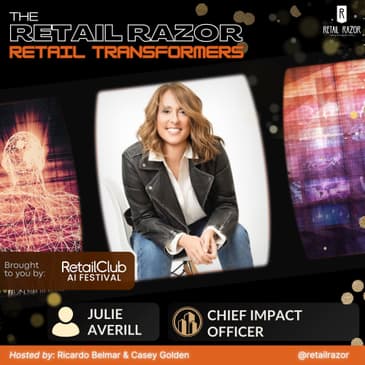



Julie Averill, Chief Impact Officer, on Retail AI Transformation & Human-Centered Leadership.
Everyone in retail is chasing AI right now, and most of them are about to learn an expensive lesson. In this episode of Retail Transformers, Ricardo Belmar and Casey Golden sit down with Julie Averill. She is the former Global CIO of Lululemon and author of the new book, Chief Impact Officer. Julie joins the podcast to talk about why AI projects fail and what real retail AI transformation requires. This is one of the most human-centered conversations about retail you'll find. This is Season 2, Episode 6.
Julie’s core argument is the one every retail leader needs to hear today. AI doesn’t fix your culture, it reveals it. Have incomplete data nd unclear decision rights? When you layer artificial intelligence on top of broken processes, the technology works perfectly and the results are still garbage. That’s the reason why AI projects fail, and it has nothing to do with the technology itself.
From a 20-hour Lululemon website outage, two days before her first day, Julie faced early scrutiny. Jim Cramer even called it out on live TV. She later built a Bangalore tech hub with 46% women. In this episode, Julie shares lessons from two decades of retail transformation. She also explains the leadership philosophy that made it last. If you want a clear-eyed take on retail AI transformation that puts people before platforms, this conversation delivers.
What You'll Learn in This Episode.
● Why 95% of AI projects fail, and why the technology is almost never the cause
● How to spot when you’re putting AI on top of broken processes and weak data
● Why a unified data foundation is the unglamorous work that decides whether retail AI transformation succeeds
● How real-time data and decision rights have become table stakes, not a competitive advantage
● How Julie built an inclusive Bangalore tech team as a business strategy, not a checkbox
● The honesty gap in retail AI transformation change management, and what happens to trust when the bill comes due
● Why the goal of leadership is to make yourself unnecessary
Standout moments.
● [07:11] The Lululemon site meltdown and the “Temporary Savasana” error screen that greeted Julie before day one
● [12:09] The catcher’s crouch: what baseball and systems thinking taught Julie about leading a tech organization
● [16:28] Hypergrowth from $2B to $10B, and learning to say “not now” to a company addicted to yes
● [21:17] Building inclusion in Bangalore: 46% women in a market where 14% of STEM jobs go to women
● [24:54] The unified data foundation she kept deferring, and the winter-coats-in-Miami AI fail it caused
● [31:32] Why real-time data is now the price of admission, using minute-by-minute competitor pricing
● [37:54] AI change management honesty: the return-to-office parallel and the true cost of losing trust
● [47:31] Making yourself unnecessary, walking away from a dream job, and “who am I without a logo?”
● [55:58] Her billboard for every retail tech vendor: “AI is not the point.”
Support our sponsors.
This Episode is Brought to You By RetailClub.
Join 2,000 retail leaders at RetailClub AI Festival, September 22–24 in Huntington Beach. Dive deep into how AI is reshaping retail while soaking up the sun at a fully outdoor, beachside venue. Decision-makers from retailers and brands can attend with free tickets and up to $1,250 in travel reimbursement. Head to retailclub.com to learn more. https://retailclub.com/retail-razor-podcast
Subscribe & Follow.
Don't forget to like, comment, and subscribe to The Retail Razor: Retail Transformers for more episodes featuring retail innovators, disruptors, and bold thinkers reshaping commerce.
Subscribe to the Retail Razor Podcast Network: https://retailrazor.com/
Subscribe to our Newsletter: https://retailrazor.substack.com
Subscribe to our YouTube channel: https://go.retailrazor.com/utube
About Our Guest.
Julie Averill, https://www.linkedin.com/in/julieaverill/
Author, Chief Impact Officer, https://goldthreadllc.com/book/
As Chief Information Officer of lululemon, Julie Averill led the technology transformation that scaled the company from $2 billion to over $10 billion in revenue while building global teams capable of sustaining that growth. Prior to lululemon, she led omni-channel and digital transformations at Nordstrom and REI, navigating system failures, high-stakes crises, and the complicated work of integrating technology with business strategy at scale. Today, she advises boards, CEOs, and founders at the intersection of AI capability and organizational readiness and serves as Independent Director at multiple companies. She lives in Bellevue, Washington, with her wife Cindy.
In her book, Chief Impact Officer (8080 Books, June 16th, 2026) Julie unpacks where so many are going wrong– it isn’t about hiring the one person who knows the model of the moment. It’s about hiring leaders who can connect emerging technology to business outcomes, are humble enough to keep learning, and confident enough to own results. That's how retail ai transformation really happens.
Connect with Julie on LinkedIn or at julie@goldthreadllc.com. Get the book, available now.
Chapters.
(00:00) Teaser
(00:52) Show Intro
(05:28) Welcome Julie Averill!
(07:11) Lululemon Site Meltdown
(10:48) Restoring Ownership and Cloud
(12:09) Catcher Crouch Leadership
(16:28) Hypergrowth and Saying No
(21:17) Building Inclusion in Bangalore
(24:54) Unified Data Foundation Reality
(27:35) Legacy Stacks vs Greenfield Rivals
(29:32) Real Time Is Table Stakes
(31:43) Flattening For Faster Decisions
(34:31) Merchandising Demo Reality Check
(37:54) AI Change Management Honesty
(42:27) Spin Trust And Layoffs
(45:22) Clean Sheet Reinvention
(47:31) Make Yourself Unnecessary
(50:35) Who Am I Without A Logo
(55:58) AI Is Not The Point
(58:43) Show Close
Meet Your Hosts.
Helping you stay sharp, be bold, and transform retail:
Ricardo Belmar is an NRF Top Retail Voice for 2025 and a RETHINK Retail Top Retail Expert from 2021 – 2026. Thinkers 360 has named him a Top 10 Thought Leader in Retail, a Top 25 Thought Leader in AGI and Careers, a Top 50 Thought Leader in Agentic AIand Management, and a Top 100 Thought Leader in Digital Transformation and Transformation. Thinkers 360 also named him a Top Digital Voice for 2024 and 2025. He is an advisory council member at George Mason University’s Center for Retail Transformationand the Retail Cloud Alliance. He was most recently the partner marketing leader for retail & consumer goods in the Americas at Microsoft.
Casey Golden, is the North America Leader for Retail & Consumer Goods at CI&T, and CEO of Luxlock. She is a RETHINK Retail Top Retail Expert from 2023 - 2026, and Retail Cloud Alliance advisory council member. After a career on the fashion and supply chain technology side of the business, Casey is obsessed with the customer relationship between the brand and the consumer and is slaying franken-stacks and building retail tech!
Episode Music.
Includes music provided by imunobeats.com, featuring Tropikool, from the album Future Beats 2, plus Virtual Apology and New Styles, from the album Shimmer Pop, written by Heston Mimms, published by Imuno.
Transcript.
S2E6 Julie Averill
[00:00:00] Teaser
[00:00:01] Casey Golden: 95% of AI projects are failing
[00:00:04] Ricardo Belmar: And it's almost never the technology's fault
[00:00:07] Casey Golden: Our guest grew Lululemon from 2 billion dollars to over 10
[00:00:11] Ricardo Belmar: And survived a 20-hour website meltdown two days before her first day
[00:00:15] Casey Golden: And getting called out by Jim Cramer on live TV for it
[00:00:20] Ricardo Belmar: Julie Averill says, "AI doesn't fix your culture, it reveals it."
[00:00:24] Casey Golden: Case in point, the retailer whose brand new AI told them to stock winter coats in Miami
[00:00:30] Ricardo Belmar: The AI worked perfectly. It's the data that was garbage
[00:00:34] Casey Golden: This one's a masterclass, and it might sting a little
[00:00:37] Ricardo Belmar: So stick around for the full episode starting now
[00:00:40] Casey Golden: And don't forget to subscribe. Your data foundation will thank you
[00:00:52] Show Intro
[00:00:52] Ricardo Belmar: Welcome to Retail Transformers, candid conversations with the visionaries shaping the future of commerce.
[00:00:58] I'm your host, Ricardo [00:01:00] Belmar.
[00:01:00] Casey Golden: And I'm Casey Golden. Ricardo, every conference, every keynote, every LinkedIn post this year is the same word on a loop. AI, AI, AI, AI, AI.
[00:01:14] Ricardo Belmar: So right. And the pitch is always the same too, right? It's buy the platform, bolt on the intelligence, watch the magic happen.
[00:01:21] Casey Golden: Except it mostly doesn't happen. Uh, nearly, right, like nearly 95% of AI pilots never make it out of the lab or, any type of scale.
[00:01:34] Ricardo Belmar: Right, right. Yeah, a- absolutely, absolutely. And that's exactly why I think today's guest is such a breath of fresh air. Julie Averill spent two decades as a technology leader, a decade at Nordstrom, then CIO at REI, and then Global CIO at Lululemon, where she helped grow the company from 2 billion dollars to over 10.
[00:01:53] So a- an impressive run.
[00:01:55] Casey Golden: Yeah, and a fun one. Before we go further, she comes from [00:02:00] a, a baseball legacy family. Her grandfather, is in the Hall of Fame. She talks about this leading from the catcher's crouch, low wide, reading the whole field. So we'll dive into that.
[00:02:12] Ricardo Belmar: That's right. And of course, Julie has a new book, coming out today, in fact, The Chief Impact Officer, and I think the subtitle tells you everything you need to know about what we're gonna talk about. Real Transformation Comes From Human, Not Just Artificial Intelligence.
[00:02:27] Casey Golden: Her core argument is one every retail leader needs to hear right now. I think we all just need to hear
[00:02:34] Ricardo Belmar: We all need to hear it
[00:02:35] Casey Golden: AI does not fix your culture. It reveals it.
[00:02:39] Ricardo Belmar: Exactly.
[00:02:40] Casey Golden: The technology is just exposing the broken processes and the weak data that we're all living with. It's just... It's being exposed faster and, we're finding more problems than the ones we intended to solve with that AI solution.
[00:02:56] Ricardo Belmar: That's right. That's right. And I think the stories that Julie brings are [00:03:00] fantastic. Starting with the one she opens the book with, a 20-hour website outage that hit two days before she even officially started the job. And then Jim Cramer, no less, on CNBC calling her out by name, on TV as what, what her goal needed to be.
[00:03:14] So there's that, for example.
[00:03:15] Casey Golden: Yeah, and, and then there's, building a tech hub in Bangalore, that reached 46% women in a country where STEM is overwhelmingly, male-dominated, and treating inclusion as a full-on business strategy and not a checkbox.
[00:03:33] Ricardo Belmar: That's right. That's right. And, and a refreshingly honest admission about the data foundation that she intentionally kept putting off until AI basically made the bill come due.
[00:03:44] Casey Golden: Yeah, it's a great one. One of my favorites.
[00:03:47] Ricardo Belmar: Of course, being, being the data junkie that you are.
[00:03:49] But first, before we get into that, let me tell you about our sponsor of the Retail Razor Podcast Network, Retail Club, and their latest industry event. Join 2,000 [00:04:00] retail leaders at the Retail Club AI Festival. It's happening September 22nd to 24th in Huntington Beach, California.
[00:04:07] Dive deep into how AI is reshaping retail while soaking up the sun at a fully outdoor beachside venue. Yes, you heard me right. It's on the beach. Decision-makers from retailers and brands can attend with free tickets and up to $1,250 in travel reimbursement. So head to retailclub.com/retail-razor-podcast to learn more and get your ticket today.
[00:04:32] Thank you, Retail Club, for helping us bring you, our audience, this podcast and all our sister shows in the Retail Razor Podcast Network.
[00:04:40] Casey Golden: Yep. And a quick favor. If this show brings value to your week, please leave us a five-star rating and review on Apple Podcasts, Spotify, or Goodpods. It genuinely helps more retail minds find us. And if you're watching on YouTube, hit that like, subscribe button and so you'll never miss an [00:05:00] episode.
[00:05:00] Ricardo Belmar: Oh, and one more thing, Retail Transformers is, of course, part of the Retail Razor Podcast Network. You might have picked up on that. So when you're done here, check out our sister shows, The Retail Razor Show, Blade to Greatness, and Data Blades.
[00:05:12] Casey Golden: All right, enough from us.
[00:05:14] Ricardo Belmar: Let's get into it. Here's our conversation with our latest retail transformer, Julie Averill, author of Chief Impact Officer: Real Transformation Comes from Human, Not Just Artificial Intelligence.
[00:05:28] Welcome Julie Averill!
[00:05:34] Ricardo Belmar: Julie Averill, welcome to Retail Transformers. We are so thrilled to have you with us today
[00:05:39] Julie Averill: Thank you so much. It's really nice to be here with you guys!
[00:05:43] Casey Golden: Yeah, Julie, such a treat. And I'll be honest, the preview copy of your book that you sent to us has been passed in, passed back and forth between Ricardo and I, and lots of digital highlighter in action.
[00:05:54] Ricardo Belmar: That's right. That's right.
[00:05:58] Exciting
[00:05:58] Julie Averill: for me to
[00:05:59] Ricardo Belmar: hear![00:06:00]
[00:06:00] Yeah, we d- we definitely had quite a lot of notes. We were just joking before recording how our shared notes page is probably one of the longest we've put together in a long time before we've done one of these recordings. So I just wanna say thank you to how open you were in the pages in the book, 'cause it, it's just so rare to find what, what's, put, put together as a business book, but it's just so honest in, in the way it's presented.
[00:06:23] Julie Averill: Yeah. Thank you. That's really the only thing I know is just to be honest. That's,
[00:06:29] Casey Golden: And you made it in corporate
[00:06:32] Julie Averill: Well, that, that's right. Yeah. Yeah. But, you know, I, uh, y- like you just, if you're just who you are, then it's so much easier.
[00:06:43] Ricardo Belmar: Yeah, that's so true. Yeah
[00:06:45] Casey Golden: So to keep from burying the lede here normally we start off these types of episodes asking our guests to give a quick background and history in retail. But I think in this case, you weave a lot of that into your overall narrative of the book, and we can just dive [00:07:00] right in, and your background speaks for itself.
[00:07:02] So we have to start with the story that you opened with the book, I feel. Like,
[00:07:08] Ricardo Belmar: Yeah.
[00:07:09] Casey Golden: definitely grabbed my attention.
[00:07:11] Ricardo Belmar: Absolutely.
[00:07:11] Lululemon Site Meltdown
[00:07:19] Ricardo Belmar: I mean, r- right, right, right as you were about to join Lululemon and the website was down for, I think it was 20 hours, and called out Jim Cramer on national TV at CNBC calling you out that way, and you hadn't even started the job yet. So, I mean, w- walk us through what that moment felt like, a- and what did you tell yourself the morning you walked into the office to get through that?
[00:07:33] Julie Averill: Yeah. Well, whenever you join a company, you don't necessarily know what you're walking into. I knew, I knew the technology was in a pretty dire st- state, which made it exciting for me. So I was I was leaving REI, which was a, you know, a co-op, not a public company, and was excited to get back into a public company and the, you know, the pace and the energy.
[00:07:57] And so [00:08:00] about three days before I've joined, I'm sitting on my couch. I'm I'm talking to the then interim CIO, I'm talking to him on the phone, and I, I pull up lululemon.com. And I click on a product page, and it displays a, a cute little cartoon of a woman in a the, in a yoga pose that's saying, "Temporary Savasana.
[00:08:25] We're usually awesome at this." I was like, okay, that's an interesting error message. Definitely a different company, but why, why are we having an error message on the product page? I clicked on another one, same thing. The entire website was down.
[00:08:42] Ricardo Belmar: Wow
[00:08:43] Julie Averill: And so I, I s- you know, I told the CIO, and he asked me to send him a screen cap so that he could forward to the team.
[00:08:55] I wanted to get everybody on the phone right away. I hadn't yet started. [00:09:00] Turns out that there was no monitoring that told the team that something was wrong, you know, no alerting. And worse than that, nobody knew really who was in charge of it. The entire website had been outsourced to a third party.
[00:09:16] That third party had sold the data center that it was in, had sold it to another company. And so I started dialing for dollars. Everyone I knew at Oracle and IBM, trying to figure out what's going on. They didn't know... IBM didn't know that, that the data center housed lululemon.com. So, long story short, we, 20 hours later are able to get it back up and running.
[00:09:46] And then, yes, Jim Cramer mentions it on CNBC and says, "Julie Averill better get to work," which was obvious, and, uh, he was not wrong. But, to answer your [00:10:00] question like what was that like, it was a reality check for me for sure of, wow, I'm stepping into this public company in, in the spotlight where this job is super critical, and I don't really know the lay of the land yet.
[00:10:15] Other than what that told me is that there was lack of ownership, So the, the team didn't have this, this mindset of, "Oh my gosh, this is my website," and of course I know when, when anything is going on with it. That just was not the case. Everything was, was just, this is just what happens.
[00:10:35] And I wanna know who owns this, who's responsible, who's driving this, and who's gonna help me report back to Cramer that we got this under control.
[00:10:43] Ricardo Belmar: Yeah.
[00:10:44] Julie Averill: that was the starting point. That was the
[00:10:46] Ricardo Belmar: Wow, that, that's incredible. Yeah.
[00:10:48] Restoring Ownership and Cloud
[00:10:49] Ricardo Belmar: Yeah, so, so, h-how do you-- how did you go about kind
[00:10:51] Casey Golden: Well, you're up from there, right? I
[00:10:52] Ricardo Belmar: I mean, it's like where do you go from there
[00:10:54] Casey Golden: too.
[00:10:54] Ricardo Belmar: to get that sense of ownership established?
[00:10:57] Julie Averill: Nowhere to go fr- but up from there [00:11:00] was what I thought.
[00:11:01] Casey Golden: Right
[00:11:01] Julie Averill: Uh, but y- I think to get ownership, you have to make it... First of all, it has to be a safe place where people can talk about the failures and really what's what's, what's wrong. And so we had to-- Like, I had to come in quickly and work with the leaders and say, "I, I need to know really what's going on."
[00:11:22] And it wasn't until my infrastructure leader and I had a conversation, and I was asking him like, "I wanna see your cloud strategy. I wanna know, like, how we get out of data centers, how quickly we can do this." And there was just, like, this pause and this hesitation until finally he said to me, "Julie, your predecessor was a bare metal sort of guy."
[00:11:42] Meaning no cloud strategy, right? Wanted to own the servers, wanted to own everything on them. And so that gave me a really clear perspective of where the team was at.
[00:11:52] Casey Golden: Right
[00:11:53] Julie Averill: I knew that, then, then we could build. Like, okay, I told Mike, "I need you," right? 'Cause this is our [00:12:00] starting point, and we have to build to something much different Yeah, quite an interesting time
[00:12:05] Ricardo Belmar: I can imagine, yeah.
[00:12:06] Casey Golden: quite, quite
[00:12:08] Julie Averill: Yeah.
[00:12:09] Catcher Crouch Leadership
[00:12:09] Casey Golden: Your grandfather was a Hall of Famer. Your dad played for, for nearly a decade. You use the catcher's crouch as a leadership posture. Low, wide, ready, seeing the whole field. I think you kind of just used an example of that as well. What can baseball teach us about running a technology organization that business and, and university won't necessarily?
[00:12:33] I think it's a great analogy.
[00:12:35] Julie Averill: Yeah. I didn't-- It was-- wasn't really until I started writing the book that I started thinking about this. I went, had my MBA. You learn a lot about frameworks and ways to, to categorize and think about problems. But I describe it as systems thinking, and the catcher is that one that's sitting there in the ready pose while every other player is looking [00:13:00] toward the batter.
[00:13:00] The catcher's looking out toward the field. And what I learned from my dad as a catcher was that he knew every player, that he studied people. He knew their behaviors. He knew their, their instincts. And but, you know, and that's what, that's what you have to do to be a professional catcher, right? You have to understand the behaviors, and if you pitch it outside, they're, they're gonna swing at every one because they love a, a fat outside pitch or whatever these tendencies are.
[00:13:29] But that's just the way he looked at everything. So he saw, he saw the-- he saw companies as the sum of the parts. You understand the parts, you understand what they all do, but he also saw how they all worked together. And, and that also applied to, to people, right? He knew people really, really deeply.
[00:13:50] And so I think it taught me to do both of those things, to understand how corporations work, integrate all those frameworks of course, but also [00:14:00] how to see the people and what motivate people, how they're gonna behave under pressure, how they're going-- you know, what their tendencies are. And you can, you know, you can recognize if this is a, a stress response, how, what, how they respond to challenges where their opportunities are
[00:14:19] Casey Golden: I think the sports reference, I mean, it speaks to me. I've been doing so much research on, like, women leaders and who makes it to the top, right? And it's something like 94% of C-suite and senior executives in leadership that are women, they a- 94% of them played some type of competitive sports.
[00:14:43] So I'm a big, huge sports advocate for girls because it's like I think that there's so much when it comes to being on a team, leading a team, being a team captain. Working in sports and being able to navigate all of those people and all of those personalities, I do think it's [00:15:00] like one of those key things that does kind of bring us all together even across companies.
[00:15:04] Think of it a little bit more like how we interact and engage in leading teams in sports. I think that the analogy is just really follow, follow through. So I
[00:15:15] Julie Averill: No, totally. Yeah. I mean, a shared goal, right? When you're part of a sports team, you have a shared goal, and everybody has their role, but you share this goal of a victory. So that mindset is definitely something that carries you through your career. You're not a, a single person out to accomplish something only for yourself.
[00:15:36] Those are not the people that you want on the team, right? You want the people who have that experience of being able to work toward, work toward a common goal to get better, to practice, to, hone your skills. You see my pickleball paddle here. My s- uh, my, uh, my sport in high school unfortunately was debate, which is not-- does [00:16:00] not really teach us all the things that we just talked about.
[00:16:02] But I did, I did play other sports. But pickleball is what I love now, and, and y- you know, and you have a partner, and you have to learn on the court those dynamics of communication in real time. Who's gonna, who's the stronger player and gonna take the, the, you know, those shots in the middle?
[00:16:24] It, it, it teaches me a lot every day
[00:16:26] Casey Golden: Yeah
[00:16:28] Hypergrowth and Saying No
[00:16:28] Ricardo Belmar: So going back to your, your, your amazing run with Lululemon, you went-- going from two billion to 10 billion in sales. And at some point in that journey, did, did you ever genuinely not know if you were gonna pull it off? I mean, what, what, what were the things you kinda looked to, to kinda guide you to say, "I gotta stay in this direction.
[00:16:47] This, this is the, this is the vision, this is, is that goal that we're all marching towards"?
[00:16:51] Julie Averill: Yes, I did have many moments of doubt, especially the first year. The first year was really difficult because here's a company, [00:17:00] a two billion dollar company, that is growing in every direction that you can imagine, especially once we put the new website up, right? That started the flywheel of more people in the stores, more online transactions.
[00:17:16] And so pressure for everybody to grow was enormous. And at the time, I reported to the COO, who was, a really incredible operator, but wanted things dialed down, and there was zero chance we were gonna dial things down at that point, right? I was hiring people. I mean, I would go out for lunch and new people would show up.
[00:17:39] And, you know, everything came to the technology organization because the-- everything that the business wanted to do required technology. And so we were growing to support the business every way we could. And there was a, there was a moment where you know, we-- it was, it was when right [00:18:00] before the Korean Olympics, and the business leader in Korea had signed a contract with Salesforce and was gonna create a Korean website without any involvement from technology.
[00:18:12] And of course, we all know that's really not possible if you wanna do things like have inventory and take sales. And so I had to come in and say, "Look, this is not possible." And that was a very difficult message to hear. We ended up, we ended up doing it because at that time, everything was possible, but not the way that was originally intended, which was, a gigantic thing for the Olympics, and we had two or three months before it was gonna launch. So, Putting that reality and saying, "Not now," to a company that was moving at that speed did not go over well. And I like I just thought, there's no way that I'm gonna be able to continue to help this [00:19:00] business if we can't introduce realities into it, right? The, the reality that you just like magic, you just can't make magic happen.
[00:19:09] I didn't know how to make magic happen. I knew how to hire. I knew how to, I knew how to grow. I knew how to do, lots and lots of things, and we did incredible Earth-defying sort of-- gravity-defying sort of technology, but you still, there's limits.
[00:19:27] Ricardo Belmar: Mm-hmm.
[00:19:28] Julie Averill: And so in a company that is so keen to say yes to everything and grow, being that person who sometimes has to say no can be a ton of friction and make you not very popular.
[00:19:44] And so I just thought there's no way I can be successful if I can't... sometimes you just have to say, "We can't."
[00:19:51] Ricardo Belmar: Right. Right. You have to know the limits, right? You have to know when you have
[00:19:54] Julie Averill: there are some
[00:19:55] Ricardo Belmar: there's always limits
[00:19:58] Julie Averill: Yeah.
[00:19:58] Ricardo Belmar: Yeah[00:20:00]
[00:20:00] Julie Averill: Yeah, so I came, I came close to quitting. I-- there was a night we were in a Vancouver hotel room and I had it out with him.
[00:20:09] Ricardo Belmar: Hmm.
[00:20:10] Julie Averill: And I went back and I, I wrote my resignation letter,
[00:20:15] Ricardo Belmar: Hmm
[00:20:16] Julie Averill: and I agreed to meet the next day. We did, and we were calmer. And what we realized was that we actually both wanted the same thing, right? We wanted the company to suc-ska- succeed. We wanted to do all of this. We just had to make some choices. And so I think that was, that was a really good turning point where we started to build trust with each other and realized that we were, we were on the same team
[00:20:43] Ricardo Belmar: Yeah. I, it's w- did it come down to just making sure that you agreed on what those next goals were going to be so that you knew you were, you were actually m- going and moving towards those same goals in, in step with each other?
[00:20:56] Julie Averill: Yeah, it did. And trying to find time [00:21:00] to, to communicate with each other, right? When you're moving so fast and everyone's going in so many different directions, like one-on-ones never happen. Like, you have to have a crisis for the one-on-one to happen. So those early days were pretty crazy.
[00:21:15] Ricardo Belmar: Yeah, I can imagine. Yeah.
[00:21:17] Building Inclusion in Bangalore
[00:21:17] Ricardo Belmar: So one of the other interesting things you bring up in the book, and this is by 2023, you mentioned that you had a pretty significant workforce in Bangalore, and I think it was about forty-six percent women in... And of course, this is in a country where only fourteen percent of STEM jobs are typically held by women.
[00:21:35] So that, that's a pretty impressive, I, I think, achievement. W- was there, were there specific things that you had to actively make, make decisions to kinda get to that point? Did it just sort of happen organically, or how did you go, go about that? I mean, how did you end up i-in that kind of a, a really inclusive environment that way?
[00:21:53] Julie Averill: Yeah. Uh, not, not by accident. And just to give you some context, we did this because we [00:22:00] saw a gap in the marketplace where we had opportunity, right? We were Lululemon, no brand awareness in Bangalore at the time that we opened the India Tech Hub, and we... You know, the figures that you just quoted, right?
[00:22:15] There's a lot of women graduating from, from STEM programs, and not enough of them being hired. So we saw that as a, a very accessible market to us. But it's one thing to hire and it's another to create an environment where, where they can be successful. So we built relationships with local colleges and universities, you know, women's only colleges.
[00:22:42] And it wasn't like we just went there and, you know, did a speech. Like, we built relationships and got involved with the students, built the brand Lululemon as, as an aspirational brand that they, that these women who were very smart and you [00:23:00] know, very keen to work in a great environment where they actually wanted to work.
[00:23:05] And then we had to create inside Lululemon a place where, where women where, you know, all forms of diversity could, could be successful. And you know what that is, is the place that That, you know, we talked about you know, being your, your full self. That's what it means, right? Creating a place where nobody had to pretend.
[00:23:28] You know, for me, growing up early, right, I had to... Like, I was the only woman oftentimes in a room full of men, and so I, you know, put on these masks to try to be something different, and that's exhausting. So we wanted to create a place where women could, could be themselves and be really successful. And it was so cool to see how much energy and excitement there was, not just in the women, but in the entire workplace.
[00:23:57] This was truly a place where the [00:24:00] culture of innovation was just part of the air that you breathed. You walked in and there was, there was energy, and the speed at which innovation happened was incredible, right? Because it was a safe environment where you could talk about your ideas without judgment. You could talk about your, your learnings, your failures, the opportunities with your team that would come together and be part of this, like, the share goal, shared goal that we talked about.
[00:24:33] So, it was not something that we did because it was the right thing to do, right? It was the right thing to do, but we did it because we believed it was the right thing for the business, and that sure- certainly paid off for us.
[00:24:46] Casey Golden: Mm-hmm. It's nice when the two align.
[00:24:48] Julie Averill: Yeah. Yeah. Surprisingly they do.
[00:24:52] Casey Golden: More often than
[00:24:52] Ricardo Belmar: More often than not, yeah. Yeah
[00:24:54] Unified Data Foundation Reality
[00:24:54] Casey Golden: You mentioned in the book that you deferred building a [00:25:00] unified data foundation year after year. I think I've been spouting off unified commerce since 2017. I'm like, "Break the silos." And I feel now AI is going to make the consequences of, of not having that necessarily completely visible of what it can and cannot do.
[00:25:21] But what is it, is there a cost to a leader admitting that publicly? Because, I mean, we still don't have a lot of unified commerce out in the, the, the, the universe right now. People are speaking about it more often than not. But nobody's come out really lately and said, "Not doing it. We have reasons why."
[00:25:43] There's just like different versions of it being done that's now like we have all these definitions for unified commerce at the moment when I thought it just meant one thing
[00:25:53] Julie Averill: I mean, in terms of a cost, maybe there's a little bit of ego associated with it. But [00:26:00] you have to admit the problems that you have. If you can't admit them, then you can't solve them, and that's-- I mean, we're talking about AI right now. There's, there's so many-- so much AI that's failing right now, and it's not the technology.
[00:26:16] Ricardo Belmar: Mm-hmm.
[00:26:16] Julie Averill: It's because we're putting AI on top of broken processes, incomplete data unclear decision rights. And so without admitting that you, that you don't have the foundation that you need, you're gonna build on top of something that's not gonna give you the results that you want. So, I, I think that the, the opportunity of, of addressing it and admitting it far outweighs, far outweighs the cost.
[00:26:44] And a lot of retailers have it. We, we just toward, I don't know, probably a year before I left, we started actually dedicating the resources to stop, just piecemealing it together and actually solving [00:27:00] the problem. It's a tough one. It's a tough one to solve because it's not in one e- in one department.
[00:27:05] You're talking about data attribution that starts from merchandising, goes through all of customer experience, goes through supply chain, right? It's truly, truly foundational, and it's, it's-- Again, it's not a technology problem, it's a business process problem. Who owns this, right? And when, when everybody's at- adding their own attributes downstream, that ha- all has to change.
[00:27:28] And so until you say, "This is just not what we can build on," you can't fix it
[00:27:35] Legacy Stacks vs Greenfield Rivals
[00:27:35] Casey Golden: I just heard a crazy stat this morning that 70% of companies don't have current documentation of their IT portfolio Like just even understanding what they have, how it's used, what the data flows are, like kinda have to have that in order to move into a lot of these AI projects. But we're already still have these, these ecosystems and these tech [00:28:00] stacks that aren't documented, and it's a lot of knowledge base, like human knowledge base.
[00:28:06] Julie Averill: You know, I get so jealous when I go and I talk to AI native companies.
[00:28:10] Ricardo Belmar: Mm-hmm.
[00:28:12] Julie Averill: It's just greenfield and you can create whatever you want, and most retailers have legacy systems that, are your source of record. They're not gonna get transformed really quickly. So, that's, that's where a lot of the work does.
[00:28:28] But the thing that I, that I tell retailers today when I talk to them is, "Your competition is starting from greenfield," right? And they're starting with, with an AI first mindset and building something from scratch. So time really is of the essence for, for these companies that have this, this legacy stack, even parts of a legacy stack.
[00:28:52] I mean, at Lululemon, we modernized went from, like I told you, on-prem to an extremely modern [00:29:00] tech stack. But there's, there's a lot of it. There's a lot of it. And so companies today that are, that are starting new have a huge advantage.
[00:29:08] Casey Golden: You've talked about like decision-making versus real-time data, and that if our decision-making cadence today is, is still monthly, then having... I mean, I feel like so many of the systems were built to understand and analyze historical data not really for in the moment real time or forecasting or looking ahead, right?
[00:29:32] Real Time Is Table Stakes
[00:29:32] Casey Golden: I feel like that's a, the, one of the biggest shifts I've noticed in 2026 is it's not such a pipe dream. There is a reality to this, and there are some people that are getting real-time data. Do you think that this is going to be one of the primary competitive advantages going into 2027, approaching 2028? Or is it... Have you seen... I mean, we just-- [00:30:00] there's so much of the industry that just runs off of, historical reports.
[00:30:04] Ricardo Belmar: Yeah
[00:30:05] Julie Averill: I don't think it's competitive advantage. I think it is foundational. I think real-time data is founda- and I'll use pricing data, for example, right? Competitors are changing their prices on a, on a minute-by-minute basis. And if, the retailer who changes prices you know, and I'm assuming these, like more commodity products.
[00:30:28] But if you have a system set up that, you know, does a weekly analysis of how prices have changed, and it shows up in a spreadsheet, and you have someone go through and set your prices and then upload it you've, you've missed 57 different times to be competitive in the market. So I think that, you know, speed of now is, is the new normal.
[00:30:53] And where the companies that are gonna have the hardest times are the ones that don't have like you talked about, Casey, like the [00:31:00] decision rights. So who makes those, that decision to change prices in the moment? Is, is it, is it one person who has the authority to do it, or is it a committee that has to meet every Monday morning and talk about price changes?
[00:31:16] So the dec- you know, the how decisions are made, how, how the organization is set up to allow allow real-time decisions and have also the guardrails in place that you need to make sure that you can trust that those decisions are ma- being made right. I think that not no longer advantage, especially as we head into '27.
[00:31:40] I think it's, I think it's just the, the price of admission.
[00:31:43] Flattening For Faster Decisions
[00:31:43] Casey Golden: Do you think that we're experiencing a like the need to flatten an organization in order to be playing in real time? Is, is that part of the struggle that we're, we're starting to see is that it's just not flat enough, and there isn't [00:32:00] enough people that have decision-making capabilities across the entire supply chain, across the entire business to be able to have maybe access to the data, to be able to have the insights to make that decision and have that authority?
[00:32:14] Julie Averill: I think a lot of companies are, are going through that, like this, the, what's the purpose of middle management especially as AI comes and you know, and fully enables people lower down in the organization. The way that hierarchies are set up, right? By definition historically, the, the people at the top have all the information flow up to them.
[00:32:36] They make decisions, the decisions cascade down. Right? Now, if we flip that on its head, now information is available at the lower level of the organization, what goes up and what comes down. Yes, flattening. And if I were, if, if I were leading an organization today besides my little tiny [00:33:00]organization that I'm leading for myself, which we don't have a huge problem with hierarchy at Goldthread LLC.
[00:33:07] Um, but if I was leading a large organization, I would look at how decisions get made. Like, what are the important decisions that your company is making, and how are those made? Right? I think there's, there-- study that and then, test it. Like, what, what... there's how are decisions made in theory, and then how are they really made in practice?
[00:33:30] So when you try something new that the organization doesn't yet have the muscle to do, hard is it, right? And what does it run into? What are these antibodies that your organization throws up, throws out to try to, resist the change?
[00:33:48] Ricardo Belmar: I think this kind of ties in back to something you said earlier about why, we see so, so many reports of AI projects that just seem to go nowhere. And so often it seems like it's-- that's exactly what it's kind of [00:34:00] exposing. It's that the process you're layering the AI on, what AI onto wasn't built for that, and it wasn't a good process to begin with, and now you're, you're just augmenting that by putting the AI with it.
[00:34:11] And we've all seen the articles with the stats, ninety-five percent of AI pilots failing, and it's not because the technology is bad or because the technology doesn't work, it's how it's being applied and what it's being applied to. Have you seen specific examples of this, like even through your roles, like where, where this...
[00:34:25] probably many, but are
[00:34:28] Julie Averill: Yeah.
[00:34:31] Merchandising Demo Reality Check
[00:34:31] Julie Averill: I'll, I'll give, I'll give an example of, of one which was trying to... So trying to improve the merchandising process. So getting the right products to the right store at the right time, the holy grail of retail, right? Having your product, the exact perfect product where the customer walks in.
[00:34:54] Very difficult. Many people involved in this. And so there was an AI [00:35:00] solution. We're gonna fix this. Look at-- And you can sh- you can create a beautiful demo
[00:35:05] Ricardo Belmar: Mm-hmm.
[00:35:05] Julie Averill: of how this
[00:35:06] Ricardo Belmar: Yeah
[00:35:07] Julie Averill: And so, CEO, head of merchandising, everyone gets really enamored with this. Oh my God, it's so amazing. And then you start counting, how can we reduce time to market?
[00:35:18] It's gonna be significant. And then, then you send a team out. They sent a team out to be able to explore, come back. The CEO and the head of merchandising ask some questions like, "Terrific. How do I make sure that I still get to show seasonal assortments in the stores?" And the answer is, "Well, if that's the best product to sell, you'll sell it.
[00:35:44] But if it's not, so, just because marketing or merchandising wants to promote a certain product, it's, that's not gonna be bought." And so you can create systems that are idealized,
[00:35:56] Ricardo Belmar: Mm-hmm.
[00:35:56] Julie Averill: But the reality of an organization is much more complicated. [00:36:00] And then, and then the next step is h- who has to give up decisions every step along the way to make this happen?
[00:36:09] Let go of that Excel spreadsheet that you've been building for the last five years, and you've been looking at your historical trend, and now you're gonna put it into this little box that'll, show you how it came to that decision perhaps. But you don't get to chew on the data. You don't get to fully understand it.
[00:36:29] You have to trust a system.
[00:36:32] Ricardo Belmar: Yeah
[00:36:32] Julie Averill: seen that model play out a couple of times and, it's like we've seen this movie before and you can predict how it's gonna happen if you don't really talk about what are we, what are we trying to accomplish? Then you pull a system in. You don't, go search for an AI magic solution, look at the demo, put the demo in place and say, "It's gonna work for us."
[00:36:53] That's, that's
[00:36:53] Ricardo Belmar: it's a culture issue, isn't it, at the end of the day that you've g- you're gonna almost have to break the culture a little bit if that's where the, the [00:37:00] issue is. You can't just expect AI to fix that.
[00:37:03] Julie Averill: Totally, yeah. It's culture, and you also have to involve... This is why I, I'm harping so much on the point that it's, it's not the technology, right? You... the technology is the easy part, like you said. It's-- The technology is the easy part. You have to involve people who really understand the business and can make sure that the technology fits the business.
[00:37:28] Now, that doesn't mean that you shouldn't change your business processes. You absolutely should. But they have to be involved because I'll tell you, I've hired a lot of really great technologists and I, I don't want them making decisions on which products should be sold in the stores, right?
[00:37:43] We, we need the experts there
[00:37:45] Ricardo Belmar: Yeah
[00:37:47] Casey Golden: I love myself a good editor.
[00:37:54] AI Change Management Honesty
[00:37:54] Casey Golden: When companies sold the return to office, they pitched the upside and skipped [00:38:00] the real cost people were absorbing. You argue that leaders are kind of doing the exact same thing with AI right now. What's not being said out loud, and what do you think is gonna happen when the bill comes due?
[00:38:11] Julie Averill: Yeah, I talk about this in the book, right? My role in it.
[00:38:15] Ricardo Belmar: Mm-hmm.
[00:38:16] Julie Averill: And you know, I think-- So, so for return to office, right, we as a, as a board, as a senior leadership team, whatever it is, the decision is to bring everyone back into office three days a week, four days a week. And so, you know, as an executive, your job is to go and bring people along and make this happen.
[00:38:41] And so I sold the upside, right? And I really believed in the upside, right? Having the ability to, to share in the culture together every day, to have the water cooler conversations, to be able to have in-person connections on the reg. I believed all of that. [00:39:00] But what I didn't say was, " And there's a cost to all of you for this.
[00:39:06] The flexibility that you've built of being able to go pick up your kid after school, right, that goes away, and you're probably gonna have to hire someone, right, to do that. Or, to, to have-- be able to care for your, your parents in your home while you're working." Now... and so these, these real world implications, by me not addressing that, then people either think you're, you're lying or you're naive, because they know the truth.
[00:39:43] People are smart, and they know the truth. And so of course there's resistance, and then, then you lose trust. So the cost of, the cost of losing trust is really, really high. It's very easy to lose trust, very difficult to, to gain [00:40:00] trust. And so what I see companies doing with AI right now is talking about the upside of it, right?
[00:40:07] "Oh, we're gonna have so much efficiencies. We're gonna... everyone's gonna have all these tools, all these answers at their fingertips, and, it's gonna be amazing." Instead of saying, "Look, I know, I know you're scared about your job, right? And I can't promise you that your job's not gonna go away. But here's what I can promise you, that you're gonna be involved in that process, and I'm gonna support you every step of the way to get all of the support that you need to be able to make use of this technology and enable you to do different things." So it's that honesty and, and again, people are smart.
[00:40:43] They're seeing all the headlines and, and companies are making it so much worse today for everybody because they're laying off under the headline of, of, uh, you know, AI efficiencies. And it's like you look a little bit deeper, this was not a company that was doing well. This was a company that overhired [00:41:00] during the pandem- pa- pandemic, right?
[00:41:03] And they, they need to cut the fat they built. And instead of saying that, they're saying, "Look, look how amazing we are because we're trimming, 3,000 people because of AI." It's not, it's not because you found
[00:41:18] Ricardo Belmar: not it. Yeah.
[00:41:18] Julie Averill: from AI. Maybe you want to go more into AI, maybe you want to invest differently.
[00:41:24] But by not being honest, just like by us as a, as a, as a collective, not being honest about what AI is doing to our, to our, our economy, we're scaring the, the daylights out of people, right? I teach a class at the University of Washington, and it's a master's program. I've got really smart, engaged students.
[00:41:48] I love being there. And we talk about, we talk about careers. And I've got, I've got one guy that just got a undergraduate degree three years ago, and he [00:42:00] asked me, "Is my degree even relevant anymore? 'Cause all the tools that they taught me how to use are no longer relevant." My answer is yes. Like, it's still-- It's, you're still relevant.
[00:42:12] Now maybe those tools aren't, you got to adapt, but you, you didn't take a degree just to learn how to use tools. So it's that, it's that human side. I'm going... You, you got me on my soapbox on this one. But it's that human, that human side
[00:42:27] Spin Trust And Layoffs
[00:42:27] Casey Golden: Well, I mean, I think the entire internet right now is on that soapbox with you with all of these commencement speeches at university graduations right now.
[00:42:36] Julie Averill: Oh, yeah. Yeah.
[00:42:38] Casey Golden: The amount of booing is, is pretty incredible, but also a lot of the speakers just speaking on how important it is for people to lean into being a great person and to follow that passion and continue doing all the things we've told everybody to do for 100 years, is like, find your path, be super passionate about [00:43:00] it and just, you know, trust that, you know, you're not gonna necessarily be, replaced and that nobody's ever gonna have a job again, right?
[00:43:07] There's so much of this like existential fear in the media and by some leaders, really amplifying that. Every time I see an article lately that, snags my attention, I go and I'm doing research and I'm like, "Do you have an open round?" 'Cause if you have an open round, then this isn't for...
[00:43:27] Ricardo Belmar: Right. And it, it does start to come off... Yeah. The...
[00:43:30] Casey Golden: trying to raise money off of it, right? You're so efficient. You're, you've let all these people go, but you know, you're going after money.
[00:43:35] Ricardo Belmar: Yeah, that, that-- and there, there's a point where all these claims of because AI is helping us be more efficient and, and these things that it starts to become so inauthentic that you, you start to peel away the layers here as well.
[00:43:46] If you were so efficient, then why-- your business must be booming. And of course, when you look into all these, these businesses making these claims and doing those layouts, they're not necessarily booming, right? So we're really just looking for-- they're just looking for spin, for [00:44:00]excuses, right? To, to try to make it look like they're-- when they're actually doing is fixing something, but they don't want it to look like they're fixing something.
[00:44:06] They wanna make it sound like it's a, a positive to chase the efficiencies, but, but that's not really what it is. And, and I think people start to see through that.
[00:44:15] Julie Averill: Yeah, the market has caught up. It's stopped rewarding the companies that, that are doing that, and I'm glad because that leads towards this, this honesty conversation that we need to have. And it goes back to that question about ego earlier. Yeah, maybe you made some mistakes. Yeah, I, I'm sorry, we over-hired.
[00:44:36] We over-hired and we're course-correcting. But that, that honest answer, I, I think should be rewarded because that's, that's the truth. And I, I... When I see all these headlines come out, I think about the employees that are still there,
[00:44:52] Ricardo Belmar: Mm-hmm. Yeah.
[00:44:54] Julie Averill: That now you've sent a message to your entire workforce that you're expendable, [00:45:00] right?
[00:45:01] And that's a two-way street, right? If, if there's no trust built, like there's no trust given, so, you're asking people to perform their job instead of, we've talked about that ownership and really that passion and creating this, this culture of innovation. You, you don't have it. You, you get performance
[00:45:21] Ricardo Belmar: Yeah
[00:45:22] Clean Sheet Reinvention
[00:45:22] Casey Golden: Is there anything you're watching companies sleepwalk into right now with AI or just the level of retail operations that we can be running coming into 2017 that regardless whether or not it's because of AI or not, it's just the whole market is changing, changing. The consumer is changing, behavior is, behavior is changing.
[00:45:47] There's just, there is so much I feel that's happening in the commerce and like shopping realm regardless of just technology. Do you think that there's something that it's just n- nobody's really paying attention [00:46:00] right now and they're just kinda
[00:46:01] Julie Averill: Well, I, yeah, I do. I think that AI gives us an incredible opportunity to rethink how we've done business.
[00:46:09] Casey Golden: Yeah
[00:46:10] Ricardo Belmar: Mm-hmm. Mm-hmm.
[00:46:11] Julie Averill: if you look at it from an efficiency ploy you miss it. So how can we really think about new ways to reach the customer, about new ways to, to bring products to market, about new, just new ways of doing business that are possible now that weren't possible before?
[00:46:31] So, and it's hard, it's hard to, to understand, especially for, boards and maybe CEOs that don't fully understand AI yet, but I think it's a, it, it's like a clean sheet exercise.
[00:46:45] Ricardo Belmar: Yeah. It's a good way to put it. Yeah.
[00:46:46] Julie Averill: if we had a blank sheet of paper, how would we build this business? So bring your technology team, bring your business team together, and just think about what could be possible if we were that startup today [00:47:00] reinventing in our space today
[00:47:02] Ricardo Belmar: Yeah, it's a new way of looking at that reinvention process that a lot of business leaders will ask themselves to not not, not end up go- you know, fading away into obscurity against other competitors, but, use the opportunity not just to chase efficiency, but to chase a new way of doing things
[00:47:17] Julie Averill: Yeah. Right. 'Cause that's, that's what your new competitors are doing. So
[00:47:22] Ricardo Belmar: Yeah
[00:47:22] Julie Averill: use the knowledge and experience that you have in the industry to create something amazing and, and keep yourself very relevant
[00:47:30] Ricardo Belmar: Yeah. Yeah.
[00:47:31] Make Yourself Unnecessary
[00:47:35] Ricardo Belmar: So there's one chapter in your book that I, I really stuck with, that you, you talk about how the goal as it wasn't to be indispensable, but it was more about making yourself unnecessary. What do you, what do you mean by that? Because it sounds like something you wouldn't hear most executives say.
[00:47:48] Julie Averill: Yeah. I mean, I think, I think we talk about it as companies, we talk about succession planning, we talk about how to hire a great team. But if the mindset really is to make yourself [00:48:00] in- dispensable, that means, that means you're, you're free to do something else.
[00:48:04] Ricardo Belmar: Mm-hmm.
[00:48:04] Julie Averill: So it-- I'm not saying it's easy to do, but that's where I got to at Lululemon, and I got to a place where I realized that what I had set out to do, I had done.
[00:48:16] Ricardo Belmar: Mm-hmm.
[00:48:16] Julie Averill: I had climbed the hill. I, I had the scar tissue to prove it. And I had, I had an amazing global team, right? We were... The business was, was on a high and the hill ahead was different, and it, it didn't need me. And that's really what allowed me to you know, to say that I am capable of something different.
[00:48:40] And maybe I don't know what that is, but it was, it was just like the incred- incredible opportunity of a lifetime for me when I realized that I was dispensable. I could hand the reins over, right? I was so caught up in this busyness, like, you know, [00:49:00] I've got all these meetings, and I need to go to these meetings 'cause it's just me, and, you know, they need the title.
[00:49:05] And then you strip that away, like, really? What is it that you are uniquely qualified to do? And what if you made yourself dispensable and gave the people that you've been growing the opportunity to step up? And I realized that a lot of things that Julie wanted to do that Julie couldn't do from inside a company, like write a book and to join several boards and things that just unleashed me and I couldn't have done that unless I disconnected myself from this perception that I was, that I was irreplaceable
[00:49:46] Ricardo Belmar: Yeah, I think it's a really interesting philosophy to take. I, I've, I've thought of this by itself in a, in a slightly different context of when you're managing any team that, one of the goals should be to develop the team to the point where you don't need to [00:50:00] be the one managing them anymore because they can just operate, they can run, they know what they're doing, the team is already functioning, the culture is there, everything works the way it should.
[00:50:07] And I think that's what you were getting to, is that ev- you had done it, right? It had-- The accomplishment was there, the, the goals were achieved, and you have to ask yourself, "Well, what's next?"
[00:50:17] Julie Averill: Yeah, exactly. Exactly.
[00:50:20] And
[00:50:20] it's a, it's also, it's a scary place to be because it's like you're, it's like you're graduating college all over again. What do I wanna be when I grow up?
[00:50:29] Ricardo Belmar: Right. Right. Yeah. And you don't know the
[00:50:31] Julie Averill: But it's pretty
[00:50:31] Ricardo Belmar: right now
[00:50:32] Julie Averill: No. Yeah, you don't
[00:50:35] Who Am I Without A Logo
[00:50:35] Ricardo Belmar: So Julie continuing on this theme, right, of when you come to that realization that I, I've done it, I've accomplished it. And so you thought about that, and then you walked away from what y- you call the dream job after Lululemon.
[00:50:49] And you had another opportunity that came, and you talk about this in the book. Most other executives probably would've just jumped on it and said yes. From your perspective, what would you tell someone? What's the question that they should be asking themselves [00:51:00] when you get to a decision like that, where it seems like you, you've accomplished what you set out to do in one role, and now suddenly here's a potential dream job.
[00:51:09] What do you tell yourself in that moment, and how do you make that decision?
[00:51:12] Julie Averill: Yeah. I think you have to ask yourself if you've really done what you set out to do. So leaving Lululemon was intentional and, you know, a personal decision, right? Like we talked about the fact that I felt like the, the, the team was ready. But for me, I've always-- there's things I always just wanted to do.
[00:51:35] And so the other job came along really quickly, and it was exciting. It was, it was a bigger company than Lululemon. It was like e- like great culture, everything that would have been that next step for me. But it wouldn't have allowed me to answer the question of, what is Julie without a company? [00:52:00] I've been working full-time since I was 16 years old and always worked for other companies. But the question inside of me is, is what am, what am I really capable of? What matters to me? And I found my voice.
[00:52:15] Casey Golden: Yeah
[00:52:16] Julie Averill: Um, I've, I've really become... This-- It's been, it's been about a year now, and it's been an incredible year of clarity for me of what I want to do.
[00:52:29] I've been able to get out in the market and learn so much and, work with startups, work with mid-size companies, work with large companies, speaking. So where is it that, what I do and the market intersect in beautiful ways? Never would have known that. So i- to me, it felt like a s- I had a safety net, which is great, right?
[00:52:53] People need safety nets. But when that job came along, I-- it would have been the [00:53:00]safe answer for me to take it, and I needed to do something different
[00:53:04] Ricardo Belmar: Yeah
[00:53:05] Casey Golden: I know so many people, so many senior executives, some C-suite, all having this conversation right now with themselves. And it's especially in retail. I don't, I don't really know what it's like too far outside of retail. I don't know very many people outside
[00:53:22] Julie Averill: are some people, there are some... I've
[00:53:24] Ricardo Belmar: they do
[00:53:24] Julie Averill: There are some
[00:53:25] Casey Golden: hear there's people that work for other, for companies that, like, aren't brands, who am I without a logo? Is like that identity of without the logo, who am I? Because that logo takes up so much of your personal identity. I always say working in the fashion industry is like, great training if you ever wanted to like build a cult, right? Like it is so... There's so much cult culture in fashion and retail in that brand and building that brand.
[00:53:52] It's so easy to get lost in it, right? Very few people ever take a job at a company because they hate the comp- the brand. It's you already had some [00:54:00] type of affinity for it. But it's so easy to lose yourself in that. And I know so many people that are now between 40 and 60 that are asking this question, "Who am I without it?"
[00:54:14] Julie Averill: Mm-hmm.
[00:54:15] Yeah
[00:54:16] Ricardo Belmar: Yeah
[00:54:16] Julie Averill: I identify with that so much. And it's been like-- I feel like it's been just such a privileged year for me, right? Of being able to explore that and understand. The first LinkedIn post that I did outside of Lululemon I had like close to a half a million impressions on it. Like, I knew that I hit...
[00:54:40] I knew that I had hit a nerve and that there was relevance there. I didn't know what that, I didn't know what that meant.
[00:54:51] Ricardo Belmar: Yeah
[00:54:51] Julie Averill: so that's why I'm excited about this book is it gives, I get to talk about all of the, the experiences that have shaped [00:55:00] me, the stories that have shaped me, and the, the beliefs that I have come out of it that, that help really forge great leadership. And in this day of AI, when technology is the headline, I think great leadership is really the answer
[00:55:20] Ricardo Belmar: Yeah, and, and I think too, when it comes time when everyone has to make that choice for themselves on, on what that next step is and, and where to go, I, I, I've had other executives tell me this in, in similar moments when I've been trying to make that choice where the-- they were telling me, the question really is to think about what's the main reason that you're thinking about making that move?
[00:55:40] Is it because you're need to move away from something or because you need to move towards something that feels right? And you kinda have to decide which one of those two are you landing on because that probably answers the question for you right there if you... And, and tells you what choice you need to make.
[00:55:55] Julie Averill: Yes, absolutely. Good advice.
[00:55:58] AI Is Not The Point
[00:55:58] Ricardo Belmar: Well, I feel like we've [00:56:00] covered so much ground, and I, I, I kinda wanna maybe close out with one simple piece of advice, just given everything that you write about in the book. 'Cause the one area I think we haven't talked as much about, but maybe this comes back full circle to that website that had been down and wasn't working and was the, the quick thing you had to, to deal with.
[00:56:18] You've sat across so many vendors over the last 20 years who are either pitching you a different platform. And having been on the vendor side, I know every vendor wants to convince you that their platform can do anything. It doesn't matter what the problem is, they can solve it.
[00:56:31] But if you could put one sentence on a billboard outside every retail tech conference particularly for the vendors, what would it say?
[00:56:41] Julie Averill: AI is not the point
[00:56:43] Ricardo Belmar: Hmm. Yeah. Yeah, that's a
[00:56:45] good one
[00:56:45] Julie Averill: it's-- if, if I was selling into retailers today, I would work very hard to understand their top problems and talk about how I can solve those problems.[00:57:00]
[00:57:00] Casey Golden: Regardless. It's like regardless of the technology, it's just like we're solving these problems.
[00:57:06] Well, I'm loving this conversation. Your book was a great tease. So I know we've barely scratched the surface, but I hope that our audience has piqued their interest to go add to cart.
[00:57:17] Julie, thank you so much for joining us today. Really appreciate you sharing some of your time.
[00:57:23] Julie Averill: Casey, Ricardo, it's been a pleasure, and I thank you very much for having me on this. It was a fun conversation.
[00:57:30] Ricardo Belmar: Yeah, I think I've better maybe go back to what we said at the beginning of the conversation where I mentioned it's feels so rare to find a business book that is so grounded in, in just being honest with the material and in everything that you talk about and how it relates to your personal journey as much as your professional journey.
[00:57:46] I think the title says it all, Chief Impact Officer: Real Transformation Comes from Human, Not Artificial Intelligence, and maybe calling back to what you just said would be the billboard for the vendors, right? It's not-- AI is not the point. It's really about the [00:58:00] people. I'm sure this is gonna be something that'll be a favorite on everyone's bookshelf, and we're...
[00:58:04] Julie Averill: Thank you.
[00:58:05] Ricardo Belmar: Everyone who's listening, the book is available, same day today.
[00:58:08] So Julie, thanks again so much. We'll, we'll have links in the show notes so everybody can find the book.
[00:58:14] Casey Golden: Yeah, and if, if, somebody in the audience wants to reach out to you after they've read the book what's the best ways, way that they can do that? Are, are you, are you always on LinkedIn or what's
[00:58:26] Julie Averill: I'm on LinkedIn. I'm on LinkedIn. My business is Goldthread LLC, so it's just julie@goldthreadllc.com. And there's ways to reach me there as well
[00:58:37] Casey Golden: Perfect. Thanks. Well, we're, we'll ensure we include that into the show notes as well then.
[00:58:41] So Ricardo, this episode is a wrap.
[00:58:43] Show Close
[00:58:43]
[00:58:49] Casey Golden: Admit it, you loved this episode. So why not drop us a five-star rating and review on Apple Podcasts, Spotify, or Goodpods? And if you're watching us on [00:59:00] YouTube, like and subscribe before you go.
[00:59:02] I'm Casey Golden.
[00:59:04] Ricardo Belmar: Follow us on LinkedIn, Bluesky, Threads, and Instagram, and subscribe to our Substack for highlights and bonus content. For transcripts and guest info, visit retailrazor.com.
[00:59:15] I'm Ricardo Belmar.
[00:59:16] Casey Golden: Thanks for joining us on the Retail Transformers podcast, part of the Retail Razor Podcast Network.
[00:59:22] Ricardo Belmar: Until next time, stay sharp, be bold, and keep transforming retail.
[00:59:27] This is the Retail Razor Retail Transformers!