
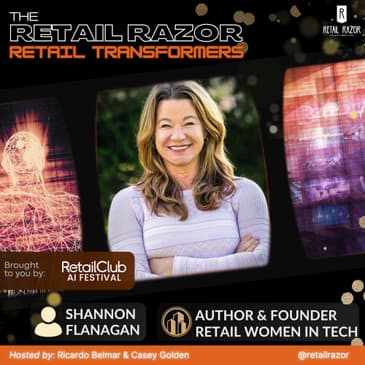



Choose, Don’t Chase, Your Career - Shannon Flanagan on career reinvention via the break, the pause, & the rewrite.
Shannon Flanagan has run more than 80 Power of We Wednesday interviews at Retail Women in Tech. Not one of those women had a linear career path. All of them hunting for jobs inside a system that only rewards one. Shannon found that career reinvention is the through line across them all.
Shannon spent two decades inside Fortune 500 retailers and hyper-growth startups developing teams, leading change management, and supporting people through career reinvention. In early 2025 the unexpected happened. A layoff, and suddenly she found herself pausing, reflecting, and looking to reinvent her own career. Two things she'd planned to do at retirement showed up 15 years early. Her fiancé told her to go all in on the nonprofit she wanted to start, Retail Women in Tech (RWIT). Then a friend called to say she wanted to write a book about career reinvention with her. The goal was to tell the stories of the women in RWIT. Shannon said yes to both, with three teenagers at home, a mortgage in one of the most expensive areas in the country, and no paycheck coming.
This is a personal story.
Shannon’s new book, Choose - don't chase - Your Career, is built in three parts: the break, the pause, and the rewrite. Shannon walks Ricardo and Casey through all three, starting with the layoff that opens chapter one and the bottle of champagne she opened on her deck by noon that same day. It's the most personal career reinvention story we've ever had on the show.
This one goes deep. Casey admits that the last real pause she took was the summer she was 17, and that she spent years chasing goals she set at 12. Shannon names money as the hardest thing she had to let go of, then gives the line from her financial advisor that she still repeats every week.
What You'll Learn in This Episode.
Why the corporate ladder still gets rewarded even though 80 out of 80 careers zigzag.
What the break, the pause, and the rewrite look like week to week.
The three months it takes to unwind, and why almost everyone quits at week two.
How Shannon answered the mortgage question when she walked away from a paycheck.
The reframe that beats the stereotypical deathbed question: what would you tell your niece or nephew to do?
The career reinvention through line she found across all the stories in the book.
Why your old journals are the place to find your career reinvention story..
Why Shannon built Retail Women in Tech with no paywall.
Support our Sponsors.
This Episode is Brought to You By RetailClub.
Retail and brand leaders can attend RetailClub AI Festival completely budget-free. A free ticket, plus $1,750 toward travel and hotel. From the founders of Shoptalk and Groceryshop, it's three days fully outdoors in Huntington Beach, September 22 to 24, with 2,000 senior leaders working through how AI is transforming retail. If you're shaping AI's future in retail, budget shouldn't be why you miss it. Register by August 28 at https://retailclub.com/retail-razor-podcast
W. P. Carey School of Business, Arizona State University.
Arizona State University is a leading public research university known for innovation, access, and impact. Its W. P. Carey School of Business is the largest in the United States, with more than 25,000 students. AI-Enabled Supply Chain Strategy is a three-day executive program running October 5-7. It's built by W. P. Carey's #2-ranked Supply Chain Management department. The program is designed for senior leaders setting AI strategy across procurement, logistics, and operations. Register at https://specialevents.asu.edu/878064 with ID Code retailrazorasu for $1,500 off. Preview it in our three-part Data Blades podcast mini-series this September with Professor Brett Duarte.
Subscribe & Follow.
Don't forget to like, comment, and subscribe to The Retail Razor: Retail Transformers for more episodes featuring retail innovators, disruptors, and bold thinkers reshaping commerce.
Subscribe to the Retail Razor Podcast Network: https://retailrazor.com/
Subscribe to our Newsletter: https://retailrazor.substack.com
Subscribe to our YouTube channel: https://go.retailrazor.com/utube
About Our Guest.
Shannon Flanagan. https://www.linkedin.com/in/shannon-e-flanagan/
Author. Choose - don't chase - Your Career. https://a.co/d/0cXKYT1f
Founder. Retail Women in Tech. https://retailwomenintech.org
Shannon has spent her career inside complex organizations, driving significant paradigm shifts in how teams operate at fortune 500 companies and hyper growth startups. This has given her a rare practitioner's view of what moves people, culture and business forward. At twenty-five, Shannon discovered her why: to create the conditions for people to love what they do every day. That purpose has been the through line of her work ever since. Drawing from her experience in organizational design, leadership development and change management, she has dedicated her career to supporting people and organizations through reinvention. Whether that means launching new businesses, optimizing talent or moving through the seasons of our lives.
Shannon made a life-changing decision in the Spring of 2025. She started a non-profit, Retail Women in Tech, and wrote a book — two things she planned to do when she "retired." When the opportunities to do both manifested in front of her within weeks of each other, fifteen years ahead of schedule, she knew she couldn't turn a blind eye. So, she faced her fears, listened to her gut and pivoted to seeing herself as an asset to invest in, giving up a paycheck and security to actualize her life's work.
She's a business owner, an author, a speaker, a life coach and a mother of three. And she believes that by sharing our stories, we spark the inspiration and change we seek in our own lives and the world around us. Shannon didn't have this figured out before she wrote a book telling other women how to figure it out. She still doesn't. And that's the point.
Chapters.
(00:00) Teaser
(00:55) Show Intro
(03:29) Introduction & The Mystery Mug
(04:28) Why She Wrote the Book Now
(07:47) The Mug Story Revealed
(09:09) Getting Laid Off
(12:21) The Corporate Ladder Myth
(18:06) Break, Pause, Rewrite
(24:27) Letting Go of Money and Fear
(31:56) Facing Fear and Choosing Not Chasing
(37:57) Redefining Success
(45:43) Final Reflections & Where to Find the Book
(53:08) Show Close
Meet Your Hosts.
Helping you stay sharp, be bold, and transform retail:
Ricardo Belmar is an NRF Top Retail Voice for 2025 and a RETHINK Retail Top Retail Expert from 2021 – 2026. Thinkers 360 has named him a Top 10 Thought Leader in Retail, a Top 25 Thought Leader in AGI and Careers, a Top 50 Thought Leader in Agentic AIand Management, and a Top 100 Thought Leader in Digital Transformation and Transformation. Thinkers 360 also named him a Top Digital Voice for 2024 and 2025. He is an advisory council member at George Mason University’s Center for Retail Transformationand the Retail Cloud Alliance. He was most recently the partner marketing leader for retail & consumer goods in the Americas at Microsoft.
Casey Golden, is the North America Leader for Retail & Consumer Goods at CI&T, and CEO of Luxlock. She is a RETHINK Retail Top Retail Expert from 2023 - 2026, and Retail Cloud Alliance advisory council member. After a career on the fashion and supply chain technology side of the business, Casey is obsessed with the customer relationship between the brand and the consumer and is slaying franken-stacks and building retail tech!
Episode Music.
Includes music provided by imunobeats.com, featuring Tropikool, from the album Future Beats 2, plus Virtual Apology and New Styles, from the album Shimmer Pop, written by Heston Mimms, published by Imuno.
Highlights.
[00:47:55] - So if someone's reading this dedication and is in mid panic right now, resume open, coffee's cold, sitting out on their desk.…
[00:04:28] - There were two moments that happened in my life early in 2025. One was well, I always knew that Retail Women in Tech would be a…
[00:09:09] - It's one of the most powerful experiences I had in my life. I would say it drove the pivot to where I am now. I always knew,…
Transcript.
S2E9 Shannon Flanagan
[00:00:00] Teaser
[00:00:01] Casey Golden: She got laid off on a Friday afternoon and immediately popped a bottle of champagne.
[00:00:06] Ricardo Belmar: Toasting her own severance package.
[00:00:08] Casey Golden: That's not rock bottom. That's page one of her book.
[00:00:11] Ricardo Belmar: Our guest spent two decades inside Fortune 500s and hypergrowth startups driving the kind of change that moves people and business forward.
[00:00:20] Casey Golden: Then in the spring of 2025, she blew it all up on purpose, 15 years ahead of her own retirement plan to write the book and start a nonprofit, RWIT, Retail Women in Tech, all at once.
[00:00:35] Ricardo Belmar: Her new book asks a simple but uncomfortable question: What if you stopped chasing your career and started choosing it?
[00:00:43] Casey Golden: I hope it's after hours because grab a glass of bubbles, this isn't Book Talk
[00:00:47] Ricardo Belmar: It's a moment to reflect on your own story and rewrite it mid-story
[00:00:51] Casey Golden: Now let's meet our latest retail transformer, Shannon Flanagan.
[00:00:55] Show Intro
[00:01:03] Ricardo Belmar: Welcome to Retail Transformers, candid conversations with the visionaries shaping the future of commerce.
[00:01:09] I'm Ricardo Belmar.
[00:01:10] Casey Golden: I'm Casey Golden.
[00:01:11] Welcome back, Retail Razor fans. This is the podcast where we cut through the clutter to bring you the sharpest insights from the leaders redefining retail careers, and frankly, the future.
[00:01:25] Ricardo Belmar: Our guest has spent her career inside complex organizations helping other people navigate reinvention, organizational design, leadership development, change management. Then in the spring of 2025, she turned that lens on herself.
[00:01:39] The book is called Choose, Don't Chase Your Career, and it's not a polished five-step formula.
[00:01:45] It's built around three parts: the break, the pause, and the rewrite.
[00:01:49] Casey Golden: Life is messy. She'll tell you straight up. She didn't have it all figured out before she wrote the book telling other women how to figure it out. She still [00:02:00] doesn't. That's kind of the whole point.
[00:02:02] Ricardo Belmar: Beyond the book, she's the founder of Retail Women in Tech, a nonprofit built around mentorship, community, and creating more room for women in the rooms where decisions get made.
[00:02:11] Casey Golden: So today we're talking about the ladder versus the stack. The money question nobody says out loud, the in-between that nobody wants to sit in, and what it costs to choose your career instead of chasing it.
[00:02:26] Ricardo Belmar: If you're in the middle of your own reinvention or thinking about starting one, you're going to want to stay for this one.
[00:02:32] Casey Golden: But before we get started, let's thank our sponsor, RetailClub.
[00:02:36] Ricardo Belmar: Retail and brand leaders can attend RetailClub AI Festival completely budget free, plus get $1,750 toward travel and hotel. From the founders of ShopTalk and Grocery Shop, it's three days fully outdoors in Huntington Beach, September 22nd to 24th, with 2,000 senior leaders working through how AI is transforming retail. you're shaping AI's future in retail, [00:03:00] budget shouldn't be why you miss it. Register by August 28th at retailclub.com/retail-razor-podcast. Casey and I hope to see you there.
[00:03:09] Thank you to RetailClub for helping us bring you this podcast and all the other shows in the Retail Razor Podcast Network.
[00:03:16] Casey Golden: All right, Retail Razors, let's go. Please welcome to Retail Transformers, author, founder, and life coach, Shannon Flanagan.
[00:03:23]
[00:03:29] Introduction & The Mystery Mug
[00:03:29] Ricardo Belmar: Shannon, welcome to the show, as
[00:03:32] Casey Golden: Does your coffee cup have three handles?
[00:03:35] Shannon Flanagan: No, just wait. I'm gonna use it. It's a prop
[00:03:37] Ricardo Belmar: Oh, I can't wait to hear this part of the story.
[00:03:39] Casey Golden: Like, wait a minute
[00:03:41] Shannon Flanagan: Oh, it's a prop. gonna, you're gonna hear it. You're gonna see it. Wait till you hear what's on it.
[00:03:46] Ricardo Belmar: this time, wow.
[00:03:47] Shannon Flanagan: Yes
[00:03:48] Ricardo Belmar: is way to encourage all listeners to actually want to watch on video now,
[00:03:52] Shannon Flanagan: Yes, exactly
[00:03:54] Ricardo Belmar: we're gonna be able to describe this for the listeners, if they're not watching on YouTube.
[00:03:59] So it's [00:04:00] even more exciting to have you on the show today then
[00:04:02] Shannon Flanagan: It is
[00:04:03] Casey Golden: Oh my goodness. Um, let's just get
[00:04:07] Ricardo Belmar: Let's
[00:04:07] Casey Golden: right into it. You wrote this book while starting a nonprofit and stepping away from a paycheck all at the same time, 15 years ahead of your someday timeline. What was the catalyst that motivated you to sit down and put pen to paper when you already had a full plate?
[00:04:28] Shannon Flanagan:
[00:04:28] Why She Wrote the Book Now
[00:04:28] Shannon Flanagan: There were two moments that happened in my life early, in 2025. One was... Well, I always knew that Retail Women in Tech would be a nonprofit. when I, quote-unquote, "retired" at 65, I wanted to run a nonprofit, not found one. That's a very different-- That was not on my bingo card. But, one night, late at night, my fiancé says, "I think you need to go all in." And it's very important for the audience to understand I've never struck it rich, wrong place, wrong time. I live in the second most expensive area in the country. I [00:05:00] have three teenagers. I pay my ex-husband handsomely. So to make that decision was a really big deal. So I was hemming and hawing over that. Then I get a, text and then a call with, Nicola Kinsella, who was one of the women who helped, write the book, and she says, "I wanna write a book with you. I've always wanted to do it on my checklist or, you know, life list, and maybe we should do it about the women in, RWIT." so that was the second thing I wanted to do when I retired.
[00:05:31] I'd already had two other books in my mind based on a similar format. so the two things I wanted to do were manifesting themselves in front of me fifteen years ahead of schedule. And, there had been a conversation I'd had, several weeks earlier when I was at eTail Palm Springs. And this woman, comes up to me after I'd done an event and says, "I'd love to talk to you."
[00:05:55] So we get, a glass of wine at the bar in the middle of the, the hotel, [00:06:00] and she talks about, excuse me, how unhappy she is in her job. She was probably in her early 30s, so kinda mid-career. She had this misnomer that the higher up she got, the easier it got, and so I was like, "No, it gets harder and harder." But she wasn't happy. She had just bought a house. She had just had a baby. And we really started to dive into, like, what really, you know, fuels your fire? Like, what are you really excited about? And it had nothing to do with the job she was doing. But she was sticking with that job because she one day wanted to retire with her husband in Italy, and she wanted the money to do it. I was like, "Oh my God," like, "we have no idea what's gonna hap--" Like, that's like, you know, twenty years from now, and you're making decisions, based on that. And so when the two moments came into my life and I reflected on that conversation, I was like, "I'd be a false prophet if I didn't go to it." And because of Retail Women in Tech, I'd heard of so many women's stories about what they [00:07:00] wanted to do that they weren't doing. So I decided to go all in, and the book is really a reflection of my own journey to get where I am.
[00:07:10] Casey Golden: And how many hours do you sleep?
[00:07:12] Ricardo Belmar: Yeah, really?
[00:07:14] Shannon Flanagan: Okay, so that's a whole nother thing. I've got comparison
[00:07:16] Ricardo Belmar: a completely separate discussion
[00:07:18] Shannon Flanagan: I work more than I've ever worked in my life. I'm the most stressed. I am poor by this... I am the most fulfilled, but I compare myself to other founders who work 18 hours a day. I now work 12, which is a lot for me. I mean, 10 to 12 and on the weekends.
[00:07:35] Casey Golden: Right
[00:07:36] Ricardo Belmar: Yeah
[00:07:36] Shannon Flanagan: yeah, I, I still feel like I'm not doing enough. That's a whole nother problem.
[00:07:40] Casey Golden: Right.
[00:07:41] Ricardo Belmar: Yeah.
[00:07:41] Casey Golden: Perfect, so like we're all kind of part of this club. He thought it
[00:07:46] Shannon Flanagan: Well, okay, so
[00:07:47] The Mug Story Revealed
[00:07:47] Shannon Flanagan: should I wait on the prop or let's, let's get the teaser going. So let's see. How do I show it? So here's a great story that at, we do a, annual gays and gals, [00:08:00] Christmas party, and we always have a secret or, like, whatever that ga- white elephant. And I g- grabbed this one that... Can you guys see the cup?
[00:08:11] Casey Golden: I see that there's, there's multiple handles,
[00:08:14] Shannon Flanagan: There's
[00:08:14] Casey Golden: but I can't read it
[00:08:15] Shannon Flanagan: it says on there is, "I literally do not know what I'm doing." I was like, "That couldn't be more perfect for what I'm doing,"
[00:08:25] Casey Golden: I love it
[00:08:26] Shannon Flanagan: what I'm doing, but I know that I'm doing what I'm supposed to do
[00:08:30] Casey Golden: Great
[00:08:30] Ricardo Belmar: Perfect. There you go. There you go. Well, well let's maybe look at how you open the book, you like jump right in, kinda like how we just jumped into this discussion. You just jump right in at the beginning
[00:08:44] Shannon Flanagan: I mean, you guys, guys two are two of my favorite friends.
[00:08:47] Casey Golden: Maybe chirp, chirp, chirp, chirp, chirp. You know, just jump in the water
[00:08:50] Ricardo Belmar: get ready for a four-hour episode, just, just saying. Um, but so let's start with where the book opens. You know, you start with the story of you getting laid off, [00:09:00] right? And then you stop at a store, you get a bottle of champagne, and toast your own severance package by noon. So walk us through this moment and what that meant, for you at that time
[00:09:09] Getting Laid Off
[00:09:09] Shannon Flanagan: It's one of the most powerful, experiences I had in my life. I would say it drove the pivot to where I am now. I always knew, right, in retail, the higher up I got, right, I'd been a VP for several years, that I would get laid off at some point. But this one came out of nowhere. you know, there's... I don't wanna, I don't, I'll give you the trailer version because there's a whole chapter, as you just said, d- dedicated to that. I was in a situation, I was working for the president of a company, and over time, I, our relationship started to change. I've always been a change practitioner, so one of the things I have to be is a truth teller. Doesn't always land well for, in particular, new leaders as they might have some insecurities about what they were doing. And, knew that our relationship was becoming strained. I ended up then spending more time, [00:10:00] 'cause she kind of kicked me to the, chief HR officer, and we were trying to figure out how my role should evolve and how I was really trying to better meet the needs of the president based on where she was. I was supposed to have a meeting with her, and I go around the corner and I see, this woman, Sheila, who I'd been, um, working for, the, the head of HR. And she looks at me and she starts, like this face on her, the look on her face, and she says, "You need to come in." And she had been also completely blindsided that, um, the, the president had made the decision to let me go. And when that happened, one, I mean, I'm very emotional, right? But as I walked out of that room, I did, I w- I went and got the bottle of champagne, I sat out on my deck on a gorgeous day, and I celebrated because I knew that I was not being, um, laid off because of [00:11:00] my skills and my contributions and what I gave. I understood it was really coming from somebody else's perspective. And little did I know, I didn't know my celebration was going to become the change and catalyst that my life came, became as a result of it. Um, and I knew I was gonna be okay. Now, didn't, you know, didn't hurt that I had a really nice severance package, but it, it did create finally the space and part of the reason, why the book is structured like it is, because it allowed me to have a pause. So I know we're gonna get into that topic as
[00:11:37] Casey Golden: Yeah
[00:11:37] Shannon Flanagan: forward here.
[00:11:38] Ricardo Belmar: Yeah. Well, there's, there's another line in the book that I think maybe relates to this too that, where you talk about the ladder, which is something like e- everybody's heard this, you know, metaphor for corporate life, right? About climbing the, the corporate ladder, and you kind of reference it how, you know, your choices, are basically, you know, you step off the ladder, well, that's like a foolish move to do because then you're just falling off, right?
[00:11:59] Or you jump to another [00:12:00] ladder, it's... then it's kind of gives the impression you're lost and you don't know where you're going. And then you're told if you pause, though, to reflect on all of it, well, then you're just gonna fall behind. but this is basically how every corporate world works, right?
[00:12:14] Every corporate ladder works this way, and this is what everyone's been told.
[00:12:18] Shannon Flanagan: Yep
[00:12:18] Ricardo Belmar: w- what's your take on that?
[00:12:20] Shannon Flanagan: Oh,
[00:12:21] The Corporate Ladder Myth
[00:12:21] Shannon Flanagan: this is one I could spend hours and hours on. And I luckily have the good fortune of, you know, I've, I've... I, well, there's a whole story about me stepping off the ladder, which was my first WTF moment. I'm gonna t- talk about a few other things. Like, the reality is we've been conditioned to believe that success follows, you know, this straight path.
[00:12:40] Ricardo Belmar: Right
[00:12:41] Shannon Flanagan: and this myth I think is especially potent for women. I, you know, I think this is now more and more true even for men. But despite decades of progress, we're still expected to prove ourselves constantly and to make the safe, smart moves. The reality is the research shows that, like, there is this huge [00:13:00] emotional and systemic toll on women and the pressure of those, especially in leadership.
[00:13:05] So leanin.org and Deloitte did a report, and by the way, their reports every year are so insightful, but that six in 10, senior level women are frequently feeling burned out, not because they aren't strong enough, but because the system was never designed with them in mind. So you think about, like, you come back, like our corporate system is designed to climb the ladder. the reality is though, we do at, at Retail Women in Tech, we do a Power of We Wednesday interview series. We've done over 80 now. Not one has had a linear career path. But we operate in a world that apparently, right, that is still the same, the same mindset, and we see it. And I don't know how many of, you guys have talked to people who are in the job market,
[00:13:51] Casey Golden: Mm-hmm
[00:13:51] Shannon Flanagan: they have gone through...
[00:13:52] I mean, it's like, it's just an absolute nightmare that the hiring managers and companies will say they're looking for a generalist, [00:14:00] but as people move through the five to seven interviews, they still are hiring for this deep functional expertise. So we've got this between the reality of what really makes great talent, which is those that have got, you know, a potpourri of the reasons why. That might have been my ding. Sorry guys, don't even know how to turn it on or off. Don't have any coming on.
[00:14:24] Casey Golden: Just blame it on Microsoft
[00:14:26] Ricardo Belmar: Yeah.
[00:14:26] Shannon Flanagan: I would. I told, that, we, like with Retail Women in Tech, like the origin story really came from how do we build the bridges across all the sectors and have an appreciation for transferable skills? When it comes to us personally, right, we're, we're find- we continue to like go for jobs that we've already had because it feels safe and because we're, we are rewarded in this deep functional expertise, but that's not what makes the greatest leaders, [00:15:00] nor does it allow you the, the chance and the p- to actually go after what you do want.
[00:15:05] Casey Golden: I know
[00:15:06] Shannon Flanagan: real power isn't climbing faster, but maybe it's stepping off altogether, right? Thinking, choosing intentionally over inertia and really understanding meaning and healing over the hustle. I do believe, excuse me, like one of the things you said in terms of the, the ladder is that we also, when we, we also can go through like trauma in some of our jobs when we keep climbing up that, that ladder.
[00:15:32] So I, I think it's, it's important. I think we as individuals understand the val- like are not as afraid of stepping off the, the, functional ladder, but we still have an industry that's hiring for it. So a lot of opportunities there for us to change the narrative and the reality.
[00:15:51] Casey Golden: Yeah. You know, it always, you know, I'm of an age where you can't have any gaps in your resume, [00:16:00] God forbid, and you have to apply vertical. Like, you can't apply horizontally. It has to be like, you can't even take like two steps up. You just, you're taking the next step up or the same exact job at a larger company, right?
[00:16:20] And then the same exact job at a larger company. That was kind of what we are trained and like programmed, like that's what you're doing. Then I stepped off. I don't know if I just didn't get on early enough, but like, you know, I always wanted to have my hand in the cookie jar of what I wanted to learn next and what I wanted to do next.
[00:16:41] it was all made sense to me on like who I want to teach me, who I, what company I wanna help, who I believe in, in the industry to win, who I want, you know, um, to be a part of that story. And I always felt like my resume was a shit show [00:17:00] unless you met me, 'cause it's just like zigzagging all over the place.
[00:17:04] And I'm like, "Nope, straight line." We just have to have a conversation. It's a complete
[00:17:10] Shannon Flanagan: clear like as leaders, don't you want... Like you just said something that, that I wanna come back. You were curious, and you wanted to learn, and isn't that like so much more valuable than somebody's that's deep in functional expertise? Now, I will, I'm hoping, fingers crossed, like in the world of AI, I really truly believe that the measurement of success and talent is gonna be from those who connect the dots and have more of that generalist experience.
[00:17:38] Casey Golden: Yeah
[00:17:39] Shannon Flanagan: we're still in a place that, in fact, it almost seems like it's getting worse based on the horror stories I'm hearing from people in the hiring process. But it, it doesn't make any sense, to be honest. It's not logical. we really look at the, the way, organizations, I think, can operate the best.
[00:17:58] Casey Golden: Yeah, I mean, the, and the latter myth [00:18:00] is basically what your book is built to dismantle, right? structured around the, the three parts,
[00:18:06] Break, Pause, Rewrite
[00:18:08] Casey Golden: break, pause, rewrite. you walk us through, like, what each of those means and why you felt like that was the arc to tell the story? Don't give too much
[00:18:17] Shannon Flanagan: wanna be...
[00:18:18] Casey Golden: 'cause everybody needs to read the book.
[00:18:21] Shannon Flanagan: Sorry, I always talk, we talk over each other. What, what were you saying before, before?
[00:18:25] Casey Golden: Oh, I just said just don't give too much away because everybody should be reading the book
[00:18:31] Shannon Flanagan: I know. I'm gonna try with a trailer. That's why we're forced to be... Like, if it was four hours, we'd keep going. But I wanna start off with This isn't a book about finding your perfect job. You know, we're not, we're not here to give, like, a five-step plan to get there. This book is really about the process that we go through, and the process of figuring out the chapters was really interesting, um, because we had to, we had to go really deep [00:19:00] into the experiences that you're having. So when we think about the break, that is really about, like, what is happening, and who am I now? And my God, I have to kinda let go of this script. And we talk about fear, and I think we'll, we'll spend a few minutes on that here in a few minutes, but that, that staying in the space and recognizing what we go through when the break happens.
[00:19:25] And the break could be because you've been laid off, and that would've been more my experience. burnout, which we'll... You know, the stories talk about that in there. Or also knowing that what you're doing isn't what you wanna do, and there is a psychological, emotional, spiritual, whatever mental experience we go through when that happens. What the, um, where the book, one of the origins of the book was my, um, with our, the, the publisher we ended up going through to didn't just take our money. You had to actually apply for this [00:20:00] program, and they do a visioning session with you, and they do not let you have the questions in advance. So I had no idea what they were gonna ask, and all we knew is that we wanted to do a story and a collection of, you know, about women's stories, and they're like, "That's not enough." one of the questions they asked me, which I can't remember, but I can remember the answer, was that I believe that we rush through our transitions Um, and we move so quickly from A to B that we don't pause. what I'd realized from the first layoff I had, and I had the luxury to pause, the reality is we all-- this is a book more for those in corporate America, we often have the luxury to pause more than we think to.
[00:20:42] And we live in a society, I'm not stating anything, is that it's all about go, go, go. So to me, the most powerful part of the book and where people are resonating the most is really that pause. And it's, you know, we have this urge to rush is one chapter. This next one is, like, quieting the [00:21:00]noise. it's leading into trusting the not knowing and rerouting success on your terms. And when you pause, you can actually hear yourself about some seeds of something new. that happens, then you can move into the rewrite. But in order to do that, you really have to define success not from what everybody else is telling you, but from the inside out, and understanding what you bring to the table, letting go of what you've had in the past, working with the people who are around you, who often see in you what you need to do before you're willing to admit it yourself, then give yourself the grace and the space to actually become who you are.
[00:21:40] Casey Golden: Yeah, I mean, I have to say, like, the only pause I've ever taken in my career was the summer I was 17
[00:21:47] Shannon Flanagan: All right, Casey, read the book
[00:21:50] Casey Golden: I know. Because it is. It's jump, jump, jump, cash out your vacation time because you never took it.
[00:21:56] Ricardo Belmar: Right. Right
[00:21:58] Casey Golden: who's paying the, who's paying the [00:22:00] rent during a break? You know? And
[00:22:03] Shannon Flanagan: about with one of our next questions,
[00:22:05] Casey Golden: Yeah
[00:22:06] Shannon Flanagan: coming questions because that's a really important one
[00:22:09] Ricardo Belmar: Hmm. Yeah,
[00:22:10] Casey Golden: But I think it's, The fact is that, like, we go through this process pretty much on autopilot. When I think about it, like when you... I read it and I was like, "When was the last time I had like three months to just be?" And I'm like, I think I was 17. It was like the last summer, 'cause I worked my... I didn't have a summer when I was, my senior year in high school.
[00:22:37] So I'm pretty sure it was like when I was 17, my junior year. That was three months off
[00:22:43] Shannon Flanagan: are to rush, to force, to panic, to react, and you said it, like, then we end up applying for the same roles we know that won't put a fire in our belly or make us happy. And you know, my bel- you know, my belief, the second, [00:23:00] um, kind of pillar of this book, so I talked about the, the rushing through the transitions, but the second pillar is my belief that the definition of success is changing rapidly. Seeing it, of course, in women, but it's also happening for men in younger generations, which is it has been historically title, status, and money. But where has that gotten us?
[00:23:23] Ricardo Belmar: Yeah
[00:23:23] Shannon Flanagan: Right? There are so many of us who are burned out. Like, the rules don't make sense, and part of it is organizationally or s- you know, it used to be, I always, and like, when you think about Mad Men and, like, they had offices with showers in them, you know. Um, I don't know how they worked all day compared to what we go through now, but I do say, like, our return on investment personally in what we give out is just not there anymore.
[00:23:49] Casey Golden: Yeah
[00:23:50] Shannon Flanagan: to get there, to understand that, we have to get off not just the ladder, but the, the, the, the whatever, [00:24:00] hamster wheel. It takes a while. It takes, like, three months to actually unwind
[00:24:06] Ricardo Belmar: Yeah.
[00:24:06] Shannon Flanagan: wound
[00:24:07] Ricardo Belmar: Yeah
[00:24:07] Shannon Flanagan: had been into the process, into the reality
[00:24:10] Ricardo Belmar: Yeah. It's hard to let go in, in those moments, right? And wh- which I guess is part of what you include as part of the break part, right? That you have to let go of these things. So, so I'm curious, what, what was the hardest for you to let go of?
[00:24:24] Shannon Flanagan: Money.
[00:24:25] Ricardo Belmar: Hmm
[00:24:27] Letting Go of Money and Fear
[00:24:27] Shannon Flanagan: Money. So, you know, I'd gotten the titles, I had had perceived success, and for me, there was a couple of things around the money. One I already shared. I, you know, I have done relatively much better than, than the United, you know, everybody else in the United States and even the world. But I compared myself, I live in the Bay Area, I have friends with a ton of tech money. I've always had financial insecurity, and the thing that allowed me to let go of that is after I was like, " [00:25:00] Okay, these two things are that, you know, the nonprofit and the book are right in front of me," I called my financial advisor, who happens to be a dear friend of 25 years, and she said, "You need to see yourself as an asset, not a liability. will make money again." And I can't tell you how many times I hold onto that, throughout the week. And here's the, the crazy thing, I have let go of it because I am so committed and I know that I'm where I'm supposed to be. But, I had to go through all the things that happened in the book. And there was actually a day, 'cause when you go through the publishing process, you have to read the book out loud multiple times, right?
[00:25:43] And, you know, as you're going through your revisions. And there was one weekend I had to read the book again my-- I had to read it, and I realized I needed the book again for myself because we are so attached to the identities. And it's not just the identities of our own self, but the [00:26:00]expectations of success is put on us, and that's why we have several chapters that talk about the dismantling of what the definition of success is because the book also reflects it's not a straight line.
[00:26:15] You are going up and down as you go through the process
[00:26:19] Casey Golden: And you mentioned that the book isn't just for women, that a lot of men told you it resonated with them as well, and, this is potentially such, like, a universal experience, but one that nobody really talked about. Two, maybe we didn't even have time to think about it.
[00:26:40] Shannon Flanagan: Yeah. Oh,
[00:26:42] Ricardo Belmar: Yeah.
[00:26:42] Shannon Flanagan: Well, and that's, I mean, that was the origin of the book is that we were like, "We're not about it enough." And that's when the publisher was like, "This is a different discussion that we're not having enough, and we're not honoring and giving ourselves the grace of this [00:27:00]journey that we go on." And so that's, the book is really about the journey, right? Not the answer, but the journey that we go on to find the work that fits. So I, I came up with this, this tagline kind of in the book or whatever, and now I've added a third, um, power of threes. But, you know, what fits, what fuels, and now really what fulfills.
[00:27:22] What fits changes throughout your life, right? Depending on where you are, and we have to understand the flexibility of our own journey based on, you know, what fits best in our life depending on, the season we're in. What fuels? Reality is we should always have a fire in our belly. Now, there are times that the flame is, like, so tiny at a job, and that doesn't mean, like, it should be, you know, all sunshine and roses at your job. But when it goes out at a job, you need to really then move on, 'cause you're not where you are. We all deserve to have the passion. And then fulfilling can look different for different people at different times in your life. But we, we [00:28:00] owe ourselves that. And, you know, as we close out, I will share one of my favorite quotes, that closes the book.
[00:28:07] I won't give it away yet. But, and this is why it is a human experience,
[00:28:12] Ricardo Belmar: Yeah.
[00:28:12] Shannon Flanagan: right? The book is grounded in the stories of women. We do have some different nuances based on how we've been conditioned, and where we are. But, uh, we're all really, I think, questioning, not all, but is this the life that we wanna have?
[00:28:29] Ricardo Belmar: Yeah. Well, you have a lot of... I mean, the book, like you said, is a lot of different stories, and it's not just your story, right? You have other women's stories, and some of them are just, they just seem like such brutal stories of things that maybe led to a wake-up moment. I mean, you've got, an example like, you know, Jill quitting on a street corner outside a Dunkin' Donuts.
[00:28:47] You've got Kimberly spending six weeks in the hospital before her company let her go. I mean, these are just amazing stories that you've gathered together this way. What, what were you thinking and what led you to say, "You know, this is the right story to include. This is what, this [00:29:00] is adding something to, to the overall message"?
[00:29:02] And how were you looking at that?
[00:29:03] Shannon Flanagan: I mean, personally, Nicola and I, you know, she, she knew three people whose stories that would relate. You know, I know, like how many do we have, 15? I can't remember. But it was through the p- you know, the women that I've k- some of them I'd known for years. Some I had just recently met. But we were, we were talking about this topic and, and we... It was important to us to have it from these different perspectives. Uh, and you know, one of the things that, that you and I, you guys had, you know, chatted about is like, what were some of the stories that changed how I saw my own transition? And you know what, um, there were two things that really came to mind, is that all, for al- alm- so many, I wouldn't say all, but for so many of us, it was our partners who saw what we needed to do before we did, and they supported us 100%, and they [00:30:00] were able to let go of some of the fear. And so I found that a really interesting theme that happened in so many of the stories. The main one that I took away, and it was from somebody I've, you know, who's been... I've known her for years, then reconnected. It's my favorite thing about RWIT, is all the people I reconnect with from my past. But, she talks about this, and a handful of other people do as well, but this idea of the through line. She is now finding the work that actually reflects who she was younger in her career, and that she had moved away from it and she found it again. And there's messaging and journaling around that idea of like there's a truth that has been with you for a long time. And for me, the through line was, at 25, I knew I wanted to create the conditions for people to love what they do every day, I believe in the ripple effect, and this is my way to rationalize being in corporate America.
[00:30:51] That, that if people are happy at work, they'll be happy at home, in their communities, blah, blah, blah, with their children. And then when I, when she said that, I looked [00:31:00] back, I was like, "That's what I've been doing with my life and my career the whole time, and here I'm now manifesting it in spades." So, you know, I, these, these moments, uh, these stories, what we're trying to do is that hopefully creating, um, experiences that people can relate, and I think everybody could probably relate to one of everybody's story in every chapter.
[00:31:24] Ricardo Belmar: L- let's go back to, you know, when I asked what was the hardest thing to let go of, you said it was, it was the money part. So if we go, dig a little deeper into this, I mean, you have a great example of this, right? 'Cause you, you moved cross-country for a job, and it was a job that let you go, right? Um, so how do you tell someone, you alluded to this a little bit earlier, but, you know, the premise of the book, right, to choose not chase. How do you kinda give someone that message when they're probably thinking in the back of their mind, "Well, that might mean the mortgage doesn't get paid next month"?
[00:31:56] Facing Fear and Choosing Not Chasing
[00:31:56] Shannon Flanagan: It's a tough one. I, I mean, I'm not gonna, I'm not gonna [00:32:00]sugarcoat it. But the reality is we actually have more money than we think we do, and we have more. When we lean into the fear. And so let's spend a few minutes on fear. It's something that, it, it, because this is the barrier, and we talk about fear in the book. And the reality is there's a lot of fear in the system in our entire society now with, with work, ex- with AI. But, what I, I... And I, this is the first thing I share, and I think it's the, I don't know, I think it's in the, the chapter about fear. It should be, is an acronym that I grew up with, um, in my past, which is fear, false evidence appearing real. And what happens, and this is a s- this is, you know, psycholo- like, psychology and just the nature of who we are, is when there's uncertainty, fear slips into the driver's seat. we're wired for, you know, fear is wired into us for survival. And when we're in a transition [00:33:00] and nothing feels certain and the roadmap has gone blank, fear, it becomes a tyrant, right?
[00:33:05] It shrinks the, possibilities. It amplifies the risk. so that we have all of these realities that we need to do, but we actually have more than what we need. And I've said to people who, you know, have asked a similar question, I was like: Would you... Is your McMansion worth your happiness?
[00:33:26] And happiness, I wanna say, is, I, I wanna take away from that word 'cause that, that's not a destination, right? Is it worth, being miserable at your job?
[00:33:34] Ricardo Belmar: Right
[00:33:35] Shannon Flanagan: know? And I think that's something people have to really question. Is the car that you have worth it? Is being able to, you know, do $10,000 trips to Hawaii worth the other 48 weeks, if you're so lucky to have four weeks off, being miserable? And I'll close with one of my favorite quotes. Um, I love quotes, so you'll see that there's many in the books. But Eleanor Roosevelt said, "You gain [00:34:00] strength, courage, and confidence by every experience in which you really stop to look fear in the face."
[00:34:05] Ricardo Belmar: Yeah No, that's a good one. I mean, it's, those are all the right questions that everyone should be asking, right? And, and if you're following the premise of, you know, around, around choosing not chasing that, that, you know, back to the corporate ladder and the whole thing that we've all been trained to, to think about the years. I think what's really interesting though is that just even going through that much and what you just mentioned about the fear, as you start to, as anyone starts to think about that themselves, it really forces you to think a little deeper than you're used to. And I think one of the premises you also follow in the book is that it's not just about a passive reading experience, right?
[00:34:41] The whole point is to get you thinking about these things for your own career, to get you reflecting on them, and to even just start writing about it, right? I think you encourage a lot of journaling, from chapter to chapter in the book to really help you kind of guide yourself through and make yourself think about all of these different things as you're analyzing where [00:35:00] are you in that c- in your career.
[00:35:01] Shannon Flanagan: Absolutely. and one of the things I will say is that I, w- and I'm coming back to the through line. So I'd actually started writing, and I remembered that I had journals for the last seven years. My favorite journal, which came right after the, the break that happened for me that we were alluding to talking about earlier, that one is lost somewhere. But I went back to my journals and could see my own journey and how I got here. And I had a through line that one of them was, and it was, and, uh, one... From, like, eight years ago, I had, like, a word dump that said, like, community, connections, shared purpose, all this stuff, but little did I know that, you know, Retail Women in Tech, one of our tag line is, you know, "Connections grow us, community grounds us."
[00:35:46] And so I'd have that through line. And so for me, I don't constantly journal. I go through ebbs and flows, but when we stop and we journal, and we allow ourselves to have that thinking, it forces the [00:36:00] pause. And what has been so fascinating to me is how many people have told me they've had to pause while they're reading the book
[00:36:07] Ricardo Belmar: Yeah
[00:36:08] Casey Golden: No, I mean, I think that that's,
[00:36:10] I think that that's great because I think in any, any good book is marked up with notes and highlighters,
[00:36:19] Ricardo Belmar: Exactly
[00:36:20] Casey Golden: little dog-eared corners.
[00:36:22] Ricardo Belmar: Yeah
[00:36:23] Casey Golden: I have a couple books that are just trashed. I've read them so many times. I mean, the... If it's squares around it or a circle or underlined, they're three different...
[00:36:33] It's like a, it's a system. 'cause I'm gonna come back to the square, you know, and, like, peruse for, like, my squares versus my circles.
[00:36:44] Shannon Flanagan: Yeah
[00:36:45] Casey Golden: but I think it is very true. You know, I am guilty of, I'm guilty of this. I didn't take a break, but I did take a moment to write down and readjust that I did [00:37:00] discover, like, I was chasing goals that I set when I was 12, 13 years old.
[00:37:06] I'm like, that was before I even went to high school or college. That was before I ever, ever had a job. Do I still want this? Are these still the... Is this still the destination? I was, I'm very destination focused, right? I kinda skipped the whole being present part. But, Just even, like, writing down, like, what do I want now?
[00:37:29] Now that I'm educated, now that I have work experience, now that I've been in the world, now that I'm like an adult, what do I actually want? Do I want these things that I'm still chasing as, like, my definition of success or what I want my life to look like or things of that nature? And holy cow, it took me six months to, like, just kind of come up with a new list.
[00:37:54] Shannon Flanagan: Well, there's a lot of decoupling
[00:37:55] Casey Golden: I don't wanna live in France forever
[00:37:57] Redefining Success
[00:37:57] Shannon Flanagan: own definitions of what you think success is gonna [00:38:00] be, but then the definition of success in our society.
[00:38:03] Casey Golden: Yeah
[00:38:04] Shannon Flanagan: And we don't put a value on fulfillment and alignment, and I do think so many of the circumstances, in particular with the amount of layoffs, and that's part of why we felt like the book was really gonna hit in a zeitgeist moment for a whole host of reasons.
[00:38:21] Ricardo Belmar: Yeah
[00:38:21] Shannon Flanagan: um... And we also will do, like, the five things. What are your goals? Blah, blah, blah. And what we really hoped with this book, and I'm gonna say it for, like, the umpteen time, is that it's a process, and there's so much unraveling that we have to do,
[00:38:35] Casey Golden: Yeah
[00:38:36] Shannon Flanagan: to get there
[00:38:37] Casey Golden: Yeah. I mean, I, I, I, I think I've been doing it again where I don't want, I don't wanna be working towards this dream. I wanna live my dream every single day now in the present. It's not in the future, it's today,
[00:38:53] Ricardo Belmar: Mm-hmm.
[00:38:53] Casey Golden: and that's probably been, like, the hardest adjustment of changing this [00:39:00] mindset that was just chiseled into my being from a very young age, to try and say, like, "I don't wanna wait to live."
[00:39:10] I've been waiting to live.
[00:39:12] Ricardo Belmar: Yeah
[00:39:12] Casey Golden: I'm like, "Well, shit, I think I missed out on a lot. I'd like to live a little bit now."
[00:39:19] Shannon Flanagan: Well,
[00:39:19] Casey Golden: do we do that?
[00:39:19] Shannon Flanagan: this comes back to, like, this idea, so I'm gonna pick on a girlfriend that was, that happened, and this, she is one of maybe at least 100 stories. I've had the opportunity to talk to, I don't know, almost 1,000 women in the last couple of years, which is crazy, but wonderful. But she, excuse me, she had gotten laid off. She had an insane severance package. She was an EVP at a huge media company. Uh, and she had gone through a lot of trauma, and that's something we don't, you know, I mentioned it for a hot second I think
[00:39:53] Casey Golden: Yeah
[00:39:54] Shannon Flanagan: that there is a lot of trauma that people go through in their jobs, and we're just told to get over it. She [00:40:00] called me, like, the next day, and, you know, what is she doing? She's on LinkedIn. She's already networking, but she's like, "You know, well, I'm gonna go do yoga, and I'm gonna walk, you know, in, you know, Central Park," or whatever it is. And we immediately move into, like, creating to-do list and checklist
[00:40:18] Ricardo Belmar: Yeah
[00:40:19] Shannon Flanagan: care of ourselves. And, you know, one of the things I did that was so powerful when I had that first layoff is I didn't make a to-do list. And any of you who know me, I'm, you know, I'm a go, go, go, high productive person, but I sat where I was. And, you know, I'd gotten the advice of, like, "Don't look for a job right away. Give yourself a little bit of time." But my friend says to me, "I don't know how to do that. I can't do... It's not me." That's one of my favorite things. "It's not me.
[00:40:49] Ricardo Belmar: me
[00:40:50] Shannon Flanagan: It's not..." Well, because it's never been you. You've been, you, you've been insanely successful How did you get to where you are? It's 'cause you never did it. But you can do [00:41:00] it, and I'm coming to come back.
[00:41:01] It usually takes three months, and then at three months everybody's like, "Oh, this is great," because they've taken the time to actually sit hear themselves.
[00:41:12] Casey Golden: Well, I could listen to you all day. I, I'm very curious, why are you not narrating the audiobook yourself?
[00:41:21] Ricardo Belmar: Yeah
[00:41:22] Casey Golden: And what was... You mentioned to me, I'm, I wanna hear this story, 'cause I,
[00:41:27] Shannon Flanagan: oh, this was
[00:41:28] Casey Golden: that pay attention a little bit more to, like, this voice
[00:41:31] Shannon Flanagan: hard decision. hard. because the-- I do think that anybody who knows me would want to hear it from me and the authenticity and the heart and obviously, right, this is something, that's near and dear to me and also, you know, a platform that this isn't the f- the only book, right?
[00:41:49] I w- I wanna pl-- do one around divorce and perimenopause, kids going back to school, right? This idea of how we move through the, the process and the transitions that we get to to get [00:42:00] to the place that we actually are. But you guys, it was gonna take-- First of all, I live in a Berkeley bungalow, so it's super small, but you have to be in the same place every single time.
[00:42:11] When I was writing, I could, you know, do ebbs and flows. I could write till 2:00 in the morning or write six hours on a Saturday. That wasn't gonna be the case with narrating the book. I had to read that book out loud for publishing. Jesus, it's hours and hours and hours, and then you have the mistakes and blah, blah, blah, and I was like, "I'm not going to give it what it needs, and the book shouldn't feel stressful." So part of the publishing is that you can go and get people to audit. It's a, it's a part of the, the, the package.
[00:42:45] Casey Golden: Okay
[00:42:46] Shannon Flanagan: Okay, so you put, you put, you know, the whole profile, who you're looking for, blah, blah, blah. You guys, they on average, the most they'd ever seen people respond-- I'm not trying to toot my own horn, but this is part...
[00:42:58] 'cause now I have another [00:43:00] to-do. I have to
[00:43:01] Casey Golden: bell.
[00:43:02] Shannon Flanagan: The highest, they normally get 40 to 50 people on average. The highest they had seen at a, is 115. As of this morning, and I'm like, "Can we please close this?" I'm at 196 people.
[00:43:15] Ricardo Belmar: Wow
[00:43:17] Shannon Flanagan: s- the ones, the amount of, of women who told their own story and the transitions they were going through, and there's one in particular, there were so many, but I wanted to pick one. Um, and what was so important to me is that somebody could understand it. Uh, and so many used their, they shared their experiences around the career transition. But this woman said, "My name is Ada, and I'm blazing my way through a c- career transition right now. I'd worked in health records for 11 years. I've had my kids. I was diagnosed with and defeated cancer. Last year, I quit that," um, and by the way, I'm reading this, guys, "quit
[00:43:56] Casey Golden: Yeah
[00:43:56] Shannon Flanagan: comfortable hospital job to focus on a new business. [00:44:00] And now I'm thrilled to have discovered audiobook narrating. Sometimes the path to a more sa-satisfying career loops back on itself 'cause I actually started in theater." She's not even read the book, and that comes back to the idea of the through line,
[00:44:14] Ricardo Belmar: Yeah. Right
[00:44:17] Shannon Flanagan: you guys, if I listened one minute to each one of these, like Now I've got another several set of hours to find the right person. But I believe that there, obviously it's connecting,
[00:44:32] Casey Golden: Yeah
[00:44:32] Shannon Flanagan: there are not many people who, wanted to do it.
[00:44:36] Ricardo Belmar: Right
[00:44:37] Shannon Flanagan: Now they just need to go buy it.
[00:44:41] Ricardo Belmar: And
[00:44:41] Shannon Flanagan: And like-
[00:44:41] Ricardo Belmar: gonna guess, too, that as you went through that list of people, um, there's nothing that sells anybody that, you know, that this is a retail career thing, right? It's, it's just a general human career growth evolution, what do you do? You know, if anything, retail is just a [00:45:00]backdrop
[00:45:00] Shannon Flanagan: Yeah, I mean, it w- yeah, we talked about it. I mean, it happens to be women in retail, and when I'm talking to the retail world, we'll highlight that. But it otherwise is, it is agnostic to, you know, like we said, gender. But I also think there's the value that's for those that are younger. Like I did a podcast with our friend, Rich and with students, and it's allowing them to think differently from the onset, right, and, their fears and working through that. And it also makes sense if you're, you know, in retirement. So it really does... It's a place for, I think, anybody to honor any season that they're in in their career. So,
[00:45:41] Ricardo Belmar: Yeah, makes sense
[00:45:42] Final Reflections & Where to Find the Book
[00:45:42] Ricardo Belmar: okay, so kind of been saving this one. picking out some things that are interesting, from, from the book. You know, there- everyone's sort of heard of the classic like, deathbed question, "I want... What would you do?" And you like to take this and change it around into something that's probably a little more relatable, whi- which I like the way you reframe [00:46:00] this. And that's, you ask someone, "What would you tell a niece or a nephew to do? Do you tell them to go chase the money or to just follow what actually brings them to life?"
[00:46:08] Shannon Flanagan: Yeah, I mean, because the real- the deathbed one, right? It's, it's, it's kinda nebulous, right? And more esoteric, and it's far away, and we all fear death, right? So it's not really one we want. It's a, it's a valid question, and I think it's kind of a uni- universal question so many people have. But I think when we frame it to, yeah, what would you tell your kids or your niece or nephew to do?
[00:46:32] And that was one of the questions I asked myself when I made this bold decision, and I haven't had a paycheck, you know, in a really long time. But would I tell them to follow the money? Would I tell them to follow the McMansion, or the BMW?
[00:46:47] No, I would tell them to follow their passion.
[00:46:49] Ricardo Belmar: Yeah
[00:46:50] Shannon Flanagan: And I think that when we create it and it becomes more relatable, and, I th- this...
[00:46:56] One of my favorite quotes, and, when we close out, I'll share my, the, the last [00:47:00] one. I think it's really important also for us to think about, but we cannot become what we need to be by remaining what we are. And so I think when we ask that question, right, we, I think we open up the aperture around really what we need to be or who, you know, who we are versus where we've been
[00:47:22] Casey Golden: It's good. If
[00:47:24] Ricardo Belmar: That's great
[00:47:24] Casey Golden: And you have a daughter, so you, you, you're, you're, you're doing this in practice.
[00:47:29] Shannon Flanagan: Well, I've got two ki- I mean, I have three,
[00:47:31] Casey Golden: Oh.
[00:47:31] Shannon Flanagan: my oldest is, you know, struggling. He's a musician and he, music school, but then he's also like, um, he's the classic brain. He's a math guy. He wants to th- he then switched into nuclear engineering. Now he's going back. Should I do music? That's where the joy is.
[00:47:47] Ricardo Belmar: Mm-hmm
[00:47:48] Shannon Flanagan: It's not a question we ask ourselves when we're 45. It's a question we're asking ourselves at a really young age.
[00:47:55] Casey Golden: So if someone's reading this dedication and [00:48:00] is in mid-panic right now, resume open, coffee's cold, sitting on their desk, what do you want them to do the second they close this book?
[00:48:10] Shannon Flanagan: I want them to believe-- And by the way, I love the conclusion of the book, so anybody who reads it, do not miss that. but put simply, you owe yourself a life that makes sense from the inside. You owe that to yourself. And you would want that for anybody, not just your kids, your friends, the world around you. And my belief is that whatever it looks like, if it's aligned, it will be sustainable.
[00:48:39] Casey Golden: And
[00:48:39] Shannon Flanagan: If it's sustainable, it will be powerful. So I'm gonna close this out with the quote that I close out the book with: "Don't ask yourself what the world needs. Ask yourself what makes you come alive, and go do that, because what the world needs is people who have come alive."
[00:48:55] Ricardo Belmar: Yeah. I love that.
[00:48:56] Shannon Flanagan: Me too
[00:48:57] Ricardo Belmar: out. Yeah, it is.[00:49:00]
[00:49:00] Casey Golden: make me cry on a podcast, Shannon?
[00:49:03] Ricardo Belmar: Casey has, is having a moment.
[00:49:08] Shannon Flanagan: Just imagine if we all, you know, we, we recentered what purpose means?
[00:49:16] Casey Golden: Yeah, I've always believed like happy people make a happy world
[00:49:20] Shannon Flanagan: doesn't have to be some big, big... Yeah, and it doesn't have to be some big idea. Just take a tiny little step what, what, what excites you.
[00:49:27] Ricardo Belmar: Yeah
[00:49:28] Shannon Flanagan: You don't have to, like, change your entire career either. Like, this doesn't have to be, you know, we talk about it, you don't have to have this huge plan
[00:49:35] Ricardo Belmar: Right. It's just one step at a time,
[00:49:38] Shannon Flanagan: Exactly.
[00:49:39] Ricardo Belmar: Yeah. Well, Shannon, thank you so much for joining us today and walking us through all, all these themes and messages from the book. We didn't even have enough time to get even deeper into what you're all the latest and greatest things you're doing with, with RWIT since the last time you were on the show. but, this is, I think, the conversation we really wanted to have, so I think this is exactly what we were hoping for
[00:49:59] Casey Golden: [00:50:00] Yeah
[00:50:00] Ricardo Belmar: And it certainly gets past, like, the polished version that every, you know, everybody comes to a podcast with hoping to do a, a very, very straight-laced kind of thing so hopefully everyone takes away a lot from this conversation.
[00:50:12] I, I think everyone will. If anybody in the audience, you know, wants to either reach out to you, learn more about Retail Women in Tech, want to learn where to find the book, obviously we're hoping everybody goes out, get the book, go read it right now,
[00:50:24] Shannon Flanagan: And share it
[00:50:25] Ricardo Belmar: more involved in, in any of these things, what, what's the best way for them to do that and reach out to you?
[00:50:30] Shannon Flanagan: Couple of different ways. shannon@retailwomenintech.org. And, if you are interested in joining RWIT, it's no paywall. We don't believe access should cost money, so you can join that, retailwomenintech.org. You can find me on LinkedIn, and shocker, the book's on Amazon. So all you have to do is say, "Choose don't..."
[00:50:50] Ricardo Belmar: To find.
[00:50:51] Shannon Flanagan: And some dude has gotten his book above me. I don't know how to do it. I did decide not to cheat the system with Amazon, but, you can find it there
[00:50:58] Casey Golden: Well, we'll go, we'll go [00:51:00] do our, our damn best for you. Thank you, Shannon. you know, I have to say before I, like, joined the community, there were so many, so many moments that I felt like I was alone, and I had a unique story or journey. And, when I joined the community, I was just like, "Oh, I'm... This is normal."
[00:51:23] This can be normal to a lot of people. This is not something unique that I'm all by myself, I'm on an island, and nobody is re- it's not relatable to anyone. And I think that it's just, it feels so good to hear these stories, to read these stories, to under- to see other, how other people move through, , and got to the other side and, and what different versions of what's next can look like.
[00:51:53] Because sometimes you just gotta hear a bunch of versions of how other people tackled these [00:52:00] problems. So I do, I really, you know, thank you for spending the time to do all these things that benefit us while you sit there and don't get paid.
[00:52:11] Shannon Flanagan: and I wanna say, like, I, I say it in the book, I say it all the time, I'm Irish. You know what we're good at? Storytelling,
[00:52:19] Casey Golden: Yeah
[00:52:19] Shannon Flanagan: right? And that's how we bring people together, right? Every culture and, you know, background has different things they're great at. And I believe stories is what makes us uniquely human, and it is the most powerful way to drive inspiration and change in this world. So fostering the spaces, be it through the book or through the community, um, which is all about impact and outcomes, both the book and the community are about that, for people to find the best work of their career.
[00:52:49] Casey Golden: Well, thank you and everyone watching or listening, if you enjoyed this episode, make sure you subscribe, leave us a review, share it with someone in the middle of their own break pause, [00:53:00] somebody you know that needs a rewrite. We'll see you next time on Retail Transformers!
[00:53:08] Show Close
[00:53:14] Casey Golden: You loved this episode, right? Drop us a five-star rating and review on Apple Podcasts, Spotify, or Goodpods. And if you're watching on YouTube, like and subscribe before you go.
[00:53:25] I'm Casey Golden.
[00:53:27] Ricardo Belmar: Follow us on LinkedIn, Bluesky, Threads, and Instagram, and subscribe to our Substack for highlights and bonus content.
[00:53:33] For transcripts and guest info, visit retailrazor.com.
[00:53:36] I'm Ricardo Belmar.
[00:53:38] Casey Golden: Thanks for joining us on Retail Transformers, part of the Retail Razor Podcast Network.
[00:53:42] Ricardo Belmar: Until next time, stay sharp, be bold, and keep transforming retail.
[00:53:47] This is the Retail Razor: Retail Transformers!