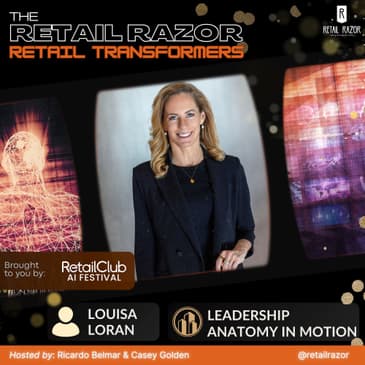



Louisa Loran on The Leadership Capacity Gap - Why Retail Transformation Stalls in the AI Era.
What if the biggest obstacle to retail transformation isn't your tech stack or your budget? What if it's the people sitting in the corner offices? In this episode of Retail Transformers, Ricardo Belmar and Casey Golden sit down with Louisa Loran, former executive at Google, Maersk, Moet Hennessy and Diageo. Louisa is the author of Leadership Anatomy in Motion. Together they unpack why so many transformation efforts stall even when the strategy looks perfect on paper. It's the leadership capacity gap . This is Season 2, Episode 7.
Louisa makes the case why the real constraint in retail today is a leadership capacity gap . The tools exist. The market is moving. What's missing is the willingness of leaders to unlearn what made them successful and become the change they're asking their organizations to make. Along the way, she explains why most companies are using AI to automate broken experiences faster than ever. How luxury went from a category to a baseline expectation. And the four behaviors that separate leaders who drive real retail transformation from those who just rearrange the org chart.
This is a conversation about the leadership capacity gap , customer experience, and what genuine retail transformation demands when there's no clear playbook.
What You'll Learn in This Episode.
• Why leadership capacity, not demand, is the constraint holding retail back.
• The “you are a chapter, not the book” trap that turns transformation into logo changes.
• How AI in retail is accelerating broken experiences instead of fixing them.
• Why luxury became the new baseline expectation for every customer.
• The four behaviors of leaders who transform: envisioning, expanding, steering, embodying.
• Why a green dashboard might be the most dangerous thing in your business.
• The first uncomfortable shift every leader should make this quarter.
Whether you lead a global retailer or a growing brand, this episode will leave you looking in the mirror and rethinking what retail transformation really requires from you as a leader.
Support our sponsors.
This Episode is Brought to You By RetailClub.
Join 2,000 retail leaders at RetailClub AI Festival, September 22–24 in Huntington Beach. Dive deep into how AI is reshaping retail while soaking up the sun at a fully outdoor, beachside venue. Decision-makers from retailers and brands can attend with free tickets and up to $1,250 in travel reimbursement. Head to retailclub.com to learn more. https://retailclub.com/retail-razor-podcast
Subscribe & Follow.
Don't forget to like, comment, and subscribe to The Retail Razor: Retail Transformers for more episodes featuring retail innovators, disruptors, and bold thinkers reshaping commerce.
Subscribe to the Retail Razor Podcast Network: https://retailrazor.com/
Subscribe to our Newsletter: https://retailrazor.substack.com
Subscribe to our YouTube channel: https://go.retailrazor.com/utube
About Our Guest.
Louisa Loran, https://www.linkedin.com/in/louisa-loran/
Website: https://www.louisaloran.com/
Author, “Leadership Anatomy in Motion”, https://a.co/d/0aU461hk
Louisa Loran advises CEOs and senior leadership teams through high-stakes decisions and structural change. Named to the Thinkers50 Radar 2026, she is recognized among thinkers whose ideas are shaping the future of leadership and business. Louisa has led transformation at Google (launching a billion-dollar supply chain solutions business), Maersk (co-authoring the strategy that doubled its share price), and Diageo and Moët Hennessy (building iconic luxury brands). She is the author of Leadership Anatomy in Motion, published globally by Fast Company Press. A strategic mind with a human lens, she has shaped industries by combining technological foresight with the courage to act before the path is clear. Across more than two decades and all continents, Louisa has worked across B2B, B2C, and global tech— bridging commercial impact with human-centered change. Louisa also serves on the boards of Copenhagen Business School and CataCap Private Equity.
Chapters.
(00:00:00) Teaser
(00:00:44) Show Intro
(00:04:03) Welcome, Louisa Loran!
(00:07:26) Leadership Capacity Gap
(00:08:32) Identity Over Optics
(00:11:44) Unlearning And Challengers
(00:17:42) Luxury As New Baseline
(00:22:17) Respecting The Rulebook
(00:24:45) Four Leadership Behaviors
(00:30:42) AI Needs Organization Change
(00:34:56) Automating Broken Experiences
(00:37:12) Change Levers Not Fifty
(00:38:11) Green Dashboards Trap
(00:41:02) Change Minds Not Reports
(00:43:31) AI Era Leadership Culture
(00:47:40) Envision Beyond Stores
(00:49:34) Four Behaviors In Practice
(00:52:13) Curiosity As Hardest Shift
(00:56:14) Make Six Seconds Shorter
(01:00:38) Show Close
Meet Your Hosts.
Helping you stay sharp, be bold, and transform retail:
Ricardo Belmar is an NRF Top Retail Voice for 2025 and a RETHINK Retail Top Retail Expert from 2021 – 2026. Thinkers 360 has named him a Top 10 Thought Leader in Retail, a Top 25 Thought Leader in AGI and Careers, a Top 50 Thought Leader in Agentic AIand Management, and a Top 100 Thought Leader in Digital Transformation and Transformation. Thinkers 360 also named him a Top Digital Voice for 2024 and 2025. He is an advisory council member at George Mason University’s Center for Retail Transformationand the Retail Cloud Alliance. He was most recently the partner marketing leader for retail & consumer goods in the Americas at Microsoft.
Casey Golden, is the North America Leader for Retail & Consumer Goods at CI&T, and CEO of Luxlock. She is a RETHINK Retail Top Retail Expert from 2023 - 2026, and Retail Cloud Alliance advisory council member. After a career on the fashion and supply chain technology side of the business, Casey is obsessed with the customer relationship between the brand and the consumer and is slaying franken-stacks and building retail tech!
Episode Music.
Includes music provided by imunobeats.com, featuring Tropikool, from the album Future Beats 2, plus Virtual Apology and New Styles, from the album Shimmer Pop, written by Heston Mimms, published by Imuno.
Highlight Clips.
[00:31:36] - I think that that the reason it makes everyone feel uncomfortable is because they they see this tool that can almost be better…
[00:38:49] - Absolutely. I mean, people feel so good where they're like, oh my god. My number's green. Mhmm. Right. Exactly. I my dashboard…
Transcript.
S2E7 Louisa Loran - The Leadership Capacity Gap
[00:00:00] Teaser
[00:00:01] Ricardo Belmar: What if your biggest problem in retail right now isn't the technology, the economy, or even your customers' expectations?
[00:00:08] Casey Golden: What if it's you?
[00:00:11] Ricardo Belmar: Our guest today, Louisa Loran, former exec at Google, Maersk, Diageo, and now one of the most sought-after executive advisors on the planet, says most leaders are mistaking busyness for progress and using AI to automate broken experiences faster than ever before.
[00:00:27] Casey Golden: She's got a name for what actually separates leaders who thrive from those who stall. And yeah, she wrote the book about it too.
[00:00:35] Ricardo Belmar: The book is Leadership Anatomy in Motion, and this conversation, well, it's going to be uncomfortable in the best possible way.
[00:00:42] Casey Golden: And stay with us
[00:00:44] Show Intro
[00:00:52] Ricardo Belmar: Welcome to the Retail Transformers podcast, part of the number one indie podcast network for retail, where we break down the ideas, the leaders, [00:01:00] and the bold moves reshaping the future of retail.
[00:01:03] I'm Ricardo Belmar
[00:01:04] Casey Golden: And I'm Casey Golden.
[00:01:05] Today's conversation is one we've been looking forward to for quite a while.
[00:01:09] Ricardo Belmar: We're diving into something that sits right at the intersection of luxury, leadership, and the reality most companies don't want to admit: the gap between what customers expect and what organizations are actually built to deliver
[00:01:24] Casey Golden: Because here's the thing, everyone wants the margins, the growth, the loyalty, but very few are willing to rethink how their businesses actually operate to earn it.
[00:01:34] So today we're getting into what's really changing across retail technology and customer behavior, and more importantly, why so many transformational efforts stall even when the strategy looks great on paper
[00:01:49] Ricardo Belmar: Our latest retail transformer is Louisa Loran, advisor to CEOs and senior leadership teams navigating high-stakes decisions, and someone who's worked across [00:02:00]companies like Google, Maersk, and Diageo. Louisa has done the thing most executives only put on a slide deck. She's actually led transformation. At Google, she launched a billion-dollar supply chain solutions business.
[00:02:11] At Maersk, she helped co-author the strategy that doubled the company's share price and pivoted it from traditional shipping to integrated logistics. And before all that, she was building iconic brands at Moët Hennessy and Diageo.
[00:02:24] Casey Golden: She's a board member and executive advisor, and she's been named to the Thinkers 50 Radar 2026, which is basically the Oscars for management thinkers. Expect the people on it to actually have useful things to say.
[00:02:38] Her work focuses on what she calls Leadership Anatomy In Motion. Not more theory, not more frameworks, but how leaders actually move, decide, and create advantage when the path forward isn't obvious. Her book titled, of course, Leadership Anatomy in Motion, is less [00:03:00] of a leadership manual and more of a mirror most executives probably weren't expecting to look into.
[00:03:07] Ricardo Belmar: This is gonna be a conversation about where the market is going, where companies are getting stuck, and what it actually takes to lead and transform when there's no clear playbook.
[00:03:17] Now, before we get into that, let me tell you about Retail Club, our sponsor of the Retail Razor Podcast Network.
[00:03:23] Join 2,000 retail leaders at the Retail Club AI Festival, September 22nd to 24th in Huntington Beach. Dive deep into how AI is reshaping retail while soaking up the sun at a fully outdoor beachside venue. Decision-makers from retailers and brands can attend with free tickets and up to $1,250 in travel reimbursement. Head to retailclub.com to learn more and get your ticket today.
[00:03:47] Thank you to Retail Club for helping us bring you this podcast and the other shows in our podcast network.
[00:03:52] Casey Golden: With that said, let's get into it. Here's our conversation with our latest retail transformer, Louisa Loran, strategic [00:04:00] advisor and author of Leadership Anatomy in Motion
[00:04:03]
[00:04:03] Welcome, Louisa Loran!
[00:04:09] Ricardo Belmar: Louisa, welcome to the Retail Transformers podcast. We're really glad to have you here with us today
[00:04:14] Louisa Loran: Great to be here
[00:04:15] Casey Golden: It's really exciting to have someone with your background to share your experience, career path, and insights on this show. So we are matchy-matchy, and let's get this fancy conversation going.
[00:04:27] Louisa Loran: Exactly. And we didn't coordinate.
[00:04:29] Ricardo Belmar: I know, right? Yeah. There you go.
[00:04:32] Casey Golden: We know what spring means.
[00:04:35] Louisa Loran: Exactly.
[00:04:35] Ricardo Belmar: Exactly.
[00:04:37] Casey Golden: Well, you've had a pretty unique path across luxury logistics and tech. I feel like we're still considered unicorns, but what pulled you into this space in the first place, and what's kept you here?
[00:04:50] Louisa Loran: Well, yes, yes, it does, it does seem unique from the outside, but, but for me, I think there are some common patterns. I think for all of them, it was a matter of, of [00:05:00] learning skills and capabilities and bringing these capabilities to where they were complementary to what was already there in the first place.
[00:05:07] So, I said the, the, the earliest part of my career was built in, in Moet Hennessy and Diageo, understanding brands and consumers and, uh, l- of course, the, the, the world of luxury and, and understanding how to create a perception of both a product and a brand. And, and I moved... I grew up in a world of marketing and, and commercial businesses, but moved more and more into how does that actually make you run your business in a wider sense?
[00:05:33] How does it influence operations, supply chains, rewards, all these type of things? And then I moved to a world of operations in, in Maersk. It's a very highly values-driven company, of course founded on asset optimization with ports, terminals, et cetera. But what I could see was that there was a huge amount of access to knowledge about global trade and about how to support customer supply chain.
[00:05:59] So those [00:06:00] skills that I had could be significantly valuable to that business, and was fortunate to be there at a point in time where there was a need for exact that change and transformation. So similarly, when I then moved into Google, it was once again saying I, I had been responsible for, for digital platforms, digital businesses, et cetera, et cetera.
[00:06:20] But seeing that from the inside and knowing how to create the bridge between a, a tech world and a more h- let's say, traditional legacy world was hugely valuable for both sides. So getting on the inside there, building solutions, technology, data solutions, AI, et cetera, and running a, a global industry there helped actually create value on both sides again.
[00:06:43] So for me, what I have done throughout my career, irrespective of whether it's one or the other industry, is, is be curious about where does change happen and what's coming next. Make sure that it wasn't just, let's say, a pie in the sky, but quite structurally go after it. And for [00:07:00] surely most effectively, find the courage within the leaders of the businesses so that they could pursue it, and they could go after it and own it after I left again.
[00:07:09] Ricardo Belmar: Yeah, that was a really in- interesting way to put it. I like how you mentioned how, those leaders have to find the courage to really pursue that and continue down that path. It's one thing to set up, an elaborate transformation and have the creativity to do it, but you have to con- sustain it and keep it going or, or it can potentially fall apart.
[00:07:26] Leadership Capacity Gap
[00:07:26] Ricardo Belmar: So o- one of the things I like about, we mentioned in the intro, we talked a little bit about your, your book and some of the work you do as a strategic advisor, and you've-- I've heard you say that the real constraint right now isn't necessarily demand, it's leadership capacity.
[00:07:40] So I really want to ask you, what, what are leaders missing about the moment we're in right now? And is it a matter of in, in o- overconfidence versus or being unprepared, or is it something different?
[00:07:50] Louisa Loran: Well, I think I, I've chosen to learn throughout my career to challenge my context, to challenge my thinking in that way, putting myself into new settings. But, but I do [00:08:00]encounter time and time again that there is a let's say an industry narrative we are best within this, instead of actually saying, what are the additional per- perspectives I need to bring in?
[00:08:09] So I put myself not just in the shoes of my customers, but also my partners and my suppliers. So, so therefore, the, the, the, let's say the chasing of where is the immediate demand today, what are the headlines telling me, is often creating a, a, an environment where people forget what they are best at themselves and how they actually make that relevant to the people around them.
[00:08:32] Identity Over Optics
[00:08:32] Louisa Loran: So I spend a lot of time with the c- the, the companies I work with today simply just being clear on who are you and who do you want to be in the future. And then we can
[00:08:41] Casey Golden: The who are you
[00:08:42] Louisa Loran: yeah.
[00:08:42] Casey Golden: gets me every time. I'm like... it just came down to ridiculous things of changing your logo. I'm like, are you forgetting who you are?
[00:08:51] Louisa Loran: yeah. W- w- what are you trying to tell me with this change besides the fact that you placed a new individual in this role who felt they [00:09:00] had a need to make a difference and therefore they changed the logo?
[00:09:04] Casey Golden: Yeah, like a font is not gonna fix your business.
[00:09:07] Louisa Loran: Oh, no. No, and I think especially in, in current time where, where let's say the movement across channels is changing people have access to a lot more information, et cetera, et cetera, that you need to be incredibly clear on who you are or it will all be blurred and people will not choose you. And I think especially right now where there's such a huge degree of change in the world and trust is declining across every parameter, especially in the developed world, if you can't trust those you buy from or what you buy, w- you are simply not, let's say, making the most of that potential relationship with your customer
[00:09:47] Casey Golden: Yeah, and I think that, that all is, it's really permeates from leadership.
[00:09:55] Louisa Loran: Yeah.
[00:09:55] Casey Golden: Somebody who doesn't, isn't obsessed with the brand, doesn't love the [00:10:00] brand, doesn't have that affinity, I think it's really hard to work in some of these retail companies. Or just company today in general, if you don't have the brand affinity for the company and believe in it you can feel that in leadership
[00:10:17] Louisa Loran: Absolutely. Absolutely. And I think also
[00:10:19] Casey Golden: all the way down
[00:10:20] Ricardo Belmar: Mm-hmm.
[00:10:21] Louisa Loran: all the way down, yes, at every single corner, in the basement, everywhere. But I think that the... What we're also seeing is that, that the change and the tenure of leaders is, is the tenure is going down now, and people are just being replaced and replaced and replaced instead of actually saying like, "What is the legacy I am responsible for now, and how am I gonna contribute to that?"
[00:10:43] It's okay to say, "I also expect in this tenure to look better on these parameters because I'm carrying this responsibility in this time. I need to prove these things." But you are a chapter in a book. You are not the book yourself. So I, I definitely see that, that, [00:11:00] the, the trigger happiness on, on implementing something to prove that activity instead of saying how I'm bettering this legacy and making it clearer for people to engage with i- is unfortunately something we see a lot right now
[00:11:13] Ricardo Belmar: Yeah. Do, do you see that often in, in the work you do with, with w- with enterprises about, you know, when you have, I don't wanna say entrenched leadership, but you know, a, a very legacy leadership that's been around for a very long time versus organizations you go into where they just had a leadership change, you know, and they're intent- with intention, right?
[00:11:33] Looking to transform things, looking to change things, and sort of disrupt themselves. Do you do you run into these extremes a lot, or is there, is there a middle that, that you're o- often working with in between those two?
[00:11:44] Unlearning And Challengers
[00:11:44] Louisa Loran: I think there are good cases and bad cases on both sides. It's not one, one perfect model, but I think it's the principle of are you willing to unlearn? So if you come from the outside, are you willing to learn what's special about this business? Why do people choose to work there? Why [00:12:00] do people choose to buy there?
[00:12:01] And what is it that you need to nurture? If you have been there for a long time on the inside, are you creating the environment where people can come challenge you? Are you making sure that the people that you hire to challenge you are actually not, let's say, dependent on your long-term revenue stream into their business so that they just cr- create that ongoing dependency?
[00:12:22] So I, I think when I look at businesses, it's, it's, it's old or new, that same lens, and then I spend quite a lot of time understanding who are the change makers in this business. Every business has a passionate individual who just wants to challenge. I'm not saying they're always right or wrong, but there's typically some interesting spaces within what they challenge.
[00:12:45] Are they getting the right context to deploy their thinking into solving the problems? Do they get the right sponsorship? When do we notice when someone starts following them? Do we, for instance, reorganize the business so it supports our future [00:13:00] strategy instead of our past strategy? There's a lot of, of, of let's say, transformative maturity you can read from who is in which roles and where.
[00:13:10] So if you're saying, "This is the new business, this is where we want to grow," but the person who has always been most respected stays in the old arm, you're sending mixed
[00:13:21] Ricardo Belmar: sending the wrong message. Yeah.
[00:13:24] Yeah
[00:13:24] Louisa Loran: so why don't you go to that individual and say, "What would it take for you to make that jump? We understand it's a bigger risk.
[00:13:30] It's a smaller revenue number most likely. But is it 'cause you don't believe that it's gonna happen? In which case we need to have that conversation and whether you have good considerations we need to challenge into the strategy, or is it because you don't wanna be part of the future story of this transformation?"
[00:13:48] So I quite quickly get to the individual motivations and mobilize people towards the change instead of just looking at it from a, a balance sheet
[00:13:58] Ricardo Belmar: Yeah. Right
[00:13:59] Casey Golden: [00:14:00] Yeah, we've al- we've also gone through a, a... The shift on, on culture where at the brands, nobody wanted to kn- it wasn't safe to stand out.
[00:14:13] Louisa Loran: No
[00:14:16] Casey Golden: You kind of wanted to keep your head down and choose your battles. And standing out was not necessarily a great thing for your career. But now I think it is becoming more acceptable to be that challenger in a room and almost necessary.
[00:14:37] But it does take a specific leader to create that space that I need you at 100% or 110%, don't shy away from things. But I do have to say I remember So many people being like, "You're crazy. You keep challenging in every..." Pick a medium. You can't [00:15:00] do all of them know? But you have to have a level of confidence or power to know, like, not gonna fire me." "And if you want this done, I'm volunteering to do it."
[00:15:17] Louisa Loran: Yeah. Yeah
[00:15:18] Casey Golden: know? But I think it's, it's starting to become acceptable now, and now it's up for the leaders to have that change that they can also, too, be that catalyst
[00:15:30] Louisa Loran: Absolutely, and I think you're right that, that sometimes actually it's, it's a privilege of the younger generations to be the challenger and the leader wants to be it themselves, but they have this amount of responsibility that they, they, they simply don't dare to. I mean, there's no doubt I've been a huge challenger throughout my career as well, but, but I've also learned, like if I get a, I don't know, a list of tasks, I do them and then challenge.
[00:15:55] It is not challenge instead of taking responsibility for what I need to do. [00:16:00] No one wants that because then you move the problem to someone else. But saying, "I've delivered this and I've come up with a better way to do it in the future." And, and I spend quite a lot of time with younger people who are like, "But, but, but, but..."
[00:16:12] I'm like, you need to create the space for people to actually absorb your ideas, whereas otherwise you're just pushing the, the, the problem to someone else. But I, I agree with you that, that the courage to speak up is essential for change, but I think that we, we should never underestimate the, the need to define the context right because people don't necessarily know what problem they need to solve.
[00:16:40] And, and I, I for instance often talk about how at, at junior level you know 100% of your specific issue, but it may not be the important thing to solve at current time. So as these mid-manager- middle management leaders, our responsibility would have at that point have time have been to say, " I understand what [00:17:00] you're saying, but my task is to connect it to this other function, and how would you use your great thinking in that way?"
[00:17:07] At the top level of the management, of course what they need to do is saying, "I understand that you've solved this problem for me, but we're actually moving at a different pace now, we're reacting to a different problem, so help me understand how it suits into that new context." And I think the, the principle of, of not saying "Thank you, I'm gonna park you in some shelf because it's not solving my problem," but acknowledge the interest, acknowledge the capability of challenging, but give them the context where they can be relevant.
[00:17:39] Casey Golden: Yeah, I think that's great advice.
[00:17:41] Louisa Loran: Mm-hmm.
[00:17:42] Luxury As New Baseline
[00:17:42] Casey Golden: Luxury used to be more of a category. Now it feels like a standard expectation for everyone. And I know that everyone has not had a true luxury retail experience or brand experience. [00:18:00] So what's changed, and where did these new expectations come from? And why are so many classically non-luxury brands why are they put-- why have they not caught up to just a level of service to try to meet any of these expectations?
[00:18:24] Louisa Loran: Yeah
[00:18:25] Casey Golden: is there, is there s- why is there still a disconnect? Luxury's been around for over 100 years. The recipe is there.
[00:18:31] Louisa Loran: Yeah. Well, well, the recipe, yes, but, but I think this is the point. It's, it's not a matter of ticking some boxes. When, when I started my career with Moët Hennessy, the, the first couple of weeks I was there, I was sent to live in a castle in France and experience what it was to have that private chef. I was allowed to go to the cellars of Dom Pérignon.
[00:18:53] I was allowed to visit the cellars of the, the the 100-year-old cognacs that I could blend into my own [00:19:00] blend so I could learn how that craft was actually so unique and so grounded in history and storytelling and all these things. I felt it. I experienced it. I got so respect. Sorry, what did you say?
[00:19:19] Casey Golden: You've got to fall in love. I go, "You've got to fall in love."
[00:19:21] Louisa Loran: It's completely falling in love, and you understand how every decision you make has to measure up to that level. and therefore, those who haven't, let's say, understood that every time they do something for these brands, they are either enhancing or diluting that picture, they haven't understood what luxury is.
[00:19:45] And another thing I think that to your specific question of what has changed, of course, with, with access to information, with social media, with let's say, filters galore, all of a sudden things look accessible. [00:20:00] We can travel the world on our phone. We can visit all these nightclubs that most people would never, ever experience.
[00:20:05] We can have a breakfast that looks like it's created by a Michelin star chef when most people have never actually tried it. So they think they understand luxury 'cause they've seen a picture of it, and they may be able to dream about it, but it's not the same thing as the scent, as the detail, as the smile, as the, the waiter's attire or anything like that.
[00:20:31] So I think the, the, the accessibility has made people believe they could, but it's not the same thing as you can. So scarcity versus accessibility is the, the, the challenge that's going on right now. And I think also because there have been a lot of projo- products that have done line extensions and said, "Actually, we need to grow, so we're gonna make a perfume with our brand name on it," and people can kind of pretend they're in the world of luxury, but you're [00:21:00] not.
[00:21:00] And many have moved away from that as well. I think we're also, of course, from a, let's say, more socio- socioeconomic perspective right now, seeing that many of those who have touched the world of luxury are now being cut off from it again because of the, the financial situation, and people don't want that.
[00:21:16] So they, they kind of make something new and they put a badge on there and they say it's luxury, but it's not. So, the heritage, the scarcity it's in the know
[00:21:25] Ricardo Belmar: Yeah, yeah. Yeah, it's interesting to me too, there are so many brands that want to create that sort of sen- feeling of a luxury experience. But to your point, maybe it isn't necessarily because what they're delivering isn't that entire experience. It's just that one aspect of it that, that tries to get their customer to feel like they're getting there or, or truly experiencing it.
[00:21:44] But I, I feel like sometimes e- even the brands that do that maybe fall into the trap themselves that they now think that they are delivering that luxury experience because they've almost rebranded themselves this way, and so now the expectations change. They expect that they're gonna get the luxury margins but they [00:22:00] haven't really invested, right, in, in the true experience.
[00:22:03] So wh- where, where do you-- I mean, how does that disconnect usually show up? How, why, how do we get there? How are the brands getting there, and is there like a s- is there a decision or something that they hit along the path that sets them in the wrong direction for that expectation?
[00:22:17] Respecting The Rulebook
[00:22:17] Louisa Loran: Well, I think, I think it is like many businesses, at some point you're like, "Oh, this is okay. I can get with- away with this." But too many of carving of the corners dilute the picture in full. I'll give an example. So last summer Luca de Meo became the CEO of Kering, the second world's largest luxury group.
[00:22:34] Well, I hope it's the second. It's one of the biggest, I will say that much. And
[00:22:38] Casey Golden: put those on a list numbered.
[00:22:42] Louisa Loran: respected, global, big, impressive, lots of famous brands, Gucci, da, da, da, da, da. The point being that he came from Groupe Renault, so automotive, largely known for mid-market cars. There was a huge backlash in the media saying, "What does he [00:23:00] know about l- luxury? He's not right for this. We need someone who's known it," et cetera.
[00:23:05] And in general, I would say that is probably a fair concern. However, I happen to have had the privilege of working with Luca when he was at, at Groupe Renault, and he is a very, very respectful person, someone who respects brands a lot. And what he did at Renault was go in and say, "Actually, what is it that this company has, and how do I protect what we're good at?
[00:23:26] How do I respect the fact that our customers can't afford luxury, but we're a mid-market brand? How do I understand what's differentiating, and how do I partner to scale all the other elements?" So it's, it's more a matter of respect than necessarily having spent all your life in a ca- in, in a certain industry that makes me believe that he will certainly be able to be successful there as well, exactly as he's, as he was at Renault.
[00:23:49] So it comes back to that, that legacy of respect and, and responsibility that you understand what you carry while you're there that makes the difference. Whereas coming in and saying, "I [00:24:00] can cut more costs I can get more reach," is, is not understanding the, the, the game you're playing. And, and I would say again, to me, this is, this is as said, what I have chosen to learn with my career jumps from one industry to the other, the, the, the rule book of one industry, many people assume that it's the same across others.
[00:24:22] It is not. But what, what one can do is you can learn to tr- to understand what motivates that other industry and therefore become r- more relevant to it. It's not rocket science, but it ca- creates it, it, it demands an active repositioning of, of someone else's context to see how you can be relevant in that
[00:24:44] Ricardo Belmar: Yeah. Yeah.
[00:24:45] Four Leadership Behaviors
[00:24:45] Ricardo Belmar: Well, it's a, it's a great point because you have been working across the luxury space into logistics and, and of course technology with Google. What, what are some of the patterns that you see that are showing up that e- each one can learn from the other to make their, make their businesses better that maybe is something most executives just don't, don't normally see?
[00:25:03] Louisa Loran: Well, I, I, I will, I will say that, that the, the m- the most important one is, is understand what are the, the motivations and, and w- where do they have their revenues coming from and, and how... what are they trying to optimize for. That's, let's say, from a business perspective. But actually, some of this also is what became the foundation of the, the four behaviors that I put in, into the book that I, I published.
[00:25:28] So this was gathered across the learnings of, of all of my career, and in, in short, there are four behaviors that I have truly seen differentiate those who manage change and, and, and grow above their industry the best, and that is envisioning ambitiously expanding with curiosity, steering decisively, and embodying with presence.
[00:25:49] And we can go through all four of them, but to answer your question, steering decisively is something you're typically very good at if you are a global legacy business. You [00:26:00] have optimized, you have done global, local, regional, you have scrutinized your cost, you have visited your processes, you have done clear communication.
[00:26:07] You've gone through all of those, so you can steer quite effectively. Versus if you are in a tech environment, you have probably envisioned ambitiously by nature because you entered the market with a dream, with an ability to say, "I'm gonna shape something new that isn't there right now, and I'm gonna be relevant in a way that people didn't even know about before."
[00:26:31] A lot of tech companies are also great about at expanding with curiosity. So Google is one example of this. It's an open business. It's a platform business. It's built on collective intelligence. We make everyone accessible, and we can see what comes from it. So all the, the thinking of building microservices and, and having people create products that can later scale is, is very much of that nature.
[00:26:57] Interestingly, the fourth one [00:27:00] embodying with presence, I don't think is, let's say, special to one type of company or not. That depends really on exactly do you know how you can be relevant in a future era as well? And some of the luxury brands are brilliant at this. They know exactly what did it mean to be classical in the 1770s.
[00:27:22] What does it mean to still be relevant today? And, and that is not about holding on to the past, but it is knowing what is culture today and what are the things that are supportive of my brand but not differentiating. So, so in that way, I have, let's say, s- extracted these from different types of companies, and none of them are, are perfect, none of them are completely wrong, but it's my desire to inspire people to learn from each other and therefore be s- more successful.
[00:27:52] Ricardo Belmar: Do you find that organizations in different segments, maybe apart from luxury, I mean, I would imagine they're gonna have some of their executives will [00:28:00] be stronger in, in one or two of those behaviors versus the others. But you know, if you go back to a, a mid-market brand, for example, do, do they tend to struggle more with that, the fourth one or, or is there, a struggle somewhere else?
[00:28:12] Louisa Loran: Well, I think let's say a mid-market brand would typically not be the ones that are envisioning ambitiously. They've seen someone else create the market and they're like, "Let me join," which is absolutely fine, but it just means that someone else is defining your ceiling.
[00:28:26] Ricardo Belmar: Mm-hmm. Mm-hmm.
[00:28:27] Louisa Loran: out of something if you have not, let's say, s- defined it
[00:28:30] Ricardo Belmar: Yeah, if you haven't defined it, yeah
[00:28:32] Louisa Loran: Exactly. So, so they are typically there and, and then some of them are very good at saying, "I can stand on the shoulders of what others have built and, and that's how I'm only gonna differentiate here, but I'm gonna partner with everyone else and therefore I'm gonna be a fast second."
[00:28:47] Ricardo Belmar: Mm-hmm.
[00:28:47] Louisa Loran: I think you can embody really well as a mid-market brand if you are clear in your proposition, but if your proposition is, "I'm the cheaper alternative," or, "I'm the smaller alternative," et cetera, then, then you [00:29:00] are not gonna have that brand equity and that IP that means that you are future relevant and future sure.
[00:29:07] At the same time, I see a lot of businesses where leaders come in and they don't understand what it means for them to embody a change. So they write a strategy, they structure a team, they see these other KPIs, this is what we're gonna do, and then they say, "See you over there," like, "Go do," instead of actually saying, "What, what do I need to do differently?"
[00:29:29] Let's say if before if it was a knowledge-based business, you may have been the smartest person in the room and therefore you became the leader, but if all of a sudden the future world is such that your knowledge-based business is now an AI,
[00:29:44] Ricardo Belmar: Mm-hmm.
[00:29:44] Louisa Loran: then for you to become the leader of the future for that business, you don't necessarily have to be a tech person, but you need to understand that you grow by usage, you grow by other people learning with you.
[00:29:57] You have to let go of [00:30:00] control and then remember if before you were the person that knew everything, all of a sudden you have to be the person that learns with people. That's a very different type of leadership style. So I see a lot of people not spending adequate time to say, "Okay, I've done the company strategy, but what is my strategy and how am I gonna create a safe space have a trusted friend, an advisor," whatever it may be, where I can go and say, "Actually, this is really uncomfortable.
[00:30:26] I, I worry I'm not gonna be that person. What do I need to learn? What do I need to practice? And if it's not me, how do I still manage the business in a successful way where I can leave when I want to, not when I get told to?"
[00:30:42] AI Needs Organization Change
[00:30:42] Casey Golden: I mean, it, it's, it's always so true, right? Like we've, we've mentioned before, people, people, people, people, regardless of how much AI. But you know, because everybody's racing into AI. And, and you've been quite clear, you know, it's not technology. We agree. It's not the technology. Technology is like a [00:31:00] commo- is becoming a commodity.
[00:31:02] It really comes down to the organization. So for AI to become a foundational, have like found- foundational use and like for the future of a lot of organizations, I think that's a lot of the narrative that's out there, is that this is foundation.
[00:31:22] Louisa Loran: Mm.
[00:31:23] Casey Golden: What needs to, to happen internally to have a foundation built on AI when it makes everyone uncomfortable?
[00:31:35] Louisa Loran: Well, I, I think that, that the reason it makes everyone feel uncomfortable is because they, they see this tool that can almost be better than themselves, and then they logically go, "Oh my God, then they don't need me." And that's also why we see businesses with 800 impor- employees having 800 agentic work streams.
[00:31:56] Uh, instead of saying, " What does our [00:32:00] business need to become, and how do we best build towards that, all of us?" It may mean that some function which before was five people only has one contribution, and another one with five has seven contributions. But if you build them individually out, then the only thing you're doing is you're hitting the wall faster.
[00:32:21] So let's say for instance, before customer service, they needed to close a case fast and and sales needed to upsell. So one upsells and the other one says, "This was an amend to the booking and I'm gonna cancel it," and then they just keep doing that all the time. Instead of saying, "What is really our objective as a business?"
[00:32:39] It is to, let's say, increase basket size, but also loyalty. You then say, "Okay, the ultimate outcome is the increased revenue," and we maybe start segmenting and saying who needs the help and who just wants a, a faster completion. So I would always say it's about knowing what your y- as we said with your [00:33:00] identity, where do you want to go, but working from a future back.
[00:33:04] And when I say future back, it is not about saying, "I have a crystal ball, and I imagine exactly what the world will look like in two years' time." But it is about saying, "I know where I have value and where it could be relevant, and let's build from that back." So as a leader, it's about holding a space, but also al- allowing for contributions, allowing for people and coming and saying, "Actually, what I do today is not relevant, but I'm afraid to speak up because then I won't get my bonus."
[00:33:34] Well, thank you for admitting that. You are still meaningful for the business, and we are gonna revisit how we reward people, so we're all shaping that future together.
[00:33:45] Casey Golden: Yeah, I feel like it's gonna take a handful of people in the room to design that, what that vision is because so much has changed and there's so many different types of capabilities, and technology's a huge part of it. And [00:34:00] so it's the vision for the company I don't feel like, can really come from one person unless they are, this wonderful unicorn.
[00:34:06] But it is more of a group project.
[00:34:09] Louisa Loran: But I would also say, why would you want it to come from one person?
[00:34:13] Ricardo Belmar: Right.
[00:34:13] Louisa Loran: you can have a, let's say almost like a guardian of the brand or something like that. Let's say, but, but, but that's more to say this is, this is the core that we protect, but everyone should sense, feel a sense of ownership and contribute to where you're going.
[00:34:29] I think that's why I'm very positive and excited about this because it actually empowers an organization significantly more. It allows people to contribute on a whole new level. It does mean that it is very hard to say, "This is exactly the outcome I expect from you and what I will measure you against," but it is easier to say, "If we achieve this together, we should all feel very proud and we will then separate for the reward accordingly."
[00:34:56] Automating Broken Experiences
[00:34:56] Casey Golden: Yeah, I've been, we've been seeing a lot of [00:35:00] companies start doing a lot of their automation. A lot of it's back office, right? Supply chain. But there's a lot of automating broken experiences just faster we all have our theories on why this is happening, but I'm not in it every day. Ricardo's not in it e- every day. Why does this keep happening? Are we that siloed that it just doesn't come up seriously in 2026?
[00:35:34] Louisa Loran: It, it, I think you, I mean, you answered it yourself. The, the point, if you tell someone, "Here's a tool, do your job better," that's what they will do, right? They will look at it from their very subjective vantage point with the information and knowledge that they hold today. So you need to set that different context and say, "In this wider context, you four people, [00:36:00] you may not have been close friends before, but you're all touching the same customer at different stages. We're buying cake for you." At the end of the day, you have come up with a better experience for them, and you need to all own the outcome together, and then we shape the journeys according to that
[00:36:19] Casey Golden: who owns that?
[00:36:21] Louisa Loran: The leader
[00:36:21] Casey Golden: mean, is that leadership? Is that structure? Like, how far do you have to go up to start blending divisions or departments or
[00:36:30] Louisa Loran: you have a very good
[00:36:31] Casey Golden: collaborations
[00:36:31] Louisa Loran: there because of course the top leader cannot, let's say the, the CEO of Walmart cannot tell this to everyone. But one of the challenges which exist in, in bigger companies and even just in mid-size is unfortunately often things get escalated to the highest level of incompetence, right?
[00:36:47] It's not that people are, are, are silly or stupid, they have different jobs. But finding the best solution on the ground, the virtual ground or the physical ground, is normally for the people [00:37:00]on the ground, right? So also spending a lot of time saying it's not about the hierarchy, it's about saying who serves, serves the customer the same way and they get together across functions.
[00:37:12] Change Levers Not Fifty
[00:37:12] Louisa Loran: So when, when I work with people on, on larger scale structural changes, we talk about what are the few change levers, not 50, we can below five. So let's say for instance, what are the customer segments? What are the future products? Some of these things that we all collectively agree on, they are part of the future.
[00:37:32] If we say for instance a customer segment and a customer journey, then let's look at that full customer journey and see who interacts at different phases. Doesn't matter whether one has a boss of a regional manager, one has a boss of a operations manager, but across that customer journey we have a shared responsibility and that's where we optimize.
[00:37:53] And then we allow people at different levels of the organization to talk to their peers and [00:38:00] solve together instead of having it go up, wait three months until it's time on the agenda and then come down and the world has changed in the meantime, right?
[00:38:08] Ricardo Belmar: Right.
[00:38:10] Louisa Loran: Mm-hmm.
[00:38:10] Ricardo Belmar: Right.
[00:38:11] Green Dashboards Trap
[00:38:11] Ricardo Belmar: Yeah, I, I feel like one of the things too that happens in, in those scenarios is that a lot of those and maybe this-- I don't wanna necessarily say this happens at that mid-level, but sometimes it's only because it's what they're being asked to from above, and that's to focus really on the measurement and the metrics as the tool that defines how successful they're going to be at this.
[00:38:31] And I know you, you have said before that the problem isn't really in the measurement, it's at mistaking that measurement as progress. And w- w-- are, are there some ex-- I mean, do you see this often where companies are in, in a sense hiding behind the metrics instead of actually making the decisions they need to be making?
[00:38:48] Louisa Loran: Absolutely. Absolutely. I mean, people feel so good when they're like, "Oh my God, my number's green." Very exciting.
[00:38:54] Ricardo Belmar: Yeah. I've-- My dashboard is green. Yeah. Yeah
[00:38:57] Louisa Loran: "But but, but what, what did it really do?" And I [00:39:00] think this is also where, where if you have taught people to worry about a number being green in a dashboard, then you haven't explained to them what the impact and value that they bring truly is.
[00:39:11] Maybe they've never met a customer, maybe they have never understood the workload that they create for other people. So all these layers of the organization have the responsibility to say, "This green number, what does it really mean?" Because it may be that a red number is better for the business overall.
[00:39:29] So for sure, this sense of completion and gratitude that people get from a spreadsheet is a misunderstood comfort that doesn't necessarily drive the change. I would also say because in any size, sizable business, setting an objective and measuring it is measuring past performance.
[00:39:52] Ricardo Belmar: Mm-hmm.
[00:39:52] Louisa Loran: are the leading indicators of the future that you want to create?
[00:39:55] Those are the ones you should be rewarding. And, and thinking about what are the, [00:40:00] the proof points of that direction that's most important. And this is not a long list. It is actually we were able to create that experience that was able to increase the margin. Brilliant. Let's talk about that story. It may be a small number.
[00:40:15] What did we learn from it? Why... What felt different? Why did the customer accept this higher margin? Was it actually the product or was it the experience around it?
[00:40:26] Ricardo Belmar: Right. Right
[00:40:27] Louisa Loran: a lot more storytelling about the learning versus the number
[00:40:32] Ricardo Belmar: Yeah. And I, I know you, you focus and you walked us through earlier on those four behaviors. And what, what I really find interesting with that is that it, it's kind of telling me that it's not as much about having more information and more data, which we-- especially now with AI, we hear so much about everyone needs the data.
[00:40:50] They need the data to be able to make the decisions. But I-- what I'm hearing your message is really it's not as much about what the data is telling you to make the decision, it's what's the behavior that needs to happen because [00:41:00] of the data?
[00:41:00] Louisa Loran: Yeah. Yeah.
[00:41:02] Change Minds Not Reports
[00:41:02] Louisa Loran: Some- someone t- taught me this sentence once and I have stolen with pride and used it multiple times since. So asking the question of what would it take to change your mind, I find hugely interesting. So going into a management meeting and people are really proud to show good numbers, da, da, da, da, da.
[00:41:22] It's, it's reaffirming and it's not really needed because people should be accountable for delivering what they do. But wanting a change, then you need to actually say what, what's the data I could bring to change your perception? And in many, many cases, it is not data that you will pull in additional reports.
[00:41:43] It is actually really it's a matter of my competition is doing something that that blew me away, and I need to understand what's our, our version of that. It's not, say, run faster and give me a bigger number. So asking the [00:42:00] question again, what would it take to change your mind? And getting people to truly think about it before they respond, 'cause it's not an easy question
[00:42:09] Ricardo Belmar: And that drives the behavior versus driving data.
[00:42:11] Louisa Loran: Yeah, yeah, yeah. And I would say especially also now where it's so easy to pull data and people come and they're like, "Well, but the la- data looks good, so I should be fine." Well, have you really thought about what data you pulled and, and why it looks fine? I think that, that we, we get numbed by more data instead of saying, what is the data that we don't see and, and what is it that enables us to make different decisions?
[00:42:36] Especially also in, in, Let's say for instance I've, I've... I'm doing quite a lot of work on, on, on global rollout strategies right now. The amount of attention that gets drawn to developed markets versus developing markets and understanding the difference in culture and therefore difference in, in, in buying capa- capacity around the world is [00:43:00] huge.
[00:43:00] But that's not what the headlines tell us. So people go, wake up, they read their news on whatever channel they do, social media most likely, 'cause that's what most people do. They go into the office and they say, "It's terrible with these tariffs. We, we, we need to, to fill our warehouses so we can continue to deliver," instead of actually saying, "There are people right now in the world who are very, very happy to buy and they're growing.
[00:43:24] How do we make sure that we invite them into our family so we actually build more optionality into our business than what we had in the past?"
[00:43:31] AI Era Leadership Culture
[00:43:31] Casey Golden: This is definitely a moment, Where everybody says it's like the AI era, right? Which I get, I get. I really feel like this moment is going, has an opportunity to build so many better leadersh- a better leadership culture going forward, as well as everybody having permission to take the time to continue their own development.
[00:43:58] Louisa Loran: Mm-hmm.
[00:43:58] Casey Golden: It's almost like that [00:44:00] permission is mandatory in order to absorb the tech.
[00:44:07] Louisa Loran: Yeah. Yeah
[00:44:08] Casey Golden: That's permission that I think a lot of people haven't given themselves in the past, that it's not a professional development, it's not a personal development, it's not a leadership development, it's not a cultural development.
[00:44:21] It's to-do list, to-do list, to-do list, to-do list, and now that to-do list relies on your ability to lead in a new way for a new type of business, new type of people, and change a very old corporate culture of standards and make this, kind of put the time in this year to make these shifts.
[00:44:48] Louisa Loran: Yeah, absolutely. But I also think we need to acknowledge that most of the leaders on top right now did not grow up in this era at all. They grew up in a different era. So some of them have [00:45:00] spent a lot of time complemented with what they have, but it's also a huge opportunity for C minus one, two, three to say, "I'll be your wing man.
[00:45:10] I'll help you out. I will carry the responsibility that you do, and I will complement you with these skills." So I agree with you, it's a huge opportunity but it's one that exists at all levels. We should not sit and wait for the, all the ones that are called CEO to change how the behaviors are because they may not actually have the same let's say input that, that everyone else has.
[00:45:35] I, I also very much believe that this is a time where those who have the ability also have the responsibility to, to, to lean in because especially with large language models, we are it's, it's easy to level out everything. The floor is being raised, but the ceiling can al- can also be lowed, lowered if you don't differentiate, if you aren't [00:46:00] constantly critical, if you aren't aware of saying, "Actually, that's not how we show up in our business.
[00:46:04] That's not what I want to optimize for." You need to continuously steer that in that way, and especially also where right now we have a lot of people investing in technology, not just, let's say, from a corporate perspective, but also, let's say, their saving goes into the shares 'cause the multiples are higher.
[00:46:21] But these tech companies do not have the operational knowledge that a lot of other businesses have. So do you really want the tech companies to shape all the agentic models or the operational models, et cetera? Or do you want to say, "Thank you for the technology. I will build it into what I know, and together we can go to market"?
[00:46:43] Ricardo Belmar: Yeah,
[00:46:43] Louisa Loran: we are seeing that companies like Amazon are building a lot of operational capability into their AI models, and a lot of the Chinese AI models are being brought closer to manufacturing and au- automation because that's their expertise. Why is that not the case for every single [00:47:00] business out there saying, "I will use all this technology for my non-dif- differentiating areas, but the area I know, that's where I'm gonna shape the market.
[00:47:08] I'm gonna transform what I have now from an analog world to an AI world, and that's how I'm gonna secure my future relevance"?
[00:47:16] Ricardo Belmar: Yeah, that's really where their opportunity is to take that leadership position, right, in the market.
[00:47:23] Louisa Loran: Yeah. It is an exciting time
[00:47:26] Ricardo Belmar: What-- Are, are there, in, in that scenario, the, the example you just h-highlighted, right, where why, why aren't they taking that operational expertise? Is there-- Does that kind of align to one of the specific behaviors you mentioned before that that's maybe missing from, from the-- for those leaders to engage with?
[00:47:40] Envision Beyond Stores
[00:47:40] Louisa Loran: Well, I think it comes back to the very first one. If you are not envisioning ambitiously, if you are like, "I'm very happy I have 30 retail stores. We are growing. We are matching the market demand. That's what we do." You may be doing some omni-channel or delivery or something, and that's how, how you're managing [00:48:00] that.
[00:48:00] But what you could actually be looking at is saying, "We know more about people's buying patterns than anyone else. That is our capability. It's not the store. Our capability is understanding what consumers need and translating that into goods on shelf." You can still sell goods on shelf, but that knowledge of reading the patterns of demand, that's your core expertise.
[00:48:26] So that, for me, is about envisioning ambitiously and not just being locked in whatever product you have today. If you envision ambitiously in that way, there is absolutely no reason why you can't first just internally capture that. You can bring all your employees to contribute to that. The model gets wiser and wiser and wiser.
[00:48:46] You can also say to some of your suppliers, "Do you want to contribute to the model? You can learn with us. We can grow together, but it's our model." You can say to your customers, "You can subscribe 'cause we can be a step ahead of you."
[00:48:58] Ricardo Belmar: Right
[00:48:59] Louisa Loran: You can even [00:49:00] have partners in other parts of the world say, "We have this knowledge, and you can use us."
[00:49:05] So you are still the core identity that you were in the past but in a very, very different format that enables you to be relevant in the future. And I said, I started, start saying, "Do it internally." I'm not saying give it away yet, but build it internally so you have that, and then start growing with it.
[00:49:23] Maybe over time that is your core business, but for now you have a responsibility to understand what it is, it, nurture it, and see where it goes
[00:49:34] Four Behaviors In Practice
[00:49:34] Casey Golden: If you're sitting next to a CEO of a, at, at a real inflection point, what would leadership at auto- autonomy in motion actually look like at that moment?
[00:49:48] Louisa Loran: Well, I, I would, I would go through the four behaviors. I would have a sense of what comes naturally to this individual? Is he able to envision or she ena- able to envision? Is he or [00:50:00] she able to actually expand with curiosity? Do they create space for people to contribute? Do they have partners? Are they open to be challenged?
[00:50:07] These type of things. Can they do all those but actually not communicate clearly and say, "Thank you. We tried this. We failed. We're gonna go this way instead"? Can they guide people on the next steps? Can they be honest about what their own, let's say future expectations are and make the staffing ahead of time for that?
[00:50:27] And, and lastly, can they actually embody that change themselves? So I will say, in theory, you can staff for the first three. You could say, "I'm not great at them, but I have this wingman, this wingman, and this wingman, and they sit very closely to me." But on top, you cannot staff for embodying the change. You can't, because then people won't follow you.
[00:50:47] They will follow whoever that will embody that change. It's okay if that's a founder or an owner or a CEO, but then the list is done. It cannot be a, "Oh, it's my assistant, my comms [00:51:00]person," or whatever it may be. So that's what I start with. I start understanding what their, let's say, awareness is, what their core skills are, where we need to grow, where we need to create something that either builds their personal capability or their organizational capability, because this is not about doing a one-off exercise.
[00:51:20] It's about training these skills continuously. So once we've kind of done that exercise, I say to them "Every day, practice them. Every single day, you have to do something where you envision ambitiously, dream a little bit bigger. You create something where people can input. You make a clear prioritization and message it, and then you show how you've grown."
[00:51:40] Because if you practice those every day, I practice them every minute, every hour, then when the big change comes, it's not dangerous. You're not afraid of change. You're very comfortable with change.
[00:51:53] Ricardo Belmar: Right
[00:51:54] Louisa Loran: Um, and, and, and that I can see grows people throughout and, and as I said, I've [00:52:00] seen great leaders who have been able to grow ahead of their industry simply by these repeated patterns because it, it be- they, they are able to raise above and, and move faster
[00:52:12] Ricardo Belmar: Yeah.
[00:52:13] Curiosity As Hardest Shift
[00:52:13] Ricardo Belmar: Are, are there-- When, when you're working with a, a organization or leaders in that, in that manner, I mean, are, are there particular flags or, or warning signs you see that say, "Oh, this is why the transformation isn't happening. This is what they can't get past"?
[00:52:31] Louisa Loran: Lots, I would say. I think the hardest one for most people is to be open.
[00:52:38] Ricardo Belmar: Yeah.
[00:52:39] Louisa Loran: expanding with curiosity, being open when it has been your entire career to have the answers. And now I'm telling you, you can't have all the answers.
[00:52:48] Ricardo Belmar: Mm-hmm.
[00:52:48] Louisa Loran: You need to be curious about what other people have of answers. That, I would say,
[00:52:53] Ricardo Belmar: And you have to be comfortable with that
[00:52:55] Louisa Loran: They need to be comfortable. They need to know what they need to unlearn. They're like, "I, I, I have the answer." I'm [00:53:00] like, "But really? Well, that was true in that context. Now you have a different context. Is it still true? I'm not
[00:53:05] Ricardo Belmar: it's not be true
[00:53:06] Louisa Loran: throw everything out, but just be open to the fact that it may not." So, so this ability to feel comfortable with a direction a responsibility, but not a complete final set objective, that's definitely the hardest part.
[00:53:23] So we practice that quite a lot.
[00:53:26] Ricardo Belmar: Mm-hmm. Mm-hmm
[00:53:26] Louisa Loran: would say it's a bit like when you have kids and you watch them do something that you know you could have done faster, but you feel much more pride. That's how I feel with them. That's how they feel with their organization. It's that sense of, "Oh my God, we got further because I created the environment for these individuals."
[00:53:44] Ricardo Belmar: Right. Right. So for any leaders who are, are listening right now to this discussion and they're, and they're feeling that pressure to evolve, what, what would you tell them sort of the first uncomfortable shift they need to be willing to make this quarter? And, and what would be the-- what would you [00:54:00] tell them the cost of not doing it is?
[00:54:02] Louisa Loran: Hmm. I, I think right now there is a lot of numbness in general. So I think we've touched upon it a few times. Be very aware of what you're, you're great at. Stop hitting yourself over the head all the time. Find that thing that you are great at, and then bring that to work, to home, to everything more.
[00:54:21] So instead of what they need to do differently, just start with that positive affirmation what, what you can actually do. Then I would say, secondly, is, is the being open. Be curious.
[00:54:32] Ricardo Belmar: Yeah, curiosity
[00:54:34] Louisa Loran: if you want to get it into a rhythm, I would say the four behaviors. But if, if you say one thing, know what you're great at and bring that.
[00:54:42] Don't bring everything else
[00:54:43] Ricardo Belmar: Mm-hmm. That's great. That's a great point
[00:54:45] Casey Golden: some of the loudest leaders in the industry right now, whether it be on tech or on retail, aren't necessarily winning me over these days. In your opinion, who's winning right now? [00:55:00] Like, where are we looking to? I feel like so much has been, is like so radical.
[00:55:08] Louisa Loran: Yeah.
[00:55:09] Casey Golden: And I'm like, where's this like, where's a, a strong North Star right now?
[00:55:14] Is there somebody that stands out to you where you're just like, props?
[00:55:21] Louisa Loran: wish I could give you a name. So I, I would say I completely agree with you. Right now, unfortunately, even many of the great, great leaders are not showing up. I think that there is an innate amount, amou- of pressure and some of the rules book- rule books are being questioned at current time. I am a firm believer that the, let's say, the, the new form of leadership will still prevail because we are seeing more challenge, more disagreement.
[00:55:55] But right now, I think that collectively these strong leaders are looking at how can [00:56:00]we show up together? Because right now the cost of standing individually seems to be very, very high. So that- that's, let's say, the meta message of I expect these great leaders to show up collectively and,
[00:56:11] Casey Golden: Great. They're in training at the moment.
[00:56:12] Louisa Loran: a different way.
[00:56:14] Make Six Seconds Shorter
[00:56:14] Louisa Loran: However, I would say I get a lot of encouragement by meeting people behind closed doors because there's a lot of desire, a lot of willingness to do it, there's a lot of intellect and hope and all these type of things. So I believe that our responsibility as, as you and me and, and, and so on, is actually to say how can we, how can we prop them?
[00:56:41] How can we support them? How can we make sure that they take this step and we are right there with them? Because it's not that hope is gone, it's not that intellect is gone. It's a matter of, of do I dare?
[00:56:54] Casey Golden: Right.
[00:56:55] Louisa Loran: And
[00:56:55] Casey Golden: that's very hopeful
[00:56:56] Louisa Loran: else, like that, that, that first person standing out looking stupid[00:57:00]
[00:57:00] Ricardo Belmar: Mm-hmm.
[00:57:00] Louisa Loran: is only looking stupid for a few seconds if someone supports them, right?
[00:57:04] So make those six seconds shorter is, is really what I am encouraging everyone to do. And, and I do see people doing good things, but it is not at the global scale that it should be
[00:57:16] Ricardo Belmar: Hmm. Yeah, so it's a, it's very much a little bit about reaching further with that curiosity.
[00:57:23] Louisa Loran: Yes.
[00:57:24] Ricardo Belmar: Yeah. Yeah,
[00:57:25] Louisa Loran: and I think also that there is a lot of, of not being deterministic with this. Uh, learning from the AIs saying, "I'm just gonna be generative. just gonna suggest do a hypothesis." It's not about saying you are wrong and I am right. could be. be
[00:57:42] Ricardo Belmar: What could be?
[00:57:43] Louisa Loran: want to join me in this?
[00:57:44] Our business could deliver this to you. Because that's also what we see in a lot of change, that someone goes out and creates a market and therefore others are willing to invest to grow it. Many industry interdependencies have come exactly through these [00:58:00] conversations. Not saying I, I will sign a contract, but if I do this, what will you do?
[00:58:06] And then together you move and you create new markets that are very let's say profitable for, for both parties. So that exploration, that hypothesis seeking, that has been at the heart of many, many industries, but not necessarily at the forefront of business the years, I think is what we're gonna see next.
[00:58:25] Ricardo Belmar: Yeah. Yeah. Well, Louisa, this has been such an eye-opening discussion. I really want to thank you for spending this time with us and our audience, sharing all these insights on how leaders, as I say, really need to look in the mirror and kind of ask themselves, are they being curious enough, right? Are they exhibiting the behaviors they need to take the business forward, whether they're, they're actively trying to transform or not even thinking about what they should be doing to go forward and to move into the next step and not be stuck in the past.
[00:58:51] I, I really wish we had a few more hours to spend on this. Um, and I'm sure Casey would wish we could dive even deeper in, into luxury specifically, 'cause [00:59:00] Casey's always open for a
[00:59:01] Casey Golden: When are you gonna be in New York? I'd like to see you.
[00:59:05] Louisa Loran: Soon. Soon. Oh, no, I would l- I, I look forward to that. And, and fortunately it is an ongoing conversation. So thank you so much for having me and, and let's keep the conversation going, whe- whether on this channel or, or, or others.
[00:59:19] Casey Golden: Yeah. I mean, I know our audience must have been taking massive notes during this discussion. I mean, there's just so many incredible takeaways and, and reminders. Things that maybe we need to set a couple reminders throughout the month to just take stock a little bit on how we're dev- you know, how we're developing and how we're, we're communicating with our team and acknowledging where we are today and where we wanna be, you know, tomorrow.
[00:59:45] If any of the listeners and viewers wanna get in touch with you to learn more or even look for your help to support their strategy and transformation, what is the best way for them to reach out to you?
[00:59:57] Louisa Loran: So of course LinkedIn is always there. Louisa Loran [01:00:00] or louisaloran.com has my information, contact forms, all of that. Or you could get started with a book, but I would say in many of these high-pressure environments, it is helpful to have a specific context and say, "What does it mean for me?"
[01:00:14] So, feel free to reach out
[01:00:16] Casey Golden: Fantastic. Thank you. We'll include that in the show notes along with a link to your book
[01:00:21] Ricardo Belmar: Oh, which we definitely recommend to everyone. Go out and get a copy and have it on your shelf
[01:00:26] Casey Golden: All right, Ricardo, this is a wrap
[01:00:29] Louisa Loran: Thank you so much. Take care
[01:00:31] Casey Golden: Thank
[01:00:31] Ricardo Belmar: Thank you
[01:00:32]
[01:00:38] Show Close
[01:00:38] Casey Golden: How much did you love this episode? Drop us a five-star rating and review on Apple Podcasts, Spotify, or Goodpods, and hit that subscribe button so you never miss an update.
[01:00:48] If you're watching us on YouTube, like and subscribe before you go.
[01:00:52] I'm Casey Golden
[01:00:53] Ricardo Belmar: Follow Retail Razor on LinkedIn, Bluesky Threads, and Instagram, and subscribe to our Substack for [01:01:00] highlights and bonus content in your inbox. For transcripts of each show and guest info, head to retailrazor.com.
[01:01:06] Retail Transformers is part of the Retail Razor Podcast Network, the number one indie podcast network for retail.
[01:01:12] I'm Ricardo Belmar
[01:01:13] Casey Golden: Thanks for joining us
[01:01:14] Ricardo Belmar: Until next time, stay sharp, be bold, and keep transforming retail.
[01:01:18] This is the Retail Razor, Retail Transformers