
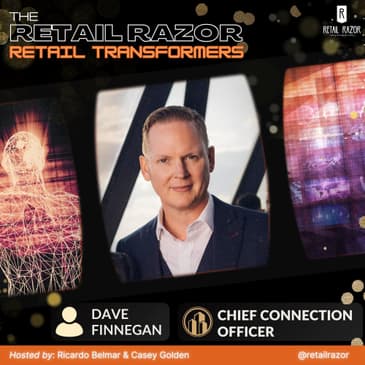



S1E6 Dave Finnegan on What Retail Leaders Must Understand Now About AI and the Future of Retail
AI isn’t just a technological shift, it’s a cultural revolution. In this powerful episode of The Retail Razor: Retail Transformers, Ricardo Belmar and Casey Golden sit down with retail innovation leader Dave Finnegan to discuss AI and the future of retail. Dave is a former CIO of Build‑A‑Bear and CIO/CMO of Orvis, explorer, anthropologist, and member of NRF’s CIO and CMO Councils. Get ready for one of the most thought‑provoking conversations of the season!
Drawing from his global anthropology journey and decades of retail leadership, Dave explains how AI as culture is reshaping identity, trust, power structures, and the human experience to define AI and the future of retail. This episode goes far beyond automation and efficiency to explore the emotional, psychological, and cultural dimensions of AI adoption.
From empathy‑driven leadership to the rising value of authenticity, from the fear of becoming invisible to the need for human connection, Dave offers a blueprint for how retailers can navigate AI and the future of retail with humanity at the center.
Key Topics Covered:
Why AI is a cultural revolution, not a tech upgrade
How AI reshapes identity, trust, and human behavior
The emotional barriers to AI adoption inside organizations
Why empathy is now a top leadership skill for CEOs
How anthropological insights help retailers navigate disruption in AI and the future of retail
The next generation of consumers as “collectors of experiences”
The rising importance of authenticity in an AI‑generated world
How to build trust in AI‑generated data and insights
Why human connection becomes more valuable as automation increases with AI and the future of retail
The role of play, experimentation, and co‑creation in AI transformation
If you care about AI and the future of retail, leadership, and culture, this is an essential listen.
Subscribe to The Retail Razor: Retail Transformers for more episodes featuring retail innovators, disruptors, and bold thinkers reshaping commerce.
Subscribe to the Retail Razor Podcast Network: https://retailrazor.com/
Subscribe to our Newsletter: https://retailrazor.substack.com
Subscribe to our YouTube channel: https://go.retailrazor.com/utube
Guest info:
Dave Finnegan. https://www.linkedin.com/in/davefinnegan/
Dave Finnegan is an award winning retail innovator, brand anthropologist, and storyteller with over 25 years of experience leading customer experience, tech and digital transformation. He helped launch Build-A-Bear Workshop (CIO) and later served as Chief Experience Officer at Orvis, driving the brand’s most successful era. Dave now advises brands and investors through roles at BlackFinn, the NRF, and NewRoad Capital Partners.
As a brand anthropologist and a member of the Explorers Club, in 2022 Dave dedicated a year to studying human experience. He traveled to every continent—interviewing indigenous leaders from the Amazon to Africa, scientists from Antarctica to the Galápagos, and some of the most interesting people in the world, including the librarian of the world’s oldest library at the Monastery of St. Catherine. He is currently pursuing a master’s in Anthropology at Harvard which is helping him to continue his journey to better understand human experience.
Featured in Ad Age Magazine feature article covering Dave’s key partnership with the CMO on delivering meaningful digital experiences, and building a true strategic partnership:
http://adage.com/article/cmo-interviews/questions-build-a-bear-workshop-cmo-teresa-kroll/235409/
Chapters:
(00:00) Previews
(01:30) Show Intro
(06:44) Welcome, Dave Finnegan!
(07:57) Dave Finnegan's Retail Journey
(09:27) Anthropology and Global Experiences
(10:47) The Next Generation of Consumers
(13:31) AI and Cultural Impact
(17:19) Navigating Technological Disruption
(22:11) Human Connection in the Age of AI
(25:42) Reflections on Past Tech Disruptions
(28:40) Reflecting on Technological Evolution
(31:03) AI and the Shift in Human Identity
(38:04) Empathy and Leadership in the AI Era
(44:11) Building Trust in AI and Data
(52:20) Show Close
Meet your hosts, helping you stay sharp, be bold, and transform retail:
Ricardo Belmar is an NRF Top Retail Voice for 2025 and a RETHINK Retail Top Retail Expert from 2021 – 2025. Thinkers 360 has named him a a Top 10 Thought Leader in Retail and AGI, a Top 50 Thought Leader in Management, Careers, and Transformation, and a Top 100 Thought Leader in Agentic AI and Digital Transformation. Thinkers 360 also named him a Top Digital Voice for 2024 and 2025. He is an advisory council member at George Mason University’s Center for Retail Transformation and the Retail Cloud Alliance. He was most recently the partner marketing leader for retail & consumer goods in the Americas at Microsoft.
Casey Golden, is the North America Leader for Retail & Consumer Goods at CI&T. She is a RETHINK Retail Top Retail Expert from 2023 - 2025, and Retail Cloud Alliance advisory council member. Obsessed with the customer relationship between the brand and the consumer. Once immersed in fashion & supply chain tech, now slaying Franken-stacks & building retail tech. She is also the Founder of Luxlock, a cross-channel customer experience management platform.
Includes music provided by imunobeats.com, featuring Tropikool, from the album Future Beats 2, plus Virtual Apology and New Styles, from the album Shimmer Pop, written by Heston Mimms, published by Imuno.
Highlight Clips
[00:00:38] - What happens to that that power structure from a culture perspective when all of us have a PhD and a lawyer and an MD in our…
[00:00:51] - It tapped into human need to express ourselves. To identify ourselves and to express who we were and what we believed. And…
Transcript
S1E6 - Dave Finnegan
[00:00:00] Previews
[00:00:01] Ricardo Belmar: So when we think about AI. Most people jump straight to the tech, the algorithms, the automation, the tools and everything you can do and build with that. But Dave brings a perspective that really flips that on its head. He sees AI not just as a technological shift, but as a cultural revolution.
[00:00:19] Casey Golden: Which is why this conversation with Dave is just so important. He's not just asking how companies adopt AI, he's asking how people absorb it and where the cultural change. The cultural shock really sets in
[00:00:38] Dave Finnegan: What happens to that, that power structure from a culture perspective when all of us have a PhD and a lawyer and an MD in our pocket that we can ask, right?
[00:00:51] it tapped into a human need to express ourselves. To identify ourselves and to express who we were and what we believed. And [00:01:00] because of that basic human need that we connected with, that's why that's one of the reasons that Build a Bear is successful is because it cuts through some of the other noise, some of the stuff that happens and gets right to some of our basic human needs.
[00:01:14] AI is about identity. It's about how we think about ourselves, how we think about others. This is the first time in the history of our planet where we've had an intelligence that is at our level that is not human. Right.
[00:01:30] Show Intro
[00:01:38] Ricardo Belmar: Welcome back to another episode of the Retail Razor Retail Transformers podcast, where we bring you candid conversations with the people reshaping the world of commerce. The crazy ones, the misfits, the rebels, and sometimes the round pegs in the square holes, but most often the bold thinkers that see things differently and drive this industry forward.
[00:01:58] I'm Ricardo Belmar.
[00:01:59] Casey Golden: And I [00:02:00] am Casey Golden. Welcome Retail Razor Fans to the show where we spotlight the leaders, the innovators and the disruptors reshaping the future of retail.
[00:02:09] Ricardo Belmar: If you're passionate about innovation, leadership, and the future of commerce, retail Transformers is the podcast for you.
[00:02:15] Casey Golden: So today we have someone who just absolutely embodies everything we designed this show to be about. Someone who has a rich, extensive retail history, but who also never strays from truly being human.
[00:02:31] We're talking about Dave Finnegan, who is probably remembered most for his long 15 or 16 year tenure at Build-a-Bear, practically since the founding of the company and spending half of that time as their CIO where he partnered with their CMO on many projects.
[00:02:50] Ricardo Belmar: In fact, Adage captured that partnership in a fantastic article about how a CIO and CMO can partner for business success. We'll put the link to that [00:03:00] in the show notes. Dave's also known for his time at Orvis as their CIO and later Chief Customer Officer with both CIO and CMO duties. So it's not surprising there.
[00:03:10] Casey Golden: His resume is like a CVS receipt! He's also been on the executive committee of NRF's CIO Council and CMO Council. He's a member of the Explorers Club and on the Retail AI Council's Executive Leadership Committee. An executive in residence at Litmus seven, strategic advisor at New Road Capital Partners. And the operating partner at Blackfin Partners where he helps brands scale by focusing on what truly drives growth, relationships, and meaningful connections.
[00:03:49] Ricardo Belmar: Yeah, talk about an impressive collection of experiences, roles and achievements right there. And today, we're not only gonna hear about Dave's experiences, but we're also going to talk about something he is very passionate [00:04:00] about, something we really believe in, something that we also feel deserves more discussion in this never ending stream of AI technology conversations, because of course, we're gonna have one more, right?
[00:04:11] So when we think about AI. Most people jump straight to the tech, the algorithms, the automation, the tools and everything you can do and build with that. But Dave brings a perspective that really flips that on its head. He sees AI not just as a technological shift, but as a cultural revolution.
[00:04:29] Casey Golden: Exactly. And. This is where we can like really geek out. Um, I'm not, it's not just about efficiency gains or process automation. It's about how AI changes the way we think, behave, and even trust.
[00:04:46] Ricardo Belmar: Right, and history shows us every major leap from the printing press to the industrial Revolution. They all reshaped culture as much as they reshaped business. AI feels like it's on the same scale and maybe even [00:05:00] faster than we can process.
[00:05:01] Casey Golden: Which is why this conversation with Dave is just so important. He's not just asking how companies adopt AI, he's asking how people absorb it and where the cultural change. The cultural shock really sets in
[00:05:19] Ricardo Belmar: That's right. I, I really think this may be one of our best retail Transformers episodes yet, which means, you know what I'm gonna say next, right?
[00:05:26] Casey Golden: pushing the fast forward button.
[00:05:30] Ricardo Belmar: Because this episode, you will absolutely believe that Dave is more than meets the eye.
[00:05:37] Casey Golden: You said it anyway. Well, we've got to find you another catchphrase for 2026 'cause.
[00:05:45] Ricardo Belmar: Let's make that a challenge.
[00:05:46] Casey Golden: Me or the audience can take anymore.
[00:05:48] Ricardo Belmar: Can take anymore. Well, that may be so. But uh, before we do that, I'll just make one quick ask of our listeners today. If you're enjoying the show, which we certainly hope you are, [00:06:00] hit us with a five star rating. Drop a short review on Apple Podcasts, spotify, Good pods, or wherever you're listening,
[00:06:07] Casey Golden: And for our video viewers, don't forget to like and subscribe to our YouTube channel. And if you haven't already. I, suggest taking a few minutes to check out our other shows in the Retail Razor Podcast Network, The Retail Razor Show, super OG, Blade to Greatness and Data Blades. You'll find them all in your favorite podcast app or on our YouTube channel.
[00:06:29] If you like this show, you'll love those too. It's time well spent, and you're just gonna have to trust us on that.
[00:06:37] Okay. Well, with that said, let's jump into our incredible conversation with our latest retail transformer, Dave Finnegan.
[00:06:44]
[00:06:44] Welcome, Dave Finnegan!
[00:06:51] Ricardo Belmar: Dave, welcome to the Retail Transformers podcast. Honestly, if there's anyone whom I think we have modeled the premise to the show for, [00:07:00] it has to be you, your background, your history in retail, and I think probably one of the most, admirable things in your rich experience during your, year long trip around the world, just absorbing and learning everything about different cultures, the human experience, understanding what that means to us in this industry.
[00:07:16] Developing that explorer's mindset. It, it's just amazing to have you here. We've really been looking forward to this.
[00:07:23] Dave Finnegan: I am honored to be here. We've been friends for a long time, so it's, it's like, uh, hanging out with, uh, two my friends. I'm really excited about it. Thank you for the invitation.
[00:07:33] Casey Golden: Yeah. It's such a pleasure to have you on this show. I mean, I think everyone knows you're one of my favorite people in retail and definitely who
[00:07:40] Dave Finnegan: what I say about you.
[00:07:41] Casey Golden: oh.
[00:07:42] Dave Finnegan: what are the chances?
[00:07:44] Ricardo Belmar: What are the odds?
[00:07:45] Dave Finnegan: What are the
[00:07:46] Casey Golden: Only be so lucky. And definitely someone who like truly sets the example. I think that that, that you do set definitely a new bar. So obviously we're huge fans of Dave Finnegan.
[00:07:57] Dave Finnegan's Retail Journey
[00:07:57] Casey Golden: But in case some of you are not [00:08:00] familiar with Dave, before we dive into this conversation, let's just take a moment to give us your background and history in retail.
[00:08:07] Dave Finnegan: Yeah, I'm happy to do that. My background is that I help to, i've been in retail for way longer than I, than I care to admit. We don't have to say numbers, right? We don't have to disclose numbers here. I've been in retail for decades and I started in retail when I helped to start Build a Bear.
[00:08:28] Build A Bear was a couple of stores when I, when I helped to start. I was there for 14 or 15 years and we grew it to four hundred plus stores in 17 different countries. I was over technology and store the future and interactive while I was there. I learned a ton about human experience there especially from Maxine Clark, who was like the master, the founder of Build a Bear, the master of of human experience.
[00:08:55] And I left Build a Bear to go to work for Orvis, which is an [00:09:00] outdoor fly fishing retailer. Orvis was started in 1856. It's been a a long around for a long, long time. When I was at Orvis, I was over technology and marketing combined. I was the experience officer there, and so we were working on rebuilding the brand and thinking about brand expansion and growth. It was a great experience. Orvis is a awesome brand and so I really appreciated my time with Orvis.
[00:09:27] Anthropology and Global Experiences
[00:09:27] Dave Finnegan: I left Orvis in 22, at the end of 21 into 22. Where I took a, a year to go on an anthropology trip, backpacking around the planet, interviewing tribes and, you know, interviewed the Ywagress tribe in, in Amazon.
[00:09:45] You're gonna be down in Brazil, so you, you'll come across potentially people from there. The Messiah Tribe in Africa, interviewed scientists in the Galapagos in Antarctica. I met with a librarian of the [00:10:00] oldest library in the world at the monastery of St. Catherine in, in Egypt.
[00:10:04] Ricardo Belmar: Hmm. Wow.
[00:10:05] Dave Finnegan: Yeah. So it was completely transformative to me.
[00:10:08] I, I came home and I was like, my first thing was I looked at my closet and said, when did I buy all this stuff? I mean, I'd been living in a backpack and so I, I saw things, stuff, differently when I came back.
[00:10:25] Ricardo Belmar: Yeah.
[00:10:26] Dave Finnegan: I valued human connection and experiences, collection of experiences way more than stuff after, after that experience.
[00:10:36] And so that, that helped to shape how, how I thought about what I was gonna do next. These days. I, I,
[00:10:41] Casey Golden: We're in the business of selling stuff.
[00:10:43] Dave Finnegan: Yes,
[00:10:44] Ricardo Belmar: Hmm.
[00:10:45] Dave Finnegan: that's right. We're all in the business.
[00:10:47] The Next Generation of Consumers
[00:10:47] Dave Finnegan: That said, what's, what I think is really interesting about this next generation of consumer is that they're a collector of experiences.
[00:10:54] Ricardo Belmar: Yeah.
[00:10:54] Dave Finnegan: More more than the
[00:10:55] Ricardo Belmar: More than the stuff. Yeah.
[00:10:57] Dave Finnegan: Yeah, more than the stuff, right? They, they collect [00:11:00] experiences and I feel like brands who understand that experiences are part of stuff. And the combination of those are the winning combination I think are the ones that are gonna win. But, so these days I, I do go to market with, with different brands. I do private equity.
[00:11:18] And then I I also am an ambassador for NRF and the Councils. Because of that human connection piece, I feel like really connecting with others, comparing notes, being vulnerable, open learning from others is extremely important. That was one of the things I really, really appreciated. One of the other things that I learned when I was traveling is a, a Zen concept.
[00:11:41] And the concept is that when you go into a new experience or you meet a new person, if you, if you go into that experience with your cup ready to receive you'll learn a lot
[00:11:53] Ricardo Belmar: Mm-hmm.
[00:11:54] Dave Finnegan: Instead, if you think you know it all, or you have to demonstrate that you know it all, or you think you're smarter or you think [00:12:00] you're better in any way, or you judge from the your own perspective, then you miss out on what you could learn.
[00:12:07] And so I'm that, that's really important to me and connecting with others is really important to me. So that's, that's a lot of what I do these days.
[00:12:15] Casey Golden: It's a great analogy, I think. Especially now that we're coming into the age of AI. Nobody knows shit. So just have the conversations, you know, and have the theoretical discussions and kind of, you know, I think there's a little bit more openness that everybody knows that everybody's learning. And everybody's thinking about things differently and having those perspectives.
[00:12:43] So I hope that these types, those types of people just remember just kind of go in with that, that cup empty
[00:12:49] Ricardo Belmar: Yeah,
[00:12:49] exactly.
[00:12:50] Casey Golden: right, like otherwise leave with an empty cup.
[00:12:53] Dave Finnegan: Yeah. You know, it's a, it's a great point, especially when it comes to go to market. There's lots of software [00:13:00] companies that are saying, this is, you know, we've got AI figured out. We've been doing AI for decades, or what, however, they spin it. And instead if you go into it with this vulnerability that we're learning together.
[00:13:12] But we've, we've got some things that are starting to really show some great results and, we're gonna craft this together, like we're co-creating. I think brands that understand co-creation and telling that story in a, in a really authentic way, are the ones that are gonna win.
[00:13:27] Ricardo Belmar: Yeah, absolutely.
[00:13:28] Casey Golden: So as always, it's just amazing to have a conversation with you.
[00:13:31] AI and Cultural Impact
[00:13:34] Casey Golden: I love when we get to push record. So let's just jump in and talk about AI culture and what's really transformational. When we look back at every massive technology leap, printing press, steam engine, the internet. Each leap changed how people saw themselves. Where do you think AI lands on that timeline and what kind of cultural impact do you think we're still underestimating.
[00:13:59] Dave Finnegan: That's a [00:14:00] great question. So I'm studying anthropology right now. And so. In fact, I had class two nights ago. My class right now is the culture of play and the power of play, which is awesome for a guy who is a toy, toy guy, right? In sports and how, how impactful that is. So interestingly, I, I, I wrote a paper or started a paper where my thesis was about this.
[00:14:25] And the idea is if you think about, from an anthropology perspective, what makes culture. And what, how culture works. Culture is ritual, it's language, it's connection, it's respect, right? There's a hierarchy to culture and typically we, we respect and the hierarchy is around people who have knowledge and wisdom.
[00:14:48] So if we think about shamans or chiefs or warriors, these people historically have had wisdom and experience. That elevated them and [00:15:00] allowed others to they shaped how others thought because of how they thought. Right. And so what's interesting that's happening right now is, and this is illustrated, like when you go to the doctor, you'll go to the doctor to ask questions.
[00:15:15] You're, you're listening to the doctor and your trust is very, very high. Right. Or an attorney, or a consultant or whatever. What happens to that, that power structure from a culture perspective when all of us have a PhD and a lawyer and an MD in our pocket that we can ask, right?
[00:15:36] Ricardo Belmar: mm-hmm. Yeah.
[00:15:38] Dave Finnegan: we're, we're, we're, we're living through a really cool time in the world.
[00:15:43] We're living through something that's similar to, the industrial Revolution, but we're, we get to live through it, right? And so yeah, we get to build it, we get to help you to navigate, we get to help to figure it out. And it's, it's of that [00:16:00] scale and I think people who understand it's that scale, will win in the end. That they, they get that it's more culturally significant than just a technology significance. So I think, I think tho those that navigate it and think about how can we help our humans to culturally navigate this are gonna be much better off.
[00:16:22] Casey Golden: I feel like a lot of technologists continue to underestimate how much people want to work and engage with other people. I think the technology has always underestimated the, the connection to people. What do you, what do you, how do you see this kind of moving with this, with like consumers and ai, like on a society basis?
[00:16:46] Like we can see like this huge shift of deleting people or putting technology in between to replace like a human connection seems to be where everybody keeps moving. AI first is to replace that moment but [00:17:00] I feel like society needs it or is really stuck on the idea that like, I'm not gonna change, I still want people, what?
[00:17:07] What do you think on there's a contrast here, right? There's a contradiction of where things are going, what's being said, versus maybe it's just like the core base of, of humanity.
[00:17:18] Dave Finnegan: Yeah, I, I would make two observations.
[00:17:19] Navigating Technological Disruption
[00:17:21] Dave Finnegan: One is that AI is super exciting and I can be really excited about it at the same time or in the same day that I'm concerned about what it means for my future. It's future, what it means for humanity. Both of those can be true. And so I'm more on the excited part of the, the spectrum.
[00:17:42] However, there are things that we need to know from a culture perspective because it's much broader than just what's gonna happen with me culturally. How do we, how do we navigate this from a culture perspective? People. I think honestly they, they don't resist [00:18:00] technology or AI because of it being AI.
[00:18:04] They, they, if there's concerns, it's the concern is that they, they become invisible in that process
[00:18:11] Ricardo Belmar: Yeah. Right,
[00:18:13] Dave Finnegan: and that sense of a loss of who am I in this process, that triggers grief and, and fear
[00:18:22] Ricardo Belmar: Yeah.
[00:18:22] Dave Finnegan: and it, and it triggers it way before curiosity, by the way. Right? Just from a human perspective. If I don't know where I fit,
[00:18:29] Casey Golden: Mm-hmm.
[00:18:30] Dave Finnegan: then, then it introduces fear and, and grief before curiosity.
[00:18:35] Ricardo Belmar: it, you, you kind of get that that resistance is more of an emotional reaction, right. Than a logical one. And something it seems like it's almost a knee jerk reaction because on the technology side, you have everyone screaming out it's all about AI adoption. It's all about AI adoption. You have to keep doing more and more and more with it.
[00:18:54] And it seems like that's where the resistance come from. People have this emotional reaction to that, versus [00:19:00] thinking through logically, what does that mean to adopt it?
[00:19:02] Dave Finnegan: Yeah. Interestingly, I think you're spot on the, what we often do to try to help people navigate that is we tell them what's possible, right? We say, Hey, look at all the great things this is gonna do, and that kind of stuff. I think that's super important. That's half the equation. The other one is acknowledging upfront to your earlier point, Casey, that we don't have all the answers.
[00:19:24] We don't know how this is gonna go. We know it's gonna cause disruption. When, when leaders are really open about that and they say, we know that this is gonna cause disruption to our business, and we're gonna have to figure that out together. We wanna work as a team to do that. We don't have all the answers.
[00:19:43] We're, we're gonna work together to make sure that we get there. When they acknowledge that there's change and that it's challenging, then people feel seen.
[00:19:54] Ricardo Belmar: Mm-hmm.
[00:19:54] Dave Finnegan: Right. People feel like, oh my gosh, they understand that I am concerned about this [00:20:00] at some level. Right. That combined with what's possible, those two, that yin, yin and yang of, we get that this is a challenge and we're gonna do it together, plus here's all the possibilities. I think those two combined are, are how we're gonna navigate this. I think companies, unfortunately, most of us go right to the, well, it's gonna pay us back and it's gonna eliminate this and this and that. And we don't do the acknowledgement part upfront.
[00:20:30] And when we don't do that then, then it creates. It creates an extra level of fear for people. 'cause they don't know. Right. And they don't feel like they're seen, they feel invisible in that process.
[00:20:42] Casey Golden: So would you say that every big leap starts with broken trust?
[00:20:45] Dave Finnegan: It has,
[00:20:47] Casey Golden: It has,
[00:20:47] Dave Finnegan: it has historically. Right. If you think about it from a pure anthropology perspective and it's, it's, it's a really a fear of the unknown. Right? And so, [00:21:00] and I don't know if it's, if it's a trust question or a just a fear question. A fear of loss question, right? Like suddenly I don't, it's not like I don't trust anyone.
[00:21:10] It's, I just don't know. Right? And my fear is that I'm, I'm gonna lose myself in this whole process. And so. major cultural revolution that we've ever had. It has that. It's part of the ingredients of it in, in fact, betrayal, feeling like I'm betrayed part of the process. That always shows up first, right?
[00:21:34] Casey Golden: I definitely felt some of that already, like the trail by some brands that did this or did that, or they're amplifying this versus that. It's not even like personal. But I'm taking it personally.
[00:21:47] Ricardo Belmar: Yeah. Yeah. It goes back to that emotional response, right?
[00:21:51] Casey Golden: I didn't even shop with them, but I'm still feeling like betrayed by like the industry or whatever you know, it's just like, how can you do that? It's so [00:22:00] wrong on so many levels, but on the same time, I'm like, it's so much cheaper.
[00:22:04] Dave Finnegan: Yeah. The, the bottom line is I'm a huge fan of where we're going.
[00:22:08] Ricardo Belmar: mm-hmm. Yeah.
[00:22:09] Dave Finnegan: It's a question of how we navigate that.
[00:22:11] Human Connection in the Age of AI
[00:22:11] Dave Finnegan: And I think from a human perspective, it isn't about convincing humans. It's about seeing them.
[00:22:18] Ricardo Belmar: yeah, yeah, yeah.
[00:22:21] Dave Finnegan: I feel like if we go through this process, seeing humans as we go through this process and not losing track of seeing them and knowing that there's uncomfortable conversations and that, that their jobs are gonna be eliminated, but we're gonna look for opportunities to redeploy that kind of, those kinds of things. I think it's all about humans being seen and not invisible in the process, and that that's the thing that causes the most
[00:22:44] Casey Golden: I think that makes a lot of sense. It makes, I mean, I'm still reconciling, you know, like you said, like I feel this way and this way at the exact same time, and they're like polar opposites.
[00:22:53] Ricardo Belmar: Right? Yeah. It's like what? Yeah. It's kinda saying you, how you get there in a way that matters more than getting there [00:23:00] in that sense. Right. Because it,
[00:23:01] Dave Finnegan: yeah, yeah. Because this is a cultural
[00:23:04] Ricardo Belmar: Right, right.
[00:23:05] Dave Finnegan: The, the hardest part is the human part of this change, not the technology part of this change. For sure.
[00:23:11] Ricardo Belmar: Well, it remains there. There's a stat floating around and I, I can't remember where seeing this, but that basically saying that if businesses take AI and they use it to optimize an existing process, right?
[00:23:23] So just saying, here's how we're doing things. Let's throw AI at it and make it better. Maybe you get 30, 40% improvement. But if instead , you look at the problem in front, well, what could I not do before that the AI can do that's new, right? Something where I basically, you're letting it start from scratch.
[00:23:40] Forget my existing process. Now I have this AI technology. How do I use that to do something better? Then you can almost double that lift. Right? It's closer to like 80% to do that. So, what do you think this says about our willingness or, or maybe it's reluctance or both, right, to adopt new things like that?
[00:23:58] It is basically saying you have to [00:24:00] unlearn your old ways of, of thinking. And, and I kinda, I say that I'm, I'm like immediately in my head going into the old Star Wars Yoda reference of you have to unlearn what you have learned young Skywalker.
[00:24:13] Dave Finnegan: Yeah, that's, that's the interesting thing about humans is that we're wired for control,
[00:24:19] Ricardo Belmar: Hmm.
[00:24:19] Dave Finnegan: right? We're wired for control because it's a safe place that we can build on, right? And so, so looking at a problem and saying, how can we automate an existing opportunity feels like a safe place because we know what that process looks like.
[00:24:38] We know what the controls are there and and we're wired that way as humans. So. That's part of our humanness. It's okay that we we're like that a little bit as we recognize it though. I think what's embedded in that stat, obviously is the, the idea that the AI rewards a willingness to step into [00:25:00]uncertainty, right.
[00:25:00] In a really meaningful way.
[00:25:02] Ricardo Belmar: Right.
[00:25:03] Dave Finnegan: So the, the real transformation happens when people stop asking, how do I, you know, redo this old process and instead, how do I completely disrupt what I'm doing?
[00:25:12] Ricardo Belmar: Right.
[00:25:14] Dave Finnegan: And, and that's, that's honestly where the 80% live. But it's uncomfortable for humans to do that. And that's okay to recognize that it, it's uncomfortable for all of us and we should feel.
[00:25:26] We should recognize that and say it's uncomfortable. Let's go after this and figure out things that we can do that's gonna disrupt our business in a really meaningful way.
[00:25:35] Casey Golden: Yeah, and just like rethinking it as if you're starting from scratch.
[00:25:40] Dave Finnegan: Yeah.
[00:25:40] Ricardo Belmar: exactly. Exactly.
[00:25:42] Reflections on Past Tech Disruptions
[00:25:42] Casey Golden: You've lived through several waves of disruption in retail, innovate from retail innovation to digital transformation. Had to roll up your sleeves across multiple changes here as technology has, just completely evolved from, you know, 20 years [00:26:00] ago how we're doing some things. Even though most of the time it feels like retail is moves so slow.
[00:26:07] Dave Finnegan: There's always something new,
[00:26:09] Casey Golden: You have to acknowledge the fact that there has been a lot of change. What feels different about AI is do you think this is the first time tech is moving faster than our ability to culturally process it.
[00:26:24] Dave Finnegan: I think the. I, I, I have been around for a few decades and we've all been in the industry for a long time, and if we combined our, our, you know, years that we've been in retail, it's been a long time. So I would ask you two, what do you guys think about this compared to the other tech disruptions that you've seen?
[00:26:46] ' cause you've been in the industry for a long time. You've seen cloud compute, you've seen. Hell, I saw the internet come out,
[00:26:53] Casey Golden: Yeah.
[00:26:54] Ricardo Belmar: Yeah. Yeah.
[00:26:55] Dave Finnegan: Yeah. I was there. You know, I was on a OLI was I was on CompuServe [00:27:00] doing stuff before the true internet came out. And so, I've gone through a few of these before.
[00:27:06] I'm curious what you guys think, 'cause you've been in the industry for a
[00:27:08] Ricardo Belmar: Yeah. I mean, I, I personally think it, it absolutely is one of these kind of moments when I look back, you just mentioned like with the early days of the internet, right? And if we think about how retail worked before that, and you just had stores. That, that's, that was it. That was the channel.
[00:27:25] You had stores, and then you had, you know, retailers who had a catalog. So there was mail order in stores, and then this internet thing came around. And in those days, I was looking at it from the point of view of helping retailers connect stores together, which wasn't new idea. I mean, the idea that, you know, you, you
[00:27:43] Dave Finnegan: For some retailers that's still new idea!.
[00:27:46] Ricardo Belmar: Yeah, yeah, exactly.
[00:27:47] Yeah.
[00:27:48] You
[00:27:49] Casey Golden: I know lots of brands that don't have.
[00:27:51] Ricardo Belmar: Oh yeah. I, I know. But you know, I, I, there's one moment. And it's not so much a retail one, but it, you know, think of car dealerships, right? Which, which is [00:28:00]essentially a retail location, right? It's a different kind of store in a sense. But the idea of car dealerships who are basically independent, right from the brand, but they work with the brand, this idea of them being connected to the brand was such a foreign concept at the time, and it required so much emotional and logical change in their way of thinking. For just something as basic as like, you take your car in for warranty repair, right? Well, what you intuitively you think, well, that probably requires some kind of connection back to the brand. 'cause you know, the as the consumer it's probably being done at no cost to you, which means somebody's picking up that cost.
[00:28:35] It's just not you. But that means that dealership, that brand, they have to be communicating for this.
[00:28:40] Reflecting on Technological Evolution
[00:28:40] Ricardo Belmar: And how did that happen before, right? You know, we, we don't think twice about this now, right? It's become ingrained in our, in our way of doing things. It's just perfectly natural. You just expect these things to exist.
[00:28:50] But I remember when that was brand new and you would talk to people at the automotive brand and this idea of the fascinated by, we'll actually be connected to them. [00:29:00] And it was a completely foreign concept that we totally take for granted now.
[00:29:04] Dave Finnegan: So how do you think that's different than what we're going to, what we're experiencing through AI? Or is it just the same?
[00:29:11] Ricardo Belmar: I, I personally think it's very similar in, in that you do have that kind of shock moment, right? Where you're suddenly realizing that there's a whole new set of possibilities being opened up. And it's one of those moments where if you look back, then just, you know, okay, internet can connect us well, there are things that were disconnected that I do today.
[00:29:30] Very similar, right to what we just said with ai. Here's a process of how we do things. Now it's really slow. But if I have this real time connection, it's gonna be a lot faster. Fantastic. The world is gonna be great. But then you haven't thought about, well, what could I never do before that I'll have the ability to do now that I can create that's brand new that I never thought of.
[00:29:50] I think it's a similar thing maybe with, with mobile and smartphones, right? Where, we all remember the early days in smartphones when everybody in retail talked about showrooming [00:30:00]and everybody. Yeah.
[00:30:04] Dave Finnegan: I had a man, that thing was the coolest phone,
[00:30:07] Ricardo Belmar: yeah. Yeah. That's right. But yeah, I mean, just think of, to me, think about the reaction a lot of retailers had of this idea.
[00:30:14] Customers coming in the store and with their, with these smartphones, and they can comparison shop, they can do all these things that they, I used to have them captive in the store. Right. And so I can, as the brand, I controlled that experience a hundred percent while they were captive in, in the store. And now suddenly there's this revelation of freedom, right?
[00:30:33] That the consumer comes in, they, and asks us anything they want. They're not constrained by the four walls that they're standing in anymore. And you had to adapt and relearn is exactly what we just, you had to unlearn how you did things before, because there's a completely new way now that hasn't really been defined yet.
[00:30:49] I mean, I, where we haven't defined this, right? We're all still trying to learn, we're what can we do, what can't we do? What can we build?
[00:30:54] Dave Finnegan: I, I think, I think there's a lot of, to your point, there's a lot of [00:31:00]similarities in things that we could learn from from the past.
[00:31:03] AI and the Shift in Human Identity
[00:31:03] Dave Finnegan: The thing that's different for me about this one is it's more intimate. It. In other words, it's not a technology that's sitting in your pocket or sitting on your desk. It can literally write with you.
[00:31:14] It can reason with you. It can imagine with you. That's not a workflow shift, that's a relationship shift, right? So suddenly digital transformation was about tools and process. AI is about identity. It's about how we think about ourselves, how we think about others. This is the first time in the history of our planet where we've had an intelligence that is at our level that is not human right?
[00:31:46] right? And so from a human perspective to process that, we're dealing with an intelligence that is no, that is not human. It it's, it's different that way. So I think there's a lot of lessons learned. To your point,[00:32:00]
[00:32:00] Ricardo Belmar: Mm-hmm.
[00:32:01] Dave Finnegan: and I think if we understand, if we layer on the idea that this is about identity. And about who we are as humans, and that it's, it's not just a technological change.
[00:32:12] We can learn from that in the past, but if we also apply some of the things from a culture perspective that'll help us navigate this from a trust, from a, you know, from a being seen perspective, I think those two combinations will help us to
[00:32:26] Ricardo Belmar: Yeah. Yeah. Well, and, and of all the things that you experienced in that year, you spent. Traveling around the world and, and experiencing and absorbing all these other cultures. How do you look at that and kind of in the context of what you're just describing in this, this change with AI and this almost like technology as an equal almost.
[00:32:46] Right? And in a sense, are there things you learned from your experiences and, and how other cultures look at their existence? And look, you, you think, yo, this says something to me and speaks to what we need to recognize [00:33:00] now with AI.
[00:33:02] Dave Finnegan: That's a really, really great question. I think, as I think about it, what was, what was one of the things that I realized is that there are human elements that no matter who or where we were in the world, where the same. Like a human smiling at you. We were in the borders of the Sudan on the border of Morocco and spent some time with a bedouin woman and we went to her, her little, they're nomadic. And so her little stick hut, she had little rooms. Interestingly, she had a smartphone by the way, and she had a, she had a little solar panel for her smartphone, and she was texting her husband who was at the camel market selling camels. But we didn't speak the same language. But I could tell from her face that she was, warm and welcoming, right? We were drinking tea in her tents together. [00:34:00] And the fact that we have human connectedness, that is something that is built into us. I have a brother who, who I heard him quote this once that from someone else. So I apologize for not knowing the source of where this is, but a person once said that, you know, we were born into this world the, the umbilical cord is cut, and then from then on as humans, we look for reconnection.
[00:34:29] Casey Golden: Oh, that's interesting.
[00:34:30] Ricardo Belmar: Oh, that's a good way to put
[00:34:31] Dave Finnegan: And so we, so as we navigate this, if we remember the human part of it, then humanness, I actually think what's gonna happen, and, and we're seeing that right now, is as algorithms take over in a meaningful way, which again, I'm, I'm a fan mostly of doing that as they take over in a meaningful way.
[00:34:50] What will also be a premium is the fact that we connect with each other. So human authenticity will matter, more human hugs will [00:35:00] matter. More human looking at each other's faces and seeing each other that matters more. And so interesting paradox that as we see these things rise, we're also gonna see the rise of human connectedness because it's part of who we are.
[00:35:13] Ricardo Belmar: Mm-hmm.
[00:35:14] Dave Finnegan: And so I think it'll be interesting to see how we navigate that as human.
[00:35:18] Ricardo Belmar: How?
[00:35:19] Casey Golden: there's a play, oh,
[00:35:20] Ricardo Belmar: Oh, that's,
[00:35:21] Casey Golden: I. A big play, play. I'm, I'm kind of like, woven a lot of Maslow's hierarchy of needs, like into purpose, user experience. Does it provide a sense of belonging? Is it, how much, you know, am I moving people towards joy versus, everybody wants to avoid pain, right?
[00:35:42] Dave Finnegan: You feel seen, right? It's.
[00:35:45] Casey Golden: You feel hurt. You have the psychological needs. Right? You know, had to cut people off from massive shopping addictions to just be, no, what's up? How's everything going? [00:36:00] Shit has obviously hit the fan. You've been in here every other day for a month. What's going on? Stop shopping. You're feeding something that we need to feed it somewhere else.
[00:36:10] Right, and kind of like managing those needs of being human, right? Because we supplement it. We supplement it a lot with shopping of, you know, how we feel like we shop our feelings, right? Like they say are you eating your feelings? We definitely shop our feelings.
[00:36:27] Dave Finnegan: One of the things that we learned at Build-a-Bear when we launched the brand, we, we always knew that creating one of the things that Maxine Clark was a master at is leading with the experience itself.
[00:36:40] And she would make sure that we were laser focused on it and making sure we're delivering on it.
[00:36:47] What we, what we learned very quickly is that what was happening with kids coming into the store, or adults or whoever was building the bear that we [00:37:00] tapped into this human need of expression and personalization, right? The, the ability to express myself in a really safe way. That's what Build a Bear magic was, it tapped into a human need to express ourselves. To identify ourselves and to express who we were and what we believed. And because of that basic human need that we connected with, that's why that's one of the reasons that Build a Bear is successful is because it cuts through some of the other noise, some of the stuff that happens and gets right to some of our basic human needs.
[00:37:35] And I think brands who understand our human needs in this process, going back to how we're gonna navigate this from an AI perspective. As we, as we do that, and some of these things get automated out of our lives that we don't have to do anymore. Remembering our human needs and our human need for connectedness is gonna be really, really important.
[00:37:55] 'cause we could be in this place where we get more lonely instead of [00:38:00] less lonely.
[00:38:00] Ricardo Belmar: Yeah,
[00:38:01] Casey Golden: Yeah, my fears.
[00:38:03] Dave Finnegan: Yeah.
[00:38:03] Ricardo Belmar: yeah. Yeah.
[00:38:04] Empathy and Leadership in the AI Era
[00:38:06] Ricardo Belmar: It, it feels like, the qualities like empathy, I mean, intuition, creativity are become more and more important as we automate more things with AI, and AI gets deeper and deeper ingrained in, in routine things that we may be doing over the next decade. And do, do those kind of emotional things around empathy and criteria, is that becoming the luxury goods over the next decade in, in terms of how we see ourselves and how we seek things out.
[00:38:35] Dave Finnegan: Yeah. You know, it's interesting you say that. The last couple of years when I came back one of the things that really intrigued me was what if I think about the best leaders that I've ever had, and the ones that I think are most effective they are super good at empathy.
[00:38:50] Ricardo Belmar: Yeah.
[00:38:51] Dave Finnegan: That doesn't mean that they accept mediocrity.
[00:38:55] They don't.
[00:38:55] Casey Golden: Yeah.
[00:38:55] Ricardo Belmar: Yeah.
[00:38:56] Dave Finnegan: They do not. They just come from a place where [00:39:00] we understand, where we hear you, and we see you, and this is where we're headed. And so, interestingly, I did a little bit of research several months ago, and in the top empathy listed as a CE, CEO trait is in the top three.
[00:39:15] Ricardo Belmar: Hmm. Interesting.
[00:39:17] Dave Finnegan: CEOs today is how good are they at empathizing with the organization?
[00:39:23] Again, sometimes we mistake empathy for thinking that it's okay to be, you know, fall short of our goals. It's
[00:39:30] Ricardo Belmar: No, it's not the same. Yeah.
[00:39:31] Dave Finnegan: Empathy is seeing the other person. Empathy is a investigative process of asking and putting ourselves in that spot all the time. Always trying to see the other perspective. Really, really good leaders navigate using empathy, and that's kind of the glue that connects results with cultural change, I think, is having leaders that understand empathy and understand how [00:40:00] empathy is, is an important bridge through this process.
[00:40:03] Ricardo Belmar: Yeah, I think it's really important.
[00:40:05] Casey Golden: want AI to really work, and it's not just about the tech stack, the belief system. What kinds of leadership mindset makes the difference between 40% adoption, 80% transformation?
[00:40:20] Dave Finnegan: For me, I think about, so it goes back fundamentally, I think really, really good empathetic leaders help organizations to navigate change. I think about the leaders that were successful during COVID. Big unknown culturally, huge change. People were now working from home for the first time. The leaders who were empathetic in that and transparent and admitted that they didn't have all the answers, they're the ones that helped their organizations to succeed during those times or to navigate those well, were going through a similar time, so leaders who have the skillset of empathy, I think is, is a critical [00:41:00] skillset. I think setting a culture of, people get worried or fearful when they don't know how they fit into the future. But if you set a culture that says, we're giving you the opportunity to dive right in, to use AI to make mistakes, to craft where you fit, and if we co-create that future together where people see where they fit into the future. Then it's gonna help our organizations way more to navigate this, this, this change.
[00:41:31] So I think empathy, crafting a future and giving people the ability to try tools. This is not controlling things. You know, I, I, I was on stage a couple days ago and talked about a a time where a company, a shoe company, brought me in to talk about AI and AI investment.
[00:41:52] And I walked in there and the, the people that were in there were the CIO and the ciso and there was no one else [00:42:00] from their company there. And they wanted to talk about how they were gonna lock things down and get their arms around how AI was gonna be used. I think the companies who take that kind of mindset that we're, we're throwing a lasso around this and we're not going to allow or we're gonna control. Don't get me wrong, I'm a huge proponent of making sure that we're responsible and that we do it in a safe way and I just think that there's a balance between that, right?
[00:42:28] So let's, let's enable our workforce, let's let them get into the tools, let's let them help invent what the tools, what the process, what the experience of the future looks like through an AI lens. Because when they're leaning in and they're taking these tools on, and they're coming up with, you know what I learned?
[00:42:45] I learned that I could do X, Y, and Z, and that would eliminate this or this or that. If they're part of the solution in that process, because we create a culture of play. Play this game together and we're gonna correct, craft it together. I [00:43:00] think between empathy, play and then expectation, like we gotta get paid back.
[00:43:04] Right? Those things balanced, I think are the, the companies that are gonna see the most success.
[00:43:11] Ricardo Belmar: Yeah. Yeah. I, I feel like when, when companies do that, they're building a layer of trust, both between their own employees. Kinda go into your example of the CEO and the CISO who are so laser focused on how do I lock this down and secure it? Where, where I, when I hear that, I, I think of, well, maybe the perspective isn't so much that you're locking it down and controlling it, but how are you ensuring that there are guardrails and that it's safe and that it's, there's no, nothing dangerous is gonna happen. Nothing's going to, data that you don't want to be released isn't going to escape. Right. Versus this notion of I have to lock it down because it's scary. Or because it's dangerous.
[00:43:51] And it's, to me, it's a, it's a minor tweak, right? And how you think of it, but one version builds trust and the o. And I think going back to what you said, Dave, about being [00:44:00] empathetic it builds that understanding that you're recognizing what people are doing and need to do versus trying to just control everything.
[00:44:08] And I think that's super important that way.
[00:44:11] Building Trust in AI and Data
[00:44:13] Ricardo Belmar: And when we look back at things, and I would argue if you look back historically, right, so many things are shaped around trust, whether it's new technologies, new, new cultural movements whether it's, revolutions, whether it's changes in media, these rise of influencers, how brands engage with customers, a lot of that is built around trust.
[00:44:30] So if you look forward at where we're going and where AI's kind of taking us, is there anything you see that you would label as the next trust crisis that's coming up that people need to really think about and and recognize, especially when we start letting the AI and the algorithms start running things.
[00:44:48] Casey Golden: Our car, access to our money.
[00:44:52] Ricardo Belmar: No. For example, minor example.
[00:44:56] Dave Finnegan: So, it's a great question, and actually I don't [00:45:00] think this is happening in the future. I think it's happening right now. We're right in the middle of this, and I, I would give two to answer your question. where are we gonna feel kind of trust crises in, in this process? There are two that come to mind straight away.
[00:45:15] The first one is there'll be a trust. There's a trust crisis of authenticity.
[00:45:21] Ricardo Belmar: Hmm.
[00:45:22] Dave Finnegan: You know, just think about you scrolling, doom scrolling on social media. Now you're seeing videos that you can't believe. Like the side of a mountain falls off and all these people fall to their deaths. Or is it real or not?
[00:45:38] We're we, we're right now going through this. Is this real or not?
[00:45:42] Casey Golden: Right. I mean, I've seen people like on these posts, I'm like, wait, no way. And you go into the comments and you're like, yeah, it is definitely AI. But then there is a number of people that said I feel violated because AI pulled an emotional response from me [00:46:00] and that that like they cry, like you wanna cry or you tear up like it was so like whatever.
[00:46:06] And you feel violated.
[00:46:07] Dave Finnegan: Yeah, so it's auth, it comes back to authenticity, right? We've, we, we crave things that are unmistakably human. Emotional and connected. And vulnerable, right? And so the first thing that we're gonna deal with, I think going through this revolution is we're gonna deal with the trust differences between stuff that's been generated with AI and stuff that's actually authentic.
[00:46:35] You know, if you're on a mountain side taking this picture, taking this video, and it actually is a person who's experiencing that compared to an AI doing that, we will value those things differently. So I think that's the first one that we're gonna experience and we're experiencing it now. You'll see it on your, when you doom scroll.
[00:46:52] I used to love, you know, fail videos as just my like, mindless okay, you know, so many dads [00:47:00] getting hit with a bat at a pinata party, right? So, you know, you can laugh a lot about those things. Well now it's hard to say which one of those are actually accurate and what ones are not. And so, they become less valuable.
[00:47:13] You know that they're not authentic or you suspect that they're not. So we're gonna go through that. I think as humans we're gonna have to navigate that. The other thing that that has come up in, in some think tanks that I've I've been participating in and running is the trust of data.
[00:47:30] Ricardo Belmar: Hmm.
[00:47:31] Dave Finnegan: The trust of data. As AI does more and more, we're gonna have to navigate the trust of the numbers that AI gives us. The insight that it gives us. So the way I think about this is I think, you know, all of us lived through building BI, right? Business intelligence came in. That was one of these things. Have you ever been in a room where your BI stack, your new BI stack generated a report and all of the leaders were like, where did this number come from?
[00:47:59] I'm not sure [00:48:00] that this is accurate.
[00:48:01] Ricardo Belmar: Mm-hmm.
[00:48:01] Dave Finnegan: All of us went through
[00:48:02] Ricardo Belmar: Yeah.
[00:48:03] Dave Finnegan: and what did we have to do? We had to say, was it pulled the right time? Did we ask the right question? Was it the right definition of sales compared to net sales? Was was it timely? Was it accurate? What did the polling happen that night? You know, we had to ask ourselves all those questions that did two things when we went through that process.
[00:48:25] One is it made sure that it was doing the right stuff and two. Is it built trust for the humans. Because if we could see that Yeah, that does foot, then we could start trusting numbers.
[00:48:39] Casey Golden: I remember going back and just dumping everything into the spreadsheet and just double checking all the work
[00:48:45] Dave Finnegan: exactly. All.
[00:48:46] Casey Golden: I never thought twice about my Excel formulas ever. I knew they were right.
[00:48:53] Dave Finnegan: yes. So, but we needed to make sure that all the data came in and we needed to make sure that it was, we [00:49:00] were getting the right definition and all of those things that you had validated. Right? And so we, there wasn't a time where we said, Hey, look, it's just BI. Just trust it.
[00:49:10] Ricardo Belmar: Right. Yeah. Yeah. There's phrases you never heard
[00:49:14] Dave Finnegan: room right then and said, okay,
[00:49:15] Casey Golden: Was reworking. It was reworking
[00:49:18] Dave Finnegan: That, that was never a good answer. Just trust it BI. So, so in the same way, I think we're gonna go, we're going through this data trust with AI. We're, we're gonna have to foot some of those numbers and say, how do we get that? How did AI arrive at it? And that, that's gonna do two things. One is gonna make sure it's getting the right data and it's pulling it from the right places so that we don't have erroneous data. More importantly, or equally as important is it's gonna help us build trust in AI because once that report that you had in BI ran a bunch of times and you knew it, then you trusted that number and after a while it was no brainer. That [00:50:00] is the
[00:50:00] Ricardo Belmar: It was just second nature. Yeah.
[00:50:01] Dave Finnegan: it's second nature.
[00:50:03] We're gonna go through that exact same, we're going through that same process, so, so just throwing our hands up and saying, trust it, it's AI.
[00:50:10] Ricardo Belmar: Hm
[00:50:12] Dave Finnegan: It is as ridiculous as saying trust it. It's BI when, when this happens, 20, you know, 15 or 20 years ago
[00:50:18] Ricardo Belmar: Yeah.
[00:50:18] Dave Finnegan: So I think us realizing that we're gonna have to do some legwork to build trust that's appropriate and that's good. It helps us as humans actually with change more than anything else.
[00:50:30] Ricardo Belmar: Absolutely.
[00:50:31] Casey Golden: I love these conversations, Dave. So
[00:50:33] Dave Finnegan: So Awesome with you.
[00:50:34] Casey Golden: joining us so that we could hit record. I hope everyone listening had a nice time. Maybe challenge their own belief systems but enjoy the moment we're building it. I can't even express how much I appreciate this. So thank you Dave,
[00:50:51] Dave Finnegan: Thank you.
[00:50:51] Casey Golden: for sharing your journey, your experiences, your perspective and the explorer's mindset on AI and culture with us.
[00:50:59] Dave Finnegan: It was a [00:51:00] blast. Thanks for the invite.
[00:51:01] Ricardo Belmar: Yeah, it is.
[00:51:02] Dave Finnegan: hanging with you.
[00:51:03] Ricardo Belmar: It is always so, and I always learn so much every time we talk, every time we go through these conversations, so I love having them. I think it's always so important that we share these different kind of perspectives and, make people think about these things like trust and, and cultural changes.
[00:51:19] And it's not always just about the technology for the sake of the technology because it really makes a difference in how we move forward, right? And, and everything that we do. So, so thank you again, Dave, for, for joining us today. We need to do this more often.
[00:51:33] Dave Finnegan: Thank you.
[00:51:34] Ricardo Belmar: Yeah. If.
[00:51:35] Dave Finnegan: time to live. That's for sure
[00:51:36] Ricardo Belmar: Oh, for sure. No, no doubt about that.
[00:51:38] If, if, if our listeners want to get in touch with you, Dave, and to either jump on any of these points in, in the conversation or just, you know, have other I ideas they wanna reach out to you with, what's the best way for them to contact you?
[00:51:49] Dave Finnegan: I'm very active on LinkedIn, so, Dave Finnegan on LinkedIn. I'm happy to connect. I'm very active in councils and meeting with people and [00:52:00] things like that, and so. So I'd love to connect in real person. I'd love to connect uh, on LinkedIn, so I would welcome that.
[00:52:08] Ricardo Belmar: Awesome.
[00:52:08] Casey Golden: Well, thank you Dave. With that, Ricardo, this episode is a wrap, but I am looking forward to a mini series.
[00:52:14] Ricardo Belmar: Exactly.
[00:52:20]
[00:52:20] Show Close
[00:52:27] Casey Golden: If you enjoyed today's episode, please give us a five star rating and review on Apple Podcasts, Spotify, or Good pods. And don't forget to hit subscribe on your favorite podcast player app or on YouTube so you don't miss an episode. I'm Casey Golden.
[00:52:43] Ricardo Belmar: We'd love to hear from you. Follow us and share your feedback at Retail Razor on LinkedIn, Bluesky, Threads and Instagram. You can also subscribe to our Substack newsletter for highlights from every episode, and visit retailrazor.com for transcripts and even more details about our [00:53:00] amazing guests.
[00:53:00] Retail Transformers is part of the Retail Razor Podcast network. I'm Ricardo Belmar.
[00:53:06] Casey Golden: Thanks for joining us.
[00:53:07] Ricardo Belmar: Until next time, Stay Sharp, Be Bold, and Transform Retail.
[00:53:11] This is The Retail Razor: Retail Transformers.