
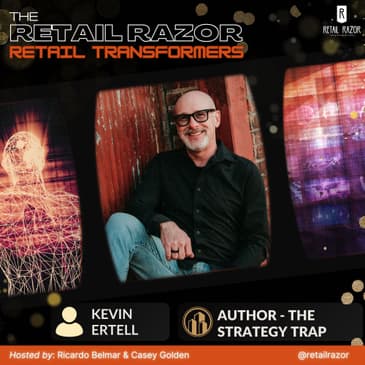



S2E2 Your Strategy Isn’t Failing - Your Execution Is. Here’s How to Fix It.
Most strategies don’t fail in the boardroom - they fail in the real world. In this episode of Retail Transformers, Ricardo and Casey sit down with Kevin Ertell, longtime retail operator and author of The Strategy Trap: Why Companies Fail at Execution and How to Get It Right. Kevin shares why 67% of well‑crafted strategies fail, the early warning signs leaders miss, and how his Six Cs framework helps teams turn strategy into real‑world results.
As Kevin explains, “Most strategies fail later, not loudly” - and the root cause is almost always poor execution, not bad ideas. Drawing from 30+ years at Nike, Sur La Table, Borders, and Tower Records, plus interviews with 60+ operators, Kevin breaks down how leaders can avoid the strategy trap and build strategies that humans can actually execute.
What We Cover
Why most strategies fail in execution, not planning
The Strategy Trap: what it is and how to avoid it
The Six Cs framework: Co‑creation, Clarity, Capacity, Communication, Coordination, Coaching
Why co‑creation is essential for execution success
The “tree stump theory” and how blind spots derail execution
Why leaders must “slow down to speed up”
How culture, incentives, and communication shape execution
Real‑world examples from Nike, Borders, and more
Why This Episode Matters
If you’re launching a new strategy this year. Or wondering why the last one didn’t land. This conversation gives you the tools, frameworks, and mindset to execute with confidence.
Don't forget to like, comment, and subscribe to The Retail Razor: Retail Transformers for more episodes featuring retail innovators, disruptors, and bold thinkers reshaping commerce.
Subscribe to the Retail Razor Podcast Network: https://retailrazor.com/
Subscribe to our Newsletter: https://retailrazor.substack.com
Subscribe to our YouTube channel: https://go.retailrazor.com/utube
About Our Guest
Kevin Ertell, https://www.linkedin.com/in/kevinertell/
Author, The Strategy Trap: Why Companies Fail at Execution and How to Get It Right. https://a.co/d/04AqxywE
Founder & CEO, Mistere Advisory. https://www.mistereadvisory.com
Kevin Ertell is a veteran executive and trusted advisor with more than 30 years of experience leading transformations at brands like Nike, Tower Records, and Sur La Table. As founder and CEO of Mistere Advisory, he helps companies of all sizes bring clarity, alignment, and action to their strategies. Known for his straight talk, practical insight, and ability to cut through complexity, Kevin draws on deep experience across leadership, operations, and digital growth to help teams turn ideas into results. When he’s not helping companies get unstuck, he’s likely playing bass, cooking for family, or following Cleveland sports with stubborn optimism.
Chapters
(00:00) Preview Teaser
(01:22) Show Intro
(04:21) Welcome Kevin Ertell to the Retail Transformers Podcast
(07:54) The Strategy Trap: An Introduction
(10:15) Common Pitfalls in Strategy Execution
(11:53) Techniques for Successful Execution
(14:58) The Six Cs Framework
(24:13) The Importance of Co-Creation, Clarity, and Capacity
(25:29) Showtime: Communication, Coordination, and Coaching
(26:31) Coaching as a Leadership Tool
(27:30) Real-World Example: Borders Rewards Program
(30:56) Key Decisions Before Strategy Kickoff
(32:41) Slowing Down to Speed Up
(37:23) The Role of Company Culture
(39:03) AI in Strategy Execution
(41:41) Conclusion and Final Thoughts
(44:08) Show Close
Meet Your Hosts
Helping you stay sharp, be bold, and transform retail:
Ricardo Belmar is an NRF Top Retail Voice for 2025 and a RETHINK Retail Top Retail Expert from 2021 – 2026. Thinkers 360 has named him a a Top 10 Thought Leader in Retail and AGI, a Top 50 Thought Leader in Management, Careers, and Transformation, and a Top 100 Thought Leader in Agentic AI and Digital Transformation. Thinkers 360 also named him a Top Digital Voice for 2024 and 2025. He is an advisory council member at George Mason University’s Center for Retail Transformation and the Retail Cloud Alliance. He was most recently the partner marketing leader for retail & consumer goods in the Americas at Microsoft.
Casey Golden, is the North America Leader for Retail & Consumer Goods at CI&T. She is a RETHINK Retail Top Retail Expert from 2023 - 2026, and Retail Cloud Alliance advisory council member. Obsessed with the customer relationship between the brand and the consumer. Once immersed in fashion & supply chain tech, now slaying Franken-stacks & building retail tech. She is also the Founder of Luxlock, a cross-channel customer experience management platform.
Episode Music
Includes music provided by imunobeats.com, featuring Tropikool, from the album Future Beats 2, plus Virtual Apology and New Styles, from the album Shimmer Pop, written by Heston Mimms, published by Imuno.
Highlight Clips
[00:00:02] - What if the biggest threat to your strategy isn't the market, competition, or even the economy, but the moment your team tries…
[00:28:17] - We did not spend enough time helping the booksellers understand why this would be good for the customers. I should have known…
[00:24:58] - All too many organizations I've been in, people say things like, look, we're just going to have to build the plane while we're…
Transcript
S2E2 Kevin Ertell
[00:00:00] Preview Teaser
[00:00:01] Ricardo Belmar: What if the biggest threat to your strategy isn't the market, the competition, or even the economy, but the moment your team tries to execute it?
[00:00:11] Casey Golden: Because here's the uncomfortable truth. Most strategies don't fail in the boardroom. They fail in the real world, quietly, slowly and often long after leaders think the hard work is done.
[00:00:25] Ricardo Belmar: Today we're talking to someone who has lived that reality. At Nike, Sur la Table, Borders, and Tower Records, and who just wrote the book on why execution breaks down and how to fix it.
[00:00:37] Casey Golden: Kevin Ertell joins us to unpack his new book, The Strategy Trap, Why Companies Fail At Execution, and How to Get it Right, and trust us, this is the conversation every retail leader needs right now.
[00:00:52] Ricardo Belmar: We get into the early warning signs that leaders miss, the myths that sound smart, but collapse on contact with [00:01:00] reality, and Kevin's six C's framework that finally connects strategy to actual results.
[00:01:05] Casey Golden: If you've ever watched a great idea stall out, fade away, or die in a postmortem. This episode is going to hit home. Stay with us.
[00:01:22] Show Intro
[00:01:22] Ricardo Belmar: Welcome back to the Retail Razor Retail Transformers podcast, part of the number one indie podcast network for retail, and the show where we bring you candid conversations with the crazy ones, the rebels, the bold thinkers, and the disruptors that see things differently to shape the future of retail.
[00:01:39] I'm Ricardo Belmar.
[00:01:40] Casey Golden: And I'm Casey Golden.
[00:01:41] Welcome Retail Razor fans and new listeners. Today's episode is one we've been excited about for a long time because we're tackling a problem every leader knows all too well, but very few talk about honestly.
[00:01:56] Ricardo Belmar: Strategy is easy to celebrate. Execution [00:02:00] is where everything gets messy. And according to Harvard Business Review, 67% of well-crafted strategies fail. Not because there were bad ideas, but because the execution fell apart.
[00:02:12] Casey Golden: Our guest today has spent more than 30 years in the trenches of retail execution. He's led teams and P and Ls at Nike, Sur la Table, Borders, and Tower Records. He's seen brilliant strategies succeed, and he's seen brilliant strategies crumble.
[00:02:28] Ricardo Belmar: And now he's distilled all of that experience into a new book that's already making waves, The Strategy Trap, Why Companies Fail at Execution and How to Get It Right. Our guest is Kevin Ertell, founder and CEO of Mistere Advisory, where he helps leadership teams turn strategy into execution, and execution into results.
[00:02:48] Now, he adds author to his list of achievements.
[00:02:51] Casey Golden: This isn't a book of theory, it's a field guide. Kevin interviewed more than 60 operators across industries representing over a [00:03:00] thousand years of operating experience to understand why execution breaks and how leaders can finally fix it.
[00:03:07] Ricardo Belmar: We're going to talk about the traps leaders fall into the early warning signs they miss and Kevin's six C's framework that turns strategy from a slide deck into real behavior and real results.
[00:03:18] Casey Golden: We're all launching a new strategy this year, and if you're still trying to figure it out, why the last one didn't land, this conversation is going to give you the clarity and tools you need.
[00:03:29] But before we jump in, a quick ask for all of our amazing listeners and viewers. If you're enjoying the show, why not hit us with a five star rating and drop a short review on Apple Podcasts, Spotify, Good pods, or wherever you're listening.
[00:03:45] Ricardo Belmar: And like and subscribe on our YouTube channel so you never miss an episode. And if you haven't already, take a few minutes to check out and subscribe to the other shows in the Retail Razor Podcast Network. The Retail Razor Show, Blade to Greatness and Data Blades. You'll find them all in [00:04:00] your favorite podcast app and on our YouTube channel.
[00:04:03] Now, let's get into it. Here's our discussion with our latest Retail Transformer, Kevin Ertell, author of The Strategy Trap, Why Companies Fail at Execution and How to Get It Right.
[00:04:14]
[00:04:21] Welcome Kevin Ertell to the Retail Transformers Podcast
[00:04:21] Ricardo Belmar: Kevin, welcome to the Retail Transformers podcast. It's exciting to have you on the show. We've been, so looking forward to this discussion for a while now, and we've been talking about it, especially with your new book out. The timing just couldn't be better.
[00:04:32] Kevin Ertell: Great. It's great to be here. Thank you guys for having me.
[00:04:34] Casey Golden: It is a real pleasure to have you on this show. I've been waiting for this discussion because your book is so needed in retail right now. So obviously we're both fans but for our audience who might not know your rich history in retail, before we dive into the conversation why don't you just take a moment and give us a little bit of background.
[00:04:52] Kevin Ertell: Yeah, sure. I mean, I've been in retail pretty much my whole career. I started out literally as a sales clerk at Tower Records when I was [00:05:00] 17 years old and worked
[00:05:01] Casey Golden: Oh, that's a.
[00:05:02] Kevin Ertell: Yeah, it was the greatest job ever. And Tower was an amazing company 'cause they believed in promoting within I, I started as a clerk and I was there for 20 years and I left as a senior vice president.
[00:05:14] Ricardo Belmar: Wow.
[00:05:15] Kevin Ertell: So I got a chance to work my way up. And I was on the team, we built the first towerrecords.com. back when, you know, we were worrying about modem speeds and that kind of thing.
[00:05:28] Ricardo Belmar: Yeah. Yeah.
[00:05:29] Kevin Ertell: So I did that for a while and then I moved on to Borders. At Borders, I, I ran the loyalty program and also borders.com.
[00:05:36] I spent a little bit of time on the solution provider side with Four C results, where I ran retail practice for them before going back into retail CMO at Online Shoes. Then I went to Sur la Table where I ran digital and marketing and technology, and then spent seven years at Nike. So three roles at Nike.
[00:05:55] Initially leading digital for the running category. Then [00:06:00] leading global digital operations. And then the last three years I was there, I did global, I led global retail operations. So actually kind of back on the store side
[00:06:08] Ricardo Belmar: mm-hmm.
[00:06:09] Kevin Ertell: full
[00:06:09] Ricardo Belmar: Wow. Yeah. full circle.
[00:06:10] Kevin Ertell: And left two years ago and started the Mistere Advisory, and now I'm focused on working with companies on building executable strategies.
[00:06:18] As you mentioned, I wrote a book on that exact topic and I'm doing some advising and coaching as well.
[00:06:23] Casey Golden: Fantastic. So no stranger.
[00:06:26] Kevin Ertell: No.
[00:06:27] Ricardo Belmar: Right,
[00:06:28] Kevin Ertell: I didn't tell you how many decades, but it's a lot of them.
[00:06:32] Casey Golden: I think, you know, we've, I think we're all beyond decades. I think everybody know anybody talking about retail these days. We're all old.
[00:06:42] Kevin Ertell: You look amazing though. I.
[00:06:44] Casey Golden: Oh, well, I petrified by Monster. Somehow I'm did not break myself. Well, a shout out for getting Pantone, my back wall, [00:07:00] getting it on their radar because I have a beautiful Pantone cup. Thanks to you.
[00:07:04] Ricardo Belmar: Very nice.
[00:07:05] Casey Golden: place smells like cloud dancer because they sent me beautiful fragrance and I have Pantone Play-Doh.
[00:07:14] Kevin Ertell: Oh wow. Okay.
[00:07:16] Casey Golden: I got so many treats and so thank you.
[00:07:22] Kevin Ertell: Very nice. Background on that. We were doing the prep for this, and I saw Casey's wall and I took a picture and sent it to the president of Pantone, who I knew, and she sent her a nice package, so that was
[00:07:31] Casey Golden: I got a beautiful package. It was so much fun. It was just a box full of surprises. You know, these days when you get a package, we all know exactly what's in it 'cause we ordered it.
[00:07:41] Ricardo Belmar: We ordered it.
[00:07:45] Kevin Ertell: Sometimes we forget what we ordered.
[00:07:47] Ricardo Belmar: That's, yeah.
[00:07:51] Casey Golden: So it was a very nice surprise. Thank you.
[00:07:54] Kevin Ertell: Awesome.
[00:07:54] The Strategy Trap: An Introduction
[00:07:54] Casey Golden: So let's dive in and talk about strategy versus execution and how this led [00:08:00] to your new book, The Strategy Trap.
[00:08:03] Ricardo Belmar: Yeah, Kevin you've famously, I think, said that most strategies fail later, not loudly.
[00:08:08] So what finally got motivated you to write this book about the strategy trap and, and how companies fail at the execution side of it? You know, even when they have the best strategies.
[00:08:18] Kevin Ertell: Yeah, I mean I, you know, I've known for a while and it's pretty common knowledge that most strategies fail and the numbers on the data on that is really high and the number one reason is poor execution. And so I've always been pretty good at that. I always wanted to focus on that. I've been very passionate about it.
[00:08:34] The funny thing is there's like a million books on how to write strategy
[00:08:38] Ricardo Belmar: Mm-hmm.
[00:08:38] Kevin Ertell: not that many on execution. And even the ones that are out there are mostly written by consultants and academics. So I wanted to write it from an operator's perspective, someone who's actually been there and done that. And I also didn't want it to only be my per point of view.
[00:08:51] So I interviewed more than 60 people across all sorts of industries, company sizes, to try to get a really good picture of, Hey, what [00:09:00] are the things that actually work? And I tried to make the book as practical and as useful as possible so that it can actually sort of almost be a field manual for people so that you have techniques you can go apply right away and help, you know, make execution happen on your side.
[00:09:15] So that was, that was a motivation I wanted to help, help reduce that terrible stat and see if we can get more strategies to be successful.
[00:09:22] Casey Golden: I mean, we've all heard the story of like, you know, what happened with Starbucks when they hired, you know. Heavy consulting person to be like, you know, the next CEO and
[00:09:34] Kevin Ertell: Yep.
[00:09:35] Ricardo Belmar: Mm-hmm.
[00:09:35] Casey Golden: it. And what'd they do? Brought in an operator.
[00:09:38] Ricardo Belmar: Yeah.
[00:09:40] Kevin Ertell: Hey, you know when you've been there and you're in the nitty gritty, you understand what it really takes,
[00:09:45] Ricardo Belmar: Yeah.
[00:09:45] Casey Golden: Yeah. I mean, that is where, you know, I think it's overlooked more so, but we need to go here. For strategy rather than looking at the operators because they, they've got it,
[00:09:58] Ricardo Belmar: Yeah.
[00:09:59] I mean, it's
[00:09:59] Casey Golden: [00:10:00] pulled out.
[00:10:00] Ricardo Belmar: It's amazing to me sometimes when, you know, people don't notice that sometimes the best person to execute something is someone who's been executing those things right. And has the experience to do it, versus relying on someone who's only ever created the strategy around it.
[00:10:15] Common Pitfalls in Strategy Execution
[00:10:15] Ricardo Belmar: So I guess I, I wanna ask a very specific point, because in my mind, in every company I've been at, whenever we start talking about strategy, one of the topics that inevitably comes up has to do with the postmortem after a project, right? And after
[00:10:29] you've either, either successfully or failed to execute a strategy.
[00:10:32] And to be honest, usually the postmortems happen, you know, when, when the project did actually fail and completely south and just didn't, didn't work out despite how amazing everyone thought the strategy was. And, and hence. The motivation, right. For the postmortem, let's figure out what went wrong.
[00:10:47] So from what you found and what we talk about in the, in the book, what, what do you think are some of the early warning signs that leaders miss, before they end up in one of those postmortems to, to look back at a [00:11:00] failure?
[00:11:01] Kevin Ertell: Yeah, it, you know, it's about validating that strategy with a variety of people up front. It's funny, one of the techniques I talk about in the book is to use a pre-mortem. So the idea there is that you imagine that it ho horribly failed, and then you apply that same mindset that you do in the postmortem.
[00:11:21] By looking back and going, okay, if it really did fail horribly, what would've gone wrong? What are the things we should look at more deeply? And I think there's a difference between that and contingency planning. You know, contingency planning all the time is you're looking at sort of logistical things that could go wrong and dealing with there.
[00:11:38] But in the pre-mortem, you're looking at strategic things. What are, what just did not go the way we expected. It forces you to go back and look at where do we make assumptions, you know, and are those assumptions valid? So that's a really good technique.
[00:11:53] Techniques for Successful Execution
[00:11:53] Kevin Ertell: Another technique I love to use is called the Six Thinking Hats, and that was created by this guy Edward De Bono.
[00:11:59] [00:12:00] And it's a really cool technique because what it does is, is it requires each person in the room to put on a hat, a metaphorical hat, but each of those hats represent a perspective. So what's our optimistic perspective about this? What's our pessimistic perspective about this? What might be innovative about what we're doing?
[00:12:20] There's, there's, there's five hats. 'cause one of them is a, a facilitator hat. What's good about that though, is oftentimes you'll get all those perspectives in a meeting when everybody's arguing about 'em. Because one person has each perspective. Here, it forces every person to have the same perspective at the same time.
[00:12:39] So the person who's naturally negative has to put on the optimistic hat also and vice versa. And what that does is it starts to open people's eyes to things that they've assumed and they've, you know, sort of expected without really deeply thinking into it. And that level of validation helps you find those [00:13:00] holes you know early so that you don't end up in that terrible postmortem.
[00:13:03] Ricardo Belmar: Yeah, so it really opens up new, kind of a new type of communication, I guess, between all the stakeholders. When you get, you're, in a sense, forced to think about it in someone else's terms.
[00:13:12] Kevin Ertell: Yeah. Yeah, exactly. And that, by the way, that creates a lot of bonding amongst the team too,
[00:13:16] Ricardo Belmar: mm-hmm.
[00:13:17] Kevin Ertell: It, you know, people the naturally optimistic person who is forced to be negative. Now has some sort of empathy for the person who's negative, all the, it's the opposite too. And so
[00:13:30] Ricardo Belmar: Makes
[00:13:30] Kevin Ertell: kind of things really help.
[00:13:31] Yeah.
[00:13:33] Casey Golden: And sometimes, I mean, I'd say that it almost validates like giving you permission to be negative
[00:13:37] Ricardo Belmar: Yeah.
[00:13:37] Casey Golden: Giving yourself permission to be optimistic when you really are typically negative and you're not spending money and I'm not writing the check and everything's gonna go wrong. Right? Like there is that person where like during non-work hours, they might be very optimistic, but they know their role.
[00:13:53] Kevin Ertell: Yeah. No. That's exactly right. Yeah and to your point about permission, that's important too because especially if the boss is in the room or [00:14:00] whatever. People have a hard time being negative, but when the boss is inviting you to be negative, there's an, there's another technique I have in the book.
[00:14:07] My friend Amber Taylor used to use, called a proposal to hate. And she would, she would put out her early draft and she'd say, this is a proposal to hate. Like, tell me what's wrong with it.
[00:14:17] Ricardo Belmar: Yeah.
[00:14:17] Kevin Ertell: And again, it gives psychological safety for people, to be able to say that. So it, and that goes a long way because if they don't have that, you end up plowing ahead with something that nobody believes in.
[00:14:28] Ricardo Belmar: Right?
[00:14:28] Casey Golden: Yeah, and even just asking is really setting up that I don't wanna just hear Yes and get things pushed through. I wanna hit pause and I wanna actually solve.
[00:14:41] Kevin Ertell: right. Because the goal is to actually create something work. No.
[00:14:44] Casey Golden: not always the case.
[00:14:46] Kevin Ertell: it's not only is it not always the case, it's honestly, in my experience, rarely the case, you know? And that's why most strategies fail. It's one of the reasons.
[00:14:53] Casey Golden: Well, you argue that writing the strategy is actually the first step of execution.
[00:14:58] The Six Cs Framework
[00:15:01] Casey Golden: I'm in the middle of a strategy build at the moment. Where do leaders get this wrong? School us!
[00:15:04] Kevin Ertell: So the, what I define as the strategy trap in the book is when leaders get all enamored with the idea and the presentation of the idea, and they forget about all the conditions that takes to create something for something that humans can actually execute. When you think about strategy as this precursor to execution, you're setting yourself up to, to go right into the strategy trap.
[00:15:27] 'cause all you're doing is talking about the idea. When you change your mindset and you say, okay, we're gonna start execution, and the first step is writing the strategy. You've already put yourself in the mindset to say like, okay, how is this thing gonna actually be executed? And you put in, you start to have to put in places for validation like we just talked about.
[00:15:46] You start to have to think about, how you're gonna really clearly communicate this and explain it and what there, what are the steps along the way. In the book I talk about all these, the six Cs, but of execution, which is a system I talk about in the book. If [00:16:00] you think about that whole system and strategy being part of that whole system, then you are holistically thinking about what you've gotta deliver.
[00:16:08] And that's why I think it's so critical to think of it that way.
[00:16:11] Casey Golden: Yeah, so often in like large retail organizations or even smaller ones, strategies are built in small circles of leaders in small conference rooms, and then rolled out like a gorgeous finished product with a big bow
[00:16:26] Ricardo Belmar: Yep.
[00:16:27] Casey Golden: and it's turned down to the rest of the organization. And it doesn't really work.
[00:16:33] Kevin Ertell: No
[00:16:34] Casey Golden: why is this a recipe for failure?
[00:16:36] Kevin Ertell: it's because, as I was mentioning, it hasn't been validated, it hasn't been pressure tested by people who are actually gonna actually, you know, make it happen. A lot of times you haven't even tested if the people that have to execute it even understand it. You know, and there's some stats I put in the book that in a lot of companies, people don't even know what the strategy is.
[00:16:59] [00:17:00] They failed the most simple test that everybody in the company actually knows the strategy. And when you do it all in a small group of people who've spent all this time on it. They also lose sight of the fact that other people did not spend all that time on it. You know, when you.
[00:17:15] Ricardo Belmar: Yeah. Yeah.
[00:17:17] Kevin Ertell: You don't see these things. I have this thing, this concept I've talked about for years. I call it the tree stump theory. And it's, and the way it goes is like, imagine you walk into a conference room and there's a big tree stump on the table and you're like, what's up with the tree stump?
[00:17:32] And someone gives you this really compelling reason why it's there. And you go, oh, okay. You know, and then you come in the next day and you see the tree stump, but you don't ask about it anymore. And you know, few, 3, 4, 5 days later you come in, you don't even see it anymore. Yet anyone who walks in the first time is like, what the hell's up with the tree stump?
[00:17:52] But if you have a small group of people and they've spent all this time creating the strategy. They, there's tree [00:18:00] stumps in there that they don't see anymore, and when they unleash that in the organization, people are like, what the hell? And that's where you get yourself into lots of trouble.
[00:18:10] Casey Golden: What does that look like on a P and L when it essentially all goes wrong?
[00:18:16] Kevin Ertell: Well, often there's a lot of money put into that strategy and that ends up being a giant cost with no return on it, you know, or very limited return. So, a Harvard Business Review puts something out that said that like strategies, leave a ton of money on the table, failed strategies, anywhere from 60 to a hundred percent of could have gained a 60 to a hundred percent more if they'd have actually executed the strategy instead of all the way they did. So, you know, you're talking about tons of revenue left on the table, tons of costs going out the door. All because you didn't take the time to set it up correctly to be executable, you know?
[00:18:53] That's really what it comes down to.
[00:18:55] Ricardo Belmar: Yeah. And are there things that you've, you hear from others that [00:19:00] sounds like a great idea to, you know, drive execution from a great strategy, but when the execution starts it, it turns out like, oh, that was a terrible idea.
[00:19:09] Kevin Ertell: I think a be careful I say this, but I think a lot of times it comes in the form of best practices, you know, and you'll get a lot of particularly coming from, you know, the consultant types or so. They'll, they'll come in with, with some best practice that isn't relevant to the organization you're in, or not exactly. You know, I mean I think you, best practices you can use as a guideline, but if you try to just exactly emulate some averaged out best practice that came across a number of McKinsey clients or something, you can't force that in. You have to adapt things to the organization you're in and I think that's where a lot of problems happen for sure.
[00:19:50] Casey Golden: I think we're also approaching a time where throw some best practices out the window, create something new.
[00:19:56] Kevin Ertell: Yeah.
[00:19:57] Ricardo Belmar: Yeah.
[00:19:57] Casey Golden: a new standard, you [00:20:00] know, just because it, that's the way it has been and it's worked in the past, doesn't mean that's gonna work in the future. And it is time for change.
[00:20:08] Kevin Ertell: Yeah.
[00:20:08] Casey Golden: You know,
[00:20:09] Kevin Ertell: Well, I agree, and I mean, if most strategies fail, then I don't know that we should be replying on the best practice.
[00:20:14] Ricardo Belmar: Right. You may, maybe they're not that. Maybe they're not the best after all. Yeah. Yeah. It kind of raises that question,
[00:20:21] Kevin Ertell: Yeah. Most common practices
[00:20:23] Ricardo Belmar: right? Yeah. Right. Exactly. Yeah. It may be common, but not necessarily best.
[00:20:28] Casey Golden: you heard it here first, folks, um, go against the grain.
[00:20:34] Your book is written from an operator's point of view, not the consultants. Which I find refreshing. But what advice to consultants give that sounds right in the room. But essentially falls off once execution starts.
[00:20:50] Kevin Ertell: I, I think that goes back to best practices in some cases, and it just goes to, oftentimes you'll hear, well, it's been done here this way, or it was, you know, we have [00:21:00] this past proof point that again, is not relevant to the current organization. I just, in my experience, every organization operates a little differently.
[00:21:11] You know, I've been at a bunch of different retailers. I know retail really well, but when I go into a company it's not the same. You know, they're never the same.
[00:21:18] Ricardo Belmar: Right.
[00:21:19] Kevin Ertell: And sometimes there's things that are the same. I'm working with the Minnesota Timberwolves right now, which is not retail, but there are retail like things that I can tie to, but there are other things that are totally different.
[00:21:28] Companies at different stages are different. You know, you just, you just can't, peanut butter spread something across everything. And I think too often consultants come in and just try to apply, what they've had already, they've done in the past without taking time to, to understand the current organization, the current people, the current, the background of the current people.
[00:21:48] You know, I mean, you can't just assume everybody's had the same background, is gonna understand things in the same way. So you really have to customize it at every organization in order to, for it to be as effective [00:22:00] as it can be.
[00:22:00] Casey Golden: I see that especially with retail because everybody. Well, nobody was going to school for retail. Nobody was getting a degree. I mean, it's possible now, but it wasn't. So you, you really do have, you know, this entire company filled with people from different backgrounds, different skill sets, different training, different like expertise and kind of all coming together to do this thing. And you know, I think. It makes so much more sense by taking those types of things in consideration. 'cause you're right, like nobody went to school for retail.
[00:22:40] Kevin Ertell: Right. Yeah. You know, the people who went to school for retail, their most effective at it are the ones their school was working in the store, you know, and they really
[00:22:49] Ricardo Belmar: Right, right.
[00:22:50] Kevin Ertell: when all these decks and strategies and all that hit the customer.
[00:22:54] Ricardo Belmar: Yeah, exactly.
[00:22:56] Casey Golden: By the time that trickle all the way down to the floor, it's a joke.
[00:22:59] Kevin Ertell: [00:23:00] Right, right. But
[00:23:02] Casey Golden: And in what time?
[00:23:05] Ricardo Belmar: Yeah,
[00:23:07] Kevin Ertell: started in the stores, it's a lot better because.
[00:23:10] Casey Golden: Yeah.
[00:23:10] Ricardo Belmar: Yeah. Right,
[00:23:12] right. That's
[00:23:13] Casey Golden: That realistic reality of what can and cannot be executed or delivered is much more clear. It's much more aligned.
[00:23:22] Kevin Ertell: Yeah. And that's like, so one of the Cs in the book is capacity, by the way. And, and I think this is where companies fall down all the time too, because they have all these ideas and then they try to dump 'em on the existing business without making any room for it. You know, you just said that Casey I'm gonna do this with what time?
[00:23:38] If you can't, if you can't carve out the space for it to happen, good luck
[00:23:43] Ricardo Belmar: right. How will it ever get executed? Yeah. Yeah, exactly. Well let's talk a little bit more about the sixties. You've mentioned them a couple of times. Let's dig into that framework that you have in the book and, and maybe go through some of like the tactics that are related with it. But then I, I saw you, you also had [00:24:00] divide them into two phases, setting
[00:24:01] the stage and showtime.
[00:24:03] So can you talk a little bit about that and explain you know, what, what breaks when leaders skip the first phase or go straight to showtime, which we see happen a lot with a lot of strategies. So. Talk us through the six C's.
[00:24:13] The Importance of Co-Creation, Clarity, and Capacity
[00:24:13] Kevin Ertell: Yeah, so like you said, I break it in two phases. Set The Stage and Showtime.Within each are three Cs. In Set the Stage, it's Co-creation. We've been talking about that a little bit. It's Clarity and Capacity. So with each of those, co-creation is all about bringing people together, different levels get and getting alignment, validation, and then ultimately commitment.
[00:24:35] That's all comes in the co-creation stage. Then you get to Clarity. And clarity is about how do you simplify the message and make it meaningful to people and make it understandable for people. And you gotta spend a lot of time doing that. Otherwise all that work you just did is gonna be for naught because people don't get it.
[00:24:52] Ricardo Belmar: Right.
[00:24:53] Kevin Ertell: Then you get to Capacity, like I was just talking about. You have to create space for it. All too many organizations [00:25:00] I've been in, people say things like, look, we're just gonna have to build the plane while we're flying it. And I absolutely hate that statement, you know? Because if you give that any thought whatsoever, you would go, Hey, would you get on a plane while it's still being built?
[00:25:16] I wouldn't,
[00:25:17] Ricardo Belmar: Yeah. Yeah. Who wants to
[00:25:18] Kevin Ertell: so like what you're actually saying is we're going to put you team in the most dangerous possible situation. You know, and it's just crazy. So we can't do that. We have to carve space for it.
[00:25:29] Showtime: Communication, Coordination, and Coaching
[00:25:29] Kevin Ertell: So then we get into Showtime, and as you said, Ricardo, sometimes people just jump straight to that, and that is when you start to implement it.
[00:25:36] But it's not like you just throw it out there and let it go. The three Cs in Showtime, are Communication, Coordination and Coaching.
[00:25:45] In communication. I have a mantra in there. I talk about early, loud, and continuous communication. First of all, you gotta set the stage for the change you're gonna make.
[00:25:53] That should happen before you're even putting a
[00:25:55] Ricardo Belmar: Before you start Yeah.
[00:25:57] Kevin Ertell: Help people understand why we need change. Then [00:26:00] it's loud, you know, you, you've got to break through all the noise in the business that's going on and make sure people understand it. Continuous is about repetition and reinforcement.
[00:26:12] There's something called the Ebbing House Forgetting Curve. This old psychologist did the study and he showed that we forget 90% of what we've learned 30 days later without reinforcement, so we'll forget almost everything if it's not reinforced. Yet many times people announce a strategy once and walk away, right?
[00:26:29] You can't do that.
[00:26:31] Ricardo Belmar: Yeah. Yeah.
[00:26:31] Coaching as a Leadership Tool
[00:26:31] Kevin Ertell: The last C is coaching, which is a specific aspect of leadership and coaching is a, is this act of leadership where you're, you know, working on the culture, you're motivating people, you're creating incentive, you know, you've gotta, you're pivoting and making decisions in the moment.
[00:26:48] And that's a stage that I think is very, needs to be very intentional and very thoughtful because that's how you're taking the team through actually bringing this thing to life. So that's the six C's in a nutshell.
[00:26:59] Casey Golden: [00:27:00] Everybody snag this book 'cause you're gonna,
[00:27:03] Ricardo Belmar: Yeah.
[00:27:04] Casey Golden: gonna need a highlighter.
[00:27:06] Ricardo Belmar: Absolutely.
[00:27:08] Casey Golden: You've run PNLs at Nike Sirta Borders and Tower records. Is there a moment that where the strategy looked solid on paper, but execution exposed a hidden assumption that nearly sank it all? Like
[00:27:25] Kevin Ertell: Yeah.
[00:27:26] Casey Golden: spill the.
[00:27:27] Kevin Ertell: Yeah. Yes. It's happened for sure.
[00:27:30] Real-World Example: Borders Rewards Program
[00:27:30] Kevin Ertell: One that, that I think about the best is when we were building Borders Rewards loyalty program. We had a lot of ideas. We built it with an executive team. We sort of put it out there. Thankfully, we at least put it in some test stores, but we put it out and it just failed miserably. And we talked to customers and asked them what they thought about it. We also talked to employees, booksellers. We cost them and asked them what they thought of it. By and large, all those people hated it, but we found some people, we [00:28:00] found some customers who liked it, and what we were able to trace back is they talked to a bookseller who liked it and who understood it.
[00:28:09] And that's when something hit me that I should have known the whole time coming up from being inside stores and starting on the ground floor, we did not spend enough time helping the books sellers understand why this would be good for the customers. I should have known that because when I was in the store. I,
[00:28:27] Ricardo Belmar: That's what you went
[00:28:27] Kevin Ertell: care that much about what corporate thought. I cared about the person who's standing right in front of me, you know? So what we ended up doing is we, okay, we dug into that, spent more time on it, even modified the program a little bit, spent time with booksellers so we could understand what they felt would resonate with customers. And then we came back out with a very different. Program, but more importantly how we communicated that program. And so we, we actually gave booksellers, they got their own brochure. This was a while back. We still had brochures and stuff, you know, but they got a [00:29:00] brochure that the theme was a program you'll be proud to share.
[00:29:03] And the whole context of it was about here's why you're gonna love sharing this with the customer and why they're gonna love it. And we developed that by talking to booksellers and understanding how they talked to customers and what they knew would be meaningful and then it went gangbusters. I mean, we expected, the first year we had a stretch goal of 6 million members, but we ended that year with 16 million members.
[00:29:25] And that was because the booksellers were into it, you know, I mean, they liked it and they told people about it.
[00:29:30] Ricardo Belmar: Yeah. So I like that example. I'm, as you're going through it, and I'm already seeing in my mind, which sees at what point, like there was at the beginning, right? It looked like there was not enough co-creation what you were highlighting, right? And the message wasn't clear. So the clarity wasn't there.
[00:29:45] So then use it with, which is why no one at first liked it from that initial version. And it, and just, you immediately see how once you brought those people in and you, they helped you clarify, what do people actually want in this program? And you co-create with [00:30:00] them. Now suddenly you've gotten to that showtime phase and you can see how everyone's motivated to execute as a, at a starting point.
[00:30:07] Where originally it's almost like you had to overcome everyone's, um,
[00:30:12] Kevin Ertell: Yeah, no, that's a great way to
[00:30:13] Ricardo Belmar: the execution going.
[00:30:14] Kevin Ertell: Yeah, that's a great way to put it. I love that. Actually, I might have to use that, Ricardo.
[00:30:21] Ricardo Belmar: Yeah.
[00:30:22] Kevin Ertell: Yeah. You never want your strategy to be something you have to overcome people
[00:30:26] Ricardo Belmar: right. Exactly. Yeah. It should be a sign, right? If you already are seeing so many obstacles you have to overcome to get anyone to accept it, that as a strategy, that should be a warning sign, right?
[00:30:35] Kevin Ertell: Yeah. Yeah. Exactly. That's good.
[00:30:38] Ricardo Belmar: Yeah.
[00:30:39] So what, okay. Yeah, there's no charge for that. That's right. Sharing's caring. So I'm just kind of thinking through, so for any, you know, anyone else listening to this conversation or thinking about how they're gonna launch. A new strategy.
[00:30:56] Key Decisions Before Strategy Kickoff
[00:30:56] Ricardo Belmar: What, what's an example, like one decision they should be [00:31:00]making before the kickoff meeting, right?
[00:31:01] Where, where they're gonna start to, almost like, you always see there's the moment when there's an announcement of this new strategy.
[00:31:08] But before you get to that point, right? What are some of the things that you wanna make sure everyone should know that they're doing and thinking about before they actually have that kickoff?
[00:31:17] Kevin Ertell: Yeah, I mean, one of the things you should do is make sure you're super clear on the problem. You know what? Before we start solving and creating a new strategy, what problem or problems are we solving and does everybody see 'em the same way?
[00:31:30] Ricardo Belmar: Mm-hmm.
[00:31:30] Kevin Ertell: You know, you start to galvanize around that, by the way, that's stuff you can use.
[00:31:35] When I was talking about communicating early. Now you can start to even use that to communicate more broadly, Hey, here's issues we're facing that we're gonna start working on. So getting clear on the problem. Again, co-creating, but making sure that co-creation group is. Is not a homogeneous set of senior leaders who aren't connected to the people who are actually gonna execute it, bring other people in.
[00:31:59] [00:32:00] Sometimes you have to start that co-creation. Usually you have to start it with a smaller group of people, but have layers of validation periods. You know, start with that core idea. Like Amber had the proposal to hate and take that out and talk to people about it. Do six thinking hat sessions with a variety of people in a variety of areas so that you're really getting that deep thinking brought into the strategy to, to round it out.
[00:32:25] Doing that kind of stuff early really sets you up for creating something that's going to be executable. So that's where I think you gotta
[00:32:32] Ricardo Belmar: Yeah. Is you, we hear so much about, things that leaders want to increase the speed at which they do things right in their
[00:32:40] operations, in business.
[00:32:41] Slowing Down to Speed Up
[00:32:41] Ricardo Belmar: And I'm kind of wondering, if you are meeting with someone and kind of reviewing the whole approach with the six Cs and everything, do you get leaders that kind of almost in essence push back and say, but isn't that going to slow us down?
[00:32:53] Do
[00:32:53] you get that kind of response?
[00:32:56] Kevin Ertell: Yes, of course, because everybody's type A, including [00:33:00] me. I wanna go fast.
[00:33:01] Ricardo Belmar: Yeah.
[00:33:02] Kevin Ertell: But here's the thing, like I talk to all those people, right? 60 plus people. The thing I heard the most overall was you have to slow down to speed up. I heard that all the time, and I think it's right, you know? Because here's the thing, if you don't slow down and do some of these things we talked about and set the stage and really sort of put a plan together, you are going to slow down anyways later, just in a much worse way.
[00:33:27] Things are gonna fall apart. The strategy not.
[00:33:32] Ricardo Belmar: Yeah. Mm-hmm.
[00:33:35] Kevin Ertell: Time upfront to slow down. I think about it like if you're on a, you know, windy road, right? You have to slow down as you're entering in these curves or you're gonna wreck, right? Well, no but Casey, that's the thing. You slow down into the curve, accelerate
[00:33:52] Ricardo Belmar: out. Yeah,
[00:33:54] Kevin Ertell: And that's what it is. So you don't end up in a ditch.
[00:33:56] I don't want you to end up in a ditch.
[00:33:59] Ricardo Belmar: That's a [00:34:00] great example. Yeah. Great analogy.
[00:34:02] Casey Golden: Asked to get out of the car.
[00:34:06] Kevin Ertell: Note to self, don't drive with
[00:34:08] Ricardo Belmar: Don't let Casey drive. Yeah. I think that makes a lot of sense because there's so many times and you hear about leaders who want to go so fast and there. They may go fast and save that time upfront to get to the execution, but if you rush through the execution, all you're gonna do is lose time afterwards because you're gonna have to go into a recovery plan, right?
[00:34:29] Because now that if it doesn't work, you've fail and now you have to recover.
[00:34:32] So what about all the time that you're gonna spend on that, that could have been spent upfront to your point in that, in the early phase before the execution, right in the first three Cs, so that you got it right to begin with.
[00:34:44] Kevin Ertell: Yeah, that's what it comes down to. And it really doesn't mean like no action. I mean, by all means get started on co-creation and go quick with that. You know, get people together, create the time so people can get in there and go. The key is. Do you wanna get to your result faster or not? Or do [00:35:00] you just wanna start faster?
[00:35:02] Because if you wanna get to the result faster, you should slow down in order to speed up later, you know?
[00:35:07] Ricardo Belmar: Yeah. That makes sense. Yeah.
[00:35:08] Kevin Ertell: that. Usually when I talk to people about it, that tends to resonate, you know, because in the end it's about the result, not about the, you know, the action,
[00:35:16] Ricardo Belmar: Yeah. Yeah.
[00:35:16] Casey Golden: Yeah,
[00:35:17] Ricardo Belmar: the otherwise the action is just a lot of wasted activity.
[00:35:20] Kevin Ertell: right? Which happens as you know it a lot in many companies.
[00:35:23] Ricardo Belmar: that's right.
[00:35:25] Casey Golden: Going back to consultants, right? Because they're not all day so.
[00:35:30] Kevin Ertell: Right, exactly
[00:35:35] Casey Golden: I can't, I don't get a lot of time to set aside for like planning and big brain thinking, right? Because you get in the weeds very often. But you know, as a culture shift, I think it's really important, especially now as we're coming into more ai, we have to have everybody to have time set aside on a weekly and monthly basis to just think and work on the [00:36:00] strategies.
[00:36:00] I can't tell you how many strategy builds I've seen that nobody went back to during the quarter. We just do it. It's out, and then I update the results. We never looked at it. See how is anything off the rails,
[00:36:16] Ricardo Belmar: Yeah.
[00:36:17] Kevin Ertell: Yeah. No, that's exactly right. In fact, in the coaching section of the book, I talk about this concept from a author named Dov Frahman, and he said, you have to plan for slop time is what he called it. And basically that's what he said is like actually plan specific time designed to think.
[00:36:32] And you should have that. Everybody should have that. Leaders for sure. Everywhere, at every level should have that, because that's how you use that time to prepare yourself to be better rather than just action. All the time. That is completely, and it's just noise,
[00:36:46] Ricardo Belmar: Yeah.
[00:36:46] Casey Golden: Yeah, it's very important culture shift that, I am hearing more about, and I hope that it does, it is something that really impacts the industry this year
[00:36:56] Kevin Ertell: Yeah.
[00:36:57] Casey Golden: or brain time. You know, and it's [00:37:00] okay, but you're gonna spend two hours and you're gonna learn something. You're gonna read something, you're gonna just think about your business, think about your plan think about what could be better and, and go drop a meeting on somebody else's calendar to say Hey.
[00:37:13] Kevin Ertell: Yeah,
[00:37:14] Ricardo Belmar: yeah,
[00:37:14] Casey Golden: Discuss this initiative or this strategy and come back to you with something, you know, like we need that time.
[00:37:19] Kevin Ertell: we absolutely do.
[00:37:20] Ricardo Belmar: Yeah. Is that cultural aspect.
[00:37:23] The Role of Company Culture
[00:37:23] Ricardo Belmar: In any organization, is that one of the big obstacles that caused people to fall into the strategy trap because of the company culture?
[00:37:31] Kevin Ertell: absolutely. Company culture. And you can, as you're implementing a new strategy, you need to be really mindful about culture and even where you wanna shift and change culture. Because culture's, how people act, I mean, people act on incentives really. And incentives come from culture.
[00:37:48] I, I think of incentives in three ways. There's financial incentives, which was what anybody let's, most executives that only talk about financial
[00:37:54] Ricardo Belmar: Mm-hmm.
[00:37:55] Kevin Ertell: and they help in some ways, but not in. Most day-to-day ways, they [00:38:00]largely help on longer big picture, particularly in the jobs we're talking about. I mean, if you're on the manufacturing or your sales person or something, you have incentives that you can realize every day, so they matter.
[00:38:10] But a lot of other jobs, that's not the case. But two other types of incentives matter every day. One of 'em is social incentives. You know, what are you getting recognized for at work or by your boss or by your peers. I mean, where does people see each other? And you know, are we competing with each other?
[00:38:26] Are we working with each other? How are we sort of tied together? Those social incentives drive daily behavior. And then the third one is, I call it convenience incentives. 'cause we humans tend to gravitate to whatever's easier. So as you're sort of thinking about things, how do you make the most desired behavior, the easiest thing to do?
[00:38:45] And if you do that, you will get more of that, you know, um, make it harder, which we do a lot of times, I, you throw all this bureaucracy in there or something like that, then you've made the desire behavior harder. Good luck getting it.
[00:38:59] Ricardo Belmar: [00:39:00] Yeah. Right, right. That's a great point. That's a great point.
[00:39:03] AI in Strategy Execution
[00:39:04] Ricardo Belmar: So it almost feels like we're doing a disservice having gone this long into a conversation in retail and business without talking about AI. Given that, given where we are this year. So I kind of feel like I have to ask you the question because I imagine in any organization that you go in and talk about the six Cs and how to avoid the strategy trap. Someone in the room is gonna look at you and say, okay, but Kevin, if we use AI in this phase, doesn't that keep us out of the strategy trap?
[00:39:33] Kevin Ertell: Yeah. The strategy trap is about how you work with humans, you know, for starters. I think AI is a tool. You know, it's not a strategy, you know, you can't make it a strategy. It's a tool you use along the way. So I think that you can use AI to help you in many of these situations. I mean, you wanna make your strategy clearer.
[00:39:52] Yeah. You should probably try to use AI to tell you where you've made it completely hard to understand. I think you can use it for tools like that. [00:40:00] You can use it for analysis, you can use it to help you craft different communication plans for sure. So by all means use it, but it's not the answer to this kind of thing.
[00:40:10] And it will not keep you outta the strategy trap. And if you go into it thinking that it's gonna be your magical solution, you are gonna crash harder into the strategy trap, in my view.
[00:40:19] Ricardo Belmar: Yeah. Yeah.
[00:40:20] Kevin Ertell: you still need to do all these things for the people as long as maybe a, actually, you know what I was gonna say?
[00:40:26] Until you have an army of agents, but I don't know if you've seen some of all this stuff going on with agents, but the reality is, agents kind of act like humans. You know, if you're unclear with an agent, guess what? It's not gonna do what you want
[00:40:39] Ricardo Belmar: That's right. Yeah. Yeah. It can only do how, however well you explain to it what to do, right?
[00:40:43] Kevin Ertell: right? So you still, even in working with ai, you need to do a lot of these things in order to be clearer to an agent to do it.
[00:40:51] Ricardo Belmar: Yep. Absolutely. Well, that's a great point.
[00:40:53] Casey Golden: Clarity.
[00:40:54] Ricardo Belmar: Yeah. So important.
[00:40:55] Casey Golden: Oh my gosh. Clear instructions. Not just like [00:41:00] make double rainbows over what?
[00:41:03] Kevin Ertell: It's hard though, you know, because we humans are really crappy about communicating,
[00:41:07] Ricardo Belmar: Mm-hmm.
[00:41:09] Kevin Ertell: you know?
[00:41:10] Ricardo Belmar: Yeah.
[00:41:13] Casey Golden: I these days you can't even get somebody with an iPhone to like use a word because we just send like an emoji or like,
[00:41:21] Ricardo Belmar: That's right. That's right. Yeah.
[00:41:24] Yeah.
[00:41:25] Well anyway, and if you send it in a text, everything's abbreviated.
[00:41:29] Kevin Ertell: Yeah, right.
[00:41:29] Casey Golden: yeah, we're terrible communicators. So I think that's, that is a challenge for our audience. We can all be better communicators by the end of this year. It's time to start practicing. There's always room for improvement there. Right.
[00:41:41] Conclusion and Final Thoughts
[00:41:41] Casey Golden: Kevin, this is such, its timely topic. It is Q1 and there's still time to make some edits.
[00:41:48] So, it's a readable book. It's not 650 pages. Um.
[00:41:55] Kevin Ertell: I tried to.
[00:41:57] Ricardo Belmar: Yeah. Yeah, absolutely.
[00:41:59] Casey Golden: [00:42:00] And I love this notion of focusing on the execution of the strategy and realizing that's where strategies fail, not necessarily because it was a bad strategy. And that even the best strategies can fail in the execution. And it doesn't work.
[00:42:15] Kevin Ertell: Yep.
[00:42:16] Casey Golden: I think there's, we have a lot of opportunity this year to really build out thoughtful strategies. Learn how to make time for it, and integrate that brain time to even just understand who needs to be in the room and what the heck am I gonna do with AI.
[00:42:36] Ricardo Belmar: Right,
[00:42:39] Kevin Ertell: you go.
[00:42:40] Casey Golden: So thank you for sharing your experience, your knowledge with us and our audience
[00:42:45] Kevin Ertell: Thank you
[00:42:45] Casey Golden: everyone out there go buy Kevin's book, The Strategy Trap.
[00:42:49] Ricardo Belmar: Right away. Yes.
[00:42:50] Casey Golden: Why Companies Fail at Execution and How to Get It Right.
[00:42:54] Ricardo Belmar: That's right. That's right. And we'll at least have a link to it and make it easy for everybody in the show notes. There you go. [00:43:00] Everybody rush out and get that right now. So much more you can get from that. Just going even deeper than, than what we talked about today. Kevin, thanks so much for spending this time with us. I know we could probably talk for a few more hours on, on this 'cause there's just so, so much more to understand right about how to do this the right way and how not to fall into that strategy trap.
[00:43:19] Kevin Ertell: Right.
[00:43:20] Ricardo Belmar: Yeah. So if anyone in the audience wants to go deeper and maybe is, wants to actually actively get your help to understand how they can better execute their own strategies in their business, what's the best way for them to get in touch with you?
[00:43:31] Kevin Ertell: Yeah, I could probably go to my website, which is Mistere Advisory, M-I-S-T-E-R-E, advisory or connect with me on LinkedIn. You know, happy to connect with everybody there too.
[00:43:41] Ricardo Belmar: All right. Excellent.
[00:43:42] Casey Golden: Or follow him on TikTok where I do.
[00:43:44] Kevin Ertell: All right. Yes, I started my TikTok channel, so you can try that.
[00:43:48] Ricardo Belmar: That's
[00:43:49] right.
[00:43:49] Kevin Ertell: still a newbie there, but I'm doing my best.
[00:43:52] Casey Golden: Hey, we're all newbies. Thanks Kevin. Well, with that, Ricardo, I'd say this episode has a bow on it.[00:44:00]
[00:44:00] Ricardo Belmar: It does.
[00:44:01]
[00:44:08] Show Close
[00:44:08] Casey Golden: How much did you love this episode? Drop us a five star rating and review on Apple Podcasts, Spotify, or Good pods and hit subscribe so you never miss an update. If you're watching on YouTube, like and subscribe before you go.
[00:44:22] I'm Casey Golden.
[00:44:24] Ricardo Belmar: Follow Retail Razor on LinkedIn, Blue Sky, Threads, and Instagram. And subscribe to our Substack for highlights and bonus content in your inbox. For transcripts and guest info, head to retailrazor.com.
[00:44:36] Retail Transformers is part of the Retail Razor Podcast Network.
[00:44:40] I'm Ricardo Belmar.
[00:44:41] Casey Golden: Thanks for joining us.
[00:44:42] Ricardo Belmar: Until next time... Stay Sharp, Be Bold, and Keep Transforming Retail.
[00:44:47] This is the Retail Razor: Retail Transformers.