
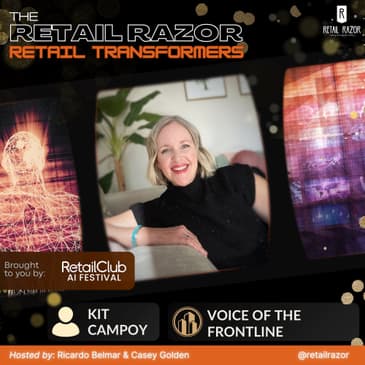



S2E5 The voice of the frontline reveals the truth about 80% retail turnover, and what corporate keeps missing about stores
What corporate keeps getting wrong about the store floor, told by someone who actually ran it. In this episode of Retail Transformers, Ricardo Belmar and Casey Golden sit down with Kit Campoy. Kit is a 25-year retail store leader and author of The Retail Leader's Field Guide. She is the writer known across the industry as The Voice of the Frontline from her Substack newsletter. Kit has managed store teams at PacSun, Lucky Brand, Anthropologie, Tilly's, Old Navy, and The Buckle. Today she helps retail tech and SaaS companies actually speak the same language as the store managers they are trying to sell to.
The conversation goes straight into the HQ-to-store disconnect that quietly costs retailers millions. The rollouts that look great in a boardroom and fall apart on a Saturday afternoon. The metrics that distort behavior on the sales floor. And the retail tech pitches that insult store managers on slide two. Kit walks through what 80% retail turnover actually feels like inside a store. She reveals why store manager pay has stopped covering rent. And she surfaces the invisible work that makes a store team function or fall apart.
If you build retail tech, lead a retail brand, or sit somewhere between corporate and the store floor, this conversation will change how you think about the frontline.
What You'll Learn in This Episode
· Why "welcome in" is a confession, not a greeting
· The corporate retail blind spots Kit sees on every store visit
· What store managers would say out loud if there was zero career risk
· How siloed HQ teams pile five priorities into one impossible week
· The metrics distorting behavior on the sales floor (yes, including the manager who yelled at her own family for hurting her conversion rate)
· The 20 jobs hiding inside the store manager job title
· How to tell the difference between an underperforming store team and one that is just overwhelmed
· The payroll game store managers play just to staff the floor
· Why 80% retail turnover is something companies built, not something that happened to them
· What store manager pay is really telling people about how much the role is valued
· What Gen Z sees through instantly, and what brands keep getting wrong with them
· The one thing every retail executive should do this quarter to support frontline teams
Support our sponsors
This Episode is Brought to You By RetailClub.
Join 2,000 retail leaders at RetailClub AI Festival, September 22–24 in Huntington Beach. Dive deep into how AI is reshaping retail while soaking up the sun at a fully outdoor, beachside venue. Decision-makers from retailers and brands can attend with free tickets and up to $1,250 in travel reimbursement. Head to retailclub.com to learn more. https://retailclub.com/retail-razor-podcast
Subscribe & Follow
Don't forget to like, comment, and subscribe to The Retail Razor: Retail Transformers for more episodes featuring retail innovators, disruptors, and bold thinkers reshaping commerce.
Subscribe to the Retail Razor Podcast Network: https://retailrazor.com/
Subscribe to our Newsletter: https://retailrazor.substack.com
Subscribe to our YouTube channel: https://go.retailrazor.com/utube
About Our Guest
Kit Campoy, https://www.linkedin.com/in/kit-campoy-you-got-this/
https://kitcampoy.com
Author, “The Retail Leader's Field Guide”. https://a.co/d/0cEHP1Xv
Substack. The Voice of the Frontline, https://kitcampoy.substack.com
Kit Campoy spent 25 years on a retail floor, then wrote the book, The Retail Leader's Field Guide. She now publishes The Voice of the Frontline on Substack. Her key message: frontline teams are the most undervalued assets in retail. Her work gives store operators the language and respect they deserve.
Chapters
(00:00:00) Teaser
(00:01:01) Show Intro
(00:05:44) Welcome Kit Campoy!
(00:07:14) Kit's Retail Journey
(00:10:31) Corporate Blind Spots
(00:14:58) What Managers Fear Saying
(00:21:23) Bad HQ Decisions
(00:27:14) Metrics Gone Wrong
(00:33:33) Store Manager Many Hats
(00:38:54) Empathy Builds Teams
(00:42:17) Gaming Payroll To Survive
(00:46:55) Turnover Never Lets Up
(00:49:52) Pay And Talent Retention
(00:55:45) Why Great Managers Leave
(00:59:57) Gen Z Sees Through Brands
(01:02:16) Reality Check And Thanks
(01:05:35) Show Close
Meet Your Hosts
Helping you stay sharp, be bold, and transform retail:
Ricardo Belmar is an NRF Top Retail Voice for 2025 and a RETHINK Retail Top Retail Expert from 2021 – 2026. Thinkers 360 has named him a Top 10 Thought Leader in Retail, a Top 25 Thought Leader in AGI and Careers, a Top 50 Thought Leader in Agentic AIand Management, and a Top 100 Thought Leader in Digital Transformation and Transformation. Thinkers 360 also named him a Top Digital Voice for 2024 and 2025. He is an advisory council member at George Mason University’s Center for Retail Transformationand the Retail Cloud Alliance. He was most recently the partner marketing leader for retail & consumer goods in the Americas at Microsoft.
Casey Golden, is the North America Leader for Retail & Consumer Goods at CI&T, and CEO of Luxlock. She is a RETHINK Retail Top Retail Expert from 2023 - 2026, and Retail Cloud Alliance advisory council member. After a career on the fashion and supply chain technology side of the business, Casey is obsessed with the customer relationship between the brand and the consumer and is slaying franken-stacks and building retail tech!
Episode Music
Includes music provided by imunobeats.com, featuring Tropikool, from the album Future Beats 2, plus Virtual Apology and New Styles, from the album Shimmer Pop, written by Heston Mimms, published by Imuno.
Highlight Clips
[00:13:00] - I think that they're I don't think that they fully grasp, like, the chaos of a store floor. So they're developing these things…
[00:15:05] - I think that they might be honest that the last three initiatives made my job harder and made my business worse. Yeah. They…
Transcript
S2E5 Kit Campoy
[00:00:00] Teaser
[00:00:00]
[00:00:01] Casey Golden: SaaS founder, retail tech provider for store tech? Yes, our guest today has probably seen your pitch deck. And every single time she's seen you insulting the store on slide two.
[00:00:15] Ricardo Belmar: Yep, that's Kit Campoy. Twenty-five years running stores, author of "The Retail Leader's Field Guide," and today she's gonna tell us what corporate keeps getting wrong about the store floor.
[00:00:27] Casey Golden: The decisions that quietly break in stores, the trade-offs managers are making that nobody at HQ sees, and what 80% turnover actually feels like from the inside.
[00:00:39] Ricardo Belmar: Yeah, if you build for retail, lead in retail, even if you're just selling into retail, or you just work in retail stores and you wish everyone would just see you, this one's for you, because we see you and Kit sees you.
[00:01:01] Show Intro
[00:01:01] Ricardo Belmar: Welcome back to season two of the Retail Transformers podcast, the number one management and number one indie careers podcast on the Goodpods top weekly and monthly podcast charts, part of the number one indie podcast network for retail.
[00:01:14] I'm Ricardo Belmar.
[00:01:15] Casey Golden: And I'm Casey Golden.
[00:01:17] And Ricardo, I feel like every episode lately we've been circling the same tension. There's what the marketing and the boardroom decks say is happening in stores, and then there's what actually happens in stores.
[00:01:31] Ricardo Belmar: And those are often two very different conversations. Which is exactly why I'm excited about today, because we've got someone joining us who spent 25 years on the other side of that gap, actually running stores, actually leading the teams, and actually living the rollouts when they hit the floor.
[00:01:49] Casey Golden: And at so many incredible brands, from PacSun to Lucky Brand to Anthropologie, Tilly's, she's done all things and lived the experience [00:02:00] in-store, loving and leading teams, something I totally relate to.
[00:02:05] Ricardo Belmar: Yeah, no, no, same, same here. It, it's been a little longer for me, though, since my retail store floor days. But that's part of what makes today's show so great. I think everyone can relate.
[00:02:16] But before I tell you more, really all about her, let me tell you about our new sponsor of the Retail Razor Podcast Network, Retail Club.
[00:02:23] Join 2,000 retail leaders at the Retail Club AI Festival, September 22nd to 24th in Huntington Beach. Dive deep into how AI is reshaping retail while soaking up the sun at a fully outdoor beachside venue. Decision-makers from retailers and brands can attend with free tickets and up to $1,250 in travel reimbursement.
[00:02:46] Head to retailclub.com to learn more and get your ticket today. Thank you, Retail Club, for helping us bring you this podcast and all the other shows in the Retail Razor Podcast Network.
[00:02:56] So about our incredible guest today. Her name is Kit Campoy. She's the [00:03:00] author of "The Retail Leader's Field Guide," released in 2023, and today she spends her time writing as the Voice Of The Front Line in retail, writing about the reality of working in stores and leading store teams.
[00:03:11] Casey Golden: And she also helps SaaS retail tech companies speak the same language as the people running the floor, which if you've ever sat through a retail tech vendor pitch, you know this is not a small problem to solve.
[00:03:25] Ricardo Belmar: No, it's not. She also covers conferences, writes industry commentary, shows up on, any, like, huge number of panels, basically anywhere the conversation benefits from having someone who's actually done the job in the room. And that's what we really wanna get into today. We're, we're gonna hear a lot about what gets d-decided in forums and built-in product roadmaps, and how it lives or dies based on what actually happens on a Saturday afternoon in a store that, let's face it, is short-staffed, running three rollouts at once, and trying to serve a customer standing right in front of them at the same time.
[00:03:59] Casey Golden: And [00:04:00] Kit has a way of talking about that reality that doesn't flinch, which is exactly the conversation we need.
[00:04:09] Ricardo Belmar: So we're gonna cover a lot of ground, the gap between what corporate thinks is happening versus what really is happening, the weight that store managers are actually carrying, you know, turnover, payroll, and what retailers are at risk of getting wrong with Gen Z again, and who she thinks is generally, you know, set up to doing this the right way.
[00:04:29] Casey Golden: It's going to be a good one. But first, just a quick ask for our fans listening and watching today. If you're enjoying this season, and we, we hope you are, I I kind of feel like if you came back to listen to this episode, that means you're a regular and you're enjoying it. So why not give us a five-star rating and review on Apple Podcasts, Spotify, or Goodpods?
[00:04:49] The button might be hidden. Do a little search for it. And if you're watching us on YouTube, don't forget to like and subscribe. We'd also love it if you would check out our other [00:05:00] shows the Retail Razor Podcast Network offers, if you haven't already subscribed. We have got the Retail Razor Show, Blades to Greatness, and Data Blades.
[00:05:10] Ricardo Belmar: Okay, with that out of the way, let's dive in. Here's our deep dive conversation with our latest retail transformer, who is so very much more than meets the eye. You didn't know I was gonna say that this time, did you, Casey?
[00:05:24] Casey Golden: I thought we made it the whole way without it.
[00:05:27] Ricardo Belmar: I was feeling inspired after last week's episode with Scot
[00:05:29] Casey Golden: That's why you gotta read first.
[00:05:33] Ricardo Belmar: So here's our deep dive conversation with Kit Campoy. It starts now.
[00:05:38]
[00:05:44] Welcome Kit Campoy!
[00:05:44] Casey Golden: Welcome to the Retail Transformers podcast. Kit, it is such a nice pleasure to have you here with us today.
[00:05:51] Kit Campoy: Thank you, Casey. Thank you for the invite, you guys.
[00:05:55] Ricardo Belmar: Yeah, this has been probably a long time coming getting you on, on to the show, Kit. I mean, [00:06:00] i, I remember first learning about what you do and listening to you. I think you were on Ron Thurston's Retail in America podcast a few years back. And then I think I remember, briefly it was probably, the hot minute where I think I first met you and Steve Worthy at the same time at an NRF.
[00:06:16] Kit Campoy: Yeah.
[00:06:17] Ricardo Belmar: Yep. And then since then, we always love talking about these topics where we really zero in on store teams, and you bring such a strong, powerful voice to the front line. Always love the LinkedIn posts that you write. Just before we recorded, we were talking about one from today that I love what you said there.
[00:06:34] So we know this was gonna be such an amazing conversation to talk about frontline teams, managing stores, and, and maybe even more importantly, what, what is it that, that the corporate retail executives often miss and don't think about with store teams that, that actually, what do they mean to them, how they fuel the brand, all, all these things that we're gonna get into today.
[00:06:53] Kit Campoy: Yes. Yeah, exactly. That's why I'm here. Talk about that HQ to store disconnect [00:07:00] all day, every day.
[00:07:02] Casey Golden: This is definitely shaping up to be a killer conversation today, especially considering we've all worked in stores and all of us have managed store teams actually. So let's dive in.
[00:07:14] Kit's Retail Journey
[00:07:14] Casey Golden: Why don't we start actually by kicking this off by having you give us a little bit about your background and experience in retail, Kit?
[00:07:21] Kit Campoy: For sure. Yeah. So, I was kind of obsessed with fashion always. Like, I was one of those kids who got every kind of fashion magazine and cut out, like, different styles that I liked and stuck them on poster boards and stuff like that. This was, like, in the '80s. And then when I went to college, I heard about a merchandising degree, and I was like, "What is this?
[00:07:47] It has to do with fashion? Like, I wanna do that." So, Got a bachelor's in merchandising, and then I really just-- I went to work full-time at a department store at Dillard's after I graduated [00:08:00]as a full-time sales associate. And I did that because I just wanted to learn kind of how the business worked, like how does this work?
[00:08:08] You know, how does a retail floor work? How does a retail store work? And had no intention really of making that a career as I think a lot of us in, in the business would say. But I just really loved it. And so the more that I learned, the more like hungry for information I was, and I just kinda wanted to learn everything.
[00:08:33] And, you know, went-- moved to like the Buckle. That was like my first key holder position. I worked for Old Navy, PacSun, Lucky Brand, Anthropology, and Tillys, all in like various management roles. And yeah, I just kinda couldn't get enough of it. And then I started in [00:09:00] twenty-eighteen-ish, I started writing online, and I just knew that I wanted t- that to be my next career, and I really just dug my heels in and spent every waking moment learning about writing online, because writing online is really different than writing for college assignments, right?
[00:09:22] Totally different.
[00:09:23] Ricardo Belmar: Yeah. Yeah.
[00:09:24] Kit Campoy: So I had to kind of relearn how to write for a different platform, and I did that, and it's funny because I started writing on LinkedIn when I was still running stores, and I was just kind of sharing like tidbits about the day or the challenges I had. And there was always sort of this you know, the underlining message was like, "You got this.
[00:09:45] You can do this." Like, "Here's what happened to me today." And that just sort of like took off, that message and that content and the realities of what we were dealing with in store. And [00:10:00] so, after failing like multiple, multiple times, I kind of just kept going back to that because it was what I loved writing, it was l- what I loved doing, and it was also what was resonating.
[00:10:14] So that's kinda how I ended up here, yeah.
[00:10:17] Ricardo Belmar: Yeah. It's, it's amazing, how much you've been able to write about that, that store experience, what works, what doesn't work. I've been following your LinkedIn writing for some time and, and, and your book as well .
[00:10:31] Corporate Blind Spots
[00:10:31] Ricardo Belmar: And I mean, after all, all years that you spent leading store teams, I think one of the themes that I know always comes up is what the corporate team misses or doesn't follow or understand about what's actually going on in a store. So when you walk into a store today, I mean, what, what are some of the things that you see that, it, it seems like corporate leaders are just blind to that you say to yourself, "Well, how do you not see this?"
[00:10:58] Kit Campoy: I think it's the [00:11:00] focus on tasks and not the people, not like the customers in front of you. And I've talked about this before, like the phrase welcome in has really been on the rise for a few years. And welcome in was like forbidden in my store 'cause I, I just feel like that just shuts down any sort of connection.
[00:11:22] And I think that there's 100 better ways to greet someone than welcome in. But I understand. I understand why that phrase really caught on because it's a way for store teams to check that greeting box, but still carry on with their list of like 20 things that they have to do. So I think it's the, the task focus for sure, the kind of lack of connection.
[00:11:53] And, I think that store managers are like always doing all the tasks right, right [00:12:00]alongside people, I think, which is great, but then they, they don't get any time to train or develop or... 'Cause they're just in it all the time. So the ta- and the tasks have just really become kind of unbearable with the ship from store and the curbside and the returns from online.
[00:12:17] I mean, stores are operating as a warehouse as well as a store, and they're getting fewer and fewer resources in order to be able to manage that. So it's, it's super tough.
[00:12:30] Ricardo Belmar: Yeah, one of the interesting things I find with that, and I totally agree with you, but it seems like there's a, a huge interest on the retail tech side to offer and build solutions that are supposed to help with that task management, right? And that are supposed to, in some way, make that easier. But I, I'm curious what your thoughts are about, as Casey and I see this, and we've talked about this a lot in other episodes, what did the retail tech guys get wrong about how these things actually work on the [00:13:00] store floor?
[00:13:00] Kit Campoy: I think that they're-- I don't think that they fully grasp like the chaos of a store floor, so they're developing these things in ideal situations. But they don't understand that maybe their new solution isn't going to talk to any other solution that's in place. That maybe store teams need a different password for 10 different tech solutions that they use.
[00:13:31] I can't tell you how many times I've walked a conference floor and talked to a tech company, and when I tell them my background, they're like, "Oh my gosh so you actually know. You actually know what works, and can we talk to you?" We don't know.
[00:13:48] Like our... The guy- the people that are develop- We don't know.
[00:13:51] We never worked retail." And it's like, okay. So I-- you know, their heart's in the right place, right? Like, they want to make people's [00:14:00] lives easier, but then they don't fully understand okay, well, that works in ideal sit- in an ideal situation when everybody shows up to work on time, and you have enough floor coverage, and you ha- then, then it'll work.
[00:14:13] But that almost is never the case, so...
[00:14:17] Ricardo Belmar: Right. Right.
[00:14:18] Casey Golden: Yeah, anybody that is just come talk to me about customer experience when you've had to sell a $3,000 handbag to pay your rent and keep the relationship with the customer, then we can talk.
[00:14:29] I'm like, "That's not nice enough."
[00:14:34] Kit Campoy: Yes. It's, it's a, it's a totally different world.
[00:14:38] Casey Golden: Yeah. It's, When we think of... I've been on the floor. You spent years on the floor. You know, I think a lot of executives in HQ have been on the floor, but it's becoming less and less common.
[00:14:52] I think that's super sad, but I think that's its whole other podcast.
[00:14:56] Kit Campoy: Yeah.
[00:14:58] What Managers Fear Saying
[00:14:58] Casey Golden: What's something store [00:15:00] managers would say out loud about their company if there was zero career risk to that?
[00:15:05] Kit Campoy: I think that they might be honest that the last three initiatives made my job harder and made my business worse.
[00:15:15] Ricardo Belmar: Yeah.
[00:15:15] Kit Campoy: They don't feel like they can say that, right? Or maybe they would say, "I stayed because I love this work. I love my team." Like we were talking about earlier we love our store team so much 'cause we spend so much time with them, and we are there for them, and we champion them, and we- coach them through tough times.
[00:15:35] So, so many store leaders are staying in it for their teams, for the people on their teams, because they actually do love the work. I mean, I get it I love the work too. But they're burning out. They don't get full days off because they're constantly pinged for stuff all the time. They're burning out, and then they can't pay their bills, right?
[00:15:59] Salaries are, [00:16:00] like, plummeting. Like, they're not keeping up with rising inflation, with, like, a million other things. And I get DMs all, all the time from store leaders who are just like, "I don't know what to do. I can't keep doing this." I got a DM recently from someone who said that they often work 12 hours in their store alone.
[00:16:24] Ricardo Belmar: Hmm.
[00:16:26] Kit Campoy: No breaks.
[00:16:27] Casey Golden: Safe.
[00:16:28] Ricardo Belmar: yeah.
[00:16:29] Kit Campoy: safe. And I, I messaged them back and I was like, "I'm ... This, first of all, sounds illegal." I don't think you can work 12 hours alone and not take any breaks, right? And then this person is not only managing customers, but then they're, they're doing everything. They're processing the online orders and the shipment, and I'm like, this is, this is bonkers.
[00:16:50] This is just ... It's just not okay to treat people like that. So ... And to your point, Ricardo there's so much fear.
[00:16:58] Ricardo Belmar: Yeah.
[00:16:59] Kit Campoy: There's so much [00:17:00] fear. They won't speak up because they're afraid, of retaliation. They're afraid they're gonna get fired, they're gonna lose their job. There's, there's a lot of fear right now.
[00:17:10] Casey Golden: and there is that perception, right? It's such a big thing in retail of perception. So if anybody's gonna remember me for something, I don't want it to be that.
[00:17:27] Ricardo Belmar: Yeah.
[00:17:42] Casey Golden: that's like shaking things up. Where is that gap between what leadership thinks is happening in stores and what's really going on? What's that widest gap?
[00:17:53] Ricardo Belmar: Hmm.
[00:17:55] Kit Campoy: I think that ex- executives don't visit ... First of all, they [00:18:00] don't visit stores enough, and they also don't just, like, pop in And like talk to people and see what's going on. Like every visit is like planned and so stores get all this extra payroll to like make the, clean the store and like refold everything and make it look beautiful.
[00:18:21] And then, you know, we get executive visits and the store teams are like, "Yeah, everything's great. Like look how great I'm doing." And it's like this dog and pony show that I talk about a lot, right? And some of the best leaders that I ever had, some of the best regional managers, they would just, they would just come in like unannounced, talk to you, talk to whoever's working.
[00:18:45] That's the other thing is when we get executive visits, we strategically schedule our best people, right? Our best sales associates, the people who we know are not gonna, you know, be late or be out of [00:19:00] dress code and all that stuff.
[00:19:02] Casey Golden: Everybody stayed an extra
[00:19:08] Kit Campoy: know. And we used to tell everybody, right? Like get, get some sleep, make sure you're on time.
[00:19:13] But that doesn't that's not reality.
[00:19:17] Ricardo Belmar: Right.
[00:19:41] Kit Campoy: So she would even go through your schedules and if you had added hours, she would be like, "What's this for? What are you doing?" Like, why, you know, she didn't want the like facade of "Oh, everything's perfect." So I think that's a big one. I think we need to like, I think [00:20:00] we-- I think the people at HQ and executives, I think they need to like visit stores, work in stores whenever possible, get in the mix to like actually see what's going on, not just the polished version of it.
[00:20:14] Ricardo Belmar: Yeah. The visit that's announced a week ahead, and everybody goes out of their way to make everything perfect, like you said,
[00:20:20] Casey Golden: There were two straws that broke me in retail that is the reason why I left,
[00:20:25] Kit Campoy: Mm-hmm.
[00:20:26] Casey Golden: of those reasons was shipping a million dollars worth of merchandise into a retailer for s- an executive to walk through and adding six people to go in there and merchandise an extra million dollars worth of product on that floor for them just to walk through the room, like on their way
[00:20:49] Ricardo Belmar: Totally staged.
[00:20:50] Kit Campoy: Right.
[00:20:51] Casey Golden: to see that department. It's just you have to cross through.
[00:20:55] Kit Campoy: Yes.
[00:20:57] Casey Golden: And then all that million dollars worth of product came back, and I'm [00:21:00] like, "I don't pull all-nighters for-- to be fake,
[00:21:03] Ricardo Belmar: Right.
[00:21:04] Casey Golden: a fake business."
[00:21:04] Kit Campoy: then at that point, it's just like, what are we doing?
[00:21:07] Casey Golden: What are we doing?
[00:21:08] Ricardo Belmar: What are you doing
[00:21:08] Casey Golden: ridiculous.
[00:21:08] Kit Campoy: This is
[00:21:09] Casey Golden: holds the business in zero.
[00:21:11] Ricardo Belmar: Yeah. What are you gonna gain?
[00:21:12] Casey Golden: the open to buy. That is not the business we have at that store.
[00:21:17] Kit Campoy: Yeah.
[00:21:18] Ricardo Belmar: Yeah.
[00:21:18] Kit Campoy: Yeah. I, I get it.
[00:21:21] Ricardo Belmar: Yeah. Yeah.
[00:21:23] Bad HQ Decisions
[00:21:25] Ricardo Belmar: Well, so, so think-- I mean, just, as we think more about this, this kind of gap between corporate and, and the store, sometimes it all comes down to, like, the decisions that get made in one part of the business that without any input from the rest al-almost don't make any sense.
[00:21:38] So I mean, are there... Have you seen examples where there's been, one of those decisions that probably made perfect sense either in a boardroom or in a conference room back at HQ that When it got to the store, it-- you're just scratching your head and it's like, "What are we doing?"
[00:21:53] Kit Campoy: Yeah, all the time. All the time. Like every month I would be like, "What is [00:22:00] this?" So one of the things I think that the people that work in home office or people that work a set schedule or like a 9:00 to 5:00 kinda forget is they would say like, "Oh, we have like, you know, these huge..." Like Casey was just talking about like overni- overnight floor sets or all this stuff, right?
[00:22:20] Or, "We want you here at 5:00 AM to do X, Y, Z." And it's like, okay, but maybe half of my employees that are gonna work on that, like they take the bus, and the bus doesn't run that early in the morning, so how are they gonna get here? Right? Like stuff like that doesn't translate a lot. It would, it would also be like...
[00:22:46] I, I, I also talk about this a lot that like I felt like every department at home office worked for a different company. Like I felt like they didn't e- 'Cause I'm like, do you guys talk to each other? 'Cause, [00:23:00] you know,
[00:23:00] Ricardo Belmar: They're all siloed.
[00:23:03] Kit Campoy: they're totally siloed. Five different departments would come up with five different priorities that the one in and of itself is that's fine.
[00:23:13] We can execute that this week. But then you get all five on the same week, and then you're like, "What? What?"
[00:23:21] Ricardo Belmar: Mm-hmm.
[00:23:22] Kit Campoy: Like, you want me to do all of this, and then also all the regular stuff we have to do, and then like also did you know that allocations is making us transfer that out? And then like... So there, that was a huge mess.
[00:23:37] Yeah, I'm sure it sounded great in a corporate office, but then when it hits the stores, it's like it doesn't work.
[00:23:46] Ricardo Belmar: Yeah. Yeah. H-how do you get that kind of feedback back to the home office? Or how do you get anyone to understand that's where the strategy maybe can't get executed to the vision they [00:24:00] had?
[00:24:00] Kit Campoy: I think that you have to create a culture where feedback is appreciated and addressed and celebrated even without a fear of retaliation. You have to have leaders that are, like, really willing to hear it and open to change. And it has to be, like, a regular
[00:24:28] Ricardo Belmar: Mm-hmm.
[00:24:29] Kit Campoy: the process. And I didn't have that for, like, most, most of my career, I didn't have that.
[00:24:36] And then finally, I had a few people who kinda, like, stopped and listened to me, what I had to say. And then I just kicked that door wide open. And then every ti- every chance I got, I was like, "This isn't working. That's not working. Why did you send me this? Can I transfer that out? It's not selling. Can I get the..."
[00:24:54] You know what I mean? Like, then it was just... so, [00:25:00] HQ is always "We want our store leaders to run the business like it was their own." Right? Ma- be proactive and make decisions and move things around and re-merchandise this if it isn't selling. But then a lot of times then store leaders get in trouble for that.
[00:25:16] So it's like, which one is it?
[00:25:17] Ricardo Belmar: Right.
[00:25:18] Kit Campoy: So, and that, and that comes down to culture, and that's ... You have to work on that every day, and that's really, really tough to make great every, like, to get that right every single day takes a lot of s- a lot of work. And so I think that's why a lot of times people are looking for other solutions.
[00:25:40] Ricardo Belmar: Yeah. That has to be hard to convey those down to your team, in the store, because everyone's gonna see the chaos because they're living it.
[00:25:48] So h-how, how do you kind of-- You almost have to act as like that safe go-between, right? You're, you're getting the strategy handed to you, but then you're seeing how it can't be done, and, and your team is looking at you like, [00:26:00] "Well, how are we gonna do that?"
[00:26:01] Kit Campoy: Yeah. And that was... I always talk about, like, my job as a store manager was like, I take all the heat and, like, protect these guys from, , all the BS and I think that's different in different positions. Like, I think a- as a district manager, you want your store managers to feel some of that heat, right?
[00:26:20] But I mean, for a lot of my career, I was leading, teams of like 60 teenagers and, you know, 20-year-olds. So like, I'm not gonna... They don't get paid enough to deal with all that. But you really, yeah, you really do have to be like the go-between and, and explain why we're doing this and how it affects the business and how it's gonna make it better.
[00:26:46] Leading from like a, "We're doing this 'cause I said so," is like the quickest, the quickest way to make people just jump ship. What do they care then?
[00:26:57] They're not...
[00:26:58] Casey Golden: hearing that at home, [00:27:00] right?
[00:27:01] Kit Campoy: Yeah, they don't...
[00:27:01] Casey Golden: I said so.
[00:27:04] Kit Campoy: Yes. They're just like, "Whatever then. I'll get some other job. Bye." I don't got bills to pay.
[00:27:11] Casey Golden: Right. Exactly.
[00:27:13] Kit Campoy: Yeah.
[00:27:14] Metrics Gone Wrong
[00:27:14] Casey Golden: Where do you see leaders confusing this activity with impact? And which metrics, we're leaning on right now are distorting behavior in stores, do you feel
[00:27:26] Ricardo Belmar: Hmm.
[00:27:27] Kit Campoy: yeah. It-- This is really tough because I think that, yes, metrics are important. Like, don't come at me being like, "Oh, how are we gonna measure anything? How are we gonna know if it's better?" Like, I get it. I get it. You need you need the baseline. You need to measure stuff. But there's a lot of the stuff that I see that is, that is could be troublesome would be kind of like speed to service, speed [00:28:00] metrics.
[00:28:00] How fast, how fast are you filling these orders? How fast are you ringing people up? Yes, like you have to have a sense of urgency and do things quickly, but then you're basically telling these people like, "Don't talk to customers because you need to be fast at this." And is that, is that how you want your store to feel?
[00:28:25] Do you want it to feel like people are just there to be fast?
[00:28:31] Um, because that's not why I go shopping. Like, I could order stuff and just sit here and wait for it to get delivered. I-- Whatever, it doesn't matter. I think people are just way too focused on the fast, and I also think that I have literally seen and I'm gonna talk about conversion here.
[00:28:52] I've literally seen another manager yell at her family for [00:29:00] walking in and out of the store too much because they're messing up her conversion numbers. And I think we've lost the plot there. I think that you I
[00:29:11] Ricardo Belmar: Yeah.
[00:29:11] Kit Campoy: you should not yell at your family for walking in and out of the store, right?
[00:29:18] And that is, that is a response to immense pressure from above, right? And that is a h- that's a horrible look. And I, I had to actively train my staff because, yes, we track conversion and we also had, you know, we were in the store that I worked at, my last store, we were in an... It was a shopping, like an outdoor, like very beautiful shopping outdoor center, right?
[00:29:48] Not very big. So, and it was very close to neighborhoods, so we had a lot of families, a lot of kids, a lot of... They would come after school. And guess what kids do? They run in and out, [00:30:00]in and out, in and out, in and out. And they yell at each other, and then they're like, "Come over here." And then they run back in, "Oh, now we're over he- " Constantly.
[00:30:08] Constantly, right? And I had to, I had to train my staff because they would get stressed, and they would be like, "Oh my God," like over the walkie, "Oh my God, Shai, these kids are running in and out, which I tell them not to." And I'm like, "No, it literally doesn't matter." Like, all of these metrics are made up. And I understand why we track them and, like, yes, if you have one that is always an issue and you're not doing anything to improve it okay, we could talk about that.
[00:30:42] But if you're in a shopping center just with tons of families that are running in and out and looking for each other and meeting up, it's whatever. I'm not gonna yell at someone because they're walking in and... Or if, I don't know if you guys have ever seen someone on a phone walking in and out [00:31:00] just 'cause they're on the phone.
[00:31:01] They're just pacing,
[00:31:01] Ricardo Belmar: Yeah.
[00:31:02] Kit Campoy: they're walking in and out, right? I'm not gonna yell at them and be like, "Hey, go stand over there." Like, and so I think that those are the kinds of the things that people corporate don't see. They don't see the families running in and out, the person on the floor.
[00:31:19] They don't see the manager yelling at her family to not walk in and out because it's gonna mess up her metric, right?
[00:31:27] Ricardo Belmar: Yeah.
[00:31:27] Kit Campoy: obviously they wouldn't want that, but that's what happens when you get this immense pressure for your numbers to be a certain way or to look a certain way. Or I just had another memory.
[00:31:41] How many times did people, employees duck under the The counter, right? They would duck under the counter so they wouldn't get counted, right?
[00:31:52] Ricardo Belmar: Yeah.
[00:31:52] Kit Campoy: like it's just, it's so dumb. I'm like, "What? Why are we doing this? This is really what you're trying-- this is what's important?"
[00:31:59] Casey Golden: [00:32:00] Yeah. I remember being measured by sales per hour, and I remember the phone call at on hour two of no sales and just this freak out of "What's going on? Why aren't there any sales? You need to let send three people home." And I'm like, "It has been an absolute madhouse all day. I need the whole staff that's here because we're actually getting stuff done right now.
[00:32:26] Ricardo Belmar: Right.
[00:32:26] Casey Golden: We are all working really hard filling the floor back up and getting everything back to where it needs to be because we got hit super hard, i- early afternoon, and I think we're gonna get super hard a little bit later too. But this is our chance to fill the floor, get all the stuff done, do all the things." But then it's seen as like this negative that, like, sales went down for two hours during the day and having that, like, micromanaged from, like, HQ, where it's just people need to eat. I got somebody...
[00:32:56] I got three people at lunch. Everybody's had water now.[00:33:00]
[00:33:01] Kit Campoy: Yeah.
[00:33:02] Ricardo Belmar: Yep.
[00:33:04] Casey Golden: sometimes, other things have to happen in order for the floor to function when it's chaos. The chaos is fun when you're on the floor. You either thrive on it or you're in the back room crying and you're not made for it.
[00:33:15] Kit Campoy: Yeah. Let's find you another career.
[00:33:19] Casey Golden: Yeah. You might wanna find another career. Um, I wouldn't, I wouldn't suggest the restaurant industry either.
[00:33:24] Kit Campoy: No.
[00:33:27] Casey Golden: But there is, It is a... You have to trust the store manager to manage the store.
[00:33:33] Store Manager Many Hats
[00:33:33] Casey Golden: Where do you see, If you had to map it honestly today, ' cause I didn't really have lists back in the day, and today with all of this tech and all of these, streamlined ops and, and omni-channel like processes and how many jobs does a store manager actually do in 2026?
[00:33:54] Kit Campoy: a lot more than what their, their job title is telling you. [00:34:00] And I think it's They're an HR generalist, they're a recruiter, they're a trainer, they're loss prevention. They handle customer service issues, right? Before they escalate, before they go viral, right? Because everyone has a camera in their pocket.
[00:34:21] They,
[00:34:22] Ricardo Belmar: Right.
[00:34:23] Kit Campoy: they can troubleshoot tech. They're setting up the Wi-Fi. They're fixing the registers. They're, like, rebooting. I mean, I could f- I could fix absolutely everything in my store. I, I knew how it all worked. They're also complying with federal, hopefully, federal and state labor laws which can be very tricky in...
[00:34:47] I worked the majority of my career in California, and labor laws are very strict in California, and we employed a lot of teenagers, and so work permits, and you can't go over four [00:35:00] hours if they have school, then it... it's, it's a million things to make sure you're not breaking labor laws. And I know a lot of companies just don't care.
[00:35:09] They're just like, "Whatever." Which really sucks. And then I think what people really don't understand is you are like a counselor, a coach, a motivator for your customers and also for your staff. And you need to get-- you need to create a safe space so that your team can be honest with you and they can come in and just be in a bad mood and be like, "Oh my gosh, just got a speed- speeding ticket," or "I was gonna fight," or whatever.
[00:35:49] And you need to be able to give them the space listen to them, hear them out. "How can I help you? You wanna go grab a coffee? You wanna take 10-minute break before you step on the floor?" [00:36:00] "What, what are we working with here?" And
[00:36:02] Casey Golden: Oh, you were a good manager. I took my-- I took them out for coffee so much because I, I worked with teenagers and there's a lot of breakups. There's a lot of high school drama and college drama, and it's like, "You know what? Before the shift, let's go grab a coffee. Let's go to Starbucks."
[00:36:17] Kit Campoy: Yeah.
[00:36:18] Like, "Let's get out of here. Let's go talk for 10 minutes." And I would also give them a choice "Okay," "Do you wanna work in shipment then so you're not maybe customer-facing for the first hour? Do you wanna clean up the shoe room?" There's a million things you can, you can do.
[00:36:34] You don't have to stand there at the cash wrap because that's kind of a demanding position. But, you know, n- nobody is teaching managers those skills. No one is really teaching leaders those skills. And I j- was just sort of lucky because by the time I started to manage larger teams of you know, 60 people and up, [00:37:00] I was already 35, right?
[00:37:05] So I sort of had the life skills already to like, okay, I understand I know what it's like to be a teenager, and I know that you're gonna need the day after prom off even though you didn't request it, right? I m- I know those
[00:37:20] Ricardo Belmar: know better. Yeah. You know how it works.
[00:37:24] Kit Campoy: and so I would just look out for them and, kinda tell them like, "Hey, this is what I'm doing," because they would always assure me, "I don't need the next day off," and then I would give it to them anyways, and then they would be like, "Oh my gosh, I'm so glad I had that day off."
[00:37:37] It's just stuff like that. And like, I was just lucky 'cause I, like, had the maturity and the life experience to know that. But I know that now, retail stores are really struggling to retain talent. They're struggling to find talent. And so that piece that is [00:38:00] invisible, because you don't see that work happening anywhere unless you're part of the team that, that's the piece is, that we're kind of losing, and that's why I think people are like bailing out.
[00:38:13] Because if you don't have a manager, if you don't have a store leader who is gonna kinda sit in the muck with you for a minute and really listen to you and they're just like, "Oh, you're late," and "Just get to your, you know, just get to the cash wrap." If you just have someone like down your throat the whole time, then why would you stay?
[00:38:33] Like, no one's gonna stay. So I just, I think that's like the biggest challenge
[00:38:38] Casey Golden: Yeah, I mean, nobody's getting rich on the floor, right?
[00:38:40] Kit Campoy: No. Yeah.
[00:38:42] Casey Golden: There's so much passion in those four walls
[00:38:46] Kit Campoy: So
[00:38:46] Casey Golden: be nurtured to get so much productivity . 'Cause it's not
[00:38:51] Kit Campoy: Yeah. And I had like
[00:38:53] Casey Golden: be
[00:38:54] Ricardo Belmar: Yeah.
[00:38:54] Empathy Builds Teams
[00:38:54] Kit Campoy: just by that little, that little piece of empathy, [00:39:00] understanding, connection, I had teams that worked with me for six years, right? Like six years in one building. That's unheard of. I had teenagers that would go to college and come back every break and work summers and work Christmas and tell their friends.
[00:39:20] We had a really, really solid team and it's, it's that kind of in between human connection that like nobody is, is really teaching anyone how to do.
[00:39:33] Ricardo Belmar: Yeah. Well, when you have so many different priorities that you're being given, all these different tasks, how do you actually tell the difference as that store manager, that if, if-- is the team genuinely doing the best they can? Do you, do you-- can you tell the difference between whether it's, there are one or more people that are underperforming that you either know can do more or could do better or, or just for whatever reason aren't, and, and that's where you need to [00:40:00] focus your attention?
[00:40:01] How, how can you distinguish these things when you've got all of these things being handed down to you?
[00:40:05] Kit Campoy: I think-- And let me make sure I under- You're, you're asking about underperforming,
[00:40:12] Ricardo Belmar: Yeah.
[00:40:12] Kit Campoy: Very-- b- versus like being, being like overwhelmed.
[00:40:15] Ricardo Belmar: Right. Right.
[00:40:16] Kit Campoy: I think that... I think a good manager can tell you right away what's in the way,
[00:40:23] Ricardo Belmar: Mm-hmm.
[00:40:24] Kit Campoy: right? Like the, these are the things that are not working. And someone who is struggling, like super overwhelmed, will tell you nothing. I think. I think they just won't communicate really. And I think that underperforming teams usually have a pattern of like same issues, same people, same excuses, right?
[00:40:50] Like you're seeing the same things kind of surface over and over again. And overwhelmed teams, I think are inconsistent because [00:41:00] like chaos is inconsistent. So like maybe one thing slips and then the n- like another thing slips. But like underperforming teams, the same things are always wrong. There was a couple stores in our district, and every two or three months, they would need a team of people to come in and clean them up and reset them, right?
[00:41:23] That's like the-- those are underper- Those, those people are just underper- They don't, they don't know what they're doing. They're underperforming. They don't get it, right? When you're overwhelmed, it's well, this thing sucks today, and then that thing sucks tomorrow, and then right? Because it's just like we're just overwhelmed.
[00:41:38] Like we know what we're doing. Yeah, it's always something different. Yeah.
[00:41:43] Casey Golden: That's, that's a really good insight. I feel like this is, this is just a great conversation for our audience to just be like almost checking in with themselves.
[00:41:53] Kit Campoy: Mm-hmm.
[00:41:54] Casey Golden: I've heard this or I haven't heard this, or gosh, I didn't even think about [00:42:00] asking, or I haven't checked on that in a really long time. Because these are all, these are all so relatable.
[00:42:07] Ricardo Belmar: Right.
[00:42:09] Casey Golden: Everything is just so relatable. I mean, store managers are making trade-offs every day that corporate never sees.
[00:42:17] Gaming Payroll To Survive
[00:42:17] Casey Golden: Have you seen moments where teams start gaming the system just to survive the week?
[00:42:22] Kit Campoy: Oh, yeah. Of course. I think, I think there's so much that corporate doesn't see. I, I have been in the store when we have been so busy and we have been short-staffed on purpose. They knew what our volume was, and they decided not to give us enough hours to help everybody. And so then managers have to decide what customer do you let walk and what customer do you help.
[00:42:55] Ricardo Belmar: Right.
[00:42:56] Kit Campoy: You can't help them all.
[00:42:58] Ricardo Belmar: Right.
[00:42:59] Kit Campoy: So you're like, [00:43:00] "Hopefully, if someone really needs something, they'll ask me." But otherwise... And I've seen so many people just walk in and then, do a lap and then walk out 'cause there's nobody to talk to, there's nobody to help them. We're all
[00:43:12] Ricardo Belmar: Yeah. Yeah.
[00:43:14] Kit Campoy: And also on that payroll note, I think that so many store managers are
[00:43:20] Casey Golden: Mm-hmm.
[00:43:21] Kit Campoy: approving schedules that they know, and district managers too, approving schedules they know will not work because they have to fall in line with some arbitrary budget,
[00:43:32] Ricardo Belmar: Right, and they've gotta
[00:43:33] Kit Campoy: right?
[00:43:33] Like they
[00:43:34] Ricardo Belmar: Yeah.
[00:43:35] Kit Campoy: they know it's not in the best interest for the store staff, for the customer, but it's well, like f-finance says we have to hit this number, so like that's,
[00:43:47] Ricardo Belmar: that's what it is.
[00:43:48] Kit Campoy: what we're doing. That's what it is. And I, I tried to solve this problem in a number of ways in my old store, and I asked, "Hey, if we save..."[00:44:00]
[00:44:00] Because the week after Christmas, you always get completely smashed with returns,
[00:44:05] Ricardo Belmar: Right, yep.
[00:44:07] Kit Campoy: and that eats all your payroll dollars. 'Cause if, if your payroll dollars are allotted based on your volume, returns eat into your volume, and then all your payroll is gone. But you're
[00:44:18] Casey Golden: February's pretty dead. February's pretty dead during the year.
[00:44:22] Kit Campoy: You're-- wildly busy, but you're not making any money, right?
[00:44:26] Ricardo Belmar: yeah.
[00:44:28] Kit Campoy: I would ask, the, my VP of stores even, I would ask my regional managers "Hey, if I save X number of dollars in payroll these previous months, can I then use them the week after Christmas so that we can actually have people on the floor, have people to help customers," right?
[00:44:49] I've thought of you know, so many different ways that I could possibly work this so that it wouldn't be really a tax on them. They're not giving me anything extra. I'm [00:45:00] just moving the money around. And I was always told, "No, you can't do that. That's not the way it works." I was like, "Then change it."
[00:45:09] "What do you mean that's not the way it wor- Like, just fix
[00:45:11] Ricardo Belmar: If you know it doesn't work.
[00:45:13] Kit Campoy: yeah,
[00:45:15] Ricardo Belmar: like one of those, if you keep doing the same behavior over and over
[00:45:17] again, you... can't expect a different result.
[00:45:20] Kit Campoy: It's like, all right, uh, that's weird, but okay. So the-
[00:45:24] I was
[00:45:25] Casey Golden: logical, totally makes sense.
[00:45:28] Kit Campoy: Yeah, I was always told no. And so, so then what I would do the week after Christmas is blow my payroll, and I would do it on purpose, right?
[00:45:37] I would be like, "I don't care."
[00:45:39] Ricardo Belmar: Uh-huh.
[00:45:41] Kit Campoy: Just like 30 hours, 40 hou- I don't c- I literally don't care. I'm not going... Like, how many hours have I saved all year? I know because I'm keeping track, right? I'm paying attention to this. I know how much I've saved all year. You're not gonna give me any extra, so I'm just gonna spend it because I'm not gonna [00:46:00] make bonus anyways.
[00:46:02] So, and I've had conversations with my leadership team, "Do you want your $100 bonus or do you want payroll?" And they would all be like, "I don't care. Just staff the floor."
[00:46:13] Casey Golden: Yeah, just set the floor and I want everybody to quit. I don't want
[00:46:15] anybody
[00:46:16] Ricardo Belmar: Exactly. Yeah. Yeah.
[00:46:18] Kit Campoy: Yeah.
[00:46:19] Ricardo Belmar: Yeah.
[00:46:20] Kit Campoy: And we so many-- And I'm not alone in that. So many retail leaders that I talk to are like, "Yeah, I blow my payroll all the time 'cause I have no choice.
[00:46:30] I have to." So it's just like these systems are put in place and it's just ki- we're told, "Oh, we can't 'cause that's the way it is." But it's also, you made this up and you have the power to change it, but you won't. So,
[00:46:42] Ricardo Belmar: Right. Right.
[00:46:44] Yeah, and so many of these things, yeah, and, and so m- much as like you, you, if you don't do the-- or you don't compensate for these things, you end up with a really frustrated team,
[00:46:52] right? And, and eventually that just leads to people leaving.
[00:46:55] Turnover Never Lets Up
[00:46:56] Ricardo Belmar: And, it, it always makes the news, right?
[00:46:58] About how turnover is so [00:47:00] high in retail. I know I just recently saw Ron Thurston even talking about how like the number is up to eighty percent now sort of... Which just if you think about it, I mean, to me, that's a mind-blowing number, right? That that's the, the, turnover. But y- what does that actually feel like when you're running the store day-to-day to see the turnover happening to you?
[00:47:21] Kit Campoy: First of all, 80% is wild.
[00:47:24] I can't believe that it's that high. I mean, I can, but it's still, it's still
[00:47:30] wild to
[00:47:31] see that number. Yeah.
[00:47:33] Casey Golden: I see that not only just as like employee turnover, but like those are your customers and your brand advocates that are leaving your brand, that are-- You're leaving a bad taste in their mouth about the brand
[00:47:44] Ricardo Belmar: Mm-hmm.
[00:47:45] Kit Campoy: Mm-hmm.
[00:47:46] Casey Golden: experience too.
[00:47:48] Ricardo Belmar: Yeah.
[00:47:49] Kit Campoy: Yes. Yeah. And it's, it's it means... So what that feels like when you're running a store and you have that much turnover [00:48:00] is that you can basically never get ahead. You can never d- really do the job that you were hired to do, which is like run the business as a whole, because you're constantly, you're constantly hiring, you're constantly training, you're constantly like rotating through a different cast of people.
[00:48:25] So it never really feels like a team 'cause people are constantly like
[00:48:30] Ricardo Belmar: You're
[00:48:31] always
[00:48:31] Kit Campoy: one foot out the door and then coming in. And then like to Casey's point, you lose those brand ambassadors. You lose all those people who have like really intricate knowledge of the stockroom, or they have a really good relationship with like your shipment driver or your FedEx person.
[00:48:57] They know where everything is. They [00:49:00] know like what actually works when you have a rush of customers. They know like what people to put where. When you just have new people all the time it doesn't, there's, the, nothing feels grounded. Everything feels kind of fleeting. And yeah, and like they're, from your customer's point of view, I mean, like I said, I had, people who stayed in my store a long time, so when one person would leave, they had regular people.
[00:49:30] And so customers would come back and be like, "Where's so and so?" "They used to help me with shoes," or, "They helped my son all the time."
[00:49:37] Um, and your customers start to build relationships with these people, and then they're just gone. And then it's like you're cut- you're making your customer kind of start
[00:49:49] Ricardo Belmar: Making them Start over too. Yeah.
[00:49:51] Kit Campoy: the... Yeah. Yeah.
[00:49:52] Pay And Talent Retention
[00:49:52] Casey Golden: Store pay used to cover a life. I mean, you're not super bougie, but like I paid [00:50:00] my rent, I paid my car payment, I paid my car insurance. I lived alone. I paid gas. I paid for food, like all the things. Now a full-time store role barely... Does it even b- cover rent these days? Um,
[00:50:15] Kit Campoy: tough. Yeah. It's, it's really
[00:50:17] Casey Golden: compensation-- I don't, I just can't imagine the compensation has kept up with, with the cost of living. ... What are companies saying about this role? I mean, there's more to do than maybe there was, 20 years ago. You have to be tech-savvy. A lot of these people have bachelor's degrees. There's no way you're paying your student loans if you work in retail right now. I'm sorry. I don't, I could not imagine. How does that really land with the people in it? I mean, you want to secure this talent. Somebody's running a $30 million store, $10 million store. That is valuable in my opinion. I mean, that's-- they're running that store. They should be able to [00:51:00] live and not get a second job, and not be always have one foot out.
[00:51:05] Kit Campoy: Mm-hmm.
[00:51:07] Casey Golden: payroll is definitely-- payroll hours are definitely a thing. We've got super high turnover. What does it really look like these days? Like, how can you secure that talent or can it still be a job?
[00:51:23] Kit Campoy: I think that, I mean, bottom line, I think companies have got to pay their store leaders more. They-- You have to. And I don't know what you need to do to make that happen, but you have to, because when you don't, you're telling them without saying that your role is unskilled, right? You're telling them this position is temporary.
[00:51:48] You're telling them they're replaceable. And, and the, the people in those roles, he-- that's, that's the way it lands [00:52:00] because... Not because someone said it out loud, because the math doesn't lie, right? I can't... You're-- Th- you're telling me that I have to run this mil- multimillion-dollar store.
[00:52:11] You're giving me 60K a year.
[00:52:15] Ricardo Belmar: Mmm-hmm.
[00:52:16] Kit Campoy: How, like, how am going top pay my rent?
[00:52:19] How am I gonna pay for gas? How am I gonna buy lunch every day? Um, you're telling them that this job is temporary, is what you're saying. And I think that's a huge part of the problem because, because people will leave for a dollar more an hour,
[00:52:39] Ricardo Belmar: Hmm.
[00:52:40] Kit Campoy: right?
[00:52:41] They'll leave for two dollars more an hour. The cost to replace, not, not necessarily a s- a l- in a leadership position, just a sales associate, right? The cost to replace someone is ten thousand dollars. So you're letting people... [00:53:00] I, I'm just like, what math are you guys looking at?
[00:53:02] Because you're not gonna give people raises to keep up with what they need to live.
[00:53:12] Not even live, but like nobody can do anything. Like, nobody can take a vacation. It's too expensive. They don't make enough money. Nobody can... Have you seen the price of concerts? What happened?
[00:53:22] Casey Golden: don't
[00:53:24] Ricardo Belmar: What happened? Yeah.
[00:53:25] Kit Campoy: what? Like, concerts are like hundreds of dollars now. Like,
[00:53:29] Casey Golden: I'm like, "Oh, I'm gonna go see Madonna," and I pull it up, I'm like,
[00:53:33] Ricardo Belmar: Yeah, exactly, right? I think that's why there was a big court case on that recently.
[00:53:36] Kit Campoy: Yes, yes, 100%. I don't... Ticketmaster, Pearl Jam tried it back in the '90s, but Ticketmaster's still in trouble. Um, yeah. I- but it's like you can't... Then what? So then you're just, that's all you do is work? Like, that's not any way... Nobody wants that. But yeah, it's just like I... And I, you know, I was [00:54:00] running $5 million store, ve- super dynamic.
[00:54:04] Like, we carried like count... I don't even know how many brands. We carried countless number of brands, countless number of vendors that I had to maintain relationships with. I was also very close to corporate, so I'd get VP visits, I'd get vendor visits all the time. I was-- This was a while ago, but I was making $60,000 a year, right?
[00:54:26] And my raise is, "What's 3%? Oh, you're getting 3%. Great.
[00:54:32] Ricardo Belmar: Yeah. Fabulous.
[00:54:35] Kit Campoy: you know what I mean? Super. I'll go buy a movie ticket with that.
[00:54:39] Ricardo Belmar: Right.
[00:54:40] Kit Campoy: you know what I mean? And after so, after a career of that, it's just and you're putting people in the position to where they have to quit and go work for another company to get a substantial raise, and you're making people play this game when you could just pay them more, [00:55:00] and then you would get people who are invested, who are dedicated, who wanna grow.
[00:55:05] But instead, there's been this, atmosphere created that if you want to get a substantial pay raise, you have to hop companies, and so that's what people are doing, and I'm, I don't blame them, you know?
[00:55:20] Ricardo Belmar: Yeah.
[00:55:21] Yeah, makes sense.
[00:55:22] Casey Golden: the-- how everybody gets a pay raise is to leave the company,
[00:55:26] Kit Campoy: Yep.
[00:55:26] Ricardo Belmar: Yeah.
[00:55:26] Casey Golden: because it's
[00:55:27] Kit Campoy: Or threaten,
[00:55:29] Ricardo Belmar: Mm-hmm.
[00:55:30] Kit Campoy: threaten, and then they're like, "Oh, wait, we're gonna give you a raise." And it's what? That
[00:55:34] Ricardo Belmar: Yeah.
[00:55:35] Kit Campoy: feel good either.
[00:55:36] Ricardo Belmar: Right. Exactly. Yeah.
[00:55:37] Kit Campoy: you know? Like, oh, so you could have paid me this much more and you didn't?
[00:55:42] Ricardo Belmar: Right.
[00:55:43] Kit Campoy: So
[00:55:45] Why Great Managers Leave
[00:55:45] Casey Golden: yeah, I mean, I don't find that... I haven't met-- I mean, and granted, I haven't met as many store managers as, as Mr. Ron Thurston or yourself, I'm sure. But it is something where I don't think I've ever met one that hated their [00:56:00] job.
[00:56:00] Ricardo Belmar: Hmm.
[00:56:02] Casey Golden: Like, they liked, it. They were very passionate about it.
[00:56:06] They did the best that they could. But they left, because they had to, because it wasn't good for them.
[00:56:15] It didn't make
[00:56:16] sense in the brain. It made sense in the heart
[00:56:20] Kit Campoy: Yeah.
[00:56:22] Casey Golden: longer than they should. I think this is why we get so many accidental careers in retail is because
[00:56:27] everybody loved the job, and they loved the environment, and they loved building that and the culture, and having the people and that store experience.
[00:56:35] It is very addicting, I feel. If you're made for it, you're made for it. But so many people that I've spoken to that are no longer store managers, it was like a come...
[00:56:47] It was like a moment where they, they had to just shut that part down and be like, "You have to use your head and do something that's logical because this doesn't serve you and this will [00:57:00]never serve you."
[00:57:01] Ricardo Belmar: Yeah.
[00:57:02] Kit Campoy: And that's, that's exactly why I left too.
[00:57:07] Ricardo Belmar: Mm-hmm.
[00:57:07] Kit Campoy: And I I-- because I didn't wanna be a district manager. I was
[00:57:12] Casey Golden: But "That's exactly what they need to, need to keep, right? Is just the people that love it,
[00:57:16] the people that are great
[00:57:17] Ricardo Belmar: Yeah.
[00:57:18] Casey Golden: at it.
[00:57:19] Kit Campoy: I loved it, and I was really great at it, but I didn't, I didn't really wanna be a district manager 'cause I didn't see career path, right? It was like priorities kept shifting, and it was like, "Well, we're gonna just kee-" It was just basically more work for the same amount of pay. "We'll just keep giving you stretch assignments.
[00:57:40] We'll just keep having you train into everybody. We'll just..." You know? So it was that. I was also really bored. And it's kind of a wild feeling to be so busy that you can't catch your breath and also bored. That's weird. And
[00:57:56] then
[00:57:57] Ricardo Belmar: time.
[00:57:58] Kit Campoy: all at the same [00:58:00] time and then, I was looking five, 10 years in the future.
[00:58:03] Retail is physically so taxing, and I just, I just was like, "I don't know if I wanna be doing this physically over the next 10 years." Like, do I wanna have to stand for 12, 14 hours a day and be like, six miles a day around my sales floor and
[00:58:26] Casey Golden: My Apple Watch would've been so happy if it,
[00:58:29] Kit Campoy: Oh, God, yeah
[00:58:31] Oh, yeah
[00:58:32] Casey Golden: was in retail. Now it just
[00:58:32] yells
[00:58:33] at me and says, "You need
[00:58:33] to stand up."
[00:58:36] Ricardo Belmar: Right. Right.
[00:58:36] Kit Campoy: we would always check our, our towards the end of my career, you know, we all had Apple Watches, and we were like, "Well, how many steps do you have today?"
[00:58:43] Um, you know, because it's, it-- you're climbing ladders, and you're on the floor, and it's dirty, and it's just okay, I don't know how... if I, if I wanna do this until I'm 60, I don't I don't think I wanna do that. But... And then, you know, I wound up doing this as a career, which is kind of [00:59:00] a wild turn.
[00:59:01] But when I left, I cried for two weeks. I was so sad to leave all the people, all the, the people on the team, like customers. I loved it so much. I loved walking the shipment racks in the morning, and I loved pulling out stuff that I knew was gonna sell, right? Like, this is gonna sell.
[00:59:24] That's gonna sell. Put it in the front. Put it here. Put this on the mannequin. And then that's the other thing you, to Casey's point you, you're in it and you love it immediately, right? Or it's not for you. Um, and I, I loved it because of the pace. The pace is so addicting, and the feedback, you get feedback in real time, which you don't get in a lot of other jobs, and that, it was just so much fun.
[00:59:53] Yeah, I loved it a lot. I don't even remember what we were talking about, but yeah.
[00:59:57] Gen Z Sees Through Brands
[00:59:57] Ricardo Belmar: Well, I, I, I do [01:00:00] want be-bef-before we get to a close, I do wanna ask you one sort of a different direction here. Let's talk about Gen Z for a minute. Because, you know, we hear a lot about Gen Z in retail from that customer point of view, but I feel like sometimes we forget that there's a lot of Gen Z that are taking jobs in retail, and at the same time as they're being the heavy targeted customer in retail.
[01:00:21] So in, in your view having lived through all this, right, what are retailers at risk of getting wrong with this demographic?
[01:00:29] And if store managers actually had an influence over this, what kinds of things would store managers be, be telling the brand?
[01:00:35] Kit Campoy: think that, I think that Gen Z is really unique, and I think that we need to not just keep treating them like another generation, you know, like we did with e-every
[01:00:48] Ricardo Belmar: Everyone before them.
[01:00:50] Kit Campoy: Yeah. I, when... So I was running stores when Gen Z first entered the workforce, and they were coming to work with me at 16, [01:01:00] 17 years old, and I immediately loved them because They're like no BS.
[01:01:09] They totally get it. Like, if I was breaking the rules for some reason, like, you know, spending extra payroll or whatever and I told them like like, we're not supposed to be doing this, but I'm just gonna, like, add a bunch of payroll. So, like, if you want another shift, let me know." They were just like, "Yeah, okay."
[01:01:26] They were-- They... No, like, "Yeah, we get it. We get, like, you're breaking the rules and-- but it's gonna benefit us, and we're here for that." They were just like, "Okay. Yeah, let's go." So I think that as shoppers, I think inauthenticity is like they can, they can sense that from a mile away.
[01:01:46] Like, they know if you're fake, and they know if you're just trying to do it to impress them, and they're, like, not about that at all.
[01:01:54] So I think that brands, need to really think about who they [01:02:00] are and what makes them unique, and lean into that rather than trying to be kind of like, "Oh, I'm gonna do this to try to appeal to Gen Z," 'cause they're gonna know.
[01:02:15] They're gonna know. Yeah.
[01:02:16] Reality Check And Thanks
[01:02:16] Casey Golden: it's been such an enjoyable conversation. And I think it's just a great reminder for, for everyone out there. We're all going back to the stores. We're all shopping in the stores right now. The, the summer weather's coming out. I feel the vibes here in New York. So be nice to everybody in the store.
[01:02:35] Ricardo Belmar: Right. That's right.
[01:02:36] Kit Campoy: Yes, please. Please. Yes. They're dealing with a lot. They're dealing with a
[01:02:42] Casey Golden: share those kudos. And I think it's a, a great time for everyone to... that's in, at HQ to see if they can do one thing each quarter to support store managers and staff better going forward. We need retail to be a [01:03:00] career. We need we need all of these people that are choosing to come and work at your brand because they love it.
[01:03:05] Nobody's walking into a store they hate to say, "Oh, I'm applying for a position."
[01:03:10] Ricardo Belmar: Yeah. That's right.
[01:03:11] Casey Golden: These are your customers as well, or your aspirational customers as well.
[01:03:15] Like, this is still your market regardless of how, whether or not they're on payroll or if they're bringing in the revenue also. So it, it's just always so energizing to kind of have a nice little reality check and have a good re- retail conversation. Kit, you've, you've done just that, so thank you. So I hope everybody feels a little bit inspired and/or just a, a little reminiscent of their time in store.
[01:03:43] Ricardo Belmar: Yeah, we'll definitely have to have you come back, Kit. There's, there's so much more we can talk about, but it's al- it's always-- it's so refreshing to kind of take a minute to talk about what, what I think really, as Casey just said, everyone's going back to stores. So it's one of the things that we-- it, it feels like people forget [01:04:00] to talk about, and that is the store teams that are actually making that environment be what it is in front of every single customer the brand has.
[01:04:08] It's easy for people at the home office to kind of sit behind the brand as if there's sort of this this plastic shield that's protecting you from separating you from the customers. But no, there really is a team of human beings that are there doing, doing the hard work for you in front of customers and making things happen. And they've got-- they're constantly faced with challenges that you don't even hear about sometimes. So it's, it's it's one of those things where thank you, Kit, for actually telling those stories and surfacing them so everybody really does know what it's like in the life, the day in the life of a store kind of thing.
[01:04:39] Thank you for
[01:04:39] Kit Campoy: Yeah. Yeah. Yeah. My pleasure. Thank you so much for having me. I just, hope to get the word out, and I just really hope that more executives, just go talk to a store manager and don't bring an agenda, and just go listen to them and see what's going on so you can, you can get the real story.
[01:04:58] Ricardo Belmar: Yeah.
[01:04:59] Casey Golden: Kit, if [01:05:00] anyone is listening or watching today and they wanna reach out to you and learn more about what you're doing, or maybe some of the retail tech leaders out there today wanna inquire about your writing, how should they contact you? How do they get in touch?
[01:05:14] Kit Campoy: The best way, the easiest way is probably LinkedIn. I am on LinkedIn. You can find me, Kit Camhoy, and you can just send me a DM or you can check out my website, which is kitcampoy.com.
[01:05:25] Casey Golden: Well, Ricardo, this episode is a wrap.
[01:05:29]
[01:05:35] Show Close
[01:05:35] Casey Golden: So you loved this episode, didn't you? Drop us a five-star rating and review on Apple Podcasts, Spotify, or Goodpods. And if you're watching on YouTube, like and subscribe before you go.
[01:05:47] I'm Casey Golden.
[01:05:48] Ricardo Belmar: Follow us on LinkedIn, Bluesky, Threads, and Instagram, and subscribe to our substack for highlights and bonus content. For transcripts and guest info, visit retailrazor.com.
[01:05:59] I'm Ricardo [01:06:00] Belmar.
[01:06:00] Casey Golden: Thanks for joining us on the Retail Transformers podcast, part of the Retail Razor Podcast Network.
[01:06:06] Ricardo Belmar: Until next time, stay sharp, be bold, and keep transforming retail.
[01:06:11] This is the Retail Razor Retail Transformers