
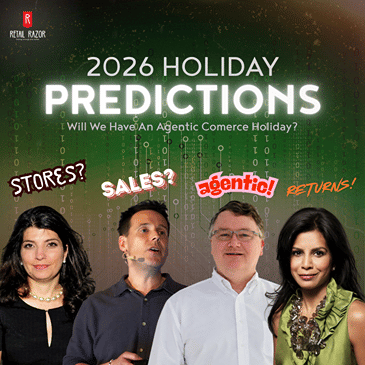


2026 holiday retail predictions - Neil Saunders, Scot Wingo, Suzy Davidkhanian and Hitha Herzog on AI gift research, the store, Black Month and the season of returns.
Holiday retail predictions this year start with one number. Forecasts say holiday sales grow about 4%. Neil Saunders says that once you take out the price increases, the stuff people buy grows about 1.4%. With that few extra units to go around, one retailer's growth comes out of another's share.
In this holiday retail predictions episode of The Retail Razor Show, Ricardo Belmar and Casey Golden talk with four guests, one at a time, then put every prediction on a scorecard: Neil Saunders of GlobalData, Scot Wingo of ReFiBuy and The Jason and Scot Show, Suzy Davidkhanian of EMARKETER and Hitha Herzog of H Squared Research.
Neil sets the number. Neil and Scot show how much holiday gift research is moving to AI, and Scot makes his agentic commerce call for the season. Suzy makes the case for stores, which still drive about 80% of retail sales. Neil explains why Black Friday has turned into Black Month. Hitha takes us into January, when the returns arrive. Then Ricardo and Casey grade the board, argue agent versus store, and each pick the holiday retail predictions they'd bet on.
In This Episode, You'll Learn:
Why 4% dollar growth and 1.4% unit growth means this holiday gets won on share.
How many shoppers plan to use AI for gift ideas this year, and why the agentic commerce purchase step hasn't arrived for gifting.
Scot Wingo's agentic commerce prediction, and why he says Amazon is playing defense for the first time in 30 years.
Why Suzy Davidkhanian expects big stores to build gift destinations sorted by price and by who you're shopping for.
Why Black Friday is a weak read on the season, and why discounting keeps starting earlier.
Hitha Herzog's three holiday retail predictions, from spending guardrails to a January wave of returns.
The one shopper all four guests describe, and where retailers can act on it this week.
Subscribe & Follow.
How much did you love this episode? Drop us a 5‑star rating and review on Apple Podcasts, Spotify, or Goodpods. Subscribe on YouTube so you never miss an episode and check out the other shows in the Retail Razor Podcast Network: Retail Transformers, Blade to Greatness, and Data Blades.
Subscribe to the Retail Razor Podcast Network: https://retailrazor.com/
Subscribe to our Newsletter: https://newsletter.retailrazor.com/
Subscribe to our YouTube channel: https://go.retailrazor.com/utube
This is one of eight episodes we recorded live at RetailClub AI Festival, rolling out across all four shows on the Retail Razor Podcast Network. Subscribe so you catch every one!
Featured guests.
Suzy Davidkhanian. https://www.linkedin.com/in/suzydavidkhanian/
Vice President, Content, EMARKETER. https://www.emarketer.com
Suzy Davidkhanian is Vice President of Content at EMARKETER, where she leads coverage across commerce media and retail. She helps retailers, brands, and industry leaders separate signal from noise, translating shifts in consumer behavior and commerce into practical business insights.
She brings more than 20 years of retail experience spanning stores, merchandising, marketing, and consumer insights. Before joining EMARKETER, Suzy led consumer insights and market trends at Macy's, where she connected changing shopper behavior to merchandising and marketing strategy. Her experience as both a retail operator and analyst gives her a practical perspective on the challenges and opportunities facing the industry.
Suzy hosts EMARKETER's Reimagining Retail podcast, featuring conversations with retail leaders on the trends reshaping commerce. She is a frequent commentator, with insights featured in Reuters, Vogue Business, WWD, and Modern Retail, and regularly moderates executive discussions and speaks at industry events including The Lead and eTail.
Neil Saunders. https://www.linkedin.com/in/neilretail/
Managing Director. GlobalData Retail. https://www.globaldata.com/
Neil is Managing Director of GlobalData’s retail division.
In this role he oversees the development of the company’s proposition and its research output. He also works with major clients to help them understand the retail, shopper and market landscape – advising them on how best to develop, evolve and implement business strategies.
Prior to GlobalData, Neil founded the retail research firm Conlumino which was subsequently acquired by GlobalData. And prior to that Neil worked for the John Lewis Partnership where he was involved, among other things, in the planning and relocation of new stores, the development of the ecommerce business, and the creation of technical and information systems.
Hitha Herzog. https://www.linkedin.com/in/hithaherzog/
Executive Director of Research. Parsons School of Design - The New School. https://www.newschool.edu/parsons/
Founder & Chief Research Officer. H Squared Research, LLC.
Hitha Herzog lives in a world where fashion, retail, finance, investigative journalism and data research all co-exist in perfect harmony—a.k.a., New York City. She is the Chief Research Officer of H Squared Research LLC a data driven, research firm for registered investment advisors. She is also consumer spending columnist at US News and World Report and author of the book "Black Market Billions: How Organized Retail Crime Funds Terrorists" published by FT Press. Hitha also uses her expertise in the retail space to advise start-ups in Silicon Valley and with Parsons The New School of Fashion incubator XRC Labs while teaching a class on social commerce. When she is not expanding her business and advising early stage companies, she is raising awareness about the criminal activity linked to the black market and counterfeit products. She created a companion app to the book available in iTunes to help people identify and spot counterfeit merchandise sold on the black market. Forbes magazine recently named her as “one of the most influential South Asian women in the United States.”
Scot Wingo. https://www.linkedin.com/in/thescotwingo/
Agentic CEO. ReFiBuy. https://refibuy.ai
Retailgentic newsletter. https://www.retailgentic.com
Retailgentic podcast. https://retailgentic.transistor.fm
The Jason & Scot Show podcast. https://retailgeek.com/jason-scot-show/
Scot Wingo, is a 5-time serial entrepreneur having started five companies: Stingray Software, AuctionRover, ChannelAdvisor/Rithum, Spiffy and ReFiBuy. Scot also co-hosts a top ecommerce podcast with Publicis' Chief Commerce Officer, Jason Goldberg (Jason and Scot Show) and his new podcast and substack is Retailgentic where he discusses the latest Agentic Commerce trends.
Chapters.
00:00 Teaser
01:41 The Number Behind the Number
07:35 AI Does the Homework
17:47 The Debate Beat
18:32 The Store Strikes Back
27:31 Black Month
31:29 The Holiday Hangover
38:12 The Payoff
41:02 The Predictions Scorecard
44:27 Show Close
Meet your hosts.
Helping you cut through the clutter in retail & retail tech:
Ricardo Belmar is an NRF Top Retail Voice for 2025 and a RETHINK Retail Top Retail Expert from 2021 – 2026 and a Top AI Leader for 2027. Thinkers 360 has named him a Top 10 Thought Leader in Retail and eCommerce, a Top 25 Thought Leader inCareers, a Top 50 Thought Leader in Agentic AI, AGI and Management, and a Top 100 Thought Leader in AI Ethics, Marketing, Digital Transformation and Transformation. Thinkers 360 also awarded him an Elite Expert Certification in Retail, a Master Expert Certification in Management, and named him a Certified Expert in AI, Marketing, and Digital Transformation. Thinkers 360 also named him a Top Digital Voice for 2024, 2025 and 2026. He is an advisory council member at the Retail Cloud Alliance. He was most recently the partner marketing leader for retail & consumer goods in the Americas at Microsoft.
Casey Golden, is the North America Leader for Retail & Consumer Goods at CI&T, and CEO of Luxlock. She is a RETHINK Retail Top Retail Expert from 2023 - 2026, and Retail Cloud Alliance advisory council member. After a career on the fashion and supply chain technology side of the business, Casey is obsessed with the customer relationship between the brand and the consumer and is slaying franken-stacks and building retail tech!
Episode Music.
Includes music provided by imunobeats.com, featuring Overclocked, and E-Motive from the album Beat Hype, written by Heston Mimms, published by Imuno.
Transcript.
S6E17 Holiday Predictions Episode
[00:00:00]
[00:00:00] Teaser
[00:00:01] Neil Saunders: on the surface everything looks really rosy and the holiday forecasts all very optimistic, around four percent or so
[00:00:08] It's not terrible, but I think
[00:00:10] the volume growth will be one point four percent this season.
[00:00:13] You know, it's going to be concentrated.
[00:00:16] Scot Wingo: they said, "We think that, agentic discovery will grow 130%." I think that's low. I'm gonna put it at 200% year-over-year growth
[00:00:24] I've been following Amazon for 30 years.
[00:00:26] They've never played defense.
[00:00:27] This is the first time I've seen them take pause and say, "We should do a little bit of defense here."
[00:00:31] Suzy Davidkhanian: I know we don't spend a lot of time talking about the store, even though it's 80% of sales
[00:00:35] Hitha Herzog: this is the season of returns. I know it sounds crazy. We're still gonna be out there buying, but this is,
[00:00:40] the season where retailers are really gonna,
[00:00:42] have the magnifying glass to how they handle returns
[00:00:44] Casey Golden: Everything is not a gift.
[00:00:46] Ricardo Belmar: 4% growth on the forecast, 1.4% in the stuff people actually buy. Somewhere in that gap, this holiday season gets won or lost.
[00:00:54] Casey Golden: So we asked four people who see the data before anyone else, where's the money really [00:01:00] going? Neil Saunders, Scott Wingo, Suzy Davidkhanian, and Hitha Herzog.
[00:01:06] Ricardo Belmar: And if you run a retail business, here's what we want you asking yourself while you watch.
[00:01:11] When shoppers buy fewer things and think harder about every single one, does your product get picked by the shopper, by the AI agent doing their homework, and by the person who opens it on Christmas morning?
[00:01:21] Casey Golden: Or does it come back in January?
[00:01:23] Ricardo Belmar: Black Friday is only days away. These are their predictions.
[00:01:27] Casey Golden: And we're holding them to every one.
[00:01:29]
[00:01:41] The Number Behind the Number
[00:01:41] Ricardo Belmar: Welcome back to season six of the Retail Razor Show, the top-ranked indie business management and marketing podcast on Goodpods, and the original show in the number one indie podcast network for retail.
[00:01:50] I'm Ricardo Belmar.
[00:01:51] Casey Golden: And I'm Casey Golden.
[00:01:52] Welcome, Retail Razor fans, to retail's favorite podcast, where we cut through the clutter to give you sharp insights on what's [00:02:00] happening in retail today and tomorrow. We get real about what's driving the future of commerce.
[00:02:06] Ricardo Belmar: So this is episode 17 in season 6, and it's just before Black Friday, so we're diving into the holiday season predictions today with four amazing guests, Neil Saunders, Scott Wingo, Suzy Davidkhanian, and Hitha Herzog. We spoke with each of them separately to get their unique take on what's going to happen this holiday season.
[00:02:25] Casey Golden: And I have to start with Neil, because he handed us the numbers I just can't shake.
[00:02:32] Ricardo Belmar: 1.4.
[00:02:33] Casey Golden: 1.4. Every forecast out there is sitting around 4%. Neil says, "Fine. Now pull out the price increases and look at how much stuff people are actually buying."
[00:02:45] Neil Saunders: Well, I think on the surface everything looks really rosy and the holiday forecasts all very optimistic, around four percent or so, some a bit higher, some marginally lower. what's interesting, though, of course, is all of those are [00:03:00] value forecasts, and I think they're reasonably accurate. But I think when you take the inflation out and the price increases, I think the picture is a little bit less optimistic.
[00:03:12] It's not terrible, but I think
[00:03:15] the volume growth will be one point four percent this season. so that's a little bit more suppressed, and I do think that presents a problem because, you know, if, if value growth is quite suppressed, it does mean that retailers can't share the spoils of that four point whatever percent growth equally between them.
[00:03:36] You know, it's going to be concentrated.
[00:03:38] Ricardo Belmar: Retailers can't share the spoils equally, so put that on a sticky note. If dollars are up and units barely move, anybody who grows is taking it from somebody else.
[00:03:47] Casey Golden: And he wasn't only talking about which retailers win. He was talking about which products.
[00:03:54] Neil Saunders: Think we're gonna see some real polarization in terms of the retailers that can win and [00:04:00] lose, but also the products that can win and lose. And I think there, there's some very interesting things we're finding in the data, including the fact that a lot of people are cutting out even more than they did last year, what we call these like frippery items, the kind of gifts you give but no one actually really likes and they end up in the trash probably a couple of weeks after, after the holidays. And, and interestingly, I think some retailers are still pushing these kind of things, and I think
[00:04:26] Casey Golden: Yeah
[00:04:27] Neil Saunders: are being a lot more selective about what they buy. So I think, you know, it's going to be a real, real battle for spend and some, some bits are just not gon-going to do that well
[00:04:39] Casey Golden: Frippery, and I'm adopting that word permanently.
[00:04:44] Ricardo Belmar: Does everybody really know what that means? I guess Neil thinks everyone does. It's things like the novelty socks, the gag gift that's sitting by the register. so, you know, I asked Neil the obvious follow-up to that. So does a concentrated season just hand everything to Amazon and Walmart then?
[00:04:58] Neil Saunders: I think so to a [00:05:00] certain extent. I think with Amazon, for example, I think it wins on multiple fronts. I think people like it for convenience. I think people like it for breadth of, of the range. And I also think people like it because it is generally very well and competitively priced. So I think there's lots of ticks in the boxes.
[00:05:17] Walmart, I think very similar. It wins but certainly on the value dimension and to a certain extent convenience as well. I think, you know, there are other players that could do potentially very well out of this. I think some of the department stores are really trying to put their best foot forward.
[00:05:34] Others perhaps aren't doing such a good job. you know, Target's the interesting one to watch because they have pulled out a lot of stops this holiday season. And I think what's really interesting there is they have got more products than they did last year in their holiday assortment, but they've really, really focused in on what folks want. So everything has been very carefully thought about. They're [00:06:00] not just chucking stuff out there, which I think they did a little bit in years past and some other retailers are still doing. So I think that curation is, is very, very critical
[00:06:10] Casey Golden: Remember that word, curation? Every single guest comes back to it today. I told Neil that this year it almost feels crass to be the person who shows up with a mountain of gifts. TikTok kind of canceled that whole moment last year. Fewer gifts, but ones that mean something. And he said the data backs it up.
[00:06:31] Neil Saunders: With gifting, I think it's interesting 'cause people have cut back a little bit on the gifting circle. Well, they say they are this year. but I think those people they're still buying gifts for, they want to be very thoughtful about them.
[00:06:43] And I think, you know, th- in past years we've seen things like cash go up as a, as a gift or gift cards because you know someone can get what they really want. I think that's still present to some degree, but in the initial data that we're seeing and the intention [00:07:00] data, we're not seeing that lift as it's done in past years because I think it's already pretty saturated. But I think the other interesting thing is as well, to your point, Casey, people, people do want the thought put into things, and it's like, well, you can give someone cash or a gift card, but actually I want to show them that I've really put thought into this. So I think people are, know, trying to be very meaningful and purposeful about gifting. But interestingly, that leads to another thing because obviously, if you're more purposeful and you're more thoughtful about gifting, you actually have to do more thinking and more research about what you buy
[00:07:35] AI Does the Homework
[00:07:35] Ricardo Belmar: Yep. More thinking, more research, And you know who's doing that research now?
[00:07:40] Neil Saunders: And, and that's another thing that I think is really interesting is the use of, of AI, for, for the holidays.
[00:07:47] So last year when we ran our pre-holiday survey to ask people whether they intended to use AI for gift ideas, we had about thirty-five, thirty-six percent of people said that they, they would, which is [00:08:00] pretty impressive. It's not necessarily buying via AI, it's just using AI for those ideas. This year when we've run it, the numbers are about forty-eight point six percent, so it's almost getting on for half, which is a huge
[00:08:14] Casey Golden: actually lower than I would've expected because like
[00:08:18] Neil Saunders: it is a bit lower, and I think that there probably are some...
[00:08:22] 'Cause what I think is interesting is I think there are some people who will use it, but they don't really know they're necessarily using it. It's like if you do a Google search, often it will come up with AI-generated responses, and I think a lot of people do use that. Or if they use Amazon and they use Alexa for shopping, maybe they're using that, but they don't really think of it as AI.
[00:08:40] Ricardo Belmar: it as
[00:08:41] Neil Saunders: So I
[00:08:41] Casey Golden: Right.
[00:08:41] Neil Saunders: that there might be a little bit of bias in, in that, but nevertheless, it is a very sharp uplift from last year, and I think it does show the extent to which AI is embedded now, and people do want to use it for those moments where they have to do a lot of research and they have to [00:09:00]do a lot of thinking.
[00:09:01] Casey Golden: And I stand by it. 48.6 felt pretty low to me.
[00:09:07] Ricardo Belmar: Yeah, his point is that a lot of people don't even call it AI. It's the answer at the top of their Google search. It's Alexa, so. So I asked whether shoppers trust what they're getting now that sponsored results are creeping into all of these tools.
[00:09:20] Neil Saunders: And I think the answer is that people don't really trust responses from AI. But what they do is they take
[00:09:28] Casey Golden: The internet
[00:09:30] Neil Saunders: and they, uh, they verify them. So it's like trust but verify.
[00:09:35] And so I think people use it as a start point. And, and as long as they... You know, 'cause if you're looking for a gift and it comes up with something, you, you'll, you'll know what's good and what's not. It has to go through your discernment filter as the, you know, as the gift giver. But I think if you do that and then you're like, "Okay, well, I kinda know this brand.
[00:09:54] I feel comfortable with it. I feel comfortable with this channel," then you can make a decision. But I think that's the [00:10:00] interesting thing because I think that's why more people are using it for gift ideas and research. But actually the agentic part where you say like, "Hey, go away and buy these things for me," and I don't intervene much.
[00:10:10] That f- especially for gift giving hasn't really taken off, um, at all,
[00:10:15] Ricardo Belmar: Mm-hmm.
[00:10:16] Neil Saunders: to, you know, to the same numerical extent. So I think that's the interesting gap
[00:10:21] Ricardo Belmar: Trust but verify, and listen to what passes the verify step. I kind of know this brand, I feel comfortable with this channel. The agent hands you an idea, and your brand still has to close the deal. It's the interesting gap. That's exactly where Scott Wingo lives.
[00:10:35] Casey Golden: Our self described agentic commerce maximalist, and his definition of agentic commerce starts at discovery and runs all the way to checkout.
[00:10:46] Scot Wingo: So, as you guys know, I am a self-described, and now the press calls me this, at least Jason Del Rey, uh, agentic commerce maximalist. So, so I think it's gonna be a big agentic commerce season. You guys have, uh, like me, have [00:11:00] been in the biz for more than a minute, and what you see is in fourth quarter, we set these new consumer behaviors, and then they kinda like wane a little bit into Q1, and then by Q3, they're kinda like back up to the previous holiday, and then we set a new,
[00:11:12] Ricardo Belmar: Mm-hmm.
[00:11:13] Scot Wingo: a new high bar.
[00:11:14] I don't think we're gonna have some breakthrough of the purchase part of that. I think that's gonna be next year we'll start to really feel the purchase part. People have to get comfortable with it. This is kinda how cellphone, you know, what we call mobile kinda went. We, we saw this huge discovery piece, but no one was buying and we're like, "What's wrong?"
[00:11:28] And then the naysayers were like, "They'll never buy on their phone. They'll never trust it." And then here we are, you know, six years later and, and s- I think it's actually larger transactions on phone than desktop. And so I think it's gonna look like that, but it'll take-- it'll go faster than six years.
[00:11:45] But, but to this holiday, you know, what I'm gonna benchmark is Adobe came out with a pretty aggressive forecast, for overall commerce that I'm sure you've talked about. But within there they said, "We think that, agentic discovery will grow 130%." I think [00:12:00] that's low. I'm gonna put it at 200% year-over-year growth, which I think is, if I do the math right, that's a 3X.
[00:12:05] Casey Golden: So here's what surprised me. The maximalist and the analyst agree. Neil said, "Go buy it for me hasn't taken off for gifts." Scott says, "The buying breakthrough is next year."
[00:12:21] Ricardo Belmar: And where they split is how big the research side gets. Scott's betting it triples, and he gave us A use case that made me look at my own gift list just a little bit differently.
[00:12:30] Scot Wingo: you know, what's gonna drive that is some behaviors of, I have seen a lot of stock-outs already. there's a couple things on my kids' list that are out. and then one thing I had never thought of,
[00:12:42] I have two daughters that are in their 20s, and they shared a Giftly, so it's like their gift list.
[00:12:47] And I just told my agent to watch it and let me know if anything goes 20% off. So, so it's gonna really trigger some Black Friday sales versus me, like, having to poke through 'em and figure out, you know, what is a good fit.
[00:12:58] Ricardo Belmar: keep track
[00:12:59] Scot Wingo: Yeah, so, so I [00:13:00] think, like, people are gonna start to learn because the use case will be very unique during fourth quarter.
[00:13:04] They're gonna learn some new behaviors other than the, the normal research discovery type thing. And I do think gifting is a pur-- just overall gifting without the Giftly link and all that is gonna be a really great use case for, for agents. They, they, they're very good at helping you figure out something unique and individualized that, that we're all looking for.
[00:13:24] So use agents to give it a human touch, ironically.
[00:13:27] Casey Golden: A human touch from an agent. I told him that beats a gift certificate. Then I asked how much shopping traffic is actually coming from AI.
[00:13:36] Scot Wingo: So, so we saw a tipping point in the third quarter where, uh, the survey data all started to report that 50% of consumers are actively using AI to, to shop. and, and again, a lot of that's up at the discovery phase. So, so I think we've crossed 50%. And the, the-- there's other supporting data. So that's survey data, which is, like, one thing you have to kind of, like, take with a grain of salt because it's [00:14:00] stated preference.
[00:14:00] Casey Golden: Right.
[00:14:01] Ricardo Belmar: The supporting data is where it gets real. Google searches are growing faster than ever because every turn in an AI.
[00:14:07] conversation counts as a search, while search ad revenue heads the other direction. Scott thinks Google will eat that ad hit to keep shoppers from leaving it for ChatGPT.
[00:14:18] Casey Golden: Then he got into Amazon, and if your brand buys sponsored placements, this is a place to listen to.
[00:14:27] Scot Wingo: The other data point is Amazon. There's a lot of noise in this, but their, their ad growth, I've always said a harbinger that we'll know discovery has tipped over is Amazon's ad business will come under pressure because people aren't gonna go through that.
[00:14:40] Amazon Discovery is pretty broke in my mind because I get way more sponsored product. It's kind of like sponsored slop. Like, it, it was useful when they first introduced
[00:14:49] Casey Golden: don't even think I've ever used it
[00:14:50] Ricardo Belmar: Yeah. But now I have
[00:14:51] Scot Wingo: Yeah. No one uses Amazon for discovery.
[00:14:53] Ricardo Belmar: of the responses are
[00:14:54] Scot Wingo: because it's kind of broken. So, so, um, so then if you're just going to [00:15:00] hop to the bottom at Amazon and never pass through the, the, the, you know, a browse or a search experience, that's where all the ads are.
[00:15:07] And I think, I think people are doing that. And, and that's what... It's, uh, kind of a self-fulfilling prophecy because again, it's kind of like Google. Amazon realizes if they don't offer it, someone could go somewhere else. They've had to offer it in the form of what was called Rufus and now is AFS. And I think what's happening is so much discovery is happening over there, it's starving off the ad system.
[00:15:28] So the ad system, you know, prior to Q2 and Q3 of this year was growing at 22%, and it took a leg down. If you normalize for Prime Day movement, it is leg down to 17%. That's a, that's a
[00:15:40] Ricardo Belmar: Mm-hmm.
[00:15:41] Scot Wingo: points out of 22% is like a 25% drop. That- that's like pretty material, and I think it's gonna continue to leg down over time.
[00:15:49] Ricardo Belmar: Sponsored slop. That one's gotta go on a T-shirt.
[00:15:53] Casey Golden: And Walmart?
[00:15:53] Ricardo Belmar: A different story. Walmart's ad business is smaller, uh, And still growing, and it's opening the doors to agents. Uh, [00:16:00] Scott sees the number two player making a bet with pretty low downside and a lot of upside. Lean in wherever Amazon won't. He called every transaction from discovery down a gunfight. And then he told us the Amazon story that pretty much stopped me cold.
[00:16:15] Scot Wingo: there was an interesting thing, um, you probably caught this, Ricardo. Reuters got a leak from Amazon. I don't know if it's true or not, so it's in the gossip kinda bucket. And it was an internal memo saying, "We need to go build a world global mo- catalog." So, so, so I, I think Amazon's looked at their...
[00:16:32] We see this a lot. We, we did a, we did an analysis of PDPs on Amazon. We just did, like, 100 to start. 80% of them have wrong information on them. Like, inside the listing, it, one part will say gluten-free and the other part will say not gluten-free. Like, the PDP itself, through the various... There's like 1,000 settings you can set in Amazon.
[00:16:53] No human... And you can tell what people have done, is they've cut, copy, pasted across their, their products, and a lot of bad [00:17:00] information has worked in there. I think Amazon is starting to realize, "We thought we had the world's best product data, but maybe we're wrong," 'cause Rufus says a lot of wacky stuff, and as you dig into it, this is why.
[00:17:11] Ricardo Belmar: Mm-hmm.
[00:17:11] Scot Wingo: And I, I think they're realizing, "We need to pull in product data from outside Amazon to clean up our own act." So there's a lot of, lot of evidence, and then I think Shop Now is part of Amazon's defensive strategy. And then,
[00:17:23] Ricardo Belmar: Mm-hmm.
[00:17:23] Scot Wingo: think the way... I think they're, uh, they just introduced Text with Alexa, which is really good.
[00:17:28] You guys should try that out. And, uh, I think, I think they will try to make x- Alexa a horizontal agent to try to... They're gonna, they're gonna start fighting on multiple fronts. Uh, I've been following Amazon for 30 years. They've never been... They've never played defense. They're always, like, playing offense.
[00:17:43] This is the first time I've seen them take pause and say, "We should do a little bit of defense here."
[00:17:47] The Debate Beat
[00:17:47] Ricardo Belmar: Okay, I'm planting my flag on this one. 80 out of 100 product pages with bad information. If an agent is doing the gift research this year, the most important shelf you've got might be the answer that agent gives. [00:18:00] So fix your product data before you touch anything else.
[00:18:03] Casey Golden: And I'm pushing back because that's what I do. Uh, no, because I'm doing my holiday shopping in stores this year. Um, it's just a bit overwhelming online.
[00:18:14] Ricardo Belmar: And you told Suzy that word for word, I think.
[00:18:17] Casey Golden: Yeah. and Suzy has the stat that makes your agent look like a rounding error.
[00:18:22] Ricardo Belmar: Maybe rounding error is a little bit of a stretch.
[00:18:24] Casey Golden: My Excel files are better than yours.
[00:18:30] But let's have her make the case.
[00:18:32]
[00:18:32] The Store Strikes Back
[00:18:32] Suzy Davidkhanian: I am very excited about this. I've been giving it a lot of thought. I think, you know, we're all focused, both shoppers and retailers, on how AI can make shopping easier for everyone online, and I think it's really a critical piece. But I think retailers are also understanding just how important the store is. And so for this holiday season, I think that some retailers, especially the multi-branded, multi-category, really large footprint stores, [00:19:00] are maybe gonna think about how they merchandise in a slightly different way so that it makes gift giving easier. And so I know we don't spend a lot of time talking about the store, even though it's 80% of sales, but I do think that online shopping, especially with AI, is making it harder for retailers to be both margin positive but also to stand out, and we're seeing a lot of the sea of sameness. One way a retailer can really, really, really differentiate themselves is by the store experience, and so I think we're gonna start to see more of that in multi-branded places.
[00:19:34] But what I think we might start seeing more and more of is like the center core or like the easier place where people can really build their baskets in an easy frictionless way, kind of, if you will, in store, versus having to wander and look for the perfect gift. It's already so, so stressful to shop for gifts, and you really want to as a retailer... I mean, this is our biggest season, right? So you really need to figure out how do you [00:20:00] get incremental purchases. If you let the person wander around, there's a chance, especially as we lead into the last days of Christmas, that people are gonna give up and they're not gonna be part of it.
[00:20:09] And so I think if they maybe double expose, if they think about not just budgets, like we see a lot of gifts under $100, gift under 50, but they also do things like for my mom, for my dad, for my child, what-whatever the categories are that you have, totally fine to double expose because we already know where to find gifts if it's somewhere that you're loyal and you go off all the time. But this might be a way for these big, big boxes, I think even, off-price, right? Because there is a treasure hunt aspect, and there are lots of brands, but it's also so treasure hunt-like that it's really hard to find the perfect gift. So if we can help... And I think, again, we're gonna see more of this. If, if retailers can help make the work easier for the shopper,
[00:20:55] Ricardo Belmar: Mm-hmm.
[00:20:56] Suzy Davidkhanian: they will see bigger basket sizes.
[00:20:59] Ricardo Belmar: A [00:21:00] sea of sameness, uh, and that's the honest flip side, I think, to Scott's world. If every retailer shows up in the same agent answer with the same product at the same price, what are you left to compete on?
[00:21:09] Casey Golden: Right. And nobody wins a price war in December.
[00:21:13] Ricardo Belmar: Yeah, so Suzy's answer is on the store floor, a gifting destination in the center of a store, sorted by price and by who you're shopping for. And then she went after a metric store teams live by.
[00:21:24] Suzy Davidkhanian: And then maybe they also have to rethink about their KPIs. Like I don't think we need to cram every last piece of merchandise on the floor. I don't think that having so much merchandise is really helping, right? With
[00:21:36] Casey Golden: Yeah. Everything is not a gift.
[00:21:38] Everything is not a gift. My line, and I'm proud of it.
[00:21:43] Ricardo Belmar: It. It's like Neil's frippery point from the store side. So then Suzy talked about bringing some digital into the aisle, even old school stuff like review cards on the shelf or screens running TikTok unboxings, that's when I brought up Michael Kors.
[00:21:57] Casey Golden: Of course you did.
[00:21:58] Ricardo Belmar: Of course. Project Runway, the [00:22:00] early seasons.
[00:22:00] Anytime a designer brought him a super hot mess of a design, he would look right at them and say, "You have to edit, edit, edit." And that's what Suzy's describing.
[00:22:10] Suzy Davidkhanian: Yeah. Right? Absolutely. And I think there's, like, art in science. The technology is really important, but the-- but understanding the underlying needs and the, like, um, I'm gonna use the word emotional state and on purpose, right? The closer you get to the holiday season, if you celebrate a gift-giving holiday, then you're starting to get more stressed.
[00:22:29] You have so many other things you have to worry about, and it's like, how do you make sure that the product is front and center? And I think especially with AI, going back to basics around the product. You know, if you only rely on AI, you're gonna start having some margin erosion.
[00:22:45] You're fighting to be visible.
[00:22:46] You've sort of lost ground on understanding who your customer is 'cause now they're coming just to your product page, and then you don't have that relationship with them. But knowing that eighty percent of sales, even during the holidays, I, I rounded up, seventy-eight percent of sales [00:23:00] are, are in a store, in a store, then I think it's really important to make sure that you use that, but that you are able to remove as much friction, whether it's with more associates, whether it's with...
[00:23:12] Yeah, uh, for me, it's the easier merchandising, right? Don't make me walk the whole store. You know I'm gonna have to buy multiple gifts. You want to make my basket bigger. Help me understand what are all the options so that I don't put an extra three thousand steps in
[00:23:26] Casey Golden: There are so many movies I can move on to, but we're not gonna do that. there it is. If you only rely on AI, you lose the relationship because they go straight to your product page and leave.
[00:23:37] Ricardo Belmar: Yeah, I'll give you that one for sure. but even Susie put AI back in the store. I asked her about using the app in the aisle as part of the visit instead of treating it like one more online channel.
[00:23:46] Suzy Davidkhanian: And it's so... It's such a good point. I think over the years, retailers are really rethinking about how they use their app, and some of it is now gen, like AI versus predictive or even like, I don't know, it's probably five years [00:24:00] ago that, um, Home Depot had the app that told you the aisle where you could find what you were looking for.
[00:24:04] Like, so I think in this world of conversational commerce, that apps also need to provide that. So like Ralph Lauren has that. Sparky has that.
[00:24:13] I was in a grocery store where there's like literally QR codes by the, like each of the items that are like, "Click here" or whatever, "Scan here so that you can get an extra coupon" and it ties back to the loyalty program, right? And so I think if you make the connection as seamless as possible, um, you collect more information about your shopper, and then you can make their journey even easier.
[00:24:34] And I think, yes, this is important all year, but given how quickly the holidays come and given how stressful gift-giving can be for the, the buyer, but also for retailers. Just think about all the returns that come in at the end of the year and into January. So... And that's like a double whammy. So you can organize your, your space in store to inspire, to like build your basket, to, to, to make it a little bit more [00:25:00] seamless for the shopper, you also earn their loyalty for future visits
[00:25:06] Casey Golden: Nobody wants to be the person that gave the gift that got returned
[00:25:10] Suzy Davidkhanian: That's it.
[00:25:11] Ricardo Belmar: Okay, a point for Scott. The store that wins has an agent in it.
[00:25:15] Casey Golden: Half a point. Then she went after one of the oldest rules in store layout.
[00:25:24] Ricardo Belmar: Put the stuff people came for in the back so they walk past everything else on the way.
[00:25:30] Casey Golden: Holiday, holiday decorations. Always, back right corner, every year.
[00:25:34] Suzy Davidkhanian: There was a time where the stores were merchandised with like the, um, highest volume driving things were in the back because they thought, you know, people thought if you walk through the store, you might throw a couple extra things into your basket. But I don't, I don't know, especially as the apps get smarter and tell you where to find Bounty or the jeans or whatever, I don't know that you can rely on that anymore. So make it easy
[00:25:55] Ricardo Belmar: Somebody on a mission feels punished when you send them to the back. [00:26:00] Somebody browsing for gifts wants help. Different shopper, different layout.
[00:26:03] Casey Golden: And I'm still waiting for someone to build me a digital Santa list. Everybody, everybody I'm shopping for, what I got them last year, links to their own wish list, and a running total of what this just cost me.
[00:26:17] Ricardo Belmar: Yeah, Scot's daughters basically have that, I think, with an agent watching it.
[00:26:22] Casey Golden: Fine. Suzy's last point is the one I think most retailers miss.
[00:26:27] Suzy Davidkhanian: And so I think it's this delicate dance of, like, surprise and delight for the gift receiver, but also make my life easier. And, and I think it's also a misnomer.
[00:26:36] There's a lot of volume that happens during the holidays that's self-gifting. So if you do these sort of, like, all merchandise together, you sort of could grow your basket with, like, one for you, one for me also in an easier way. And I mean, we didn't really talk about this, but the holidays is when it's the most promotional activity.
[00:26:56] And so that, too, you have to watch out for. I think when you're [00:27:00] in a store, you still have to think about promotions, but maybe if you give a really good experience and you have a lot of unique items that you can't comp shop, then it becomes easier to, for that piece to be whatever that price point is
[00:27:14] Ricardo Belmar: Okay, so that's one for you, one for me. And unique items you can't comp shop. That's how you get out of the sea of sameness. If an agent can't find the same thing cheaper three tabs over, you get to hold your price.
[00:27:24] Casey Golden: Which takes us to the calendar, because holding price is about to get very hard.
[00:27:31]
[00:27:31] Black Month
[00:27:31] Casey Golden: Black Friday's this Friday. I asked Neil if Friday tells us anything about December.
[00:27:37] Neil Saunders: I, I, I think so, but I would put a caveat around it because I think Black Friday itself, uh, you know, the day or the, the little period around that Friday, I think it's become quite an unreliable indicator now I think that it's not really Black Friday, it's like Black Month and
[00:27:56] Casey Golden: Yes, it's there
[00:27:57] Neil Saunders: it because--
[00:27:59] Ricardo Belmar: week,
[00:27:59] Neil Saunders: exactly, [00:28:00] because
[00:28:00] Ricardo Belmar: like the whole month
[00:28:01] Neil Saunders: it, it's just a constant discounting cycle.
[00:28:04] So I think-- I mean, people look at Black Friday and they go, "Oh, it's terrible," like the foot traffic's down and the sales growth isn't great. And it's like, well, on, on the day may-
[00:28:13] Ricardo Belmar: the
[00:28:14] Casey Golden: I mean, you're surprised you get anybody showing up knowing what they're, they, with them knowing what they're walking into with the lines and the people. Like, I wouldn't go to a physical store on Black Friday. Like, what did I do to deserve that? Like...
[00:28:26] Neil Saunders: Yes. but I, but I do--
[00:28:29] Casey Golden: I'm
[00:28:29] Neil Saunders: that's the
[00:28:30] Casey Golden: sure
[00:28:30] Neil Saunders: thing. It's, it's the season around it. And I think when you look at that as a whole, um, it seems to be trending from what we can see so far in the early things and the Amazon, you know, Prime Big Deal Days in, in October. Uh, it seems to be trending quite well because I think that's the other thing. this holiday, if they're not buying cheap 'cause they're not just looking for lower prices, they're trying to buy on discount 'cause they're trying to maximize bang for their buck. So everyone is crowding [00:29:00] into these like tentpole events for discounting. and if, and if you offer them as a retailer, you can probably do quite well.
[00:29:07] But it does mean like things that fall outside of those tentpoles don't tend to look quite so good. Um, so I, I think, yeah, it's a very-- it's got a lot more complex than it used to be for, for predicting and it's just, it's spread out and protracted a great deal more in terms of the spend profile.
[00:29:27] Ricardo Belmar: Okay, so you'll be in stores this year, just not on Friday.
[00:29:31] Casey Golden: I have limits. I mean, for standards. I have no
[00:29:36] Ricardo Belmar: al-
[00:29:36] Casey Golden: for that.
[00:29:37] Ricardo Belmar: Yeah, exactly. Well, Neil also said retailers actually like it this way. Spreading demand out beats staffing up for doorbuster fights over TVs or pushing one giant online spike through warehouses that were never built for it. Uh, and You made the calendar point.
[00:29:51] Casey Golden: You can lose two days in November and you've still got 28. December doesn't give you a full 30, so [00:30:00] you have to win in November.
[00:30:02] Ricardo Belmar: Yeah. So then he explained why the discounting keeps creeping earlier and earlier and earlier every year.
[00:30:08] Neil Saunders: Yes. And I think that's the other thing as well. I, I think retailers-- I mean, the reason that the discounting starts to creep earlier and earlier, mean, partly it's because of Amazon with, you know, its, its October events. But I don't think it's just because of that. I think it's also because when retailers are a little bit nervous about market share and gains, th-they tend to want to get in early.
[00:30:30] It's like, "Okay, the consumer's a bit constrained, so we should have first bite of the cherry, 'cause if they come and spend with us, then we've secured our, our share early on."
[00:30:39] Ricardo Belmar: Right
[00:30:39] Neil Saunders: think that just nudges everyone to sort of try and start coaxing the consumer into spending in October, in early November, um, because they feel if they get that, like they can relax a little, a little bit more. And I think to a certain extent, it, it works, um, because consumers [00:31:00]have spread spending a little bit more over that, that period.
[00:31:03] Casey Golden: So if you're reading Friday's foot traffic numbers this weekend and starting to panic, stop. Read the whole season, and if your promo calendar has a hole between the tent poles, that's where you're gonna feel it.
[00:31:21] Ricardo Belmar: Which brings us to the part of the season nobody ever puts in the forecast.
[00:31:26] Casey Golden: Funny how that works. January.
[00:31:28] Ricardo Belmar: Yeah.
[00:31:29]
[00:31:29] The Holiday Hangover
[00:31:29] Casey Golden: Hitha brought three predictions, and every one of them lands after the wrapping paper hits that recycle bin.
[00:31:37] Hitha Herzog: Yeah. Okay, I have three big ones. The first one is spending and how people are spending. So, uh, Afterpay did a holiday report that said around 47% of people are feeling really stressed about the holidays. And I guess one in three parents feel that the holiday gift list that they are [00:32:00] getting from their kids, they cannot afford, which shocking surprise, I looked at my kids' gift list and I thought, uh, "Sure, yeah, just throw in a Hamptons house at the same time.
[00:32:09] Like, just, just put a,
[00:32:10] Ricardo Belmar: as
[00:32:11] Hitha Herzog: put it all on there."
[00:32:12] Ricardo Belmar: not?
[00:32:13] Hitha Herzog: why not? Uh,
[00:32:14] So I think there's going to be a real shift in the way that people are spending.
[00:32:19] The guardrails are up. Uh, we have younger generations, Gen Z in particular, that are very, uh, attuned to how they are spending. They don't really love credit cards.
[00:32:30] Ricardo Belmar: Mm-hmm. Yeah
[00:32:31] Hitha Herzog: kind of gives them the ick according to Afterpay. So, uh, so I think that this type of spending is really going to come into focus. Um, guardrails, spending within your means, and using these tools like buy now, pay later to make sure that those guardrails are up and you don't have this holiday hangover.
[00:32:48] And come January, you look at your credit card statement, and
[00:32:52] most people, more than you think, open up their credit card statements and, and say, "Oh my gosh, we spent a ton. I can't pay it [00:33:00] off in full," and suddenly we're getting hit with interest rates and massive interest.
[00:33:04] Ricardo Belmar: Okay, put that next to Neil.
[00:33:05] Fewer units, discount hunting at every tent pole, and now guardrails on how people pay. Three signals and one very careful shopper.
[00:33:13] Casey Golden: Then her second and third prediction.
[00:33:15] Hitha Herzog: So, so that I feel like is going to be one trend we're seeing, a more conscious way of spending. Another is an understanding of supply chain, and we talked about this. My mother now can talk to me about supply chain, which I-- you can imagine my shock and awe when she started waxing poetic about that.
[00:33:35] And I think the reason why is because it has become full- fully focused upon, um, not just from our industry and people within our industry, but people, the, the consumer wants to know where their, their products are. And there's a radical transparency around that. so I think certainly supply chain, and of course, I talked to you guys about this as [00:34:00] well, returns. I think there's gonna be a real focus on returns. Well, there was a statistic... Actually, I was talking to someone, one of the, uh, executives over at Revolve, and she was saying that for them, 40% of their online purchases, result in returns. So 40% at Revolve.
[00:34:19] Casey Golden: Wow
[00:34:21] Hitha Herzog: that told me that, but I'm gonna put that out there on R-
[00:34:23] Ricardo Belmar: 40%.
[00:34:24] Hitha Herzog: But I don't think that's a, I think that's a number that is pretty much standard across the board
[00:34:29] Casey Golden: I said it to Hitha, and I'll say it again. If a physical store had a 30 to 40% return rate, every alarm in the building would be going off at corporate.
[00:34:40] Ricardo Belmar: So I asked her whether gifting makes it worse, bad sizing, people buying three sizes for themselves.
[00:34:45] Casey Golden: All of the above. She's guilty of it herself. She also told us about Nordstrom's Santa brunch, 20 minutes with Santa, and the whole family goes shopping afterwards. Adorbs.
[00:34:59] Ricardo Belmar: of course, [00:35:00] which is exactly the kind of reason to visit a store that Suzy was talking about.
[00:35:04] Casey Golden: And she bought the dresses. She confessed.
[00:35:07] Hitha Herzog: But I don't wanna go in, and I think most people, with the exception of Casey, who seems to know your sizing perfectly. I don't know how you do that. But I buy several sizes and try them on and then return it. So I'm part of the problem, you guys.
[00:35:21] Ricardo Belmar: Yeah. But so many people are
[00:35:23] Hitha Herzog: but
[00:35:24] Ricardo Belmar: mean, everyone I know does that.
[00:35:25] Casey Golden: For the record, I'd rather go into the city and get it done than deal with a return. The hassle is exactly where Hitha sees the opening.
[00:35:34] Hitha Herzog: And I think that's the pain point, Casey. That's the white space we're talking about. Retailers are now realizing that this is how people are shopping. There's a 40% return rate. We want to mitigate that and not have that have an impact on our bottom line. But how do we make it incredibly easy for people to return things?
[00:35:55] And it's certainly gotten easier over the years, right? Before we'd have to
[00:35:59] Casey Golden: And they [00:36:00] need to turn those returns into exchanges. Like, they need to keep the dollars somehow, right? So
[00:36:05] Hitha Herzog: Yes
[00:36:07] Casey Golden: uh, most, most e-coms don't offer exchange. There's very few. I know Free People, their website offers exchanges, which I love. But most of them you have to process a return, and then you have to repurchase.
[00:36:21] Ricardo Belmar: Right.
[00:36:23] Casey Golden: guaranteed that extra dollar. If it is cumbersome to make the return, you're done. You want out.
[00:36:29] Ricardo Belmar: Mm-hmm.
[00:36:30] Casey Golden: but being able to keep those dollars, it's really driving wanting to get those people in the store to make the return so they can shop more
[00:36:40] Hitha Herzog: Yeah.
[00:36:40] Ricardo Belmar: Hitha pointed to Quince as a brand that's built exchanges right into the system and said it's a big reason her family keeps going back. So I asked her a big question, "Is January a wake-up call?"
[00:36:51] Hitha Herzog: I think yes. I think January if these systems haven't already been put in place, which I'm hoping, you know, [00:37:00] after years of seeing 40% returns from online purchases, you know, 30% to 40%, would've gotten a clue at this point. I think that if that hasn't already been established, the retailers that are behind on that, gonna have a wake-up call. I think it's just the, the, the volume of returns that are gonna be coming in. And again, we're talking about bottom lines for retailers. How is that gonna have an impact when you are seeing this crush of returns? How do you process them? How is that process going to dollar for dollar, equate to you making sure that you made money during this holiday season? And I don't think we talk about that enough
[00:37:42] Casey Golden: Yeah.
[00:37:43] Ricardo Belmar: Yeah
[00:37:43] Hitha Herzog: that in particular, that is really sort of the white space, not only for January and this holiday season that retailers are gonna be focused on, but I think going forward, this is really going to be the turning point for retailers.
[00:37:58] But this, this is the [00:38:00] season of returns. I know it sounds crazy. We're still gonna be out there buying, but this is, this is the season where retailers are really gonna, you know, have the magnifying glass to how they handle returns and, and what, what are the best practices going forward.
[00:38:12] The Payoff
[00:38:12] Ricardo Belmar: Scott had a February prediction too, and it plugs right into Hitha's.
[00:38:15] Casey Golden: I asked him what changes for 2027 once the holiday numbers come in.
[00:38:20] Scot Wingo: Yeah, I think, you know, if we have this new high watermark, if my prediction holds true... And I think we're gonna see some, some journalists pick up on this gifting thing. I, I'd be surprised if the articles aren't kind of locked and loaded for, for kind of next week. that, you know, the good news is in our world the, the promotion wheel rolls right around to Valentine's Day.
[00:38:41] So, so Casey, to your point, if by two-one we realize gifting is a big thing, I think it'll come- uh, it'll actually-- I think, I think people will catch onto this earlier. then I think that, uh, everyone's gonna really lean in on the-- Every business that's impacted by gifting is gonna lean in pretty hard. Um, so that, that's kind of a [00:39:00] given.
[00:39:00] I think that's pretty easy prediction to make. Um, so there you've got your Victoria's Secret, all your candy companies, your chocolates, your Godivas, uh, all the gifting, the flower companies. I think, I think they're, they'll... They're already kind of leaning in a bit. I think they're gonna like get, get lean way forward on it.
[00:39:19] Ricardo Belmar: And then the prediction I'd want every chief digital officer to hear before Friday.
[00:39:24] Scot Wingo: and then the folks blocking, I think Amazon will be the last one to kind of take the walls down because I think they have the most to lose, so, so they're not gonna be a harbinger. Um, Chewy is one I keep an eye on. They're, they're pretty aggressive about blocking. They're not in the press a lot. But amongst the Chewy, Petco, PetSmart, they, they're very aggressive at blocking.
[00:39:45] In the apparel category, there's some brands that are blocking, but a lot of it's accidental. When I actually talk to the brands they'll-- I'll talk to the, the chi- CDO and they'll say, "We wanna... You know, what should we do to lean into agentic commerce?" And I'm like, "Well, are you aware you're blocking brands, the bots?"
[00:39:59] And they're [00:40:00] like, "What?"
[00:40:00] the, the... But then they'll be blocking one of the ChatGPT bots or, uh, Claude is actually the number three agent. A lot of people don't realize that on the answer engine side. A lot of them are blocking,
[00:40:11] Ricardo Belmar: Mm-hmm.
[00:40:12] Scot Wingo: the, the Muse bot, which is Meta's, you know, Meta's bot that pulls into the Muse agent.
[00:40:17] So, so those types of things. So, so I think, I think it'll cause more people to g- become awareness, and I think we'll start to see the blocking stop. But there'll be, there'll be a s- set of staunch people that are gonna kinda wait till the, the, they see evidence that it is a losing strategy and they have to reverse, and they'll reverse quickly.
[00:40:34] Ricardo Belmar: And everybody knows not to block Google because that kills your SEO, but what about the AI bots? Are you aware you're even blocking the bots? If you run digital at a retailer, go ask your team that question this week.
[00:40:45] Casey Golden: And he's got one more for next year.
[00:40:47] Scot Wingo: Next year, we are gonna see a ChatGPT device, and rumors are it's gonna be pretty good, and kind of a little handheld, speaker-ish thing, maybe with a screen, maybe not, that, that we can just chat, chat with ChatGPT, and it [00:41:00] will...
[00:41:00] I'm sure it will have a bunch of shopping things that it does
[00:41:02] The Predictions Scorecard
[00:41:02] Ricardo Belmar: Okay, let's put it all on a scoreboard because we told you we're holding them to it.
[00:41:06] Casey Golden: Neil, dollars up around 4%, units up 1.4, and don't judge it by Friday. About half of shoppers use AI for gift ideas, and go buy it for me stays small.
[00:41:25] Ricardo Belmar: So for Scott, agentic discovery triples 200%, way past Adobe's 130. Amazon's ad growth keeps slowing, and the bot walls start coming down, and Amazon's the last to open them up.
[00:41:37] Casey Golden: Suzy, the big multi-category stores, off-price included, start merchandising for the gift giver by price and by who you're shopping for, and the ones that do it are gonna see bigger baskets.
[00:41:51] Ricardo Belmar: And Hitha, spending with guardrails and buy now, pay later is one of those guardrails. Then a January wave of returns that [00:42:00] wakes up every retailer who hasn't fixed returns yet.
[00:42:03] Casey Golden: Oh, maybe a couple credit card hangovers.
[00:42:05] Ricardo Belmar: Mm, maybe. Yeah, maybe we might want to add that one.
[00:42:09] So here's what jumped out when we put these four side by side. We talked to every one of them separately, nobody heard anybody else's answer, and they all described the same shopper.
[00:42:18] Casey Golden: Fewer gifts, more thought into each one, done with frippery, and watching every dollar.
[00:42:24] Ricardo Belmar: That shopper is editing. So the question for you is whether your business is editing with them.
[00:42:32] Casey Golden: And each guest told us where the editing happens.
[00:42:36] Neil, the assortment. Target added products and still cut the noise.
[00:42:41] Ricardo Belmar: For Scott, it's your product data. If the agent can't trust your listing, you don't make the list. And if you're blocking the bots, you're not even in the running.
[00:42:48] Casey Golden: Suzy the floor. Put the gifts where people can build a basket and stop making them walk 3,000 extra steps.
[00:42:56] Ricardo Belmar: And for Hitha, it's all about the returns. Turn it into [00:43:00] an exchange and keep the dollars.
[00:43:02] Casey Golden: So Ricardo, agent or store?
[00:43:05] Ricardo Belmar: Hmm. Well, let's say, I guess I can concede this much, An agent does the homework, but the brand still has to close the deal, right? Neil said it himself, "Trust but verify," and people verify with brands they already know.
[00:43:16] Casey Golden: And I'll concede that my perfect store has Scott's agent in the app telling me which aisle to go down. That's fine.
[00:43:25] Ricardo Belmar: Yep. I'll say Michael Kors had it right. You've got to edit, edit, edit.
[00:43:30] Casey Golden: Because everything is not a gift.
[00:43:33] Ricardo Belmar: So if I'm betting on one prediction, I, I might have to go with Scott's 200%. Uh, Neil's survey already has half of shoppers using AI for gift ideas, so there's-- behavior's kind of there. Season may just make it a, a full-time habit.
[00:43:47] Casey Golden: Mine's, Hitha. January returns, careful shoppers, gifts nobody asked for, three sizes in the cart, all of it ends up in the returns counter.
[00:43:57] Ricardo Belmar: Yeah. So we'll have to grade every one of these when the [00:44:00]numbers actually come in.
[00:44:01] Casey Golden: Neil, we're holding you to the 1.4.
[00:44:04] Neil Saunders: You can, yeah. You can, you can see how accurate it is
[00:44:07] Ricardo Belmar: And we'll see Scott at NRF.
[00:44:09] Casey Golden: Now, tell us yours. Drop your prediction in the comments. Which of these four nails it, and who's going to miss? Happy holidays, everyone.
[00:44:20] Ricardo Belmar: Happy holidays.
[00:44:27] Show Close
[00:44:27] Casey Golden: All right. You know this was your favorite episode ever. You loved it. So hit subscribe and drop us a five-star rating and review on Apple Podcasts, Spotify, or Goodpods. And if you're watching us on YouTube, like, subscribe, and drop a comment before you go.
[00:44:44] I'm Casey Golden.
[00:44:45] Ricardo Belmar: And don't forget to follow us on LinkedIn, Bluesky, Threads, and Instagram, and subscribe to our Substack newsletter for highlights and bonus content. For transcripts and guest info, go to retailrazor.com.
[00:44:55] I'm Ricardo Belmar.
[00:44:56] Casey Golden: Thanks for joining us on the Retail Razor Show, part of the Retail [00:45:00]Razor Podcast Network.
[00:45:01] Ricardo Belmar: Until next time, stay sharp, stay human, and stay ahead.
[00:45:04] This is the "Retail Razor Show."
[00:45:06]