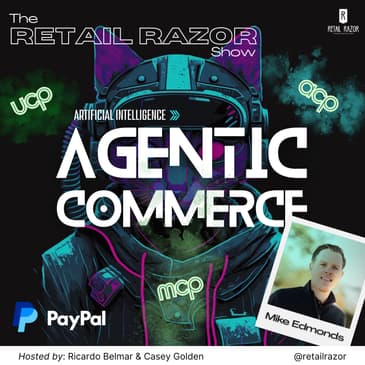



S6E3 PayPal’s Mike Edmonds breaks down agentic commerce and how it redefines trust, loyalty, and the merchant‑of‑record future
Agentic commerce is no longer theoretical. It’s already reshaping how shoppers discover, evaluate, and buy products. In this episode, we sit down with Mike Edmonds, VP of Agentic Commerce & Commercial Growth at PayPal, to break down what agentic commerce really means for retailers right now and how agentic AI is transforming the entire shopping lifecycle.
We explore the three major use cases of agentic commerce, how AI shopping agents are changing product discovery, why payments and trust are now central to the agentic commerce experience, and how retailers can maintain control of customer relationships through merchant‑of‑record models.
If you’ve been trying to understand how agentic commerce works, how agentic AI fits into the retail ecosystem, or what retailers must do in the next six months to stay competitive, this episode delivers the clarity and direction you need.
What You’ll Learn
What agentic commerce actually is; and why it matters now
How agentic AI is reshaping product discovery, checkout, and loyalty
The three core use cases: CUA, agentic checkout, and autonomous agent‑to‑agent shopping
Why payments, identity, and trust are the foundation of agentic commerce
How merchant‑of‑record models protect data and customer relationships
The role of loyalty programs in an agent‑driven world
Catalog readiness and the challenge of integrating with multiple LLMs
How close we are to the universal cart
What retailers must do today to prepare for the agentic shift
Why This Episode Matters
Agentic commerce is moving faster than most retailers realize. As agentic AI becomes embedded in browsers, apps, and everyday workflows, retailers must rethink how they manage trust, identity, payments, and customer experience. This episode gives you the frameworks and real‑world examples to understand how agentic commerce will reshape retail in the months ahead.
Subscribe & Follow
If you enjoyed this episode, please leave us a 5‑star rating and review on Apple Podcasts, Spotify, or Goodpods. Subscribe on YouTube so you never miss an episode and check out the other shows in the Retail Razor Podcast Network: Retail Transformers, Blade to Greatness, and Data Blades.
Subscribe to the Retail Razor Podcast Network: https://retailrazor.com/
Subscribe to our Newsletter: https://retailrazor.substack.com
Subscribe to our YouTube channel: https://go.retailrazor.com/utube
About our Guest
Mike Edmonds. https://www.linkedin.com/in/michaeledmonds/
VP Agentic Commerce, Commercial Growth at PayPal. https://www.paypal.com/us/business/ai
Mike Edmonds is VP of Agentic Commerce, Commercial Growth for PayPal, responsible for global commercialization, go-to-market, and operational execution across PayPal’s portfolio of AI-powered and agentic commerce products. Mike brings deep expertise having joined PayPal from Microsoft where he led AI and ecommerce strategy for Microsoft’s worldwide retail and consumer goods industry team. Prior to Microsoft, Mike was an agency operator, entrepreneur, and product leader driving digital transformation across B2B, DTC, and marketplace business models spanning a range of verticals including retail, CPG, high tech, industrial manufacturing, automotive, and foodservice across the US, Europe, and China.
Mike is also an adjunct professor at Northwestern University teaching Kellogg MBA, MS in Design Innovation, and MS in Product Design and Development students through the Segal Design Institute at the McCormick School of Engineering and Applied Science.
Chapters
00:00 Teaser
01:00 Show Intro
04:04 Welcome Mike Edmonds
05:22 Mike’s PayPal Role
07:14 Defining Agentic Commerce
14:40 Real World Agentic Checkout
19:33 Trust Merchant Data Loyalty
26:16 Loyalty As Differentiator
27:21 Travel Points And Agentic Commerce
28:32 Trust KYA And Liability
34:46 Skills For Future Commerce Careers
41:54 2030 Multimodal Future And Wrap
48:40 Show Close
Meet your hosts
Helping you cut through the clutter in retail & retail tech:
Ricardo Belmar is an NRF Top Retail Voice for 2025 and a RETHINK Retail Top Retail Expert from 2021 – 2026. Thinkers 360 has named him a Top 10 Thought Leader in Retail, a Top 25 Thought Leader in AGI and Careers, a Top 50 Thought Leader in Agentic AIand Management, and a Top 100 Thought Leader in Digital Transformation and Transformation. Thinkers 360 also named him a Top Digital Voice for 2024 and 2025. He is an advisory council member at George Mason University’s Center for Retail Transformationand the Retail Cloud Alliance. He was most recently the partner marketing leader for retail & consumer goods in the Americas at Microsoft.
Casey Golden, is the North America Leader for Retail & Consumer Goods at CI&T, and CEO of Luxlock. She is a RETHINK Retail Top Retail Expert from 2023 - 2026, and Retail Cloud Alliance advisory council member. After a career on the fashion and supply chain technology side of the business, Casey is obsessed with the customer relationship between the brand and the consumer and is slaying franken-stacks and building retail tech!
Music
Includes music provided by imunobeats.com, featuring Overclocked, and E-Motive from the album Beat Hype, written by Heston Mimms, published by Imuno.
Transcript
S6E3 Mike Edmonds - PayPal - Agentic Commerce
[00:00:00]
[00:00:00] Teaser
[00:00:01] Ricardo Belmar: What happens when AI doesn't just help you shop, but actually shops for you?
[00:00:07] Casey Golden: Curious what that means for trust and loyalty? Who really owns the customer relationship when your agent is doing the buying?
[00:00:15] Ricardo Belmar: Are retailers is ready for agent to agent commerce. And what about the messy part in the middle of that relationship? Things like returns, fraud, identity, and the payment rails that make it all work.
[00:00:26] Casey Golden: Plus, how close are we to that universal cart we've always wanted.
[00:00:30] And what skills will the next generation of retail leaders need to survive the agentic shift?
[00:00:37] Ricardo Belmar: We're digging into all of that with someone who's building the future from the inside. PayPal's, Mike Edmonds.
[00:00:43] Casey Golden: Stick around if you care about the future of commerce. This is a conversation you can't miss.
[00:00:49]
[00:01:00] Show Intro
[00:01:00] Ricardo Belmar: Welcome back to season six of The Retail Razor Show. A top three podcast on the Goodpods Top Indie Management weekly and monthly podcast charts.
[00:01:09] I'm Ricardo Belmar.
[00:01:10] Casey Golden: And I am Casey Golden.
[00:01:12] Welcome back, Retail Razor fans to retail's favorite podcast where we cut through the clutter to give you sharp insights on what's happening in retail today, tomorrow, and where we get real about what's driving the future of commerce. And today we're diving into a topic that honestly feels like it's taken over every retail conversation lately.
[00:01:34] Agentic Commerce.
[00:01:35] Ricardo Belmar: Yeah, it feels like you can't really open LinkedIn these days without someone declaring that AI agents are about to change everything in retail again and again. What does that actually mean for retailers, brands, and shoppers?
[00:01:49] Casey Golden: And more importantly, what problems does agentic commerce solve today versus the sci-fi version everyone keeps talking about.
[00:01:57] Ricardo Belmar: Exactly!
[00:01:58] So we brought in someone who's [00:02:00] not just talking about the future. He's building it.
[00:02:02] Casey Golden: Our guest today is Mike Edmonds, who leads Agentic Commerce Commercial Growth at PayPal. If you've been wondering how payments, trust, identity, and AI all collide, Mike is the guy you wanna hear from.
[00:02:16] Ricardo Belmar: Mike's background spans Microsoft, PayPal, and teaching at Northwestern, so he's got this rare perspective that blends tech, retail, and the next generation of talent entering the industry.
[00:02:27] Casey Golden: And what we're asking him are the big questions. What does a real agentic shopping experience look like for an everyday consumer? How do merchants keep control of the customer relationship? And what does "know your agent" even mean? And how to build trust when agents make making decisions on our behalf?
[00:02:49] Ricardo Belmar: Yeah. Plus we get into loyalty, universal carts. I know I've been waiting for that one for a long time now. Product catalog readiness, and just what retailers should be doing [00:03:00] right now, so they're not left behind six months from now. Because realistically, I mean, in agentic AI time, six months is like, what, 10, 15 years it feels like?
[00:03:09] I don't know. Yeah, exactly. Exactly.
[00:03:13] Well, before we jump in, a couple things to go over first. Just a quick favor. If you're enjoying season six, and I hope you are, if you came back to this episode, it feels like that means you're enjoying it. So why not give us a five star rating and review on Apple Podcast, Spotify or Goodpods.
[00:03:27] Casey Golden: And don't forget to like and subscribe on our YouTube so you never miss an episode. We'd also love it if you could check out our other shows in the Retail Razor Podcast Network. If you haven't already subscribed to Retail Transformers, Blade to Greatness, and Data Blades.
[00:03:45] Ricardo Belmar: All right. With that out of the way, let's get into it. Agentic Commerce, PayPal, trust, payments, and the future of shopping with the one and only Mike Edmonds, VP of Agentic Commerce and Commercial Growth. Let's go.
[00:04:04] Welcome Mike Edmonds
[00:04:04] Ricardo Belmar: Mike, welcome to the Retail Razor Show Podcast. Excited to have you on the show. Good to see you again. Just quick for everyone in our audience. Mike and I both previously worked at Microsoft supporting their retail and consumer goods business. I was fortunate enough to benefit from Mike's amazing knowledge and expertise in a number of projects that I had supporting Microsoft partners.
[00:04:23] So it's great to great to be here and have Mike with us on the show.
[00:04:27] Mike Edmonds: Awesome. Ricardo, thank you so much for having me. Yeah, really happy to be here. Incredibly excited to be partnering with you again, I missed the days at Microsoft, but really happy to see the podcast that both you and Casey have,
[00:04:37] Ricardo Belmar: Yeah. Thanks. Yeah, thanks. Yeah. I mean, and, and we've got so much ground to cover today around Agentic Commerce. I, we have really been looking forward to this conversation. You know, just is everything around agentic, around payment technology now, just being so front and center in, in this environment. This is gonna be great to, to dig into.
[00:04:52] And I think we may even hit you up for some thoughts on what that agentic future may hold for, for college students in the industry [00:05:00] given your role teaching at Northwestern. So hopefully we'll come back to that a little later.
[00:05:03] Mike Edmonds: Let's do it.
[00:05:04] Casey Golden: Yeah, Mike, it's kind of a thrill to have you here and talk about all things agentic commerce. It's a fascinating moment in the industry right now, and I always say it's not commerce unless you check out. So, that's what we're gonna be talking about and you're certainly right in the middle of it with your role at PayPal.
[00:05:22] Mike’s PayPal Role
[00:05:22] Casey Golden: So why don't we just start by giving the audience a quick rundown on your background in retail and your role at PayPal.
[00:05:29] Mike Edmonds: Awesome. Thank you so much Casey. So, yeah, so my background, I've been with PayPal. I'm into my eighth month and I lead Agentic Commerce from a commercial growth perspective. So what that means is really three things. Number one, I collaboratively define what our strategy is in agentic commerce. So effectively what are the bets that we're making when it comes to the problems that we're solving and the products that we're building. That is an incredibly fun, fast-paced environment as you can imagine. But like, part one is strategy. Part two is growth. So, [00:06:00] that's growth measured in terms of, you know, commercial metrics like revenue. Also it is onboarding merchants into our agentic commerce product portfolio. And then number three is around operational alignment. PayPal is a matrixed organization just like Microsoft was, but its own different version of it. And getting everyone playing off the same sheet of music with what we're doing, why we're doing it, how do we measure success is definitely a full-time gig.
[00:06:22] So that's my remit at PayPal. It has been wildly exciting as you can imagine. This is the buzzword of all buzzwords, so externally with partners and merchants and customers, I'm having an incredibly awesome time doing it. As you mentioned earlier, before joining PayPal I was with Ricardo at Microsoft where I led AI and e-commerce strategy for Microsoft's worldwide retail and consumer goods team for just about four years.
[00:06:44] And as you mentioned, also I am based in Chicago, a town just north called Evanston. I have a personal passion around teaching where I've proudly been a part of Northwestern's graduate program, both MBA design and a product management discipline. Really helping equip the next [00:07:00] era of product people to be mindful with their use of ai.
[00:07:03] So
[00:07:03] Ricardo Belmar: Awesome.
[00:07:05] Mike Edmonds: I'm staying busy, that's for sure.
[00:07:07] Ricardo Belmar: That's right. Yeah, for sure.
[00:07:08] Casey Golden: Mike, I, I really appreciate that background and so good to know that you're, you know, doing both things, right. Who knew?
[00:07:14] Defining Agentic Commerce
[00:07:14] Casey Golden: So let's talk about all things agentic.
[00:07:18] Aegntic Commerce is getting a lot of airtime. I mean, I don't think anybody can have a conversation without coming up into being THE conversation, but it's still abstract for a lot of operators. In plain English, just like how do you define agent commerce and what's the first real problem it solves for retailers today?
[00:07:41] Mike Edmonds: I love starting from that place of clarity, Casey, I, I'd say the, the most fun part about my current job now is spending time with merchants, and I spend most hours of my working day working with merchants. And you'd be, maybe you're surprised, maybe not, but like every conversation around agentic commerce starts with, let's [00:08:00] establish a shared understanding for what it is and what it isn't. Because as you know, if you start going down the path before having that common alignment, things go off the rails really quickly. So I have a very simple perspective on what agentic commerce is, and then I'll play out the use cases 'cause I think the devil's in the detail when we're talking about the use cases.
[00:08:17] So agentic commerce very simply put is when agentic AI is involved in the shopping experience. What I mean by that is when a customer or a shopper is researching, finding, or buying, what's the role that agentic and agentic AI plays throughout that lifecycle? So the logical question is, well, okay, what do you mean specifically?
[00:08:38] And we're seeing three different themes of use cases that really break down and hopefully establish clarity with what we mean by agenticcommerce. So. The first use case is computer using agents. You often will hear either CUA or the acronym cua, and that is when it's most popularized by humans going to AI browsers. So think of Perplexity's [00:09:00] Comet, Open AI's Atlas, Google over the past couple weeks announced you know, Gemini being kind of writing shotgun within their browser. And it's effectively when shoppers are entering shopping related prompts into the browser via the agent. And then you're effectively watching the agent do a bunch of things that humans typically do. Like go scan a bunch of websites, find a bunch of products, potentially build a cart.
[00:09:22] Another iteration of that is called browser automation. And I think a beautiful execution of that is what Google is doing with their buy for me flow that's tied to their price tracking. Co-pilot's doing a very similar thing where it's effectively you're going, Hey, I'm looking for a new pair of jeans from this brand. Once they're under $200, let me know 'cause I wanna purchase 'em. And the agent goes and does that analysis of product, brand, price. When it finds that match, it'll send you a notification. I get an email and then I effectively as a shopper have both hands on the wheel and I can be like, yep, that's the right pair of jeans.
[00:09:54] They're $197, let's create buy. We're interested in that use case at PayPal. We think it's only [00:10:00] gonna get better. But the reality is it's really at best for hobbyists is what I say, because it typically takes a long time and I don't think the average shopper has like minutes to watch an agent do a bunch of things that I could just do.
[00:10:11] Okay, so that's use case one.
[00:10:13] Use case two is a agentic checkout, which we're really excited about this one because it's really the blend of like, what's here and now, and also with where things are going over the near future. So agentic checkout is when a shopper goes to an agentic surface. So think of ChatGPT, Gemini, Copilot, Perplexity, Meta, Amazon. The list goes on and on, and the shopper can just in natural language, describe what they're looking for. I'm running my first marathon in Chicago in November. What should I get? And, the merchants who have integrated their catalogs directly, either API or through a company like PayPal and also their order management capabilities can effectively provide shoppers with a way of finding what they're looking for in a very easy, fluid way.
[00:10:57] So products start to show up. I could not only research and [00:11:00] find products, but then to your point earlier, when it comes to the moment of truth that matters in commerce, which is the transaction, you can effectively check out directly on the agent surface. Which is awesome. And why we're so excited about that is because, humans are still in the loop. We think that there's going to be a shift eventually towards a more autonomous future, which I'll describe as the third use case. But the here and now is people are already using agentic surfaces for things like writing emails or summarizing articles, and it's only a matter of time until they start using those for commerce and shopping jumping off points.
[00:11:33] Okay. That's use case two then use case three. I promise this is the most that I'll ramble is the future that I think a lot of people mistakenly talk about when they say agentic commerce, which is imagine a world where it's all agent to agent and shopping is completely automated and handle autonomously by agents.
[00:11:50] So this is a world where we as humans give permissions and authority. And even thing like things like spending controls and spending limits to agents. You ask an agent to do something and it goes and [00:12:00] just takes care of it. I think we will move towards a world where that's the case for sure. But I believe in my heart of hearts that there's a large percentage of shopping that will always be human centered.
[00:12:11] And I think that like when I'm buying a new bag for my wife for Christmas and it's, I don't know, $2,000, like I'm not gonna, at least today, have an agent go take care of that. Like I want to be a part of that. So I think it's gonna be category specific and it's gonna require, I think a behavior change.
[00:12:25] Casey Golden: Yeah, I mean, search sucks. Shopping doesn't,
[00:12:29] Ricardo Belmar: Yeah, exactly. Exactly.
[00:12:31] Casey Golden: I like shopping. We still like scrolling for two hours to find something to a certain extent. I wanted to throw my mobile phone and ChatGPT out the window last night trying to find a different size in a pair of boots. Um, resorted to ChatGPT. I'm like, search France. I don't care. Find me one pair of these
[00:12:56] Mike Edmonds: That's so good.
[00:12:57] Casey Golden: on the globe.
[00:12:58] Ricardo Belmar: Yeah. Yeah. [00:13:00] I, I, I'm, I'm totally there on that too. I feel it kind of feels like the agents have, when the agents have total free reign to go anywhere and everywhere, right. To look for things, I think that starts to make a little more sense. And then on the other end, maybe of that spectrum, it's like there are a lot of, at you end the mean, there are a lot of commoditized things that are so essential that we just, it's like automatic even for a human right.
[00:13:21] I know I'm gonna buy this every week or every two weeks, or every month, or whatever it is. 'cause when I run out, I gotta buy it again. Done. Right. So to me, those are all e easy use cases, right? To, you know, take that off my plate so I don't have to think about it anymore. Let my agent go out and buy those things.
[00:13:34] It knows which brand I want, it knows what price I'm wanting to tolerate and so on, and just do it. I, I can see that. But I'm with you on the other use cases too. I feel like that second one, I, I'm a big proponent of waiting for, and maybe we'll get into this. I'm, I'm kind of waiting for the universal cart in one of these checkouts where it just builds a cart across however many retailers it takes to buy what I wanna buy, and it just magically does it.
[00:13:56] And again, I think that, we'll get into it. 'cause I think that's where the payment [00:14:00]part, just like Casey says, checkout, makes the commerce you know, that, that's where that part is so critical.
[00:14:04] Casey Golden: Yeah, so I'm not a typical customer. You've watched any of our podcasts,
[00:14:10] Ricardo Belmar: in our audience knows that.
[00:14:11] Casey Golden: over here. But I also come from the brand side. I got into the business because like, I love the brands, love product, super product junkie, and a lot of our listeners work at the brands. They are product junkies. We're not typical shoppers, we're not a typical consumer.
[00:14:27] So like our expectations or how we shop is probably very different than like the mass consumer, the traditional consumer. The, the everyday consumer that I would say most technology is built for. Right.
[00:14:40] Real World Agentic Checkout
[00:14:40] Casey Golden: Can you walk us through a realistic agentic commerce experience for a consumer, not all of us, like industry professionals that have spent 25 years being like practically professional shoppers
[00:14:54] Mike Edmonds: Yeah. Yeah, totally. And.
[00:14:56] Casey Golden: and like, what does that look like?
[00:14:58] And then. [00:15:00] How are we picking between like ChatGPT or Gemini or, or Perplexity? Like, I'm not having these conversations with all these people and building preferences across all these platforms, but as a consumer, I would expect all the catalogs are linked to all of 'em.
[00:15:13] Mike Edmonds: Mm-hmm. Yeah. Okay. I love it. So, there, there's two parts of that question, which is like, number one walkthrough in real life, today, what that looks like from a shopper perspective. And then I'll talk about what really what that means for merchants and the decision that's in front of 'em. I think in order to participate, so one that's real, that PayPal has launched that you should go check out as soon as you can, is you can go to either Perplexity or Copilot.
[00:15:35] And let's say you're looking for a new winter coat. I live in Chicago, like I mentioned, and it's been a brutal winter. I've kind of loved it, but it's been a brutal winter. You could go to Perplexity as an example and say, Hey, I'm looking for a new winter coat to brave the Chicago weather and say, from Abercrombie.
[00:15:53] And what happens is you get a, like a q and a like, conversational type dialogue where [00:16:00] it's like, this is what makes a winter coat great and here are some different, attributes and filters that you should be aware of. And then there's a tab for shopping where if you click on the shopping tab, it shows you a bunch of products, which looks and feels like e-commerce as we know it.
[00:16:12] And the products that have a light blue instant buy button on it are ones that are available to check out with on the surface itself. So you can go from like the inspiration flow of conversational back and forth it, it can effectively mimic the conversation that one might have with the store associate.
[00:16:30] And then for those high intent shoppers, the ones who are like, you know what, that's the coat, that's the size I'm in. Rather than being catapulted off to a different website, which does create an opportunity for people like me to abandon the funnel, I can effectively check out in one of the most safe, secure, and seamless fashions possible, which is either by PayPal or with a credit card.
[00:16:49] So I think that, like, what I love about that is that it's iteratively, and Incrementally different than e-commerce as we know it, but it's better. And it's not a crazy [00:17:00] far version of the future where it's like, hold on, now I'm freaked out about making this transaction. Like it's just an easier way for me to research and find, and then the checkout, the moment of truth is actually brought to me directly in the conversation.
[00:17:11] So we're fascinated with that because what Perplexity, what Copilot, what Gemini, what Chat GPT offer to merchants is new channels for growth for reaching their customers, where more and more of their customers will likely be over the interim. Now, the challenge from a merchant perspective is in one word, it's complicated.
[00:17:30] And what I mean by that is think about the number of LLM services that are out today. You have, like you mentioned it, Casey, there's ChatGPT, there's Perplexity, there's Copilot, there's what's Amazon doing? There's Meta, there's Gemini,
[00:17:41] Casey Golden: there's a zillion apps and startups.
[00:17:43] Mike Edmonds: Totally. And then, and then there's, those are the general purpose, the LLMs, and then there's the vertical specific niche like SLMs, small language models that are more shopping specific and having a merchant pick a winner.
[00:17:56] A combination of winners is really hard to do. Like no one knows where this space is gonna go. [00:18:00] What's making it even more complicated is we are still in a divergent state when it comes to protocols. You have ACP, UCP, A2A, MCP, AP2. I think we'll ultimately get to a place where we are more converged.
[00:18:13] But today, it is multiple services, multiple platforms equals complicated. So our perspective from a PayPal point of view is. There's always gonna be a certain top tier of merchants who have the resources, the ambition, the curiosity to go integrate directly with seven different LLMs and to see which one's best and to tinker, and then to have a team that's dedicated to understanding these protocols, the rules that are governing how agents, businesses, and humans come together that make this work.
[00:18:40] We think that most retailers are not afforded that luxury and are looking for an easy way. To connect once, have access to many, and then to toggle on and off, like what's working and what's not. Whether it's products, product categories, even channels themselves. So that's what we're looking to do over the, over the immediate term.
[00:18:59] Casey Golden: Well, I'll [00:19:00] give you a phrase if you ever need to use it. Figuring that out is easier than making the damn shirt.
[00:19:08] Mike Edmonds: I love it. I love it.
[00:19:09] Casey Golden: There's like 16 systems and you've got thread coming from one country and it's being produced in another and fabric another. We figured that out. We can all figure this out.
[00:19:18] Yes, enough, there's enough smart brains in the room to get this done for sure.
[00:19:23] Ricardo Belmar: exactly. Exactly.
[00:19:25] Casey Golden: But yeah. Some of us more sophisticated shoppers are just gonna have to sit here and wait for it to catch up to our expectations.
[00:19:31] I have a feeling.
[00:19:33] Trust Merchant Data Loyalty
[00:19:33] Ricardo Belmar: Well, and, and I think too, one of the things that strikes me in all this is that trust really becomes the, the biggest gating factor right in, in this whole process. Whether it's, you know, the consumer trusting that the whole process works, the retailer trusting that the system is gonna satisfy the whole transaction for them, right. And give them, that they're gonna get enough information about that consumer.
[00:19:54] And then I think also on the consumer side, you know, we often, I don't hear people always talk about what happens [00:20:00] post-transaction, right? We, we used to always talk about the post-transaction experience between consumer and retailer.
[00:20:05] And whenever you have something that's an intermediary between it, you always have to ask, well, how do I trust that that experience is gonna be what it needs to be? If for, however, whatever kind of support I might need as a consumer. But it also seems to me that, payment technology now is like right in the middle of this.
[00:20:22] And, and it really both in, in the middle of the technology component of it, but also in the middle of bringing that trust element between the consumer and the merchant. In my mind it's a lot like the early days of e-commerce. It's like from your perspective, I mean, do you also see that? Do you see that like the trust is this big factor and that that's part of the reason why payments is, is now really in sharp focus?
[00:20:42] Mike Edmonds: Yes, a hundred percent. Ricardo, I, I have the, I'm guilty of oversimplifying in a way that just makes it easy for me to understand, but I realize I can get myself in trouble often. I, I wholeheartedly agree, like what is the one obstacle in front of us that is gonna determine merchant adoption, customer habituation, everything in between. It's trust.[00:21:00]
[00:21:00] And like why does trust matter so much? You remember, like we all were a part of e-commerce in the first iteration, you 20 some odd years ago, and remember it, there was this hurdle of can I trust that businesses are legitimate online? And then even if they are, am I really gonna enter in my credit card, right?
[00:21:16] My debit card? Like, is that gonna happen on an e-commerce? And that's where you look back at PayPal like 25, 26 years ago. We brought a level of trust to internet commerce in a way that ensured that the businesses that you're dealing with through KYB, know your business, are legitimate. And then that customers have all gone through a verification process so that both sides of the equation, KYC, and KYB.
[00:21:38] That we have validated that, and like that's a thing that you can trust, like fast forward to where we are now. It's, it's a different game, but there are, there are similar tenets from e-commerce as we know it, to agenticcommerce. Like not only do we have like the validity of businesses is gonna be critical because there's all sorts of opportunities for fraud and for scam and all that.
[00:21:57] Same thing with the identity of is this a real human [00:22:00] or is this a good bot or a bad bot? Right. And then there's the idea of knowing your agent and like understanding how to, how to have verified identity of businesses, agents, and customers is, is what determines whether a transaction is trustworthy or where it's fraudulent and to like the so what of that, Ricardo, which you mentioned is how we bring that to life is the payment rails.
[00:22:22] The payment rails are where obviously, where payment happens, where identity happens where fraud protection, where risk controls exist. And that becomes like, those are the, are the rails that are gonna determine how quickly people trust agent commerce and the scales as a viable business model and channel for merchants.
[00:22:42] Ricardo Belmar: Yeah. No, i, i, I agree com completely. And and you alluded earlier too, too, we're, we're in this mode where we have competing protocols, in a sense, competing technologies. And you mentioned how, you know, if you're at that larger tier of retailer, maybe you, you have the resources, you can forge yourself, the time and luxury to go ahead and do the integration [00:23:00] with 15 different entities, whatever it takes to get that done.
[00:23:03] One of the key things that I think comes up, and I know you're proponent of as well, is, you know, merchants, brands, want to be the merchant of record and need that transaction with the customer, right? So in a sense, if this is taking away from the experience where that customer would've landed on the brand's e-commerce page, where obviously they were, they were capturing the transaction directly.
[00:23:25] We, we know that both through both a CP and UCP, they're delivering that merchant of record capability to the brand. But it, so alongside that and just this overall sense of who's in control of the data, the customer relationship, where is the accountability? I, I kind of, since from the consumer's perspective, what happens when I need to return something?
[00:23:42] Right? There's always that question, which kind of plays into what we just talked about with the trust. But when you look at how this centers around the data, what, why is this so important right to every brand and every merchant. And, and how it gets implemented.
[00:23:56] Mike Edmonds: Yeah, I love that question, Ricardo. I remember when I was at Microsoft [00:24:00] just about a year ago and before a lot of the early conversations around agentic and agent commerce, I felt a feeling of fear, uncertainty, and doubt. From merchants 'cause this is a net new channel. A lot of ambiguity, and the number one concern that I would hear time and time again is, does this mean that I as a brand, I as a merchant, am going to be disintermediated from the relationship that I have with my customer?
[00:24:23] Ricardo Belmar: Right.
[00:24:24] Mike Edmonds: like that's, as you all know, like Casey, you're a brand person. That's where the conversation ends, right? If this is all seen as a severance between me as a brand and the people that matter most, which are my customers, that's why merchant of record matters so much is that merchants maintain control.
[00:24:40] Like it is their data, it's their relationship with customers. They're the ones who are sending post order confirmation and emails when, if there's a problem with my order, if I need to refund, if I need to return, I you are, I as a customer, I'm reaching out to the brand and that relationship remains intact.
[00:24:57] That's, as these protocols, as like the [00:25:00] first LLM surfaces came about as these protocols kind of defined it and put it into stone as the merchant, maintaining the merchant of record is such a critical piece. Where I see that going in the future is now that that's table stakes and that's a core part of these agentic commerce experiences.
[00:25:15] Now, let's talk about, I think the biggest thing I'm hearing today, which is loyalty. Like if I as a brand can still maintain the relationship, and you've promised me that I'm not gonna lose that. Now how can I bring my customers to the table in a way where they get to earn points by rewards, by transacting through me.
[00:25:32] And then how can they ultimately have the ability to spend things like rewards. I see loyalty as a critical way of paying off why merchant of record matters. I mean, we see as like a huge forefront with how these conversations are evolving.
[00:25:44] Ricardo Belmar: Yeah, that makes sense. That loyalty is always a big piece for every brand is how do I make sure I don't lose my customer relationship.
[00:25:52] Casey Golden: Yeah, I was thinking that that's like a really it's a big like tracking issue, right? And I was thinking like, oh, this is gonna be difficult. [00:26:00] This is gonna be difficult. But then I was like, thinking, I was looking at it and I've been trying to use it. And I'm like, who's got a decent enough loyalty program outside of Sephora that I even care to go through the trouble to get my loyalty?
[00:26:12] Because the programs have been so bad lately, like they've kind of decreased.
[00:26:16] Loyalty As Differentiator
[00:26:20] Casey Golden: So I actually think that loyalty could be not just a key point for it, but I think loyal. I think it's a competitive piece.
[00:26:25] Ricardo Belmar: Yeah.
[00:26:26] Casey Golden: Into having better loyalty programs coming into the new year, because I do think that they got a little lazy over the last like three years.
[00:26:36] No, their points didn't do much. And I'm like, well, if you want me to go through that trouble, you want the identity, you want these accounts synced you. I think these loyalty programs might actually get a lot bigger and I could see like getting a discount even just for making your first transaction via. Rather than just in general. So, I [00:27:00] do see a big opportunity as a competitive layer, even for loyalty, not just being there, but also being better.
[00:27:07] Mike Edmonds: Yeah, totally. I, I mean from a shopper, from a human perspective, I hope that's the case because I, I, I totally agree. I I, and often, like short of a couple brands like Sephora that, you can all resonate with, the loyalty programs themselves have kind of followed into like this, what's in it for me, point of view.
[00:27:21] Travel Points And Agentic Commerce
[00:27:21] Mike Edmonds: Well, I think what's fascinating though is you look across different verticals and let's, like I'm on the road more than I care to admit. You think about what
[00:27:27] Casey Golden: Yeah, travel for sure.
[00:27:29] Mike Edmonds: Yeah. Like Marriott and United, like, I wouldn't be caught dead making a travel purchase without those points going back to my hotel and my airline.
[00:27:37] And it's like now in those instances like PayPal, we just had an awesome announcement just yesterday on a partnership between PayPal, Sabre, and Mind Trip to effectively enable future of what agentic commerce can look like in the travel space. We see loyalty as like a future forefront there because I mean, that's gonna be such an amazing way of delivering true value back to customers, [00:28:00] right?
[00:28:00] In a way that's not only fluid and easy to use, but then also makes financial sense for every shopper that uses it.
[00:28:05] Casey Golden: A hundred percent. And I do think, like that's a great example of where I would do the work to even fill it out in sync like I do in my tra corporate travel portal, right? Where I'm like, here's all my loyalty numbers, like sync, sync, sync, sync, sync. Like I'd go through the trouble, right? I think it's, I think it could, it's, it's a key standout piece for sure, for marketing to be thinking about that.
[00:28:29] On how, on how they're gonna be looking at loyalty.
[00:28:32] Trust KYA And Liability
[00:28:32] Casey Golden: Going back to KYC, we're hearing a lot about this, Know your Agent and we have KYC and KYB. What does baseline trust actually look like in a true like agent to agent shopping? And who's responsible when something breaks. Like, I mean, I know some people are getting
[00:28:58] Ricardo Belmar: Yeah.
[00:28:59] Casey Golden: a [00:29:00] little mini macs, mini macs are back ordered for like the first time in.
[00:29:02] I don't know ever.
[00:29:04] Ricardo Belmar: Yeah, that's right.
[00:29:06] Casey Golden: Because everybody wants a,
[00:29:07] Ricardo Belmar: Everyone wants to build their personal agent.
[00:29:09] Casey Golden: at home just to try stuff that are running autonomous and have like some agents and give it some control, but don't want it in their real laptop yet.
[00:29:17] Mike Edmonds: Yeah.
[00:29:20] Casey Golden: What, what is this
[00:29:22] Mike Edmonds: Yeah.
[00:29:23] Casey Golden: and like where does that liability lay?
[00:29:26] Mike Edmonds: Yes. Okay, so this is why it's, we started the conversation by really being clear on these different use cases because what is what, like KYA means in the world of agentic checkout is really like not a whole lot, right? Because we already know, like the agent in that case is Gemini or the agent is Chat GPT or Copilot.
[00:29:45] And we as humans are still at that moment that matters. We're the ones clicking. Yep, it all looks good. I'm gonna click buy. As we shifted the use cases into autonomous, like the game changes and what I'll say right now is. This use case has not picked up and it's not ubiquitous. However, [00:30:00] we better figure these things out now because when, like all things ai, when it does tip, like it's not gonna tip slowly, it's gonna tip in, in, uh,
[00:30:08] Ricardo Belmar: right.
[00:30:09] Mike Edmonds: an existent or in a exponential way.
[00:30:11] I mean, hope it's not existential.
[00:30:15] Um,
[00:30:16] yeah. So, so baseline trust in a to a commerce, like starts with verified agent identity. We have to be able, there has to be a system and guardrails in place that understand good bots from bad bots and understand like which ones are acting with like cryptographically verified intent. So we know who they are and what they're looking to do.
[00:30:36] Clear, explicit customer authorization and a robust sense of fraud monitoring, like those three things together, identity, authorization and fraud all need to happen hand in hand. And this goes back to your question earlier, Ricardo, around like, why payments, why now? Like these are the rails that are gonna deliver in the era that we did with KYB and KYC.
[00:30:57] Like, this is how we will be able to KYA [00:31:00] in a way that everyone feels really good about it. Our, like, this is why we're super bullish about PayPal's role in this ecosystem because the same way that we helped, like I said before, K-Y-C-K-Y-B, like we'll do the same thing with KYA, but this does require working hand in hand with the protocol layers to really define the rules and the guardrails and like the governing structure for how these things are gonna happen, and to align on common interoperable standards so that we don't have to have different languages and different versions of what verifying an agent looks like in one surface versus another. If you take this back into like the, so what, like have you all been following along the the open claude or, sorry, the, uh, bot,
[00:31:40] Ricardo Belmar: Yeah. Claw bot it became Molt Bot Open Claw. Yeah. Yeah,
[00:31:44] Mike Edmonds: Yeah, yeah, yeah.
[00:31:45] Casey Golden: wants it. I
[00:31:47] Ricardo Belmar: Right.
[00:31:48] Casey Golden: I'm not making commitment to my,
[00:31:51] Mike Edmonds: No, no, no.
[00:31:53] Ricardo Belmar: Yeah. Yeah.
[00:31:54] Casey Golden: I'll buy a different.
[00:31:56] Mike Edmonds: Yeah. And, and like I'm not an expert on [00:32:00] open claw, but like what I'm seeing and feeling and like experiencing in that world is we are now equipping humans with agents that not only can help like find stuff, but can actually go take action. Right. And now even in a world before this stuff has been fully figured out, we're seeing things pop up like agents.
[00:32:17] I was just reading something around how a gentleman was able to create a series of agents that created music. And then created a bunch of fake bot agents to go listen to the music and ultimately made money off of that. So it's like, in that scenario, the agent, like, those are all agents with malicious intent, and there's no system or governing body that's like
[00:32:36] Ricardo Belmar: Right. Yeah. What's, what catches that?
[00:32:37] Mike Edmonds: And those are the, that's just a minor use case. But think about it as these, platforms and capabilities catch wind and catch fire the payment rails are gonna be a critical perspective to making sure that trust is carried through ubiquitously.
[00:32:49] Casey Golden: a hundred percent. Yeah. I saw there's a guy on TikTok that created something called Rob using it, and it gave him like three months to figure out how to make $40,000 a [00:33:00] month. Otherwise he'll die. So he put this like, it's in survival mode, right? And so it spent all this money on these like, I don't know, hermo classes and this and this, and like, yeah, I'm gonna be able to 10 x my marketing and like, we're just all like literally just watching it, right?
[00:33:17] On TikTok. And, and he went and bought some stuff and, and then there's, this piece of going out and buying these packets or these packages designed for them, right? And they've got little viruses in them, that are malicious. And there's just so much that I feel like consumers need to learn, and it's gonna be the technology and the brands that are going to have to find ways to communicate and just build that trust that, we've checked all the boxes, and we've been looking at all the boxes on what needed to be checked, what needed to be addressed so that you can go and play.
[00:33:53] You know, and not really have to think about all the security pieces out there. And I think it's really nice to [00:34:00] see like tech and retail, have this 50 50 relationship. Usually, tech is so one-sided and it's so easy to get into all of these previous innovations where it felt more like we're always at war with technology and technologists.
[00:34:16] This is one where I feel like it really takes 50 50 from both sides because the brands have inherent trust. They have all the trust, they have the brand equity and the technology is just not something that they're all gonna be able to build, right? They're just not technologists and cybersecurity
[00:34:35] Ricardo Belmar: right,
[00:34:36] Casey Golden: professionals, right?
[00:34:37] I mean, everybody gets a couple, but I think it's, it's gonna be pretty cool to see what the, the industry can do together here.
[00:34:46] Skills For Future Commerce Careers
[00:34:46] Casey Golden: And kind of thinking on, when it comes to the people. I mean, we have incredibly talented people with very broad experiences, like very diverse experiences, right?
[00:34:57] Kind of coming together to build this [00:35:00] future of commerce. But we just got retail and supply chain and even e-commerce into universities.
[00:35:06] Mike Edmonds: about time, right? Yeah.
[00:35:08] Ricardo Belmar: Yeah,
[00:35:08] Casey Golden: You know, it's just like finally, that's like a thing. Otherwise, we all learned.
[00:35:14] Ricardo Belmar: In the field.
[00:35:15] Mike Edmonds: Yeah.
[00:35:15] Casey Golden: have degrees in random, in fields, right? Nobody went to school for supply chain or like retail back in the day.
[00:35:23] But the industry is changing faster than any curriculum considering how long it took for that shift. If somebody, if a student wants to work in retail, wants to be in commerce, I used to say always just, just go into finance. Well, I don't necessarily think that that's necessarily a good recommendation anymore, but what should they actually be going to school for now?
[00:35:46] And what skills do you think are still gonna matter in five years if you wanna play in this future of retail commerce space?
[00:35:53] Mike Edmonds: Yeah. So this, so being a part of the Northwestern community and the graduate programs that I teach, this is one that [00:36:00] I get asked all the time, either from students, from family members, from people who understand my affiliation with Northwestern. And I think it's important to say is like, look. Nobody has a clear answer to this question, right?
[00:36:10] I have a point of view and like a hypothesis, and I have reason why I've kind of supported that. But at the end of the day, like this is a very fast moving space, and there's gonna be a bunch of different paths. We're gonna have to see how this all plays out. What I'll say in the world that I'm in, so what I teach at Northwestern are two classes.
[00:36:24] In the fall I teach a course through the Kellogg MBA program. It's a dual MBA and design innovation program, and the class is called Mindful Product Management. So what that class is around is how do you help equip the next era of product people to not only understand how to do Core PM responsibilities, but to also have a sense of like empathy and purpose with how to deploy AI power.
[00:36:48] Products that are not gonna contribute to the clutter of digital, you know, 2.0 but are actually gonna uplift humanity and create better, better communities, better relationships and all that. I teach [00:37:00] another course that's on business model design. 'cause what we've learned through the social media era as an example is if we leave the business model as a, yep, we'll figure that out later. The business model is the core product.
[00:37:12] Ricardo Belmar: Hmm.
[00:37:12] Mike Edmonds: Business model creates and drives the experience. So those things really need to be coupled together. So the reason why I mentioned that is the way that we think about like when people are like, Hey, how can I equip myself to be a product person in the future?
[00:37:23] Like number one, there's gonna be, and this is true for retail, for consumer goods, for finance, for any industry you can think of, the core foundation is you have to be AI literate, data and data fluent. Like that is non-negotiable no matter which way you go. Because the days of being like, I'm not technical or I, you know, I have people who understand. Like, now you have to be curious enough to under, you don't have to be an expert in it, but you really have to know how that works, right? How AI works and what data fluency looks like.
[00:37:52] Number two, I would still, and I still like, recommend if people fall in love with retail, whether it's merchandising or store [00:38:00] design or product development. Like fall in love with the function for for sure. That should never stop you, but you have to understand what's the role that AI and data play in accentuating outcomes along that function.
[00:38:13] Right. I also think, so when it comes to like product as an example, like we are still advocating like, look, the world's gonna need more product people, not less, they're gonna need more, but the expectations for your output. As a product person today versus five years ago versus five years in the future, are gonna be drastically different.
[00:38:31] And the people who understand, who know how to harness AI as a superpower will be the ones who separate themselves from other PMs.
[00:38:37] Casey Golden: Thank you.
[00:38:38] Ricardo Belmar: that makes.
[00:38:39] Casey Golden: Beautiful answer everybody.
[00:38:46] Ricardo Belmar: Well, I, one of the things that's always interesting when we look ahead, right, like if we, if we were to look ahead even just 12 to 18 months, which I know in, in agenticic AI terms, that's like five lifetimes, right? Five generations later. But if you, if you're [00:39:00] trying to advise someone, a commerce leader on, on what, what's the one thing that, you know, when they get to that point 12 months ago that they, they really wish they had done earlier. And made a higher priority now versus later. To really embrace and, and do what they need to do to enable themselves for, for these future agent use cases. What, what would you be telling them right now?
[00:39:20] Mike Edmonds: Yeah. You know it, what's, what's, what's funny is, you know, we've been, all three of us have been a part of other major competing paradigms of the past, right? Whether it's the shift to cloud or when commerce first came around, or even things like social. And I remember being, having lived through those moments.
[00:39:36] As a professional thinking like, man, this is gonna be what, like totally changes the game and there's gonna be the people who opt in and the people who who don't, and there's gonna be a separation. I think that was true. As we look at where we are now with the Gentech, like my advice to a merchant of any size is get off the bench and into the game.
[00:39:53] Ricardo Belmar: Hmm.
[00:39:53] Mike Edmonds: Now that does not mean, I'm saying very clearly, that you jump in with both feet and it just, you'll figure it out on the [00:40:00] fly. But I think the difference between people who are testing and learning now. Versus people who are testing and learning in six months is gonna be a crazy difference in people who can move forward with insight and clarity versus people who are fast following.
[00:40:14] And if you think about like what does that mean in like a very practical sense, let's go back to the use case on agentic checkout where I as a brand, I'm gonna share my product catalog with either a PayPal or directly through an LLM so I can understand how people are like looking for and searching for my products and services.
[00:40:30] At the end of the day, the way that I, as a merchant attribute and merchandise my product catalog is not the same way that people are looking for it in LLMs. Like when I say, you know, basketball shoes or running shoes or my first marathon in Chicago in November, like those are attributed differently.
[00:40:46] And what I mean by learning quickly is like the brand who understands how their catalog must be changed and enriched to show up in human-centered prompts is going to be in a serious competitive position versus [00:41:00] brands who have not gone through that transformation 'cause discoverability is, is gonna be more important than anything, right?
[00:41:06] You can't check out what you can't find, right? And if you're in, your product data is not in a ready, a ready state for agentic, like you're gonna be completely left behind. So I would say off the bench into the game, and, you know, to kind of wrap up the answer, like, I remember learning about way back in the day when I was in school, like the, and I, I forgot who said this quote, but our only sustainable competitive advantage is learning faster than others.
[00:41:29] Ricardo Belmar: Hmm.
[00:41:30] Mike Edmonds: I think like these, these opportunities where like if you believe in the wave and that's where your customers will be, your ability to learn faster is what will create a more data-driven approach for how you make decisions in agentic.
[00:41:40] Ricardo Belmar: Yeah. Yeah, no, that, that, that makes sense. And it really does come down to, I agree you, you, this isn't one where you can just sit on the bench and watch it go by and then hope that and just say to yourself, I'll catch up later. That's just not how, how it's gonna work out.
[00:41:54] 2030 Multimodal Future And Wrap
[00:41:54] Ricardo Belmar: So, so what if we look out even further, and I know this is gonna be harder because.
[00:41:58] We just as everything [00:42:00] changes so fast, but let's go a little further, like 2030, you know, you mentioned, we started this conversation when you went through the use cases and we talked about that fully autonomous agent use case number three. That really isn't there yet. But a lot of people get hung up on the nomenclature and the definition of that.
[00:42:16] You know, we both kind of said, well, there might be some. Product examples or that might make sense and others, or probably doesn't make sense that you always wanna be in control, but is 20 30 far enough out that you think maybe that's when will that use case will start to show up more and everyday consumers are going to get used to the convenience of that because I, I personally kind of feel like that's the motivator.
[00:42:37] We, we have so many conversations the past few years about what are the convenience features that consumers want in commerce and how merchants and retails need to deliver that. To me that, that is usually drives a lot of adoption. I always used to argue when we got all, everybody got distracted by the metaverse a little bit, is that as interesting and cool as that might be? It lacks [00:43:00]that convenience piece because there's a lot of things that consumer has to do to get into it, right? You've got equipment, there's hardware you gotta get used to using, you gotta learn a lot of stuff. Whereas here, we're talking about making a big part of the experiences go away in a sense, right?
[00:43:14] We're making the shopping go away by letting the agent, so is 2030 like a date when you're in mind, where you think that's where we start to see that? Is there something even beyond that, that you think we're, we're just evolving so rapidly we might see then and, and how would a merchant prepare for that?
[00:43:27] Mike Edmonds: yeah, I mean, the doesn't 20, 30 might as well feel like 30, 90 at. Like, it, it like in this, at least in the world that I'm, and I realize I'm reading the label from inside of the bottle, but it feels like six months there will be a major leap. So even short of like four and a half years, I mean, it's, so, yeah.
[00:43:44] So I, I do think 2030 is a good like future state horizon where things will be fundamentally different than they are today. I think when we look at that use case of autonomous, that agents to agents kind of collaborating, we will, in my humble opinion, we will [00:44:00] definitely see that has picked up steam. And if it's not ubiquitous, it is certainly gonna be more commonplace to caveat before, like, I, I don't think it's gonna be across every category, every part of the world.
[00:44:11] Like I think there's gonna be specific things where that just makes sense where, and specific versions where it oesn't. I think what we're gonna see by 2030 as well is multimodal. I think what's fascinating about agentic is it's still, and it's incredible, but it's still tied to like back and forth conversations, predominantly through text.
[00:44:29] Ricardo Belmar: Mm-hmm.
[00:44:30] Mike Edmonds: And it's become so easy to do, like, which it's natural, but like if we expand our mind a bit and think like, look, these multimodal multi reasoning capabilities can not only have text in text out, but it can be speech in, speech out, it can be images in, video in. So when you start to think like, I think voice, we've, we've talked about voice for many years, that's is such a natural, sophisticated point of view that when you have verified identity and your favorite payment system is tied into the equation. You have already [00:45:00] linked your loyalty account, so you know that's happening. And I can just say like, check out with a pair of size 11 basketball shoes. Like that's talk about no friction. I mean, that's wild. And then you start to play in. What you can see, right? And like the visual of wearables.
[00:45:15] Is it gonna be glasses? Is it gonna be context? Like if someone can answer that question, they'd be in a lot better place than I am. We started to think about like what that looks like from a commerce point of view as well, like for the categories where it makes sense, where you can snap, you can look at it, and all the identity around your biometrics, your wallet, all our first class citizens in that equation, and you completely trust what's happening.
[00:45:35] Talk about like a complete removal of friction from shopping as we know it today.
[00:45:39] Ricardo Belmar: Yeah. Yeah. It is. It is it gonna be the end of e-commerce as we know it?
[00:45:44] Mike Edmonds: I, you know, as a, as a true e-commerce person, like through and through, I refuse to believe that e-commerce will ev will ever go away. I think my caveat is always like, let's go back to the use cases. Like I think e-commerce will be infused into experiences that are [00:46:00]fundamentally different and better.
[00:46:01] Then websites today that are effectively our reflection of the way that we store and categorize products in a warehouse. I think we're gonna look back at the commerce that I grew up like having a heavy hand in, as like an archaic time intensive, like not great experience but provided tremendous, you know, opportunities for folks like us to learn.
[00:46:20] Casey Golden: Yeah, it hasn't changed much since, since the Spiegel catalog. I mean, I always say like, we just digitize the catalog business, like, and it hasn't changed much. It hasn't changed much but I'm definitely seeing some more interesting things for us to have our own ex individualized experience as soon as you hit that URL and there's a lot of things to use brand.com for other than a digital catalog.
[00:46:43] Ricardo Belmar: Yeah, absolutely.
[00:46:45] Casey Golden: I have no doubt that our audience enjoyed this conversation, so thank you for spending the time with us and sharing your knowledge and experience and what's happening at PayPal in agentic commerce.
[00:46:57] Mike Edmonds: Yeah, of course. So, first of all, thank you [00:47:00] for the opportunity to, to chat here. Are you asking me to share what's happening at PayPal
[00:47:03] Ricardo Belmar: Oh yeah.
[00:47:04] yeah, yeah. Anything else you wanna share about what's going on? Yeah. That we haven't talked about yet?
[00:47:07] Mike Edmonds: I misinterpreted that. No, we, we've, you've already kind of hit on it, right? Like we're working backwards for merchants, making sure that we're abstracting away that, that complexity.
[00:47:15] I think what we should do is we should bank on, we should do this again, either next year or year after, and reflect on all the things that we talked about here
[00:47:23] Ricardo Belmar: everything and how everything
[00:47:25] Mike Edmonds: either changed. Yeah. Yeah, yeah.
[00:47:26] Ricardo Belmar: because it's evolving so fast, like we just said. I mean, it's like we can say, oh, that's gonna be nine months from now, but that's like almost an eternity
[00:47:33] Mike Edmonds: Yeah.
[00:47:33] Ricardo Belmar: measured in AI terms based on how rapidly it's changing. So I, I have no doubt that we're gonna be wanting to revisit this conversation with all kinds of new information and experiences to share.
[00:47:44] And I'm gonna keep holding out for that universal cart with the multi retailer checkout experience. I know it's gotta happen sooner or later.
[00:47:51] Casey Golden: Yeah, and I'll, I'll, I'll let you know what agent ends up finding this damn shoe.
[00:47:57] Ricardo Belmar: That's right. That's gonna be the real winner. [00:48:00] Everyone's gonna take note. The real winner is the agent that can shop for Casey.
[00:48:03] Casey Golden: Yeah.
[00:48:04] Mike Edmonds: with that next time we talk.
[00:48:05] Ricardo Belmar: That's right. That's right. Well, Mike, if our listeners, after this conversation, if they want to connect with you, maybe go a little deeper and to any of the things you talked about, you know, what's happening at PayPal, what's the best way for 'em to reach out?
[00:48:15] Mike Edmonds: yeah. Find me on LinkedIn. LinkedIn is the best place. That's where I post as regularly as I can and where I go just to learn from other people in the community. So hopefully it can be a many to many experience.
[00:48:25] Ricardo Belmar: Absolutely
[00:48:26] Casey Golden: Thanks for that. We'll be sure to have all the info in the show notes for everyone. Thanks again, Mike.
[00:48:32] Mike Edmonds: Thank you both. Appreciate it.
[00:48:34] Casey Golden: Ricardo, I'd say this episode is officially wrapped.
[00:48:38] Ricardo Belmar: it is.
[00:48:40] Show Close
[00:48:45] Casey Golden: Loved this episode. Drop us a five star rating and review on Apple Podcasts, Spotify, or Goodpods. Hit subscribe so you never miss an update. And if you're watching on YouTube, like and subscribe before you go.
[00:48:59] I'm [00:49:00] Casey Golden.
[00:49:01] Ricardo Belmar: Follow retail razor on LinkedIn, Bluesky, Threads, and Instagram, and subscribe to our Substack for highlights and bonus content in your inbox. For transcripts and detailed guest info, head to retailrazor.com.
[00:49:14] The Retail Razor Show is the original show in the Retail Razor Podcast Network.
[00:49:19] I'm Ricardo Belmar.
[00:49:20] Casey Golden: Thanks for joining us.
[00:49:22] Ricardo Belmar: Until next time, stay sharp, stay human and stay ahead.
[00:49:25] This is the Retail Razor Show.
[00:49:27]