
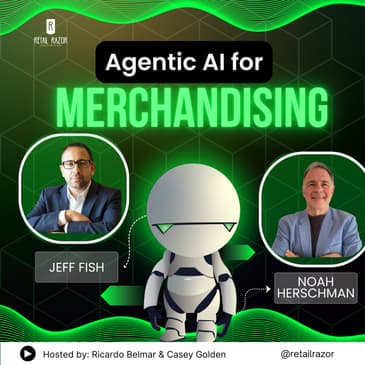




S5E12 The Future of AI in Retail Merchandising & Buying with Noah Herschman and Jeff Fish
In Season 5, Episode 12 of The Retail Razor Show, hosts Ricardo Belmar and Casey Golden sit down with Noah Herschman and Jeff Fish of Intelo.ai to explore how agentic AI is revolutionizing retail merchandising and buying. From the art and science of retail merchandising to the persistent challenges of planning and allocation, this episode dives deep into how collaborative intelligence empowers merchandisers, planners, and buyers to make smarter, faster, and more creative decisions.
What You’ll Learn in This Episode:
Why merchandising is the “hub of the wheel” in retail success
The balance between creativity and analytics in buying decisions
How agentic AI enhances human judgment without replacing it
Real-world examples of AI improving in-season planning and merchandising financial plans
Why spreadsheets aren’t going away, but AI agents make them smarter
The future of retail technology and how Agentic AI delivers superpowers to retail merchandisers
Subscribe to the Retail Razor Podcast Network: https://retailrazor.com/
Subscribe to our Newsletter: https://retailrazor.substack.com
Subscribe to our YouTube channel: https://bit.ly/RRShowYouTube
About our Guests
Noah Herschman. Senior Industry Advisor, Intelo.ai
Noah is an ecommerce strategist who’s been shaping online retail since the 1990s. He’s held leadership roles at Amazon, eBay, and Groupon. As a Microsoft Senior Retail Industry Architect, he has worked with more than 150 global retail & CPG clients. Noah has lived in China for 15 years and fluent in Mandarin, Noah operates out of Hong Kong. He is currently a Senior Industry Advisor for Intelo.ai
Jeffrey Fish, Co-CEO, Intelo.ai
Jeffrey Fish Co-Founded the Chatly platform serving global retail & hospitality brands targeting the China market (exited to Salesforce in 2020). He then led Salesforce China in partnership with Alibaba Cloud. Now he's scaling up Intelo's Collaborative Intelligence Agentic Merchandising & Planning Platform.
Chapters:
00:00 Previews
01:39 Show Intro
04:13 Welcome Noah Herschman & Jeff Fish
04:37 Guest Backgrounds and Expertise
07:33 The Importance of Retail Merchandising
11:41 Challenges and Solutions in Modern Merchandising
16:25 The Role of Agentic AI in Merchandising
23:09 Future of Agentic AI and Merchandising
40:04 Practical Steps for Retailers
41:36 How to Reach Out And Contact
42:10 Show Close
Meet your hosts, helping you cut through the clutter in retail & retail tech:
Ricardo Belmar is an NRF Top Retail Voices for 2025 & a RETHINK Retail Top Retail Expert from 2021 – 2025. Thinkers 360 has named him a Top 10 Retail, & AGI Thought Leader, a Top 50 Management, Transformation, & Careers Thought Leader, a Top 100 Digital Transformation & Agentic AI Thought Leader, plus a Top Digital Voice for 2024 and 2025. He is an advisory council member at George Mason University’s Center for Retail Transformation, and the Retail Cloud Alliance. He was most recently the director partner marketing for retail & consumer goods in the Americas at Microsoft.
Casey Golden, is CEO of Luxlock, a RETHINK Retail Top Retail Expert from 2023 - 2025, and a Retail Cloud Allianceadvisory council member. Obsessed with the customer relationship between the brand and the consumer. After a career on the fashion and supply chain technology side of the business, now slaying franken-stacks and building retail tech! Currently, Casey is the North America Leader for Retail & Consumer Goods at CI&T.
Includes music provided by imunobeats.com, featuring Overclocked, and E-Motive from the album Beat Hype, written by Heston Mimms, published by Imuno.
Transcript
S5E12 Agentic AI for Retail Merchandising
[00:00:00] Previews
[00:00:00]
[00:00:01] Casey Golden: I'd cut off anybody's hand that even attempted to touch my Excel spreadsheet.
[00:00:10] Jeff Fish: Not a lot has changed!
[00:00:13] And that interaction with the agent is critical for long-term success because it's like hiring six or seven PhDs that come and work with you to help you make your job better. But working 24 7 without vacation, without breaks, and continuously learning from what you're doing.
[00:00:30] Noah Herschman: But the merchant is really the person that controls the outcome of the retailer, whether it's e-commerce or bricks and mortar. I always like to say, yes, the Apple Store is a beautiful store with great sales help and fantastic wood floors and all that stuff, but that would mean anything that they didn't have the iPhone 17.
[00:00:52] Jeff Fish: let us focus on instinct. So let me just give you a real example that people are thinking about today, right? Two years ago, nobody knew what a Labubu was [00:01:00] and, and over the past six, nine months and we do a lot of work in fashion luxury. Every luxury brand has their own version of a Labubu. They're, you know, these key chain things that are hanging from bags that are selling off the shelves.
[00:01:12] Noah Herschman: We're not trying to replace anybody or do anything like that. What we're trying to do is just make, turn you into like super mega whatever the superhero, incredible hulk of buying by you, by having these, these powerful tools that you know, the world couldn't even have imagined a couple years ago.
[00:01:28]
[00:01:39] Show Intro
[00:01:39] Ricardo Belmar: Welcome to Season 5, episode 12 of The Retail Razor Show, the only retail podcast in the Top 10 All Time Indie Management podcast charts on Good pods and the highest ranked retail podcast in the Top 100 Indie Marketing podcast charts on Good pods. I'm Ricardo Belmar.
[00:01:57] Casey Golden: And I am Casey Golden. Welcome Retail [00:02:00] Razor Fans to retail's favorite podcast where we cut through the clutter to bring you sharp insights on what's happening in retail today, tomorrow. And where we get real about what's driving the future of retail.
[00:02:13] Ricardo Belmar: Today we are diving into one of the most complex and critical areas of retail, merchandising, and buying. One that I know is near and dear to Casey's heart. And so we're exploring how the next wave of AI naturally, specifically Agentic AI, is poised to transform all of the processes involved in in merchandising and buying.
[00:02:35] Casey Golden: Yeah. To help us unpack this, we're joined by two guests. First, Jeffrey Fish Co-CEO, and founder of intelo.ai, a company that's pioneering AI powered agents that embed intelligence directly into retail planning workflows, and alongside him, Noah Herschman. Strategic industry advisor to intelo.ai and [00:03:00] formerly principal industry architect at Microsoft with decades of leadership experience at Amazon, eBay, Staples, and a few more.
[00:03:08] Ricardo Belmar: Together, Jeff and Noah will help us understand the challenges retailers are facing in merchandising today. Why the traditional methods are falling short, and how agentic AI can really go beyond, what we've seen with machine learning and generative AI to deliver real actionable impact.
[00:03:25] Casey Golden: Yes. So before we dive in, just a quick favor. If you're enjoying the show, hit us with a five star rating and drop us a short review on Apple Podcasts, Spotify, Good pods, or whatever you're listening.
[00:03:39] Ricardo Belmar: And don't forget to like and subscribe on our YouTube channel, so you never miss an episode.
[00:03:43] Casey Golden: Check out the other shows in the Retail Razor Podcast Network, Retail Transformers, Data Blades, and Blade to Greatness. You'll find them all in your favorite podcast app or together on YouTube channel.
[00:03:57] Ricardo Belmar: So with that, let's get into it. Our discussion [00:04:00] with Noah Hirschman and Jeffrey Fish on how agentic AI can reshape the future of merchandising and buying in retail.
[00:04:07]
[00:04:13] Welcome Noah Herschman & Jeff Fish
[00:04:13] Ricardo Belmar: Welcome, Noah. Welcome Jeff to The Retail Razor Show.
[00:04:16] Casey Golden: We're excited to have you both on the show. This is a topic we haven't covered very much in the past, but one we definitely should be digging into. Merchandising and buying and how AI can really transform these critical retailing functions.
[00:04:29] Ricardo Belmar: That's right, and admittedly one, we are thrilled to have both of your expertise on.
[00:04:34] Jeff Fish: Thanks for having us.
[00:04:35] Casey Golden: So before we jump in.
[00:04:37] Guest Backgrounds and Expertise
[00:04:37] Casey Golden: In our intro to this episode, we walk through a bit of your bios, but Noah, Jeffrey, why don't you give us each a quick rundown of your backgrounds to kick us off.
[00:04:46] Noah Herschman: Sure. Who do you want to go first? Me or Jeff?
[00:04:50] Ricardo Belmar: No, why don't you go ahead and kick us off, Noah..
[00:04:51] Noah Herschman: Sure thing. Yeah. Hello everyone. Ricardo and Casey. Yeah, I'm Noah Herschman and I'm work with Jeff at [00:05:00] intelo.ai. You know, my background is almost entirely about retail merchandising. I've been a retail merchant since I was in my early twenties, sort of my first job out of, you know, moving to the sales floor at retail and getting promoted into the buying offices like a junior, junior associate buyer, making almost no money at all, but really loving it.
[00:05:20] And it's really, , what I've done to, and, and risen to being the leader of, of categories in merchandising for large companies like Amazon and eBay. And most recently I've been with Microsoft for the last almost nine years working on their retail consulting business for the consulting part of, of Microsoft.
[00:05:39] And left Microsoft recently to join Intelo where I'm helping them on a number of different things as a strategic advisor.
[00:05:46] Jeff Fish: Thanks, Noah. Hi everybody. Jeff Fish been in retail tech or technology altogether for 20 plus years. Started out in retail went into e-commerce. Left e-commerce to go into talent acquisition [00:06:00] technology and try to apply e-commerce methodologies back then to things like recruiting technology and ATS and various forms of recruitment methodologies back when social media wasn't even a thing.
[00:06:12] So, applying, e-commerce methods to the first users of LinkedIn and various ways to look at talent acquisition websites. Left that company Symphony Talent, about 10 years ago when I started a company called Chatly, which was a WeChat management platform and we were focused on retail, luxury retail specifically, for China and travel and hospitality.
[00:06:38] And we had a WeChat CRM, WeChat Commerce Solution, WeChat Marketing Solution. We integrated all of that with Salesforce. And Salesforce acquired that company back in 2020. And in 2020, I, I came along with the acquisition and led Salesforce China for about five years. And several months ago Rupesh Nair who's [00:07:00] product owner and one one of our co-founders and Co CEO spent a year convincing me to come over and get back into the startup world and take on Intelo.
[00:07:09] He had a long background in, in retail technology as well. And I convinced Noah and some other folks to join me on, on this adventure of really transforming how merchandisers and planners think about how they interact with technology. And we are specifically focused on really transforming their work with collaborative in intelligence, with Intelo.
[00:07:29] Ricardo Belmar: Great. Thank you both. Thank you both for that. Good, great background.
[00:07:33] The Importance of Retail Merchandising
[00:07:34] Ricardo Belmar: So what, this is gonna be a fun conversation, so why don't we start with a sort of a big picture. Look, Noah, you've described merchandising in the past as sort of the hub of the wheel in retail. So what makes it such a foundational function and why is it so often misunderstood or maybe undervalued?
[00:07:49] Noah Herschman: Sure. Let me take a crack at that. The thing that really attracted me to retail early on in, in my life is this balance between left and right brain. [00:08:00] You know, you have to be analytical obviously, to understand what's selling, why it's selling, what are the things that are, you know, the data that's driving everything.
[00:08:09] But then there's a creative side. You can tell by my. Guitarist in the background. I have a creative bend as well. And so it's like great balance between, especially when you're talking about things like fashion, which is a, a perfect example where you have to have a vision for what the hot fashion, you know, are, are gonna be what the trench, what the colors are.
[00:08:29] But then at the other side, you also have to be able to understand how many you allocate. What's the, you know, you have, basically it's about forecasting what's, what prices is it gonna sell at, where's it gonna sell, who's gonna buy it? What are the sizes, what are the colors, right? So you have to kind of do both of those things, predict the future, understand the trends, and really look at the analytics.
[00:08:52] But the merchant is really the person that controls the outcome of the retailer, whether it's [00:09:00] e-commerce or bricks and mortar. I always like to say, yes, the Apple Store is a beautiful store with great sales help and fantastic wood floors and all that stuff, but that would mean anything that they didn't have the iPhone 17.
[00:09:14] It's about the product, and so really you have to have a vision for the product and how much it costs, and then from that, you being that product. You know, the product imbued with, with some sort of, of of, of religion around the product, you have got to go and spread that across all of the different parts of the company that need to be able to do something with that vision.
[00:09:40] Right? And so that could be obviously supply chain. They have to, you know, you, they have to order the right amount, they have to allocate it to the right stores, et cetera. It has to do with marketing. What are we gonna tell the customers about this product? How are we gonna position it? Back in my day, it used to be flyers and circulars in the newspaper.
[00:09:59] You know? Now it's [00:10:00] obviously digital marketing, but it's the same general thing, right? You have to tell the sales floor, how do you merchandise it if you're in a bricks and mortar store, or if you're online, you know, how do you merchandise it online? Where does it go? What does the end cap need to be? You know, what are the different displays?
[00:10:16] Is it in the window or not? Right? And then from there, you have to be able to, you know, sales train. Jeff and I actually used to work a long, long time ago at a electronics chain, you know, and when you're selling complicated things like televisions and. At that point, DVD players, right? You have to be able to train the salespeople.
[00:10:33] So this all comes from the merchandising, and obviously you have to work with finance and you have to do all that kind of stuff as well, to be able to make sure that you're earning a profit, that you're doing the right markdown, that you're not underwater on the margin. This all comes from the merchant and the merchandising department.
[00:10:50] Casey Golden: So I've been, I was, I was a planner, I was a merchant. I consider myself a merchant. And you know, I'd cut off anybody's hand that even attempted to touch my [00:11:00] Excel spreadsheet.
[00:11:05] Jeff Fish: Not a lot has changed!
[00:11:09] Casey Golden: And there was a lot of shooting from the hip, a lot of gut, a lot of intuition, really knowing your customer and not really having a lot of data to back anything up when it came to it. If you wanted to go off of just comping last, last season and last year, and retailers today face a lot of complexity in planning and allocation, especially so many more manufacturers have begun to go direct to consumer. I think if I were in that position today, I wouldn't wanna change.
[00:11:41] Challenges and Solutions in Modern Retail Merchandising
[00:11:41] Casey Golden: What are some of the most persistent challenges you see?
[00:11:45] Jeff Fish: I, I think when you were, when you were in planning and, and merchandising. The challenges that you faced and the uses that you had have not changed that that much, except they've just grown exponentially to today. [00:12:00] There are still merchandisers and planners in every organization that hold their Excel spreadsheets like they are gold and will not give them up.
[00:12:08] And we understood that and, and, and we, and we understand that, you know, 20 years of doing something a certain way. To do total change management and change everything you're doing overnight is impossible. And understanding that and building product to support, that meant that at any step stage of the process, when a merchandiser planner is using intelo, they can upload their spreadsheets.
[00:12:33] And they can download their spreadsheets and they can interact, and they can interact with the agents just like how we're talking now, they can have a conversation with the agent and reason with it. So the way that we built the stack, it is very much collaboration between the planners and allocators working with the agents.
[00:12:50] And then working with each other. And the agents learn from the spreadsheets that they've used. They learn from the data that we're bringing in. They learn from third party data that you wouldn't have had access to in the [00:13:00] past and that many, many organizations don't have access to today. And they'll reason with, with the agent, but ultimately it's the human in the loop, right?
[00:13:07] So that planner or the allocator makes that final decision and can push that data downstream to their WMS. Can push the data downstream to another system, or they can just download that spreadsheet and then manipulate it from there. And I, I think what Noah pointed out earlier is so critical. There, there is the creativity or the art and the science.
[00:13:27] And I think what you had mentioned earlier around, you didn't have a whole lot of data behind you and you were working it from your gut. The, you have a luxury today if the organization has that data, whether it's sitting in a data lake house or sitting in other systems or third party data to be able to apply a lot more science to the art, but ultimately the art still exists and that, that creativity still has to be there.
[00:13:49] So we believe. Collaborative intelligence with Intelo can do is marry those things together. And what we've seen with our customers is that change management cycle is very quick [00:14:00] now, whereas compared to implementing a big system like an Oracle or an SAP, which I think everyone on this call has probably dealt with before, those are multi-year change management processes.
[00:14:11] Whereas if you're interacting with an agent. If you know how to use chat, GPT, you know how to use Gemini. You pretty much know how to use an agent, and as long as you can build trust with it, and trust shouldn't happen over. Happens over time, then you start to relinquish less and less time spending on your spreadsheets, whereas we know that'll never be a hundred percent removed, but maybe 30, 40, 50% over, over a couple of months, and you spend more time interacting with your agent.
[00:14:38] And that interaction with the agent is critical for long-term success because it's like hiring six or seven PhDs that come and work with you to help you make your job better. But working 24 7 without vacation, without breaks, and continuously learning from what you're doing. So our belief is that working together with the agents, you'll have a much better outcome [00:15:00] in a much more efficient way.
[00:15:00] Noah Herschman: And let me just add onto that a little bit if that's okay. It is that I don't think that the agents are gonna replace the genius of the buyer, you know, the natural
[00:15:12] Ricardo Belmar: Mm-hmm.
[00:15:13] Noah Herschman: And so a lot of of buyers that, that, even when I was at Microsoft, a lot of them who I talked to were very defensive and said, Hey, you know, you know, machine's not gonna do and it's true.
[00:15:23] But what it can do is it can superpower, give them superpowers and make them better at their job and do things that they may not wanna do or have the capacity to do. So, for example, looking at a full product lifecycle. You know, when is the best time to mark something down? How do you know that you should be moving it ahead of time from this store to that store?
[00:15:45] These are the kinds of things that, yes, you're a great buyer. You've proven track record of making great buy and selling and making the company money, but there's still money that you're leaving on the table because you're not doing this PhD stuff that Jeff was talking [00:16:00] about. You're not really looking at.
[00:16:02] This kind of next level down of elasticity data, you know, of size curves, of the things that are kind of, maybe not the fun part of the job, but everyone knows that they're super critical and that's where these agents can come in and really do an amazing job. But and turn you from good to great or great to amazing or whatever it is.
[00:16:23] Ricardo Belmar: Mm-hmm. Right, right.
[00:16:25] The Role of Agentic AI in Retail Merchandising
[00:16:25] Ricardo Belmar: So I guess one, one thing I would think of as I, I hear you both kind of walk through the challenges are and, and what the benefits are that this kind of, let's call it this latest generation of intelligent tools. You know, there there've been tools before, right?
[00:16:39] That have tried to solve these things and to make life better for the buyers and merchandise. So what in your mind, I mean, what, why has this been so hard to solve and really make better with those traditional tools? Up until now when we have these, this agentic AI capability.
[00:16:53] Jeff Fish: Why don't I take a stab at that and, and Noah, you can, you can chime in. I, I think, you know, ML, I, I, I've been working with [00:17:00] ML for 15 years, right? Machine learning is not, is not something that's new and, and AI is not new. Right. And there are systems designed and built for merchandisers and planners that have been using machine learning for just as long, and they've gotten better and better, but they're, they're algorithmic and they're constrained, and generally they're a black box and they're hard to manipulate.
[00:17:20] So I I, I think I, I spend almost every day talking to merchandisers, what you hear all the time is, yeah, we've got a system. But ultimately I can't do what I need to do with it. So I download a spreadsheet and then I've got no constraints and I can work within that spreadsheet. I can add rows, I can do v lookups, I can get to the data that I need to get to, and then I have to upload that back into my system.
[00:17:41] And that has been not just the case in merchandising and planning, but the case in CRM in marketing platforms. There's, there was a rigidity in machine learning once generative ai. Came onto the scene and you know, let's just say that the inflection point was ChatGPT. You [00:18:00] realized there's a much wider aperture in how you can interact with ai.
[00:18:04] The challenge with just, you know, plugging in a chat GPT into those systems is now you're interacting with all of the data in the world. Your data's not protected and it doesn't know you well enough. Right? It's gonna, it's gonna give you some crazy answers. So even two and a half years ago, it wasn't ready for enterprise level interaction like merchandising and planning.
[00:18:25] Now, fast forward a little bit and think about what reasoning allows you to do, and reasoning allows you to have an interaction the same way the four of us are, and having the AI come back to you with what it did, why it did it and then allows you to interact with it to bring it down to what you're looking for.
[00:18:43] So compare that to your spreadsheets which are near and dear to the hearts of merchandisers and planners. What is what a merchandisers and planner would do would be continuously work with and massage the data to get it to where their gut feels it's right. And the, the art of the [00:19:00] possible within their organization is the creativity that happens within those merchandisers and planner's work.
[00:19:04] When you have reasoning and you have, you have an agentic layer with the LLM underneath it. It allows you to do that, but it allows you to do it with massive amounts of data. It allows you to do it looking at the constraints that you can set that can be highly constrained or you can widen those constraints depending on what your goals are.
[00:19:25] And it's looking at elements that you would've never looked at before. So it's looking at elements like, you know, weather patterns or economic updates in real time or events that are happening around stores. These are things that historically you were just looking at last year's data and the year before's data, and that's, that was it.
[00:19:42] You're just trying to make a prediction. So I think that the game changer today is the massive amounts of data that can come into the system, the ability for a planner or an allocator to be able to interact with that data in real time and let the data learn from you and you learn from [00:20:00] it and then get to the outcome you're looking for.
[00:20:02] So that just didn't exist before. So the capability of the technology is in a very different place today than it were, was even three years ago.
[00:20:09] Noah Herschman: Yeah. And it before the systems that Jeff was referring to generally did one thing. The allocation system, whether it's a, a JD or, or one of these systems, very good using machine learning to figure out a forecasting plan, right? But what we're talking about really is parallel to how we started this conversation.
[00:20:29] We're just the merchant. A really good merchant, a really good buyer, does many, many things just thinking about many, many things at one time. Not only what the weather is gonna be, but you know what's happening in this store, that store, what's the pricing here? What competitor pricing is gonna be influencing me, right?
[00:20:46] There's so many moving parts. So instead of just having one machine that does one thing and another machine and a different department that does another thing, this combines everything so that all it's sucking in all of the data and it's [00:21:00] really making, using this data to make decisions based on multiple touch points.
[00:21:05] Ricardo Belmar: Yeah. So I, I guess thinking about that, Noah, you've obviously through your career you've pretty much had a front row seat to this evolution of, of, of retail tech. From all the examples that you and Jeff have been talking about here from, you know, whether it was with machine learning and now all the things that Gen AI has done. Talk a little bit more about now that we have agentic AI and, and what these agents can do to kind of work more proactively on your behalf.
[00:21:27] And helping you make these decisions. Tell us a little bit more about how you see that fitting into this overall journey for the buyer and for the merchandiser.
[00:21:33] Noah Herschman: Well, I mean, I think, you know, Jeff said it, it's really about the reasoning, right? That before, so I was part of the team that was launched pricing rules at Amazon back in the day when it was scraping the websites. And it was, you know, giving the buyer a choice to, you know, either keep the product or don't keep, you know, keep the price or don't keep the price right.
[00:21:54] If it was over a certain contribution profit, and it was like a rules-based [00:22:00] engine, right? But so the, and then the buyer would have to pick a reason code and then, you know, agree with the price or don't agree with the price, right? So that is completely out the window now because this engine would, would, you know, in this particular case but could be anything.
[00:22:15] It could be allocations, it could be many, many different scenarios. But in the, you know, if we had in jet to back in those days, it would say. You know, yes, we're gonna match the price and here's why, or no, we're not gonna match. And then you would have a discussion with it and you might say, you know what?
[00:22:33] I don't agree with your reasoning here. This is how I would do it. And then next time it would learn from you and it would be able to say, okay, judge, you know, based on our last conversation or whatever, it's going to make this decision. So it's really that, you know, being able to have the understand the reasoning of it and then to be able to have it learn over time that we didn't have back in the name.
[00:22:55] That's, to me, you know, one of the most exciting things about this new [00:23:00]technology.
[00:23:00] Casey Golden: I kind of want a sandbox like I wanna play.
[00:23:09] Future of Agentic AI and Retail Merchandising
[00:23:10] Casey Golden: Jeffrey, when you look at how AI is being applied to merchandising, buying today, what kinds of planning task or decisions do you, do you think benefit the most from intelligent automation? If we have some planners and buyers in our audience right now, what would be. Some context, would it be like top door? Bottom door? Would it be SKU counts? Would it be what? What area
[00:23:36] Jeff Fish: I think
[00:23:37] Casey Golden: see this?
[00:23:37] Jeff Fish: some of the areas that we've seen. The the biggest wow moments from our customers. HA has been in, in, in season planning, so how to do the proper allocations, how to rebalance for your stores, how to factor in data that they had never thought about. Right. I mentioned earlier things like current events or physical events happening around stores.
[00:23:59] These [00:24:00] are things that generally, you know, you get a phone call or an email from a store manager and they'll say, we need to increase. Inventory and increased product because we're having this event at this time. The system just knows that, right? The system's gonna know that and make recommendations, and it's gonna be looking at, at all of your data in real time, especially if you have, you know, your data sitting in a lakehouse.
[00:24:20] And we're looking at that data at and real time access to it, and it's starting to make recommendations and updates a against it. You start to see, you know, that, that amazement from planners and allocators around, wow, this feels like magic. This feels like this. The system knows better than I do, and it it's because of the interactions that that planner and allocator had.
[00:24:40] What we're also seeing is in the, in building out the MFP or the merchandising financial plan that generally has been a very long and arduous process with a lot of people, and I don't think it'll ever not be a lot of people. And there's a lot of art that goes into building the MFP, especially when you're dealing with the [00:25:00] product teams and you're dealing with finance and you're dealing with the buyers and the merchants.
[00:25:04] Historically, no matter what system, this was very spreadsheet heavy. And now if you have a central location where you're interacting with each other and you're interacting with the agent, and the agent is sitting alongside you, helping to make recommendations and helping to hone in on what your financial plan should look like for next year, that's another area where there's that magic moment going.
[00:25:24] I never thought this was possible. So I think those are the areas where we've seen with our agents that we've seen. I'd say the most amazement from our customers.
[00:25:31] Casey Golden: It's pretty cool. One thing that that stands out in your approach is the idea of keeping humans in control. You know, I still think what, like everybody in fashion wants to be a buyer. Still. There will never be enough buying jobs for the demand. How do you design AI systems that support planners and merchants rather than replacing their judgment?
[00:25:53] I mean, I think when we look at a buyer, their personal point of view [00:26:00] is a huge asset into that edit. Whereas a planner working on a full brand has a little less control over that edit and it's, it's much, much more a mathematical formula. One season you might be bullish on tops or collection because they're fire. And then the next one, just like every single thing designed showing you, you just, it's just like a dog. It's just I gotta make the numbers the best that I can, but I'm not feeling this collection at all.
[00:26:34] Noah Herschman: Right.
[00:26:35] Jeff Fish: I I think that's where the art comes in, right? The art never goes away and instinct in, in, in what these extremely talented buyers do. It can never be replaced by ai. You know, you hear about this panacea of AGI is gonna come in the next five years and maybe it will or maybe it won't, right?
[00:26:54] And we'll see if, if AGI comes in the next five years. Some, you know, meta is now calling it super intelligence. They don't wanna [00:27:00] call it AGI anymore. There's still not gonna be the art to it, right? There'll be a AI is gonna get better and better and we'll be able to do more and more. For example, pattern recognition.
[00:27:10] Gen ai, and, and certainly agentic AI is already doing much better in pattern recognition than a human can. And buyers and planners and allocators. And really, whatever part of retail you're in should recognize that and say, let's let the pattern recognition go to the agents and let us focus on instinct.
[00:27:26] So let me just give you a real example that people are thinking about today, right? Two years ago, nobody knew what a Labubu was and, and over the past six, nine months and we do a lot of work in fashion luxury. Every luxury brand has their own version of a Labubu. They're, you know, these key chain things that are hanging from bags that are selling off the shelves. Our agents wouldn't know that. Right? Our agents c couldn't sell you. You know what? You should make this bet and make your own version of your labu boo for your bags that in the next month because it's so hot out. Because it's so hot in, in, in the market. So I [00:28:00] think there's always gonna be that creativity.
[00:28:03] And talent that needs to be brought to buying and to planning and allocation as well, right? That an agent can never do. What the agent's gonna do is gonna really help you make those decisions much faster and more efficient.
[00:28:13] Ricardo Belmar: Yeah, I think you raised an interesting point that there, you, we could say there's often a, a sort of a tension between a desire for automation versus creativity. So, so really this is for both of you and I'm saying this as I, I see the guitars behind you, Noah, which is making me think of the this, but how do you see o overall, these AI systems helping merchants maintain that creativity while still seeking a way to improve efficiency and gain consistency?
[00:28:39] Noah Herschman: So. You know, there's math and there's non-math. You know, I mean, the, the creativity can be enhanced or it can be giving you more suggestions by going around and scraping and doing the kind of pattern recognition that Jeff was just talking about. You know, what's gonna be the hot color for next year?
[00:28:57] It gets, you know, multiple [00:29:00] Instagram. There's already companies that are doing this, right? It gets scrape multiple Instagram and make predictions and. But at the end of the day, you know, you've gotta be the person who has the vision, you as the buyer, and you're gonna take some of those suggestions and recommendations and you know it'll be yet another data input, right?
[00:29:19] I mean, you know, you can talk to people about it. You can go out and see, you can go to the fashion shows, be the Anna Wintour or whatever, but it's just a data point and you've gotta be able to do it. What this can do now is do math stuff that you may or may not wanna do, or it may be difficult. Another example would be, okay, you've got a choice.
[00:29:41] You you've got two volume rebates. You're gonna hit between two different manufacturers, right? And one of 'em, you could either hit one of 'em or you can hit the other one. You don't have the open to buy to do both, right? So this could do some modeling that says you should. Go for this one because you're gonna [00:30:00] make slightly more money than if you go for the other one and you know what I mean?
[00:30:04] Those are the kinds of decisions. Again, not necessarily the creative, like super cool part of being a buyer, which is going to the fashion and shows and picking out the collections, but you know, who am I going to? Bet on how am I gonna optimize my backend programs? How am I gonna optimize my open to buy and my merchant?
[00:30:26] Those are the kinds of things that this could do very well. And you know, there are people who do that now, but I think that anybody would wanna have some help doing that 'cause it's not the most auspicious
[00:30:39] Casey Golden: It's not a glamorous job like being a planner. I mean, I loved it. I think every planner loves their job. But it's not something that you don't know, you don't learn about that job until you're not a buyer or you got to be, you were a buyer for a short period of time and then you became a planner.
[00:30:57] You're like, oh, this is where all the volume [00:31:00] is. This is where I get to make all the edits and changes before production. Right? Like it's really the, the fun place to be in control. It really feels like this is a very low risk, high reward opportunity to have access to these tools to start playing with them, to start experimenting, to start blowing out plans and, and doing scenario planning.
[00:31:26] I think scenario planning was one of the things that took a lot of time in the we hours where you're just trying to. Run a few more scenario plans just to throw some numbers on a wall just to make sure I feel good about this. That could save, you know, one hundreds of hours in a season. What, can you share an example, like real world example of how this has helped a retailer avoid a costly [00:32:00]mistake?
[00:32:01] Jeff Fish: Yeah. Yeah, we can. So let's look at scenario planning, right? It with, we have an agent specifically for scenario planning. And if you are building out your scenario plan for next season, and you're factoring in your. Tariffs, which are different every week, and you leverage our data that's coming in with the tariff information.
[00:32:27] And you and this is, this is happening with customers of ours today. They need to update their scenario planning because. You know, there's things going on in, in I think he's in Japan today or in South Korea with our, with president traveling in, in Asia. And tariffs can change literally today.
[00:32:43] So to, to rather than go back in and, and run all of those different analog reports that you were doing in the past. You can just factor that in, in into the plan. And it will re reformat the plan based on your tariff data that's been updated in real time. So you can [00:33:00] run an agent, let's say go look at tariff updates on a daily basis and reoptimize based on tariff updates that are coming globally.
[00:33:07] And we have customers that are doing that today. So there is an area where you can significantly reduce risk. And increase margin where needed based on real time data that's coming in that could ha, that could change at any moment.
[00:33:19] Casey Golden: That's super interesting. Super interesting. Yeah. I mean, I miss it, but I don't miss it. I've got lots of friends that are still planning businesses right now and I'm pretty sure that this will be a hot topic of conversation the next time I'm going out to dinner because I think everybody's a planner.
[00:33:42] You mentioned that like multiple agents can collaborate to drive like a better result and have kind of almost like subject matter experts is the way I'm kind of hearing it. How does that orchestration work?
[00:33:54] Jeff Fish: So Jensen Wong said very recently [00:34:00] that the C, the IT department or the office of the CIO. Is also gonna be HR for agents. And that's a, that, that's a, you know, gentleman says some amazing things pretty often and they come true. And what he means is that organizations, large organizations are gonna have HR agents.
[00:34:27] They're gonna have marketing agents, they're gonna have buying agents, they're gonna have planning agents, they're gonna have e-comm agents, they're gonna have shipping agents, they're gonna have all these types of agents. Right? And they need to, they need to interact with each other and, and they can't be in silos.
[00:34:40] 'cause if they're in silos, then the IT department's gonna fall apart, right? It just won't work. So there's a, there's a standard protocol called the MCP Protocol, which allows this a, allows agents to talk to each other. All of our agents are built on that, so you can orchestrate whether you have two agents or 16 agents.
[00:34:57] So you have basically all of our agents [00:35:00] our agents talk to each other through MCP. And then if you have your e-comm agents and your shipping agents and your marketing agents. They would all be orchestrated together too. And then you'd have an agent of agents, and generally the office of the CIO is gonna own that so that you are, you're managing all of your agents, whether it be from vendors like ours, or vendors like Salesforce or ServiceNow, wherever it is.
[00:35:20] Right. So that they're all working in concert with each other. Now in theory, that sounds super easy and every organization's gonna have a thousand agents next week, and they're all gonna be working alongside their their employee teams with collaborative intelligence. In reality, it's gonna take a few years.
[00:35:36] It's gonna, it's gonna take a few years to get this right. And for everybody to build, be built on MCP and then for the IT teams to start to corral this. But we started out with everything on MCP. So whatever agents we deploy, they're, they're able to interact with each other. And when we deploy them, they're, they're all visible at, at a role level.
[00:35:56] So, you know. CIO has access to [00:36:00] everything. Maybe chief merchant has access to everything, but a planner only has access to a couple. An allocator might have access to a couple, and that data can interact with each other. Sitting within that, that that tenant.
[00:36:11] Ricardo Belmar: Yeah. So I guess now I'm looking ahead as I hear you say that, and I'm wondering now how do you see the role of the merchant evolving, right? As you get more and more integrated with these AI agents and these systems, and they're more embedded in your planning workflows and every other aspect of what you're doing is you add layer more and more agents into it.
[00:36:31] How does the role change? How does it evolve now?
[00:36:34] Noah Herschman: Well, I think that there is an automation component that's gonna take a lot of the, the drag work, as Casey said earlier, away from this. So, as we start off the conversation, right, I make a buy or I have a sale, have a, you know, buy a, a special thing. I need to do a bunch of things with that.
[00:36:52] Right. And so right now what I'm doing is I'm stopping what I'm doing. I'm writing an email to this guy or I'm, putting something in the newsletter for [00:37:00] that. This can do a lot of that work that says, okay, this special buy needs to go to marketing with these, the parameters needs to go to the you know, the stores for this merchandising thing.
[00:37:11] There's a lot of things that can happen that can generate from you. So instead of having to spend a lot of time doing those kinds of tasks that are important but not, that great. You could spend a lot more time being really good at being a buyer, understanding the product, understanding the trends, and doing those kinds of things, right.
[00:37:31] So that's one way that it is gonna change, I think, in the automation part of it as well. And then of course, all of the math part that we talked about earlier. As a merchant, which you still have to do, you could be in a more supervisory role with that and you could be a little bit more adherent to the kind of financial position that you're in and be better at it.
[00:37:50] I don't know, Jeff, you wanna add anything?
[00:37:51] Jeff Fish: I I would add that I don't know that any merchants or buyers or planners or allocators went into the, went into their industry [00:38:00] and built a career around, you know, I wanna spend half my day in a spreadsheet. I don't think they did that.
[00:38:07] Noah Herschman: Right.
[00:38:07] Ricardo Belmar: Yeah, they, yeah. I don't think anyone go, goes in dreaming about, well, maybe some people do, but I think most people dreaming about spending their day in a
[00:38:16] Jeff Fish: I think, you know, you could go into accounting and do that. You can go in financial planning and even they're starting to use new
[00:38:23] Ricardo Belmar: that's right.
[00:38:24] Jeff Fish: But I, I, I've never met anybody that went into fashion retail and said, I wanna
[00:38:29] Ricardo Belmar: need a spreadsheet.
[00:38:30] Jeff Fish: spreadsheet. Right? And, and, and I think what's gonna happen is they're gonna get to work on what they went to school for and why they've got into, into this career in the first place.
[00:38:40] They're gonna do a lot more planning and they're gonna do a lot more strategic thinking around the brand and how to make the brand more successful, get better customer satisfaction because they're not spending so much time doing data analysis. And if I fast forward 24 months. I look at where we want Intelo to be, I want [00:39:00] all of our customers to be able to say they were able to do that.
[00:39:01] And I think that's, that's the direction, not just with what we do, but any, any agentic platforms that are out there that, that should be the direction that they're looking to bring the customers that they're working with towards let the, the repetitive tasks and the automation do its work while you can focus on more strategic things.
[00:39:22] Noah Herschman: And it's really, there's two sides to AI and Ricardo, we talked about this earlier as well, right? There's efficiency, which is, yes, you can spend less time doing that, but that's not really, I mean, that's one part of it, but really what the sweet spot is the excellence. This allows you, gives you the tools and the data and these things and the, and the reasoning and all the things that we're talking about just to be much better at your job.
[00:39:46] Right. But that's really what we're trying to do. We're not trying to replace anybody or do anything like that. What we're trying to do is just make, turn you into like super mega whatever the superhero, incredible hulk of buying by you, by having these, these [00:40:00] powerful tools that you know, the world couldn't even have imagined a couple years ago.
[00:40:03] Ricardo Belmar: That's a great point.
[00:40:04] Practical Steps for Retailers
[00:40:08] Ricardo Belmar: So if you're a retailer and you're listening, you're out in our audience and you're listening today, what's a practical first step you would tell them to do, to really start this journey of modernizing, maybe that's not even the right word, but maybe about leveraging it and benefiting from these kind of AI tools.
[00:40:19] Jeff Fish: I, I think understand where your, where your pain points are, right? You not, you can't, everything can't be a pain point, right? You can't have, everything's wrong. I wanna fix everything. And, and there's I think two years ago, or two and a half years ago, at this point, there were a lot of CEOs that said, wow, this is world changing.
[00:40:37] Let's let's dive headfirst into generative AI and let's, let's start a bunch of projects and a lot of them failed. In fact, the MIT study came out, which is pretty well, well, known now. 95% of them failed in the Fortune 500 and I think it's because. AI is not gonna fix bad processes within your organization, right?
[00:40:56] It's just gonna make those processes faster. [00:41:00] So, so, so I think the first problem, and, and or the first step is not that different than any other major technological change. You have to identify the problem you wanna solve. And then go try to solve that problem. And there might be two or three problems we wanna solve.
[00:41:15] There might be five or six, but it can't be, I need to transform everything all at once and AI is gonna do all that for me. And you know, everybody's gonna go sit on the beach. That's not reality. Right? Reality is figure out where your pain points are, figure out what you wanna solve for, and then go to try to solve that.
[00:41:31] But you need to, you need to identify that first.
[00:41:33] Ricardo Belmar: Great advice. Great advice.
[00:41:36] How to Reach Out And Contact
[00:41:36] Casey Golden: Well, Noah, Jeffrey, this has been a really fun conversation and I appreciate you running through how AI is transforming merchandising. Thank you so much for sitting down with us and digging into what brands can do now.
[00:41:48] Jeff Fish: Thanks for having us.
[00:41:49] Ricardo Belmar: Yeah. And before we go, I guess I'll ask both of you, Noah, Jeff, anyone in our audience wants to reach out to you, maybe learn more about what we talked about today, connect with you, what, what's the best way to do that?
[00:41:59] Noah Herschman: I guess through [00:42:00] email, right? Either Noah or Jeff at Intel, I-N-T-E-L-O, dot ai.
[00:42:06] Casey Golden: Amazing. Thank you both. It's a wrap, Ricardo.
[00:42:10] Show Close
[00:42:15] Casey Golden: If you enjoyed our show, please consider giving us a five star rating and review on Apple Podcasts, Spotify, or Good pods. Remember to smash that subscribe button in your favorite podcast player and like, and subscribe to our YouTube channel so you don't miss a minute. I'm Casey Golden.
[00:42:34] Ricardo Belmar: Please follow us on social and share your feedback at Retail Razor on LinkedIn, Bluesky Threads and Instagram. Subscribe to our substack newsletter to preview the best highlights from each episode and get bonus content right in your email inbox. View our website at retailrazor.com for transcripts and more info about each episode and our amazing guests.
[00:42:54] The Retail Razor Show is the original show in the Retail Razor Podcast network.
[00:42:58] I'm Ricardo Belmar.[00:43:00]
[00:43:00] Casey Golden: Thanks for joining us.
[00:43:02] Ricardo Belmar: Until next time, Stay Sharp, Stay Human and Stay ahead.
[00:43:05] This is The Retail Razor Show.
[00:43:07]