
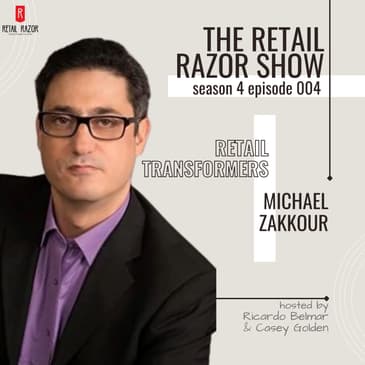


S4:E4 Retail Transformers: Michael Zakkour
In this episode of The Retail Razor Show, hosts Ricardo Belmar and Casey Golden are joined by special guest Michael Zakkour, founder of 5 New Digital and author of two Amazon #1 bestselling books, to discuss the transformative power of unified and immersive commerce in the retail industry. Michael, a thought leader and practitioner in digital commerce with 25 years of experience as a CEO, CMO, and Founder, shares his extensive expertise on retail strategies, AI, the evolution of e-commerce, and the impact of video as a foundational tool for immersive commerce. Together they explore key topics such as the shift from omnichannel to unified commerce, the impact of social commerce and livestreaming from Asia on global markets, and future opportunities with AI in retail. Michael also provides practical advice for retailers to enhance both digital and physical store experiences that resonate with today's digitally savvy consumers, while aiming for higher conversions, better customer engagement, and sustainable profitability.
00:00 Show Intro
04:36 Retail Transformer - Michael Zakkour
06:42 The Evolution of Retail
12:36 Challenges in E-commerce
16:35 The Future of Immersive Commerce
26:07 Video Commerce: The Next Frontier
28:39 The Evolution of E-commerce
30:04 The Importance of Immersive Commerce
32:10 Case Study: Live Streaming Success
38:47 The Role of AI in Retail
48:04 Navigating the Future of Retail
50:57 Future Trends
58:05 Show Close
Meet your hosts, helping you cut through the clutter in retail & retail tech:
Ricardo Belmar, a RETHINK Retail Top Retail Expert for 2024, 2023, 2022 & 2021, RIS News Top Movers and Shakers in Retail for 2021, advisory council member at George Mason University’s Center for Retail Transformation, and director partner marketing for retail & consumer goods at Microsoft.
Casey Golden, CEO of Luxlock, RETHINK Retail Top Retail Expert for 2024 and 2023, and Retail Cloud Alliance advisory council member. Obsessed with the customer relationship between the brand and the consumer. After a career on the fashion and supply chain technology side of the business, now slaying franken-stacks and building retail tech!
Includes music provided by imunobeats.com, featuring Overclocked, and E-Motive from the album Beat Hype, written by Hestron Mimms, published by Imuno.
Follow The Retail Razor Show on Social
LinkedIn: https://bit.ly/LI-RRazor
Twitter: https://bit.ly/TwRRazor
Facebook: https://bit.ly/TRRSface
Instagram: https://bit.ly/TRRSinsta
Threads: https://bit.ly/TRRSthreads
BlueSky: https://bit.ly/TRRSbsky
Host → Ricardo Belmar
Follow on Twitter - https://bit.ly/twRBelmar
Connect on LinkedIn - https://bit.ly/LIRBelmar
Co-host → Casey Golden
Follow on Twitter - https://bit.ly/twCasey
Connect on LinkedIn - https://bit.ly/LICasey
[00:00:07] You're listening to The Retail Razor Show, where your expert hosts and their guests cut through the clutter in retail and retail tech to shape the future of retail.
[00:00:19] Hello and welcome to season four, episode four of The Retail Razor Show.
[00:00:24] I'm your host, Ricardo Belmar.
[00:00:26] And I'm your co-host, Kasey Golden.
[00:00:28] Welcome to Retail's favorite podcast, where we cut through the clutter to give you sharp insights on the retail industry and commerce technology.
[00:00:37] It's the show for e-commerce specialists, store operations leaders, customer experience officers and everyone else in retail and retail tech alike.
[00:00:45] I like to say that we're the show that tackles retail strategy above all across our three themes, AI, retail media and the human connection, right?
[00:00:53] Hundred percent, which is why I'm also very excited for this episode.
[00:00:58] We've sort of been holding this one back until the right time to record it and unleash its raw power and insight.
[00:01:05] Raw power and insight.
[00:01:07] Oh, I love that.
[00:01:09] We should have thought of that before.
[00:01:10] But, you know, speaking of raw power and insight, Kasey, what has happened to your face?
[00:01:16] And, you know, I mean that in the nicest possible way.
[00:01:18] But I think anybody watching this on the video version is probably been waiting for me to ask that question.
[00:01:24] Yeah.
[00:01:25] And you'll be seeing it for potentially like a couple of months here.
[00:01:29] So I got in a knife fight with a plastic surgeon in Mexico.
[00:01:33] Aha.
[00:01:35] So nothing serious, just cosmetic.
[00:01:38] Oh, good.
[00:01:39] Just decided to have a moment that if I wasn't born with it, I don't need it right now.
[00:01:46] Talk about raw power.
[00:01:50] Well, I'm sure our guest is going to find this to be an incredibly unique and enticing introduction.
[00:01:55] Oh, well, you know, leave it to me to, you know, keep everyone on their toes.
[00:01:59] This episode is kind of blending a multitude of topics that we've covered before, but with a special twist.
[00:02:06] Yes, that's definitely true.
[00:02:07] I'd say we're combining topics like e-commerce, unified commerce, social commerce.
[00:02:13] You might hear a trend there with live streaming, maybe with a touch of AI and some retail media thrown in for good measure.
[00:02:20] You might even say it's more than meets the eye.
[00:02:25] No, no.
[00:02:25] Ricarda, we have agreed that you are like banned from ever using that phrase on this show again.
[00:02:31] I think we're going to have to do a poll to see where all of our listeners lie on this like line because there's a line.
[00:02:40] There's a line.
[00:02:40] I feel like I'd be lying if I said, yes, I've had enough of it.
[00:02:44] But OK, so I'll just say there was just about one more time and we needed to get it out there since we have such a special retail transformer on the show today.
[00:02:53] In fact, you could say he's an honorary retail Avenger.
[00:02:57] Full OG.
[00:02:59] Yeah, you could say that.
[00:03:00] You could.
[00:03:00] Absolutely.
[00:03:01] So let's not keep it a secret any longer.
[00:03:03] Let's go ahead and reveal this episode's guest and tease some of his unique experience.
[00:03:08] Absolutely.
[00:03:08] Our special guest is none other than Michael Zaccor, a thought leader and hands-on practitioner in building and transforming businesses for the global digital economy.
[00:03:18] Michael is one of the world's leading experts in digital commerce, next-gen retail, and immersive commerce.
[00:03:25] Michael is also the founder of Five New Digital in retail and digital commerce research and strategy firm.
[00:03:33] He has more than 25 years of experience as a CEO, CMO, and founder and has innovated new go-to-market activation and marketing strategies and tactics for some of the world's largest brands, retailers, and CPGs.
[00:03:49] Roll call would include Saks Fifth Avenue, LVMH, the Coca-Cola company, Church & Dwight, Microsoft, Alibaba, Starbucks, Unilever.
[00:03:59] Who are we leaving out here?
[00:04:00] Yeah, exactly.
[00:04:03] He is the author of two Amazon number one bestselling books and a regular contributor at the BBC, CNBC, MSN, BC, CNN, and other outlets.
[00:04:16] Most recently, he is also the managing director in the technology practice at the M&A firm CellSite Group and has deep insights into investment and acquisition in technology and consumer-focused companies.
[00:04:31] Well, with that amazing background, let's get right to the conversation with Michael Zaccor.
[00:04:42] We've talked about many specific technologies and commerce strategies in the past, usually in their own standalone discussion with guests we thought were specialists in each one of those topics.
[00:04:52] Things like social commerce, live streaming, e-commerce, unified commerce, even AI.
[00:04:57] But today, we decided to go a slightly different way and really dive into how those strategies and technologies meld together to deliver truly immersive commerce experiences.
[00:05:09] And for that, we needed to bring in a specialist we haven't had on the show before.
[00:05:14] Okay, technically, he has been on the show twice before.
[00:05:17] I think it was our second episode of the show, in fact, way back in the first season and in our season three opener on the Metaverse, for those listeners that remember our Metaverse episode.
[00:05:29] But those were episodes obviously going way back to the beginnings of our show back when we hosted them on Clubhouse.
[00:05:36] And Michael was a frequent member in the audience, often joining us on stage, sharing a few extra insights, asking us some very pointed questions of our Retail Avengers team.
[00:05:46] But today, we have Michael Zakor, a pioneer in the transformation of digital commerce, retail, through the application of immersive commerce, and what Michael will refer to as 3C integration, content, community, and commerce, and platform retail channels with us to talk about all things immersive retail, which some might say goes far beyond unified commerce.
[00:06:11] Welcome, Michael.
[00:06:12] Thanks, Ricardo.
[00:06:13] Thanks, Casey.
[00:06:14] Yes, it goes all the way back to the pandemic days of Clubhouse.
[00:06:19] I think that's when we really started talking as a group in earnest.
[00:06:24] And boy, that seems like a long time ago.
[00:06:26] But yeah, it's great to be here with you guys today.
[00:06:29] Appreciate it.
[00:06:30] Thrilled to have you here, Michael.
[00:06:32] True OG.
[00:06:33] And now we're on the record.
[00:06:36] So we're going to have to rewind a little bit before we push play for this episode.
[00:06:41] Let's start with the foundation of this conversation.
[00:06:45] How would you define unified commerce?
[00:06:47] And why is it crucial for the future of immersive retail experiences?
[00:06:52] Sure.
[00:06:53] Yeah.
[00:06:53] So I think it requires a little bit of context for my background that brought me to this.
[00:06:58] I've been in internet technologies and e-commerce literally since day one, since 1994.
[00:07:06] So this is my 30th year in the business.
[00:07:08] I have been through, been a part of, talked about, thought about, and acted on everything
[00:07:15] that's happened in digital commerce and retail since 1994.
[00:07:18] We're actually coming up this coming year on the 30th anniversary for Amazon, which is hard
[00:07:25] to believe.
[00:07:25] And so I've had a view of two things, being on the ground for the birth of the internet
[00:07:32] and e-commerce in the US.
[00:07:34] And in the early 2000s, I moved to China.
[00:07:37] And in 2004, I was on the ground there for the birth of the internet and e-commerce in
[00:07:44] China when Alibaba launched Taobao, China's first e-commerce platform.
[00:07:49] And so I have this perspective from the two most important hubs of the confluence of technology,
[00:07:57] commerce, and consumerism in the world.
[00:07:59] And I was there for both and have been in the 20 years that followed.
[00:08:04] And so as I've seen over this development, I think the first thing you have to go back
[00:08:09] to is around 2015, to give credit where credit is due, Jack Ma introduced the term, the new
[00:08:17] retail model to the world.
[00:08:19] And it certainly was focused on China only at first, but the basic idea behind it was the
[00:08:26] full integration of online, offline technology, supply chain, and entertainment to build a
[00:08:33] commercial ecosystem, which sounds commonplace today.
[00:08:37] I assure you in 2015, it was not, right?
[00:08:42] The vast majority of brands and retailers had a website and or physical stores and a supply
[00:08:48] chain, and they had a tech stack, but none of them were really integrated or working in concert
[00:08:54] to build something bigger.
[00:08:56] So the roots of unified commerce and immersive commerce go back to the development of this
[00:09:02] new retail model over the last decade or so, as a matter of context.
[00:09:07] In terms of unified commerce, I don't know.
[00:09:10] There are people who would tell you one thing or the other.
[00:09:13] I was certainly among the first people to actually introduce the term unified commerce to the American
[00:09:19] marketplace.
[00:09:20] I wrote my first unified commerce white paper in 2016.
[00:09:26] Initially, I called it unichannel commerce, and then I adapted it to unified commerce.
[00:09:31] And you guys have known me long enough to know that I've been a champion and evangelist for the
[00:09:38] unified commerce model for a very long time.
[00:09:41] And I was largely a voice shouting into the forest with nobody listening, right?
[00:09:46] If there's a man standing in the forest making a noise, make a sound.
[00:09:50] I don't know if nobody's listening.
[00:09:51] That was certainly me.
[00:09:53] And then all of a sudden, guys, right?
[00:09:55] I think back to not this past shop talk, but two shop talks ago when basically the two themes
[00:10:02] of the day were AI and unified commerce.
[00:10:06] It was the first time I felt like I saw it really being talked about in the mainstream.
[00:10:11] I don't know if you felt the same way.
[00:10:13] So what is it?
[00:10:14] What is unified commerce?
[00:10:15] I think there are quite a few definitions out there, depending on who you're talking to.
[00:10:20] For me, I would start by saying there is still a perception that unified commerce is largely a data and technology
[00:10:29] backend effort.
[00:10:31] Whereas from my viewpoint, it always has been about the front and backend, right?
[00:10:37] So we start with that word omni-channel, which I think was a fine word as we went through legacy retailers, adding new digital channels and digital natives, adding physical channels.
[00:10:52] And if you went from one to two or three or four channels, you were omni-channel.
[00:10:57] Great.
[00:10:57] To me, not so different from multi-channel with some token effort to tie it all together.
[00:11:03] But I've read at least four articles in the past month that have basically said why the promise of omni-channel never came through.
[00:11:11] And the argument was largely because just saying you were omni-channel wasn't going to magically connect it all for you.
[00:11:17] So for me, unified commerce is the evolutionary next step up for monni-channel.
[00:11:24] And essentially what you want to do is on the front end, connect all of your consumer-facing channels together.
[00:11:30] And on the backend, connect your data, your technology, and your supply chain.
[00:11:36] And then one more time, connect that front and backend.
[00:11:40] And if you do that, you have a truly unified approach to commerce.
[00:11:45] So it's that evolution from new retail where we're doing the integration and then unified commerce, which is the complete connection.
[00:11:54] And we're at a point now where, listen, it's not theoretical.
[00:11:59] I've implemented this for top 500 CPG companies and brands and retailers.
[00:12:05] It's gone from theoretical to the practical.
[00:12:08] But we still have a long way to go in the marketplace for people to understand what it means and to take the necessary actions to execute upon it.
[00:12:18] So that's a great starting point because there is a lot of confusion on, well, what's the difference, right?
[00:12:24] So why do you think that the unified commerce approach is crucial for the future of immersive retail experiences?
[00:12:32] Okay, so I think that there's two parts to that.
[00:12:36] The first is it's really hard to make a profitable dollar in e-commerce today.
[00:12:43] You have to really, really work for it.
[00:12:45] And by the same token, it's really tough to make a profitable dollar in the physical environment, right?
[00:12:52] And so we certainly have the outliers.
[00:12:53] So what you're basically seeing is a massive consolidation at the top.
[00:12:58] From a technology point of view, you have the Magnificent Seven, Ricardo.
[00:13:03] From a retail point of view, you have the top five or seven when you get into Walmart and Target.
[00:13:12] From a ecosystem point of view, you have big companies like Amazon and the way Target is adapting.
[00:13:19] What you're left with is the 80% below the 20 who are really having a hard time making a profit in this business.
[00:13:28] And it is a business and the idea is to make profit, right?
[00:13:31] And so you have to say, well, what's wrong with this picture?
[00:13:36] There's a few things.
[00:13:37] One, cost of consumer acquisition is higher than it's ever been, period.
[00:13:42] Whether it's in-store, digital, or a mix of both.
[00:13:46] It's, check was already on an upward trajectory.
[00:13:49] It's quadrupled the pace in the last two years post-pandemic.
[00:13:53] So if it cost me $100 to acquire Roberto to sell him a handbag three years ago,
[00:14:00] it cost me $250 in media to acquire that same consumer today.
[00:14:05] On the other end, you have permanent disruption and permanent price fluctuations
[00:14:11] in supply chain logistics and fulfillment.
[00:14:13] So your average brand or retailer is being squeezed like a vice from the two ends, right?
[00:14:19] Their margin is being squeezed.
[00:14:21] And then you have the high cost of paid media.
[00:14:26] And we also have had trillions of dollars go into the technology and interfaces
[00:14:30] to make e-commerce and retail something newer, better over the last few years.
[00:14:35] But if we stick with e-commerce for a minute, my goodness,
[00:14:38] how different is shopping online today than it was five or six years ago?
[00:14:43] Not much.
[00:14:44] Just more ads.
[00:14:45] I mean, there's more ads.
[00:14:46] There's more pop-ups.
[00:14:47] But we're still dealing with a two-dimensional flat screen
[00:14:51] where you're being asked to scroll, click on a picture,
[00:14:55] scroll, click on a description, over and over and over again.
[00:15:00] Right?
[00:15:00] Right.
[00:15:01] Yeah.
[00:15:01] I always say that e-commerce is still nothing but a digital catalog.
[00:15:05] Right.
[00:15:06] And it shouldn't be after 25 years.
[00:15:09] Right?
[00:15:09] And that's the point.
[00:15:11] Okay?
[00:15:12] Right.
[00:15:13] And that, right?
[00:15:14] And then you look at the numbers.
[00:15:16] And my goodness, guys, we're still looking at brands aspiring to get a 2.4 conversion rate.
[00:15:24] That's not, oh my God, that's awful.
[00:15:26] That's aspirational after 20 years.
[00:15:29] How could that be?
[00:15:31] How could that be?
[00:15:32] Right?
[00:15:32] And then 70% card abandonment rates.
[00:15:35] You have a completely...
[00:15:37] If there was a physical store, we would shut it down.
[00:15:39] We would close that so fast.
[00:15:42] So fast, right?
[00:15:42] It would be your lowest performing door, right?
[00:15:44] So 70% of people walk into your store and walk out with nothing.
[00:15:48] Right?
[00:15:48] And can you imagine that's acceptable?
[00:15:50] Or 2% who walked in and bought something.
[00:15:53] And then 30% return it?
[00:15:53] And then the returns.
[00:15:54] Yeah, exactly.
[00:15:55] Then the return rate.
[00:15:56] And so that, a few years ago, really got me thinking about what is the future of e-commerce
[00:16:03] and where does it play into the future of retail in general, right?
[00:16:06] Because, guys, retail is retail.
[00:16:09] Whether it's on this screen, on my phone, in a physical habitat, on Roblox, right?
[00:16:15] Retail is retail.
[00:16:17] So you have all of these horrendous KPIs.
[00:16:20] You have margin being squeezed from both sides, both online and offline.
[00:16:25] And you ask yourself, how sustainable is that?
[00:16:28] How long can the majority of brands endure that model and those economics?
[00:16:35] And that is the reason unified commerce and immersive commerce become important.
[00:16:41] Because once you unify on the front and back end, you're getting more productivity, better operations, more efficiency.
[00:16:50] You're giving, ultimately, consumer centricity.
[00:16:54] A truly consumer centric company makes it easy for the consumer to listen, absorb, interact, buy, talk, return everywhere.
[00:17:06] And the economics follow that.
[00:17:09] Economics follow consumer centricity.
[00:17:12] So that unified commerce from a enterprise point of view is going to lead to better efficiencies and more profits.
[00:17:19] And how do we know that?
[00:17:21] Because the companies who are on the top end making the most money have done it already.
[00:17:27] Walmart has spent the last six years building a unified commerce ecosystem.
[00:17:32] Period.
[00:17:33] End of story.
[00:17:34] Retail media, logistics, a marketplace.
[00:17:38] We could go on.
[00:17:40] Yeah.
[00:17:40] Right?
[00:17:40] Yeah.
[00:17:41] It works.
[00:17:42] So it's really about economics.
[00:17:45] Yeah.
[00:17:45] So, Michael, let me ask you a question.
[00:17:47] You kind of touched on this a few minutes ago.
[00:17:50] And maybe Walmart's a great example of this.
[00:17:52] It's like in those, I don't want to say early, but let's go back in those five, seven years ago timeframe, right?
[00:17:58] When people used to talk about how Walmart didn't seem to get e-commerce at the time versus where they are now, to your point, with unified commerce approach.
[00:18:06] So wasn't Omnichannel supposed to be the launch pad to that kind of a future?
[00:18:11] And wasn't that the promise at the time?
[00:18:13] And you mentioned earlier how maybe that ended up being a distraction for a lot of brands in this pursuit of Omnichannel versus trying to get to a unified commerce.
[00:18:23] I mean, what's your take on that?
[00:18:24] Yeah.
[00:18:24] I mean, I think it has the potential to be a distraction.
[00:18:28] I think if you look at Omnichannel is the first step, right?
[00:18:32] There was a time when Walmart didn't get e-commerce, but then they added the elements in over the years that made them a player in digital commerce, right?
[00:18:42] Or we could look at the opposite end where D2C brands like Harry's eventually realized in order to truly scale and be profitable, they had to get an end cap at Walmart.
[00:18:54] So it worked both ways.
[00:18:57] I think the problem for some companies is if they get stuck on Omnichannel and don't start moving towards unified, that's where it becomes a distraction and a problem.
[00:19:09] Because ultimately, what you've done is you've added multiple channels, but they're still largely siloed.
[00:19:17] I mean, it's 2024 and I still run into in my client work companies that still see a sale online as a loss for their flagship store.
[00:19:27] I mean, it's hard to believe, but it's true.
[00:19:29] So I think as long as you said, okay, Omnichannel was a phase for us, a necessary step.
[00:19:37] And now where do we go from here?
[00:19:39] Because ultimately the economics of having three, four, five, six, seven sales channels and not connecting them just means you're going to lose a little bit on each channel.
[00:19:50] Right.
[00:19:50] So that's really-
[00:19:51] It just increases the cost, right?
[00:19:52] It just increases the cost, right?
[00:19:54] Yeah.
[00:19:55] Yeah.
[00:19:55] That's right.
[00:19:56] Exactly.
[00:19:56] So let's layer on some additional pieces to this discussion.
[00:20:00] So as you mentioned before in your background, you have a lot of extensive experience in retail in China.
[00:20:06] And oftentimes we hear folks say it's almost like a true north for consumer commerce opportunities,
[00:20:13] while people on the other side of the spectrum say, well, it really only works for Asia because of the way retail operates without,
[00:20:21] maybe I should put this in quotes, a traditional e-commerce and extremely mobile centric model.
[00:20:27] Can you tell us your thoughts on how things like, for example, another one of my favorite topics here,
[00:20:32] social commerce evolved in the China market and other parts of Asia and how that has impacted consumer behavior and retail strategies?
[00:20:41] Yeah.
[00:20:41] So I think that's the right question to ask before you understand what the evolution of unified commerce into immersive commerce is.
[00:20:52] That's the perfect kind of bridge, right?
[00:20:54] Listen, I've been in the digital commerce world for 30 years.
[00:20:58] I've been doing it in China for 20.
[00:21:00] What I can tell you without a doubt is for at least a decade and a half, China has been consistently,
[00:21:08] depending on the category, two to four years ahead of the rest of the world on innovation
[00:21:13] and evolution of the online, offline shopping experience.
[00:21:19] They have set the gold standards.
[00:21:21] I hear a lot that idea that you propose that people say, well, it only works in China because dot, dot, dot.
[00:21:30] Right.
[00:21:31] Yeah.
[00:21:31] Right.
[00:21:32] In 2019, my book, the new retail born in China going global outlined everything that has happened in China
[00:21:40] in the previous 10 years to 2019 and what I thought was going to come to the rest of the world in the next five years.
[00:21:49] I haven't checked in a while, but I think I had about an 80 percent hit rate on the things people told me would not work in the West
[00:21:56] because it was unique to Asia.
[00:21:58] So let's look at things like live streaming, $700 billion industry.
[00:22:04] I'm going to hold that thought for a minute though, Casey, but it's already a $50 billion industry in the US.
[00:22:10] So I guess it didn't work.
[00:22:12] Quote unquote, QR quote.
[00:22:14] Who needs $50 billion?
[00:22:15] Billion.
[00:22:16] That's 50 billion.
[00:22:17] QR codes are ubiquitous.
[00:22:19] They're the glue of a unified immersive world.
[00:22:23] Obviously, the new retail model was adopted by all the major players in the West.
[00:22:29] Social commerce, you commented on.
[00:22:31] The big difference between their social commerce and our social commerce traditionally is that we have awkwardly tried to bolt commerce onto social platforms in the US,
[00:22:42] whereas they built platforms that had every intention of being commerce fueled by social, where the commerce came first.
[00:22:53] And now we're starting to see that evolution here, that it's really hard to just bolt on awkward commercial solutions to social platforms that were never meant for it.
[00:23:05] I think that's a really great point to just pause on is if we would have built commerce for social versus shoving it in front of every single consumer on these social platforms,
[00:23:19] because it has traditionally ruined engagement on these social platforms.
[00:23:25] And TikTok is one of those happening right now.
[00:23:28] I think that's a really key defining factor right there.
[00:23:33] Yeah, absolutely.
[00:23:34] And hey, look, you want further proof of what won't work over here because we're American?
[00:23:40] Last time I checked, last time I checked, Teemu has been the number one most downloaded app for a year and a half.
[00:23:47] They spent $20 billion in ad money just in 2023.
[00:23:53] They're highly profitable, right?
[00:23:55] There's this idea that because they sell stuff for cheap, that they're losing money on every sale, which is absolutely untrue.
[00:24:02] They're realizing incredible profits, tens of billions of dollars in gross revenue.
[00:24:08] Well, what is Teemu?
[00:24:10] It's just the American version of PDD, Pinduoduo.
[00:24:14] So, Pinduoduo came literally out of the blue five years ago and shocked China because six years ago, Alibaba and JD had a 95% market share of digital sales.
[00:24:29] And that number is down to 65%.
[00:24:33] And Pinduoduo was responsible for grabbing about 15% to 20% of that market share.
[00:24:39] So, what did they do?
[00:24:40] They built a commerce social company.
[00:24:44] And essentially, what they did was now they're operating in 51 countries as Teemu, which is essentially just Pinduoduo exported.
[00:24:54] So, that's just one more thing that could never work over here.
[00:24:58] Right.
[00:24:59] So, I just...
[00:25:00] And so much that it could never work that Amazon's copying it now, right?
[00:25:05] Yeah, exactly.
[00:25:06] Right.
[00:25:07] You know, I think what a lot of people don't realize is how much under the covers copying of what's been happening in Asia has been happening over here.
[00:25:18] Yeah.
[00:25:18] You know, it's kind of reverse skies, right?
[00:25:20] I mean, if you go back 15 years ago, Baidu was the Google of China.
[00:25:25] Q was the Twitter of China.
[00:25:27] Taobao was the Amazon of China.
[00:25:29] Well, now it's the opposite, right?
[00:25:32] It's kind of like, oh, Teemu is the American Pinduoduo, etc.
[00:25:38] So, in terms of advancing how a retail operation is structured, how they integrate technology and entertainment with the experience, that's the jumping off point for immersive commerce.
[00:25:53] Do you still see live streaming transforming the retail experience in the landscape here?
[00:25:59] Like, where are we on the pendulum?
[00:26:02] Do you think we're like halfway in?
[00:26:04] Or do you think we're maybe only just a quarter?
[00:26:07] I think we're only about a quarter to 40% of the potential for live streaming.
[00:26:15] But what's changed over the last two years is a term I started talking about maybe three, four years ago, which is v-commerce, video commerce.
[00:26:27] I think I was even talking about that in our clubhouse days, right?
[00:26:30] And so, when you look at immersive commerce, video is the foundation stone of all things immersive.
[00:26:38] And again, you just follow the numbers, right?
[00:26:41] 87% of all content consumed on the internet is video.
[00:26:47] So, a mere 13% is left over for everything else.
[00:26:52] We're not doing this via an email correspondence that we later print.
[00:26:58] We're doing this through video, right?
[00:26:59] And so, it makes sense.
[00:27:03] Go where the consumers are hanging out, at least digitally, which is video.
[00:27:07] And so, we've seen the development of not only live streaming, but just in the last year, we've seen major breakthroughs in shoppable video,
[00:27:16] which is evergreen and can sit on a platform 24-7 and be shoppable.
[00:27:22] We're seeing shoppable video ads.
[00:27:25] We're seeing now a company out of Florida that developed a tech where an influencer can walk into any store while they're live,
[00:27:35] scan the barcode, and their followers who are watching them can buy it instantly.
[00:27:41] And so, actually, that influencer is now a retailer.
[00:27:45] And in a sense, the department store is the wholesaler to the influencer, right?
[00:27:51] Because the influencer has last touch points.
[00:27:53] More middlemen, right?
[00:27:53] Right.
[00:27:54] So, I mean, it's just, it's videos everywhere.
[00:27:56] And then, we also know that, look, something like 75% of offline purchases are influenced by a video.
[00:28:03] So, whether it's a commercial that you see on TV or something that you see.
[00:28:08] So, we're a very video-centric culture, and that's where this is going.
[00:28:13] And so, if you look at video as being that foundation for immersive.
[00:28:18] And let's go back to the way we talked about why unified commerce came about and is important.
[00:28:24] Well, why is immersive commerce important?
[00:28:26] Why is it important, right?
[00:28:27] Before we say, how do you do it?
[00:28:29] Why is it important?
[00:28:30] Well, we talked about all the ridiculous KPIs that should be embarrassing that are still aspirational for a lot of companies.
[00:28:37] Well, that flows over.
[00:28:39] So, when you have those low conversion rates, expensive traffic, difficulty in building AOV, and perhaps most difficult of all is building LTV, you got a problem.
[00:28:53] And so, what I see is e-commerce eventually evolving into, it may not be called immersive commerce a year or two or three from now.
[00:29:03] But it's evolving towards that, whatever that will be called.
[00:29:07] And the reasons are simple.
[00:29:09] The numbers and KPIs show that it's a superior model and a more profitable model as to what's on offer now.
[00:29:17] It reminds me, two summers ago, I took my son to the Baseball Hall of Fame in Cooperstown.
[00:29:23] He's a big baseball player, and we got there.
[00:29:26] I don't know if you've ever been there, but they show you a half an hour movie of baseball history before it starts.
[00:29:31] And I was crying like a baby.
[00:29:32] Different story for a different time.
[00:29:34] But we went into the museum proper, and we're walking around after about an hour.
[00:29:38] I said, what do you think?
[00:29:40] He said, it's really cool in here.
[00:29:42] He said, but everything's behind glass, and nothing is interactive.
[00:29:46] It's a 12-year-old, right?
[00:29:48] Yeah.
[00:29:48] And what do we see?
[00:29:49] We're seeing museums and art museums and science institutes.
[00:29:55] Everybody's trying to make camp stores, right?
[00:29:59] Interactive.
[00:30:00] Except it's just happening at a glacial pace online.
[00:30:04] So what I've done with my clients, and what I hope everyone will do, is say, have an immersive commerce strategy.
[00:30:13] Have a v-commerce strategy.
[00:30:16] And eventually, you can do that simultaneously while getting more unified.
[00:30:21] And so what I'm suggesting is, and I know Casey might disagree here.
[00:30:26] Well, VR, eh, to a certain degree.
[00:30:31] But AR, ER, 3D product pages, real storytelling, movie time, games, trivia, virtual spaces.
[00:30:42] Forget the metaverse.
[00:30:44] Virtual spaces are important.
[00:30:45] And once you start adding that all up and telling a really good story, and by the way, start focusing on branding again, we've become obsessed with programmatic paid media conversions.
[00:31:00] And the dirty secret is, it's not as trackable and attributable as we thought it was going to be 10 years ago.
[00:31:07] What was the great promise of digital advertising?
[00:31:10] In the 70s on Madison Avenue, the saying was, I know I'm wasting 50% of my ad budget, but I don't know which 50%.
[00:31:17] And the promise of digital advertising is you'll never have to say that again, because we're going to show you 95% attribution for the money you're spending.
[00:31:29] You'll never be wondering what works and does it again.
[00:31:32] Well, at 2% conversion rates, I have a bone to pick with that.
[00:31:36] Yeah, so immersive is all about creating an immersive interactive experience on the screen, but just as importantly, creating an immersive interactive experience in the physical store.
[00:31:50] It's not either or.
[00:31:52] And then ultimately, if you can connect to that, wow, now you've hit gold.
[00:31:57] So I look at companies today like PacSun.
[00:32:00] I think they've done the immersive play and the unified play as well as anybody out there.
[00:32:07] I don't know, maybe I can just give one example, right?
[00:32:09] One real life example.
[00:32:11] So recently we ran a two-hour live stream for a venerable women's luxury apparel firm based in New York City.
[00:32:21] We ran a two-hour live stream from their flagship store in the meatpacking district.
[00:32:26] We had the CEO and the granddaughter of the founder as the host, and everything was brightly lit and models walking around.
[00:32:36] I think we're all in the privilessers now.
[00:32:41] And so two hours, what were the results?
[00:32:46] We sold more in that two hours than that flagship sells in an average month.
[00:32:50] But that is the least, in my opinion, impressive KPI.
[00:32:54] We did a four-week tracking after the live stream, and we found that foot traffic to the store was up 50% in the following four weeks.
[00:33:05] We found that traffic to their website was up 60% in the following four weeks.
[00:33:11] AOV was up 35% in the following four weeks.
[00:33:15] And so you saw this incredible, like this is unified immersive commerce writ large, right?
[00:33:22] That perfect integration of the digital element with the physical store and the KPIs that showed 30% conversion rates, 10% return rates, okay?
[00:33:36] And higher traffic, right?
[00:33:38] The mission, traffic conversion, AOV, LTV.
[00:33:41] So that is a great example of how the combination of unified commerce and immersive commerce makes a difference.
[00:33:49] Yeah.
[00:33:50] And really being able to get that attribution.
[00:33:53] I feel like a lot of the new things we know we want to do and that we should be doing here.
[00:33:58] It's so hard to get that post-event attribution to be able to pull this all in to say that there was an ROI.
[00:34:06] Yeah, well, I guess...
[00:34:07] But it's getting easier now.
[00:34:08] Yeah, I think traditionally it's been harder to track.
[00:34:12] I think it's easier to track now.
[00:34:14] But I also think that you just have to know how to do it.
[00:34:18] I think it's not tracked well because the internal, in a lot of cases, the internal skill set just isn't there to say, because you're not used to doing it.
[00:34:28] Nobody walked into a job, a coach maybe, and said, okay, I'm the specialist in tracking how online, offline.
[00:34:37] Yeah, it's something that's in development, but that's part of the trick is learning some new tricks.
[00:34:43] But it's there.
[00:34:45] And so, like, in general, live streaming has lower return rates, higher conversion rates, lower costs.
[00:34:52] Here's something I'll throw out there.
[00:34:54] I wrote an article about two months ago called The Rent is Too Damn High.
[00:34:58] Do you remember that guy from, I think it was like the 2012 election, and he was a New York City guy who decided to run for mayor, and his slogan was, the rent is too damn high.
[00:35:12] That's it.
[00:35:12] That was his entire platform.
[00:35:14] He got on the ballot, and he became a national sensation because people really related to everything in life is expensive.
[00:35:23] The rent is too damn high.
[00:35:25] So, I wrote this article basically to talk about paid media, that the rent is too damn high in paid media, and that you need to find ways to mitigate, not eliminate or replace, but to mitigate the role and cost of paid media with innovation and technology and new channels.
[00:35:46] And so, I think that's really where a lot of this immersive stuff comes in is the commerce, social, live streaming.
[00:35:56] By the way, like another one that's very trackable.
[00:35:59] It's already shown that 3D product description pages convert in a 40% to 50% higher rate than static pictures.
[00:36:08] Yeah.
[00:36:08] And the answer from a brand might be, well, do you know how much it costs to do a 3D PDP?
[00:36:14] And by the way, do you know it'll take 10 minutes for my site to load?
[00:36:18] Okay.
[00:36:19] Those were good arguments two years ago.
[00:36:22] Today, there's a dozen companies that have compression technology that make your 3D PDP look like 128-bit file on your website.
[00:36:32] Yeah, we had one of those on the show last week.
[00:36:35] Oh, yeah.
[00:36:35] Just that example.
[00:36:36] Yeah, absolutely.
[00:36:38] So, in one way, I mean, this is why I also favor live streaming and these channels because they're so visual.
[00:36:46] And shopping is a visual function.
[00:36:48] So, in my mind, making these experiences more immersive and the reason that, to your example, with the live streaming having better conversion, lower returns, because it makes everything so much more visual.
[00:37:02] The experience is a combination of attached a little bit more emotionally to the consumer and also just a little bit more accurate.
[00:37:09] Because the more visual you make it, the more the consumer feels they know well what it is they're buying that I think you lose on just pure two-dimensional e-commerce.
[00:37:18] Yeah.
[00:37:19] No, I agree with that.
[00:37:20] And, you know, just emphasize again, I think it's as important in the physical store as it is in digital to have that, you know, why your son's saying it's really cool, but everything's behind glass and I can't touch it.
[00:37:33] I think in the physical store, that really matters too.
[00:37:35] And one thing that I know both of you and me and a lot of our industry peers and people in, you know, the Rethink Retail World, we were all of the mind against the face of what the media was saying, that stores are still important and not going away.
[00:37:51] Right?
[00:37:52] Right.
[00:37:52] When all that talk about the retail apocalypse was going on, my standard stump speech line was, it's not a retail apocalypse, it's a store apocalypse.
[00:38:04] Retail is everywhere.
[00:38:06] So, yes, were tens of thousands of old school legacy chainsaw doors closing?
[00:38:12] Yes.
[00:38:13] But a whole lot of doors were opening at the same time.
[00:38:17] The apocalypse was, as Steve says, the boring middle and the mediocrity.
[00:38:23] I mean, that's what was being hollowed out.
[00:38:25] So I think we've moved beyond that now.
[00:38:27] So, frankly, I'm as excited about what's possible in the physical environment in terms of unified and immersive as I am in the screen.
[00:38:38] Yeah, totally agree.
[00:38:39] Totally agree.
[00:38:40] Michael, these have all been great points.
[00:38:42] I think one, and this maybe is, depending on your perspective, a detail or maybe it's a game changer.
[00:38:47] It all depends, I guess, on how you approach it.
[00:38:49] But how is artificial intelligence and all the various flavors of AI influencing anything from whether it's social commerce, live streaming, all the video commerce aspects that you've talked about?
[00:39:01] I mean, just in all aspects of retail business, right?
[00:39:04] What future developments do you anticipate here and what you think is the most important things that retailers need to be doing here with respect to AI in the context of everything we've already talked about?
[00:39:14] So AI is, generative AI is still a relatively new phenomenon, right?
[00:39:21] So AI has played a major role in retail and digital commerce for a minimum of the last 15 years.
[00:39:29] But that was algorithmic and that was based around predictive analytics.
[00:39:35] So look, we've had predictive analytics, especially in the CPG world for a very, very long time.
[00:39:41] And it's proven to be very useful, maybe incomplete, but overall useful.
[00:39:46] There's a clear ROI in predictive analytics.
[00:39:49] It's really the generative AI with the emphasis on the word generative.
[00:39:54] It creates.
[00:39:55] This is AI that creates things.
[00:39:58] And what it creates depends on the amount of input that you as the human interfacing with it give it.
[00:40:06] And obviously, the amount of information it's able to scrape based on how the people programming the generative AI programs and platforms are doing, right?
[00:40:15] So it's really, for me, it's where does traditional algorithmic predictive AI come in?
[00:40:23] And where does it meet generative AI?
[00:40:26] And then where does all of that meet immersive?
[00:40:30] And so I am definitely on this side of AI is real.
[00:40:38] It's being used.
[00:40:39] We've actually done studies that show almost 60% of C-suite leaders who've implemented AI in the last, some sort of generative AI in the last year and a half are reporting an ROI.
[00:40:53] So that's way beyond we're thinking about, we're exploring, we are testing.
[00:40:59] They're saying, we've done it and we've seen a positive ROI from it.
[00:41:04] So to me, this idea, this lazy idea of comparing AI to the hype cycle of the metaverse is just that.
[00:41:12] It's lazy and it's apples and oranges.
[00:41:14] So you have to set the foundation for it's there, it's being used, it's making people money.
[00:41:20] In the retail context, I think where we've seen it being used the most thus far is on the creative side.
[00:41:28] So in terms of being able to create massive amounts of product description pages, massive numbers of digital advertisements.
[00:41:39] So a lot of the creative process has been augmented by generative AI in terms of retail.
[00:41:47] I think I've also seen some companies who've gone overboard and fired 28 of their 30 marketing staff and say, we need two people and some AI and we'll be fine, which is ridiculous.
[00:41:59] It's as ridiculous as saying, I'm shutting the door on generative AI and it's not going to play any part in my operation.
[00:42:06] There's a happy middle in there somewhere.
[00:42:08] So I think we've definitely seen on the creative side.
[00:42:11] I think what we're starting to see too is, let's say digital shelf labels, which are coming.
[00:42:20] It's going to be massive.
[00:42:21] You're able to see generative AI on the fly, learn in real time and produce, whether it's dynamic pricing initiatives,
[00:42:32] or I'm going to stop you on your tracks in this aisle and grab something and tell you which aisle to go to to get the next thing.
[00:42:40] So a lot of problems that grocery and other retailers has, somebody walks in, they walk down the aisle,
[00:42:47] they need the three obfs and they might not explore the rest of the store.
[00:42:50] So in terms of prompting the consumer journey, both online and offline, I think that's going to be huge.
[00:42:57] And speaking of the consumer journey, one of the big changes we've seen, Ian, another reason why do you need unified commerce and immersive commerce is because it's become clear now.
[00:43:09] And a few years ago, for me, it was theoretical and speculation, but now it's real, which is this.
[00:43:15] Guys, the quote unquote consumer journey, however you want to define it, is now forever altered.
[00:43:21] It's not linear anymore.
[00:43:24] The funnel system where you follow linear top to bottom just doesn't apply anymore.
[00:43:32] The truth is, and it may be uncomfortable for some people, the algorithm does more shopping for you than you do for you, whether you realize it or not.
[00:43:43] And so what we've discovered is that if you look at Amazon and other marketplaces in particular, they all run on the algorithm.
[00:43:53] But guess what?
[00:43:54] You can train those algorithms.
[00:43:57] We can train those algorithms and you train them with data, right?
[00:44:02] And once you've done that now and you're accelerating that through AI, what does that mean?
[00:44:09] So there's a company I love out of California that I work with called Product Wind.
[00:44:13] And they have basically quartered the market on how to train the algorithms for share of voice.
[00:44:21] So if we think about share of voice on a marketplace, it essentially means if I type in Blender and Casey's Blender brand shows up at one of the first 20 results, she has 5% share of voice.
[00:44:35] If she shows twice in that list, she has 10% share of voice.
[00:44:40] And the reason that's important is share of voice, accelerate sales.
[00:44:45] There's a direct correlation.
[00:44:46] And the algorithms that run Amazon and Walmart marketplace and the other marketplaces now are trained to make very, very fast decisions about where and how often they're going to show product.
[00:45:00] This is very practical stuff for people who are listening today.
[00:45:04] Okay.
[00:45:05] What they have found is that the combination of user-generated video, corporate video, reviews, and a mix of paid media all train the marketplace algorithms to give you a higher share of voice, which gives you a higher level of sales acceleration, which then now you're on a flywheel.
[00:45:26] Now you're on a flywheel.
[00:45:27] Yeah.
[00:45:27] And so imagine now we've done all that without artificial intelligence.
[00:45:34] Imagine the speed and detail that will be added to that process.
[00:45:39] And so that's something I see really becoming important is how does that relationship between the person, the algorithm, and the product.
[00:45:47] So these marketplace algorithms are literally saying, we're not just looking at, or a lot of people looking at it and buying it.
[00:45:55] They're looking at it and saying, every day, are you getting more sales than the day before?
[00:46:00] And as soon as your numbers start dropping, you lose share of voice and you go down.
[00:46:06] And so what does that mean for a brand or a CPG?
[00:46:09] It means you're opening on a new product launch.
[00:46:13] That product's fate is going to be determined in the first three months it's online.
[00:46:17] It's like a big movie opening weekend.
[00:46:20] Yeah.
[00:46:20] And this kind of feeds into my greatest fear of some of the applications when it comes to retail is that we start getting a very homogenized amount of products where we're getting fed what's selling or what's available.
[00:46:37] And we have less choice and everybody's making the same thing or the version of the same thing.
[00:46:44] And not having that merit be able to rise necessarily for the freshness, the newness, regardless of what's selling.
[00:46:54] We need to move on.
[00:46:56] Right.
[00:46:56] Right.
[00:46:58] Like it is part of one of my biggest fears is not taking in consideration.
[00:47:03] Sometimes you just got to stop buying blue shirts.
[00:47:08] You're done.
[00:47:09] Yeah, I hear you.
[00:47:10] I think I share that fear.
[00:47:12] I think we're living in a bit of homogenized environment as it is.
[00:47:18] And I see things like.
[00:47:19] Yeah, like we already see it, right?
[00:47:21] So the question then becomes how do we use this technology and AI and more immersive experiences to break that?
[00:47:28] And so the point is if you can bring different products and ideas to people directly without that filter, more will get through.
[00:47:36] Right.
[00:47:37] So if I can see a live stream from I'm talking to a company now in Texas that makes vegetarian beef jerky until two months ago, I thought that was an oxymoron.
[00:47:48] Apparently, it's not.
[00:47:49] There's a big there's a big market for vegetarian.
[00:47:52] But what are they doing?
[00:47:53] They're using all the methodologies to go direct and bypass the algorithms in a way.
[00:48:00] Right.
[00:48:00] So to me, it comes back to this is important.
[00:48:03] OK, I think this is really important to understand.
[00:48:05] What we've seen emerge in the last three years is that the channel for a sale has basically broken down into three main highways, if you will, or silos.
[00:48:19] The first one is ecosystems and marketplaces.
[00:48:23] So if you're a brand or a CPG or a manufacturer, you have to understand in full how Amazon works, how marketplaces work and say, what are my pros and cons of playing and selling in those spaces?
[00:48:37] Then the second column is habitats.
[00:48:41] So we have a dozen digital habitats and we have a dozen different formats for physical habitats.
[00:48:47] And so, again, the brand, retailer, manufacturer, CPG says, what is my plan, offense and defense for habitats?
[00:48:57] And then finally, the one that's really emerging and is going to juice the immersive experience is P-commerce, platform commerce.
[00:49:04] And we define that as spaces that were built not for commerce, but for a gathering of a community of people who have a like interest.
[00:49:14] So Netflix for visual entertainment, Twitch for video games, Roblox for creation.
[00:49:23] And so what we're starting to see now is those platforms are all adding commerce in.
[00:49:30] And unlike the social platforms, they're doing it really well.
[00:49:34] So if we look at what Roblox is doing with Walmart and others, if we look at Netflix now is opening Netflix house.
[00:49:44] Yeah.
[00:49:44] Right.
[00:49:44] So these are physical shops.
[00:49:46] Does that sound like unified commerce?
[00:49:48] Does that sound like immersive commerce?
[00:49:50] It sure does to me.
[00:49:53] And so I think, Casey, to your point, to avoid that homogenization and to stand out, you have to have a plan for ecosystems and platforms, habitat, ecosystems and marketplaces, habitats and platforms.
[00:50:09] Yeah.
[00:50:09] And I think this also goes back into the refocusing on building a brand.
[00:50:13] Absolutely.
[00:50:14] Right.
[00:50:15] Rather than.
[00:50:15] God, yes.
[00:50:16] I think it's really important for our listeners to understand that everything that we've really been talking about today is happening in retail today.
[00:50:26] We are talking about retail today.
[00:50:28] As much as we love to discuss the future of retail, this is all happening now.
[00:50:34] This is a normal operating business day for a Tuesday.
[00:50:40] I'm sorry.
[00:50:42] It's summer.
[00:50:43] We'll forgive you.
[00:50:44] Days blend.
[00:50:45] Days blend.
[00:50:46] Yes.
[00:50:47] Right.
[00:50:48] Been at a conference.
[00:50:49] So in your opinion, like looking ahead, what really can lie beyond that unified commerce?
[00:50:56] And if you were giving some advice to three key trends or technologies that you feel will shape the future of immersive retail, is there anything that you would recommend brands look at in the next quarter?
[00:51:13] Like we're in Q3.
[00:51:15] What can we do?
[00:51:16] What can they do in Q3 to prep up for Q4 and to really start looking at how they're going to be spending their money in 2025?
[00:51:26] Yeah.
[00:51:27] I think it still starts with education, making sure that leadership and people in key positions at whatever company it may be actually understand this landscape.
[00:51:37] Right.
[00:51:38] If you're going to start with, do I understand what's going to do?
[00:51:41] If you're going to start with, do I understand the new retail model?
[00:51:42] Do I understand what unified commerce is?
[00:51:44] Do I understand what a immersive commerce is?
[00:51:47] And do I understand why these trends have developed into strategies?
[00:51:52] What are the economic implications?
[00:51:56] Again, we're talking about, in every case, a business that exists to make a profit.
[00:52:01] And so understanding the economics around it.
[00:52:05] And the truth is, the economics of the current model are unsustainable, unscalable, and don't provide the ROI that's ideal.
[00:52:14] So that's number one.
[00:52:15] It's just get knowledgeable about what's happening out there.
[00:52:19] From there, I think the good news is there are tons of tools now that are, I don't want to use the word cheap, but affordable, that you can stand up and stand down.
[00:52:32] So in the old days, you had to stand up an entire tech stack for purposes A, B, C, D, and E.
[00:52:39] And then when the world changed, oh boy, here comes a two-year, $20 million retooling of our tech stack.
[00:52:48] So the good news, all these things that we're talking about that are happening right now, this is not about rip and replace, guys.
[00:52:55] This is, we've passed through the era of digital transformation.
[00:53:00] We are now in the era of digital enablement.
[00:53:03] Don't rip and replace.
[00:53:04] Take what you have, squeeze the most out of it, and then take these affordable, easy to stand up and stand down tools to test and learn quickly.
[00:53:14] You don't need a new tech stack to start doing live streaming.
[00:53:17] You don't need a new tech stack to do great UGC.
[00:53:21] You don't need a tech stack to train the Amazon and Walmart marketplaces to give you SOV.
[00:53:28] You don't need those things.
[00:53:30] So it's not rip and replace.
[00:53:31] So education, understanding of the trends, but then understanding what tools are available out there and take a digital enablement mindset are clearly the first two steps.
[00:53:42] And then look, it helps to look to the future a little bit and keep an open mind.
[00:53:47] Everything we've talked about today, the three of us talked about on the Clubhouse show you guys did in 2020 and 2021.
[00:53:56] There's not a single topic we covered today that wasn't theoretical three years ago in a reality today.
[00:54:03] And so let the lesson be learned.
[00:54:06] There is a way to see the future.
[00:54:08] And it's not a particular form of genius.
[00:54:11] It's looking at money, people, processes, and how they're flowing and seeing where those flows go.
[00:54:19] And you'll have a pretty good idea.
[00:54:20] And it doesn't hurt to look back at Asia every once in a while, right?
[00:54:25] So where we are with Asia right now is China in particular.
[00:54:29] It's not so much about getting your product into the China market to sell anymore for most brands.
[00:54:34] It's about observing China and how they do business and then bringing that back home.
[00:54:40] So I think what is the future?
[00:54:43] And I think we're going to see a proliferation of factory direct shopping apps.
[00:54:50] A little known secret is there are several American-based shopping apps that run in Asia the same way Tmoo does here.
[00:54:58] In fact, those companies preceded Tmoo coming here.
[00:55:02] So that cross-border dynamic has been happening for a long time.
[00:55:06] So I see cross-border through app becoming a really big part of the retail landscape going forward.
[00:55:14] I think we're just on the cusp of making the physical store experience great again.
[00:55:22] And I mean at scale, not just if you select really good retailers, but at scale.
[00:55:28] It has to be.
[00:55:29] If commerce is culture, then how does the physical store not reflect culture going forward?
[00:55:35] Right.
[00:55:35] Yeah, absolutely.
[00:55:37] It would be corporate suicide not to reflect that, right?
[00:55:41] So hopefully five years from now, I'll take my son back to the Baseball Hall of Fame and he'll be able to swing a bat and play trivia or whatever and not just stare at objects.
[00:55:52] So I think that's big.
[00:55:53] I think also, and this is harder to predict where it'll end up, but I can see where it's starting.
[00:56:00] Once you start blending generative AI with video and immersive tools, it's like putting two batteries together.
[00:56:10] Sparks are going to fly.
[00:56:12] Right.
[00:56:12] And so I think when we see that, fundamentally, it's going to change the online, offline shopping experience.
[00:56:19] And then I think what this also holds promise all of this for is the chance for innovative, great storytelling brands and CPGs to get visibility again.
[00:56:30] And so the practical advice is, guys, you have to pay attention to the marketplaces and ecosystems and you have to account for algorithmic shopping and you have to account for paid and programmatic.
[00:56:42] I get that.
[00:56:44] But if you rely on that solely and don't open your mind into how immersive and unified commerce is going to be the future, you are going to get left behind the way legacy retailers got left behind.
[00:56:56] Which just makes tuning in to retail tech podcasts even more and more important for everybody that works in retail.
[00:57:04] Exactly.
[00:57:05] Exactly.
[00:57:08] Oh, I have to say, Michael, I mean, I know we could keep on talking for hours and hours.
[00:57:13] We have.
[00:57:14] We've done it before.
[00:57:14] There is.
[00:57:15] So, yeah, we have before.
[00:57:16] There is, there's so much ground to cover when it comes to the future of immersive commerce.
[00:57:21] I'm very excited for it.
[00:57:23] I think consumers are at the point where they're going to just demand it as like a new base core, like starting base.
[00:57:32] And all the brands and retailers are going to have to pick up speed pretty quick.
[00:57:35] And I think we're going to see a lot of fast changes in the next 24 months as well because the consumers are just well beyond the average brand, I feel.
[00:57:44] So, thank you so much for joining us today and bringing us and our listeners and viewers so many sharp insights on what they should be doing to embrace the future of commerce and what's actually happening today.
[00:57:58] Thanks, Casey.
[00:57:58] Thanks, Ricardo.
[00:57:59] Always lovely talking to you guys.
[00:58:01] Thanks for joining us, Michael.
[00:58:03] Well, Ricardo, I'd say this episode is a wrap.
[00:58:11] If you enjoyed our show, please consider giving us a five-star rating and review on Apple Podcasts, Spotify, or GoodPods.
[00:58:19] Remember to smash that subscribe button in your favorite podcast player and tune in on YouTube so you don't miss a minute.
[00:58:27] A big thank you to our GoodPods listeners for helping us continue to stay in the top two spots of the charts.
[00:58:34] I'm your co-host, Casey Golden.
[00:58:36] Please connect with us and share your feedback on Twitter at Casey C. Golden, Ricardo underscore Belmar, and at RetailRazor.
[00:58:42] Or find us on LinkedIn, Threads, and Instagram.
[00:58:45] And if you want to preview the best highlights from each episode right in your email inbox, subscribe to our Substack newsletter for full episode transcripts and bonus content.
[00:58:54] I'm your host, Ricardo Belmar.
[00:58:56] Thanks for joining us.
[00:58:57] Until next time, keep cutting through the clutter and stay sharp.
[00:59:01] This is The RetailRazor Show.