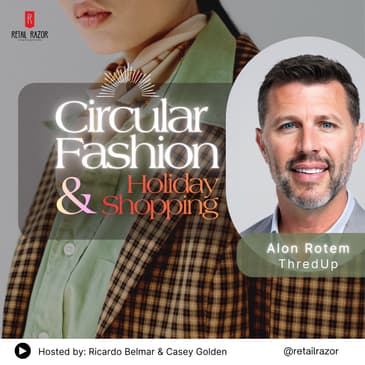



S5E11 ThredUp’s Resale Revolution: Holiday Shopping & Gift Giving Trends with Alon Rotem
The holidays are here and resale and circular fashion are at the center of this year’s shopping story! In this timely episode of The Retail Razor Show, Ricardo Belmar and Casey Golden sit down with Alon Rotem, Chief Strategy Officer at ThredUp, to unpack the company’s 2025 Holiday Shopping Report. From surprising insights on resale and circular fashion gift giving to how shoppers are embracing sustainable fashion and circular economy models, this conversation reveals why resale is becoming a mainstream holiday shopping strategy.
We also explore ThredUp’s evolution from a secondhand marketplace to a Resale as a Service (RaaS) leader, powering branded resale and circular fashion programs for fashion retailers. Alon shares how ThredUp’s AI-powered innovations — including image search, natural language search, and personalized curation — are transforming the secondhand shopping experience and driving conversion.
If you want to understand how resale and circular fashion, sustainability, and AI are reshaping holiday shopping in 2025, this episode delivers insights every retailer, brand, and shopper needs.
Subscribe to the Retail Razor Podcast Network: https://retailrazor.com/
Subscribe to our Newsletter: https://retailrazor.substack.com
Subscribe to our YouTube channel: https://bit.ly/RRShowYouTube
About our Guest
Alon Rotem, Chief Strategy Officer & General Counsel, ThredUp
Alon Rotem has served as ThredUp’s Chief Strategy Officer and General Counsel since September 2024. Alon has also served as Chief Legal Officer since February 2021 and Secretary since March 2017 and previously served as General Counsel from January 2017 to February 2021. From September 2013 to November 2016, Alon served as the General Counsel of Rocket Lawyer Inc., an online legal technology company. From June 2010 to August 2013, he was an associate at Goodwin Procter LLP, a global law firm. Alon holds a Juris Doctor from the University of California, Berkeley School of Law and a Bachelor of Science in Managerial Economics from the University of California, Davis.
ThredUp 2025 Holiday Report - https://newsroom.thredup.com/news/thredup-2025-holiday-report
ThredUp Resale-as-a-Service - https://www.raas.thredup.com
Chapters
00:00 Previews
01:13 Show Intro
04:51 Welcome, Alon Rotem - Chief Strategy Officer, ThredUp
08:38 ThredUp's Evolution and Resale as a Service
15:51 Implementing Resale and Circular Fashion Programs with ThredUp
21:31 Challenges and Successes of Going Public
25:36 AI Innovations in ThredUp's Shopping Experience
33:06 Insights from the Holiday Report
35:25 Consumer Behavior and Secondhand Gifts
36:24 Top Gifting Trends in Resale
39:49 The Role of Data in Resale
41:32 Consumer Funding for Holiday Shopping
47:21 Luxury vs. Mid-Market Resale
51:05 Sustainability and the Future of Fashion
55:11 Future Outlook 59:47 Show Close
Meet your hosts, helping you cut through the clutter in retail & retail tech:
Ricardo Belmar is an NRF Top Retail Voices for 2025 & a RETHINK Retail Top Retail Expert from 2021 – 2025. Thinkers 360 has named him a Top 10 Retail, & AGI Thought Leader, a Top 50 Management, Transformation, & Careers Thought Leader, a Top 100 Digital Transformation & Agentic AI Thought Leader, plus a Top Digital Voice for 2024 and 2025. He is an advisory council member at George Mason University’s Center for Retail Transformation, and the Retail Cloud Alliance. He was most recently the director partner marketing for retail & consumer goods in the Americas at Microsoft.
Casey Golden, is CEO of Luxlock, a RETHINK Retail Top Retail Expert from 2023 - 2025, and a Retail Cloud Allianceadvisory council member. Obsessed with the customer relationship between the brand and the consumer. After a career on the fashion and supply chain technology side of the business, now slaying franken-stacks and building retail tech! Currently, Casey is the North America Leader for Retail & Consumer Goods at CI&T.
Includes music provided by imunobeats.com, featuring Overclocked, and E-Motive from the album Beat Hype, written by Heston Mimms, published by Imuno.
Transcript
S5E11 Circular Fashion & Holiday Shopping
[00:00:00] Previews
[00:00:00]
[00:00:01] Casey Golden: Shoppers plan to put nearly 40% of their holiday budgets towards secondhand gifts. That's not a niche trend. That's a behavioral change.
[00:00:12] Ricardo Belmar: you had 47% of shoppers either planning or considering to sell their own stuff, to fund their holiday gifts. And maybe even more interesting that that number was 70% for millennials and 57% for Gen Z. How does this buy sell loop change how you think about customer relationships?
[00:00:28] Alon Rotem: By the way, when I share that story with other lawyers every lawyer is trying to get out of practicing law. So they're all like, well, how'd you do it?
[00:00:36] yes, there is value and, and you can find great deals, but I do think that there's a story component to, to all of this as well that's really driving it.
[00:00:44] We've processed, over 250 million items of clothing and we have a lot of information about what customers are searching across, again, 50,000 brands. What other company has that kind of data over the last 15 [00:01:00] years, that has a catalog of clothing that's anywhere from three months old to 30 or 40 years old. Brands start getting interested in the data
[00:01:08] So I would say value is Batman and sustainability is Robin.
[00:01:12] Ricardo Belmar: I like that.
[00:01:13] Show Intro
[00:01:13]
[00:01:24] Ricardo Belmar: Welcome to season five, episode 11 of The Retail Razor Show, the only retail podcast in the Top 10 All Time Indie Management podcast charts on Goodpods and the highest ranked retail podcast in the Top 100 Indie Marketing podcast charts on Goodpods.
[00:01:39] I'm Ricardo Belmar.
[00:01:40] Casey Golden: And I'm Casey Golden.
[00:01:42] Welcome retail Razor Fans to retail's favorite podcast where we cut through the clutter to give you sharp insights on what's happening in retail today, tomorrow and where we get real about what's driving the real future of retail.
[00:01:57] Ricardo Belmar: And today we've got a guest who's been at the [00:02:00] center of a pretty big shift in fashion, I would say, where shopping used to mean new and now it increasingly means secondhand. So we decided to go straight to the pioneers in this space, ThredUp.
[00:02:12] Casey Golden: ThredUp just dropped their 2025 Holiday Report and one line jumped out at us.
[00:02:17] Shoppers plan to put nearly 40% of their holiday budgets towards secondhand gifts. That's not a niche trend. That's a behavioral change.
[00:02:28] Ricardo Belmar: Yeah, so , we're talking about more than just bargains, right? , We'll dig into why people are choosing pre-owned goods for big, meaningful moments. Is it value, uniqueness, nostalgia, even a social signal, and why so many shoppers are selling their closets to fund holiday giving.
[00:02:44] Casey Golden: We'll also pull the curtain back on how ThredUp evolved from a resale marketplace to a platform that powers other brands' resale programs. Why they're leaning hard into AI and what lowering resale as [00:03:00] a service prices means for retailers who wanna get in on the game.
[00:03:06] Ricardo Belmar: Plus there's policy and real world friction. And how do laws, logistics, and consumer expectations need to change to make circular fashion more mainstream? And here's something to think about as you listen in to the episode. Looking ahead, will we still own most of our clothes in five years? More on that later on.
[00:03:23] Casey Golden: Our guest today is Alon Rotem, Chief Strategy Officer and General Counsel at ThredUp. He'll walk us through the company's journey, the holiday report, surprise takeaways and what all this means for retailers trying to compete in market that's suddenly getting very circular just in time for the holidays.
[00:03:43] Ricardo Belmar: So stick around if you're a retailer, brand leader, or just someone wondering what to buy. This episode just might change the way you think about holiday shopping and gifting. You know, we haven't done a holiday themed episode in a while, have we?
[00:03:55] Casey Golden: it is true. I think we opted out of a holiday theme last year, didn't we?
[00:03:59] Ricardo Belmar: Yeah, I think [00:04:00] so. I think that's right. So before we dive in, a quick favor from our audience. If you're enjoying the show, why not hit us with a five star rating and drop a short review on Apple Podcasts, Spotify, Goodpods, or wherever you're listening.
[00:04:11] Casey Golden: And don't forget to like and subscribe on YouTube, so you never miss an episode.
[00:04:17] Ricardo Belmar: Plus, be sure to check out the other shows in the Retail Razor Podcast Network, Retail Transformers, Data Blades, and Blade to Greatness.
[00:04:26] Casey Golden: And of course, you can find those in pretty much any podcast app including your favorite or on YouTube channel where you can watch all of it as well.
[00:04:36] Ricardo Belmar: Okay. With that said, let's get into it. Here's our deep dive into the resale market with Alon Rotem, Chief Strategy Officer of ThredUp.
[00:04:51] Welcome, Alon Rotem - Chief Strategy Officer, ThredUp
[00:04:51] Ricardo Belmar: Welcome Alon to The Retail Razor Show.
[00:04:53] Alon Rotem: Thank you for having me. Happy to be here.
[00:04:55] Casey Golden: We're thrilled to have you on the show. I'm really excited. We've been waiting to do a deep [00:05:00] dive episode on what's happening with resale in the fashion and apparel industry for a really long time. So excited for you to share the ThredUp story and talk about the holiday report you recently released.
[00:05:13] Alon Rotem: That sounds great. I've been waiting to talk to you guys too.
[00:05:16] Ricardo Belmar: Oh, that's great. That's great. So before we jump into everything, why don't you give us a quick rundown on your background to kick us off, how you got to your current role at ThredUp and what, what you've been doing before that?
[00:05:26] Alon Rotem: Sure. So I started off as a corporate lawyer worked in law firms for about seven years and then went in-house to an e-commerce company. And that company was mission-driven. It was trying to democratize access to legal services for consumers and, it was a great experience and I think what happens when you work at a mission-driven company is it sort of ruins you. 'cause when you are looking for the next role, it has to have a mission and it has to, serve like a, a greater purpose than just profits and growth, as you hear typically in, in in other roles. [00:06:00] And so, ThredUp was actually a client of mine back when I was at, in the law firm days.
[00:06:04] And when I was looking around for the next role the, the partner at the law firm that was still servicing ThredUp was like, Hey Alan, you need to go talk to James, who was our CEO. They've grown to the point where they're ready to start an in-house legal department.
[00:06:19] And you guys got along so well when you were back at the law firm, like maybe you'll hit it off. And so, James and I had lunch and it was really at the beginning of my of my sort of career journey. And so, I remember setting up the lunch I'll just give you advice on what you should be looking for in a lawyer. I was sort of playing coy about it and we had a good conversation and I was like, well, he should have this background.
[00:06:43] He or she should have this sort of background, but really I was talking about myself. And at the end of the lunch we kind of agreed, I'm gonna go talk to other companies and see if there's a good fit there. You should go talk to other lawyer candidates and see if there's a good fit there. And then if there isn't in a couple months let's get back together and, and go forward.[00:07:00]
[00:07:00] And that's actually what happened. So
[00:07:01] Ricardo Belmar: Oh, wow.
[00:07:02] Alon Rotem: we played the dating game. We, kissed a bunch of frogs and then at the end of the day decided to work together and it's been that was like nine years ago, so it's been a while. And even within ThredUp I've had a little bit of a journey there too, because I did start off really just standing up the legal department. And performing all those legal services in-house and running that show as we went public and everything. But over the course of that experience, I got really interested in the business side and every time there was an opportunity to, have an impact in a business role, I was raising my hand and credit to James because, I don't think I was necessarily very good at that stuff early on, but I, he really encouraged me to keep going.
[00:07:45] And then, and that sort of culminated in a title shift last year from Chief Legal Officer to Chief Strategy Officer.
[00:07:51] Ricardo Belmar: Well that's a real amazing, amazing journey.
[00:07:54] I'm glad to hear it.
[00:07:55] Casey Golden: into.
[00:07:55] Ricardo Belmar: know, right? Yeah,
[00:07:56] Casey Golden: But they say we always say like it's, it's an [00:08:00] accidental career.
[00:08:00] Ricardo Belmar: yeah, yeah.
[00:08:01] Alon Rotem: Yeah,
[00:08:01] Ricardo Belmar: Everybody, so many ends up in, in retail by accident in that, that sense so often.
[00:08:06] Alon Rotem: By the way, when I share that story with o with other lawyers every lawyer is trying to get out of practicing law. So they're all like, well, how'd you do it?
[00:08:14] Casey Golden: How'd you do it? How'd you do it?
[00:08:15] Ricardo Belmar: How'd you do it? Yeah. Tell me more. Tell me
[00:08:16] Alon Rotem: And yeah. And it's, I'm still in transition because 50% of my role is still legal, so I'm kind of like, I haven't shed that Caterpillar skin yet entirely.
[00:08:25] Ricardo Belmar: it's a work in progress.
[00:08:26] Alon Rotem: Yeah,
[00:08:27] Casey Golden: Well, at least, like all the strategy and like campaigns and all of that. Like it's already gone through legal
[00:08:33] Alon Rotem: right, exactly. I can fast
[00:08:34] Ricardo Belmar: Yeah. You can fast track yourself. Yeah. That's great.
[00:08:38] ThredUp's Evolution and Resale as a Service
[00:08:39] Ricardo Belmar: So let, let's talk a little bit more then about ThredUp's history now. So you, ThredUp started as a, a direct to consumer resale marketplace. And then expanding into what just before we recorded, we were talking about this amazingly brilliant move to go into resale as a service in a B2B capacity with other brands where you run the resale program for those brands.
[00:08:56] And if I'm remember from our previous conversation, that's a pretty significant [00:09:00]portion of the business now. So tell us how that shift happened and what kind of pushed you from, making that choice to go from just pure marketplace to more of a services company.
[00:09:09] Alon Rotem: Sure. Yeah, when I started at ThredUp at least we're an independent marketplace reselling 50,000 different brands. In some respect, like within the retail industry, it felt like it was ThredUp against the world, right? You have the brands over on this side, you had ThredUp over here. They were frustrated with, what we were doing. But as a company grows and matures and starts thinking about partnerships and how to integrate itself in, in ecosystem, we started having those conversations with retailers and brands and it became clear that there are, there were some natural points where our businesses could help each other. So, we're looking for more points of distribution for our clean out kits and brands and the retailers have lots of customers with closets full of clothes that, we really think should, should, be coming into ThredUp on a circular [00:10:00] basis. And because the business is built on consignment, there's economic value in each one of those items of clothing and there's room to share that economic value with the brand. That's how the partnership. Like thinking started and over time the like partnerships grew up and we decided to build like a real business around it. And that is what we coined the term resale as a service, I think back in 2017 or 2018. And from there it was all about this a couple things. One was the cleanup kit program where again, we could offer our services to the brand's customers and, and instead of just getting a cash consignment payout for ThredUp from the items that they sold online, we could really move that, that money into a gift card for the brand. So it became a loyalty program, which brands totally understand and fit into their strategy. And we really tried to develop it as like a win-win win where ThredUp was gonna get more supply, [00:11:00]the brand was gonna get funded. Gift cards that were, that would have UPS spend on the gift cards is really gonna drive their business forward. And the customer's happy because they've got space in their closet.
[00:11:11] They're loaded with a gift card to spend on a brand that they already have affinity to. And so we saw that model work. Now, beyond that, there were also the even more forward thinking brands that are like, Hey, resale is happening. We see the data, it's like clearly a trend that's not going away. And it's becoming a normal part, not just of the, of a consumer's closet, but really a wallet share. And so, the brands that were ready to actually stand up a resale shop quickly figured out it's, it's not that easy to do it internally 'cause they're just not set up to do it.
[00:11:46] And so when we saw that opportunity, we were like, oh, we can build this for you. It's really easy for us 'cause that's what we do all day, every day. And there was born like two sides of the resale as a service offering. We're constantly [00:12:00] working on other innovations to make it even more compelling and to really round out the services. But that's really kind of the, the way that we got started with, with the B2B program.
[00:12:09] Casey Golden: When I saw the press release I like out loud was like smart, smart, smart, smart, smart. Like, just like this is really smart. Because I've spent my side on let's say the fancier side of retail and, there's all of this talk and communication about being a more sustainable consumer.
[00:12:28] And I'd catch some flack and I'm like, listen, the resale market doesn't exist if nobody's buying full price.
[00:12:36] Ricardo Belmar: Right.
[00:12:37] Casey Golden: we're all fighting over 30-year-old clothes. If we don't get new stock in there, we need the closet cleanouts. We need customers to be buying full price. But we have to have the whole loop.
[00:12:49] Ricardo Belmar: Yeah.
[00:12:49] Casey Golden: If we don't have the whole
[00:12:50] Ricardo Belmar: It is a circle. Yeah.
[00:12:52] Casey Golden: is a problem, but I really feel like having a customer resell their product, get a gift card to go back to the [00:13:00] brand and buy new product really helps fuel an actual sustainable model.
[00:13:07] Ricardo Belmar: Yeah.
[00:13:08] Alon Rotem: Yeah, well obviously we, we totally agree with that. And even though we've had a lot of success with the resale as a service program, I think we still were a little bit frustrated with the scale of adoption on it.
[00:13:20] And so back in May, we did a strategy shift, even within resale as a service. And what we decided to do was, we looked at the program over the, over the past few years. We thought that we were gonna generate like meaningful fees from the program that were really gonna move the ThredUp overall business forward. And we were generating fees. And like the business was fine and, and, and profitable with within, within, ThredUp. But as we dug deeper, we realized like the real value is the supply, not the fees.
[00:13:50] Like the fees that the brands, give us, really don't move the needle the way scale on supply is gonna move the needle for ThredUp because ultimately we're this [00:14:00] large managed marketplace and any marketplace really survive.
[00:14:04] You gotta have demand. Sure. But it really, thrives on, abundant supply. And so we did away with the up the upfront monthly fees for brands to lower the barrier of adoption. Because what we want is, there's always a champion in a brand that's hey. We gotta do a resale program. These ThredUp guys or, or whatever other branded resale service company out there, can really help us dip our toes and get into, get into it and we can show them the ROI of how, how it's gonna build. But there's so many competing priorities inside of a brand that it's, they're, they're fighting up against another thing that, that somebody else wants to do internally. And so we thought to ourselves, why are we creating this, this fee barrier? Why don't we, just do away with it and make it really easy for the internal champion to sell the, the idea with really low risk. And we've really found a lot [00:15:00] of interest in that, that's created a lot of momentum and we're really excited about where this is gonna take, the resale as a service into next year and the next few years. And the other thing I'd say is it's a, it's something that only ThredUp can really do. It's a really unique ability and it's because we didn't stand up a branded resale company on its own. It's really leveraging the infrastructure, the scale, and the success of the managed marketplace that we have.
[00:15:27] Ricardo Belmar: Mm-hmm.
[00:15:29] Casey Golden: Yeah, I mean the infrastructure and, and workflows is really where you guys can win big. Where a lot of people have lost in the past. Right. It's complicated. It's always complicated. Retail's so fricking complicated. We're just trying to move laundry here. We're all schlepping laundry. I would think that it would be like, so, such a complex supply chain.
[00:15:51] Implementing Resale Programs with ThredUp
[00:15:51] Casey Golden: Can you walk us through a real example? If a brand wanted to launch resale with ThredUp, what does that look like day one and [00:16:00] then like in six months, because this isn't new for a lot of brands, maybe they haven't even heard of it. Or they've been thinking about it, but there's just okay, like I don't even know what type of resource I was I would need on my end.
[00:16:11] Ricardo Belmar: Right.
[00:16:12] Alon Rotem: Yep. So I agree with you that retail is complicated and resale might be even more
[00:16:18] Ricardo Belmar: More complicated.
[00:16:18] Yeah.
[00:16:19] Alon Rotem: We've invested, over $400 million over the last decade and a half in infrastructure to to build up and, and make it work. the good news I have to share with you, and I guess any brand that's listening is standing up a resale program with ThredUp is actually surprisingly easy. So the first, when we first start talking to a brand even before we get to signing a contract, there is a lot of education. So we're trying to teach the brand, like how ThredUp works the scale that we operate at, what our distribution centers look like all of that stuff. In terms of standing up the program after they decide, yes, I want, I want to get into, into this, I want to have this loyalty program, or I wanna have a, a resale [00:17:00] shop that's branded for, for me once we figure out really what opportunities the brand is trying to go after, it's so easy.
[00:17:07] Like in a matter of days, we can stand up a Clean Out Kit program. It, it mostly consists of a digital landing page that we can connect to their website. Where a customer would come, they would see the brand's imagery, they'd order the brand's clean out kit, and the customer experience would be a parallel, similar journey to what it is on ThredUp, they get a bag, they put all the clothes in, there's a prepaid label on it. They, they send it, they put it on their porch, or they send it off to UPS and like the work is done. Then the magic of ThredUp happens. All the, all the processing of the clothing, the listing of the items, the selling and the payout calculations. We all, we do that on, on the backend with ThredUp. And then we come back to the brand and, and tell them, here are all of the customers that sent in a bag. Here's what their payouts should be. We can connect this to your automated gift card program and automatically send out the gift cards [00:18:00] to the customer. Customer gets it, they're shopping and they're happy.
[00:18:03] So it's actually really simple.
[00:18:05] If the brand has physical stores, we create physical, clean out kits that are co-branded. They look really pretty. They have the brand's logo on them and they, they get put into the stores. And our client success team has like a training program. So we can teach your store associates how to talk about sustainability, how the program works.
[00:18:24] It's actually really nice 'cause a customer comes in, maybe they're looking for clothes, but like they, there can be like a non-sales, fund sustainability conversation they can have with the
[00:18:34] Ricardo Belmar: Right, right.
[00:18:36] Alon Rotem: And that's really all that, that's all it takes for that brand. So in a matter of days, they can get up and running, we have to print some, some physical, kits and we ship them to the, to the stores.
[00:18:45] But it's, it's really very simple. On the resale shop side, it's actually not that much harder either. Like we, we have, a product team that's already built out, like what these resale shops should look like. We need a lot of brand assets from the brands, but they have [00:19:00] those readily available. So the shop looks like true to the brand's aesthetic, but because we have, 5 million items for sale on ThredUp at any given time, we've already got thousands of items of, of the brand that we can cross list right into inventory.
[00:19:17] And then if the brand has excess inventory or things that they wanna sell, maybe Warren returns, they can list them directly. Or if they don't have anyone to do that, they can just ship it to us. We can process it and
[00:19:28] Ricardo Belmar: Hmm.
[00:19:28] Casey Golden: I.
[00:19:28] Ricardo Belmar: Oh yeah. Yeah.
[00:19:32] Alon Rotem: I mean, when you are a, ThredUp is a business that's like really been built on physical infrastructure. We touch things, like we
[00:19:40] Ricardo Belmar: Mm-hmm.
[00:19:40] Alon Rotem: all of these items in our, in our distribution centers when we're already built for that. It's just, it's not hard to turn it
[00:19:47] Ricardo Belmar: Yeah. Yeah.
[00:19:48] Alon Rotem: over to, to however the brand wants it to look. 'cause the backend is already there.
[00:19:52] Ricardo Belmar: Yeah,
[00:19:55] Casey Golden: Hindsight is, it's a natural progression. Right.[00:20:00]
[00:20:00] Alon Rotem: yeah,
[00:20:00] It's,
[00:20:01] and, and for us, we're excited about it and we invest in resale as a service because Ricardo, as you said, it's become a meaningful channel of
[00:20:09] Ricardo Belmar: Mm-hmm. Right. Yeah.
[00:20:11] Alon Rotem: and we get to pick and choose the brands that we work with.
[00:20:15] And, we're really interested in the closets of these brand, of these, of the customers, of these brands. So it's a symbiotic relationship and at the end of the day, especially with the way that we've changed our business model, the interests are really aligned. We just wanna help the brand scale this. We wanna help them lean in and they are going to make money doing this.
[00:20:36] Ricardo Belmar: Yeah. And it really, you're really not asking them for a heavy lift either, because you're, you're really taking on, the, the, what, what's I, I would think that the most challenging part for a brand who would be trying to do this is how are they gonna manage the inventory of the resale goods? Right. And you're basically taking that from them and just running it and they don't have to worry about it.
[00:20:54] Alon Rotem: They have better things to do, let us do it.
[00:20:56] Casey Golden: Yeah. I always say let the branches focus [00:21:00] on
[00:21:00] Ricardo Belmar: On what they know how to do.
[00:21:01] Casey Golden: and selling a dream. Just make, sell a dream.
[00:21:04] Alon Rotem: and Casey, if, as you asked me that question, it just reminds me like, ThredUps DNA is about convenience, right? Our cleanup kit is just about helping customers get stuff out of their closet and not have to work very hard doing it. So that ethos we, we, we feel that same way about our brand clients.
[00:21:23] Like we're, we know you have other things to do. You have your core business to run, let us help you do this and, and let us do the hard work.
[00:21:30] Casey Golden: I think it's great.
[00:21:31] Challenges and Successes of Going Public
[00:21:35] Casey Golden: They say going public changes everything. I. And then nobody talks about anything anymore.
[00:21:38] Alon Rotem: Yeah,
[00:21:40] Casey Golden: What were some of the toughest, toughest, like challenges you faced becoming a public company and how did that shape your strategy and how you look at the business today?
[00:21:53] Alon Rotem: sure. Yeah. I mean, I can tell you intimately, even from the legal side, 'cause when I joined ThredUp, I [00:22:00] remember, yeah, a long time ago it was like, oh, we need a lawyer. We're gonna go public in 18 months and we need to build out, our, our back, our back office in order to be able to do that. Well, that process did not take 18 months.
[00:22:12] It took like more than four years. And because we went public during COVID we we started it and we were like six months into the process and then like the, the world changed on us and we had to stop the process. And then when it became like more clear that like the world wasn't going to end and, and capital markets were gonna keep going, we had to do it again.
[00:22:34] So it really felt like we went public twice internally. And so that part was really interesting. But in terms of the era in when in which we went public, this was like the zero interest rate policy era where the c the, the investment community really just prioritized growth at all costs. At all costs.
[00:22:53] So we built a strategy entirely based on growth, as did many other companies that [00:23:00]went public with investor bases. Perfectly comfortable with, with these companies losing. Lots of money so long as there was a growth story. And so, even as we were going public, I remember our CEO kind of came to me and our CFO and was like, Hey, this is a growth story, so as soon as we get this money, we're gonna go acquire another business to build on the growth.
[00:23:20] So we ended up buying a European business called Remix that was essentially resale for Eastern Europe. And it was, it was a really interesting company, but it was an early stage company and also still very much figuring out its its way. And so, less than a year into being public, all of a sudden the sort of the, the. Investor appetite changed and now it was like profits at all costs not growth. And so it took, and when a company is built for a certain strategy, it's a, it's a little bit like an ocean liner when you tell it to take a hard left. And so learning how to, how to, figure out how to balance, balance the growth story with a profitability story was [00:24:00] hard.
[00:24:00] And, and I think we learned that the markets are, they are harsh, they are impatient, and, if, even if you just step track our stock price from back then, I think we opened, we went public at $14 a share and we grew from there. And, several years later, as we were, still hadn't figured out how to show profitability, we were below a dollar. And so, we, we had to make the hard choice to, to divest from the European business. And really revealed that the core US business was actually quite healthy, and that took a long time. And so, now we're on the other side of it and we're really excited about where we're at and we, we see investors really excited about resale, excited about ThredUp. And, but it's, it's been, an up and down story for sure. It's not been the linear process.
[00:24:52] Ricardo Belmar: Yeah. Well, I think it's a great, it's a great turnaround story
[00:24:55] Alon Rotem: Yeah, it is. And, and the, the positives of being a public company, I would [00:25:00] say are, it forces you to be extremely disciplined about investments. Right. And even as we plan, the next quarter or the next year or the next five years we're really, we're not just being thoughtful about where we want ThredUp to be on.
[00:25:15] Its, in the core business we have to really balance like incremental.
[00:25:19] Ricardo Belmar: Mm-hmm.
[00:25:20] Alon Rotem: Nonlinear growth from new vectors and it's, it makes us a better company ultimately.
[00:25:26] I think it's like pressure creates diamonds if it doesn't break you.
[00:25:31] Ricardo Belmar: Right. That's right, that's right.
[00:25:36] AI Innovations in ThredUp's Shopping Experience
[00:25:40] Ricardo Belmar: Well, since let's, let's dig into an investment as well, because it's, it's impossible these days to have a retail discussion without talking about ai. So from that perspective, I mean, you've made a, I would say, pretty, pretty heavily investment in AI tools, right?
[00:25:51] Whether it's around image search, natural language, visual search, the, the daily edit attribute tagging. You have AI generated model images, you know, all [00:26:00] all around, built around making discovery easier. So how, how does all of this tech investment around AI that, that you've done, really make shopping for secondhand items less frustrating, more fun? H how do
[00:26:12] you or how do all this really impact at the end of the day? Things like conversion and, and retention and, and new buyer acquisition.
[00:26:18] Alon Rotem: Yeah, I mean at, at ThredUp, I can just, I can share with you, we're extremely bullish on ai and I think early on our CEO kind of made it clear we were going to lean into this new technology. And I think it's because the problem you, you mentioned discovery, the problem that we face or the challenges we face in as being a resale company and selling 5 million snowflakes unique items, single SKU items in our marketplace are really well suited to to, to be enhanced by ai. And so, there's naturally, it's naturally harder to shop on, secondhand or thrift shop than it is to, to shop new. [00:27:00] There's much more variety in the items and, we, we start use, we started using this term internally at ThredUp called thrift overwhelm. Like it's really easy to get overwhelmed with how many things there are there for sale.
[00:27:13] And with AI capabilities, like you said on search, where it can be conversational the same way it is on ChatGPT or something like that. We're really able to help consumers find what they're looking for a lot easier. And it's more fun. Like I, when I'm at dinner parties, I like, I love showing off the image search where I'll just take a picture of somebody at dinner with their permission with their outfit and I go watch this and I'll show them on the app.
[00:27:39] And, we've got so many items that are similar. I'm like, this is how you can, how you can do it.
[00:27:44] And people are blown away by it. And, and that's exciting because at the end of the day, the, the idea here is for AI to help level the playing field
[00:27:54] between what it's like to shop secondhand and what it's like to shop new end.
[00:27:58] Casey Golden: Yeah, I mean, I [00:28:00] mean, I, I don't mind scrolling for, a while, especially when it's like resale. Like I'll scroll
[00:28:06] Alon Rotem: Well, that's good. I, I love that we have you as a, as a
[00:28:09] Casey Golden: I'll scroll. But it is also my biggest pet peeve and why I choose one over another. Because I feel you have two very distinctive customers. You have the people like me that knows what the print was in spring of 2006, Poochie.
[00:28:31] I know exactly the, what was spring design was, I know the print from resort. I know everything about a product that I'm looking for and I know what season it was. And that's where I get like the biggest pet peeves of I'm looking for d and g. I am not looking for Dolce Gabbana, they are not the same.
[00:28:52] Alon Rotem: Right.
[00:28:53] Casey Golden: Or if I'm looking for something that's pink, I don't want the brand that has pink in it. I'm looking for the color. Or [00:29:00] just that search, the sizing, things of that nature. You've got the really educated person that.
[00:29:07] Who plans for that, right? And then you've got the person that is just discovering everything, every brand, discovering their style. It's such a great way to try different things without making this huge upfront investment because we do go many, many years trying to discover what our style is. And this is a great way to play with different things.
[00:29:31] Learn about brands, discover brands you've never seen before, and you don't know what you're necessarily looking for. And how do you take somebody that wants something or to discover something and, and start with from zero, right? And really start from scratch and what are we teeing up for this consumer group?
[00:29:51] So I mean, search, I just feel such an important piece of reell with the skew counts and the brand counts. [00:30:00] How do
[00:30:00] Alon Rotem: I mean, you would have the, Casey, you would have the most fun conversation with our marketing team because they definitely think about our customer base in, in different personas.
[00:30:10] And we are trying to do, we are trying to serve each persona a little bit differently. So you're right for, for some people who know exactly what they're looking for, we just have to have amazing search so they could, so that the results are super relevant and frankly, that was a hard thing.
[00:30:26] A thing that wasn't even that great I would say a couple years ago. But we've really made leaps and bounds and, and AI has been at the center of that, of that improvement. I would say even beyond the ability to serve up relevant content for people that are searching for what they want. Really, the next phase is, is getting great at curation.
[00:30:45] Like our job is to show wonderful things that are personalized for our consumers. I think AI does a wonderful job of helping, supercharge personalization and if we're really playing at the highest level, we're [00:31:00] ultimately gonna be serving our customers things that they didn't even know they wanted, but when they see it, they're like,
[00:31:05] Ricardo Belmar: yep, I gotta have it. Yeah, yeah,
[00:31:06] Alon Rotem: I love,
[00:31:08] Ricardo Belmar: yeah.
[00:31:08] Casey Golden: you curate a Y2K collection for me, and I'll see you every week
[00:31:13] Alon Rotem: okay.
[00:31:14] Ricardo Belmar: There's the challenge.
[00:31:17] Casey Golden: because I'm actually finding more joy. Like I, I'm not happy with shopping today. Regardless of the spend, I'm not really inspired. I'm not impressed by a lot. I feel like a lot of stuff is not really merchandisable. I can't walk in and leave with an outfit or, pieces that all mix and match or everything just essentially looks the same.
[00:31:37] It's the same thing in every single store, and I'm not living the quality. So. I'm going backwards to a four, four year period in like the mid two thousands. When the contemporary industry became a contemporary industry and all of these contemporary brands launched because I'm like, amazing [00:32:00] fit, great style, great freaking quality, and everybody bought so much during that time period.
[00:32:08] Nobody wore anything twice. I mean, maybe they wore the jeans like five times, but we all had 40 pairs of jeans in our closet or a hundred, right? Everybody was buying a new pair of sevens or, and a top and all this stuff like every week. And so I'm just like, yeah, let's just, I just want the Y 2K stuff. Lemme, lemme filter through this stuff because I'm not inspired today on the full price racks.
[00:32:35] Alon Rotem: I feel like that stuff was built to last, too, a little bit better as well. Back then it was just more well constructed. And yeah, it's really it's actually interesting for me to hear your perspective on what you're unsatisfied with and, and, and what you, what sort of you, you long for and nostalgically.
[00:32:50] Casey Golden: Well, I find that it's just like I've made a lot of nostalgic purchases lately, and I think that that's very interesting because I wanted to go buy [00:33:00] something new for so long, and then when I could, I'm like, okay, I guess I'm buying something old.
[00:33:06] Insights from the Holiday Report
[00:33:06] Alon Rotem: Yeah. I mean, we're finding that even as we looked at our, at our holiday report that we just put out recently and we were paying attention to how much millennials are, are into it. I think part of that really is the nostalgia, like they're tapping into kind of an earlier era. And finding that resale is like a gateway to that nostalgia, and that's pretty cool, I think.
[00:33:30] Ricardo Belmar: Yeah, yeah. Well, let's dig in a little bit more into the, the holiday report, because there's, I think, some really fascinating insights that came out of that. I'll start with just a, a basic level thing where the I think the, the number one thing that came out of it is this notion that consumers in general are gonna, are looking to spend nearly 40% right.
[00:33:48] Of any other holiday budgets, on secondhand gifts which is a significant increase just from regular everyday shopping. So, did are, do you, are you finding that this is a, a unique, quirky seasonal [00:34:00] shift because of where things are at this year? Or do you think this is more of a systemic kind of change going forward that's gonna last?
[00:34:06] Alon Rotem: Yeah, it's a great question. I, I. I'll admit, I was surprised at how, at how great the numbers looked. We've been at this for 15 years and we've been part of the story of the de-stigmatization of, of secondhand and, and the rise of resale. But, historically, as we've gone, as we've gone through the fiscal years, we've always accepted the fact that in resale Q4 is not quite what it is for all the other retailers that like really get, get into the black and, and have these, great surges. And part of that I think was the, the status quo of the way the consumer mindset was. But I think also part of it was maybe even our own doing, because we would bring down our marketing spend, in Q4 because we just didn't find that, the, the juice was worth the squeeze. But I think as [00:35:00] the the long, long-term de-stigmatization has happened and we we're seeing it generationally that like younger consumers are more and more into it and it's become much more mainstream. I think that and now we're increasingly bullish on what holiday could be for resale and, it starts, it starts with the consumer surveys and the data.
[00:35:21] So, that's why we were super interested to find out this information.
[00:35:25] Consumer Behavior and Secondhand Gifts
[00:35:25] Alon Rotem: And I think, just going back to our conversation about nostalgia. I think that people are looking for stuff that evokes emotion. They're looking, Casey, you, you said this, even everything looks the same.
[00:35:38] They're looking for uniqueness. And then yes, we are also in, in, in a period of time where the consumer, at least the bottom 90% of consumers, if you will, are strapped for cash and resale offers a way to stretch the dollar in. And so you put all the confluence of all those things together and you're finding consumers [00:36:00] much more open-minded and, and interested in secondhand
[00:36:03] Casey Golden: Yeah. I find this very interesting. I could dig into this holiday report with a, a little pen and a few highlighters and, and keep you busy for a few hours.
[00:36:11] Alon Rotem: Color.
[00:36:13] Casey Golden: Yes, rainbow. I have the pastels.
[00:36:18] Alon Rotem: I believe you.
[00:36:22] Casey Golden: I've got a whole wall. I obviously like color.
[00:36:24] Top Gifting Trends in Resale
[00:36:24] Casey Golden: The report shows that like the top reasons shoppers turn to resale is better value, like 62% and, and unique finds like you mentioned. What are some of the, the top gifting lists? Are they like accessories and apparel? Is it, is it going back to like vintage? When someone buys like a secondhand G are they mostly hunty bargains or are they looking for kind of like a story?
[00:36:49] Alon Rotem: Yeah, it's a mix. I, I definitely, accessories are very popular as gifts. I think part of that also is because there's less of an issue with fit.
[00:36:59] you, know, you, [00:37:00] you can find vintage sunglasses and, and scarves and, and things like that really easily. But dresses are the number one category on ThredUp, and those are really popular as well. And even beyond ThredUp ,beyond apparel, you're, we're finding, yeah, like even trinkets and electronics that are vintage people love gifting. Those like electronic cameras that were super popular, 15, 20 years ago before the iPhone kind of took that over.
[00:37:26] So there, so I think that there, there, yes, there is value and, and you can find great deals, but I do think that there's a story component to, to all of this as well that's really driving it.
[00:37:38] Casey Golden: When I'd go through, I mean, I, I've, I just find, consumer behavior in general and, and why people pick certain things and, and where that intrinsic value is. Right? I've always loved jeans because you make so many memories in your jeans. So you'll hold onto jeans even if they don't fit for 15 years.
[00:37:54] Because like you went to this concert and you went to this, you went to that and you went to Europe for the first time. So many of [00:38:00] our clothes like can carry these memories. And I find it interesting when people are willing to part with something. 'cause I've been in closets and I've had to put it in a, a pile saying, prove it.
[00:38:13] This goes, this stays, it's getting hung up. Here's your pile that you, you need to fight for this and, and state your case. 'cause you can't have four, three drawers full of concert T-shirts not happening. This is my closet now. You need to make a pick. You need to pick. And you're gonna have to wear it.
[00:38:30] Alon Rotem: which of which of these children are my favorite?
[00:38:33] Casey Golden: Right, exactly. Which of these children are your favorite? You can't have them all. Um, and I think it's very interesting when you see this how. How people value things. The more I love it, the more expensive I list it. 'cause I really don't wanna get rid of it. But if you really wanna pay me enough, like it's yours.
[00:38:51] How should retailers and brands, are they using these signals that from you to, to merchandise and market and curate assortments? 'cause I assume like a [00:39:00] sell through through you could potentially signal like a recut or seeing how much people are selling these for a specific pair of overalls that I am searching for from like 1996.
[00:39:14] Alon Rotem: Yep.
[00:39:15] Casey Golden: They're everywhere for like over $400 and I'm like, oh my gosh, would they just remake them and I'll just go buy a pair because I think they cost me like $52 and that was expensive in 96.
[00:39:28] Alon Rotem: Yeah.
[00:39:29] Casey Golden: Like we're paying $400 for this, $800 for an old leather ja or denim jacket for 2003.
[00:39:36] Alon Rotem: Yeah, no, I mean, some, some brands are really interested in, in, in doing that specifically, they want to either build a capsule collection or do a vintage drop or something like that, and we can definitely help them do that.
[00:39:49] The Role of Data in Resale
[00:39:49] Alon Rotem: But beyond even the merchandising side, it's really about the data.
[00:39:53] We've processed, over 250 million items of clothing and we have a [00:40:00] lot of information about what customers are searching across, again, 50,000 brands. It's think about what other company has that kind of data over the last 15 years that, that has a catalog of clothing that's, anywhere from three months old to 30 or 40 years old and, and across the breadth of those brands. And so, brands start getting interested in the data and you
[00:40:22] Casey Golden: find that more
[00:40:22] Alon Rotem: through our research.
[00:40:23] Ricardo Belmar: Right. I mean, you must have ama amazing trend level data.
[00:40:26] Casey Golden: I'm more interested, I find that more interesting than Google, Google search history for the last 12 months
[00:40:32] Ricardo Belmar: Mm-hmm.
[00:40:33] Casey Golden: I'd rather look at the search history from ThredUp for the last 12 months.
[00:40:38] Alon Rotem: Yep,
[00:40:38] Ricardo Belmar: Yeah.
[00:40:39] Alon Rotem: yep. No, it's, it's fascinating and we have a whole data science team that like every day will put out a nugget to the broader company about did you know that, searches on this specific type of thing are, are way up? Or we're we're surprised that like in our supply chain, that there's such a demand on this specific thing.
[00:40:57] And then you ex extrapolate out, you understand the trends [00:41:00] that are happening,
[00:41:00] Ricardo Belmar: Yeah. Right,
[00:41:01] Alon Rotem: in the world and wonder head of merchandising that really connects the dots. The data and, the lived experience of of our customers.
[00:41:11] Ricardo Belmar: Yeah. No, that's really fascinating. 'cause you, you have a unique ability to look at that trend data over what, what items that going. You could go back 10 years right? And look at a 10 year period and say, what, what are you getting more search and interest for for things from one era versus another, which I would imagine is gonna be hugely valuable to designers and to brands to understand what, what they're doing.
[00:41:32] Consumer Funding for Holiday Shopping
[00:41:32] Ricardo Belmar: I want to ask you, or shift a little bit and ask a little back more to the whole state of the consumer that's surfaced from the, the data you have in the report, particularly around how shoppers are, are planning to fund their holiday shopping. 'Cause obviously this is one nature of, for, of your business is how people look at their closet and decide what do they want to put back into this circular resale world that they don't need anymore. And some of the data that stood out to me was that, you had 47% of shoppers either planning or considering to sell [00:42:00] their own stuff, essentially to fund their holiday gifts. And maybe even more interesting that that number was something like 70% for millennials and 57% for Gen Z. Who, who say they're likely to do that. So how do, how do you view that? I mean, how does this kind of, this buy sell loop change how you think about customer relationships? How does that impact, lifetime customer lifetime value, inventory dynamics and things like that for brands?
[00:42:24] Alon Rotem: Yeah. So for the, for customers increasingly willing to, to sell, in order to fund their holiday purchases, I would say that's probably a function of two things that we're observing. The first is the state of the consumer, right? Consumers are under a lot of pressure. Their wallets under a lot of pressure. We're in a tariff environment. Prices are way up on clothes. I think I read an article recently that said even, depending on the category, prices of clothing are up as much as 25%.
[00:42:55] Ricardo Belmar: Yeah.
[00:42:55] Alon Rotem: And so, the, the pressure is probably a factor in them, [00:43:00] like figuring out how they're gonna fund their holiday purchases, because at the end of the day, Americans love giving gifts.
[00:43:05] They're gonna keep spending. So how do we keep, how do we keep
[00:43:07] Ricardo Belmar: Mm-hmm.
[00:43:09] Alon Rotem: I think the other piece is how much easier it's gotten to sell things and, ThredUp is a part of that, but there's, there's lots of, marketplaces where people can get rid of stuff. And if they, if the consumer feels confident that they can turn to that marketplace and, and earn something for, for the items that they have, then it's like a, it, it's, it's like a positive flywheel and that, and that keeps going. And so I think that's what's happening. Millennials, you mentioned 70% of millennials being interested in doing that and maybe a smaller percentage, 57% of Gen ZI thought that was curious. So, when we dug on, in the data there, I think what we're observing is. Millennials have been through a downturn before they remember 2008.
[00:43:56] Ricardo Belmar: Hmm.
[00:43:56] Alon Rotem: They remember being strapped and I think they're probably [00:44:00] also a little bit more financially mature and more resourceful and, and they're, they've figured this thing out. Whereas I think that on the Gen Z side, they're, they're probably just more willing to buy, to, to spend less or buy cheaper things and find ways of saving it that way. But over time, I think as the Gen Z generation grows up, they're, they're gonna, close that gap and figure it out too.
[00:44:25] Casey Golden: So according, to your report, two thirds of shoppers are open to giving secondhand, which is a lot higher than I expected. But 80% with millennials, like that's significant,
[00:44:36] Ricardo Belmar: Yeah.
[00:44:37] Alon Rotem: It is significant. And, and again, I think here, this is where like the storytelling the
[00:44:41] Ricardo Belmar: Mm-hmm.
[00:44:43] Alon Rotem: Items that they're looking for that sort of like evoke memories, like you said at that concert they went to back in 2005 capsule collections. They just have a longer richer history of life and I think resale really opens the door to accessing that.
[00:44:59] Casey Golden: Yeah. We had [00:45:00] really good brand stories back then too, like the brand stories, like we were
[00:45:04] Ricardo Belmar: That's it too. There's more, there was more storytelling.
[00:45:07] Alon Rotem: Yeah. And, and I mean, you were, I wasn't even in the retail industry back then and you were, so I'm sure you have, more about this than I do.
[00:45:14] Casey Golden: brands were just ro so romancey to the consumer about the brand and how it's made and everything behind it. And yeah, and we, we were romanced I mean, I think, and it still stage, 20 years later, 10 years later, we're still like, have some of that nostalgia in the romance that they left us with.
[00:45:31] Alon Rotem: I need to have you on my podcast. I don't have one. If I had one i'd have on I'd want hear those stories.
[00:45:38] Ricardo Belmar: Well, think of all the, all the stories you could tell just based on the products you have and, and going back into so many different time periods and, and layers. I, I could, I could say that would be super interesting.
[00:45:49] Alon Rotem: Actually, we, we recently collaborated with Disney and we, and we had these capsule collections for all those popular shows like Boy Meets World and, and things like that. And, and yeah, that,
[00:45:59] Ricardo Belmar: You could make so [00:46:00] many interesting associations from cultural activity o of the time and, and what that meant to people and to Casey's point, right. What were the emotional connections that people associated with those items that whether they, apparel, accessories, you, you name it, I, I, there's some, so many different interesting stories I think to be told there.
[00:46:18] Alon Rotem: I, I mean, I came up and since we're talking music and concerts, and you see these guitars in the background of my, of my screen here, I came up like right at the intersection of. Hiphop,
[00:46:29] Ricardo Belmar: Uh huh.
[00:46:30] Alon Rotem: and boy bands like right there is
[00:46:33] Ricardo Belmar: Yeah, Yeah, yeah. Exactly.
[00:46:41] Casey Golden: Oh, I love it. So I've, if you haven't been able to tell already Alon, I, I come from like the luxury side of retail so Yeah,
[00:46:51] Ricardo Belmar: yeah. You may have noticed.
[00:46:52] Casey Golden: I've spent my career on the bougie side. So resale is really important to me. Because like I am a Bruno Cuccinelli [00:47:00] obsessed, and I have been for like most of my life once I found out what clothes were, like, really knew what clothes were. And so if it weren't for resale, I mean my closet would be really weak.
[00:47:12] And I think a lot of the, the companies over the last, couple decades that have tried to play in this resale space have all gone towards luxury.
[00:47:21] Luxury vs. Mid-Market Resale
[00:47:24] Casey Golden: You guys really made a hard stand on a larger brand assortment and mid-market. And how do you guys balance that? Like appetite between premium and luxury and the marketplace and resell and like that broader, like sustainability claims, right?
[00:47:41] And how, how, how do brands ensure. That authenticity and circular impact are, are visible to shoppers, right? I mean, I think we just had somebody go to prison for, what, seven years for buying designer and then returning it a fake to Nordstrom or [00:48:00] something. She did it 2, 300, 232 times.
[00:48:04] Ricardo Belmar: Hmm.
[00:48:04] Alon Rotem: Well, it wasn't an accident, in
[00:48:06] Casey Golden: yeah. No, it wasn't an accident.
[00:48:08] Ricardo Belmar: yeah, it was very planned.
[00:48:10] Casey Golden: But a lot of the luxury brands, they won't even touch authenticity, even if it's their own and they have cr rem showing that the customer bought it. They're just like, we just, we're just not touching it again. How do you, how do you reconcile that in your guys' own strategy and legal.
[00:48:26] Alon Rotem: Yes. Yeah. No, you're talking to the right person. No, I think it really comes down to prioritizing authentication and trust. With, with the consumer, particularly in the higher end goods. But you're right, the majority of ThredUp's business is really about that middle market. And we made that conscious decision a long time ago and, and it's a lot harder that the truth is, it's a lot harder because luxury items, they cost more, they have much more inherent value.
[00:48:56] And so it's easier for a resale company to find margin [00:49:00] in selling a product for $500 an item even if it's, even if it's secondhand. And so for us, really the key was building out like world-class never been done before, infrastructure to efficiently process at scale 50,000 brands. And so, we're, we're, we're processing like more than a hundred thou thousand items per day. And we've had to build to that. And, but once we did it, we knew we had built this really incredible moat around our
[00:49:31] business because who else wants to do that? Who else wants to invest 400 million item, or sorry, $400 million in three stories of carousels? This thing looks like Monsters Inc.
[00:49:43] Or like the Matrix, like on steroids or something. It's, it's really unbelievable what, what our,
[00:49:48] Ricardo Belmar: Yeah.
[00:49:50] Alon Rotem: I mean, hats off to our industrial engineers, that they've really built something special. And that's what, that's what enables us to process at scale.
[00:49:57] But to your question about luxury, [00:50:00] again, like it authentication matters and it matters not just to the brand, it matters to the consumer. These consumers that are coming to marketplaces and buying luxury items, expect them to be authentic. And so we have to make investments there as
[00:50:13] Casey Golden: Yeah.
[00:50:14] Alon Rotem: But I would also say that, when, when we talk about luxury and sustainability, oftentimes luxury items are among the best made items.
[00:50:23] They're built to last. They're built to be passed from generation to generation. And to me that's like a natural sustainability resale story.
[00:50:31] Casey Golden: Yeah, I always say that sustainability is built into the business. So I don't, everybody's like, why don't you have all these sustainability goals and dah, dah, dah. I'm like, it's by luxury. It's built in. I don't have to think about it.
[00:50:43] Alon Rotem: Fair.
[00:50:44] Casey Golden: There, there's no, there's there b birken bags aren't lined up, showing up on the beaches anywhere.
[00:50:50] And if they are like, oh, I haven't, I haven't found it.
[00:50:53] Alon Rotem: Yeah. Right. And by the way, like even from a. Even from like a policy standpoint, I think areas where [00:51:00] resale companies and luxury companies are standing on the same side of, of
[00:51:05] Sustainability and the Future of Fashion
[00:51:05] Alon Rotem: this like, of this battle is like we're looking at, the fast fashion world and the waste that's created and we're either giving products a second life or the, the luxury brands are building things to that are made to last. I think we both, we look at that as very symbiotic.
[00:51:21] Casey Golden: You're really active on the, on policy and coalition coalition work. How much of scaling resale is about changing the laws and infrastructure? I mean, to have you in strategy also with legal puts you in a very unique position that I can say like a lot of people in product are on the business side, leading strategy, don't have that background to pull in.
[00:51:51] 'Cause you're not just changing consumer habits.
[00:51:54] When it
[00:51:54] Alon Rotem: we're looking for the, we're looking for, governments and policy makers to, to pay attention and, [00:52:00] and support our movement.
[00:52:02] Ricardo Belmar: Mm-hmm.
[00:52:02] Alon Rotem: Yeah, on that front, what I would say is, when I came to ThredUp, I really, I understood the, the point of, how resale extends the life of clothing and keeps it out of landfills and really maximizes kind of the, the, the usable life of, of the garment. And it, it's, it's not hard to understand why that's good, but I don't think I really appreciated just how. Damaging, like the fashion industry is to the environment. And even once I realized it, I, I didn't see the fast fashion scourge coming either, where you had these companies that were just producing like incredible volumes of clothing extremely cheaply. And not really focusing on what happens with all that unsold merchandise or if it's built to be disposable. Like how does that impact our landfills and our environment? And, and really got a sense for kind of the, the like potential for destruction that, that an unchecked industry
[00:53:00] Ricardo Belmar: Is, is there and do you see a, a balance, like kind of one. Final thing I'm thinking of from the report that kinda relates to what you're, you're bringing up when you look at a balance between, are consumers shopping resale primarily as a value play because they're looking for that, that value.
[00:53:15] And, and I think even in, in the study you found it was some, somewhere around maybe it was 52% or, or people thinking they're getting more items for less money, which is where the value part comes in, or, or is there an equal part of sustainability that's driving the story behind that and, and, and the motivation for buying because people feel like they're engaging in a sustainability practice by doing this in addition to getting the values.
[00:53:36] Is it, is it evenly balanced in your mind, or is one outweigh the other?
[00:53:40] Alon Rotem: Ricardo, it's a great question because we, we think about it all day long at ThredUp and debate it all day long. 'cause it's not, it wasn't inherently obvious to us. So there's definitely, a faction that's it's all about value. And then there's like a, the, the DO-gooder faction, which pro I probably tend to like, started out in more was like, no, it's all about sustainability.
[00:53:58] This is our d [00:54:00] differentiator. The, the reality for us today, like as we've observed the consumer habits over the last, decade or so, is value really is king.
[00:54:09] Consumers are primarily looking for great value and resale is delivering that. But what I'd say is that the environmental or the sustainability side as like a secondary factor. It, it's not insignificant and it's a real di differentiator because there's lots of places that consumers can come and find value.
[00:54:27] They can find value at off price, they can find it, at a, in fast fashion they can find it in, in a, in a lot of different places. But the feel good sustainability side that resale brings to the, like the, the value, the values and value proposition is, is legitimate.
[00:54:45] And it, it does play a significant role. So I would say value is Batman and sustainability is Robin.
[00:54:53] Ricardo Belmar: I like that. Yeah, that's a good way to put it. That's a great way to put it. Because you real, it really is like this ideal team up that you have that, that [00:55:00] in some ways it increases the value, right?
[00:55:02] It, it, it sort of, it augments the value part of that equation. I think in a pretty, me in a meaningful way that, that makes people feel good about it.
[00:55:08] Yeah, I think that, I think that's great.
[00:55:11] Future Outlook
[00:55:11] Ricardo Belmar: So I, it maybe to close this out, let, let's look ahead a little bit. If we were to fast forward five years from now, do you picture people are owning fewer clothes, leaning into more, more rental subscriptions or other brand different kind of circular closets? Or are people still gonna be thinking in terms of ownership of these items first and everything else second? Where, where do you see ThredUp and, and your brand partners playing in that shape and, and, and how you're impacting fashion in general?
[00:55:37] Alon Rotem: Sure. I mean, I, I'll start by saying I love that there's lots of different models out there in the, in the industry between, what some of these companies are doing on rental and, and, and, others doing on managed marketplaces or peer-to-peer marketplaces. It's great that there's a variety, I feel kind of agnostic about the rental versus, ownership. Debate or question. What I'd say is [00:56:00]ultimately these closets are gonna be much more circular and there's gonna be like a dynamic velocity to them. So you could rent it and wear it and love it and, and send it back and get like your next kind of monthly shipment of, of things that are rented and wear them. Or you could buy them knowing that you don't have to keep them in your closet for, for 30 years because they don't bring you joy anymore. Or Casey as you put it is it, how did you say? Is it worth it? Or prove it?
[00:56:25] Ricardo Belmar: Prove it. Yeah.
[00:56:26] Alon Rotem: Yeah, prove it. Like, yeah. I mean, it's the, to me, it, it's two sides of the same coin.
[00:56:32] As long as the things that are in your closet are things that you love, things that you want to wear, and the things that are no longer in your closet are not just getting thrown out curbside, but but they're coming back to a resale market to find a second owner. To me, that's what's important.
[00:56:48] So circularity can take many forms as long as there's like a dynamic closet.
[00:56:54] Ricardo Belmar: Yeah, that's a great point.
[00:56:55] Casey Golden: Yeah.
[00:56:56] Alon Rotem: And I, the other thing, and, you mentioned is sort of like the future. What does the future look [00:57:00] like beyond just like what's in our closet? It's like, how are we finding the things? How are we getting inspiration for things that we wanna buy or end and put in our closet? And there, to me again, like we had that conversation about artificial intelligence and AI tools and how that's gonna change it. At the end of the day I, I would be so happy to come back to you five years from now and share that like most shopping journeys, like the discovery, the excitement, the in the inspiration, all of that starts at ThredUp. And who knows where it goes from there
[00:57:30] Ricardo Belmar: Yeah.
[00:57:31] Alon Rotem: That would
[00:57:32] Ricardo Belmar: Yep.
[00:57:33] Alon Rotem: one wish for.
[00:57:35] Ricardo Belmar: There you go. That's perfect. Yep.
[00:57:37] Casey Golden: Well, Alon, I have to say, I'm coming away from this like deep dive with a new admiration for the resale industry because I don't really dig into it too often, but I, I'm definitely a user consumer and mad respect for ThredUp. I mean, we all wanna do business with passionate operators and people who really care.
[00:57:57] And it, it's very obvious that you [00:58:00] care. And you have the support of the founders and the rest of the executive team to really be, spearheading not just the business objectives, but you know, policy and change. It's really about, the long tail strategy, not just short term wins. So, super impressed.
[00:58:18] Thank you so much for, for joining us today and, and digging in.
[00:58:23] Alon Rotem: Thank you for having me. This was fun and I appreciate you guys letting me tell the the ThredUp story.
[00:58:27] Ricardo Belmar: Yeah, this was a, a super fascinating discussion. I think there is, there's just so many interesting things that we, we can see just from your holiday report about what consumers are thinking how they're reacting and engaging in the resale market, and incorporating that into their overall holiday buying mix. I really think it's gonna be fascinating to see how the season plays out and, and what the future holds broadly, right, for ThredUp as you guys are doing such amazing things.
[00:58:52] Alon Rotem: We're obviously going to be paying attention as well.
[00:58:55] Ricardo Belmar: Yeah. Yep. So, so before we sign off Alon, [00:59:00] if, if any of our listeners wanna know more about ThredUp or the holiday report, or just wanna get in touch with you to understand how they can build a resale strategy with you, what's the best way for them to get in touch with you?
[00:59:09] Alon Rotem: The best way would be to go to our website RaaS.ThredUp.com, so that's r a a s period ThredUp.com. Or you can also send an email to raas@thredup.com. Either way hopefully we're not too hard to find and definitely would love to talk to, to you guys and also to brands if they're interested in doing something. Appreciate it.
[00:59:31] Ricardo Belmar: Yep. Excellent. We'll be sure to put that in the show notes as well.
[00:59:34] Alon Rotem: Thanks.
[00:59:35] Casey Golden: Thanks, Alon. It's been great having you here with us today.
[00:59:38] Ricardo, i'd say this episode is a wrap.
[00:59:47] Show Close
[00:59:47] Casey Golden: If you enjoyed today's episode, please give us a five star rating and review on Apple Podcast, Spotify, or Goodpods. And don't forget to hit that subscribe button on your favorite podcast player [01:00:00] or on YouTube so you never miss an episode.
[01:00:02] I'm Casey Golden.
[01:00:03] Ricardo Belmar: We'd love to hear from you. Follow us and share your feedback at Retail Razor on LinkedIn, Bluesky, Threads, and Instagram. You can also subscribe to our Substack newsletter for highlights from every episode, and visit retailrazor.com for transcripts and more details about all of our amazing guests. The Retail Razor Show is the original show in the Retail Razor Podcast Network.
[01:00:25] I'm Ricardo Belmar.
[01:00:26] Casey Golden: Thanks for joining us.
[01:00:27] Ricardo Belmar: Until next time, Stay Sharp. Stay Human. And Stay Ahead.
[01:00:31] This is The Retail Razor Show.
[01:00:33]