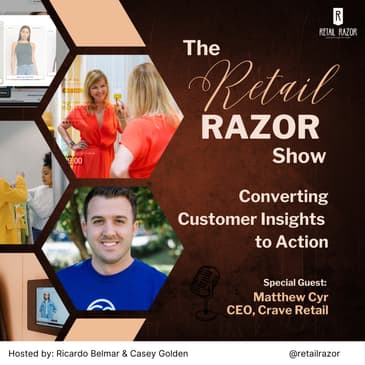


S4:E7 How Smart Fitting Rooms’ Data Insights Transform Store Operations & Shopper Conversion
Hosts Ricardo Belmar and Casey Golden dive into the transformative potential of smart fitting rooms in the fashion and apparel industry. Joined by Matthew Cyr, founder and CEO of Crave Retail, the discussion explores how digital fitting rooms enhance customer experience, boost conversion rates, and provide invaluable analytics that can revolutionize store operations and merchandising strategies. The episode emphasizes the importance of integrating technology with personalized service to create a seamless and satisfying shopping experience. Discover how retailers can leverage smart fitting rooms to gain deeper insights into customer behavior, optimize in-store performance, and ultimately drive revenue.
About Matthew Cyr & Crave Retail:
Matthew is a seasoned and three-time founder, CEO and co-founder of Crave Retail. Starting back with Abercrombie and Fitch and Skechers, he developed the commit to convert program that led Skechers expansion across southeast Asia, opening over 250 stores and optimizing in store experiences. Matthew has earned a 40 under 40 recognition from Retail Touch Points.
Crave Retail helps retailers elevate their stores by giving shoppers the best-in-class digital fitting room experience. Crave's proprietary fitting room technology and touchless experiences allow retailers to meet each customer's unique needs, access real-time insights into all customer activity, increase conversion, and improve customer satisfaction..
Subscribe to our Newsletter: https://retailrazor.substack.com
Subscribe to our YouTube channel: https://bit.ly/RRShowYouTube
00:00 Show Intro
03:31 Converting Customer Insights to Action Through Smart Fitting Rooms
06:40 Challenges and Benefits of Smart Fitting Rooms
10:37 Customer Journey: Enhancing the Fitting Room Experience
18:16 Impact on Retail Operations and Return Rates
20:36 Leveraging Data for Retail Success
23:55 Implementing Smart Fitting Room Technology
26:56 Importance of Executive Leadership in Retail Strategy
28:28 Engaging Store Operations for Smart Fitting Rooms
30:15 Understanding Store Performance Metrics
32:47 Leveraging Fitting Room Data for Business Insights
38:03 Enhancing Customer Experience with AI and Technology
47:43 Future of Smart Fitting Rooms in Retail
54:39 Show Close
Meet your hosts, helping you cut through the clutter in retail & retail tech:
Ricardo Belmar is an NRF Top Retail Voices for 2025 and a RETHINK Retail Top Retail Expert from 2021 – 2024. Thinkers 360has named him a Top 10 Retail Thought Leader, Top 50 Management Thought Leader, Top 100 Digital Transformation Thought Leader, and a Top Digital Voice for 2024. He is an advisory council member at George Mason University’s Center for Retail Transformation, and is the director partner marketing for retail & consumer goods at Microsoft.
Casey Golden, is the CEO of Luxlock, a RETHINK Retail Top Retail Expert for 2023 and 2024, and Retail Cloud Alliance advisory council member. Obsessed with the customer relationship between the brand and the consumer. After a career on the fashion and supply chain technology side of the business, now slaying franken-stacks and building retail tech!
Includes music provided by imunobeats.com, featuring Overclocked, and E-Motive from the album Beat Hype, written by Hestron Mimms, published by Imuno.
[00:00:07] You're listening to The Retail Razor Show, where your expert hosts and their guests cut through the clutter in retail and retail tech to shape the future of retail.
[00:00:20] Hello and welcome to Season 4, Episode 7 of The Retail Razor Show. I'm your host, Ricardo Belmar.
[00:00:26] And I'm your co-host, Kasey Golden.
[00:00:28] Welcome to Retail's favorite podcast where we cut through the clutter to give you sharp insights on the retail industry and commerce technology.
[00:00:37] It's a show for store operations leaders, marketing executives, customer experience officers, and everyone else in retail and retail tech alike.
[00:00:46] And in this episode, we're doing something we haven't done in a while.
[00:00:49] We're shining a light on the fashion and apparel world, specifically the store experience there.
[00:00:54] The most important location in any retail store is the fitting room.
[00:00:59] Tune in for an insightful discussion on the transformation potential of digital fitting rooms.
[00:01:04] Combining customer experience, retail performance, and the future innovations in retail technology.
[00:01:11] There's just so much to talk about with the fitting room experience and the impact it can have across the whole experience.
[00:01:17] We'll get into conversion rates, of course, but there's so much data that can be gleaned from how customers use or don't use the fitting room that most retailers are overlooking and just not taking advantage of.
[00:01:27] This is going to be such a valuable discussion for store operations leaders.
[00:01:30] How did we wait so long to record this one?
[00:01:33] Stores were closed for a couple of years.
[00:01:37] Just going back to a location was like a big deal.
[00:01:41] Now that we're in it, it's time to talk about the fitting room and reactivating it.
[00:01:45] So to dig deep into the fitting room experience, our guest today is Matthew Sear, founder and CEO of Crave Retail.
[00:01:53] Matthew is a seasoned and three-time founder whose journey began at just 13.
[00:01:58] Now he's the CEO and co-founder of Crave Retail.
[00:02:01] He brings an impressive track record in retail innovation, starting back with Abercrombie & Fitch and Skechers.
[00:02:06] He developed the Commit to Convert program that led Skechers' expansion across Southeast Asia, opening over 250 stores and optimizing in-store experiences.
[00:02:17] Before founding Crave, he worked in Austin's e-commerce tech space, partnering with some of the largest brands in the country there.
[00:02:23] Now Crave has become one of the fastest-growing private software companies in Texas, and he's earned a 40 under 40 recognition from retail touchpoints.
[00:02:32] 100%.
[00:02:32] Why don't we jump right into the conversation?
[00:02:35] Well, before we do that, a quick reminder to all our listeners to please give us a five-star rating and review on Apple Podcasts, Spotify, or GoodPods if you like our show and this episode.
[00:02:46] In fact, it even turns out that contrary to what some people might think, there's no limit to the number of five-star ratings a podcast can accumulate.
[00:02:56] Take that as a challenge.
[00:02:58] Yes, and even more surprising, there's no limit to the number of reviews your podcast can have either.
[00:03:04] No way, Ricardo.
[00:03:05] Yes, it's true.
[00:03:07] It's true.
[00:03:08] I thoroughly researched it.
[00:03:09] So no limit to anybody who would like to give us a great rating and a great review.
[00:03:14] We may even talk about it later.
[00:03:16] All right.
[00:03:16] So check us out on YouTube.
[00:03:18] Don't miss out.
[00:03:19] You can never forget our fabulous YouTube viewers.
[00:03:21] Yep.
[00:03:23] Are not to be missed.
[00:03:24] That's right.
[00:03:24] That's right.
[00:03:25] Remember to like this video and subscribe to the channel.
[00:03:28] So let's just get to the conversation.
[00:03:30] I thought you'd never ask.
[00:03:37] Welcome to the show, Matthew.
[00:03:39] Thank you for having me.
[00:03:40] We are excited to have you here today, especially since this is a topic we don't hear enough about in retail, I'd say.
[00:03:47] Right.
[00:03:48] Obviously, we'll get into the details around smart fitting rooms and the impact they can have.
[00:03:52] But what I'm really excited to be talking with you about is the additional impact and all the other things that this kind of technology enables around store operations and measuring that in-store customer experience that I think we don't normally think of in terms of the fitting room experience.
[00:04:07] So I think this is going to be a great conversation.
[00:04:10] I hope that we're going to learn a lot from you, Matthew, about how retailers can leverage the right technology to do so much more measurement and generate so much more excitement around their store experience.
[00:04:20] Absolutely.
[00:04:21] Looking forward to it.
[00:04:22] We're going to, as a business, this is what we wake up to every single day is video of technology, which is an interesting choice as a career move.
[00:04:31] But we really enjoy it.
[00:04:32] And hopefully everyone listening today will find value in the content.
[00:04:35] Sounds like there's a deeper story there on how you got into this in the first place.
[00:04:39] We might have to get into it.
[00:04:41] So, Matthew, let's start with some basics.
[00:04:44] Many people have an idea of what smart fitting room experiences might be, myself included.
[00:04:49] But times have changed and there may be a lot more misconceptions and curiosity around just what does it mean today?
[00:04:57] Maybe start off by telling us how smart fitting rooms work and explain what some of the bigger misconceptions about digital or smart fitting rooms are in retail.
[00:05:11] Yeah.
[00:05:12] Yeah.
[00:05:12] Well, look, I think a lot of people think smart fitting rooms is a thing.
[00:05:18] And it's not a thing.
[00:05:20] It's a strategy.
[00:05:21] It's a plan.
[00:05:22] Right.
[00:05:23] Right.
[00:05:24] It's a conscious decision to say we have to actually understand more about this area of our store.
[00:05:31] Right.
[00:05:32] There's so many parts of the store that we fully understand that we can track and we can measure.
[00:05:37] And yet when a shopper walks into the fitting room after traveling all the way to the store, they've made a decision to visit.
[00:05:44] They made a decision to try.
[00:05:46] They're hoping to buy.
[00:05:48] Right.
[00:05:48] And retailers have no idea what's happening.
[00:05:51] Right.
[00:05:51] And so I think a lot of people come to us saying, what's the screen look like?
[00:05:56] What is, you know, do you have a magic mirror, which I've got a lot of opinions on.
[00:06:01] Right.
[00:06:01] And the reality is I come up, what's your plan?
[00:06:04] Right.
[00:06:04] What are you trying to solve for?
[00:06:06] What do you want to understand?
[00:06:08] It's a smart fitting room.
[00:06:09] Right.
[00:06:09] The idea of smart is to be informed.
[00:06:12] Right.
[00:06:12] And so our goal is to help you understand more about this space, but it's to help you with your strategy.
[00:06:19] And so for us, it's really helping retailers see it's not just the customer engagement tool or a screen in a room.
[00:06:26] It's not something you can just magically throw into a room and sales will suddenly change.
[00:06:31] It's a strategy to really figure out those customers who are making a really high commitment to your brand.
[00:06:40] Matthew, let me ask you a question.
[00:06:41] Let's go in there.
[00:06:42] You said some interesting things about the strategy around this rather than just being a technology.
[00:06:47] So why do you think retailers are so hesitant to adopt this in the first place?
[00:06:52] What are some of the objections?
[00:06:54] What are some of the resistance points you hear from retailers when it comes to adopting a smart fitting room approach?
[00:07:00] Yeah.
[00:07:01] Yeah.
[00:07:01] No, it's a good question.
[00:07:02] I think for a lot of retailers, they don't want to fix something that doesn't appear broken.
[00:07:12] Right.
[00:07:12] And there's a lot of different things that are happening in the store that are easily measured.
[00:07:16] If you ask a retailer what their return rates are, they know exactly what it is.
[00:07:20] So if you're trying to find a solution for that, they understand exactly what that impact is going to be.
[00:07:26] They understand what's being bought at the registers and how much that's costing them.
[00:07:29] They understand labor.
[00:07:30] They understand fixture costs.
[00:07:32] They understand almost every part of their business.
[00:07:33] But if you go to a retailer and you say, what's the revenue coming from your fitting rooms?
[00:07:37] Everyone kind of looks at each other in points and says, I don't know.
[00:07:41] Do you know?
[00:07:42] Right.
[00:07:42] How many shoppers are going in there?
[00:07:44] What merchandise are people trying on?
[00:07:46] Are we actually servicing these customers really well?
[00:07:49] Nobody has an answer for it.
[00:07:51] I've seen retailers debate for six or seven months whether they should lock their doors or not lock their doors.
[00:07:57] I mean, you mentioned earlier about decision making being slow.
[00:08:00] It's because they have nothing to measure against.
[00:08:02] And so I think the real root of why some of the hesitancy comes is this is a space really unknown to a lot of people.
[00:08:09] And for some retailers, they're definitely bold and making risks, taking risks, which is great.
[00:08:14] But for a lot of retailers, they're just tackling the things they understand super well.
[00:08:19] And so I'll share this.
[00:08:22] A couple of our retailers recently, we've been able for the very first time to show them that 55% of their store revenue is generating from a shoppers who are visiting their fitting rooms.
[00:08:35] Wow.
[00:08:36] That's great.
[00:08:38] That's amazing.
[00:08:39] Now make a conscious decision to avoid that space.
[00:08:42] 55% of our revenue is coming from an area of the store that 9 out of 10 customers would say they hate experiencing.
[00:08:48] Right.
[00:08:49] That doesn't make any sense.
[00:08:50] You know, I firmly believe that the fitting room is the most important area in a physical store.
[00:08:58] Coming on from the luxury side, our fitting rooms are gorgeous.
[00:09:02] We have lounge chairs.
[00:09:04] We have bottles of bubbles.
[00:09:06] We spend hours in the fitting room.
[00:09:10] That's where the relationship happens.
[00:09:12] It's where the sale happens.
[00:09:14] It's where the fit happens.
[00:09:17] Yeah.
[00:09:18] And it is so incredibly important to know what is going in the fitting room and what is being sold out of the fitting room.
[00:09:27] And even when I worked at a store, I was very adamant that to have coverage on fitting rooms and get those people out of the fitting room, get them into conversations or just really help them like service the fitting rooms.
[00:09:44] It's the most important part.
[00:09:47] Get another size.
[00:09:48] Did something that fit.
[00:09:50] Really understand what products are always going into a fitting room and never being sold.
[00:09:56] There's it's an easy way to identify even just like a fit.
[00:10:01] Yeah.
[00:10:01] So from my experience on my retail experience, I have my own opinions on what are the benefits.
[00:10:10] But that's that's just a normal fitting room with no technology being serviced.
[00:10:14] What are the primary benefits of a smart fitting room for customers at the same time?
[00:10:22] Like how do they enhance the retailers operations and bottom line?
[00:10:25] I can only make assumptions because I have very limited physical experience with a smart fitting room.
[00:10:32] So what does this mean now for customers and for brand for retailers?
[00:10:37] Yeah.
[00:10:38] So let's let's put ourselves into character mode here.
[00:10:42] All right.
[00:10:43] Let's let's beat Katie.
[00:10:45] Katie is a 22 year old college student.
[00:10:50] She's going to plan tonight to go out with her friends.
[00:10:53] There's going to be some guys there, some girls there.
[00:10:55] They're all going to have a really good time.
[00:10:57] She's on her phone.
[00:10:58] She's looking around at something.
[00:10:59] She thinks they're super cute.
[00:11:01] But she realizes I don't really know if this is going to fit me.
[00:11:05] Right.
[00:11:05] I don't really know if this is my style.
[00:11:07] I'm going to go down to the store.
[00:11:08] So she gets into her car, makes a decision to go to the store.
[00:11:12] Right.
[00:11:13] What am I going to go to the store?
[00:11:15] It should be this easy purchase online.
[00:11:17] But I'm going there.
[00:11:18] And she walks in and she starts to go around and she sees that everything she was looking at online.
[00:11:24] Colors aren't installed.
[00:11:25] The sizes she needs isn't there.
[00:11:27] Right.
[00:11:27] The anxiety starts to build.
[00:11:29] But she finds frantically a couple of things and she says, OK, I'm going to go try these things on.
[00:11:33] And she sees a lot.
[00:11:34] Right.
[00:11:34] There's a lot at the fitting room because the doors are locked.
[00:11:37] And the anxiety of standing in a line knowing I'm about to go undress and a four by four foot cubicle starts to build where a bunch of other people are getting undressed.
[00:11:47] And it's weird.
[00:11:48] And then finally, you know, Bob comes over and says, here's the fitting room.
[00:11:52] Right.
[00:11:52] And walks you into the fitting room.
[00:11:54] And now you're like, gosh, I really don't want Bob.
[00:11:56] I'm knocking on my door to ask you how I'm doing in two minutes.
[00:12:00] And, you know, decision challenges start to fix her.
[00:12:04] Right.
[00:12:04] You know, I'm not sure if this really fits.
[00:12:07] It doesn't fit.
[00:12:08] The three items I just tried on don't fit.
[00:12:10] I see one that's kind of cute.
[00:12:11] Am I going to be able to afford it?
[00:12:13] Because it's the most expensive one.
[00:12:14] What's the price of this thing?
[00:12:15] What else goes well?
[00:12:16] The most expensive one always fits the price.
[00:12:21] And she says, OK, I'm just going to grab this one.
[00:12:24] I'm going to get out of here.
[00:12:25] That is not what we should be doing for our customers.
[00:12:28] No, that's not a great experience.
[00:12:30] It's 2024.
[00:12:31] That is not acceptable.
[00:12:33] So what it should be is Kate should show up to the store knowing that the colors and sizes that she was looking for are available.
[00:12:42] Right.
[00:12:43] And she shows up and maybe Bob is there.
[00:12:45] And Bob says, hey, I've got a fitting room ready for you.
[00:12:48] Here's here's an experience inside her room.
[00:12:50] Don't worry about me.
[00:12:51] If you need a different size, you need to check price, you need a different style of recommendation.
[00:12:56] Just go ahead and interact with the screen.
[00:12:58] I'll be available for you.
[00:13:00] I mean, she now feels comfortable.
[00:13:03] She feels at ease.
[00:13:05] It was completely frictionless.
[00:13:06] She gets exactly what she needs at her own, you know, time and her own way.
[00:13:12] The convenience that she wants.
[00:13:13] That is a recipe for a happy shopper for as long as you can imagine.
[00:13:20] Right.
[00:13:20] That is a sale.
[00:13:21] That is a customer who's going to go back and tell Lindsay and all of her friends, go to that store because that's a store that made it super easy for.
[00:13:28] So I think those are some of the biggest things that we really try to think about is, you know, get ourselves into that customer journey.
[00:13:35] And what does she really deserve when she visits a store in today's world?
[00:13:39] Yeah.
[00:13:40] I think that so many stores, their loss prevention tactics treat us, treat customers as like inherit thieves.
[00:13:49] And I just think that that we're not, that it's a wrong attitude to go with.
[00:13:53] Like a child that needs to be policed when trying to dress on because of theft rather than because the opportunity for service.
[00:14:04] It is supposed to be enjoyable.
[00:14:07] Standing in line for two hours at Zara is not enjoyable.
[00:14:11] Yeah.
[00:14:12] And it's not the lie to ever start at Zara.
[00:14:14] Right.
[00:14:15] The decision for you in New York started at home.
[00:14:18] Right.
[00:14:19] Before you even went to the store.
[00:14:20] You had to do your hair.
[00:14:22] You had to get into your car or taxi, whatever you did.
[00:14:26] You had to go to the store.
[00:14:27] You then had to get into the store, walk around.
[00:14:30] The fitting room is the last mile.
[00:14:32] You had to do everything else.
[00:14:34] It's the last mile.
[00:14:35] Yeah, it is.
[00:14:36] You have a customer that's ready to convert, has already had so much pain to be there.
[00:14:41] You're almost at the finish line at that register.
[00:14:45] And a lot of retailers fail.
[00:14:47] Yeah.
[00:14:48] Right there.
[00:14:49] Yeah.
[00:14:50] Because it's hard.
[00:14:52] Yeah.
[00:14:53] Absolutely.
[00:14:53] Can you describe for us, Matthew, what are some of the things that a customer can do in the fitting room when it's equipped this way that makes this experience better?
[00:15:02] You gave the example where the store search is telling you, if you need something, you can interact with the screen.
[00:15:06] Let me know.
[00:15:07] So what does that translate into for that experience for the customer?
[00:15:38] Yeah.
[00:15:40] So full privacy, very secure.
[00:15:42] And everything that you have in the fitting room appears kind of like an online cart.
[00:15:48] And maybe I'll talk about this a little bit later on, but I like to draw parallels to the online cart because that's what she's doing.
[00:15:54] She's getting ready to buy.
[00:15:55] And so she's in there.
[00:15:57] She sees that this doesn't fit well.
[00:16:00] We'll have real-time inventory of what's in store and online for the retailer's benefit.
[00:16:05] If she knows, if she has exactly what she wants and the products available online, don't make that hard for her.
[00:16:10] Allow her to see that and make that transaction.
[00:16:12] But she can request any item to be brought right to her.
[00:16:15] We also have, in our experience, an AI-style engine, which is really, really cool.
[00:16:21] If you ask me about it, I'll tell you about it.
[00:16:22] But I won't go into it here.
[00:16:25] But we can showcase to Casey, here are some cross-category items that go really well with what you're trying.
[00:16:33] This is a new product that just hid that matches your style.
[00:16:37] This is something that everyone's trying and buying for the retailer, back-end levers.
[00:16:42] This is an overstock item.
[00:16:44] Something we're trying to do.
[00:16:45] This is a high-priced item, right?
[00:16:47] We want to try to get those basket sizes up.
[00:16:49] So as a shopper, you get everything that you could imagine inside the fitting room.
[00:16:54] For some retailers, they've integrated in ratings and reviews.
[00:16:58] So to give some customers that extra layer of confidence, although I think if you're trying it on and it feels good, you should just buy it.
[00:17:05] We have Aladre Brand, who's put bra fitting videos inside the experience to help her understand how to fit and feel.
[00:17:12] So for us, we built a platform that allows the retailers to think about what's important for the shopper in the space and give them some of those experiences available while they're inside of a fitting room.
[00:17:25] The associates, they get to see everything in real time too, right?
[00:17:30] So they get to see these customer notifications.
[00:17:33] They get to see, like Casey just went into the fitting room and she's got $2,900 worth of items at Old Navy, right?
[00:17:41] That's 48 items.
[00:17:43] She's someone that should get a little extra luxury.
[00:17:45] I would recommend anybody going into a fitting room of 48 items.
[00:17:52] You're either going to get really great customer service or a loss prevention.
[00:17:56] Sorry.
[00:17:57] It's going to happen.
[00:17:59] That's really great.
[00:18:00] I'm glad to have some of that context of like real use case of what can I do?
[00:18:06] Because I think it really helps anybody, any of our audience who's listening to really understand the context of really what does it mean today?
[00:18:13] And how can I see that helping my business?
[00:18:15] I have to assume, but please tell me if I'm wrong.
[00:18:20] What's the correlation between smart fitting rooms and return rates?
[00:18:25] Do you feel that you are able to measure the impact of this is an opportunity to reduce return rates?
[00:18:33] Because online is incredibly high for most apparel companies.
[00:18:38] What are your thoughts?
[00:18:39] I mean, not a doubt in my mind that it impacts, right?
[00:18:43] But it's not about smart fitting rooms.
[00:18:45] It's just fitting rooms in general.
[00:18:47] Fitting rooms in general.
[00:18:49] You have an opportunity to make sure your customer is in the right.
[00:18:53] And if you don't give them that opportunity, then people are going to have the same level of return rates that you have online.
[00:19:00] That's why returns are such smaller in store versus online.
[00:19:04] Really interesting.
[00:19:05] We did a study once with one of our customers where we looked at all the highest convert, excuse me, the highest tried on items and lowest converting.
[00:19:14] And we compared it to the highest return rates.
[00:19:17] And it was a direct correlation.
[00:19:19] Okay.
[00:19:19] So imagine all the shoppers who would have traditionally came in for that style and left the store thinking they were a medium, but actually the style happened to run small.
[00:19:29] And you do the same size.
[00:19:30] Oh, yeah.
[00:19:31] Right.
[00:19:31] And that's a missed opportunity.
[00:19:33] So as a result of having, you know, smart fitting rooms, a strategy to know what's happening, you can start to understand these types of things.
[00:19:41] For example, we have a customer who a big portion of their stores, when they lost their first 20 stores, four to 5% foot traffic going into some of their fitting rooms.
[00:19:52] Other stores had 25 to 35% foot traffic going into fitting rooms.
[00:19:57] Return rates were a lot worse at these stores than these stores.
[00:20:01] They got these stores fitting room traffic up because they could now measure it, be it managed.
[00:20:07] Fit returns on those customers dropped 40%.
[00:20:10] I'd be very curious to see also if the difference between first time customers and repeat customers as well.
[00:20:18] You know, a lot of times a brand will change their fit or their fit models or things of that nature.
[00:20:25] Right.
[00:20:25] And did it just cause a huge issue?
[00:20:28] Right.
[00:20:28] With returns and are now repeat customers coming into their fitting room more often.
[00:20:33] I think that there's a lot of really interesting data here.
[00:20:36] I've always felt like fitting room data is one of the most where all the secrets lie for retail.
[00:20:43] I'll share one example for you on that.
[00:20:46] We had a customer where we did their study with and we were showing them this item was incredibly popular.
[00:20:54] But one half of their stores, conversion was higher on that item and the other half stores were lower.
[00:21:02] So they did some research.
[00:21:04] Turns out that they had two different supply facilities for the merchandise.
[00:21:09] And one design standard were off and the other one was good.
[00:21:14] And so what they did is they went right to the supply chain and said, you've got to fix this.
[00:21:19] It's a problem.
[00:21:21] That's great.
[00:21:22] You don't catch that type of data when you're looking at just what landed in your store and what sold.
[00:21:27] Right.
[00:21:28] What's trying on tells you a whole lot more about the whys that get really interesting.
[00:21:32] Maybe.
[00:21:33] Actually.
[00:21:34] Our video resolution.
[00:21:36] That's awesome.
[00:21:37] Yeah.
[00:21:37] And what retailers should be doing.
[00:21:39] Right.
[00:21:39] Yeah.
[00:21:40] Like I said, it's not a...
[00:21:42] I think the easiest thing to talk about and to think about is what's in the fitting room in terms of the customers seeing a screen and interacting with it.
[00:21:51] That's just a means to get the information that these merchandisers, these demand forecasting folks who are trying to make the best decisions to reach sustainability goals, right?
[00:22:07] To reach more margins, to limit residual inventory.
[00:22:17] And so, yeah.
[00:22:20] So, yeah.
[00:22:21] So, yeah.
[00:22:31] So, yeah.
[00:22:35] So, yeah.
[00:22:39] up that you did not have it stopped.
[00:22:41] Sorry, you actually did not sell.
[00:22:44] Right.
[00:22:44] You could have.
[00:22:45] Yeah.
[00:22:45] There was a lost opportunity there.
[00:22:47] You did in your store.
[00:22:49] Yep.
[00:22:49] That miss list is critical.
[00:22:53] And that miss list comes from the fitting room and it comes from that sales floor.
[00:22:57] And it's something that typically has not been able to be documented in a scalable way.
[00:23:02] You know, your top salespeople always know what you missed.
[00:23:06] And that's a great KPI.
[00:23:09] Yeah.
[00:23:09] Sure.
[00:23:10] Yeah.
[00:23:10] I think that speaks to what you said at the beginning here about how this is really about
[00:23:14] what's that store's operational strategy you're trying to solve for?
[00:23:19] Because you're right, you know, just from those examples, it's not just about having that
[00:23:23] technology in the fitting room to enhance experience.
[00:23:26] It's what's the retailer learning from this?
[00:23:28] What analytics are they gaining in the store that, actually, I'm going to go back to what
[00:23:32] you said earlier too about how comparing to that e-commerce experience where we have loads
[00:23:37] of analytics available.
[00:23:38] But not so much in the store because we lack the measurement tools.
[00:23:41] And that's a huge benefit here, I think, to the retailer is that level of analytics and
[00:23:46] intelligence that you're giving them based on what's coming in and out of the fitting
[00:23:50] room that's otherwise not measured.
[00:23:51] Yeah.
[00:23:53] Yeah.
[00:23:54] Yeah.
[00:23:54] Yeah.
[00:23:54] Yeah.
[00:23:55] Yeah.
[00:23:55] Look, if it's something you're exploring, I've got some customers who start off and they're
[00:24:00] instantly like, how does this compare against somebody else?
[00:24:05] And my response is, as a store nerd, it doesn't matter right now.
[00:24:09] What matters is that we understand, we get a baseline of what's happening in your stores
[00:24:15] first.
[00:24:16] I talked about this a little bit ago.
[00:24:17] Yeah.
[00:24:18] When a retailer launches, they start to learn everything that they never knew, right?
[00:24:22] And so if you're a low touch brand versus a high touch brand versus a medium touch brand,
[00:24:29] you're going to learn different things about what's happening in your store.
[00:24:32] You're going to learn that, you know, 5% foot traffic in this store, 25 over here.
[00:24:38] You might learn that in this store, you've got only one and a half items per video visit,
[00:24:45] right?
[00:24:45] Shoppers are bringing in only one and a half items while this other segment of your stores
[00:24:50] are bringing in seven, right?
[00:24:52] You might learn that these associates respond to requests faster or slower, right?
[00:24:56] All of these things present opportunities.
[00:24:59] The first objective is to get all of your stores performing equally consistent with the strategy
[00:25:08] your brand wants, right?
[00:25:10] I like to compare it to a foot traffic countering solution.
[00:25:12] You're not buying it for the counter.
[00:25:16] You're buying awareness for conversion, right?
[00:25:21] Now that I know how many people are coming into my store and when I can service them well,
[00:25:26] right?
[00:25:27] And once you have a whole bunch of stores that are all performing well at 35% conversion,
[00:25:32] you don't just turn the thing off, right?
[00:25:35] Because people change.
[00:25:37] We're humans.
[00:25:38] We make errors.
[00:25:39] There's turnover.
[00:25:40] There's pandemics.
[00:25:41] There's things that happen.
[00:25:42] We've got to continuously monitor this.
[00:25:45] I get really excited about the first few months with any customer because we get to finally
[00:25:51] understand their business and get them to level up consistent performance across all their
[00:25:57] stores.
[00:25:57] It's a fun journey with any retailer who understands what they're signing up for when they're buying
[00:26:03] smart fitting room technology.
[00:26:05] That's an interesting point.
[00:26:06] I want to get into a little more.
[00:26:07] So when you start working with a retailer and you're going down this implementation path,
[00:26:13] I imagine from what you just said, one of the challenges must be working with the retailer
[00:26:18] and understand what questions are they trying to answer?
[00:26:21] Because they haven't had the ability to answer these things.
[00:26:24] They probably haven't had the ability to even ask the question before.
[00:26:28] So is that one of the challenges?
[00:26:30] I would say maybe is that, for example, a top challenge you run into in a new implementation
[00:26:34] is getting the retailer to understand how can they use this information?
[00:26:38] How are they going to leverage this data?
[00:26:39] What questions can they ask?
[00:26:41] Or are there other things that you're running into that you would list as here are the challenges
[00:26:45] to getting something deployed?
[00:26:47] Yeah.
[00:26:48] Look, I think it's pretty simple, but it's sometimes hard to get a massive retailer to
[00:26:54] sign up for the program.
[00:26:56] It comes with education and creating a strategy at senior level leadership.
[00:27:00] Right.
[00:27:02] Why?
[00:27:03] You know, when you start to understand this is going to impact 50% of your store revenue,
[00:27:07] this shouldn't be a product manager decision.
[00:27:11] This should be the C-suite and we've got to get a grasp on 50% of our revenue.
[00:27:16] What are we going to do to make this successful?
[00:27:19] What do we think we're going to be solving for?
[00:27:21] How are we going to hold our stores accountable?
[00:27:23] Or how are we going to reward our stores?
[00:27:25] How are we going to attract this and make this a key part of our customer service moving forward?
[00:27:29] And I think that has to be a really critical part to onboarding because at the end of the
[00:27:35] day, all of this technology that enters into the store, it's going to be at the frontline
[00:27:40] staff's responsibility to make it successful.
[00:27:43] And they are being asked to do a million things and they're being asked to do all those things
[00:27:49] with less people.
[00:27:50] And if it's not super clear from you as a leader that this is important, this is why it's important,
[00:27:58] this is why it's important for them and their customers, then solutions, any technology
[00:28:03] solutions won't yield the full benefit that they've been designed to do.
[00:28:09] And so for us, we like to spend a lot of time in executive leadership strategy, getting them
[00:28:18] committed to a set of KPIs and really thinking about their store teams who are going to be
[00:28:23] responsible for embracing and embodying this new customer service.
[00:28:28] Matthew, who's the first person you try to reach out to and talk to at a retailer to see
[00:28:33] what their interest level is in implementing smart fitting rooms?
[00:28:38] Who's the first role that you reach out to?
[00:28:40] Typically somebody in store operations.
[00:28:43] I'd like to be a little bit because that's my upbringing, if you will.
[00:28:48] You know, I spent a lot of years at Evercombe opening stores and I spent a lot of years at
[00:28:52] Sketchers in stores.
[00:28:53] I built a whole program called Commit to Convert.
[00:28:56] That's, you know, Casey mentioned this earlier, like origin story years.
[00:28:59] I spent ridiculous amount of time traveling to hundreds of stores annually to help retailers
[00:29:09] understand what's happening in the Miller store.
[00:29:10] Right.
[00:29:11] And what that meant was me being there, talking to everybody, asking them questions.
[00:29:16] Are you guys doing what I said?
[00:29:17] And everyone would be like, yeah, of course we are.
[00:29:19] Right.
[00:29:19] Are you guys bringing extra items to every customer?
[00:29:21] Yeah, of course we are.
[00:29:22] And it just baffled me that we actually did not know anything.
[00:29:28] These are not sustainable goals.
[00:29:30] We have such strong emphasis to hit UPT goals, hit average basket size.
[00:29:36] That's the result.
[00:29:38] But we don't say, hey, here's all the things that you're doing well or wrong or opportunities
[00:29:44] for better trading in the middle of the store that can help you hit these metrics.
[00:29:47] We just say at the end of the quarter, you didn't do it.
[00:29:51] Right.
[00:29:51] That's not correct.
[00:29:52] Right.
[00:29:53] Continue to work harder.
[00:29:54] We have to apply methods and help these brands understand what's happening in the middle
[00:29:58] of the store.
[00:29:58] So that's kind of always got me energized is finally unlocking that middle of the store.
[00:30:05] Yeah.
[00:30:06] You're going to be best days.
[00:30:07] I know.
[00:30:08] I was going to say you're absolutely warming Casey's heart with those statements.
[00:30:11] That's it.
[00:30:13] Yeah.
[00:30:15] Here's another, I'll ask you this too, Matthew.
[00:30:18] From what you said so far, would you say that, you know what, you could measure the success
[00:30:22] of a store on how effectively customers are using fitting rooms?
[00:30:27] You know, in other words, if I say differently, if I have a store where I can measure and say,
[00:30:31] you know what, their fitting room is very busy versus a store where very few people,
[00:30:36] you kind of had an example to this earlier, right?
[00:30:38] A few people are using the fitting room.
[00:30:40] Is that a direct measure of success for a given store and a brand?
[00:30:45] I think it helps you identify opportunities, but it's not necessarily the only factor.
[00:30:56] There's a lot of things that happen in stores, right?
[00:30:58] You know, of course, I think fitting rooms are incredibly important, but if your fitting
[00:31:04] rooms are always busy, what matters is whether or not you're maintaining conversion.
[00:31:10] Through those busy moments.
[00:31:12] And if you don't know that that's happening, then you're missing out on a better customer
[00:31:16] experience, right?
[00:31:17] That means a lot of customers are going in there with the intent to buy and you're dropping
[00:31:21] the bull.
[00:31:22] So you've got an opportunity to say, oh, look, every Saturday between two and six conversion
[00:31:28] drops from 50% in the fitting rooms down to 25%.
[00:31:31] Maybe we should stop that with an extra person for four hours.
[00:31:35] And so you get to use that to build a strategy to create a successful experience that will maximize
[00:31:43] it.
[00:31:43] I think there was a recent report is like 61% of shoppers now are visiting stores to touch,
[00:31:49] feel, and try on things.
[00:31:50] Right.
[00:31:51] You can't drop the ball on that experience.
[00:31:53] If your stores are not having a lot of customers visiting fitting rooms, it's okay.
[00:31:59] Right.
[00:31:59] That means when they do conversion better be a 90%.
[00:32:03] They better be trying on 10 things, right?
[00:32:06] They better be having the world's best experience because you've got to maximize that customer.
[00:32:12] But if you realize that it's your Southeast market that is having really slow foot traffic
[00:32:20] and your Northeast market has on average 25% foot traffic, then you know something's wrong
[00:32:27] in this region, right?
[00:32:28] You might need to talk to the regional manager and say, hey, let's start identifying how we
[00:32:32] can do this.
[00:32:32] And now that we've got this technology, we can start to measure what type of impact that
[00:32:37] has.
[00:32:37] So yeah, I think having this type of technology starts to give you those insights to make sure
[00:32:43] your store is successful, but it's a part of the bigger picture.
[00:32:47] So let's say we've got all of this fitting room data now that a retailer is sitting on
[00:32:53] once they implement your solution.
[00:32:56] What are some of the things that, I mean, are they able to really understand like which
[00:33:01] stores are outperforming or underperforming that you're able to kind of tie back into
[00:33:07] that fitting room performance?
[00:33:09] What are some of these for that strategy?
[00:33:12] What are some of these like indicators actually mean to the overall business on that store level?
[00:33:17] Is there some visibility into that that you've seen with some of your customers?
[00:33:22] Yeah.
[00:33:23] Yeah.
[00:33:23] We've got a, we've got an athletic brand.
[00:33:26] It's been working with us since the beginning.
[00:33:27] I mean, they, they did a study once that helped them learn through people standing in the stores,
[00:33:36] doing this manual study that every time a shopper was assisted by a store team member
[00:33:43] that that customer would spend, excuse me, every time a shopper was assisted into the fitting
[00:33:49] rooms and supported by a team member of the store, they would spend about 20 to 25% more.
[00:33:55] Hmm.
[00:33:56] And so they had no idea at an individual store level, how they could possibly hold anybody
[00:34:01] accountable to this, but they knew that would be important.
[00:34:03] And that was, that was their use case for, and talking to us.
[00:34:07] I don't mean to speed up.
[00:34:09] This is not a sales.
[00:34:11] But it just is.
[00:34:13] That's what's cool about this is that that's where they call.
[00:34:15] They're like, Hey, look, we, we, we found this at a store level.
[00:34:19] We measured this at a couple of stores.
[00:34:21] We want to now create this behavior at a repeated basis.
[00:34:24] And so now their regional managers get to see how individual stores are supporting customers
[00:34:30] into favors.
[00:34:31] And they get to see that impact on sales and conversion.
[00:34:34] And then they get to see top performers, right?
[00:34:36] They can say, Hey, this week, such and such at this store helped us pay customers.
[00:34:41] Right.
[00:34:42] And they provided this level of great service and they get to reward and recognize those
[00:34:45] people.
[00:34:46] And in other opportunities, they get to see training, right?
[00:34:49] It's not to be brother, but it's a, it's an opportunity to, you know, as an ex-trainer,
[00:34:55] the thing I hated most was to go into a sales meeting with a hundred store managers and give
[00:35:00] them all the same steel.
[00:35:02] It was a waste of time for half of them based off of different skill sets or qualities they
[00:35:06] have.
[00:35:06] So now I can say, all right, let's pull a group together.
[00:35:10] And for you guys, we're going to talk about fitting room customer service.
[00:35:13] And for this group, we're going to focus on visual merchandising, right?
[00:35:18] It can start to be separated.
[00:35:19] And so at an individual store level, they get to really pinpoint these out.
[00:35:23] And I think that's, that is the challenge.
[00:35:26] Some of these brands with like hundreds of stores, they often take, and I don't blame them.
[00:35:32] This is not a, I think at that, they take broad strokes approach sometimes to strategies
[00:35:37] because how can you possibly look at everything on an individual store level?
[00:35:41] But if we could start surfacing that up to district managers and giving them things to
[00:35:46] prioritize, right?
[00:35:48] You talk about having to do a million things, that level of prioritization now is more essential.
[00:35:54] And for us, it's heavy.
[00:35:55] Don't worry about these seven stores.
[00:35:57] They're great.
[00:35:58] These four stores, they need a little bit of TLC.
[00:36:01] Why don't you give them a ring?
[00:36:03] They seem to be missing a hundred percent of their requests.
[00:36:05] I don't know what's going on, but you got to give them a ring.
[00:36:09] And that helps them.
[00:36:10] That helps them prioritize their day up that, that if that has an impact on 50% of their individual
[00:36:15] store revenue, they're going to lead into that.
[00:36:17] And I think everyone finds value by surfacing up that individual store information.
[00:36:21] Yeah.
[00:36:22] Yeah.
[00:36:22] Yeah.
[00:36:22] I think this is a big portion of in-store training and really understanding how you are creating
[00:36:29] those positions and supporting those associates.
[00:36:32] You know, when you covered fitting rooms, a lot of times there was just like this excitement
[00:36:37] that you are on fitting rooms because it's fun.
[00:36:39] But then that also meant you were in charge of go-backs, which is terrible.
[00:36:44] I don't want go-backs, right?
[00:36:46] It's a social spot in the back.
[00:36:48] It is a social spot in the back, right?
[00:36:50] If you structure it that way and don't put them on the little island, if these are your
[00:36:54] go-backs.
[00:36:54] If you do a great job in the fitting rooms and the product sells, then there's no go-backs.
[00:37:00] Yeah.
[00:37:01] Yeah.
[00:37:02] Yeah.
[00:37:03] But with these like smart fitting rooms, you know, taking lessons from our past, it was
[00:37:10] make the fitting room smart and then fire everybody from fitting rooms.
[00:37:16] And you'd have to wait, you know, sometimes 10 minutes to find somebody to let you into
[00:37:21] a fitting room because it was just impossible to find a sales associate because they replaced
[00:37:27] people for technology.
[00:37:29] And that's just a recipe for a disaster.
[00:37:32] I think we've seen that in the past with some other types of companies out there that went
[00:37:37] to make them smart and they become unmanned and nobody managed them at all to the point
[00:37:44] where you couldn't even get into a fitting room.
[00:37:46] And a lot of this conversation has been about, it's not just about the fitting rooms as much
[00:37:53] as it is about augmenting the associate to customer interactions, which I think that's
[00:38:00] all the magic of the fitting room.
[00:38:04] How does knowing what products customers are trying on or need, how does that help the sales
[00:38:10] associates just better serve them?
[00:38:12] That this isn't a this versus that it's like them together is, is that magic?
[00:38:19] Yeah.
[00:38:20] Well, I'll take what you said and feel back the others a little bit further.
[00:38:25] Some of these retailers, it's not that they made the choice for technology first.
[00:38:29] And then that happened.
[00:38:31] They can't staff their stores like they used to.
[00:38:35] Right.
[00:38:36] They have to, they're being forced to reduce labor coverage.
[00:38:41] And so you have these store team members who are really challenged, provide this service
[00:38:47] expectation that they aspire to.
[00:38:51] Frontline people are amazing.
[00:38:53] They love, a lot of, they love their jobs.
[00:38:56] They love providing really great experiences.
[00:38:58] They're not in retail for no reason.
[00:39:00] They love what they're doing.
[00:39:01] And so when you have to go tell somebody, Hey, by the way, you no longer can staff your fitting
[00:39:07] work.
[00:39:07] We no longer can have you back there.
[00:39:09] The first thing that comes to their mind is when, who's going to help them?
[00:39:13] I propose to help them.
[00:39:15] Well, sorry, but we have to run a two person floor.
[00:39:17] One's on the register and you're out front greeting.
[00:39:20] So when you get to come in and say, Hey, Jenny, don't worry about it.
[00:39:24] We've got a solution where you can be anywhere in the store and still be able to service those
[00:39:31] customers when they're in those buying decisions, they feel supported, right?
[00:39:35] They feel more empowered, right?
[00:39:37] When you go into a luxury brand and you say, Hey, look, I know you're probably doing a lot
[00:39:43] more today than you used to, because we've got one less person or whatever it might be.
[00:39:48] I've got 20 different technology solutions you're supposed to be doing today, right?
[00:39:53] Here's something that's going to give you full visibility of everything that Casey's trying
[00:39:57] on right now.
[00:39:59] And by the way, we're going to give you some tips of some things that might go well with
[00:40:03] what she's trying on.
[00:40:04] We're going to let you know that she's trying on a couple of things that nobody ever buys
[00:40:07] well together.
[00:40:08] All right.
[00:40:09] We're going to, we're going to let her know that you're available and she can call you
[00:40:13] at any time she needs, but we're going to stop you from going over to walking all the
[00:40:20] way over there just to go and find a size that's not actually in stock to then walk all the
[00:40:26] way back over to sell the person.
[00:40:28] I don't have your thing at stock and waste three different trips.
[00:40:32] We're going to save you and everybody time, right?
[00:40:35] Because we're going to tell you, Jenny, that by the way, Casey's looking for something.
[00:40:39] You got three in stock.
[00:40:40] It's over there.
[00:40:41] If you go grab that, you know, she's going to be super happy.
[00:40:43] It's a win-win for everybody.
[00:40:45] The associates feel like they're saving time.
[00:40:48] The associates feel like they're getting supported and they feel like the engagements
[00:40:53] that they're having are higher value.
[00:40:55] A lot of these smaller questions that people ask for, they're not, technology can answer
[00:41:02] them.
[00:41:02] But when it comes down to styling and purchasing and really connecting, you want to get those
[00:41:08] associates there with them when they're in those moments.
[00:41:11] And I think technology has a really great way to bring those two people together.
[00:41:15] So on that point, you mentioned earlier, really briefly, you know, some of the AI based capability
[00:41:21] you have to give you some of those style recommendations.
[00:41:23] How is that playing into that interaction with the store associated as a factor?
[00:41:28] Is that being seen as something helpful?
[00:41:30] Is that being seen as really beneficial to increase basket size or to just generally make
[00:41:35] that experience better for the customer?
[00:41:37] Yeah.
[00:41:38] Yeah.
[00:41:38] So I'm going to talk about this for a little bit because I think it's, I'll try to be
[00:41:42] very kind of, but I would say it's really unique when you go into a store with technology,
[00:41:47] right?
[00:41:47] A lot of systems are completely disparate and they're not connecting or not talking, right?
[00:41:53] And e-commerce, they're all connected.
[00:41:55] So when you build out an outfit engine online, you get to have all these connected solutions
[00:42:02] and watching the customer click and visit pages and go about their journey.
[00:42:06] And it allows you to build out a profile.
[00:42:09] Sometimes this is mirrored by a merchandiser who's aggregated some things together.
[00:42:14] But in a store, you don't have any of that.
[00:42:18] And what's really unique and what we built with our AI style engine is we're capturing what's
[00:42:24] available in store, inventory, pricing, overstocks, understocks, what's on sale, not on sale,
[00:42:32] sales.
[00:42:32] We have all the customer interaction data.
[00:42:34] We know what people are trying on together and we know what they're leaving behind.
[00:42:39] So we already can tell Ricardo, hey, look, you're trying on a pair of shorts right now.
[00:42:44] That's not going to go well with that shirt.
[00:42:46] Maybe.
[00:42:47] But we know that 95% of men who try those two things on together did not buy other things together.
[00:42:53] We're going to say, hey, this is the thing that you should buy.
[00:42:56] We're not going to tell you the stock doesn't go well.
[00:42:58] We'll let you buy it if you really want it.
[00:42:59] If you get your own style.
[00:43:00] Stop them.
[00:43:02] Stop them.
[00:43:02] Stop them.
[00:43:03] Don't let them.
[00:43:04] No, no, no, no.
[00:43:06] Yeah.
[00:43:08] Yeah.
[00:43:08] And so now you get to do that with the associates.
[00:43:11] Mm-hmm.
[00:43:11] Right.
[00:43:13] Turnover is happening.
[00:43:14] Again, it's all about personalization and convenience, if you will.
[00:43:19] Mm-hmm.
[00:43:19] We can do anything to give them a nudge to say, hey, there's a shopper in there.
[00:43:25] Here's a couple of things that will go well with their outfit, as opposed to go ahead and knock on the door and say, hey, Casey, what do you need in there?
[00:43:33] I don't need any.
[00:43:33] I want you to get away from me.
[00:43:34] That's what I really do need.
[00:43:36] I want you to do things, but I don't want you to ask me, well, I'm changing.
[00:43:40] Right.
[00:43:40] So now we get to do that with the Asimcia, and absolutely.
[00:43:43] Right?
[00:43:43] Because now you take it, we track this.
[00:43:45] So this is something we track, units for fitting room visit.
[00:43:48] Right?
[00:43:49] And so we get to see, hey, as a result of this style engine, we're increasing the units per fitting room visit, which is allowing you to sell more on an average basket size.
[00:44:00] A lot of these retailers, even if their shoppers are going in with two items or six items, the merchandise level conversion is the same.
[00:44:09] So if you can do anything to get more shoppers trying to get them eight, they're still likely to buy four.
[00:44:16] If they're only going in with two, they're going to buy one.
[00:44:20] Yeah.
[00:44:20] So anything that can influence how many things that they're trying on and the right things, not anything, but the right things.
[00:44:28] It's we've seen anywhere between a 10 to 40% increase in basket size.
[00:44:32] Okay.
[00:44:32] Yeah.
[00:44:33] Okay.
[00:44:33] And when you're, if you're the customer seeing these kind of recommendations and things in the fitting room is, is there a associate that's also seeing that these things are being presented to me so that they're kind of have that awareness?
[00:44:44] So that if I look at that and I'm the customer and say, oh, you know what?
[00:44:47] I want to try this.
[00:44:48] They automatically know that that's something I'm interested in.
[00:44:51] Yeah.
[00:44:51] They get the notification right on their phone.
[00:44:53] So it's giving them real time information on everybody.
[00:44:57] Yeah.
[00:44:57] Okay.
[00:44:58] Excellent.
[00:44:59] So it really does augment that experience in that way, make it easier for the associate to help them.
[00:45:03] A hundred percent.
[00:45:04] I mean, anytime anyone ever says, oh, this is going to get in the way of the associate, it's going to be a hundred percent not.
[00:45:10] It's going to give your associates the right things to do at the right time in a way that's going to drive conversion in the happier customer.
[00:45:17] Right.
[00:45:18] Save them from knocking on doors when people are just about to take their pants off.
[00:45:22] Right.
[00:45:23] Save them from saying the wrong thing.
[00:45:25] Just make it easier for everybody.
[00:45:27] And you actually create more.
[00:45:28] Yeah.
[00:45:29] People are requesting more service because you made it easier.
[00:45:33] Right.
[00:45:33] We're at 24.
[00:45:35] Right.
[00:45:35] It's not early 2000 where that was the only option you had.
[00:45:39] Today, we're all used to work phones.
[00:45:41] Yeah.
[00:45:41] We're all used to not talking to people as much.
[00:45:44] But you put a screen in somebody's face that says, request all these things.
[00:45:48] People are in there.
[00:45:49] Ding, ding, ding, ding, ding.
[00:45:50] You know, making requests.
[00:45:51] It's not overboard.
[00:45:52] It's not going to work.
[00:45:53] But it is creating more engagements than less.
[00:45:58] And this is how you move product.
[00:46:01] Exactly.
[00:46:02] You work with customers to buy the product.
[00:46:04] To get the more product.
[00:46:05] Yeah.
[00:46:05] Yeah.
[00:46:06] You don't get the returns.
[00:46:07] You don't get the gobacks.
[00:46:08] You get the right product, the right time for the right customer.
[00:46:11] And they walk out with the bag and they only come back with a purse the next time.
[00:46:16] Right.
[00:46:16] Yeah.
[00:46:16] Not the bag crumbled up, ready to do a return.
[00:46:19] It's the beauty.
[00:46:20] And I'd like to say this is like a significant part of the art of retail.
[00:46:24] It is a service fitting room experience.
[00:46:27] It's trying products on.
[00:46:29] You know, I always say that, you know, buying and shopping is very different.
[00:46:33] Buying means I need to go buy this and I'm going to go buy it.
[00:46:37] And it's a task oriented purchase where a lot of shopping is.
[00:46:42] I don't know what I like.
[00:46:43] I know what I don't like.
[00:46:45] I feel like I want something like this, but I haven't tried it on.
[00:46:49] I love color.
[00:46:51] I don't buy it.
[00:46:52] I try it on and I just can't do it.
[00:46:55] I buy white and beige and cream and every shade of gray and navy, you know, but I try.
[00:47:03] But I go in that fitting room to try something and to explore and see if I like a new style,
[00:47:10] if it fits good for a new brand.
[00:47:13] You know, how bad would you acquire me?
[00:47:19] Ignoring me and leaving me alone and making me do all the work is not a great way to acquire
[00:47:24] a new customer.
[00:47:25] And I think that these are all really great points, Matthew.
[00:47:28] Congratulations on what you've been doing and, you know, from one founder to another,
[00:47:33] just keep fighting the good fight.
[00:47:37] We've got one last question for you, Matthew.
[00:47:39] Maybe put you on the spot a little bit here.
[00:47:41] Let's fast forward a little bit.
[00:47:43] I'd say five years from now, where do you see the opportunity for smart fitting rooms
[00:47:47] in that overall store experience?
[00:47:49] Well, one, say something, maybe an unpopular comment is I don't want the technology in the
[00:47:58] room to be more complicated.
[00:48:02] Let the shopper go in there, try their things on, get what they need and get out and move
[00:48:08] on with their day.
[00:48:10] However, I mentioned this earlier.
[00:48:13] I like to draw parallels to the online cart, right?
[00:48:16] The online cart is when you get to learn about Casey.
[00:48:21] We get to learn about price sensitivity.
[00:48:23] We get to learn about style, when she makes purchases.
[00:48:27] The cart is when you're preparing for that.
[00:48:28] So you learn that she puts a bunch of things in the cart and she makes a decision when a
[00:48:31] promotion comes around, right?
[00:48:34] And as a result of having a connected cart, you get to plug in a marketing solution that
[00:48:40] starts to say, hey, Casey, come back.
[00:48:43] I've got your item in stock.
[00:48:45] And it says, hey, Casey, by the way, the thing that you bought last week was it's back
[00:48:51] in stock, a new style, right?
[00:48:53] And you get to plug in an outfit engine into that and you get to optimize conversion, right?
[00:49:00] You get to optimize SMS messaging into that for communication.
[00:49:03] You get to take all that and put it into emails and say, hey, by the way, these are the things
[00:49:08] they drive.
[00:49:08] 70, 80% of retail still happens in stores.
[00:49:12] The biggest, best buying decisions, most loyal customers are in your fitting rooms.
[00:49:17] And you have none of that happening today.
[00:49:19] That has to be a part of where this goes.
[00:49:23] You have to get smart fitting rooms to allow yourselves to really connect and understand
[00:49:28] your customers and use that data upstream.
[00:49:31] And so I really, I really believe that that is going to be a big part of making there.
[00:49:37] There's, you've got to get the technology in there so you then can use it to advance how
[00:49:43] you engage, personalize the journey for your customers.
[00:49:46] Like I said, demand forecasting and merchandising, huge, right?
[00:49:51] You've got to know everything that's going in and out of that.
[00:49:54] You've got to know why it's been left behind.
[00:49:57] You've got to use that data to be smarter about the merchandise that's in your stores
[00:50:01] to be able to plan for that.
[00:50:02] I'll give you an example.
[00:50:04] I'm in suburban Austin, okay?
[00:50:07] I'm your typical dad bod, if you will, right?
[00:50:12] But if you go to a, if you go to Banana Republic where I live, right?
[00:50:18] Or you go downtown where my cousin James is a V-cup bachelor, right?
[00:50:24] We're going to dress differently.
[00:50:27] But a lot of these brands, they don't have the ability to buy store, set up styles for
[00:50:34] the bachelor James or dad Matthew over here.
[00:50:38] And so what I think is this bidding room technology can start to allow more granular planning and
[00:50:44] merchandising at an individual store level.
[00:50:46] So when I walk into the store, I'm not seeing the same thing James is seeing because I'm dressing
[00:50:52] differently than him.
[00:50:53] And the way you capture that is you start to learn about style preferences.
[00:50:59] If you look at a cart, you might be able to measure some of that.
[00:51:02] But what's going into a fitting room, that's everything I thought I wanted, right?
[00:51:07] That is my style.
[00:51:08] That is me showing you.
[00:51:09] But now you collect that over the course of six months and you really know what are the
[00:51:14] styles of people, the typical sizes of folks in your stores, the demographics of your folks
[00:51:19] in stores.
[00:51:20] You can use that to have better planning.
[00:51:22] And if people care about turnover, if people care about margins, if people care about people
[00:51:26] coming back to the store because they have the right product, then that has to be a part
[00:51:30] of how you're planning and merchandising your stores in the future.
[00:51:33] So I think like the fitting room technology, there's some really cool things we can do with
[00:51:37] personalization.
[00:51:38] Knowing that Casey's in there instantly and making it accessible for her to see her online
[00:51:45] cart and show her recommendations and share with friends and make it a destination where
[00:51:50] Casey can go with her friends and shop and try things out and explore.
[00:51:53] I think influencers having better fitting room spaces to showcase what they're trying on
[00:51:58] and fitting and doing is something really special.
[00:52:01] It will become a part of the future.
[00:52:03] But to really move the needle in retail, we got to be better merchants, which means we've
[00:52:08] got to be better at knowing our stores, how you use that data to influence planning,
[00:52:13] merchandising, demand forecasting.
[00:52:15] It's not easy.
[00:52:16] It's going to take us time.
[00:52:18] It could happen today, but fast forward four or five years, we're using more of these granular
[00:52:24] customer interactions to make better decisions about the merchandise that's in our stores.
[00:52:29] Yeah.
[00:52:30] Well, Matthew, this has been an incredibly illuminating discussion.
[00:52:33] I think really appreciate it.
[00:52:35] There's so much more to thinking that this would just be about smart fitting rooms was not
[00:52:39] the way to look at the conversation.
[00:52:41] It really, to your point, just comes down to how well you're measuring the overall experience
[00:52:47] in the store that customers have and how you're reacting to that operation in your business,
[00:52:52] whether it's impacting how you merchandise things, how your associates interact with customers,
[00:52:57] how they improve that interaction.
[00:52:59] I think it was fascinating to see how you can anchor all of those things around what you could
[00:53:04] measure and learn from that fitting room experience with the right technology in a way that retailers
[00:53:09] couldn't do before, whereas so much knowledge is kind of lost there in a black hole that you can
[00:53:14] surface now with this kind of augmentation.
[00:53:17] I think that really is an amazing way to kind of leverage technology in a positive way for that
[00:53:22] store experience.
[00:53:23] Well, thank you both for having me on.
[00:53:25] It's a real pleasure and certainly a privilege.
[00:53:28] You guys have some amazing folks on your show.
[00:53:30] I was really grateful to...
[00:53:31] I'm all happy to have you added to the list of, you know, just really great retail technologists, merchants,
[00:53:39] just really helping under, you know, helping our audience and brands and really understand like
[00:53:44] what is going on in technology right now?
[00:53:47] What does it mean?
[00:53:48] This was great context of what smart fitting rooms look like today.
[00:53:53] And glad we could really dig into what's to come in physical stores as they become more digitally enabled,
[00:53:59] because we have a lot of preconceived notions of what that might be.
[00:54:04] But this is really how we dig into what's it going to mean to the business?
[00:54:09] Do I need to move this forward, deploy more resources?
[00:54:12] Do we need to adjust our priorities of what we're deploying in our stores to really come in together
[00:54:18] for that customer experience?
[00:54:19] I believe every customer deserves the experience that you're helping retailers provide.
[00:54:25] I think it's great.
[00:54:26] So thank you so much.
[00:54:28] And thank you for joining us today and digging in with us.
[00:54:33] Thank you.
[00:54:34] Thank you, Russ.
[00:54:34] I appreciate it.
[00:54:36] Well, Ricardo, I think I'd say this episode is a wrap.
[00:54:38] Yes, it is.
[00:54:45] If you enjoyed our show, please consider giving us a five-star rating and review on Apple Podcasts,
[00:54:51] Spotify, or GoodPods.
[00:54:52] Remember to smash that subscribe button in your favorite podcast player or like and subscribe
[00:54:57] to our channel on YouTube so you don't miss a minute.
[00:55:01] A big thank you to our amazing GoodPods listeners for helping us consistently stay in the top
[00:55:07] three spots of the indie management and indie marketing chops.
[00:55:12] Thank you.
[00:55:12] I'm your co-host, Kasey Golden.
[00:55:14] Please connect with us and share your feedback on LinkedIn, Threads, Facebook, Instagram,
[00:55:19] and now Blue Sky.
[00:55:20] And if you want to preview the best highlights from each episode right in your email inbox,
[00:55:24] subscribe to our Substack newsletter for full episode transcripts and bonus content.
[00:55:29] I'm your host, Ricardo Belmar.
[00:55:31] Thanks for joining us.
[00:55:32] Until next time, keep cutting through the clutter and stay sharp.
[00:55:35] This is The Retail Razor Show.
[00:55:37] We'll see you next time.
[00:55:38] Bye-bye.
[00:55:38] Bye.