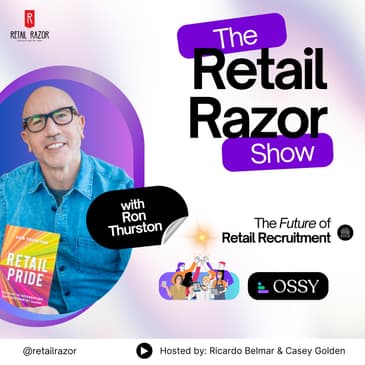



S4:E3 Revolutionizing Retail Hiring: A Conversation with Ron Thurston
In this episode of the Retail Razor Show, hosts Ricardo Belmar and Casey Golden welcome back Ron Thurston, founder of OSSY, and author of 'Retail Pride’, to discuss the company's innovative approach to transforming the retail hiring process. Focusing on the integration of AI and the human touch, Ron shares insights into how OSSY is addressing common retail recruitment challenges, such as speed to hire, candidate experience, and the importance of clear career paths. The discussion highlights the broader implications for the retail industry and the immense value of creating supportive and accountable hiring practices. This episode is a must-listen for anyone involved in retail and retail hiring.
00:00 Show Intro
02:35 Revolutionizing Retail Recruitment with Ron Thurston and OSSY
04:07 Ron Thurston's Journey and OSSY's Mission
08:58 Challenges and Innovations in Retail Hiring
22:01 Best Practices for Retail Hiring and Career Development
27:23 The Influence of People on Your Success
28:02 Accidental Careers in Retail
28:58 The Importance of Mentorship and Leadership
30:41 Preparing for the Holiday Season
37:02 The Role of AI in Retail Hiring
42:21 Building a Retail Community
46:38 How to Get Started with OSSY
47:51 Show Close
Meet your hosts, helping you cut through the clutter in retail & retail tech:
Ricardo Belmar, a RETHINK Retail Top Retail Expert for 2024, 2023, 2022 & 2021, RIS News Top Movers and Shakers in Retail for 2021, advisory council member at George Mason University’s Center for Retail Transformation, and director partner marketing for retail & consumer goods at Microsoft.
Casey Golden, CEO of Luxlock, RETHINK Retail Top Retail Expert for 2024 and 2023, and Retail Cloud Alliance advisory council member. Obsessed with the customer relationship between the brand and the consumer. After a career on the fashion and supply chain technology side of the business, now slaying franken-stacks and building retail tech!
Includes music provided by imunobeats.com, featuring Overclocked, and E-Motive from the album Beat Hype, written by Hestron Mimms, published by Imuno.
Follow The Retail Razor Show on Social
LinkedIn: https://bit.ly/LI-RRazor
Twitter: https://bit.ly/TwRRazor
Facebook: https://bit.ly/TRRSface
Instagram: https://bit.ly/TRRSinsta
Threads: https://bit.ly/TRRSthreads
BlueSky: https://bit.ly/TRRSbsky
Host → Ricardo Belmar
Follow on Twitter - https://bit.ly/twRBelmar
Connect on LinkedIn - https://bit.ly/LIRBelmar
Co-host → Casey Golden
Follow on Twitter - https://bit.ly/twCasey
Connect on LinkedIn - https://bit.ly/LICasey
[00:00:00] Hello and welcome to Season 4, Episode 3 of The Retail Razor Show. I'm your host, Ricardo Belmar. And I'm your co-host, Casey Golden. Welcome to Retail's favorite podcast where we cut through the clutter to give you sharp insights on the retail industry and commerce technology.
[00:00:37] It's the show for e-commerce specialists, store operations leaders, and everyone else in retail and retail tech-alike. Well, Casey, so far this season, admittedly, we've been off to a bit of a slow start.
[00:00:49] Yes, so far this season it has been a little bit slow, but I know we've had fans of the show asking us when we were getting back on the mic and here we are. That's right, here we are. We are fully back in the flow now.
[00:01:03] We're getting so many great topics and guests lined up for the rest of the season. It's going to be the best one yet. And today we are here with a fantastic episode for everyone, keeping with our theme this
[00:01:14] season of unlocking retail with the integration of AI, humans, and media. This episode, we focus our attention on the human part of that retail equation by tackling an area that's so easy to overlook in retail. That's right, Ricardo.
[00:01:28] Today we're asking a question we first visited last season in episode five. How do we change how we hire, connect, and match retail brands to retail workers respectfully, transparently, and humanly? And specifically, how can technology help?
[00:01:44] Yeah, so last season we had one of our favorite retail transformers, Ron Thurston, on the show. And he introduced us to what was then going to be a soon-to-launch tech startup solution he founded, Aussie. Specifically to solve this challenge.
[00:01:57] At the end of that episode we agreed that once Aussie launched and was running full steam, we'd have to bring Ron back to hear not only how the launch went, but what kind of impact is Aussie having with that solution?
[00:02:09] Plus, we'll want to talk about how this impacts the entire career development process for retail workers and learn how retail executives may finally be changing their perspective on this whole equation. 100%. I know I've been waiting for this discussion for some time now.
[00:02:24] Let's not wait any longer and get right to the main event. Let's join our discussion with Ron Thurston, founder of Aussie, and hear how Aussie is disrupting the hiring process in retail. Today's guest is no stranger to the show.
[00:02:44] With this episode marking his 10th appearance, someone who truly is known as the voice of retail and retail frontline workers, certainly one of my personal favorites and a huge friend of the show. That's right.
[00:02:57] It's always a pleasure to bring on our good friend Ron Thurston, best-selling author of Retail Pride, host of the Retail America podcast, an industry speaker, advisor, board member, multi-year re-think retail, top retail expert, and most recently, disrupting how the retail industry hires, engages, and connects retail workers with
[00:03:17] retail brands and technology providers as the co-founder of Retail Tech Startup, Aussie, which we learned about in Ron's last appearance on the show. Ron, welcome once again. Thank you. Thanks, Ricardo. Hi, Casey. I'm really happy to be. 10 appearances is, I think it's a record. It's a record.
[00:03:36] I think it must be. You have to get like a special plaque or something to commemorate the 10th appearance. I like it. I like it. It's nice to be asked back always. I have a feeling that you have no shortage of invitations.
[00:03:52] And I also host my own show, which you may know called Frontline Friday. That's right. It's live on LinkedIn and is also a podcast and a YouTube channel. So I love talking about everything, retail, frontline, throw it at me. I'm ready. Awesome.
[00:04:07] Well, Ron, last season, you were on the podcast with us, one of our retail transformers, where we talked about and previewed what you're doing with Aussie. For listeners and viewers who may not have tuned in yet and need a refresher,
[00:04:24] why don't you give us a quick summary of what brought you to this moment and joining us on the retail tech side of the business and launching Aussie? Great. Thanks so much, Casey. I'll just take a step back as if we didn't speak about it. Quick intro.
[00:04:41] So part of my experience leading retail brands for three-plus decades and writing retail pride, going on tour, you know, the country for 14 months. I just did a keynote called 14 Months, 31 States, Hundreds of Retail Success Stories. And I just can't get enough about this industry.
[00:05:04] And most importantly, the people that do the most important work, which are those that are standing in front of the customer. And I believe so strongly in this as a future skill, as an industry that's booming, always evolving, always exciting. There's no shortage of highs and lows.
[00:05:26] You know, something that drives so many of us. It's an industry that drives us all. And part of what I felt like is the biggest opportunity for the next decade or generations, however you want to describe it, is how people find work specifically in stores.
[00:05:45] And there has been very little attention played to the space of frontline jobs, including leadership roles that often executive search is dedicated to kind of VP and above, which was my experience until I was an executive. I wasn't placed by an executive recruiter.
[00:06:07] I kind of did my own work and it's very much the same when it comes to frontline employees and stores. There's very little dedicated experience recruitment for them. And part of that is two reasons. One is that traditional recruiting is extraordinarily expensive.
[00:06:26] And so what you apply then is a significantly high percentage of an annual salary on jobs that are also often within a couple of years. So there's a high turnover, traditional high turnover rate applied to a budget conscious industry and an extraordinary cost.
[00:06:49] And so I knew the only way we could change this would be by changing number one, the pricing model. So making it flat rates, predictable in cost kind of package based. And at the same time change the candidate experience.
[00:07:03] So we've built on the technology that's the biggest build around digital profiles. So candidates go into the Aussie site at useaussie.com. They click on candidate start here. AI takes them through a series of questions about who they are,
[00:07:19] their work in sales or store management, whatever that may look like produces a digital profile that then we can use at Aussie to share with retailers. So this is not AI matching resumes and job posts. There are plenty of people that do that.
[00:07:36] This is high touch recruiting executive level search recruiting utilizing the latest technology in AI built digital profiles and a cost that is reasonable. And those two things combined, I believe will really change what retail recruiting means to
[00:07:56] students just getting out of school or people that are dedicated to store level roles. And when I say that my reference point is jobs under $100,000. Because those are also jobs traditionally recruiters don't want because the percent of salaries too low.
[00:08:14] So I just see this as a gigantic open space of no one has paid any attention to this to these people primarily, they struggle connecting the dots between open jobs and hiring managers because it's really just a job post.
[00:08:30] And the feedback is very, we'll just say not great when it comes to percentage of people that get a response to a job post to really low. So those are really big goals to change a big industry, but I can't think of
[00:08:46] anyone that understands it better from behind the scenes than I do to do this. I agree. You definitely have founder fit. Thank you. So you've watched last time we were on the show, we asked you about moving from retail to being a tech founder.
[00:09:06] Now that you've launched, how is it treating you? Concept into practice. Concept into practice. So we launched for NRF, which was in January, beta for candidates. So we really wanted to make sure that the candidate experience first and foremost
[00:09:24] was exceptional like this as Generative AI was building your profile. Did it sound like you? Did it feel like you? Did the questions that it asked feel appropriate? So we wanted to make sure that that's we got hundreds of people through
[00:09:39] your profile to just learn more about it. And so now it's actually out to brands, speaking to all kinds of different kinds of people that have stores and rich brands, small brands, DTC brands, brands coming to the US and
[00:09:55] opening their first locations in the US for a conversation with lots of different companies. And part of again, the most important selling point here for brands in today's climate and cost-conscious ideas of stores are a large expense.
[00:10:16] But the expense of hiring the best team for that store shouldn't be the one that you skip. So you may say, I'm going to spend slightly less on a build out or on something in order to make sure I have enough of a budget for hiring.
[00:10:32] Like the teams we know are smaller than they used to be. The expectations are higher than they used to be. So all of this is even more reason to dedicate some time and energy to filling those store level roles. We're having great conversations.
[00:10:48] We've filled some roles already as more of a test, but we are definitely ramping up quickly here. Well, it is also we're having a moment where I know a couple companies are closing 600 to 1,000 stores. And I know a couple other companies that are opening up 600 to 1200 stores.
[00:11:07] There is this huge shift of just where do you go? There and there is. And the funny part is that there always has been. This is a very fluid industry of store growth. You store, store count decline, but the reality aggregated together is that we have more stores
[00:11:27] in this country than we've ever had. And yes, the headlines of express closing 100 stores hits a lot of news. But in the scheme of things, that's really nothing. And by the way, if you're in any major city where I'm in Miami,
[00:11:43] there's no shortage of demand for that real estate. So the minute someone goes out, someone wants it. And then it becomes even more exciting. So none of that bothers me. If someone wants to close some stores, great, because there's some new stores coming right
[00:11:56] behind you. And I don't want anyone to close stores, but sometimes it's also the right thing to do to right sides your business. I spent the first decade of my career at Gap. We all
[00:12:09] know this kind of gap story of there was a gap store or one of the brands in every mall in this country. And sometimes there's just too much real estate. And so shrinking it and then new
[00:12:23] concepts and new ideas, new brands, new DTC, new to the US, there's all of this that continues to create demand for what I'm doing and what other great new technology companies are doing.
[00:12:38] Yeah, absolutely. And I think it's definitely something to be said there when it comes to a store counts right about that sometimes there can actually be too many of one brand or one thing.
[00:12:49] I always give examples like here in my area, if I can, for any given brand, or if I'm within, let's call it an hour's drive and I can touch a half dozen different stores of the same brand
[00:13:02] within that hour, then you almost have to ask, well, why are they that many? Is the population density that significant that the store needs six different stores within that close proximity? Or would it be better served by slightly different locations,
[00:13:16] different size formats? And I think that's what's interesting, right, that we're starting to see brands think of it that way. One format does not fit all, right? So there's no reason that
[00:13:25] a given brand can only have one format store to satisfy those needs. And I think what becomes for me then really interesting is that, and this may be something we can get into, but the hiring requirements then and the staffing requirements for those locations,
[00:13:40] especially if the formats are varying, are not uniform. They're not necessarily the same at every location, which adds a layer of complexity. But at the same time makes it that much more important to find the right candidates.
[00:13:54] Exactly right, Ricardo, because if a brand says, you know, large, you know, 1000 square foot format, but we're going to test and learn a 10,000 square foot format. The expectation from the customer in a more intimate setting is that the service is better.
[00:14:10] And so you would say, okay, great, then the hiring profiles do change. The compensation programs change. The maybe one is commission based, one is not there are so many variables in here. There's also, you think about then hiring a different level of candidate that maybe comes
[00:14:28] from a different brand, the leadership expectations are different. People love to be led by other great leaders. And so there's just, it's very, it's complicated and when brands try to do it,
[00:14:41] but you're right, applying one size fits all to a brand in any store in any city is very different. We think about, you know, language expectations, we think about what is the, where
[00:14:54] the clear career paths do I start in large scale and move to smaller, smaller format? Do I start in small and move to large? Maybe my goal is actually to move into our corporate role.
[00:15:05] How do I do that? So there's also part of the challenge of high turnover in our industry and stores, statistically, his lack of clear career path progression. So the more transparent we are
[00:15:20] to say, how do we identify great talent? How do we provide clear career paths? How do they move to leadership roles and beyond? How do I get there? How do I move my career? What does
[00:15:33] advancement look like? There's a lot of this that as some of the challenge as brand still maybe overwhelmed, maybe not having enough team members, not enough learning and development. Some of this has created obstacles to advancement. And that's part of also why we want to have
[00:15:50] honest conversations at Aussie with candidates. So like, we're really glad that you're here. How can we also support you? How can we write tools because we all love LinkedIn, but LinkedIn to an early, maybe just out of school or still studying or didn't go to
[00:16:07] school can feel very overwhelming about how to use the tools and resources. And if we say, we're going to dedicate a platform exclusively to the frontline of retail, doesn't even matter what you sell. And here are in development, maybe here are blogs, here are podcasts,
[00:16:25] here are all the tools that will help you better candidate but also in support you in your growth as you move forward. I just think that there's a gigantic open space that no one has really tackled this. No one's doing this. Yeah, and I think to your point,
[00:16:41] right? You've just listed, I think I lost track, right? How many different questions and challenges can you list out that apply here? Well, since you've launched out of all those different areas and challenges, what's steered out the most to you that's bubbling to the
[00:16:56] top as being what people most look for from Aussie? Now, it's I'd say speed to hire. And to be part of what happens when you've said, you know what, we can only now have a smaller headcount than we
[00:17:14] then we used to based on maybe the traffic is lower, maybe there are other financial demands, maybe it's higher average hourly wages. So a lot that push payroll hours down. And when payroll
[00:17:28] hours go down or maybe headcount goes down, that when you have an open role, that role becomes critically important to fill quickly. So speed to hire. And so that means how fast can we get
[00:17:41] your candidates? How fast can we can you identify the digital profile because the digital profile removes the resume? And then that speed to hire the consistency of the profile is what improves efficiency. And because resumes, everyone's resume looks different. Resumes are
[00:18:01] as different as we all are as humans. There are no ones resume to resumes look the same. And that's beautiful. But there's a lot of bias in resumes. There's a lot of
[00:18:13] people with similar skill sets, one could have a four page resume, one could have a half a page resume. And so it's really hard for for hiring managers to quickly assess skills. So that's part
[00:18:25] of the challenge speed to hire cost efficiency. And then how fast can you get me candidates? So that's that's the number one, for sure. I think that it's I think a traditional resume also just never serve the purpose for retail. It's just they're not
[00:18:42] skills that make you look great on paper. That's not that's not that's not the structure in which like we're hiring or just no, I just need to get in front of somebody. And I'm great in person.
[00:18:53] And getting that personality to come out and getting all of those soft skills to make it feel important and prominent rather than a bullet point that just seems so soft on a traditional resume, where it's just it just doesn't make sense. And I think that
[00:19:11] it's apparent that you're changing the narrative in this space. How are you looking at language and tone on the platform to cultivate this this culture and process that you're envisioning? I would say culture and tone is about I'd say support and accountability would be the
[00:19:32] two words that I would use. So support for the frontline saying, I understand the challenges, I see you, I hear you, I understand maybe more about your goals. Let's support you through resources and tools training and network free by the way everything I've committed that anything
[00:19:53] that's for a candidate is free. You shouldn't pay for coaching, you shouldn't pay for training, shouldn't pay for this because you are probably in a job search. And again, if you focus on jobs under $100,000, no one has $1,000 to give you for a training class, you just don't.
[00:20:12] And so I think that should all be free. And so that's part of my commitment. But I would also say accountability on the retailer side, that we also have to behave better. We have to think about there's a just bad behavior and ghosting candidates,
[00:20:29] you need through multiple interviews and then this thing over the side to go in a different direction, confidential searches, not being transparent about compensation, doing jobs that aren't actually really open jobs because your data collecting,
[00:20:42] there's I could list a lot of really bad behavior that we have to change. Because what happens when candidates continue to experience those things is diminishes their pride in their work and their diminishes their commitment to a career in retail. And we can't say we're going,
[00:21:02] we have the highest number of stores we've ever had brands are excited to open new formats. Brands want to come to the US all of this. And at the same time, we've tortured
[00:21:14] candidates that want to work in stores and they're trying to get out. They're like, no one, no one will listen, no one will interview me, no one will give me my shot. We have to we have to change that. And so when I say support and accountability,
[00:21:29] I really do mean that in a way of like also holding candidates accountable. Candidates can also no show for interviews. Candidates can also not be great at what they do. So we need actually accountability and training on both sides, and we need support on both sides.
[00:21:48] Yeah, it's a good point. And along those lines, or what are some of the other, you mentioned bad behaviors, what are some of the best practices and strategies that as Aussie recommend for retailers in terms of how they communicate with candidates? And
[00:22:01] then once they do go through that hiring process, there's aspect you touched on earlier around career paths and they need to have well defined those on the retailer side. What are some of those strategies that you recommend for the retailer side?
[00:22:15] Yeah, I would say number one, when we talk about speed to hire, often the obstacle to that is a complicated hiring journey that doesn't need to exist. And everyone should know who
[00:22:31] who's going to report into you, who you're going to report to. But you don't need to go through seven or eight interviews in order to get a storm manager job. You don't. And so you can
[00:22:43] maybe there's a panel, maybe there are ways to speed this up. So best practices is how can we efficiently hire people and also creating an experience that's great for that? I think that's number one. How do and then you're really clear about training and onboarding.
[00:22:58] What what is your process once an offer is made? What does onboarding and training look like? Am I traveling? Am I going to learn how quickly can I be up to speed to get to work? There has
[00:23:11] certainly in many instances been a lack of this stuff like job's been open for a long time. We're panicked. We'd love to do some training, but we really just need you to go work on the floor.
[00:23:23] I've been through that many times myself. I know this from experience and it has retailers were like, sure, no problem. Like you just get in there and do it because that's who we are. But the reality is brands that take their time and are very
[00:23:37] full about training, onboarding, career path conversations, meeting people are going to improve your retention. And you will then therefore you've just spent some time, some money hiring great people now pick up the ball and talk about training and
[00:23:56] development, career coaching, clear paths, input into maybe stretch assignments or being involved in teams through the corporate office. Maybe it's product development, maybe it's diversity, equity and inclusion. There are so many different ways the field
[00:24:13] can help influence corporate. And that's often what really just what they want to do. They want to be involved. They want to help on create change and do the right thing for their customers. There are multiple things Ricardo, but I would start with that. Like you're going to
[00:24:29] commit to doing this well then you do it well through every step of the journey. Yeah. And I think when you don't have intentional hiring process, it's hard to implement skill development and an additional career advancement because you never
[00:24:49] started off on the right foot in the first place to build off that. How are you thinking about really going from that retail job to a retail professional, like just beyond a job placement? Yeah. Yeah, I think it's part of the conversation which I
[00:25:12] loved to talk about when it comes to retail pride is that your pride in your work shouldn't be attached to a brand. And that's really hard to do when it comes to our business because we're really proud
[00:25:27] to work for certain labels and others maybe not so much. But the reality of a great career path is that it requires people around you to move you forward. And so what I do is I really try
[00:25:40] to encourage you to accept roles based on the people that you meet, not just the brand label, not just who you because you think it's going to be great because it has a certain brand or a
[00:25:54] certain reputation. Who did you meet? And so it's also teaching people to unravel their attachment to brand and their attachment to their pride in their work which is often attached to the price. Yeah. And so there's this sense of like I'm actually trying to teach people
[00:26:12] that others around you, your personal board of directors, your the leaders that you have, who are you reporting to and what's their journey? Ask questions that I when I was doing work with
[00:26:28] say like NRF Foundation and I was able to speak to in 1200 students during their big day of speakers. I said ask questions that maybe no one's expecting you to ask. Ask questions like how many
[00:26:44] females or on how many women are on your board of directors? Like the makeup of your board? Tell me three examples of people who have come from a store manager role into in multi store or corporate opportunities? Like the tough questions, not just
[00:27:05] just about the brand but about the people and their career paths and the choices that brands make and that will serve you really well. So I'm actually trying to long answer to your question, Casey, but I'm trying to unravel some old thoughts about what a career means and
[00:27:22] and people, the people around you have the biggest influence on your success. You know, are they speaking about you in rooms when you're not there? Are they mentoring and coaching you? Are they providing opportunities for advancement?
[00:27:42] You didn't expect. There's a lot here that becomes about leadership and mentoring and coaching and less about trying to get a job at that brand. And so I get, I get a lot of that
[00:27:53] inbound of like, I really want to work at their meds. I see that there's an opening there. Like my response is why? Like why? Why? Yeah, I think it goes back to your
[00:28:04] the accidental careers in retail, right? We woke up one day and we're like, Oh my gosh, what am I doing? I've been here for two years. What am I doing? And it was because
[00:28:13] of the people. And I think every single time, like during your, your journey, like interviewing all of these amazing sales associates and in store retail professionals, it always came down to the people. And so I think the way that you're essentially restructuring this process is really
[00:28:37] getting to that people part earlier because it doesn't really matter the brand. If you're working with amazing people, you love what you do. The brand can come down and can come down a notch.
[00:28:50] Right. That's not why we end up working at 15 different brands or six different brands. And we love them all because we love the people. Right. And I use my own experience. And I
[00:29:00] think that's some, that's really valuable as we all share our own story, you know, started in a gap in entry, but I spend a lot of my career gap in outlet. But I also then went into home. I
[00:29:11] also worked at Apple. I also then worked in contemporary fashion. Then I worked in men's startup world. Then I worked at the highest end of luxury. Then I worked in multi-brand. And while that was a 30 years worth of work, the point is I followed people sometimes. I
[00:29:28] followed, I did my own homework of like, why is that person at that brand? I want to, I want to go there because these people, some of the best people I know in the industry are there.
[00:29:39] And therefore they're creating change. So there's, it's so much, I try to take the accidental part. It's how I finish retail pride. Like referring to this as your accidental career. Start thinking about this. While it's funny, you diminish your own pride when you call this accidental.
[00:29:58] And if you say, you know what? I work in retail and I love it. And therefore I'm going to make different choices. And because this is my career and people in the corporate world don't
[00:30:10] speak like the way we do in stores. They don't speak about their careers as being accidental. So we have to shift this mindset. And I'm really happy that in the book,
[00:30:22] I get to be able to speak and talk about it and talk about pride three and a half years after it was published, which is crazy now. And there will definitely be another book before you even ask this. That's definitely the goal this year,
[00:30:37] because we have to keep talking about these things. Yeah, have to. We're coming up to, so you've recently launched and the retail calendar moves quite fast and forward. How are you preparing for holiday? It's like just like seasonal hiring and just
[00:30:54] like this fluctuating demand. I'm sure that as soon as you push the go button, you're like, and I've got holiday and life. It's true. And we should be thinking about that now. Our goal is primarily full time permanent, which could be we've already filled sales roles and leadership
[00:31:11] roles. So it becomes less about the season, but you need to be or I should say about seasonal roles, but you need to be fully prepared for what that looks like. And
[00:31:21] sometimes it hits people by accident or they weren't as thoughtful or maybe you're D to C and don't really understand that you need to actually start hiring in September for this to be fully
[00:31:34] ramped up. And so my goal is also just contribute my guidance, whatever I can do to help you be successful behind the scenes. I'm here to help. It's part of just building a company around
[00:31:48] people is also what resources and tools and direction and support you need to be successful. Let me help you do that at the same time as I hire your people for you. Yeah, yeah, there's definitely
[00:32:03] a combination of the matching part of this, right? The matching candidates to roles. Almost it seems just as much as the educational piece, right? Where we've highlighted a few of
[00:32:16] those, but where are you seeing the most impact so far with us? Is it in that educational piece of the example you just gave of needing to recognize that if you're going to have that seasonal increase,
[00:32:28] you can't wait for the season to hit you to start that process. You have to do it a couple months ahead to be ready. Now, so obviously there's an educational aspect to us that I think is highly
[00:32:39] valuable, but where are you seeing the most impact so far? I think the most impact is that there is now a resource outside of traditional search, but is solely dedicated just to retail. And there isn't another recruiting agency that's just dedicated to stores. It doesn't exist.
[00:33:05] And so I have a level of expertise and the people that were adding onto the team and the development team that we've built to help us with the tech understand exactly what the experience should be, exactly who were targeting what we're going after. Very large market, this underserved
[00:33:26] under served market I believe. That's I think the biggest impact is the fact that we're dedicating resources and a tech company just to the front line that has never existed before. And that feels good because I know how needed it is. So I'm seeing a lot of
[00:33:46] responses to someone coaching and holding someone along the way of a job interview. And so questions like, how much should I be making? What questions should I ask or shouldn't I ask? What should I do in order to be the best candidate? How do I stand out?
[00:34:03] These are questions that I get a lot on the candidate side. And so I love to do that, provide tools and resources or people for that part, but at the same time, let's get you hired
[00:34:15] quickly because every retailer I know is hiring. Yeah. And every candidate I know is looking. And there's nobody in the middle. That's why I feel so strongly about Ossie to help this happen. So we talk a lot. Everybody talks a lot about community these days.
[00:34:36] I never felt like when I worked on the floor that there was any community outside of my own floor. It was not necessarily a professional community. It wasn't treated necessarily that way. I didn't
[00:34:49] know anybody that worked at other stores. How important is it to you to foster that community, not just with the customers or the brands, but for the talent? Is how are you fostering that sense of community or belonging among retail professionals on the platform?
[00:35:10] I know you had a lot of big ideas and concepts. Where are you at so far? So far, I think we haven't really even tapped into this yet, Casey. I think other than through my work, whether on Fridays or through retail pride or like other sources that create
[00:35:30] community, but ultimately, you know, saw when I was traveling around the country is there is a real we won't say need. I think it's more of a desire. It's like I really want to meet other people
[00:35:42] that do this because often like yours and family are not in the same industry. And so you're not at an office and yes, we love our store teams and maybe our neighbors in
[00:35:52] the mall, but there is a lack of community here. There is. And so that's, I would say, a longer term goal as we get, you know, some thousands of candidates on the platform. Then
[00:36:05] I'd love to go to a city and then host an event. I just did one here in Miami with Blue Dot Furniture where the CEO came in from Minneapolis. I did a fireside chat in the store.
[00:36:20] We got every, I think first 40 people that arrived got a copy of retail pride. So there was combination of like in the Miami design district. So most of the people that worked in retail,
[00:36:32] they came to hear, you know, the interview, they got signed book and we took a lot of pictures and just had a really fun night celebrating Blue Dot and retail. And those things are such a joy
[00:36:45] for me. And I want to do more of that around the country with brand partners, maybe future tour that's going to happen. So there's, I have a lot of big, big goals around this because I know how important it is. Yeah, we've throughout this conversation,
[00:37:04] a couple of times talked about AI and retail and it's hard to avoid talking about AI and retail these days if we're honest, right? Because it's just everywhere much to Casey's
[00:37:13] delight. But given that it's such a hot topic for me, how is AI fitting into the Ossie platform? So I happily share. So I think part of the really incredible development that's happened here is it
[00:37:29] helps us create most importantly, the digital profile for candidates. So by crafting these questions, so as you enter the platform, it says, well, tell about your role. So we'll just use an example as a store manager. I'm currently a store manager. Great. So the AI then asks
[00:37:47] you questions that are right for your level of role. And the output is a summary based on retail pride of your, of empathy examples that you've used focus and curiosity, and then a summary of those
[00:38:00] three or more so linking it back to the big tenants of retail pride. So AI is helping build that. It also it says your work history, what are things, what are five things you're
[00:38:12] most proud of in that job? And so then AI helps us write a summary for there. So we're just using the tools to help create language for people to use as they become better, better candidates.
[00:38:26] So it isn't here of like, you know, resume for you, it's actually creating language so that you can articulate your skills as a candidate better than you could through a standard resume. That's everyone. The interesting thing is every profile is different
[00:38:44] because it learns different things about you as it, as it writes. And you can end that video into this so it becomes even more personal. There are deep dive questions or actually using AI to write questions that an interviewer should ask this candidate. So we're actually trying
[00:39:03] to say so I'm trying to actually say based on everything that AI had learned about this person, you interviewer here's some great questions you could ask. Because you can't say that every interviewer is also really good at doing that. Right. So why not teach people how to interview
[00:39:22] at the same time you're teaching people how to be a good candidate all in one place? And so the things like that are actually really valuable for us. Again, this is not a matching, there are resources out there matching resumes to open jobs using AI keyword searches
[00:39:38] searches every major platform uses AI. This is not that this is we're going to use it to help you represent yourself in the best possible way give you language to use to speak about yourself give context for interviewers but all the it's very handheld here it's very personal
[00:39:58] we are tapping you on the shoulders saying we think there's a great opportunity for you here. Yeah and what's really interesting for you to describe that and it's still working towards that
[00:40:08] goal of speed to hire that you mentioned before right of making that process faster in I guess I would say in a very appropriate and human way. Exactly right exactly right and because the better
[00:40:19] think about it the better candidate you are the faster you're going to move to hire. Because everyone's been through this of like yeah I like the first few people I met but can you
[00:40:29] find me more I'm not really sold. Yeah and so like that's what drags on the interview process instead of saying oh my gosh like you sent me the three best people they're prepared they're ready
[00:40:40] I hope this interview quickly job offer comes and we're actually trying to solve it on both sides because those the open jobs here's where the the perception of our industry also falls apart is that open jobs create poor customer experiences we know that the line's too long
[00:40:58] yeah no one to help no one to answer questions all of a sudden and you had no idea as a customer what's going on behind the scenes all you all you know is that there's nobody to help me
[00:41:09] it's there it did actually the longer a job goes open the longer the severe negative impact on on just top line revenue right but customer experience nps scores it gets really it's really
[00:41:23] bad really fast yeah so that's where speed to hire it's not just because you need to be able to open the store it's so much bigger than that and if you posting a job on Indeed or anywhere and
[00:41:36] you've got 200 resumes to review and then you're trying to contact people and then a week by in two weeks go by and yeah when I speak to mall I've spoken to a lot of mall owners and a lot of
[00:41:48] mall developers and I'm headed to Dallas tomorrow to speak at our real estate conference mall developers know exactly which stores don't have a store manager and they can track the decline in sales immediately when that job goes open so mall developers actually have a very vested
[00:42:04] interest that stores are fully staffed interest today they are potential customers here they know their top line revenues going down when jobs are open that makes sense yeah so there are multiple
[00:42:16] players in here that have meant meant to do this better and it's it just has been broken for a long time and I love being able to try to fix it yeah yeah and any upcoming features developments or new
[00:42:32] things in Aussie that people can look forward to that you can share I think new because we're still in the first few few months of launch but that there's definitely some some long term roadmaps
[00:42:44] that we have but maybe I'll you know baby my 11th appearance there you go we'll have we'll save that for the 11th visit later I'll have even more to share no that's awesome I think that I think that this this whole concept of really just turning
[00:43:04] hiring in retail like on its head I think that it's just very compelling what kind of trends do you foresee in the retail job market as a whole that is being your north star as you're building
[00:43:19] Aussie and adapting to to meet those evolving needs for both the job seeker and the the retailers yeah I think you know we've we've come through now for four years you know a very volatile four
[00:43:35] years of unpredict unpredictability about what the shoot brick and water is and we understand maybe more clearly than ever how important the story is to a brand's business and a brand's customer
[00:43:51] experience and a brand's ability to connect and acquire new customers and the list goes on of why a story is so important and that so the trend is that isn't that is not changing the the business
[00:44:06] models might change or the size or the footprint or how brands assortments evolve more quickly there's a lot of evolution happening in formats and store types and how it works between luxury and contemporary and entry price points and there's just a lot of complexities but the store
[00:44:32] has always been important the store we now know today even after the last four years has never been more important but the piece that we haven't put enough effort in is like
[00:44:43] who's working in these stores who what does this career look like and how do we you know change the narrative about what it means to have a career in the field and that's really what I want to do
[00:44:57] is because I still get callouts non-retail people have a perception that everyone shops online and so I love to just drop some statistics yeah you know to non you know people that I
[00:45:11] meet at events or in random places about how powerful this industry is and we have to put that power back into the hands of the people that do that work and that's the trend that I but really
[00:45:24] here to support doing through a lot of different venues and including I appreciate this opportunity and through my own platforms and through traveling on the road and the support that it had through sponsorship we can't talk about this enough because there are millions and millions
[00:45:41] and millions of people that have done this work that no one has ever heard of any of us right and are probably really annoyed that they are again back at the mall today doing a
[00:45:52] trying to think of something else it never heard of me I love when someone actually all of a sudden you see it on LinkedIn someone finds a copy of retail pride and then it's like god
[00:46:01] like their world just turned upside down and then they start posting about it oh my god I just discovered Ron Thurston and those just make me so happy of like because we as all the work I've
[00:46:13] done the last three and a half years I feel like I've barely scratched the surface there's so much still to do and yeah that keeps keeps me going every day yeah yeah there's no doubt through
[00:46:24] for me this is certainly a conversation you could just go on for hours and hours and I think we would still reach the same conclusion that we've only just started the conversation right
[00:46:34] there's so much more ground to cover so much more to say that that needs to be said and before we wrap up for today ronnie how does someone whether they're on the brand side or they're a retail worker
[00:46:45] that's looking for their next opportunity or career growth how do they get in touch how do they get on the osse platform what's the first step they should take yeah thanks thanks for
[00:46:54] part of so go to use osse.com us e o s s y whether you're a retailer or a candidate it's really clear of where to get started you can learn more information on the site you can always
[00:47:07] find me on linkedin pretty easy to find and those are really the two best ways to to do that there's even just book a call directly on use osse.com and let's get on on zoom and talk it out time
[00:47:22] I'm ready and available well you're fantastic Ron so thank you so much for joining us today we always love it when you can bring these types of conversations up to the forefront thank you for
[00:47:36] everything that you're doing and sharing all of your insights and your approach to elevating retail to something better and better thank you and thanks Gracie yeah Ricardo I think I think this
[00:47:49] episode's a wrap it is if you enjoyed our show please consider giving us a five star rating and review on apple podcast and good pods remember to smash that subscribe button in your favorite podcast
[00:48:07] player and tune in on youtube so you don't miss a minute a big thank you to good pods listeners for helping us stay at the top of the charts I'm your co-host Casey Golden please connect with us
[00:48:18] and share your feedback on twitter at kcc golden rickardo underscore belmar and at retail razor or find us on linkedin threads and instagram and if you want all the highlights from each episode ships right to your inbox subscribe to our sub-stack newsletter for full episode
[00:48:33] transcripts and bonus content I'm your host Ricardo Belmar thanks for joining us until next time keep cutting through the clutter and stay sharp this is the retail razor show