
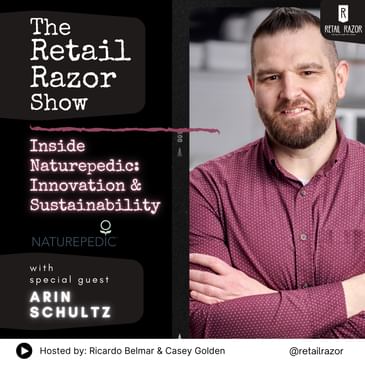



S5:E5 Leading with Values: How Naturepedic Builds a Better Brand, with Arin Schultz
What does it take to lead growth at the forefront of a movement for safer, healthier sleep? In this episode of The Retail Razor Show, we sit down with Arin Schultz, Chief Growth Officer at Naturepedic, a pioneering brand in certified organic mattresses and bedding. With over eleven years in the organic sleep industry, Arin shares how he’s helped Naturepedic expand its market share, launch innovative products, and build a trusted brand committed to health, sustainability, and safety. We talk about the evolution of the organic mattress category, how purpose-driven growth strategies translate to retail success, and the balancing act of leading multiple departments—sales, marketing, retail, R&D, and more. Whether you're in retail, health-conscious consumer products, or looking to build a values-based, mission-led brand, this episode delivers sharp insights from one of the industry’s most committed and capable leaders!
Subscribe to our Newsletter: https://retailrazor.substack.com
Subscribe to our YouTube channel: https://bit.ly/RRShowYouTube
About our Guest
Arin Schultz is Chief Growth Officer at Naturepedic, the leading organic mattress brand. As the lead on all Naturepedic marketing efforts, Arin develops and implements strategies that support the company’s business growth, customer retention, product innovation, consumer education initiatives and sustainability goals. Working for the certified organic, non-toxic mattress pioneer opened Arin’s eyes to the dangers of harmful chemicals and their pervasive presence in households across the globe. This knowledge has added a deeper purpose to his relentless push to help transform the brand’s vision into reality. A father of four and an empathetic listener, Arin’s success at Naturepedic is centered on his authentic understanding of the Naturepedic customer and his genuine desire to help families make the safest, healthiest sleep choices.
00:00 Preview
01:45 Show Intro
07:21 Arin Schultz, Chief Growth Officer, Naturepedic - The Mission
08:43 The Founding Story of Naturepedic
12:09 Challenges and Growth in the Mattress Industry
17:13 Retail Expansion and Customer Engagement
19:30 Product Innovation and Sustainability
23:10 Industry Environmental Impact and Continuous Product Improvement
35:20 Customer Experience and Meeting Their Needs
38:21 Replacing Your Mattress & Customer Service Excellence
43:20 Sourcing and Tariffs Impact
49:53 Embracing AI in Marketing and Operations
56:28 Advice for Growing a Values-Based Brand
59:23 Final Thoughts
01:00:38 Show Close
Meet your hosts, helping you cut through the clutter in retail & retail tech:
Ricardo Belmar is an NRF Top Retail Voices for 2025 & a RETHINK Retail Top Retail Expert from 2021 – 2025. Thinkers 360 has named him a Top 10 Retail Thought Leader, Top 50 Management Thought Leader, & Top 100 Digital Transformation Thought Leader, plus a Top Digital Voice for 2024. He is an advisory council member at George Mason University’s Center for Retail Transformation, and is the director partner marketing for retail & consumer goods at Microsoft.
Casey Golden, is CEO of Luxlock, a RETHINK Retail Top Retail Expert from 2023 - 2025, and Retail Cloud Alliance advisory council member. Obsessed with the customer relationship between the brand and the consumer. After a career on the fashion and supply chain technology side of the business, now slaying franken-stacks and building retail tech!
Includes music provided by imunobeats.com, featuring Overclocked, and E-Motive from the album Beat Hype, written by Heston Mimms, published by Imuno.
Episode Transcript
S5E5 Inside Naturepedic with Arin Schultz
[00:00:00]
[00:00:01] Preview
[00:00:01] Arin Schultz: 54% of mattress customers wanna start their journey in a store. So it is pertinent to be omnichannel in that sense to, to get things started because you're just, you're literally missing half of your audience.
[00:00:14] And I thought like, oh, organic mattresses, baby mattresses, this is gonna be great. You know, and you pull the the curtain away and there are a hundred different chemicals that go inside of a mattress.
[00:00:28] I cannot go to a standard corporate world. It's gonna, it's, I'm gonna die a wither and die.
[00:00:33] there are, yeah. There are about 50,000 mattresses that get thrown away almost every single day. And it's 18.2 million every single year, and that number keeps growing. It's probably, and that was a couple years ago. It's probably closer to like 20 million at this point.
[00:00:50] Our pillow business has actually grown by 300% in the last two years. Just because we've, we've put more offerings out there and I'm very glad we came to the [00:01:00] end result of what a good pillow was and what wasn't because I had 47 pillow prototypes in my house at one time.
[00:01:07] But two is like we, when I took over the helm entirely, I mean, I've been here for 11 years. When I took over everything four years ago, I made it a big strong point to focus on doing good in the world
[00:01:18] Ricardo Belmar: mm-hmm.
[00:01:18] Arin Schultz: And, it resonates well with our, our employees. I feel great about it. And our customers just like, that's who they wanna give their money to.
[00:01:27] It's too, I wanna give my money to, and it pays off.
[00:01:30]
[00:01:31]
[00:01:31] Show Intro
[00:01:43] Ricardo Belmar: Welcome to Season five, episode five of The Retail Razor Show, the original podcast in the expanding Retail Razor podcast network, where we cut through the clutter to give you sharp insights on what's happening in retail today and tomorrow. I'm Ricardo Belmar.
[00:01:57] Casey Golden: And I'm Casey Golden. Welcome [00:02:00] Retail Razor Fans to retail's favorite podcast, and the only podcast in the Top 10 All Time Indie Management Podcast charts on good pods where we get real about what's driving the future of retail.
[00:02:14] Ricardo Belmar: So, Casey, let me ask you, how does it feel now that we have four shows in the podcast network? Did you think we'd make it to this many?
[00:02:20] Casey Golden: No. , I have to say I'm impressed. We, we, we made it, we've done it, let alone one,
[00:02:30] even though two of the shows are in between seasons right now. We're really working hard to get those new seasons up and running. it feels like quite an accomplishment for us.
[00:02:39] Ricardo Belmar: Yeah. Yeah, that's right. And for those listeners and viewers who haven't checked out, the Blade to Greatness podcast for the best leadership skills and career tips you could ever ask for in retail straight from the best leaders in the business and data blades, where you'll get deep, practical insights into customer experience tactics you can use based on real world research, then you owe it to yourself to give [00:03:00] them both a try. Each episode is usually less than 15 minutes, so it's a quick hit. And now is the best time to get caught up on season one before we launch season two for both of these.
[00:03:09] Casey Golden: And of course if you haven't heard our newest show yet, Retail Transformers, then you're in for a treat and absolutely need to smash that subscribe button.
[00:03:20] Ricardo Belmar: Well, maybe not right now since they're listening to this show, but you know right after you've listened to this show. But love the enthusiasm though.
[00:03:26] Casey Golden: I am quite partial to the Retail Transformers, as you know how much I love these candid conversations with people driving real transformation in retail, change makers, innovators, and disruptors who are reshaping the industry from the inside out. If you're passionate about innovation, leadership, and the future of commerce, Retail Transformers is the podcast for you.
[00:03:49] Ricardo Belmar: A hundred percent. If you haven't checked out Retail Transformers, just like Casey said, go check it out. Listen to the trailer, jump into the premier episode. It's a real treat where we brought back our original retail [00:04:00] transformer from way back in season one of the show, April Sabral. So go check that out and then hopefully you'll feel like giving us a five star rating on Apple Podcasts, Spotify, or Goodpods, and maybe drop a review no matter how brief, just to let us know how much you loved it, or if you wanna let us know what you'd like to see us talk about next. Either way, it helps us grow the show and reach more people, and we are all about bringing knowledge and sharp insights to as many people as we can in retail.
[00:04:26] Casey Golden: And don't forget our YouTube audience. If you're watching us on YouTube and like the show, please hit that subscribe button and smash that bell. If you haven't already, give us a like and drop a comment. We do really wanna hear from you.
[00:04:41] Ricardo Belmar: Absolutely. You said it. So let's talk about today's guest. It's really special for us when brands reach out to us and wanna share their stories. And this is an amazing example of that. We've got such a great brand leader from a truly pioneering brand in certified organic mattresses and bedding.
[00:04:57] Casey Golden: And the conversation [00:05:00] is even more valuable when it's with a brand on a mission to make the world better and what could be more important than the quality of our sleep?
[00:05:09] Ricardo Belmar: I cannot argue with that. So the brand we're talking about is Naturepedic, the leading organic mattress brand that works to keep us and our children safe by removing harmful chemicals from mattresses and bedding products, and educating new parents on the importance of sleep safety.
[00:05:25] Casey Golden: And to guide us on this amazing sustainability journey is Naturepedic's Chief Growth Officer Arin Schultz. As the lead on all Naturepedic marketing efforts, Aaron develops and implements strategies that support the company's business growth, customer retention, product innovation, consumer education initiatives, and sustainability goals.
[00:05:46] Ricardo Belmar: I love this conversation. Arin has so much passion for the brand's purpose and mission. We talk about what brought him to the brand and not just go through a list of accomplishments growing the brand to, to the powerhouse it's become, but starting from its early [00:06:00] direct to consumer days to opening stores and so much more we get into more than just the marketing tactics.
[00:06:05] Arin really helps us understand why the mission matters. Why being an organic isn't just a gimmick or a tactic. It's fundamental to the mission of healthier sleep and healthier lives that really matters and drives the brand.
[00:06:17] Casey Golden: Yeah, I, I appreciate meaningful conversations on sustainability and the real impact of commerce on our environment. Um, Erin does a great job walking through what's real and what's just words.
[00:06:29] Ricardo Belmar: Yeah, we all know that greenwashing has become a real problem in the market where it's getting harder and harder to see through the hype and understand the real value of of, of brands like this. And Arin does a, a fantastic job helping us understand the dangers of harmful chemicals or pervasive presence in households across the globe.
[00:06:46] It really speaks to the brand's mission and how they're achieving it. By the end of the conversation, I'm pretty much ready to buy a new mattress. So get ready everyone. You're gonna be so tempted and you'll absolutely know why.
[00:06:57] Casey Golden: It is always special when we get to talk to someone that [00:07:00] genuinely loves what they do and with a brand behind them that's equally authentic and committed to making a meaningful impact. This episode is a gem, so let's get straight to our conversation with Arin Schultz, Chief Growth Officer at Naturepedic.
[00:07:21] Arin Schultz, Chief Growth Officer, Naturepedic - The Mission
[00:07:21] Casey Golden: Welcome to the show, Arin. We're so excited to have you here today.
[00:07:24] Arin Schultz: Very excited to be here today.
[00:07:26] Ricardo Belmar: Well, we're excited to have you here to talk about your retail journey, the amazing growth story behind the Naturepedic brand. So maybe start us off here. Arin, why don't you give us a quick background for both yourself and Naturepedic..
[00:07:37] Arin Schultz: Yeah. You know, I, I've been here for going on 11 years this September. And , I, I, I'm slightly biased, but it's probably the best place that I've ever worked for. It's, it's a great company and, and it stands for a lot. And I'm, I'm probably gonna, they're gonna have to drag me outta here, so, I'm gonna re, I'm gonna retire here one day, hopefully.
[00:07:57] And we just can do really like, fun and exciting [00:08:00] things and, and, learn a little bit more. And it's nice to come to work and, and know that we're making a little bit of a difference. And I mean, that's what Naturepedic has always stood for. I mean, we are, you know, as we get bigger we're in our 22nd year of business, but you know, every year the amount of money that we give away as a company in terms of, charitable organizations and around the, the environment and the homeless population, to foster kids, to just general education about what we do is phenomenal.
[00:08:29] And I think that's why, everyone's very passionate about Naturepedic here.
[00:08:34] Casey Golden: Well, I don't think a founder could want any more than what you've said about the company to be said. That's every, every, every business owner's dream, right?
[00:08:43] The Founding Story of Naturepedic
[00:08:44] Casey Golden: So, looking at Naturepedic's, founder Barry and his journey. What brought him into the world of organic sleep products and ultimately building Naturepedic.
[00:08:54] Arin Schultz: Well, we used to tell the story from, almost the inception of, of when Barry had the idea for organic [00:09:00] mattresses. But, in the last few years , I've started to tell the story a little bit farther down the line. And , for those who don't know , we're Cleveland based company and there's a river that runs through downtown Cleveland called the Cuyahoga River.
[00:09:12] And through the sixties Lake Erie was dying. Through the industrial age and everything. They just kept dumping gobs and gobs chemicals into that river and it flows right into the Lake Erie. And in 1969, that river caught on fire. Water does not catch on fire. Yeah,
[00:09:28] Ricardo Belmar: That doesn't happen every day.
[00:09:30] Arin Schultz: yeah, the flames got as high as five stories.
[00:09:33] That's how high, that big that that fire was. And Barry was going to college in Cleveland and he was an environmental engineer and it just had this, he always had a tie to, to the environment in general, but it was just kind of this spark of, of him, wanting to, make the world a little bit better of a place.
[00:09:51] And he has. , I've met some people, myself, included, I, some very driven people, and Barry, like his one singular focus, and that [00:10:00] is trying to get chemicals taken outta products. Not even just mattresses. He worked in they did a lot of soil testing in and around the, the Cleveland area for, for many years.
[00:10:08] Him and his wife Reggie had their own other business before Naturepedic. And really wanted to make sure that like parks were safe for children and, and more buildings were being made that they were, to, to code and, and all that stuff. And, Barry and his wife actually, you wouldn't notice by looking at 'em, but they're kind of like old hippies.
[00:10:24] They started the first organic co-op in Cleveland in the 1970s. And so yeah, cut to, 2002. Barry and Reggie, his wife, were about to have their first grandchild and Reggie sent Barry to the store to go buy a crib mattress. It was the last crib or big gift they had to get for their first grandchild, and we're very lucky that she did.
[00:10:43] And, Barry's very, like I said, very, very analytical. I mean, we have three veritable libraries here in our factories of nothing but textbooks and papers. And we actually have an in-house chemist that does a lot of research for us as a company and for Barry two to kind of do you know what's [00:11:00]going on in the industry, what's going on just at the world at large when it comes to chemicals?
[00:11:04] And so Barry's flipping over law tags and he is reading labels and, and he knows exactly what chemicals are being used to make those materials for these crib mattresses. And he was absolutely appalled and just, I mean, really how harmful they are. And he came home empty handed and he told his wife Reggie, that, my grandfather slept on a pile of hay.
[00:11:26] And he's like, I would be more than happy to have my my grandchild do that versus what that alternative is. So he got together with his two sons, Jeff and Jason, and, he, he had this idea, he is like, I know we can do better. So, about six months later they had their first prototype in Barry's garage and we're off to the races and, and, 22 years later from this little idea in Barry's garage and now we've got 30 Naturepedic stores and over 170 employees and, we're having some of our best years ever.
[00:11:57] And it's really, even after 22 years, it's a very [00:12:00] exciting time to be here. And it's all because of that one idea that Barry had. So we're, we're very lucky for that respect.
[00:12:06] Casey Golden: It's a great story.
[00:12:07] Ricardo Belmar: Yeah. Amazing story.
[00:12:09] Challenges and Growth in the Mattress Industry
[00:12:18] Ricardo Belmar: So you've been overseeing all this growth in what's, I guess, in each category, organic mattresses for a long time now, and as you said, it's 22 years later. Business is doing well, growing. I think what we spoke before we mentioned 2023 was your best year, and then you beat it last year in 2024, and it looks like you're on track this year to do even better.
[00:12:29] Now, what are some of the unique challenges and opportunities that come with building that kind of, the kind of market share that you have in, in such a purpose driven space.
[00:12:37] Arin Schultz: You know, I, I think our, our big, I I, we had a dinner earlier this week and, and I think my, my biggest struggle is scaling. I don't think we're having a hard time getting business right now. like when know to, to push on the gas and let off just so we can kind of grow. Because I think that's what happens with a lot of companies in the mattress industry is a lot of times they get too big, too fast, and [00:13:00] then they've got you know, and sometimes they've got VC money to answer to and, and investors and, and everything.
[00:13:07] And, luckily we're still family owned and, and Barry will, jump out of his grave one day if we ever do anything differently. So, you know, that, really, I, I think. , The hardest part about running any business is finding the right people. It's not, your product, it, it's, you can, you know, they can help you make a great product.
[00:13:23] It's, it's finding people who are as passionate as you are about what you're doing and that you take care of and, have that drive. I think any, any great leader will be able to find some thing in everybody that, that makes them, , an asset to the company. Sometimes you can't, you know, sometimes there is that.
[00:13:41] But largely, we've grown. You know, it's funny, I it's some, it still surprises me today, but, cut from 2021 is when I kind of took over everything. I used to have one direct report and that was it. That was the only employee I had over that my watch. And now cut to four years later, I have 66 people who work for me.[00:14:00]
[00:14:00] So, you know, keeping track of all the day-to-day stuff and, people's growth and, and, people are still human and life goes on. You know, I've got four kids and, we're a very family forward company. So, if you're sick, stay home. We don't have a sick day policy. If your kid's sick, stay home with your kid.
[00:14:16] If your kid has a recital or a whatever, like go to your kid's thing. Like, we're not, we're not performing heart surgery around here. And it really does. It, it allows people to, do the things that they're, they're more focused when they come back and they're happy to do it, you know, which is, it's a rare thing I think.
[00:14:34] I mean, I, that's why the Oh, yeah. And that's why they're gonna have to drag me outta here. I cannot go to a standard corporate world. It's gonna, it's, I'm gonna die a wither and die. So.
[00:14:42] Ricardo Belmar: Well, you know, and, and that kind of corporate culture in the, in the business, it always gets reflected in the brand. I think consumers and customers, they feel that, when they engage with the brand, and, and use your ,products. I mean, you've talked about how great customer retention and repeat purchases come with the [00:15:00] business.
[00:15:00] Can you talk a little bit about, how you, you grow that kind of lifetime value with your customers?
[00:15:04] Arin Schultz: Yeah, I mean luckily we're in the, obviously we started with baby. I mean, there's no other, better place to start from, from long time order value you know, we're getting when they're young. And, it's really about education. I mean, a very good portion of our parents who buy our crib mattresses end up buying our kids' beds.
[00:15:20] And then once, you know, as we're, we're building on the education of, unfortunately with four children, my kids are in my bed more than I would like them to be. But you know, and that's if you're willing to invest in, an organic mattress for them. And they're like, my, my 4-year-old comes into our bed almost every single night at like 2:00 AM It's like clockwork.
[00:15:40] So he's there for four to five hours. So like half of his night's sleep is spent in our bed. So like, we should, theoretically, I mean, we, we have an organic mattress because I work here and I'd be talking out of both of my mouth. So yeah, we have an organic mattress and, and I think that's when parents are starting to realize like, maybe we can at least get organic sheets or an organic top or organic pillows [00:16:00] and, and, and more often than not, they're just flat out getting organic mattresses too.
[00:16:04] And then if those kids were, introduced to those things when they were younger, I mean, we literally, we have some customers now who our, our crib or our kids' beds were bought for them when they were little, and now they're actually coming up to the age where they're buying crib mattresses now for their
[00:16:19] Ricardo Belmar: Hmm. Wow. Yeah.
[00:16:20] Arin Schultz: So, it's, the, the joy being around for 22 years. But as long as you're doing the right things and making sure that, you're authentic as a company, obviously there's, there's economic headwinds that everyone has to face. I mean, this company was started in a recession, so we've got that going for us.
[00:16:38] But you know, I think the, the growth will come as long as you stay authentic to yourself. I think when people start to like, try and get too tricky, they try and like step out of their comfort zone. That's why like, we are always gonna be very bedroom focused. We're not trying to be like a, you know, a green brand where like we're trying to dip our toe into everything. We do mattresses very, [00:17:00]very well.
[00:17:00] Yeah. It's not, it's not our thing and ever will be our thing. And because you lose sight of what you are, you're good at, at
[00:17:07] Ricardo Belmar: Hmm. Yeah,
[00:17:08] Arin Schultz: we're not trying to be this conglomeration of, all these different things for home. It just doesn't make sense.
[00:17:13] Ricardo Belmar: Yeah, yeah.
[00:17:13] Retail Expansion and Customer Engagement
[00:17:13] Ricardo Belmar: you mentioned earlier, how you, you're up to 30 stores. How, how much of that growth was after COVID and how did that impact, your, your sales channels from being direct to consumer to focusing on stores?
[00:17:27] Arin Schultz: We've almost doubled since COVID in terms of that, retail landscape. And, it's been a fun ride. I'm glad we took a little bit of a, this year we opened up Nashville and that was the only one that we've done in 2025. Last year we opened up eight stores it was I was gone a lot, which my wife was not very happy with.
[00:17:47] And but no, what we're, most 54% of mattress customers wanna start their journey in a store. So it is pertinent to be omnichannel in that sense to, to get things started because you're just, you're literally [00:18:00] missing half of your audience. They just will refuse to buy from you no matter what you do, unless you have some sort of a retail footprint, whether it's your own stores or you're working within through other retailers.
[00:18:10] And it, it's been very successful for us. every time we see that we open up a new store, we see a 10 to 15% lift in that overall geographic area on our website. Just craving that because obviously we're pumping more into marketing and
[00:18:22] Ricardo Belmar: Right, right.
[00:18:23] Arin Schultz: You know, and, and, and it works well.
[00:18:24] And we're starting to see in our stores, some of our legacy stores where, they're starting to build too, just like they would be in their own business. You know, you start off a little bit quieter, but you know, the more return customers you get, the more referrals you get the, we're actually doing a lot of activities in our stores now and events which has actually been very, very helpful for us. We definitely wanna feel more of like, part of the community. You know, we do a lot of stuff specifically to our cities. We do environmental cleanups. We, give to charities in those cities too 'cause we want, when people think about mattresses, we want 'em to think about us and it seems to be working,
[00:18:55] Ricardo Belmar: and you also distribute through other retail channels and other retail stores too, correct.
[00:18:59] Arin Schultz: [00:19:00] Correct. Yeah. Yeah. We're, we're within Raymore or not. Oh yeah, we're on Raymore and Flanagan. We're on Restoration Hardware, Pottery Barn, Target, Amazon, which is, you know, it's the devil everyone has to deal with. It's kind of like Google. But it works. I mean, it's, you know, I'm guilty of it, I we probably, at least, with four kids and we live in a, a fairly rural area.
[00:19:19] I've got a package showing up probably every single day to house from I would die if we didn't have Amazon, I'll be
[00:19:24] Ricardo Belmar: Yeah. It's very much like our house. Yeah.
[00:19:26] Arin Schultz: Yeah.
[00:19:27] Ricardo Belmar: Yeah. Very true.
[00:19:29] Arin Schultz: Yeah.
[00:19:30] Product Innovation and Sustainability
[00:19:30] Casey Golden: Naturepedic is a leader in certified organic and non-toxic mattresses. But what does that, what does that organic mean in this space, and how do you educate consumers on that value?
[00:19:44] Arin Schultz: Luckily in 2025 it's, it's, it's becoming less and less like the Wild West. I would say probably a decade ago was worse it was ever been because people are like, Ooh, green, organic, I'm gonna start a company and, lie through my teeth or, you know, to [00:20:00] the best of my ability, try and do whatever to try and capture customers.
[00:20:04] And, you know, we we're very stringent and we always have been on our, our certifications. Those, if you're buying any product, whether it's an organic mattress or not, look for certifications and do research on those certifications because there's a lot of fake ones out there too ,unfortunately, there's no certification police, so, we are, we are, our product is, and our, our factory is GOTS certified, which is a Global Organic Textile Standard. And what that means is three times a year they have a third party verifier that comes to our factory. They pull a mattress off the shelf and we have to tell them what farm that cotton came from and what crop that cotton came from.
[00:20:39] And they trade traced that from the time that seed was planted to when it showed up in Naturepedic's factory to make sure that it was un fussed
[00:20:46] Ricardo Belmar: Mm-hmm.
[00:20:46] Arin Schultz: start to
[00:20:47] Ricardo Belmar: Yeah. Yeah.
[00:20:48] Arin Schultz: And then it's, it's easy to buy, like certified organic cotton and just wrap it around whatever you want. And then to kind of play like these, word salad games where people are, like, oh, that seems well [00:21:00] enough and it's just not because you, you have no idea what you're actually buying.
[00:21:03] You know, the mattress industry, you know, it's funny, I, I used to be in the, the metals industry before this, and I did that for five years and it was so, cutthroat, and it just was not for me. And it was like very down and dirty the metal trading game. And I thought like, oh, organic mattresses, baby mattresses, this is gonna be great. You know, and you pull the the curtain away and there are a hundred different chemicals that go inside of a mattress. And some of 'em are formaldehyde, which people commonly known as embalming fluid cyanide, antimony, flamatory chemicals, which are known carcinogens.
[00:21:41] And the list goes on and on and on. And, we don't put a single one of those in our, our mattresses and we are, I'll say one thing about Naturepedic, since day one, our, our big tagline internally and externally is just no compromise. And even if something is easier, faster, cheaper, and the, the, even [00:22:00] if the verifications and certifications get watered down, we just refuse to do so.
[00:22:03] We've always gone above and beyond. We can use glues or adhesives in our products and we choose not to. It takes twice as long to make one of our mattresses because we choose not to use glues and adhesives. Instead, we use a, it's kinda like a round staple. It's called a, a, a hog ring, and they individually go around and secure all the certain pieces within this mattress so we don't have to just lather it with glue.
[00:22:25] So, it, it, that's, I think what sets us apart from the rest of the industry and why, the mattress industry in general right now is down like 12.9%. We're, we're very easily into the double digits with our growth this year.
[00:22:39] Ricardo Belmar: Yeah. That's
[00:22:40] Arin Schultz: we're actually farther ahead, percentage wise than we were in 2024.
[00:22:44] You know, I set a goal for us, which ownership was very happy that, they thought it was a little ambitious of like 2027, I set a goal for us as a company. We are probably gonna hit it by the end of 2026. So, I mean, I look like a rockstar right now, [00:23:00] so I'll take it. So, it's been great.
[00:23:03] I walk around here like I, I'm trying to like, keep the size of my head in check, so Yeah. Yeah.
[00:23:08] Ricardo Belmar: Yeah. Yeah.
[00:23:10] Industry Environmental Impact and Continuous Product Improvement
[00:23:10] Casey Golden: Where do mattresses go?
[00:23:12] Ricardo Belmar: That's
[00:23:12] Arin Schultz: there are, yeah. There are about 50,000 mattresses that get thrown away almost every single day. And it's 18.2 million every single year, and that number keeps growing. It's probably, and that was a couple years ago. It's probably closer to like 20 million at this point. And it
[00:23:29] Ricardo Belmar: amazing.
[00:23:31] Arin Schultz: Trying to get things recycled and, and, and everything.
[00:23:34] We are, we are doing our part, we try and donate to charities when possible. So, those mattresses can see a second life. And for any of our returns, which is still very low for the industry in general, but the, the sad statistic of 50,000 mattresses per day and 18.2 million per year is, that's enough to cover the state of Kansas by a third. If you laid them end to end, that's how many mattresses end up getting thrown away. [00:24:00] It's a lot of land. So, we're, very happy with our lack of environmental footprint, overall. We're trying to get ourselves to like a, a being a zero waste company within the next year. And we are well on our way for that.
[00:24:14] Casey Golden: It is incredible. You know, you, I, I would think, coming in that mattress business is very niche, very small, low lifetime value, very, but, 50,000 a day, if they're going out, that means they're also purchasing. And it's a very specific destination. So it's very interesting. Was not my expectation.
[00:24:39] I don't think I thought about a mattress until I really started hearing about all of these direct to consumer brands. I'm like, the mattress business really? I had never even thought about it. And the more you kind of dig into like what those businesses look like and then hear about your business, it's wildly different.
[00:24:59] And it's a [00:25:00] market that I just, I didn't even consider.
[00:25:04] Arin Schultz: You know, it really exploded after you know, 2018 was kind of like the catalyst for the bed in a box industry, and that was really what exploded because now you're having like, 180 day return policies, 365 day return policy, which I think is absolutely ridiculous to have a 365 day return policy if you haven't figured out you like it in a
[00:25:27] Ricardo Belmar: In a year. Yeah.
[00:25:28] Arin Schultz: Yeah. It, it's,
[00:25:29] Ricardo Belmar: There's something wrong there. That's right. That's right. Nothing's gonna make you happy.
[00:25:34] Arin Schultz: Well, and the problem with it too is it, it became, people were basically showrooming in their own, bedrooms and, there's, we, there's instances where people are trying to buy. We've had people come to our stores before and they're like, you guys are the sixth mattress company that I'm looking at in the last month.
[00:25:52] And they're like, oh, I just returned all the other ones that is literally six or five mattresses prior to even coming to us that are now God knows [00:26:00] where, probably in a landfill. And that's just one customer. So, any, it ain't like buying a shirt. And that's why having like a retail footprint is huge because it, it ultimately really cuts down on our, our return rate in general because people are able to touch it, feel it, smell it, whatever, in inside of a store and they feel a lot more comfortable with that purchase and they know what they're gonna end up getting.
[00:26:22] Ricardo Belmar: Yeah,
[00:26:23] Casey Golden: it. Got. Just gotta do some target marketing over here in New York, because I don't know anybody that would go through the trouble of returning a mattress in Manhattan and having to deal with getting it out of your apartment
[00:26:38] After you finally got it in.
[00:26:40] Arin Schultz: well, it's nice. New York is, is a great market for us. I we, we have a Manhattan store and we have one over in Brooklyn as well. And you're a hundred percent right and I mean, I'm not taking a mattress up and down a fifth floor walkup. So,
[00:26:53] Casey Golden: I'm not even returning a lamp that I bought because I'm like, I have to get in the Uber to go to the post office to wait [00:27:00] two hours, and I'm like, you know what?
[00:27:01] Ricardo Belmar: It's an ordeal.
[00:27:02] Casey Golden: I'm putting out on stoop.. Somebody will enjoy it. Take the lamp
[00:27:06] Arin Schultz: I, I like to visit New York, but living there hats off to you. I I can't, I can't do it. But I mean, it's, it's absolutely an amazing town, but it's, you're right. I mean, it's not feasible for, for those, that type. But, our EOS mattress is, is really cool in the sense that for, and I mean, it was designed for some of those things in mind.
[00:27:24] I mean, you have some very narrow stairways and hallways and corners and everything else in a, these very, old buildings and, they're trying to stack you guys in like sardines and.
[00:27:34] Casey Golden: a business that cuts your couch and then puts it back together once it's inside your apartment.
[00:27:40] Arin Schultz: I've heard of that. Yeah. No, it's they're, they're, they're getting creative. But our, our US mattress actually fully comes apart. So like you can actually take each piece up the stairs and if
[00:27:49] Ricardo Belmar: And then put it back
[00:27:50] Arin Schultz: to move, you can actually, you know, unzip everything and put it back together in your next fifth floor, walk up somewhere else.
[00:27:56] So,
[00:27:57] Ricardo Belmar: Well, so
[00:27:58] Arin Schultz: or move outta the city. [00:28:00] I.
[00:28:00] Ricardo Belmar: there's always that op, that option. I don't think you'll get Casey outta the city though.
[00:28:05] Casey Golden: good luck.
[00:28:05] Ricardo Belmar: Yeah. So, so o on that point of that, that sort of, that kind of product innovation. So, you mentioned before like when there was that turning point when the whole mattress in a box became a thing and we saw so many direct to consumer mattress brands just pop up outta nowhere around that single innovation.
[00:28:22] How do you look at product innovation? 'cause you've mentioned how, you're really focused in the bedroom. You're not trying to have products throughout everyone's entire home. You're very focused in that area. How do you look at product innovation and is there an example of maybe a recent launch that you could share that, that really, it worked for your customers and brought out something new that that they weren't buying from you before?
[00:28:43] Arin Schultz: Yeah, we had two things. The biggest one I think was probably our, our pillows. It was really, I wouldn't say it was like an afterthought, but it wasn't short of that necessarily. It was like we had two kinds of pillows in like 2021 and and then we introduced another one the following year and [00:29:00] people are like, yay, do more.
[00:29:01] So, not everyone sleeps the same. And not everybody types the same either. And we really wanted to put out a stellar product that people really bought in, because what we were finding is there's like a direct correlation. If you don't have an amazing pillow, people generally just, they equate that to having a bad sleeping experience.
[00:29:20] So for one, it actually brought our return rate down. But two it actually allowed us to, be able to kind of, curtail our business to a specific customer of like, here we have a side sleeper PO pillow. Now we have a body pillow. Now we've got wool, we have down, we have three different kinds of shredded latex pillows and what that's done, expanding out on that product line.
[00:29:41] Our pillow business has actually grown by 300% in the last two years. Just because we've, we've put more offerings out there and I'm very glad we came to the end result of what a good pillow was and what wasn't because I had 47 pillow prototypes in my house at one time.
[00:29:58] Ricardo Belmar: Yeah.
[00:29:58] Arin Schultz: my kids loved [00:30:00] it.
[00:30:00] They loved it. But we, we really just wanted to put out a, like a really, really good product and we're, you know, we're looking at everything else that was on the market and, just like we do with our mattresses, we wanted something that we can put our stamp on and feel great about putting out in the marketplace, and the customers have responded.
[00:30:15] And I think the same thing goes with our, our bedding. We, which my marketing team is so excited about, we were a sea of white and beige for years. That was it. White and beige. And
[00:30:27] Casey Golden: It is My color palette.
[00:30:31] Arin Schultz: I, I I'm more of an earth tone, so, but yeah, they, and we have so many, and we have, we have another launch that's coming later in the year and last year, I mean, our sheet betting business just absolutely exploded because people actually had choice now and, you know, to fit their, their own style. And, we, we had an introduction of, of a lot more fabric types too.
[00:30:51] I mean, we've got, French flax linen we've got Supima cotton that's launching soon, which is really exciting. It was actually grown on a [00:31:00] native American reservation in Arizona. And so we're excited about that launch. But, our sine Satine and per kale, we went through 17 rounds of, of choosing new fabrics for our bedding because we just wanted something that everyone felt comfortable with.
[00:31:15] And oddly enough for anyone listening, even again, whether it's, I mean, I hope it's Naturepedic sheets, let's be honest, but if it's not. What we found is, is, everyone's like, I mean, ever since like the nineties, it was like, ooh, Egyptian cotton, like everyone had this like, it was amazing and, and, and a very high thread count.
[00:31:34] And the problem with a very high thread count is it actually read a little bit rougher to be honest, and it doesn't breathe because has such a tight weave
[00:31:42] Ricardo Belmar: Right, right.
[00:31:43] Arin Schultz: if you're a hot sleeper, do not buy a high thread count. We actually found between like three and 400 is absolutely perfect for any sleeper.
[00:31:50] It's got the right amount of softness, it breathes perfectly, it's got a good weight to it. And it actually holds up well over time too 'cause you're not dealing with tinier threads now. [00:32:00] So, that is, for us, that was the perfect thread count and it took 17 rounds to figure that out and a lot of people looking at this stuff.
[00:32:06] But you know, we're very proud of that and I think putting that time and care to it, and it's not the fastest thing in the world, you know, I think when you're trying to like rush something to market, you're gonna get rush results. And those are ultimately not gonna be what you're hoping for. If you really take the time to, really go through the role of, I just don't like this.
[00:32:26] Like, I read something the other day about WD 40 the, the stuff they spray on nuts and bolts and everything. The reason, the reason for that name, it was like the 40th formula. They kept
[00:32:35] Ricardo Belmar: They kept going.
[00:32:36] Arin Schultz: trying and trying until they found something that was absolutely perfect.
[00:32:40] And then that's, it's, it's just like,
[00:32:42] Casey Golden: kind of like Chanel No 5.
[00:32:44] Arin Schultz: it was just as a household thing anymore. Like you just have to go through these rounds where you feel as a business owner and everything else, like, this is what I can put my name on and feel good about, and it pays off in
[00:32:55] Ricardo Belmar: Yeah. Now, when you do these iterative product designs, are you, [00:33:00] are you testing these out all internally or do you have like a, a customer base that you go to that you, you trust their, you want their opinion and, and feed that back into the process? Or are you ex totally doing this in-house before you release that first one?
[00:33:12] Arin Schultz: It's a little bit blend of a couple things
[00:33:14] We will utilize, we have, you know, a pretty decent sized workforce here too. But we, we are utilizing parents, brothers, sisters, moms within, within the team too of trying to get an unbiased opinion. And when you tell somebody to be unbiased, they're as brutal as physically possible.
[00:33:31] You're like, gloves off. Tell me how bad it is. And it's like, I didn't expect you to be that mean about it, but they will tell you. And it, it's honestly very helpful for us because it's like. We felt good about something and then like the resounding opinion was like, this thing sucks. And I was like, oh, well we should probably go back to the drawing board then.
[00:33:47] So again, and again, and again and again. So, it took a good chunk of 2022 and half of 2023 for those pillows, but we, we did it. And, we're not sticking to our laurels either. Like, [00:34:00] we, we are looking at introducing some new stuff into the line and even making some slight improvements to the existing stuff because we, our company is owned by three engineers, which some days is the most annoying thing in the world, I'll be honest. But it
[00:34:14] Casey Golden: could be two engineers and a sales person, which that's also a lot of friction.
[00:34:18] Arin Schultz: Yeah, yeah, yeah. It's, it's like, come on guys. So, but they, they're, they're always tinkering and I, I appreciate that about them because they're, they're like, I think I can do better. I think I can do better. And it, you know, it's, it's nice about 'em too, is it keeps things fresh for us as a marketing team.
[00:34:36] Because what it allows and the sales team too is, is, we're not dealing with the same things all the time. If you made, here's your widget and that's the only thing you got, and you got that forever, like, you know it at some point in time, like you're gonna have very small incremental growth. But like now we have something interesting to talk about. It has PR value, it has, it peaks the interest of our existing customers. It's like, oh, this is new. Like, I've been buying Naturepedic [00:35:00] for a decade now. I would love to try that. So, constantly innovating and changing has, has really been helping us propel our growth
[00:35:05] Casey Golden: and you guys have, you guys are Amish crafted and made in the US so I mean, those are some pretty significant claims to, like the way you think about sleep and the way you think about building your company. how do you
[00:35:20] Customer Experience and Meeting Their Needs
[00:35:22] Casey Golden: look at that customer experience when it's something so deeply personal, like sleep,
[00:35:27] Arin Schultz: yeah, I think we're, for us, yeah, I mean we're, we're, you know, trying to meet them where they're at. We have an amazing content team, and I, I think with, what we're trying to put out for them is meeting the customer where they're at, what are their concerns? And we're not trying to, I think sometimes.
[00:35:45] And it's, it's smart. But it, I don't think it's everlasting is, is, you, you come up with a fake problem or a perceived problem and you're like, I got to think it's gonna fix it for
[00:35:55] Ricardo Belmar: Mm-hmm.
[00:35:56] Arin Schultz: And, that may work for a little bit of [00:36:00] time, but you know, you're not gonna get a lot of repeat business.
[00:36:02] So for us, we meet where our customer, where they're at, and what, what are, what are your issues when it comes to sleep? Are you sleeping too hot or does your back hurt? Do you, and then, I think equating all that to the handcraftedness that goes into our product we, we have a guy that's actually working with us this week a consultant for some, some trading stuff that he's doing for our stores.
[00:36:22] And, he is worked with some mattress companies before and he is been in a ton of factories and, and being Amish crafted, he. He was like this, I've never seen anything like this before. He is like, everywhere I go, it's nothing but robotic arms and laser cut this and computer that and it is fairly rudimentary in the best way where, they're still working with like wooden hand tools in
[00:36:46] some instances to make our mattresses.
[00:36:48] And, I don't want it to be where it's like, it's not the factory out there I'll that much.
[00:36:53] Casey Golden: No, but I mean, I find great value in that. You know, I love [00:37:00]handcrafted products. I value the talent. The craft, the work, the labor and like the talent of like that training. So, I mean, it goes a long way with me on my perceived value because that immediately increases it. Because that's something that I definitely wanna support.
[00:37:17] I love products made by people.
[00:37:19] Arin Schultz: Yeah, I mean if you were getting like, you know what, I think what we are trying to get away from is, and I think the rest of the, the, the world is in a lot of ways is, fast fashion. I, I think we're going back a little bit in the sense that I think people have gotten a little tired of all those things where they're made unethically in a lot of instances and very cheaply and, it's probably gonna last you like five or 10
[00:37:42] wears maybe.
[00:37:43] And but you know, the older you get, you appreciate things more. It's like if I'm gonna get a jacket. For, for, you know, work or whatever, like, I'm gonna have it tailored to my fit and I know it's gonna be done extremely well. And like, sometimes the little chalk lines and everything's being measured out perfectly.[00:38:00]
[00:38:00] And I know that that thing, when it gets to me, it's, if, if I take care of it, well, it's gonna last me probably a decade or two as long as it, stays in style. But, it, that's the point of, people are willing to put more money into things that they know are handcrafted. And that's why I think our business is
[00:38:14] Casey Golden: Especially a mattress. And I, I mean, you know what, let's just talk about that for a moment, for all of our listeners.
[00:38:21] Replacing Your Mattress & Customer Service Excellence
[00:38:21] Casey Golden: How often are you supposed to replace your mattress?
[00:38:23] Arin Schultz: Well, generally every eight to 10 years we do have a 25 year warranty. But for a lot of ones that you would suspect and a lot of ones that are gross, that you might not suspect are good reasons to wanna replace your mattress. It is your, I will tell you this much, your mattress weighs more when you throw it away than when you first bought it.
[00:38:41] yeah, yeah, yeah.
[00:38:43] Casey Golden: So I could gone without knowing that.
[00:38:46] Ricardo Belmar: Well, now we've learned
[00:38:48] Arin Schultz: Happy sleeping tonight. tonight. So,
[00:38:51] Ricardo Belmar: Give gimme one, one more additional reason why we're thinking we need to replace our mattress.
[00:38:56] Arin Schultz: well, you know, it'll, it'll maybe you'll, you'll gather the strength to huff it [00:39:00] down your staircase now in New York City to the sidewalk. So just a thought of sleeping on it at night. But no, it's, it's, but ours, stand the test of time. Our crib actresses do have a limited lifetime warranty.
[00:39:11] That is one thing we've always been very liberal on in the sense that, even if it's, 8, 9, 10, 12 years down the line if there is something. Wrong with that mattress, have it made it through like three kids. And again, I have four kids. They're abusive to just about anything they get their little hands on. So, Barry and, and Jeff and Jason, they are again, another reason why it just great working here is they could be a lot more hard lined about it and just like, no, you gotta pay for it. Or, no, that's not whatever. They just wanna make babies safe. So if, you know the, the thought of like having a parent just because they don't have another option, put their baby on a one of our mattresses that might not be up to snuff anymore after three kids in 10 years, they'll just replace it.
[00:39:56] And, and they're very proud to do that. 'cause you know why? [00:40:00] It is, that makes a customer for
[00:40:02] Ricardo Belmar: Yeah,
[00:40:02] Arin Schultz: and they're gonna tell everyone about that, and they're gonna remember that. So when it comes time to buying another mattress or buying sheets, you know, who else would you rather, would you rather buy it from yourself or, or buy from another company or the company that took care of you in your time of need and didn't hassle you about it?
[00:40:18] Casey Golden: Yeah, word of mouth is still the highest converting, longest lasting marketing that anyone can do, and it's much less expensive.
[00:40:28] Ricardo Belmar: Mm-hmm.
[00:40:29] Arin Schultz: Oh yeah, we, a couple years ago we had our our furnace replaced and, and it's, it's a local company and I, I won't blast them nationally, but anyone here in Cleveland, if everyone's like, oh, I'm gonna get my air conditioning, I'm like, don't use these guys. It was a very terrible experience and they tried to like gaslight me and, I mean, there was many, many reasons why I would never, ever use this company again.
[00:40:52] And here we are. I got that done actually in 2017. It's 2025. And I'll say that to my grave that they're a terrible [00:41:00] company or until they go outta business, so
[00:41:02] Ricardo Belmar: Yep. Yeah, those, those
[00:41:03] feelings always last
[00:41:04] Casey Golden: knows that I love a product and if I have a bad experience, everybody's gonna hear about this experience.
[00:41:12] Ricardo Belmar: It's those extreme conditions, right? Those, you
[00:41:15] always remember the extreme conditions, whether good or bad, and that's what you keep telling everyone. That's what you, in what influences your next purchase decision.
[00:41:23] So I think very
[00:41:24] much makes sense if you're building for a lifetime value. That totally makes sense.
[00:41:27] Casey Golden: Keeping the values forward is definitely I feel a de-risking business strategy and definitely can help drive more revenue than being mediocre Also.
[00:41:38] Ricardo Belmar: Yeah.
[00:41:38] Arin Schultz: we, we've had some instances the last couple years where, I mean, our, our customer service is, they are, a big reason why we've been who we are. I mean, customer service is so lost on any industry at this point. I mean, that is, you get that right and everything else will fall into place.
[00:41:55] And our, we've had people where they wanna turn their mattress. [00:42:00] We don't hassle 'em on it, it's like, okay, we just need X, Y, Z information. Boom. Done. We're gonna have it come picked up for you. And they're like, wow. It was that easy. Instead of like trying to like gaslight them or force it down their throat and we've had like, Hey, this wasn't for me, or maybe it was a different mattress, I'll try again.
[00:42:18] And they're like, we've had referrals from people who like, Hey, my girlfriend bought your mattress. She said it wasn't for her because, she, it was just
[00:42:25] Ricardo Belmar: Mm-hmm.
[00:42:26] Arin Schultz: princess in the peace situation or it just wasn't like, you
[00:42:30] know, whatever. And she's like, but she's like, she just sung your guys' praises about how
[00:42:35] Ricardo Belmar: because it was a great
[00:42:36] Arin Schultz: you're a great experience.
[00:42:38] And we've gotten orders just from that simple fact. So, you know, yeah, you're, but you know, turn those into
[00:42:45] Ricardo Belmar: Yeah.
[00:42:46] Arin Schultz: make.
[00:42:47] Ricardo Belmar: Yeah, so I'm come back for a minute to product itself. So, the fact that you are an organic product and it, and you look closely at not just, saying that it's organic as mentioned [00:43:00] before, like it's not just a veneer of an organic layer in a product, it's throughout the whole product itself.
[00:43:05] That really speaks a lot to the sourcing of raw materials that you're using. Right. So either to both avoid the chemicals that you mentioned before, the other mattresses use. But let's get to the more pointed question of the year. 'cause it's on everybody's mind this year.
[00:43:20] Sourcing and Tariffs Impact
[00:43:20] Ricardo Belmar: You probably source, I'm, I'm guessing those materials from all over the world. So how are you looking at the potential impact of new tariffs this year and how that's gonna impact your sourcing?
[00:43:33] Arin Schultz: Yeah, I mean, it, it definitely, hopefully some of these things are starting to get settled out. I think, largely for any company right now, there is still so much uncertainty. And I mean, honestly, even when there is certainty like. Tomorrow? Maybe not. I don't know. It's, it's you know, it's this, but, luckily it's, it's not hurting our business at this point, but you know, we're. We're not trying to pass that along to our customers. We're gonna try and eat it where [00:44:00] we need to, and maybe source differently if it makes more sense in those instances. But, bottom line is, with us being a, an a, an American company and we are American made you know, we're doing all of our finishing here in the United States and we have a very, very busy factory, but we're buying a lot of these components from overseas that just frankly, are not made here in the US.
[00:44:21] And you know, we are in a lot of ways because these tariffs now, which I wish there were exemptions for we are having a growing American workforce, which they're all, current administration is like, that's what we want, that's what
[00:44:34] Ricardo Belmar: Mm-hmm.
[00:44:35] Arin Schultz: we're also, getting kind of, push back a little bit in the sense that now I have to pay more for my raw materials.
[00:44:42] And, luckily we are not in this position, but like with other companies, like maybe I don't hire as much anymore. Maybe I have to lay some people off. Maybe, I don't market as much before, so my business is just gonna be stagnant until maybe this changes. And I think we aren't the, the China thing [00:45:00] too, I, I, were, it was before it was people, people really didn't care as much, I guess where as much.
[00:45:06] But now it's like, where are you getting your stuff from? Because they're trying to preemptively figure out if you're gonna raise your
[00:45:11] Ricardo Belmar: Right, right.
[00:45:11] Arin Schultz: I think with the tariff, the tariffs that got announced for like August. I mean, frankly, the, where, I mean, I think everyone's it, I'll be honest, it feels like you're pissing on my head and telling me it's raining.
[00:45:24] 'cause now we're at 55% cost of goods are gonna go up. I mean, we were at 30 for a little while. Now it's going up another 25%. So, where's that coming
[00:45:34] Ricardo Belmar: Right. It has to
[00:45:35] Arin Schultz: you know, China ain't paying that. I'm paying that. You're paying that. So, that's, that's where all that's landing. And you know, we just, at the end of the day, we wanna make. A, a great product and make it as affordable and accessible as possible. And I will say just another I, I kiss their ass when they're here and I do it when they're not here. But ownership, they're great guys. They really are. They're, obviously they want the [00:46:00] business to grow and we're all excited for that to happen.
[00:46:02] But you know, Barry specifically, I don't know if that man knows that he's got $10,000 or a million dollars, like he just wants to like watch this company grow. So every single dollar that we make as a company either gets put back into us or growing the company. And, they're, they're not looking to make, all these, shifty changes to really line their P pockets.
[00:46:24] They're very humble people. And, and that's why I think we're gonna continue to grow as a company is, there'll be a time to be greedy. And they know that, and we know that. And I'll be greedy too, it's human nature you know, and but going without has been the greatest thing that's ever happened to Naturepedic in the sense that they're all not trying to make a million dollars a year.
[00:46:45] Every single dollar goes back, like I
[00:46:47] said, into the company
[00:46:48] and you know, product and, and innovation and not skimping on the materials and, and everything. Frankly, they would rather just not do it altogether than half, half.
[00:46:58] Ricardo Belmar: Yeah.
[00:46:59] Casey Golden: [00:47:00] That's great. I think we've had in the last five years we've had these, these great. Lessons in retail and commerce for the general public to learn about supply chain with COVID now learning about tariffs. And I think with this, it is an, it's a painful education process to start learning and paying attention to tariffs and what supply chain in is and making yourself aware of where your product comes from
[00:47:33] Ricardo Belmar: Mm-hmm.
[00:47:34] Casey Golden: how it's made that I think that I agree with you when you, when you had mentioned that there is kind of a shift that's happening where we do have an authentically engaged, more conscious and educated consumer, and I can, I think that that will only serve more brands that make premium products over, over time for the long [00:48:00] run. Regardless of the pain today, I do think that, having the consumer be aware and learn these things will only help our industry.
[00:48:08] Arin Schultz: Yeah, no. And I think just being. True to yourself. We're not trying to be altruistic. We're really just trying to educate people of like what's out there in the marketplace. And, Barry, our, our founder and I have to go myself, which is a, is a, is a weird torch to pick up, but, we're, Barry's been to Capitol Hill before I have to go in September to speak on Capitol Hill.
[00:48:30] And you know, we're, we're just trying to get, educating our lawmakers into, what's happening within the environment to to consumer goods, to to, all these things that, they can help be a part of to, ultimately help their constituents out. And so I, I guess the point of telling that story is, is, we're not just trying to put out a, a great product and be authentic about it.
[00:48:52] Like Barry, Barry is instilled in, in a lot of us too, is like trying to invoke change across the board. And you know, I think consumers are waking up [00:49:00] to that. And, you know, again, we're not trying to create this like, marketed hippie dippy lifestyle where like people wake up in the morning and it's like, did you see that?
[00:49:09] That thing, it was big for a couple weeks ago where the guy had the, the Saratoga water bottle or whatever. And it was great marketing for Saratoga Water, the, the big blue wa wa water bottle. But like, the guy woke up at like 4:00 AM and he did pushups and then he put the water bottle. I have four kids, man.
[00:49:27] I wake up, my back hurts.
[00:49:29] Ricardo Belmar: That's right.
[00:49:30] Arin Schultz: I'm pissy like nobody's doing pushups in
[00:49:33] my, my house. So,
[00:49:34] you know, we're not
[00:49:35] Ricardo Belmar: You, you're not getting woken up. If you getting woken up at four in the morning. It's not because you have a desire for pushups. It's 'cause you've got a, a kid who's waking you up.
[00:49:41] Arin Schultz: Yeah. I got a foot in my face. That's what's
[00:49:43] Ricardo Belmar: Yeah,
[00:49:43] Arin Schultz: So, yeah.
[00:49:45] Casey Golden: Speaking of the, like, marketing strategies today I mean, you have so much that you can really wrap a story around.
[00:49:53] Embracing AI in Marketing and Operations
[00:49:53] Casey Golden: What is your perspective on ai, what's happening with search? Are you guys, I'm [00:50:00] sure you're on BabyTok, TikTok, what are you finding is the behavior that's kind of shaping this product development and marketing strategies?
[00:50:09] Because we have so much more access to our customers now than we ever did.
[00:50:13] Arin Schultz: Yeah. No. You know, AI, I think provided it doesn't bite us in the ass, and they come and kill us in a couple of years. I did I say I was one of those people I saw the note or the article about how Sam Altman was like, stop telling AI please, and thank you. Yeah. Because I just wanted to be known.
[00:50:30] It was, it was stupid, but it was like, if they come like, I wanna know. I was polite. I was polite and don't, don't
[00:50:35] Ricardo Belmar: I was nice to you. Don't take
[00:50:36] Arin Schultz: I was nice to you. Yeah, yeah. I stopped doing that, so I guess I'm, fair game now. So, but no, it is, it is from like just the simplest things to, creating the, the, the framework to an SEO blog to where like we're able to like churn out more content.
[00:50:53] And we do, we have an amazing writing team, but it really just helps, like, here's the, the building blocks. Now go expand on all of it. And it, it [00:51:00] really does it, it creates this like. I think block that you're, you're having, whether it's writing or, or imagery or planning, and AI is able to take, as long as you prompt it the right way, takes like hours and hours of work and it's like that and it's done.
[00:51:16] And like we've done a lot of hiring. I've done, AI generated job descriptions. I put in like a couple of prompts and boom, it's done. And it's specific to our company. I might have like one or two, three change changes in there, but it's done. It's saved me probably over an hour or two of work of like trying to shape out what I was specifically looking for.
[00:51:36] And you know, even though we're an organic company, we've, we've definitely adopted all of it. I think there are, there are pros and cons, but I think there are, there was an article not too long ago, they said like, how bad AI was for the environment, but using AI for an hour takes up less energy than watching Netflix for an hour.
[00:51:57] So, you know, and people, they're like, there's literally [00:52:00] billions of hours of Netflix being watched, so I think we're gonna be okay. The only thing I wish they would do honestly is if I had run, run one one request to the AI community would be anything, and this is for the artists, the creators that are like, you know, my son is a, a musician and he plays like five different instruments and he's like. In a couple of years, you're gonna be able to type in and make me an album of like, that's similar to such and such and such artist. It's done. And he's like, where's the creativity? And, and he's also a painter too, and like, yes, you wanna have a physical representation to it, but if they could have like a watermark or a warning or whatever, like these things are not real, or these were computer generated, I think consumers generally would probably, you're gonna have people that will flock to it.
[00:52:47] But I think overall, like you are gonna wanna be supportive of, of real human
[00:52:52] Ricardo Belmar: Right.
[00:52:53] Arin Schultz: And so,
[00:52:55] but it does, like for an ad, if you have an AI generated ad and we didn't have to [00:53:00]pay, 60 grand for it to, to do it. Like, I mean, there is the, the advantageous part of that. But there is always going to be a place for real life photographers.
[00:53:09] And we have, we have an in-house videographer here in Naturepedic there's, there's a lot that, he's doing. He's just pointing and shooting. There's no computers involved. He's just pointing and shooting. So.
[00:53:19] Casey Golden: Yeah, no, the, the human touch and the, the craft, I mean, I just hope everyone that's working with AI really focuses on automating the things that we don't like doing, so we can just do more of the things that we love. Like the good stuff.
[00:53:39] Ricardo Belmar: Well, and, and I always think too, when we talk about the, the creativity product, you were just mentioning Arin, I think, how does the AI know how to do these things? Well, it's because someone trained it right on the creativity of other creative masters, essentially. And for human beings, that creativity often takes time to develop. And so you have, there are people who are, even in advertising or, or videography, [00:54:00] photography, right? There are people who have 15 years experience, right? And who know how to do things differently than someone who's just starting out.
[00:54:07] And to get to that 15 years means that you have to always have a supply of new people coming into the field, right? And developing that same experience. So I think when we think about, is AI gonna take that away? Well, if it did, then there won't be anyone new for the AI to learn from down the line.
[00:54:21] So I think there's still always gonna be a need for those humans. Yeah. We still need the humans to keep doing things because the AI has to learn from somewhere. So hopefully that means we're, we're, and we'll be safe from
[00:54:32] Arin Schultz: we could figure out a an AI to get stuff up and down from your apartment stairs for you in New
[00:54:36] Ricardo Belmar: Now, see, that would, yeah. There, there's something you wanna automate.
[00:54:39] Arin Schultz: yeah. Yeah. We could automate
[00:54:40] That That would be, that would be a real world use
[00:54:43] Ricardo Belmar: That's right. There you go. There you go.
[00:54:45] Arin Schultz: But yeah, I know you're a hundred percent right and I, I think it needs that, that human interaction.
[00:54:49] And I think you know, I think largely, I think there is, there's apprehension that will keep it from being so, much a, a part of, I mean it's definitely gotten it, it's, it's weaved its [00:55:00] way around, but I think there's some things that people are just gonna be like, nah, I'm good. and
[00:55:04] Ricardo Belmar: right.
[00:55:04] Arin Schultz: you know what's weird is AI has been such a conversation for the last two or three years, but I feel like VR, VR was like a hot thing a couple years ago and it's like almost all but gone away at this point.
[00:55:17] You know, they had those like fancy headsets and whatnot, and I know Meta was building this entire VR world and it's.
[00:55:24] Casey Golden: there's, it's still, it's still, it's still baking. It's in the oven. It's still
[00:55:28] Ricardo Belmar: yeah. It just needs
[00:55:29] Casey Golden: but I don't even like wearing these. This is like a new thing and I hate it. I dunno how everybody deals with it. I'm like, I've lost like 12 pairs. I don't wanna wear glasses, I don't wanna wear smart glasses. I don't wanna wear goggles.
[00:55:46] Like, this is not it.
[00:55:48] Arin Schultz: If, if they could have it where they could be like AirPods. I saw and I haven't never used them, but I saw like the, the meta AI glasses the other day, which I think in a real world case is allow, it like opens up lines of [00:56:00] communication where, you're in a different country and it picks up the language and then it translate for you right in your ear.
[00:56:06] Like for me, I, like, I wish I, I wish I would've paid so much more attention to remedial Spanish so bad and, cut to, 20 some years later it's like I would, I would kill to be able to learn Spanish and but it, it, it's, it kind of bridges those gaps a little bit more. So I, I do see where there is, is use cases for it.
[00:56:25] It's just
[00:56:26] Ricardo Belmar: Yeah. Absolutely. Absolutely.
[00:56:28] Advice for Growing a Values-Based Brand
[00:56:32] Ricardo Belmar: So Arin, to kind of close us out here, I've one last question for you. I , What advice would you give others and any listeners we have who are in a position where they're trying to grow a values-based brand like you've done with, with Naturepedic in a competitive retail environment.
[00:56:42] What would be your top advice for them?
[00:56:45] Arin Schultz: I, I had a podcast that I had a couple weeks ago, and, and it's the same advice I usually like to, to give is I think, we'll, especially if you're a value-based brand is one, don't sell out that, your customers will sniff that out in a [00:57:00] heartbeat. But two is like we, when I took over the helm entirely, I mean, I've been here for 11 years. When I took over everything four years ago, I made it a big strong point to focus on doing good in the world
[00:57:10] Ricardo Belmar: mm-hmm.
[00:57:11] Arin Schultz: And, it resonates well with our, our employees. I feel great about it. And our customers just like, that's who they wanna give their money to.
[00:57:19] It's too, I wanna give my money to, and it pays off. Like I don't have to have this giant good, a good PR company and, do some good in the world and that will help propel your business because that's how I'm gonna, how I'm gonna ultimately purchase. And I know your customers would too.
[00:57:35] And it's gonna be the deciding factor of you or the other guy if they know that like, I make a purchase and you're gonna go out and feed the homeless with it, or do a environmental cleanup or, support something that's, that's trying to do good in the world, that ultimately pays off in spades.
[00:57:51] And for us, I mean, in the last four years. We have had, we've, we've, we haven't had, we had one down quarter in [00:58:00] 2019. It was the only down quarter we've had in our 22 years in
[00:58:03] Ricardo Belmar: Wow. Yeah.
[00:58:04] Arin Schultz: but most of that has been like low single digit, or even low double digit, but the last four years alone, because we really, really made a focus on that.
[00:58:14] We're not taking these baby steps anymore. We're taking these giant leaps as a brand because, and we're not gonna change anything. I mean, what we're doing now, we'll just double, triple, quadruple down on how we do things around here.
[00:58:25] Casey Golden: And there's been quite a few, like natural disasters that you guys have been res responded to, so, over that four year period as well. So your business is still growing and you're giving more. You've been giving more as well.
[00:58:37] Arin Schultz: Yeah, no, we're we're very proud to do it and it's, like I said, I have four kids to think about, and at the end of the day, I want them to be, let's be honest. I mean, if you have kids, you want them to be proud of you. So, you know, hopefully one day, I mean, I've, teenagers, they talk a lot of shit.
[00:58:53] But when
[00:58:54] Ricardo Belmar: so true.
[00:58:55] Arin Schultz: when they're adults and they finally appreciate me again [00:59:00] um, I, I, I hope that they can look back at my career and wanna do something in the
[00:59:03] Ricardo Belmar: Yeah
[00:59:04] Arin Schultz: and, and, kind of, you always wanna, you know, as a son too, you wanna, you just, your dad proud too and, and everything, and it's just yeah.
[00:59:12] It, it's really, if you really get down nitty gritty, money's great. Money's a great motivator, but it's only a short term motivator you really gotta, you gotta feel good about what you're doing
[00:59:21] Ricardo Belmar: Yep. A hundred percent.
[00:59:23] Final Thoughts
[00:59:23] Casey Golden: Well, Arin, this has been an incredible discussion. I know this is an episode Retail Razor listeners will be rewinding over and over to pick up some of these amazing insights and gems that you've been dropping about Naturepedic. If they're mattress shopping, you, I think you automatically make it onto the list.
[00:59:40] Arin Schultz: hope so.
[00:59:42] Casey Golden: I haven't heard so many good things about any mattress company before that I can really get behind. So, thank you and keep doing amazing work. We're really excited to be able to share this, this story and this journey.
[00:59:57] Arin Schultz: I won't let you guys down.
[00:59:58] Ricardo Belmar: Well that, thank you [01:00:00] so much, Arin, for joining us today and for doing everything you do with Naturepedic. It certainly makes an impact. And just really quickly for listeners, who want to learn more about the Naturepedic story. What's the, the best way you would direct them?
[01:00:12] Arin Schultz: Yeah, you just go to our homepage, we have a, we also have a veritable library on our website of, of blogs and learning, and it's www.naturepedic.com, n a t u r e p e d i c.com
[01:00:24] Ricardo Belmar: There we go. Thank you.
[01:00:26] Arin Schultz: Thank you guys.
[01:00:27] Casey Golden: That's great, Arin!
[01:00:28] So Ricardo, I think that is a close for this episode.
[01:00:31] Ricardo Belmar: It is!
[01:00:38] Show Close
[01:00:38] Casey Golden: If you enjoyed our show, we have a simple ask for you. Please consider giving us a five star rating and review on Apple Podcast, Spotify, or Goodpods. Remember to smash that subscribe button in your favorite podcast player. Like and subscribe to our YouTube channel so you don't miss a moment.
[01:00:55] As always, a huge thank you to our amazing Goodpods listeners [01:01:00] for helping us consistently rank in the top three podcasts for Indie Management and Indie Marketing charts with every episode.
[01:01:08] I'm Casey Golden.
[01:01:10] Ricardo Belmar: Please follow us and share your feedback at Retail Razor on LinkedIn, Bluesky, Threads, and Instagram.
[01:01:16] And if you wanna preview highlights and transcripts from each episode right in your email inbox, please subscribe to our substack newsletter.
[01:01:23] I'm Ricardo Belmar.
[01:01:24] Casey Golden: Thanks for joining us.
[01:01:26] Ricardo Belmar: Until next time, keep cutting through the clutter and stay sharp.
[01:01:29] This is the Retail Razor Show.