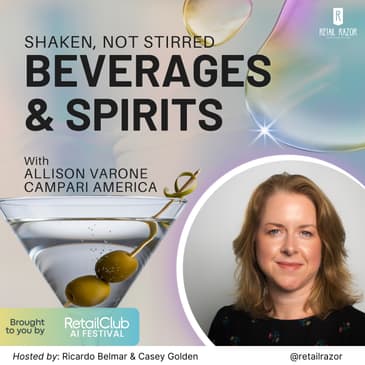



Campari America's Allison Varone on the future of beverages and spirits, Gen Z, and the new mindful drinking rules of beverage brand building.
Everyone keeps repeating that Gen Z doesn't drink. The data tells a far more interesting story for the future of beverages and spirits and this episode unpacks it.
In this episode of The Retail Razor Show, Ricardo Belmar and Casey Golden sit down with Allison Varone, Head of Marketing at Campari America, for a genuine masterclass in beverage brand building. With more than 20 years across the wine and spirits industry, Allison leads marketing for one of the most iconic brand portfolios in the world: Aperol, Campari, Wild Turkey, Courvoisier, Grand Marnier, Espolòn Tequila, and the newly US-launched Crodino, a non-alcoholic spritz beloved in Italy since 1965.
This conversation goes beyond the headlines about the future of beverages and spirits industry to explore the cultural shifts, strategic bets, and marketing instincts behind some of the most recognizable drinks in the world, and what they mean for anyone building consumer brands in 2026. This is Season 6, Episode 6.
What We Cover.
How Gen Z is redefining drinking culture, and why mindful drinking is a growth opportunity for the spirits industry rather than a threat.
The "zebra striping" trend: how consumers now bounce between alcoholic and non-alcoholic beverages depending on the occasion.
Crodino's US launch and the strategic timing behind Campari America's move into the non-alcoholic spirits space.
Why occasion-led marketing has replaced category-first brand thinking across the beverage industry.
What Aperol's Coachella activation and Negroni Week reveal about experiential marketing ROI.
How Wild Turkey's "Don't Change a Damn Thing" campaign keeps a heritage brand culturally relevant on TikTok.
The real playbook for challenger brands trying to break through a crowded beverage market.
What premiumization actually means when consumers are cautious, and how Espolòn Tequila balances premium with accessible.
Inside the Campari Academy and how bartender education becomes a competitive advantage.
A bold look at the future of beverages and spirits in 2035: more inclusive, more occasion-led, and centered on human connection.
A Standout Idea from This Episode.
Allison's advice to brand strategists was refreshingly direct: focus less on categories and more on how consumers are actually evolving. Lead with the occasion, then figure out where your brand fits into that moment. That is brand strategy advice that travels far beyond the spirits industry.
Whether you work in retail, brand marketing, CPG, or you are simply curious about how culture shapes consumer behavior, this episode delivers insight you can use immediately.
Support Our Sponsor.
This Episode is Brought to You By RetailClub.
Join 2,000 retail leaders at RetailClub AI Festival, September 22–24 in Huntington Beach. Dive deep into how AI is reshaping retail while soaking up the sun at a fully outdoor, beachside venue. Decision-makers from retailers and brands can attend with free tickets and up to $1,250 in travel reimbursement. Head to retailclub.com to learn more. https://retailclub.com/retail-razor-podcast
Subscribe & Follow.
If you enjoyed this episode, please leave us a 5‑star rating and review on Apple Podcasts, Spotify, or Goodpods. Subscribe on YouTube so you never miss an episode and check out the other shows in the Retail Razor Podcast Network: Retail Transformers, Blade to Greatness, and Data Blades.
Subscribe to the Retail Razor Podcast Network: https://retailrazor.com/
Subscribe to our Newsletter: https://retailrazor.substack.com
Subscribe to our YouTube channel: https://go.retailrazor.com/utube
About our Guest.
Allison Varone, Head of Marketing, Campari America.
https://www.linkedin.com/in/allison-varone-4650901/
https://www.camparigroup.com/en
Allison Varone is Head of Marketing at Campari America, a growing powerhouse group in the U.S. spirits market. A seasoned executive, leader and strategist, she has more than 20 years of experience driving growth, market share and profitability for both large and small brands. She joined Campari America in 2024 and previously served as Vice President of Channel and Customer Marketing, where she lead Campari America to some of its greatest partnerships and campaigns, including Negroni Week for Campari, SKYY Vodka for PRIDE, Courvoisier Bring Your Own Courvoisier campaign and Aperol as a sponsor of the U.S. Open and the official Spritz Partner at Coachella.
Chapters.
00:00 Opening Teaser
00:49 Show Intro
06:02 Welcome Allison Varone
07:23 Gen Z & Mindful Drinking Culture
09:09 Non-Alc Innovation & Product Strategy
12:46 Occasion-Led Marketing & Coachella
14:39 Shifts in Consumer Behavior
17:02 Spanning Generations Across the Portfolio
19:26 Measuring Activation Impact
21:27 Advice for Challenger Brands
24:33 Honoring Heritage Brands
26:22 Premiumization & Value
28:18 The Campari Academy & Elevated Experiences
30:53 The Spirits Industry in 2035
33:17 Advice for Brand Strategists
35:27 Wrap-Up
37:23 Show Close
Meet your hosts.
Helping you cut through the clutter in retail & retail tech:
Ricardo Belmar is an NRF Top Retail Voice for 2025 and a RETHINK Retail Top Retail Expert from 2021 – 2026. Thinkers 360 has named him a Top 10 Thought Leader in Retail, a Top 25 Thought Leader in AGI and Careers, a Top 50 Thought Leader in Agentic AIand Management, and a Top 100 Thought Leader in Digital Transformation and Transformation. Thinkers 360 also named him a Top Digital Voice for 2024 and 2025. He is an advisory council member at George Mason University’s Center for Retail Transformationand the Retail Cloud Alliance. He was most recently the partner marketing leader for retail & consumer goods in the Americas at Microsoft.
Casey Golden, is the North America Leader for Retail & Consumer Goods at CI&T, and CEO of Luxlock. She is a RETHINK Retail Top Retail Expert from 2023 - 2026, and Retail Cloud Alliance advisory council member. After a career on the fashion and supply chain technology side of the business, Casey is obsessed with the customer relationship between the brand and the consumer and is slaying franken-stacks and building retail tech!
Episode Music.
Includes music provided by imunobeats.com, featuring Overclocked, and E-Motive from the album Beat Hype, written by Heston Mimms, published by Imuno.
Transcript.
S6E6 Future of Beverages & Spirits
[00:00:00]
Opening Teaser
Ricardo Belmar: Quick question.
Casey Golden: Gen Z doesn't drink, or are they just drinking better than us?
Ricardo Belmar: The Aperol Spritz went from, " What is that?" To showing up at Coachella with Charli XCX.
Casey Golden: A generation is rewriting drinking culture from scratch, and non-alcoholic spritz that's been quietly beloved in Italy since nineteen sixty-five just landed in America.
Ricardo Belmar: The spirits industry is being completely reinvented culturally and literally, and today we've got the executive actually doing the reinventing.
Casey Golden: Alison Varone, head of marketing at Campari America. Aperol, Wild Turkey. The entire portfolio is icon status.
Ricardo Belmar: You do not want to miss this one.
Casey Golden: Hit subscribe. Grab a bougie bev. We'll wait.
Show Intro
Ricardo Belmar: [00:01:00] Welcome back to season six of The Retail Razor Show, the number one management and indie marketing podcast on Goodpods, and the original show in the number one indie podcast network for retail.
I'm Ricardo Belmar.
Casey Golden: And I'm Casey Golden.
Welcome back, Retail Razor fans, to retail's favorite podcast, where we cut through the clutter to bring you the sharpest insights in retail, consumer brands, and the trends reshaping how people shop, buy, and yes, drink.
Ricardo Belmar: Ah, yes, definitely one of the best parts. Always better with a quality beverage in hand.
Casey Golden: That's right, Ricardo. And today, we're raising a glass because we are diving into the world of spirits and beverages. A category that has been shaken, stirred, and completely reimagined over the last few years.
Ricardo Belmar: Uh, Casey, I think you mean shaken, not stirred, right? At least if we're talking about one of the, the things I love to have in common with James Bond.
Casey Golden: Ricardo, one of the things you have in common, as in one of many? [00:02:00] I'm almost afraid to ask. Actually, no, I'm gonna-- We'll keep that for another podcast.
Ricardo Belmar: It would be a fun podcast for sure, I can tell you that.
Okay, so let's set the scene then for this episode.
It's 2026. Gen Z is officially of legal drinking age across the board, and they are not doing what anyone expected. Big surprise. At least not what any of us did at that moment. They're not doing-- You're not gonna find them doing shots at the bar.
They're curating their cocktail moment like it's a key part of their aesthetic.
Casey Golden: And you, unlike Gen Z, used aesthetic in the proper context. Take note, Gen Z. And meanwhile, your aperitivo hour has gone from something your Italian grandmother talked about to something Charli XCX is doing at Coachella.
Ricardo Belmar: Yeah, you could say the Aperol Spritz is basically a fashion accessory at this point.
Casey Golden: Right? And somewhere in [00:03:00] between the sober curious movement, GLP-1 meds, and the explosion of premium non-alcoholic spritzes, the entire industry is asking, "What does it actually mean to drink in 2026?"
Ricardo Belmar: Yeah. Now, if you've been listening to the show for a while, you know how much we love bringing in the executives who are actually living these transformations, not just talking about them in a boardroom or a PowerPoint deck, but out there building the campaigns, the culture, and the brands that consumers are choosing.
Casey Golden: And today, this guest is absolutely that person.
Ricardo Belmar: But before we tell you all about her. Let me tell you about our new sponsor of the Retail Razor Podcast Network, RetailClub. Join 2,000 retail leaders at the RetailClub AI Festival, September 22– 24th in Huntington Beach. Dive deep into how AI is reshaping retail while soaking up the sun at a fully outdoor beachside venue.
Decision-makers [00:04:00] from retailers and brands can attend with free tickets and up to $1,250 in travel reimbursement. Head to retailclub.com/retail-razor-podcast to learn more and get your ticket today. A big thank you to Retail Club for helping us bring you this podcast and all the other shows in the Retail Razor Podcast Network.
Casey Golden: Today's guest is Alison Varone. She's a 20-plus year veteran in the spirits and marketing world. She's led campaigns spanning from Negroni Week to the Aperol Spritz Piazza at Coachella. She's joined Campari America in 2024 and is now head of marketing, leading one of the most iconic and ambitious brand portfolios in the entire spirits industry.
Ricardo Belmar: We're talking Aperol, Campari, Wild Turkey, Courvoisier, Grand Marnier, Espolòn Tequila, and the newest kid on the block for US consumers, Crodino, Campari's non-alcoholic [00:05:00] spritz that's been beloved in Italy since 1965.
Casey Golden: This woman is essentially the chief curator to cocktail hour.
Ricardo Belmar: And we could not be more excited to learn from her. I expect this to be a masterclass in branding.
But before we jump in, we do have a favor to ask of you, our fans listening and watching today. If you're enjoying this season, and we hope you are, and I kind of feel like if you came back to this episode, that probably means you are enjoying it, so please give us a five-star rating and review on Apple Podcasts, Spotify, or Goodpods.
And if you're watching us on YouTube, don't forget to like and subscribe. We'd also love it if you check out the other shows in the Retail Razor Podcast Network if you already haven't: Retail Transformers, Blade to Greatness, and Data Blades.
Casey Golden: With that said, let's welcome to the Retail Razor Show, Alison Varone, head of marketing at Campari America. Our conversation starts now.
[00:06:00]
Welcome Allison Varone
Ricardo Belmar: Welcome to the Retail Razor Show, Allison. It's a real pleasure to have you here with us and have this opportunity to really dig into the spirits and beverages industry, talk about the most important trends. This is honestly probably going to be one of my new favorite episodes because we never get an opportunity to have this kind of discussion.
Allison Varone: Great. Well, thanks for having me. Great to be here today
Casey Golden: Yeah. I love the fact that we'll have the opportunity to essentially deep dive into this specific industry segment. It's gonna be a real treat for us and our audience. So to get us started, Allison, why don't you just tell us a little bit about your background and role at Campari, and in case there's anyone left out there who isn't familiar with the brand, maybe a little bit of background there too.
Allison Varone: Sure, sure. So, so I'm, I'm thrilled to be here today. Thanks again, and I've been working and, and leading brands in the wine and spirit space for many years, almost 20 years of my career. Brands across multiple categories within wine and spirits probably most of them at this point. [00:07:00] I'm currently the head of marketing at Campari for the US market.
And a lot of people don't know, we obviously have Campari brand, which hopefully everyone knows that brand, but we're also a very large portfolio of brands, including, you know, brands like Aperol, Espolon, Wild Turkey, Skai Vodka, Courvoisier. There's Grand Marnier and, and many others. But but yes, obviously well known for our Italian portfolio.
Gen Z & Mindful Drinking Culture
Ricardo Belmar: Great. Well, thank you for that. So one of the things I find is like super interesting about what's happening in this industry segment is really the way that Gen Z seems to just be rewriting the rules of how and why and when people drink these products. You know, seems to be moving towards more of a, I just call it a more mindful, intentional kind of consumption rather than just saying, "Let's have a drink," because that's what people might do.
So, so from Campari's vantage point, what to you is the most exciting part of where this drinking culture is evolving and how is a brand like Campari kinda helping to shape that next chapter with this generation?
Allison Varone: Yeah, we're in [00:08:00] very interesting times and you're right that people's consumption patterns are changing, right? And the way we're responding to that is really about responding to the moderation trends with our diverse portfolio, right? So, and offering different products for different occasions and different moments of that moderation.
So we have low-alc options, like a spritz as an example, is, is a very low alcoholic cocktail, which has been a phenomenon in the United States that came over from Europe. We also have a non-alc offering within spritz called Crodino, which we just launched last year in the US. So we have non-alc we also have high proof and, and, and all of our other brands as well.
So I think from our perspective is we're focusing on what we call the first share drink. We wanna be people's first share drink of the day of the evening when they're, you know, ready to obviously, you know, unwind and, and have a social occasion. So we think we're well positioned to answer on the new moderation trends.
And again, lots of, lots of chatter [00:09:00] out there about, you know, people consuming less. Of course, I think people are, but I think people are also consuming more mindfully, and we're well positioned to answer that that trend as well.
Non-Alc Innovation & Product Strategy
Casey Golden: Yeah, between the sober curious movement, GLP-1's influence on all cravings and a shift toward just quality over quantity I mean, as a '90s child, like how many times did we drink something and like hold our nose? Um, don't think that's like a Gen Z thing that's happening here, right? Consumers are fundamentally rethinking this relationship with alcohol in general. How has that inspired these new product innovations at Campari, and what does opportunity look like for brands that lean into that shift rather than resist it?
Allison Varone: Yeah. We, as I mentioned before, we have a portfolio that's built on full strength and moderation led occassions, right? [00:10:00] Which we're very lucky. And I think for us, we're inspired by the ability to focus on flexibility of day parts in the sense of we have products and experiences that can be enjoyed in daytime occasions, social occasions, at home occasions, which we know ever since the pandemic has also, certainly blown up the at home entertainment aspect of what consumers are doing and also con-- and also convenience, right?
So in terms of innovation, I mean, the RTD space has been so interesting as we know, and consumers are looking for high quality products in a convenient format. So we're starting to explore that. We already have ready-to-serve options with Campari, with Aperol where consumers can just, you know, open the bottle and pour it over ice and it's ready-made and, and a high quality experience.
So, I think convenience is a big part that we're leaning into. But we also are making sure that our innovations stay premium, they [00:11:00] stay high quality because there's a lot out there. We need to make sure that ours are brand led and really rooted in the authentic serves that we drive here at Campari through all of our products.
Casey Golden: Yeah, it's gotta be a fun space. There's so many new drinks out on the market, so many brands. And it is kind of difficult to try something new when you're not buying wine very often
So this is re- it's really interesting. So much I haven't got onto the non-alcoholic yet because I always think drinking or not drinking. And so, I'm really curious now of like a whole handful of things that I wanna try.
Ricardo Belmar: Yeah
Allison Varone: And I think what's interesting about the non-alc mindfulness is that there's a lot-- what we see in the data is that consumers are just being more choiceful in when they want an alcoholic versus a not, right? Not necessarily where it's one or the other, right? It's both, right? So I think, as I said, we have options [00:12:00] for that, what people want in terms of flexibility of choice,
Ricardo Belmar: Yeah, but
Allison Varone: great. And it's a good trend. I mean, it's all good things. People should be mindful with what they're putting in their bodies and, we're able to offer that in our portfolio.
Ricardo Belmar: And it really does seem to be more of an occasion-led experience now where it seemed we moved from an era where, where people thought about drinks as it's just, it's what they do when they go out, whether it's a restaurant or a bar or they're with people. But now it's really more about the occasion and how the drinks, whether it's alcoholic or non-alcoholic, whether...
How does it add to that experience? And I I see that in, and you mentioned, I see that in the, the more premium nature of some of these things where, we-- there was a time when the re-ready to drink, we used to think that was practically a disposable product, but, you weren't expecting premium quality and experience from that.
Occasion-Led Marketing & Coachella
Ricardo Belmar: But now it almost is the expectation around that occasion. I, I'm curious, like, how, how do you look at, from a marketing perspective, how do you look at translating that into new campaigns that you design, new [00:13:00] experiences that you're trying to engage with your consumer? You know, like for example, what would be some of the most creative executions that you, you've you've been able to do in the past year following this trend?
Allison Varone: Yeah. Definitely, I mean, 100% correct. I think the occasions are really fluid now, right? Driven by people, how people are gathering versus kind of the cookie-cutter approach to going out at night to a bar, to a nightclub, very, very I should say simplistic view of the occasion.
So it's definitely fluid. The way we activate is really, is meeting the consumers where they're at in real life, in culture, digitally, obviously social. And a great example is, is let me give you an example of Aperol. We just came off of Coachella. I'm sure you can't, open your phone and the news without
Ricardo Belmar: And not get a post about it, yeah
Allison Varone: But we just came off of that, which was excellent. But that's a great example of consumers are looking to have a real experience, led by music, led by culture, obviously led by fashion, and Aperol was at the middle of it in the sense that we wanna give them an [00:14:00] elevated experience, while they're enjoying, that occasion.
So that's an example of how, festival life is alive and well as an occasion how and, and we come into that. And then another good example for Aperol again, is we ran a, a campaign last year, which we called Aperolidays, which was a spin on, you know, bringing Aperol into your at-home holiday entertainment, right?
Which is not something you, you think about maybe when you think about spritz, but Aperol has become such a large brand that consumers are drinking it all year long, right? So again, how do we insert ourselves into those holiday occasions, which we know consumers are doing, are gonna be doing no matter what, and we wanna be at the center of that
Shifts in Consumer Behavior
Casey Golden: With over 20 years in the industry, you've seen massive shifts in consumer behavior before. You've probably seen pretty much all of it. Some that maybe surprised everyone. Was there a prediction about where drinking culture was headed that you later came to see differently, or something that [00:15:00] really a shift happened that unlocked a whole bunch of opportunity for any of the brands today?
Allison Varone: Yeah, I think I think a couple things that we knew, I mean, I've been in the industry for quite some time. We knew many years ago that the shift of, of mindful drinking was gonna be a thing. We definitely saw that. I think that the notion that people were going to not drink at all was kind of what we thought it was gonna be.
But what it's actually coming out to be is, again, what we call this kind of zebra striping, which is people are bouncing between, right, non-alc and alc, and they're looking for a diversified diversified products for whatever they feel in that moment, right? So I think that it's been tempered in the sense of that, that mindfulness drinking.
I guess the other one I wasn't necessarily maybe ready for, which has really been dynamic is the shift in daytime, the daytime occasions. They're much more prominent now than they were in the past. You know, 10 years ago it was, you know, you went, e- especially in New York or [00:16:00] metropolitan areas, I mean, late night was where you spent most of your socialization, right?
But consumers now are really, really bringing that up earlier in the day. And again, we're well-positioned here at Campari to answer on that, that that shift
Casey Golden: Goodness. Like, I actually, like, really need an education because I just went to the movies last night with a friend. We-- The only place to go was a bar. Neither one of us wanted to drink 'cause we had to be up early for work in the morning, and I-- we didn't even know what to order. Like, we need, like... I, I guess I need to start following a whole lot I'm gonna be following Campari and a whole bunch of others because I need ideas.
I don't even know what to ask for
Allison Varone: Yes. I think that's the beauty of, of the non-alc, right? A lot of, a lot of bars and restaurants now have, non-alc menus, you know, and we're at the forefront of that, which is great because again, we wanna make sure that we're giving people an ex- an elevated experience even when they're not, they don't wanna be consuming the the ABV
Ricardo Belmar: Yeah. No, that's so true. And it's, and it's such a different I-- this is such a different evolution where we came [00:17:00] from in this, in, in this segment.
Spanning Generations Across the Portfolio
Ricardo Belmar: When you think about, you know, how you're building out the brand and kind of architecting around all these different occasions and trying-- and of course still speaking to multiple generations how do you look at that when you're thinking about these things and how you're gonna implement that and activate on it?
How do you view that? And maybe thinking particularly across-- 'cause we seem to have so many differences, like Casey just highlighted, these are all practically generational differences, right? And, but it's still the same products. You're still trying to reach them with the same brands. How do you see that kind of playing out when you're activating it in market?
Allison Varone: Yes. I think again, our, at Campari, our portfolio is quite diversified, which we're very lucky, which means that we can span generations with our products, right? Which is great. So you have maybe, let's just say, entry consumers where spritz plays in the Aperols of the world, Campari, Espolòn Tequila, which is a massive brand for us at great success, Crodino [00:18:00] exact- which is a non-alc spritz obviously.
Then we move into heritage brands, right? Like Wild Turkey, we have Russell's Reserves and then we obviously have non-alc. So we're able to really span different types of consumers, right? And we definitely segment them. The way we go to market is really keeping the consumer target for that specific brand at the heart of what we do and make sure that we have cohesive marketing plans, but being able to be, you know, flexible to build scale of the different occasions that they live in.
So, you know, I'll give you an example. We'll do, let's just say Negroni Week, right? For Campari, which is in September, which is really a week where we kind of really take over Negronis, kind of take over metropolitan areas, which has been a great success. So that's one activation. And then we have, we do tasting events and master distiller type of events that we do and tastings for Wild Turkey, right?
Which obviously goes after a a different occasion. Then we even have, which we just launched this [00:19:00] week with Espolòn is Short King Week. I don't know if you guys saw it, but the idea of, small-- bigger is not always better, and Espolòn is a short tequila bottle in a sea of large, tall tequila bottles.
So we kind of put that notion, right, and have a little bit of levity. And that goes after a very big social content campaign, right? So you can see we kind of carve out the spaces depending on the brand and depending on the consumer target that we're going after for that particular brand.
Measuring Activation Impact
Casey Golden: With these activations, there's so many brands. You cover so many generations across it, different types of drinking styles, events. How do you measure the impact of all of these immersive moments and, like, brand love, customer acquisition? How does that whole piece, like, roll up to you?
Allison Varone: Yeah, ROI is a very big piece of what we do. And at the core of it we activate the brands and we bring the [00:20:00] brands to life, and we bring the liquid and the drinks to life, right? In a way that is immersive, memorable, and shareable, right? So that's kind of our mantra is we want, we want our consumers to really emotionally connect and have a really great experience that they're willing to share, right, with others.
So, and that drives scale. So the way we measure that is obviously through sales, of course, at the forefront, right? But also at kind of social listening, you know, the cultural signals, earned media relevance, our brand health metrics, obviously. Social listening is a big piece of what we do. As an example, you know, we just did Coachella.
I mean, Aperol was at the top of social mentions for the past two weekends because of obviously all the buzz and everything around that. So we measure that literally day by day, you know, when we're in the market doing something. So, and the goal again is to really drive emotional connection and affinity for our brands, not just awareness itself.
But when people are, bringing products to them and they want to speak to them, they wanna be emotionally connected. So that's why the brand equity piece of what we [00:21:00] do in the long term is so important.
Casey Golden: That's great. With the spirit space, like I'm almost like more proud than ever. We've got so many indie startups which going against portfolio giants, but all their exit strategies are literally to be acquired by the giants, right? Um, but some of these challenger brands have been winning by just going deep on culture and community and super niche consumer tribes.
Advice for Challenger Brands
Casey Golden: What do you see as the real playbook for a new beverage company to break through today? And what do you s- do-- like the most interesting emerging players understand that maybe some others don't?
Allison Varone: Yeah, it's it's tough to be a small brand emerging these days, right? 'Cause it's such a cluttered environment. So, from my perspective, I've worked on big brands I've worked on small brands in my past. So, you know, being a small brand can be challenging. I think the trick is, is, is the, the trick [00:22:00] is not to be too broad and to really, if you're a new brand, is, is find your voice and have a strong POV, right?
To be able to cut through and not be too generic, right? So I think that is-- that's important because again, it, it's, and you might not be a brand for everybody at that moment, right? But if you're starting out, you know, you wanna make sure that you have a strong point of view and a strong voice. And I would say it's really about building credibility, right?
It's selecting, what are the markets, cities you wanna go after because when you're small or emerging, you can't do everything. And I think that, you know, have a strong back to the brand voice is have a story. You know, and the brands that have strong stories and drive storytelling, and again, bringing it back to emotionally getting consumers and also trade partners in this, in this industry are quite important.
You know, getting the gatekeepers along with your story is gonna be key to starting out.
Ricardo Belmar: Yeah,
Casey Golden: Lots of friends in the space and I wouldn't have traded their people for mine any day. When [00:23:00] you're doing really hard stuff.
Ricardo Belmar: And if we turn that around a little bit, like when you as, as Campari are looking at bringing in a new brand for a new product whether it's a new category, a new, new alcohol segment, is it a similar approach? Or how, how do you think about that if you were to go introduce a new brand? Are you-- do you start by thinking of that particular very focused, well-defined segment that you think isn't being served by one of the other brands in the portfolio and then grow from there, or is it a different approach?
Allison Varone: I think it depends. Let me give an example of, of Cordino as an example, right? Which is our new non-alc. So Cordino is not a new to world product. It's actually was was created in nineteen sixty-five by herbalists in Italy. And we just recently decided to bring it here to the US, which a lot of people have been waiting for.
And the reason for that is that, you know, we felt like we needed to get the [00:24:00] spritz Aperol and Campari to a certain scale first before we introduced the non-alc version, right? The non-alc expression. So to answer your point, we see obviously now is the right time with all the mindfulness drinking we've been talking about, right?
So it's more about where's the space what's the need, what's the consumer need, and what product then answers on that need. And in a challenging business environment, I think that's the, that's the way to success versus kind of being very, very product-focused and making, making sure you're keeping your eye on the consumer need at the forefront.
Honoring Heritage Brands
Ricardo Belmar: Mm-hmm. Yeah, and then if we kinda look on the other end of the spectrum, you've got, strong heritage brands like Wild Turkey. You've got, you, you were talking about Negroni Week, right? And the strength behind that, and, and that's something that's been around for, gosh, hun- hundreds of years at this point, right?
H-how do you kinda honor that sort of heritage and still keep making it resonate with new consumers who are just discovering these brands and, and maybe it's they're discovering it through a social [00:25:00] activation on TikTok, for example. What's that art of keeping these iconic brands and their timeless nature, but without making it feel like it's old and tired, but still new and fresh?
Allison Varone: Yeah. Yes, I mean, certainly our brands are, iconic and have been around for a long time. And you mentioned, you know, Wild Turkey is a good example. So we, we launched a new campaign last year called Don't Change a D- Don't Change a Damn Thing which is very kind of an homage to Wild Turkey always being the same formula, right, which people love, which is great.
The trick is how do we stay true to that brand and we translate that messaging onto different platforms, right? Translate them onto social, translate them onto TikTok, right? Which we know consumers are obviously, you know, that's what they're consuming media-wise. And really understanding the medium the medium itself, and then how does the creative voice come through that medium.
So I'll give you an example. On TikTok, we don't wanna seem too polished, so we bring a campaign like Wild Turkey, which we bring, you know, a, a very elevated, beautiful campaign, and we [00:26:00]change the assets slightly and kind of nuance them to be fitting for the platform, but still staying true, obviously, to the message of the brand.
So it's really about being medium first and thinking about how consumers interact with the platform and then how do we, you know, bring our campaigns to life in that medium. So it's not so cookie cutter. It's very very strategic in terms of how we roll those out.
Ricardo Belmar: And that makes a lot of sense. Makes sense that way.
Premiumization & Value
Ricardo Belmar: So one other aspect I'm curious about, so, we're, we're in this environment where you hear in the news every day about different economic pressures and different demographic segments and, and you have to take that into account, I'm sure, as you're coming up with these new campaigns, right, and for the different products.
But particularly when you're thinking about premium brands and premium products and you mentioned a few earlier, I'm particularly curious around like the ready-to-drink premium ones, where again, you're, you're asking for more share of wallet, right, for these at a time when consumers are being a little bit more specific and cautious about where they're placing [00:27:00] those dollars.
How do you go about finding the right balance there?
Allison Varone: Yes. I think the notion of premiumization is interesting because we see it as premium equals value, right? So if, so if people feel your brand is valuable to them, they will pay the money, right? They will purchase your product, right? But also consumers are more intentional, as we, as you just said.
So I think for us, we balance the premium-ness of the value we bring to the consumer with you know, price and obviously the trade-off. So I'll give you an example. Espolòn's a great example. So Espolòn's our, our tequila, one of our biggest tequila brands. The fastest-growing, one of the fastest-growing premium tequilas in the US over the past, you know, several years.
And it's a very high quality, very, You know, has craftmanship, but is accessible to people, right? And it's accessible. We have not, you know, we want it to be kind of the brand for the people, if that makes sense, and we want it to be democratized for everyone to enjoy it. So [00:28:00] we balance that premium-ness with making sure that we're accessible and approachable.
And again, I think that, you know, bringing what's the value equation for the consumer? What experiences do we bring to them? How are we in culture that they see our brand as valuable to them as a consumer that they're willing to pay for?
The Campari Academy & Elevated Experiences
Casey Golden: This is really interesting. My brain has been like, ever since we started, prepping for this call, for the podcast, my brain has just been cycling through what I know and what I don't know, and what I think is normal and what is not normal. And you think, when you go out, I want that beverage experience.
I want the fancy drink. I want that, like, I want the cute glass. But like, n- who am I kidding? I'm a complete lightweight. I can't handle it. It ruins my whole next day. And you just think it's been ingrained for so long in like soda, water, beer, alcohol. I don't get that, that other [00:29:00] thing, and this is just-- There's, th- there's this other space now.
There's this other beverage experience, this new drinking experience. I can have the fancy drink. I can have the fancy glass. I can have something that tastes absolutely delicious, and it's none of those things. Um, like now it is this whole new category that I just never considered it personally non-alc. I just didn't even think that, that's what the category was. That didn't even come into my mind until we're sitting here like reading and writing this.
Allison Varone: Well, it has really evolved. It has really evolved beyond our space, right? And I think what we've learned here at Campari, and you might not be aware, but we have what we call a, a Campari Academy here at the US, um, office here. We also have it globally, right? And we have a... It's an entity that we have that's been for several years, which is really driving education for our brands within the bartender community, right?
So the, the academy has been for [00:30:00] years talking about and educating on how we can bring elevated cocktail experiences to our bartenders, and bartenders can then obviously bring them to consumers and give them an elevated experience. And it's not always have to be with an ABV or an alcohol attached to it, right?
So I think the industry has really, really evolved, and you go to restaurants now and bars and, you know, they're bringing it on and, and they're putting it on the menu to offer, you know, different experiences for people. So at Campari, we've been, we've been thinking about this trend for a while and we bring a lot of bartenders and trade community here in the office in our academy space to kind of play with cocktail concoctions, play with, different flavors and to be able to deliver that to their bars and therefore obviously to our consumers and their patrons
Casey Golden: How fun. I need to go out and have drinks tonight. I gotta figure out what I'm ordering before we get off this podcast.
Ricardo Belmar: right.
Casey Golden: What am I asking for?
The Spirits Industry in 2035
Casey Golden: Looking ahead 10 years, the spirits landscape could be, could look radically different with [00:31:00] functional drinks, premium non-alc, and, and culturally specific spirits all vying for this same share of glass. What does a thriving, exciting spirits industry look like to you in 2035? And do you think some of these consumer behaviors that are emerging are going to be critical for that to happen, or do you think there's another shift coming?
Allison Varone: Yeah, I think it's a very dynamic environment. I think if you look 10 years ahead, I think we're gonna see a much more inclusive industry in general, focused on moments of connections and occasions, not just drinks or products. Obviously consumers wanting real world experiences, but offer-- also wanting a wide variety of offerings, which is where we at, are now, as I'm mentioning, right?
Non-alc, alc, high proof and consumers really, I think, imbibing and consuming in social occasions and experiences versus [00:32:00] kind of just drinking for drinking's sake, which might have been the, the, you know, kind of how the culture was many, many years ago. So, which is great, right? It's really about human connection.
It's really about people wanting to be together, coming out of the pandemic. Of course, that's been exasperated. And for us, even as an Italian company at Campari, we've also seen, what we, we call the aperitivi culture, which is the idea of, everyone's first shared drink, which I mentioned before, is usually a Campari drink or a Aperol or a spritz, which is a low ABV option to start your evening after a day of work or a day of school, right?
With a little bit of food and being, at the core of it is being social with people. And we see that as a trend as well that hopefully will continue which is which is nice
Ricardo Belmar: Yeah, I like-- I love how that is framed i-in shape because it really is about the, the cultural moment, the experience, and the occasion, and it feels like now like industry's coming together on helping consumers sort of expand that, right? And really, and really deepen that relationship.
So it really does become now a [00:33:00] relationship with the brand versus it's just the alcohol on the shelf, which I, I think honestly is what years ago is what it came down to for most consumers. And now, the things like, we, we care more about the experience that it's bringing out by having that like the Aperitivo drink is, is creating the experience for us and helping to build it.
Advice for Brand Strategists
Ricardo Belmar: So I think it really is more of an integration between brand and consumer than it ever was before. Like how you put it, that's just gonna continue to evolve and, and kind of grow from there. I'm wondering like if you were advising a brand strategist in the space today, right? On like where these things are going and how should, how should they place their big bets over these next few years to help grow the brand they're responsible for?
You know, are-- is there a particular type of activation, a particular marketing approach you think of, or a particular consumer behavior they should be really watching out for, latching onto, and, and, and kind of lean into what would that be? What would you tell them?
Allison Varone: Yeah, I would say focus less on [00:34:00] categories if you're looking to launch a brand or, you know, to obviously drive and, and grow a particular brand. Less on categories and more on how consumers are evolving and also occasion first approach, right? Where do you wanna reach consumers and how are they socializing today, and where does your brand fit into that versus coming at the brand, then figuring out, how to make them enjoy your brand, right?
I think there's a little bit of a, of a mindset shift there. And then I would say probably, if you wanna launch a big brand or you're working on a big brand, I mean, cultural resonance is a real big one, and that's the only way to have long-term success. Certain products, CPG products, obviously wine and spirits, the experiences that you give consumers are long-lasting if it's a good one, and it will stick with them, right?
And it will help your brand in long term.
Ricardo Belmar: Yeah. No, I think that's true, and I, I-- just listening to you say that, I'm thinking about, what are those brands that I would truly claim to have actual brand loyalty [00:35:00] to? And for me, just given the space I'm in, there are some technology brands that I would say that for. But when I think in terms of CPG brands, there probably are spirits brands that are ones that I would have the absolute most brand love for and relationships I know I'm getting it.
That's the brand. Don't give me another one. That's the one that I want because I know what it tastes like, I know what the experience is, and there aren't that many categories where I think that a lot of consumers can say that.
Casey Golden: Yeah, it's very interesting.
Wrap-Up
Casey Golden: This has been such an eye-opening discussion. Personally, my mind's a bit blown that, like, I'm looking at an entire category that I think I-- is completely aligned with me. Like, it's a bougie drink and the fun experience, and I haven't been, like, I haven't been doing this.
So you've got a new customer over here for sure. I've got so much to learn. I will be following, so, we'll get that voice share up, um, by one at the end of the day.
So thank you so much Al- Allison, for joining us [00:36:00] today a- and sharing your deep experience and knowledge into the spirits and beverages industry.
For an industry with so much legacy brand value, which I love brand legacy, I love hundred-year-old brands. They mean the most to me in the world. There is certainly more happening here now than ever before and I just find it very exciting, and there's so many lessons regardless of what industry you're in. This is such a winning recipe, and it's completely proven. It's just sometimes you gotta get out of your, out of your norm and take a glance and see what other industries and other categories are doing and how they're growing and how they connect to their consumers. This is super great.
Thank you.
Allison Varone: Great. Thanks for having me
Ricardo Belmar: Yeah, no, and I think Casey said it best right there. There's so much to learn from how you're building that brand relationship with consumers, how you're really integrating the cultural aspects to it. I really feel like it was just a great ma-masterclass [00:37:00] on how to do branding , which is one of my favorite topics.
So thanks again for joining us. If anyone in our audience, Allison wants to reach out and connect with you, what's the best way for them to do that?
Allison Varone: Yeah, I'd probably say usual LinkedIn, happy to... We get lots of, you know, we have a lot of brand fans both from a business standpoint and consumer, so feel free to reach out. We're always happy to to connect.
Casey Golden: Great. Thank you.
Ricardo, this episode is a wrap
Show Close
Casey Golden: I know you loved this episode, so drop us a five-star rating and review on Apple Podcasts, Spotify, or Goodpods. And if you're watching on YouTube, like and subscribe before you go.
I'm Casey Golden.
Ricardo Belmar: Follow us on LinkedIn, Bluesky, Threads, and Instagram, and subscribe to our Substack for highlights and bonus content. For transcripts and guest info, visit retailrazor.com.
I'm Ricardo Belmar.
Casey Golden: Thanks for joining us on the Retail Razor Show, part of the Retail Razor Podcast Network.
Ricardo Belmar: Until next time, stay sharp, stay [00:38:00] human, and stay ahead.
This is the Retail Razor Show.