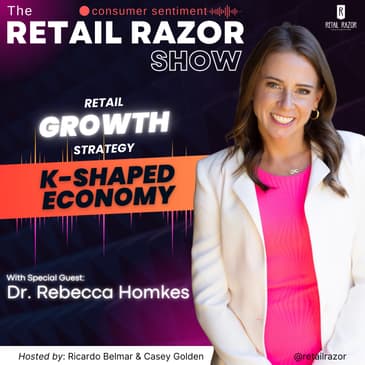



S6E2 The Retail Growth Strategy Retailers Need for 2026 with Today’s Economic Realities, Tariffs and Consumer Shifts
In this powerful episode of The Retail Razor Show, Dr. Rebecca Homkes, London Business School lecturer, Duke faculty member, high‑growth strategy advisor, and author of Survive, Reset, Thrive: Leading Breakthrough Growth Strategy in Volatile Times, joins Ricardo and Casey. Rebecca breaks down what retailers building their retail growth strategy must understand about the economic outlook in 2026, shifting consumer behavior, and the strategic moves that separate winners from laggards.
Rebecca explains why uncertainty is not a threat but a catalyst for growth. She walks through how her Survive, Reset, Thrive (SRT) framework helps leaders stabilize quickly, reset strategy intelligently, and execute a retail growth strategy that works even in volatile conditions. She also unpacks the realities behind sticky inflation, tariffs, the no‑hire/no‑fire labor market, and the rise of the K‑shaped consumer economy.
If you want to build a retail growth strategy that thrives in the face of market shocks, this episode gives you the playbook.
What We Cover
Why the economic outlook in 2026 is full of contradictions, and what that means for retail
How the SRT loop helps leaders stabilize, reset, and thrive
Real‑world examples of companies using SRT to turn crises into growth
Why averages hide the truth about consumer sentiment
The rise of the K‑shaped economy and the death of the “everyman” consumer
Value vs. price: why consumers will still pay more for what they truly value
How retailers should think about store formats, assortment, and experimentation
The must‑win battles for 2026
Where AI actually moves the needle in a retail growth strategy
Key Takeaways
Uncertainty is the best time to grow: because customers, partners, and employees are more honest about what they value.
Value ≠ price. Consumers want their dollar to go further, not necessarily cheaper products.
The middle of the market is the danger zone. Retailers must choose: differentiated premium or true value leadership.
Retail growth strategy in 2026 requires testing, iteration, and abandoning legacy assumptions.
Economic outlook in 2026 signals a decoupling between GDP strength and consumer reality: leaders must plan accordingly.
Subscribe & Follow
Subscribe to the Retail Razor Podcast Network: https://retailrazor.com/
Subscribe to our Newsletter: https://retailrazor.substack.com
Subscribe to our YouTube channel: https://go.retailrazor.com/utube
About our Guest
Rebecca Homkes, https://www.linkedin.com/in/rebecca-homkes/
https://www.rebeccahomkes.com
Author, Survive, Reset, Thrive: Leading Breakthrough Growth Strategy in Volatile Times. https://a.co/d/0aXECIB2
Rebecca Homkes, is a high-growth strategy specialist, CEO and executive advisor. After more than a decade of advising her clients on developing, executing and innovating on strategy, Rebecca is sharing her proven and practical playbook in Survive, Reset, Thrive: Leading Breakthrough Growth Strategy in Volatile Times. She is a Lecturer at the London Business School, Faculty at Duke Corporate Executive Education, Advisor and Faculty at the Boston Consulting Group focused on AI and Climate and Sustainability, and a former fellow at the London School of Economics Centre for Economic Performance. A global keynote speaker and recognized thought leader, she is also the global Faculty Director of the Active Learning Program with the Young Presidents Organization (YPO), leads several fintech accelerators, and serves on the boards of many high-growth companies. She earned her doctorate at the London School of Economics as a Marshall Scholar and is now based in Miami, San Francisco, and London.
Chapters
00:00 Teaser
01:10 Show Intro
04:40 Welcome Dr Rebecca Homkes
05:46 The Survive Reset Thrive Framework
08:04 Real World SRT Success Stories
12:55 Macro Economic Outlook for 2026
17:38 Understanding the K Shaped Economy
19:39 Value vs Price Strategy
24:06 Differentiation and Competitive Advantage
26:41 Store Strategy and Expansion
30:37 Consumer Experience and AI
32:34 B2B Software Experience Gap
34:04 Financing and Inventory Strategy
36:28 Supply Chain Robustness
38:10 No Regret Moves
40:40 Defining Right to Win
43:45 Hard Reset Strategy
45:51 Strategic Center of Gravity
48:24 Must Win Battles
49:34 Closing and Contact Info
51:36 Show Close
Meet your hosts
Helping you cut through the clutter in retail & retail tech:
Ricardo Belmar is an NRF Top Retail Voice for 2025 and a RETHINK Retail Top Retail Expert from 2021 – 2026. Thinkers 360 has named him a Top 10 Thought Leader in Retail, a Top 25 Thought Leader in AGI and Careers, a Top 50 Thought Leader in Agentic AIand Management, and a Top 100 Thought Leader in Digital Transformation and Transformation. Thinkers 360 also named him a Top Digital Voice for 2024 and 2025. He is an advisory council member at George Mason University’s Center for Retail Transformationand the Retail Cloud Alliance. He was most recently the partner marketing leader for retail & consumer goods in the Americas at Microsoft.
Casey Golden, is the North America Leader for Retail & Consumer Goods at CI&T, and CEO of Luxlock. She is a RETHINK Retail Top Retail Expert from 2023 - 2026, and Retail Cloud Alliance advisory council member. After a career on the fashion and supply chain technology side of the business, Casey is obsessed with the customer relationship between the brand and the consumer and is slaying franken-stacks and building retail tech!
Music
Includes music provided by imunobeats.com, featuring Overclocked, and E-Motive from the album Beat Hype, written by Heston Mimms, published by Imuno.
Transcript
S6E2 Dr Rebecca Homkes
[00:00:00] Teaser
[00:00:00]
[00:00:01] Ricardo Belmar: What if the next big market shock didn't sink your retail business, but instead became the moment you leap ahead?
[00:00:09] Casey Golden: In this episode, Dr. Rebecca Homkes, London Business School lecturer and author of Survive Reset, Thrive, walks us through a real comeback story and breaks down her survival, reset, thrive playbook so you can stabilize fast, reset strategy smartly, and execute to grow in 2026.
[00:00:33] Ricardo Belmar: We'll unpack the macro signals shaping consumer behavior, what rising rates and tariffs mean for margins and inventory, and the must win battles that separate winners from laggards and an AI first checklist you can use right away.
[00:00:46] Casey Golden: So stay with us to hear exactly what moves to make this year so you can achieve the growth you want, under even the most uncertain conditions.
[00:00:57] Ricardo Belmar: Let's get into it.
[00:00:59]
[00:01:10] Show Intro
[00:01:10] Ricardo Belmar: Welcome to the Retail Retail Show, a top 15 retail management and top 10 retail marketing podcast on Apple Podcasts, and the only retail podcast in the top 10 all-time indie management charts on Good pods.
[00:01:23] I'm Ricardo Belmar.
[00:01:25] Casey Golden: And I am Casey Golden.
[00:01:26] Welcome back Retail Razor fans to retail's favorite podcast where we cut through the clutter to give you sharp insights on what's happening in retail today, tomorrow, and where we get real about what's driving the future of commerce.
[00:01:40] Ricardo Belmar: Today's episode is something you haven't seen from us before. We're diving into new territory because you can't really develop a strong strategy for growth just by understanding the trends without really analyzing what's happening throughout the economy, what risks government policy changes could bring, and without a look at how [00:02:00] consumers are reacting to all that financial uncertainty.
[00:02:04] Well, you really need a capable guide to help you navigate all of that, don't you? Otherwise, how can you create a growth strategy for the year?
[00:02:11] Casey Golden: That's right. So today we're joined by someone whose specialty is analyzing all of those difficult, both tangible and intangible criteria to help you shape your strategy for the year. We're talking to someone who brings both an academic viewpoint and a management consultant's sharp point of view to the situation.
[00:02:32] Ricardo Belmar: We're joined today by Dr. Rebecca Homkes, a high growth strategy specialist, and the founder of a boutique consultancy firm, GrowthX, advising CEOs and executive teams focused on growth and success through uncertainty. She's part of the faculty at Duke Corporate Executive Education, a lecturer at the London Business School, Executive Education Advisor and faculty at BCGU, the Boston Consulting Group University, and a previous fellow at the London School of Economics [00:03:00] Center for Economic Performance.
[00:03:02] Casey Golden: Rebecca is also a global keynote speaker and the author of the book, Survive, Reset, Thrive, Leading Breakthrough Growth Strategy in Volatile Times, A Practical Playbook for Leading Growth Through Uncertainty.
[00:03:17] Ricardo Belmar: Rebecca developed the Survive, Reset, Thrive or SRT approach to creating and leading growth strategy through uncertainty. Her SRT loop, which we'll learn about in detail, helps leaders stabilize during market shocks, reset strategy when the market changes, and then execute to thrive. We'll talk about what that means for retail in 2026 from consumer behavior and store strategy to interest rate risk, tariffs, and where AI can actually move the needle.
[00:03:45] Casey Golden: And spoiler alert. Later in the episode, Rebecca will share a checklist for retailers facing a hard reset, name the must win battles she expects will define retail winners in 2026, and give you all the tools you need to [00:04:00] thrive in the most of uncertain conditions.
[00:04:03] Ricardo Belmar: But before we dive in a quick favor. If you're enjoying the show, hit us with a five star rating or like, and drop a short review on Apple Podcasts, Spotify, Good pods, YouTube, or wherever you're listening and watching.
[00:04:15] Casey Golden: Plus check out the other shows in the Retail Razor Podcast Network, Retail Transformers, Blade to Greatness, and Data Blades. You'll find them in your favorite podcast app or together on our YouTube channel.
[00:04:28] Ricardo Belmar: Now let's get into it. Here's our deep dive into the uncertainty and realities of 2026 with Dr. Rebecca Homkes, whom I have no doubt will quickly be a fan favorite on the show.
[00:04:40]
[00:04:40]
[00:04:40] Welcome Dr Rebecca Homkes
[00:04:46] Ricardo Belmar: Rebecca, welcome to the Retail Razor Show. We are so excited to talk with you and learn from you and get your guidance on how retailers can really prepare for this year while once again it seems expecting more uncertainty this year, changing [00:05:00] economic conditions, and a very cautious consumer.
[00:05:03] Rebecca Homkes: Absolutely. Thank you so much for having me.
[00:05:05] Casey Golden: Yeah, it's really wonderful to have you on the show. It's not often that we have the opportunity to learn from someone who really understands how to create growth out of all of this uncertainty and deliver strong execution.
[00:05:18] Ricardo Belmar: And I guess we could say you, you wear quite a few hats so to speak, right? For ranging from, economist, London Business School lecturer, Duke faculty, you're the author of the book, Survive, Reset, Thrive, which I know we'll get to learn more about. For listeners who haven't had the opportunity to meet your work yet, can you give us a, a quick kinda background on what your various roles are, kinda explain that Survive, Reset, Thrive Loop that I know we'll get into more details on from your book and, how that grew out of your experience advising companies.
[00:05:46] The Survive Reset Thrive Framework
[00:05:46] Rebecca Homkes: Yeah, absolutely. So I am based across London, Miami and San Francisco, and I'm a faculty member at the London Business School and Duke. But in both of them I just work in our executive program, so working with companies because I spend the majority of my time working directly with [00:06:00] CEOs and executive teams who are looking to grow. And so my specialty is high growth strategy. That's developing strategy, executing on strategy and innovating on strategy, which of course now includes incorporating AI into your value creation story. And I've been doing this for a very long time and where kind of the Survive Reset, Thrive mode came out of was a little bit after Brexit, which happened in the UK in 2016, but really hit home after COVID in 2020. Was speaking to so many executives across all industries, but a lot of retail and consumer goods, and I found that whenever we had a big shock to the system, the constant thing I would get from CEOs and executives is this, why me? Why now? Like why is this happening to me? I had a plan. Everything was working and realization one was, you can't call yourself an entrepreneurial leader if you can't grow in any market, right? We don't let the market tell us when it's a good time to grow. And second, growth is a loop, not a line, which [00:07:00] sounds really theoretical, but to make it practical, we have frankly, unfortunately, raised leaders in organizations with linear planning like checklist, and you know, the 10 point checklist, a five point checklist.
[00:07:11] We've almost convinced ourselves we can checklist ourselves to growth. And that's not how the world works. This is a loop, and loops are great, and you're gonna go through this constant loop of survive, reset, and thrive. There's gonna be shocks to the system you've gotta stabilize, but then you need to reset to change for the new world.
[00:07:27] Then you can go back to being a thriving organization. But even when you're doing everything right and thrive, there's gonna be other shocks. And embracing the loop allows you to lead your organization through different parts of the journey and not always assume it's about getting back on track.
[00:07:41] Casey Golden: It's a great mindset shift actually.
[00:07:43] Ricardo Belmar: Yeah.
[00:07:44] Casey Golden: know, so you've worked with many leading retail and consumer brands and, and companies, and advised executive teams through these unexpected market shocks. Without naming names, of course. What's a short example of a company that [00:08:00] used SRT to turn a disruption into a growth opportunity?
[00:08:04] Real World SRT Success Stories
[00:08:04] Rebecca Homkes: Yeah, well, I'm really fortunate to work with a lot of great brands, so I work with companies like WD 40 and Gorilla Glue. I do some work with Proctor and Gamble, but also brands across many other industries, a lot in the infrastructure, construction, concrete, and fashion space.
[00:08:17] You know, WD 40 is a great example of an organization that has hit some shocks. For instance, when COVID, when their kind of retailers were closed for a bit, they had to really leverage up on e-commerce. Their user is shifting now, right? Is that their kind of typical user is aging a bit and we've gotta think about building the brand with the next generation, and of course, what AI and sustainability means. And so they really use survive, reset, thrive to one, make decisions based on beliefs. Not always waiting for established facts.
[00:08:45] You've really gotta take some stances on how quickly some of these key themes are gonna influence your industry and also emphasize on the learning. So they really have embraced the mode of SRT and focusing on building what we call this learning organization. And so that's again, [00:09:00]advancing that partnerships with their retailers, but also understanding where future growth is gonna come from. Which will be from emerging markets, their industrial channel, as well as embracing these key, what we call mega trends around sustainability and growth markets and digital commerce.
[00:09:13] So I think some really successful examples, there's also smaller examples, but I'll just share my, one of my favorites, and of course I love every company I've worked with equally. But a really great example of Survive, Reset, Thrive was in the consumer space and actually one of the companies runs all the zoos and amusement parks in Scandinavia, and if you think your business got hit hard in the early 2020s, well their business was closed by the government. So you go from two weeks to opening the season to every single business is closed. And the CEO was a fourth generation, and he had this really difficult moment where he said, you know, my great-great-grandfather got this company through World War I. My grandfather got this through the Spanish War in World War II. My father got this through the inflation spikes in the 1970s and now on my [00:10:00] watch, you know, the whole family of business is gonna go down and they really embrace the notion that we first have to survive. That too many people in the industry were just focused on opening and they took the opportunity to really survive.
[00:10:12] They did things like mapping out their supply network and saying, well, everyone is trying to stop paying people. They mapped the ecosystem and realized there's two or three suppliers that if they don't survive, this industry won't, and they prioritized paying them. They built really proactive relationships with the government and so they were able to go into reset months before anyone else in the industry. And why I love this story is as they were going into reset, they realized that mentally the team was struggling to get outta that survive mentality. And we'll come back to this. We're seeing this with some retailers in the US right now. And so what they did is they split the team into two. They made a survive team and a reset team, and they told the survive team, look, you're responsible for these critical metrics like cash and cost and customers and communication, but reset team, I need you to open your growth mindset and be prepared for where [00:11:00] growth is coming. And they realize that asking people to do both wasn't happening.
[00:11:04] And they likened it to sports. If you think about any sport, American football or European football, you don't ask a player to play offense and defense in the same game. Yet, why are we asking our teams to do both right on a day to day? And so splitting them allowed both mindsets to really focus. So they moved outta that reset into the thrive, and 2020 was their most profitable and highest growth year, despite being limited to 20 to 30% capacity. But they also had their highest levels of NPS and engagement, and they kept building on those metrics of five years after that. So really embracing the mode of survive, reset, thrive, I've seen such powerful examples, and that's just two of them.
[00:11:41] Casey Golden: That's a really compelling value proposition. We're seeing a lot of org charts changing in, in and have to change now because of AI. And more organizations flatten. Very compelling when you think about it, because it's typically just all on your desk,
[00:11:59] Rebecca Homkes: All on your desk. [00:12:00] Yeah. And here's, here's the thing, and then we, and then we make that a prideful moment and we brag about how my team is great in a crisis and we love it when there's this urgency. And this is a top question I get asked is, how can I always have this spirit of urgency and crisis, and that's actually not what you want, right? Because that is emotionally and mentally draining and that doesn't actually build this growth mindset we want. So frankly, we need to stop romanticizing being great in a crisis. Crisises happen. We can't avoid them, but we need to acknowledge them for what they are parts of the survive phase. We can move on to that next aspect.
[00:12:34] Ricardo Belmar: Yeah, that's, that's a great point. E especially, you know, in your example when they recognize they needed to split the team into these moves, because that's something you don't hear often where, where a lot of leaders wanna focus on getting everyone in the team involved in the same focus, and sometimes that's not the right answer.
[00:12:52] Right? That that's not the way to make the best use of the resources you have. So
[00:12:55] Macro Economic Outlook for 2026
[00:12:56] Ricardo Belmar: I wanna shift a little and look a little bit forward into what we think may be hap may [00:13:00] happen this year. So just looking at the bigger macro picture for 2026, at, at this time, right? We're recording this in, in February.
[00:13:06] We're already starting to hear a lot of forecasts and what people are expecting for modest GDP growth, what they're expecting around sticky inflation for parts of the year. Concerns about what the fed may or may not do around throughout the year. How should retail leaders really translate that picture into their immediate checklist of priorities and, and how they should look at the
[00:13:28] Rebecca Homkes: Yeah.
[00:13:29] You, there's so many of these top trends, right? If you really think about it, we're looking at the, the macro economy, right? We're looking at the geopolitical volatility when it comes to tariffs and trade, the impact of AI and where the consumer is. And what we're really seeing is a decoupling of a lot of things that used to, we would say, correlate kind of work together, is that US GDP is red hot, right?
[00:13:53] It is fiery hot. It is numbers that people like myself did not anticipate and estimated to get even hotter. [00:14:00] But that is happening at the same time that these two key aspects we look at in the economy, we call them the dual mandate of the Federal reserve, inflation on the job market. Are both moving in the wrong direction now, albeit slowly, but both moving in the wrong direction. So we are seeing a decoupling of top line economic indicators from actual economic indicators that our consumer feels day to day. And this is something that requires a lot more thought leadership than, frankly I'm seeing from folks right now because we can't claim the economy is strong when we are still in what we call this no hire, no fire job market
[00:14:37] in that the headline labor market looks okay and not great. But again, okay, in around the mid fours is historically low and we need to acknowledge that. But we are strongly seeing that companies are not creating jobs. And where this is really happening is our small to medium sized business job growth is flat to negative. And these are typically the engine of the US economy. Now you put that [00:15:00]against inflation. We, you know, the Federal Reserve likes inflation around 2%. We've been above that for five going on six years. Now, some people say, well, three is the new two. Well, not really, right, because consumers are actually really feeling the punch of where that is.
[00:15:17] And we still have not seen the full impact of tariffs. So we've only really seen anywhere between 20 to 50% of the impact of tariffs come through to the consumer. So when I look at the economy, I look at these other aspects. I take all the headlines, but then I go down to the next five pieces of the storyline. We are seeing a no hire, no fire, with two exceptions, construction and healthcare.
[00:15:40] Who's losing jobs, retail, consumer goods, et cetera, and we're seeing an inflation that's not moving higher, which is great news, but there's very little, which is gonna cause it to come back in the near term. This is making the Fed's job complicated, but it's really actually making a retailer's job complicated. Because I'm in this stalemate of my [00:16:00] consumer is demanding a lot more value, they're also feeling a lot more of a crunch, and we're gonna need to start some, see some shifts in how we react to this.
[00:16:08] Ricardo Belmar: Yeah, it's a lot to take in for a retail leader who in many cases, I, I imagine, and probably worked with many in this mode who haven't been in this kind of position before. Right? They're used to, in the pre COVID years, they're probably used to a pretty consistent kind of flow, year to year, pretty steady and mainstream.
[00:16:25] And now they're, they're being challenged with these sort of conflicting data points and conflicting movement, and trying to
[00:16:31] Rebecca Homkes: tell me the story you want the data to tell, and I'll make the data tell that story. Right? If I worked for the administration, I could paint a very rosy picture of how great the economy is. If I was trying to beat the administration in the midterm elections, I could paint a very scary picture about where the economy is going. Now, I don't want any retail leaders to get into politics, that's your personal choice.
[00:16:53] We need to deal with the environment we have in front of us, which means being brutally honest about what these indicators are telling us, and more [00:17:00] importantly, what that means for our value offering, depending on who our ideal consumer is in this environment.
[00:17:06] Casey Golden: Yeah, it's I think a lot of consumers, there's been talk that we're, we feel very, everybody feels very conflicted, where two truths are like two opposite truths are true at the same time. You know, where you just like, you feel like it should be going this way, but it's going this way. But, you know, it's very much, you know, just kind of. So much more into a loop of I don't know where we're going, if we're going forward or if we're going backward. I have no clue right now everything seems to me to make sense and not sense at the exact same time!
[00:17:38] Understanding the K Shaped Economy
[00:17:38] Rebecca Homkes: You know, and the answer is a little bit of all of the above, and that's where averages are really damaging. Right.
[00:17:44] And you know what I'm saying right now, and this is again, my hypothesis is, we used to in, especially in retail and consumer goods, talk about the every man. The every man product.
[00:17:53] And for those that don't know what this actually came out of kind of political campaigns, you wanted the every man president, the person that could sit next [00:18:00] to you on a bar stool and have a beer with. And it was always a debating campaigns. Who's our every man president? But we do it in consumer goods. Who's the every man? And I'm challenging retail leaders that I don't think every man exists anymore. So if you're trying to make a product for this every man consumer, you're finding yourself in this really messy middle, where there really isn't a market there. We are talking a lot about the k-shaped economy, and I'm okay with that. That's what we're in, right? Is that the luxury, upper income level, especially for our consumers who are really well invested in the equity market, that spending is incredibly robust and confidence is also pretty high. For our lower income, especially if you have less of your assets in the equity market and you're more reliant on just a basic bank account, the consumer confidence is at historical lows, like these things are tanking more than we've seen in previous recessions or wars, and we're seeing reflected in spending patterns as well. But the danger goes back to the data story. If I look at holiday spending numbers, because a little bit of inflation and a little bit because of these [00:19:00] averages, I can say, Hey, it was the best retail year ever. We're gonna say that every single year because of inflation. You really need to dive into that next aspect of where you wanna play within this k.
[00:19:11] Ricardo Belmar: Right, right. Yeah. It's a bit like whenever I used to see it every year, someone, we see a lot of reports about e-commerce growth as a segment, and, and the headlines are always about how, oh, it was the best year for e-commerce ever. Well, you know, in, in my head, well, this is a little bit of just plain playing with numbers because of course it's gonna grow.
[00:19:29] More people are gonna buy. So it would be a real headline if it didn't grow and, and versus how much it's growing. And so we can easily get fooled by by numbers like that.
[00:19:39] Value vs Price Strategy
[00:19:39] Casey Golden: Research from Bain and, and some others suggest a flight to value. And slower discretionary spending from consumers in, in 2026, while grocery, discount, and service formats look stronger. From an SRT perspective, how should [00:20:00] retailers decide whether to double down on value, protect margins, or pivot into some of the new formats or assortments sales channels? There's a lot changing at the moment. A lot of directions to go in.
[00:20:14] Rebecca Homkes: This is one of those, unfortunately, it depends answers, right? So I wanna pause on the push to value, because I think it is sometimes interpreted as lower price. Value does not necessarily mean lower price. It means more value for my offering. And this was a really key takeaway for me of the late previous holiday period. Was consumers were not saying, I want the lowest price. They were saying, I want my dollar to go as far as possible, and I am actually willing to pay more for brands that I value or I have a relationship with. As long as I still feel that value equation is there. And especially in a very difficult economic headwind environment where we're being asked to increase margin.
[00:20:55] I just always caution retailers as like, value does not equate to lower [00:21:00] price. We have to be very careful when we say that. As I know that you were implying in your question. Look, the, the general train is doing well. My favorite stat, I mean, I have many favorite stats, so I'll try not to bore your listeners with them, is, Dollar General is a retailer here in the US got 3 million new customers in Q4 of last year. That's crazy, right? But what's more interesting is 60% of these new consumers have an average income of over a hundred thousand US dollars. So we are really seeing a shift into this, which goes back to that every man, consumer, my retailers in the middle are, it's a really messy middle right now.
[00:21:32] Mm-hmm. If you don't have a very strong, differentiated offering for my luxury consumer, or an incredibly strong value play for my consumer shaping that, I think it's gonna be very difficult to compete in the current environment. And what I want to see is very nuanced choices. So experimenting with different formats.
[00:21:50] Really playing with, maybe some of the sister brands to find my different consumer. What I'm afraid we will also see is this one size fits all. Well, we're just gonna [00:22:00] move to a single store format for operational efficiency. That's great. If you're at the extremes of the K, that could really hurt you if you're in the middle of the K because again, that every man is not there. So my answer besides it depends is nuanced choices. And what we really wanna see is this testing and iteration, which retail used to lead the game on, right? We used to be the industry that taught others how to experiment and learn for consumers and I, we've gotten lazy in some ways. There are still leaders, but there is some laziness.
[00:22:31] And this is why I love uncertainty, because uncertainty is actually the best time to grow. For those listening to this call and there,
[00:22:39] Ricardo Belmar: Yeah. Oh, absolutely.
[00:22:41] Rebecca Homkes: and there's hundreds of reasons for this, right? But the number one reason is that when uncertainty is high, so is honesty. Consumers and customers, partners, suppliers, vendors, employees are never more honest with you about what they really value and what they don't then in times of uncertainty. So for our retailers who want to lean in and say, [00:23:00] this is gonna be the best growth period we've ever had, because we're gonna learn faster than we ever have. This is gonna be the next exciting cycle they've ever had.
[00:23:07] Casey Golden: Yeah, I always said like when we came into like the pandemic, I, it's. It's the most fun train wreck, right? Because it's just the moment where if you were behind but have an incredible product and value proposition and customer base, this is your one opportunity to like leapfrog.
[00:23:28] Rebecca Homkes: Yes.
[00:23:29] Ricardo Belmar: Right,
[00:23:30] Casey Golden: and you can kind of leapfrog against all the junk you've been competing with.
[00:23:33] Just sometimes it's just sheer volume and money and marketing because so much of retail is pay to play. And sometimes this is where you can kind of take your kind of like have that X-ray vision to see like, okay, what's really in the market right now? Like, what's real versus like what's fomo?
[00:23:50] Rebecca Homkes: Exactly.
[00:23:51] Ricardo Belmar: Yeah.
[00:23:52] Yeah,
[00:23:53] Casey Golden: like to see that.
[00:23:54] I think it, it's a fun, it's always a fun time
[00:23:56] Rebecca Homkes: Yeah,
[00:23:59] Casey Golden: and your [00:24:00] has good value. This is your chance to like get a competitive edge.
[00:24:04] Ricardo Belmar: Mm-hmm. Right. Exactly. Exactly. Yeah.
[00:24:06] Differentiation and Competitive Advantage
[00:24:06] Ricardo Belmar: And and I I love that you brought up the point that I think we, we've actually said this, I think many times on the show too, that value doesn't have to mean price for your consumer. And, and I'm a big believer as well that it, it oftentimes doesn't, right? It's, it really does depend.
[00:24:20] So I think actually it depends, in this case is the best answer because it really does depend on who is your customer, who is the target customer for
[00:24:27] Casey Golden: Yeah. Let me know if you can figure out a way to get, you know, 1994 double stuff Oreos back, because these things are ridiculous.
[00:24:36] Rebecca Homkes: Yeah.
[00:24:36] Ricardo Belmar: Yeah, exactly.
[00:24:39] Casey Golden: value is zero.
[00:24:40] Rebecca Homkes: Yeah.
[00:24:40] Ricardo Belmar: Exactly. Yeah. That, that's why value is so different to different people and in different segments and product categories. Value can mean something very different. So I do, I do love hearing that, that part of it about how to find the right, the, the right value basis for, for what your customer wants and then differentiate from there.
[00:24:57] As I think I completely agree with you, that, that, [00:25:00] especially in that middle segment where just to most consumers, every retailer looks the same because you're, you're selling the same products.
[00:25:06] Rebecca Homkes: Very similar strategies. We have very similar offerings. We have. Of all the kind of key questions I would say you need to answer in a growth strategy, we have gotten the absolute laziest about what I call our right to win or a competitive advantage. There's many reasons for this, but it's an issue, right? As we tend to do like where to play, oh, these are where I wanna play. Then I call it playing to win, and I justify my where to play choices by having. Great brands or great legacy or great partnerships are great people, the same blah blah nonsense that every single one else has. And the challenge in the retail space is that differentiation does not equal advantage. We have so many wonderful retailers and wonderful brands who have this incredible brand heritage and legacy and manufacturing footprint and partnerships, and these are indeed different and rare. That doesn't mean the consumer of the future finds them advantaged. [00:26:00] And so the key thing I really ask people to think about is, am I different or does my differentiation actually provide me advantage? Because if I look at the industries that are changing the most right now, and I work with a lot of, again, the big brands, it's you have to give the message that you could have something which was right to win. And in a strategy cycle, it went from right to win to table stakes, to irrelevant to your consumer, and that it feels like a punch in the gut on a daily basis.
[00:26:27] But again, you can get better than anyone else at taking the punches and decide how I'm gonna learn faster, to grow faster in this, or continue to sit on a legacy that your consumer, again, is no longer willing to pay more for.
[00:26:38] Ricardo Belmar: Right. Yeah, yeah. Exactly. Exactly.
[00:26:41] Store Strategy and Expansion
[00:26:44] Ricardo Belmar: I, I, I wanna get, get your view and talk a little bit about stores in particular for retailers, because stores are always, you know, a hot topic of discussion. We seem to go this year from the, these pendulum swings
[00:26:52] Rebecca Homkes: like, called the death of stores at least 20 years ago, I think. I'm not gonna speak for anyone else on this call, but I certainly have been through a few cycles, [00:27:00] how many times we've called the death of the stores.
[00:27:02] Ricardo Belmar: Exactly. Exactly, exactly. So if I look at what some, you know, some reports we're seeing like from, from real estate analysts or folks like CBRE or who are, talk about, you know, availability and real estate, commercial real estate availability for new stores. Because oftentimes we see retailers right, pursuing that growth just by opening new stores, versus any other kind of approach that they might take. And sure, if you open a new store and you increase sales and, and, and those surrounding zip codes, that looks like growth. But is it, but is it really strategic growth or is it just this organic growth that, because you happen to open a store, have you really, I think maybe it's to your point about the right to win, have you really won those customers or not?
[00:27:40] So for retailers that are, are weighing that kind of expansion versus looking more closely at the productivity and results of their existing stores, what are some of the triggers that you would look, look at retailers and talk to about that kinda gives them that indication that, yes, it's the time to expand more stores versus it's time to pause that and optimize the stores you have.[00:28:00]
[00:28:00] Rebecca Homkes: There's, and I know you weren't posing it as an either or. It's not necessarily an either or. Like we can be optimizing our current footprint a as we're looking at new footprints. So it comes back to a couple of things. First, what are your beliefs? A big reason that teams do not agree on strategic choices is they haven't aligned on beliefs. Is they look at the environment and we have a temptation and classic, what I call operational strategy, to go from trend to implication. So trend foot traffic down, implication. We need to close doors or trend foot traffic up, implication we need to open stores. The real sweet spot of a strategy through uncertainty is your beliefs actually getting together with your team and saying, well, what's our beliefs? Where is the younger millennial want to shop? Where does the Gen Z want to shop? Where does the gen alpha want to shop? How does this differ between our urban and suburban environments? Inc assuming your retailer, that spans across all of those. This debate is critical across all industries. This week I was with some of the OEMs having this debate about, insourcing software or kind of the move to electric or hybrid [00:29:00] or self-driving, and the debates will determine your choices.
[00:29:02] So first, aligning on your beliefs, and then second, who is your ideal customer? If you are truly competing in that cost leadership space, then single format, incredible efficiency is the way to go. The challenge with the cost leader in the retail space is, as I always say, like everyone else is the loser. Unless you're the winner, you're the loser when you're trying to play that game, when you're not set up to win. So if you're a differentiated player, really nuanced, who is your ideal customer? What do they want? What do they look like and how are we gonna win for them? So I actually love to see more experimentation with different formats.
[00:29:38] Smaller footprint, maybe some larger footprint. And look, the trend of omnichannel, I know is cliche and old now, but that is what the younger consumer wants to shop when they want. How they want, and they're influenced. Again, you can like it or not, I always say, but it is what it is, right? When it comes to the influence of influencers.
[00:29:56] On kind of the product journey by and are you set up [00:30:00] that when I am influenced by my influencer, I was just with a big cosmetic brand. So the skin influencer, the skin influencer, excuse me, is very top of mind. If the skin influencer influences me. Are your brand there and are you available? So I think the key is availability much more than geography, right?
[00:30:16] So are we available for where they are? But the store is not dead. The retail presence is not dead. We've got a consumer that wants the experience. They, again, going back to the value play, value does not mean price. And I want to test this value, one, by having multiple influences into my decision point. But then I might wanna actually try this and experience this value myself.
[00:30:37] Consumer Experience and AI
[00:30:37] Rebecca Homkes: And are we available for those consumers that want that?
[00:30:39] Casey Golden: Yeah, I always say , as every, all the technology companies are deleting the shopping experience by removing all the friction. I'm like, please remember that there's some of us that actually enjoy shopping.
[00:30:52] Ricardo Belmar: Right.
[00:30:54] Casey Golden: And that's not friction to a lot, you know, probably half the population.
[00:30:59] Rebecca Homkes: Still [00:31:00] part of the experience. Yes,
[00:31:01] absolutely.
[00:31:02] Casey Golden: It's, it's, it's the fun part
[00:31:04] Rebecca Homkes: yes. yes. yes. Yeah, The
[00:31:06] final transaction is not from any of us the journey. It's that experiments that we, the experience that we're doing around there, which, and just because we're saying that doesn't mean it needs to be all physical. You can have an incredible shopping experience through VR and ar, different AI tools as well. But again, what are you doing in a nuanced way that matters? There's a bit of consumer tolerance for AI sloppiness right now, but I think that tolerance is relatively short-lived, and so brands have a very short runway, right, to be sloppy and try a bunch of stuff out before they're gonna need to figure out the right AI match for their consumers as well.
[00:31:41] Casey Golden: Yeah, well, I mean the consumer is more and more unforgiving.
[00:31:45] Rebecca Homkes: Yes.
[00:31:46] Ricardo Belmar: Mm-hmm.
[00:31:47] Casey Golden: Because there's a lot of, you're no longer, brands and their user experience or customer experience. Technology adoption, adoption. I, well, maybe adoption. It's, you're not [00:32:00]really competing against a brand when it comes to that customer journey, that customer experience. You are competing with uber or Pure, I mean, I just bought Pure, it's the best mobile app and customer experience I've ever, I didn't even know the, the thing connected to Bluetooth and I'm like, oh my gosh, this is amazing. And I like the whole entire experience. That's, that just kind of rose my bar for everybody else, regardless of what industry you're on a fricking air freshener.
[00:32:34] B2B Software Experience Gap
[00:32:34] Rebecca Homkes: You know where I love this is we're speaking about very much consumers, but you know, we have customers as well, and this is a trend that we've been speaking about for a while that's really coming to head. The three of us, if we're used to these, frictionless, or enjoyable experience in our consumer life and yet our business life engaging with retailers or retail negotiation or shelving is so painful and antiquated and manual and Excel based. We [00:33:00] have much less tolerance for that there as well. We want the same joy in working with these tools to translate, and so retailers need to remember the whole ecosystem needs to embrace these trends, not just the specifics of the consumer journey.
[00:33:12] Casey Golden: I never understood why B2B software had to be so chunky and ugly and clunky when we, as soon as we clock out, we're all using iPhones and love it.
[00:33:22] Ricardo Belmar: Yeah.
[00:33:23] Rebecca Homkes: We wanna translate that
[00:33:24] Ricardo Belmar: We're all consumers.
[00:33:25] Casey Golden: makes no sense to me because every single retailer and brands primary customer base, like ideal customer base. Literally our employees.
[00:33:34] Ricardo Belmar: yeah.
[00:33:35] Rebecca Homkes: Which goes back to incredible testing ground, right? Incredible testing ground. And are we using our employees to be this testing ground?
[00:33:43] Ricardo Belmar: Yeah. Yeah. Exactly. Exactly.
[00:33:45] Casey Golden: I hope that's something that we're gonna see a lot more of. With AI I'm seeing that user experiences and user interfaces are getting worse, not better, but, um, it should be very interesting to see how all of this stuff starts [00:34:00] shifting. 'Cause I think you're a hundred percent right, a hundred percent
[00:34:02] Ricardo Belmar: Yeah, a hundred percent. A hundred percent.
[00:34:04] Financing and Inventory Strategy
[00:34:12] Ricardo Belmar: So I, I wanna ask you as well too, about some more operational questions for, for the retailers to listen what they can do. So, so how should retailers be thinking this year about financing, inventory, carrying costs? I mean, their overall pricing strategy.
[00:34:20] Given what mentioned earlier, the expectations are around, you know, what may happen with inflation, what may happen with interest rates and, and so on that broader economic conditions. What, what, what are you recommending to retailers
[00:34:32] Rebecca Homkes: yeah, well. No retail strategy should be dependent on the Federal Reserve interest rate policy. Right. Is you know, what are estimate, and we have a new fed chair in place, which is helpful. That doesn't really help us on predictions because we've got so many other influences that come in.
[00:34:48] But luckily I am. I am reassured right that the new Fed chair, he has a background, he has a history, we've, he's got a dynamic of working on the Fed, which gives a little bit of assurance to people like myself that not only the Fed [00:35:00] independence, but that whole meeting structure will stay. But I. I've always been a little on the other side.
[00:35:05] I'm at best pricing in two to three additional cuts this year. Again, we might get a bit more, but if we get more, it's not gonna be for the right reason. Right? If we get more, it's gonna be, 'cause inflation is spiking up again.
[00:35:15] And in some ways the Fed has to help the administration help themselves because we're gonna have a lot of stimulus checks hitting in Q round Q2 with some tech stimulus and potentially some others. We don't want a bunch of money hitting the system at the same time that tariff implications might start passing through. Now, to a retailer, it's gonna be like a sugar high, right?
[00:35:35] There's gonna be this small blip of money going into the system. We're gonna reassure ourselves that good times are here again to stay, and we're gonna get lazy.
[00:35:43] It's incredible how quickly this industry can get lazy
[00:35:45] Ricardo Belmar: and get lazy.
[00:35:46] Rebecca Homkes: It is a
[00:35:47] Ricardo Belmar: Yeah.
[00:35:47] Rebecca Homkes: High, right? It's an insulin spike from too much money in the system for a very short period of time. What happens in Q2 does not negate any of the things that we've just been saying so long way around to think that it's, I'm assuming the [00:36:00] interest rate environment is gonna be roughly as it is, but hopefully not spiking back up again. There's very little to indicate that interest rates would need to increase, right. Assuming we roughly have a sense of the economics of the tariff pass through, even actually regardless of Supreme Court decisions and those other aspects, so financing, I'm assuming it is where it is, you should be making some other plays.
[00:36:20] I still do like prioritizing that steady flow of cash flow right now. There's just gonna be too much volatility in the system to run leaner than you should be doing.
[00:36:28] Supply Chain Robustness
[00:36:28] Rebecca Homkes: Now in the B2B space, we're seeing what I call continuity trumping cost, and by that I mean on anything from foundry, so steel, aluminum, input for the large auto manufacturers, there is much more tolerance to pay more over the last year and a half than there has been before because I need that continuity over cost. So that's the analysis I like to do, across our supply chain, where does continuity Trump cost? And then that's where I'd work for multiple suppliers or more domestic shoring, where actually [00:37:00] continuity is not just critical.
[00:37:01] Then continue to source a lower cost items, but be prepared that there might be a pause. So really again, it has to be almost a case by case basis. It's cliche to say that robustness is the way, but that was really what you want.
[00:37:14] You want wherever possible, dual or tri suppliers, right, that you can work with. You want as much flexibility as you can, and you really, and this is where AI tools can help, you wanna use your AI tools to do a lot as supply chain modeling, building what we call this digital twin,
[00:37:29] Ricardo Belmar: Mm-hmm.
[00:37:29] Rebecca Homkes: get a sense of all
[00:37:30] Ricardo Belmar: Yeah.
[00:37:30] Rebecca Homkes: scenarios that might come in play.
[00:37:32] Ricardo Belmar: Yeah, I'm, I'm glad you mentioned that concept, that as a digital twin, that's.
[00:37:37] Rebecca Homkes: Mm-hmm.
[00:37:39] Ricardo Belmar: It gets overlooked a lot. Um, and everyone has been in such a mode in past years of optimizing down to one and, and feeling like that's the most efficient way to lower costs. But I think I, I agree with you that you, it's that it, it does feel a little cliche to say, right, that, you know, you need to be as robust and, and as agile as possible, but that means going in the other direction in a, in a [00:38:00] sense to say you need the variety, right?
[00:38:01] You need
[00:38:01] Rebecca Homkes: and robustness are not synonyms. They're related, but they are not the same thing. And robustness is your sweet spot, not necessarily efficiency.
[00:38:10] No Regret Moves
[00:38:10] Rebecca Homkes: And the real thing I like to look for is what I call no regret moves. And this is really critical in the supply chain financing conversation. Because we sometimes get into such a paralysis that we don't wanna make any decisions until we know and we can actually end up stretching decisions for months, an entire year.
[00:38:26] And paralysis is really scary when it comes to growth strategy. Now paralysis is bad 'cause you're moving slower than everyone else. And our industry, by definition is called fast moving, right? That is actually part of the acronym that we decided with. So being slow, not good.
[00:38:38] Second paralysis is scary 'cause growth is a muscle and we seem to forget this sometimes. Growing your team and your organization is a muscle. Performance, is a system fit, and if you keep delaying decisions, you actually lose the muscle
[00:38:52] and that can really weaken performance over time. So what I ask retail leaders to do is end every strategic meeting with identifying your no [00:39:00] regret moves and a no regret move would say, even if we get our belief wrong.
[00:39:04] We would not regret making this move. So moving our manufacturing footprint from China to Vietnam, that's a regret move. If tariffs go the other way, we would regret making that move, but vetting additional suppliers, that's a no regret move. Should we need to move quickly? We've already done the vetting.
[00:39:20] You always have more than you think, and it helps our mindset stay in that growth mindset versus that hunker down one.
[00:39:26] Casey Golden: I think that's a really good point. I heard, you know, during, during the pandemic coming out of the pandemic, still coming out of the pandemic, the wait and see,
[00:39:36] Ricardo Belmar: Yeah,
[00:39:37] Casey Golden: what are we still waiting for, to see what? Returning to anything. We're It's a new world, make new hypotheses, new theories. And there was so much of that. And when you look at like turnover rates in retail, they're not the lowest.
[00:39:52] And I think that there is something to be said for like that muscle. It's like every single time you jump, you know, [00:40:00] off like the high dive, you know, you go in increments to go higher and higher and it's easier and easier. And if you just stop. For like two years and go right to the top to do that. It could be really scary and feel so risky than if you had
[00:40:14] Ricardo Belmar: Yeah.
[00:40:15] Rebecca Homkes: Yeah.
[00:40:15] Casey Golden: been making those changes and, and, you know, flexing that growth muscle because the more you do, the bigger and bigger and bigger you can go and it doesn't, it doesn't feel as scary.
[00:40:25] And we hit this thing where, come, you know, 2025. We're kind of asking everybody, could you please jump off the cliff? I need you to jump off the cliff because you have done nothing in 24 months.
[00:40:39] Ricardo Belmar: Yeah.
[00:40:40] Defining Right to Win
[00:40:40] Casey Golden: In the book, you ask leaders to define their right to win
[00:40:44] Rebecca Homkes: Yes.
[00:40:45] Casey Golden: And I love this. I, I mean, I, I think this fabulous question to ask every single person in the room, especially the executives and founders. For a mid-market retailer facing squeezed discretionary spending. What are the practical steps to [00:41:00] identify and test a credible right to win?
[00:41:04] Rebecca Homkes: Love this question. It's probably the topic I spend the most time with and I love this topic, and again, I think it's one that we've gotten relatively lazy about, so right to win. For folks who have been to business school, we spend months on this topic. I always say no one running a company has time for that, and so I like to summarize right to win as just this..
[00:41:22] It's what does your organization have that others do not? What can your organization do that others cannot? Or how can you build moats around your advantage? And that's your only options. You can have stuff others don't. You can do stuff others can't. Or you can build moats around your advantage. And moats, sometimes referred to as things like barriers to entry or switching cost or loyalty lock-in, I like the term that many consumer goods company use of irrational loyalty.
[00:41:49] I just love this concept of irrational loyalty. 'cause you're saying my brand value proposition is so strong and differentiated. The thought of not getting it gives me so much friction I [00:42:00] can't bear it. And that's irrational loyalty. Yes. Yes. I have lots of irrational loyalty in my own personal life as well. And so you have to test that. You really, I right to win is like doing an annual physical. You've gotta lay everything out and challenge every assumption of what do we have that others don't?
[00:42:18] What can we do that others can't? How can we build moats? And the tests are called the VRI Test for valuable, rare and difficult or impossible to imitate. And the challenge that many retailers have is they have lots of things that are rare and hard to imitate. But they're no longer valuable. You could say, oh, I have this manufacturing footprint.
[00:42:37] Cool. Like it's super rare, but no one else is stupid enough to build it, right? 'cause it's losing your money. And this unfortunately is a challenge with brand. There's lots of brands that are rare and hard to imitate. But consumers are saying, I no longer value this in a way that I'm willing to pay more.
[00:42:52] So being ruthless and honest, I always say, we're not putting the answer on a billboard. We're not presenting to the board tomorrow if you're not gonna be honest with [00:43:00] yourself now, I can't build the right strategy after this. And quickly this is where AI is really coming into growth strategy because it used to be I could have a right to win for multiple cycles. Then that timing went down a bit. AI is very quickly competing away resources. It is in the last kind of cycle started competing away capabilities. Where I'll offer as a really great opportunity is, it hasn't competed away moats yet.
[00:43:26] If you as a brand have truly built that differentiated value proposition, that irrational loyalty, an AI solution can't break those moats yet.
[00:43:34] So that's where I really want people leaning in.
[00:43:37] Casey Golden: Yeah, the love factor is Yeah. very
[00:43:41] Ricardo Belmar: important. Yeah. Yeah. So important. I love that. Love that.
[00:43:45] Hard Reset Strategy
[00:43:45] Ricardo Belmar: So you, you also describe hard resets, right, for companies that that need that fundamental change. So if you have retail that has reached that conclusion, they need a hard reset, what are you telling them are the immediate things they need to consider [00:44:00] around people, their portfolio or capital moves or things that they should be prioritizing in those first 90 days of how they approach this hard reset?
[00:44:08] Rebecca Homkes: Well, we're watching them in the retail space right now. So let's talk first about the public one. Starbucks is going through
[00:44:14] a hard
[00:44:14] Ricardo Belmar: Mm-hmm.
[00:44:15] Rebecca Homkes: Nike is going through a hard reset. Disney needs to go through a hard reset. We'll see whether or not they accept that reality. What I love about Starbucks is he's being very clear, the new CEO, that this is going to be a hard reset. Burberry has been through one and needs to go through a second one. I'll stop naming examples, but there's so many. I'm working with a couple right now. I won't name those yet. Hopefully when it's a successful case study, we'll come back and talk about it. The first thing is gonna sound silly, and I'm not a leadership coach, but this point is really important. Is you stop and align with the team. When I'm with someone, you know who anyone could be, industrial retailer, and we realize this will be a hard reset. I just pause. I say, do you want to go on this journey? 'cause this is not going to be in a couple of months. We're out of this and it's gonna feel great [00:45:00]again. This could be anywhere from six to 12 months. Occasionally longer than that, the organization will emerge from the hard reset, a different organization. 'cause we're gonna potentially reset everything from our beliefs to our right to win, to our top priorities, to our ideal customer. And it's okay to not wanna go on that journey.
[00:45:17] Some folks are at a point in their career where that's not the time for them. And I always say to CEOs. Give an out, right? Give an out. So the team that's going to be on with you is aligned.
[00:45:28] Then you don't rush it. You spend as much as you need in the survive phase. I don't want people stuck in survive, but rushing survive is a trap because also survive is not a strategy.
[00:45:38] Being operationally efficient, like having great cashflow in a strong balance sheet is not a strategy. There is nothing strategic about it. It is a basic playbook. I can give it to you right now. There's nothing secret or differentiated about it, so get through that phase.
[00:45:51] Strategic Center of Gravity
[00:46:08] Rebecca Homkes: And then the key thing is when you're in the reset. You need what I call a strategic center of gravity, and you can't start making decisions until you have identified that strategic center of gravity, which is like this crystallizing insight that all of the decisions I'm gonna make going forward. Take, recent example would be Tesco in the uk, the large grocer there who went through a hard reset in 2015 to 2018, and their strategic insight was UK and fresh.
[00:46:18] Again, these are never like groundbreaking and the notion is we're competing against Lidl, Aldi, Asda. We're the only UK grocer. Why aren't we leading into our UK supply chain being bring a bit more of the British heritage.
[00:46:29] Advantage them very well because they started right before Brexit and the second was fresh. The acknowledgement that we can't win against Asda, Aldi and Lidl on cost, but we can be cost competitive and more fresh. And so every decision they make, when it came to the store layout, the supply chain, the optimization was through that insight. IBM's very famous one is, we don't sell mainframes, we sell integrated technology solutions to the world's largest customers. Burberry strategic insight was, we're gonna offer the heritage brand to the emerging market millennial. [00:47:00] Check trench, trench coat, and the check. So I'll just stop with those examples. But if you try to move forward without your center of gravity, your decisions are gonna be chaotic, and you've gotta wait until you've identified what that center of gravity is
[00:47:12] Ricardo Belmar: Yeah. Yeah. You're, you're kind of also redefining what your customers, in turn defines as their value. Right. Which, again, back to your earlier
[00:47:21] Rebecca Homkes: Which could be new customers. It could be new customers as Burberry moving into emerging market millennials versus the standard kind of woman of the Europe. It could be going back to your existing customers as Starbucks is trying to do and say, I'm gonna refresh this value proposition that you used to know us and love us for.
[00:47:36] So there's no right or wrong.
[00:47:37] Ricardo Belmar: Mm-hmm.
[00:47:38] Rebecca Homkes: is moving before you have it.
[00:47:40] Casey Golden: Yeah, no, I think there has been, you know, a lot of things where you've been a loyal customer for like 30 years. You kick yourself that you never bought stock for every purchase you made, right? Like every purchase I should have bought some stock. And then you kind of wake up one morning and. You don't even recognize them and [00:48:00] you wonder like, do you guys even know who you are anymore? Do you know your own brand story?
[00:48:05] Rebecca Homkes: And unfortunately we're seeing some retailers in this space right now who are in this messy middle that I've been describing, and it's now or never, right? For some of these brands to figure out where I wanna play and what my right to win is gonna be, or kindly exit stage left right, and leave some space for others who do wanna make these decisions.
[00:48:23] Casey Golden: I think that's great.
[00:48:24] Must Win Battles
[00:48:24] Casey Golden: You recommend defining must win battles to move into the the Thrive stage.
[00:48:31] Rebecca Homkes: Yeah, I'm agnostic on what you call them, right? But just have a term like, we are inundated inside companies with 600 different terms that mean most important thing, from aims and goals, KPIs, OKRs, rocks. I could keep going. I started using the term must win battle. I just wanted, I wanted the punch in the face.
[00:48:48] Like these are the four or five things that matter above everything else. Everything else is tinkering. And the key to this, Casey, is differentiated. When I'm looking at a company and your [00:49:00] strategic priorities or pillars don't change. In fact, you pride yourself on the fact that they don't change and everyone knows them.
[00:49:05] That's not a growth strategy. That's what we call an operational strategy. If you want differentiated growth, you must have differentiated priorities, which means your list looks different than other people's lists.
[00:49:16] Casey Golden: Everybody take note of that.
[00:49:18] Ricardo Belmar: Yeah, I'm gonna remember. I'm gonna use that one. Yeah. You want differentiated growth, differentiated priorities that, that's amazing.
[00:49:24] Casey Golden: You are just dropping the gems today.
[00:49:27] Ricardo Belmar: I know.
[00:49:28] Rebecca Homkes: All due to the great questions I'm being asked.
[00:49:32] Ricardo Belmar: No, this has been amazing.
[00:49:34] Closing and Contact Info
[00:49:34] Casey Golden: Well, Rebecca, this has just been such an eyeopening discussion. I know that this is gonna be just really good conversation, just like. Coffee, coffee shop. I'm gonna definitely be sending this recording to a few friends and I'm like, great. Let's do a virtual coffee afterwards and discuss,
[00:49:51] Ricardo Belmar: Exactly. Yeah, yeah, yeah. This is definitely one of those where, where I almost wish we had an an after show, really to let people give [00:50:00] immediate feedback on what they're hearing 'cause there's just so much to take away.
[00:50:03] Casey Golden: So thank you for spending time with us and our audience and sharing Survive, Reset, and Thrive methodology. I am totally ordering this book asap. And really sharing, you know, how retailers should be thinking about their strategy for 2026. And for some of them you've kind of defined some pieces and strategy and added a little bit of color that may have been pretty dull from their day-to-day operations of like what strategy meant. I think that there's definitely some, some great gems in there to look at it a little bit differently.
[00:50:34] Ricardo Belmar: Yeah. I think it really puts into and that exactly, that's exactly it, you know, there, there's that risk of, of falling into laziness. And you're right, that that's a, a huge trap that blocks you from getting into a growth mode. So I think that that's just been fantastic to, to hear you talk about.
[00:50:49] So Rebecca if any of our, listeners or or viewers of the, of the show want to dig a little deeper into their strategy with you, what's the best way for them to reach out and contact
[00:50:57] Rebecca Homkes: Yeah, so the best way to go to just [00:51:00] rebeccahomkes.com and or surviveresetthrive.com. I've got a monthly newsletter. I only send it once a month. It's called The Loop.
[00:51:06] I do a roundup of what's going on in the macro world that matters to you as a leader. I do three top headlines that the most CEOs are asking about.
[00:51:13] I dig into the storyline then I give you, the punchlines. So if you're inundated by the news, I'll give you the nuance and cut out the noise. And then I also write a blog every month. So go to either website, sign up for the newsletter, and of course follow Casey and others and hopefully buy the book as well.
[00:51:26] Yeah,
[00:51:27] Ricardo Belmar: Excellent. We'll be sure to include all of that information in the show notes as well.
[00:51:31] Rebecca Homkes: would appreciate that. Thank you.
[00:51:32] Casey Golden: So with that, Ricardo, it's a wrap.
[00:51:35] Ricardo Belmar: It is.
[00:51:36] Show Close
[00:51:42] Casey Golden: Love this episode. Drop us a five star rating and review on Apple Podcasts, Spotify, or Good pods. Hit that subscribe button so you never miss an update. If you're watching us on YouTube, like and subscribe before you go.
[00:51:54] I'm Casey Golden.
[00:51:56] Ricardo Belmar: Follow Retail Razor on LinkedIn, Blue sky, Threads, and [00:52:00]Instagram, and subscribe to our Substack for highlights and bonus content in your inbox. For transcripts and detailed guest info, head to retailrazor.com.
[00:52:08] The Retail Razor Show is the original show in the Retail Razor Podcast Network.
[00:52:13] I'm Ricardo Belmar.
[00:52:14] Casey Golden: Thanks for joining us.
[00:52:16] Ricardo Belmar: Until next time, stay sharp, stay human and stay ahead.
[00:52:19] This is the Retail Razor Show.
[00:52:22]