
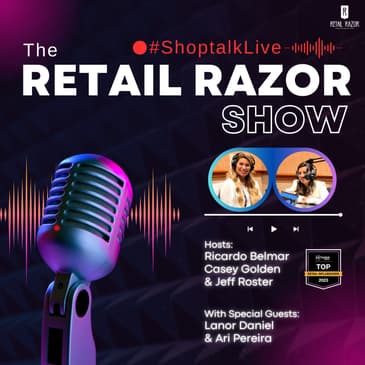



How well do you know your in-store shopper versus your online shopper? If you’re like most retailers, you probably believe you know more about those online shoppers. But what if you had a full set of analytics on your in-store shoppers? What if you knew how shoppers react to a product they pick up off the shelf? Why they put it back instead of purchasing it? Meet ShopperAI, a startup that’s trying to change that perception by leveraging the existing video footage you have from loss prevention cameras to understand shopper intent and sentiment.
It’s the second in our podcast cross-over event with This Week in Innovation and special guest host Jeff Roster! Recorded live and in-person during Shoptalk 2023, Jeff and regular host Ricardo Belmar sit down with ShopperAI’s CEO, Lanor Daniel, and VP of Strategic Growth, Ari Pereira, to learn just how significant the insights are that retailers can learn about their in-store customers using their existing LP camera infrastructure. And if you’re a startup, you’ll also learn some important tips about how to present your solution to retailers by showing compassion first and foremost!
We’re standing at number 19 on the Feedspot Top 60 Best Retail podcasts list – if you enjoy our show please consider giving us a 5-star review in Apple Podcasts! With your help, we’ll move our way up the Top 20! https://blog.feedspot.com/retail_podcasts/
Meet your regular hosts, helping you cut through the clutter in retail & retail tech:
Ricardo Belmar, a RETHINK Retail Top Retail Influencer for 2023, 2022 & 2021, RIS News Top Movers and Shakers in Retail for 2021, a Top 12 ecommerce influencer, advisory council member at George Mason University’s Center for Retail Transformation, and director partner marketing advisor for retail & consumer goods at Microsoft.
Casey Golden, CEO of Luxlock, and RETHINK Retail Top Retail Influencer for 2023. Obsessed with the customer relationship between the brand and the consumer. After a career on the fashion and supply chain technology side of the business, now slaying franken-stacks and building retail tech!
Includes music provided by imunobeats.com, featuring E-Motive, and Overclocked, from the album Beat Hype, written by Hestron Mimms, published by Imuno.
The Retail Razor Show
Follow us on Twitter: https://bit.ly/TwRRazor
Connect with us on LinkedIn: https://bit.ly/LI-RRazor
Subscribe on YouTube: https://bit.ly/RRShowYouTube
Subscribe on Apple Podcasts: https://bit.ly/RetailRazorShow
Retail Razor Show Episode Page: https://bit.ly/RRShowPod
Host → Ricardo Belmar,
Follow on Twitter - https://bit.ly/twRBelmar
Connect on LinkedIn - https://bit.ly/LIRBelmar
Read my comments on RetailWire - https://bit.ly/RWRBelmar
Co-host → Casey Golden,
Follow on Twitter - https://bit.ly/twCasey
Connect on LinkedIn - https://bit.ly/LICasey
Read my comments on RetailWire - https://bit.ly/RWCasey
TRANSCRIPT
S2E12b In-Store Analytics with ShopperAI
[00:00:00] Show Intro
[00:00:20] Casey Golden: Hello Retail Razor Show listeners and viewers, and welcome to retail's favorite podcast for product junkies, commerce technologists, and everyone else in retail and retail tech alike. I'm your host, Casey Golden.
[00:00:34] Ricardo Belmar: And I'm your host, Ricardo Belmar. Welcome to another episode in our Shop Talk live crossover event with Jeff Foster and This Week In Innovation podcast.
[00:00:43] Casey Golden: These crossover podcast series are really so much fun and I have to start going to Shop Talk on a regular basis. I do.
[00:00:53] Ricardo Belmar: Well, it would be amazing for her to join us next time. Casey, we missed here on this series for sure. So on today's show, [00:01:00] we are talking about the consumer struggle factor when choosing a product on the shelf. How to convert in-store data you didn't realize you had into meaningful customer insights. And the best contribution to your data analytics, loss prevention can make.
[00:01:15] First I've got a startup life Question for you, Casey.
[00:01:20] Casey Golden: Oh, bring it. Typically My answer is yes. More caffeine, please.
[00:01:25] Ricardo Belmar: Of course, of course it is. So, so here's the question. So how important is compassion when working with retailers?
[00:01:33] Casey Golden: Oh, that's good. There needs to be a lot of room for compassion. Operators have heavy workloads and technology has a tendency to add more work, not less. I feel that outsiders always need to go in humble and serve pretty much the opposite of our day-to-day with investors and startup culture. Really focusing on like the what if, how would, how important is just go in knowing and acknowledging that [00:02:00] you know nothing.
[00:02:00] They know everything.
[00:02:02] Ricardo Belmar: Yeah. You're, you're, you're really there to help make them better, right. Not tell 'em what to do, but you're acknowledging that it's not that they're doing anything wrong, it's that there's always room to do better
[00:02:13] Casey Golden: Because they're doing something so amazing. You wanted to bring this solution to them first.
[00:02:19] Ricardo Belmar: it. There you go. There you go. That's right. It's, it's an honor to bring it to them because they're the best.
[00:02:25] Casey Golden: They are, and that's why we decided to build these companies for like the best. Right.
[00:02:30] Ricardo Belmar: right, that's right. That, that is so, so the right attitude and, and wait till you see where that comes into play in this discussion. So as you might have guessed in this show, we are interviewing a startup, Shopper AI. An Israeli startup specializing in a unique form of video analytics with the goal of giving you in-store data analytics that's as good as what you get on your e-commerce site.
[00:02:52] So their, their c e o explains it makes the analogy that, you know, they, they are trying to be the Google Analytics for your store,
[00:02:59] Casey Golden: [00:03:00] Fascinating. Now I see where the loss prevention angle comes from
[00:03:03] Ricardo Belmar: right?
[00:03:04] Casey Golden: all the security cameras providing that video footage for analytics. Right?
[00:03:08] Ricardo Belmar: That's right. Exactly.
[00:03:10] Casey Golden: Well, now I can't wait to see where this struggle factor you mentioned comes to play and how compassion works into all of this.
[00:03:18] Ricardo Belmar: Well, it will definitely be illuminating for sure. No doubt about it. It's all part of our Shop Talk Live crossover event with Jeff Roster and This Week In Innovation. We recorded live and in person at Shop Talk, of course in Las Vegas last month. And Jeff really demonstrates how the struggle factor plays into making choices as a consumer.
[00:03:38] So there's a good story about that that he uses to kind of illustrate that in the discussion. Plus we end with a really great discussion on how hard it is for startups to pitch to a retailer without coming across, perhaps a little bit too arrogant in trying to solve problems for the retailer. Which I think you just nailed it there, Casey, in your description of how to approach that, [00:04:00] that pitch session with the retailer.
[00:04:01] We'll, we'll see how that goes.
[00:04:04] Casey Golden: All right. In that case, let's get right into the interview with Shopper AI's, CEO, Lanor Daniel and their VP of Strategic Growth, Ari Pereira with you and Jeff.
[00:04:16] ShopperAI Interview
[00:04:16] Ricardo Belmar: Hey Everyone, welcome to another podcast crossover. This time coming to you live and in person from Shop Talk 2023. I'm Ricardo Belmar and I'm here with good friend Jeff Roster, host of This Week in Innovation. How you doing, Jeff?
[00:04:36] Jeff Roster: You know, I'm I'm actually a little slow today. I might have gotten just a slight hard on day one of Shop Talk lots of evening research opportunities that I was
[00:04:44] Ricardo Belmar: re research opportunities. Is that what we're calling it now?
[00:04:47] Jeff Roster: that what we're calling it. Okay,
[00:04:48] Ricardo Belmar: We'll go with that.
[00:04:49] Jeff Roster: Really good research to be honest with you. But definitely you know, first day tons of energy It's just a great, it's really a, I'm really impressed with this venue because I had three events and they were all within, I dunno, you could throw a rock and [00:05:00] hit the main part of the exhibit and so, which meant people were walking by. So you not only had your event, but you also had all that traffic coming by
[00:05:07] Ricardo Belmar: all the passers by, yeah.
[00:05:08] Jeff Roster: was Just a fantastic day day one I thought.
[00:05:11] Ricardo Belmar: I agree. Day one was pretty, pretty interesting compared to, this is my second Shop Talk. Compared to last year, I think it was busier, a little more action.
[00:05:19] I think people were enjoying themselves, a little bit more on day one than maybe last year, where last year this was probably for most people their first time out in an in-person event. So I think we're all getting a little bit more used to that. So this is a continuation, I guess I'll call it, of our crossover from NRF, where we had a number of super interesting interviews with really interesting retail tech companies.
[00:05:41] And in that theme, we've got a fascinating discussion today for listeners. We have with us the team from Shopper AI that we're really excited to chat with. So I'm gonna ask Lenore and Ari to please introduce yourselves.
[00:05:54] Lanor Daniel: Hi everyone, my name is Lanor Daniel. I'm the CEO and co-founder of ShopperAI.
[00:05:58] Ari Pereira: Hello everyone. [00:06:00] I'm Ari Pereira I'm the VP of Insights and Strategic Growth for Shopper AI. Thank you for having us in the podcast.
[00:06:06] Ricardo Belmar: Oh, it's great to have you here. So why don't we start by having you tell us a little bit about what's the challenge that Shopper AI addresses for retailers and how you're solving that.
[00:06:14] Origins of ShopperAI
[00:06:14] Lanor Daniel: Yeah. So basically we started four years ago in Israel. Me and my co-founder Sivan came from marketing online, digital marketing landscape. And we got partner with the retailer and we asked the question, how can we analyze data from your store?
[00:06:30] And he was like, what data? And we were like, you know, in e-comm you have Google Analytics in order for you to be better, to optimize, to convert more. Conversion. What's conversion? And then we understand that there is a big gap between what's going on in the online landscape and what's going on in the stores.
[00:06:48] And it got us so fascinating because, you know, ecomm just keeps growing and growing and we like to purchase online. It's easy. You feel like the website knows you, everything is so [00:07:00] focused and accurate. And when you go to a store, all the mess, all the noise, all the things going around and you feel like, I don't wanna go to a store, I want to buy online.
[00:07:09] And basically this thing that we see in the past four and five years, e-com is growing fast and it's easy to understand. There is a lot of data you can be better, and the website really actually knows you and what's happening in offline stores that you come as a shopper. Shoppers, they're paying so much money for marketing, they're paying so much money for personnel, logistics promotions, and they don't know what happening with the user's journey. They don't have any data of users. I'm saying users because it's anonymously, so they don't know what's going on in the store in front of the shelves. Where are the problems? And this is where Shopper AI come to the picture. So this is what we've done in the past four years, building technology that allows us to grab this data from an offline store.
[00:07:57] Jeff Roster: So let's talk about what it takes to get that [00:08:00] data.
[00:08:00] Converting In-store Data to Insights
[00:08:00] Lanor Daniel: Okay so basIcally. When we started to work with retailers in Israel, we didn't really understand how deep the gap is. So what we found out that in order for us to collaborate with retailers when they have all these things going on, like all the logistics and personnel, what I just mentioned, you need to be very easy, seamless integration.
[00:08:21] And for that, we only had the security camera, so we need to crack the, the idea how we can get the data from a security camera that is already there. So we've been through four years of developments with engineer professors and like the best of the best. And we build an algorithm, a software that once we have a connection to the IP of the security camera, automatically takes the video.
[00:08:45] We can show it as well, simple video from the store and turn everything that we just see right now to data.
[00:08:54] and from a data to a dashboard. So if we take the equivalent on Google Analytics, Google Analytics, [00:09:00] analyze each and every movement in the website, what you're looking for, user's behavior, and put it in a dashboard.
[00:09:06] So same thing over here. This is our website, the shelf. Each and every category is different. And what we see, it's all the movements and everything that they're doing. It's listed. We're saying you need to monitor your touches from the shelf, just like you monitor your clicks. Then we have conversion funnels, interaction.
[00:09:24] We have a toucher, we have market shares. This is what everybody knows. So we have a toucher and we created a new language and things that if you come from E-com world make sense, but here for, for the industry, it's a bit new. So this is the process. We get connection to an IP of the security camera, the video, we turn it into data, and this data set turns into a dashboard.
[00:09:49] Ricardo Belmar: So you've taken e everything that we're used to seeing in e-commerce metrics around, you know, if I the equivalent of looking at a product page, then by taking the video feed you're mapping that to, is this [00:10:00] person looking at a particular product on the shelf? If they're picking it up? If they're taking it, then you know they've added it to a basket like they would in an e-commerce site.
[00:10:07] Lanor Daniel: they Correct.
[00:10:08] Ricardo Belmar: So you can imagining, you can measure how long is someone standing in front of a product to see how effective the shelf placement is.
[00:10:13] Lanor Daniel: Correct. And add another more thing for that. What you cannot see in online website. , it's a struggle rank. So we have ranking that you can use. So you mentioned time. So for example, things that we are looking for a specific product, a shampoo or a snack, or even in a, you know, in a Foot Locker store, you are looking for a shoe and then you're in front of the shelf, you're looking and I, something happened there that you're starting to struggle.
[00:10:40] You know, this place like nevermind. I'll do it later.
[00:10:43] Ricardo Belmar: Okay
[00:10:43] Lanor Daniel: You know this feeling. So we have a struggle rank. You cannot have a struggle rank online.
[00:10:48] Ricardo Belmar: Right. So you, you, so you have a measure of what that customer's sentiment was when they were standing in front of the shelf looking at products. So you have a little, you're adding some insights into their decision making process while they're shopping.[00:11:00]
[00:11:00] Lanor Daniel: so it's accurate.
[00:11:01] We are discovering the decision making tree. So each and every movement becomes suddenly a full map of what's happening. This is our dashboard by the. We can show it as well. So this is the decision tree looks like an octopus, but every moment since the moment that the shopper arrived, bef in front of the shelf, then we start the measuring.
[00:11:24] So we have people who stopped, who are interested. You have people who interacted with a category and you have people who touched a certain product, look at it, put it back, and then either abandon the entire category. And this is for a retailer, a very bad thing because it lost the opportunity to sell the product.
[00:11:41] And what we saw that happen during the research time that we've conducted in Israel, if you took a certain product, you looked at it, you put it back, you probably bought it somewhere else. We saw based on the research that 85% of those shopper go home. Maybe they stop in a convenience store and bought that product that they [00:12:00] were looking, but put it back.
[00:12:01] So this is our lost potential.
[00:12:02] The Consumer Struggle Factor
[00:12:02] Jeff Roster: So how do you deal with, let's say if you followed me in my grocery shopping about four months ago, I really cleaned up what I was eating. So I'm paying very close attention to high fructose corn syrup. I'm paying very close attention to carbs, all, all that stuff. So I, I will pick up a product, look at it, and, and the struggle aspect.
[00:12:20] It was interesting. I've never heard that term before, but I'm looking at it going, Ooh, too many carbs. Put it back. That was, I mean, that was just me analyzing the product and putting it back. There's, there's no chance, well, hopefully there's no chance I'm buying that because I've already made that calculation.
[00:12:32] I don't want that. How, how are you classifying that kind of an engagement and how frequent is that? Is is hopefully more people are, are paying attention to what, what we're consuming.
[00:12:40] Lanor Daniel: So this is a good example. We are not doing personalization measurements yet. We're looking for the big numbers. So basically I give the equivalent of Google Analytics. So what's happening in the store, every shopper that entered the category is measured. So every shopper, if we see this kind of a [00:13:00] behavior for 70% of the shoppers looking, turn it back and put it back.
[00:13:04] We can say there is something in the product, in the ingredients that there is a problem with that.
[00:13:08] Jeff Roster: Interesting.
[00:13:08] Ricardo Belmar: Interesting. Very interesting
[00:13:10] Jeff Roster: is crazy.
[00:13:13] So if I'm, if I'm producing a product that let's say, maybe isn't the, the most healthy or not even close to being healthy and, and your data comes back and says, Hey, you have this, huge percentage of people that are looking at your product and putting it back.
[00:13:27] Wow, I've never heard that before
[00:13:29] Lanor Daniel: Yeah. and it's based on real life data. And I'll take it to a different category. You spoke about healthy food, but you know, take shampoo category. So one of our clients in Israel, it's a big shampoo distributor, and he was like, I don't know why my shampoo is not selling. I think it's the price. And so we are not thinking, we are watching data and analyzing and what we saw, it was amazing.
[00:13:53] Like, we had this questionnaire that we were doing with it onboarding, and we asked could it be a problem with the product [00:14:00] itself? And they were like, no, it's the number one product. We did test, we did like a focus group. In the focus group, we ask everybody, which is, which is the best smell, and they choose that smell.
[00:14:11] And this said, this is the best smell. So there is no way there is a product ah, problem. So we open the camera. And in Israel there is a thing that we're doing once we touch the shampoo, if it's a new shampoo, we, we like to open and smell it.
[00:14:23] Jeff Roster: Oh, Jesus
[00:14:25] Lanor Daniel: Is that, is that common
[00:14:27] Ricardo Belmar: of course. Yeah. That's common. Yeah. Oh, I've, I've seen that. Yeah. Yeah. That's
[00:14:31] Lanor Daniel: It's common.
[00:14:32] Yeah. So it's not just Israel is,
[00:14:34] Ricardo Belmar: yeah.
[00:14:35] Lanor Daniel: So what we saw, 75% of people, like the shoppers came to the shelf. They were looking at the new product, touching, taking the product. So that means it's not a price issue. I took it already, it's in my hand. And then they open, smell it, and they were like, Ugh, put it back
[00:14:52] Ricardo Belmar: because you could see it on the video.
[00:14:53] Lanor Daniel: listen, it's crazy.
[00:14:55] Ricardo Belmar: You see on the video that they didn't like like
[00:14:56] Lanor Daniel: it's crazy. And then you show those numbers, like it's [00:15:00] hundreds of thousands of people every day. You know, in a, in a big chain. And they were like, there's no way. And I was saying like, listen, if you ask somebody a question, ask me if you look good today, I'll say, yes, , maybe I don't
[00:15:12] You know what I mean? Maybe it's
[00:15:14] Jeff Roster: Wait a minute. You said we look good today.
[00:15:18] Lanor Daniel: So I'm
[00:15:18] Ricardo Belmar: yourself. Jeff
[00:15:21] Lanor Daniel: like in a focus group, people are saying like the rational thing and, and it doesn't mean that they will be motivated to purchase that product. And once you identify the problem, we're talking like in a category.
[00:15:33] Identify the problem, the, the vendor itself or the retailer itself can understand, okay, so I don't need to do like a big sale or a big promotion because even
[00:15:41] Ricardo Belmar: it's not price
[00:15:42] Lanor Daniel: exactly
[00:15:43] Ricardo Belmar: it's not price
[00:15:43] Lanor Daniel: to identify the problem
[00:15:45] Ricardo Belmar: Yeah. So, so this is, so we, you and I have talked about this, Jeff, when ever, we see some of these interesting survey, consumer surveys, that show up in the industry and our, our friend at George Mason University that's doing a very different kind of consumer in insight survey where, and, and I think your [00:16:00] example reflects that, Lenore, very closely because you have consumers in a focus group, if they know they're in the focus group and they know there, there are lots of people in the group, they may be psychologically less inclined to want to go against the group because you don't want to feel like you're the one that did that said what?
[00:16:15] You're the, you're the one that's different, but you're right. When standing in front of the products at the store, in front of the shelf and you actually look at it and smell it and you're, you think, oh, this isn't what I like at all, and you make a completely different decision.
[00:16:28] Next Generation Shopper Research
[00:16:28] Ari Pereira: That's why we are the next generation of shopper research because we can really look of what is happening in front of the shelf, and we are translating that into different insights in terms of the shopper journey, the shopper behavior, and everything that is happening in store. That's where most of the retail stores are blind today.
[00:16:48] Lanor Daniel: And take it one step ahead, because we're talking on in store, but let's talk about chains. In, in America, the scale is much bigger than in Israel. This is why we waited so much up until the [00:17:00] technology and the structure of the, you know, the architecture of the software will be scalable enough. So we spoke about one store, but if you're a chain like Nike or Walmart, and I give you your entire map, and we are connecting in all of the stores, suddenly you can see that.
[00:17:16] You get alerts, not just about the shopper struggle ranks, you get alerts from the entire chain. So for example, in Denver, Denver, Colorado, what we see now, it's like we have less conversion. We have a problem with specific female that don't buy it. And as a manager or CEO or or VP marketing, you can see it pushed to you, as alert, what is the problem in the chain? And then you can take drill down to see the video that we saw before, specific category, what's the problem? So it's not just one store, it's scalable. We can see it
[00:17:51] Ricardo Belmar: scales the whole chain.
[00:17:52] Lanor Daniel: Exactly. And then the metrics is different. And we can do static statistics for the entire chain, which brings us to a different [00:18:00] universe.
[00:18:00] And that was the idea, like making an unscalable world scalable,
[00:18:05] Ricardo Belmar: so, so really you're combining the performance metrics that you would expect on your e-commerce site, but you're delivering that in store. And then on top of that, you're delivering all of these actual shopper insights and on shopper sentiment on their behaviors while they're engaged in that shopping.
[00:18:22] Lanor Daniel: Exactly.
[00:18:22] Ricardo Belmar: All in one dashboard,
[00:18:23] Ari Pereira: yes, and when you think about harmony, right, You have all the metrics in E-com and most of the industries, they have some difficulty to make the data make sense because they are looking at something in the brick and mortar space. They are looking something different in e-com. And when you have similar KPIs, you can start to bridge the data and you can start to have a holistic view, which today you might be different because you're looking two different ways, but now you can have a holistic view of the data. Both places.
[00:18:56] Lanor Daniel: Full pictures
[00:18:57] Jeff Roster: So in your [00:19:00] deployments in Israel, I'm guessing you probably have more security cameras, although I think probably in America we might be catching up. How do you have to add anything additional to get the da? Anything from a hardware perspective or you are literally just using the footprint that's already existing.
[00:19:15] Lanor Daniel: the beginning, we're starting only with what's existing and it gives you so much.
[00:19:19] Jeff Roster: Wow.
[00:19:19] Lanor Daniel: so much because you don't have anything like this. It's ongoing all day. Think that you're doing all the statistics of each and every shopper that answers the shop. So in the beginning, maybe there will be some you know blind spots.
[00:19:33] Like we don't see everything, but we see most of it. So we can recognize most of the problems. And after a certain time, if the retailer wants to upgrade, we can put like our own cameras. In Israel, we add some cameras, but most of the chains that we're working with, we don't need
[00:19:49] Ricardo Belmar: you don't need to add anything.
[00:19:50] Jeff Roster: And what, what's your thinking as far as US retail? Do they have enough security cameras? It's the same deal that you're gonna get more than enough to, to get going.
[00:19:58] Lanor Daniel: So it's, it's interesting [00:20:00] this question. So the, our first time we touched base with America was at the nrf. We didn't really know what to expect. Mm-hmm. , We have Ari in our team and she's very experienced. , but all of us came from Israel. So what we found out in the nrf actually one of the meetings that we've conducted there so the VP marketing told me, she was like, we have like $30,000 worth of security cameras in our store and we're not doing anything with it.
[00:20:29] And basically now you're saying that we can earn money from that.
[00:20:32] Jeff Roster: well, let me make sure I understand. They're using those cameras for security purposes. They're just not using them. So a hundred years ago when I was back in retail we were not. I can say it cuz the company's outta business. Now, Mervins, we were not allowed as managers to use LP cameras for observing employees.
[00:20:50] Just from a performance perspective. That was absolutely verboten. LP didn't, wouldn't allow us to even do that because we're all like, can I just look instead of walking all over this distribution center, can I just sit here?[00:21:00] So I don't know. Yeah. So I don't know. Is that still the, the is, does that still something you're gonna have to battle with lp?
[00:21:07] That, hey, we actually wanna use your cameras for other reasons I could get where they don't want you to be moving their cameras, but is that an issue or is that, have we already moved past that?
[00:21:15] Lanor Daniel: is that so today they are looking at employees, they're looking for performance. Those are some of the problems and issues that we heard from the industry while we were at nrf. And also for security matters. There is a big thief thing right now, right?,
[00:21:31] Ricardo Belmar: Yeah.
[00:21:31] Jeff Roster: yes there is
[00:21:32] Ricardo Belmar: I you're a little familiar with
[00:21:33] with that,
[00:21:33] Jeff Roster: Jeff.
[00:21:33] Yes. I'm, I live in California, so yes, very familiar with that.
[00:21:37] Lanor Daniel: Yeah..
[00:21:37] Jeff Roster: It's not even an lp, it's more a more a political thing of, of we're no longer prosecuting crimes and, you know, less than 900 bucks, so you can literally steal $800 worth of
[00:21:46] Lanor Daniel: more, yeah, so we heard that a lot from, from a lot of retailers. Like they're, they're, they're believing that they had, there is a very high percentage today of. Thief that is going on in the store and they can't really see everything even with their [00:22:00] security cameras. So today they're using that for security and so for performance as well, trying to it's not an issue.
[00:22:07] And basically our software is fully anonymously. If you saw the movie, everything, it's blur. I'm not looking to understand who is the person personally, I'm looking to understand the problem with the touches, with the body movements. That's what we're looking for. So, with with that being said, there is no problem
[00:22:24] Jeff Roster: Wow. Very cool.
[00:22:25] Ricardo Belmar: I guess at the end of the day too, compared to when you're thinking Jeff, now these are all IP based cameras. So everything is a video stream being stored in a server somewhere that even LP is using to go back to bring back footage. So now you're just taking a, you can take advantage of that same IP stream for a completely different purpose and, and let marketing have some advantages.
[00:22:45] Store operations have advantage or you're extending the usefulness of the equipment that's already there
[00:22:50] Jeff Roster: Yeah, boy.
[00:22:51] Lanor Daniel: Exactly.
[00:22:52] Jeff Roster: just adding another budget to, to bind that, that infrastructure. So that's, that's fantastic.
[00:22:57] Ricardo Belmar: bringing a lot more value that way. Wow,
[00:22:58] Lanor Daniel: Yeah. And it's, [00:23:00] this is the exact point. So it's already there. They're not making money out of it. I'm not really sure how many thief they're catching from it. So then we come and then we bring them. Look, you get information, you get Ability. By the way, all this data that we are collecting, we're doing AB test.
[00:23:20] So you know, in online we're saying like there is the, the certain color that you're choosing for the button, which color convert more. It's very easy to chain change online, off line.
[00:23:30] Ricardo Belmar: You can see that now, right? to actually show
[00:23:32] Lanor Daniel: So we are changing like things, we're moving things and you see that conversion metrics go up or. and we want to really be better for the shoppers. And we're looking for, this is why I show the map. Like each and every area in New York, there are different needs that in Texas
[00:23:46] Ricardo Belmar: mm-hmm
[00:23:46] Lanor Daniel: makes sense, right?
[00:23:48] So why does, why doesn't it look different?
[00:23:50] Ricardo Belmar: Yeah. Why not adapt it? Yeah.
[00:23:52] Lanor Daniel: And you speak about health, if we see in a certain city in Israel that there is more people who are looking for the ingredients and looking to [00:24:00] buy healthier food.
[00:24:00] So why don't you as a retailer, put more shelves for healthy people? Like there is a lot of products put. Make it more accurate to the people around. And then if you see that there is a store which has all the, I dunno, best, healthiest food, you would like to go to check it out. Because right now you're keeping your diet, you're keeping your health, so the store will be better for you.
[00:24:24] Up until today there were, you know, all the managers were, were gathering data by, by doing this market research once a year. And here you can see how shoppers change and their needs and to be connected to their needs daily.
[00:24:39] Jeff Roster: Gosh, that's,
[00:24:40] Ricardo Belmar: so you got some,
[00:24:41] Jeff Roster: I'm stunned
[00:24:41] Ricardo Belmar: advantages. You you're validating some planograms. You've got benefits for the category managers.
[00:24:47] Lots of different roles that can
[00:24:48] Lanor Daniel: can you imagine E-com word without Google Analytics? Let's say now we wanna sell this product or this computer, and we are a team and I will tell you guys, listen, I'm doing e-comm, I'm specialized with, you know, users [00:25:00] analytics. You will bring me the product, I'm gonna build the website and do the sales.
[00:25:05] So we did this business partnership and now I open a website. And then what I, I tell you guys, after one week we sold 1000 computers. Is that good? Sounds good. Right? And the next week we sold 2000 computers. But then I would expect you to ask me from how many people who interacted, right? Like what is the
[00:25:22] Ricardo Belmar: many people that didn't
[00:25:23] Lanor Daniel: Like this is the first question, right? And they don't have this answer, like the basic answer, like conversion funnel. and then you have it all the time. And if you see that in the first week we had, I dunno, like 100,000 people in the website and the next week I had 500,000 people on the website and it go just with from 1000 to 2000.
[00:25:41] Like,
[00:25:42] Jeff Roster: You know, the question I'd love to have answered is how many people do that struggle engagement with a product? Meaning, cuz if. You know, looking at my behavior in the last three, three months, every single thing I buy at a grocery store, I'm, I'm looking at the ingredients, every single thing [00:26:00] and, you know, I'm, now, I'm gonna be making that, I'll be thinking of you folks.
[00:26:03] I'll be making that face,
[00:26:04] Lanor Daniel: ah,
[00:26:04] Jeff Roster: and put something back
[00:26:05] Lanor Daniel: if
[00:26:05] it's you do it. It's, it's like not rational movement
[00:26:08] Jeff Roster: what I want to know, would it be really fascinating to know, is how many pe, how many, let's say a hundred people looked at a product, how many looked. And, and put it in their shopping cart or, or put it back because that might also be a really interesting indicator, Hey, wait a minute.
[00:26:23] A lot of people are looked at your product, but boy, they look at those carbs, they look at those calories, or they look at that and put it back. That would be really cool too. That might be the, that might be the biggest opportunity to maybe bring some, some more enlightenment to
[00:26:35] Ricardo Belmar: what
[00:26:36] I mean, think what I'm hearing is you can be even more granular than that, because if I pick up the product off the shelf, the way you are measuring this, if I turn it around to look at the ingredients, so the ingredients are always on the back.
[00:26:45] Yep. Right. You'll. Your data will show that. Well, the reason the person put it back is because they turned it around so you can, you can make a logical assumption. If they turned it around, they'll check the ingredient list and that's why they put it back. Yeah. If they picked it up, looked at the packaging and put it [00:27:00] back, then you might say to the retailer, well, there's something wrong with their packaging, and they should go back to the brand and talk about redoing the packaging.
[00:27:05] Lanor Daniel: Exactly. But we're looking to see not just, you remember it's big
[00:27:09] Ricardo Belmar: but yes. Yeah. How so? It's right across all your stores, across all the customers that went by. If you know 50% of them picked it up and put it back, did
[00:27:16] Lanor Daniel: suddenly, you know that 50% put it back. You
[00:27:19] Ricardo Belmar: which you didn't know before.
[00:27:21] Ari Pereira: but the mo most important thing, then we can see what was the other product they touched next. Was it healthier? Which one did they buy in the end? Did they buy a healthier product
[00:27:30] Jeff Roster: Boy,
[00:27:30] Ricardo Belmar: Oh,
[00:27:30] Jeff Roster: imagine
[00:27:31] what our friend at George Mason University
[00:27:32] Ricardo Belmar: Oh, would do with that data . That's.
[00:27:35] Jeff Roster: I mean,
[00:27:36] just
[00:27:36] Ricardo Belmar: would have a field day looking at
[00:27:37] Jeff Roster: Oh my gosh. Wow. Phenomenal.
[00:27:40] Ricardo Belmar: Wow.
[00:27:41] Activating Insights from Data
[00:27:41] Lanor Daniel: so this is exactly it. Just today, to explain it a little further, so the numbers that everybody knows, it's. The numbers that it's in the cashier, right? How many, what is the market share? What is the market share they're looking to to raise that all the time. But this number, like they already interacted, they touched it and [00:28:00] put it back.
[00:28:00] So there are some categories that reach to 70% abandoned rate, 70%. And what you see, this is very interesting, that from those 70%, like you can see more than 60%, most of the time the same problem.
[00:28:16] Ricardo Belmar: Interesting
[00:28:17] Lanor Daniel: So if you change a small thing, you can convert those 60% because they already show the interest. It's not just stopping.
[00:28:24] It's not just looking. They, you touched it already. Think about this moment you touch, you look at it. All you need to do is right?
[00:28:30] Ricardo Belmar: Which is in some ways more than what you would know on the e-com side, because all you know on the e-com side is that you went to the product page, but you don't know anything about other than how long you had that page open, which doesn't necessarily tell you anything about intent.
[00:28:43] But here you actually know and you can know that they make a face at it, right? So you have all these other factors that you're measuring.
[00:28:48] Lanor Daniel: time. What is the average time in a specific category? In snacks category, it's lower than other categories, cuz snacks, it's like more impulse, like cashier area, you know, [00:29:00] always the cashier area.
[00:29:00] We say to put impulse product. Who said who said that? Why? You know what we're doing today, we're we're next. When we are next to the cashier, we're playing with our phone. .
[00:29:11] Ricardo Belmar: Everyone's
[00:29:11] Lanor Daniel: So there is no focus to the outside and this is the most expensive area today in the store, but you're like this, or maybe with your child or maybe with your fr like everything
[00:29:21] Ricardo Belmar: is because that was a theory that a grosser decided 80 years ago made sense do.
[00:29:25] Lanor Daniel: Exactly. And you know the theory that you said that it should be an eye level to sell more. who said that? is it really true?
[00:29:33] Ricardo Belmar: is it still true. Yeah,
[00:29:34] Lanor Daniel: exactly. And once you discovered this, you understand the problem. We saw it in one product.
[00:29:40] It was mento, you know,
[00:29:42] the, so Mentos want to, to understand what is their problem, and the VP marketing was like, listen, Lenore, my problem is that I'm not on the eye level. And I'm like, okay, let's check. And what we saw that in the cashier area, if you managed to put away your phone, , what got you attracted [00:30:00] to the shelf was the Mentos color.
[00:30:01] Ricardo Belmar: Mm-hmm. Interesting. like, yeah. Right,
[00:30:05] Lanor Daniel: So we saw shoppers. Once they le left the phone looking at the color, the color, attract them to come, they came the touch. That was their first touch. Come touch the Mentos, look at it, put it back, and took the
[00:30:18] competitive. And the competitive back then when we started was 47% market share and Mentos was 29.
[00:30:25] And what we told Mentos, it's a simple thing, listen. People are looking for you, you're the anchor. They're not purchasing you. So they never saw this kind of data. You need to move around from the competition. Once they move around away from the competition in a different shelf,
[00:30:42] they got like 200 uplift%
[00:30:46] Ricardo Belmar: Christmas
[00:30:47] Lanor Daniel: And today, after a year, Mintos is almost 49% market
[00:30:52] share. and the competitive is 27. But listen, it's a small insight. So we're not saying push it to people that don't [00:31:00] want, if a person, a shopper interacted, something got interested, so
[00:31:04] Ricardo Belmar: was just grabbing more conversion from people who were already showed some intent in your
[00:31:08] Lanor Daniel: promise.
[00:31:09] Exactly. Crazy, right?
[00:31:10] Ricardo Belmar: Yeah.
[00:31:12] Jeff Roster: Yeah,
[00:31:13] no, I I mean,
[00:31:14] Lanor Daniel: I overwhelmed you guys. I'm sorry.
[00:31:17] Jeff Roster: Yeah, that's, well, that's what we get paid to do. We get paid to be overwhelmed? Actually, no. I mean, I just, I just, I just love this idea in that I don't have to put in new infrastructure. Because I've seen it all. I mean, I've seen the concept of flying a drone down an aisle, which is insanity.
[00:31:31] Robots stuff on rails. I mean, I've seen it all. And you know, it's me, myself as an analyst. It's not my job to say, oh, that's good or that, well, it is a little bit, but it's more, you know, what retailers are gonna embrace. And the problem I always have with startups that are some of the smartest people in the WO room, but they'll come in and say, Hey, I can do this.
[00:31:49] And, and then I have, I'm the guy that has to say, do you understand there's 5,000 stores? So
[00:31:55] Ricardo Belmar: It's what you're doing times
[00:31:56] Jeff Roster: times 5,000 and you see the air just go outta [00:32:00] people. . And
[00:32:01] Lanor Daniel: I have scars from what you're
[00:32:03] Ricardo Belmar: you're
[00:32:05] Lanor Daniel: We learned it. We learned it.
[00:32:06] Startup Lessons
[00:32:06] Jeff Roster: Well, welcome to America cuz that is, that is not unheard of to have 5,000. Most of the people you'd be talking to are gonna have a thousand stores.
[00:32:13] Lanor Daniel: Yeah, so this is why we were waiting guys. We were waiting to the moment that will be scalable enough interesting that we have the best features that we can because once you go on scale, there are features that are left behind, unfortunately. But this is what we were trying to build and when we saw that it's working and we can bring it here and still be in the professional level that we wanted to be, then we came and, and, and you just mentioned something, but I think I can say a little bit more about it.
[00:32:42] today, we come with compassion when we see retailers. I didn't understand how hard it is to run a chain It's like a war zone, right? Really? It, it's like each day you go to, I was a captain in the idf. Mm-hmm. in a 200. Mm-hmm. And you know, like [00:33:00] operational. So I know what it is. Like your phone is always your, all the day like, , you know, try to fix problems and make sure that everything is working.
[00:33:06] This is like for, you know, a manager in a, in a retail store, big managers, and then we come and say, Hey, we come to save the world. Exactly. And, and, and so today we come with compassion. We're saying we want to take the burden, you know, with you guys, and we understand how it's working. We understand your problems, we understand the pressure, and we want to take some, mm-hmm , let us help you.
[00:33:27] And this is the idea.
[00:33:29] Jeff Roster: Yeah.
[00:33:29] let me give you some feedback on that. Typically what I hear startups do is come in and start off by insulting the retailer saying, oh, you really don't know what you're doing. I'm 26 years old and I'm, you know, I'm an engineer out of Stanford, and here I'm here to fix you. And I'm, I've sat with 15, 60 year old CIOs. Mad as be Jabbers cuz listen, you have no idea what it's like to work 24 7, 365 when every single person in the store has a phone, is just waiting for [00:34:00] something bad to happen so they can video it and then, and hopefully go viral. And it's like the biggest mistake. And I see it again and again and again when startups will come in and say, Hey, you know, you don't, and it's, it's, I don't think they believe it.
[00:34:11] I think it's a throwaway line.
[00:34:15] I just, you could not be more insulting, not, not you, but that person could not be more insulting if they tried. And it's a very bad strategy to start a pitch by insulting the person that you're asking to buy the technology. So that's i I com. You know, I congratulate you on being being really, really savvy about, about how words impact people, and
[00:34:34] Lanor Daniel: No, because we understand that. We really understand that. We see it. We are working with retailers. We come from the, from the store, we say the field, but we come from the store. We understand, like it took us some time.
[00:34:44] We didn't start it like this in the beginning. This is why I say I'm scarred about it because listen, when you come from a different, like technology wise, to this industry and you were like, what's going on here? Why are they working like this? Why not like this? You come with a lot of, you know, I don't know, I don't [00:35:00] wanna say like arrogance.
[00:35:01] Mm-hmm. , but like, you don't really understand.
[00:35:04] Ricardo Belmar: understand.
[00:35:04] Lanor Daniel: You're Right.
[00:35:05] Jeff Roster: No, it, it is arrogance. It's a hundred percent arrogance. Yeah. People that don't, don't listen to, you know,
[00:35:10] Lanor Daniel: we cannot understand
[00:35:12] Jeff Roster: Yeah. Just, just, I mean, first of all, there's an old, there's an old cowboy expression that says, before you tear down an old fence, know why it was there.
[00:35:19] Lanor Daniel: Correct.
[00:35:20] Jeff Roster: Somebody put that fence there.
[00:35:21] Why?
[00:35:23] Lanor Daniel: Wow. That's really good. Yeah.
[00:35:25] Ricardo Belmar: Yeah. You have to understand their why.
[00:35:27] Jeff Roster: Yeah,
[00:35:27] Ricardo Belmar: exactly.
[00:35:27] Lanor Daniel: Exactly. So it took some times, and after we understand and learned, one of our investors is a retailer. So we got like, you know, one-on-one school.
[00:35:36] Ricardo Belmar: Mm-hmm. . There you go.
[00:35:37] Lanor Daniel: So we got, I wanna say like the slap from here and the slap from there And then today we understand that and we come with this. Why I say compassion because we need to help. We don't need to put some more pressure. You know, I said with, I remember that was the first time I met an American retailer, a CEO has 1,200 stores and I was like pitching and you know, like, ah, it's my baby.
[00:35:58] And, and he was like, [00:36:00] listen young dear, from Israel. With a very heavy Texan accent. I remember that. And he was like, I don't have time or effort for your mumbo jumbo technology, but if you can show me 5% growth, I will put T-shirt with your name on it on every employee in my store,
[00:36:19] Jeff Roster: Done.
[00:36:19] Lanor Daniel: So
[00:36:20] Ricardo Belmar: that line before. I
[00:36:21] Jeff Roster: I think.
[00:36:22] Lanor Daniel: you know what I mean? So I understand like, yeah, it's the
[00:36:26] Ricardo Belmar: Mm-hmm.
[00:36:26] Jeff Roster: some pretty good coaching you got got
[00:36:28] Ricardo Belmar: in that one for sure. That
[00:36:29] That was, that was pretty strong
[00:36:30] Lanor Daniel: Come with compassion. Understand if you really want to work in this space,
[00:36:35] be the retailer. Like walk the walk, talk the walk. Understand how you can really help and not just come and say how sophisticated you are. Yeah, yeah. Who cares? It should work.
[00:36:45] I need help right now. I'm fighting right now. Like, so this is the idea and this is the school that we've got and this is why we come. Very, yeah. We have a team with very experienced people. We have history in Israel for the past four years, [00:37:00] and we're looking for our partners here.
[00:37:01] Ricardo Belmar: Well, excellent. I like hearing that. Yeah. Right. Yeah.
[00:37:04] Lanor Daniel: It's different, right? it's
[00:37:06] different.
[00:37:06] Jeff Roster: I'll give you that. I mean, listen, I've heard hundreds of pitches and I'm, I, I typically wait for that, that arrogance to start. Right. And when it, when the feedback, when they ask for feedback. If I heard, I mean, I've heard it hundreds of times. I, I mean, I hit so hard. Cause it's so, and the, and the thing
[00:37:21] Lanor Daniel: where are they now?
[00:37:23] Jeff Roster: Well, I mean, some have done well, some haven't because they learn, you know? But the point is, why, why? I mean, why? I mean, I guess that's the whole point of what I do in my podcast is I try to bring startup stories of like, don't do this, don't do this, don't do this. I mean, it's more don't do than do. But that's, but I mean, I, gosh, I've just sat in that seat so many times.
[00:37:44] NRF Tech, I can remember very vividly, a couple of our friends and I were watching that presentation and the guy just started off and it just, it was a throwaway line. And, and I won't say who, but they wasn't even mine. But they just grimmaced. It's like I'm, I'll never do That's so insulting.
[00:37:59] So anyway, [00:38:00] right. Yeah. Very good.
[00:38:01] Ricardo Belmar: it's a lesson that has, well, has to be learned sometimes. Yeah. Well, Lanor, Ari, I want thank you so much for joining us. This has been a fascinating discussion. I think we've learned a lot here about how to approach retailers in one part of the discussion, but I'm really, truly fascinated by the approach you've taken with this technology and how you're delivering that to retailers.
[00:38:21] So thank you again for joining us.
[00:38:23] Lanor Daniel: Thank you so much for having us.
[00:38:24] Ari Pereira: Thank you for having us.
[00:38:26] Jeff Roster: Our Pleasure.
[00:38:26] Show Recap
[00:38:26] Casey Golden: What a great discussion. I love the closing bit about compassion and how Jeff explained what every startup should know to not come across as arrogant in making your pitch. But then again, maybe he hasn't heard my perfect pitch. There's no arrogance there and I'm always full of compassion. I've been on that side.
[00:38:52] Ricardo Belmar: Yes indeed. Yes indeed. So true. So what, what did you think of their approach to analytics?
[00:38:58] Casey Golden: It is fascinating not [00:39:00] just because they're leveraging existing video cameras. I mean, I think we've all seen other video analytics solutions before. But shopper AI is really attacking the insights in a different way, focusing on the big numbers as Lenore put it, showing you across your whole fleet of stores what consumers are doing, how they're reacting to products.
[00:39:21] I can just see so many AB testing opportunities you could do to learn more about your stores better, and to feed that data and insights back into the brands you work. I'm already seeing another B2B services tie in, just like we keep talking about.
[00:39:39] Ricardo Belmar: Yeah, I totally agree, and I hope Leor and Ari find ways to lean into that line of thought, what the B2B offering that retailers can deliver to their brands by using this solution. It's a super interesting approach. I hope listeners and viewers agree.
[00:39:52] Casey Golden: So who's coming up next in this series? Got any hints for us?
[00:39:57] Ricardo Belmar: Well, you know me when it comes to hints for these. [00:40:00] So all I'll say is we've got one more startup that Jeff and I met with, and then we close it out with another of my favorite chats with some retail friends. So listeners and viewers will have to stick around to see who it is. But now I do want to thank both Lenore and Ari for joining Jeff and me for this discussion.
[00:40:16] Thank you both so much for joining.
[00:40:19] Casey Golden: So with that, Ricardo, it's time for us to wrap this second episode of Our Shop Talk Live mini-series Crossover with Jeff Roster and This Week In Innovation, it's a wrap and a mouthful.
[00:40:35] Show Close
[00:40:35] Casey Golden: If you enjoyed our shows this season, especially our podcast crossover events, please consider giving us a five star rating and review on Apple Podcasts. Remember to smash that subscribe button in your favorite podcast player so you don't miss a minute. Plus, you can watch us, not just listen on our YouTube channel and [00:41:00] like, and comment about this season there, too.
[00:41:02] And if you wanna know more about what we talked about today, including a transcript of each episode, take a look at our show notes for handy links and more deets. I'm your co-host, Casey Golden.
[00:41:14] Ricardo Belmar: And if you'd like to connect with us and share your thoughts on this season and the crossover series, follow us on Twitter at Casey C Golden and Ricardo underscore Belmar, or find us on LinkedIn. Be sure and follow the show on Twitter and LinkedIn at Retail Razor for the latest updates. I'm your host, Ricardo Belmar.
[00:41:31] Casey Golden: Thanks for joining us.
[00:41:35] Ricardo Belmar: And remember, there's never been a better time to be in retail if you cut through the clutter. Until next time. This is the retail Razor Show.