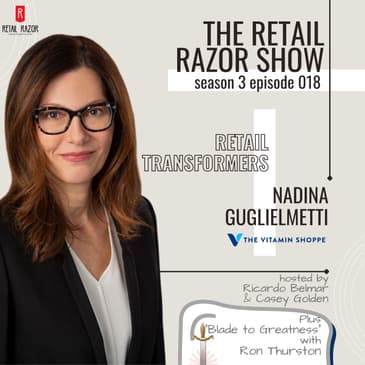


As we approach the end of Season 3 of the Retail Razor Show, hosts Ricardo Belmar and Casey Golden engage in a rich dialogue with The Vitamin Shoppe’s Chief Customer Officer, Nadina Guglielmetti. They explore how customer behavior insights guide business decisions, the interplay between acquiring new customers and nurturing existing ones, and the evolution of customer experience amidst changing health trends. Nadina also details the role of The Vitamin Shoppe’s in-store health enthusiasts in enhancing customer engagement and trust, and their careful approach towards leveraging AI and 'headless commerce' platforms to enhance efficiency and personalization. In this final Retail Transformer episode of the season, you’ll learn why Nadina is truly more than meets the eye!
We also bring you the final episode in Season 1 of our "Blade to Greatness" mini-series. This episode features an insightful conversation with retail expert, Ron Thurston, co-founder of Ossy, author of Retail Pride, the Guide to Celebrating Your Accidental Career, host of the Retail in America nationwide tour and podcast, speaker, advisor, board member, and former retail operations leader at numerous famous retail brands. Ron shares his three pillars of success in retail and life- empathy, curiosity, and focus. He illuminates strategies to bridge the communication gap between corporate offices and stores, emphasizing the importance of empathy in grasping the pressures faced by in-store teams, the power of curiosity to understand their needs and experiences, and the role of focus in dealing with the information obtained. Ron also emphasizes the importance of maintaining transparency and dialogue with retail employees from the recruitment stage, thus enhancing their sense of belonging and commitment.
NEWS! We are thrilled to report that our fans support propelled us as a finalist in The Retail Voice Award for the Vendors In Partnership award gala at NRF 2024! You’re votes made a difference and we’re honored to be one of 3 finalists for this prestigious award!
WOW! As we march into our 3rd year on the show, we’re honored and humbled to have hit the top of the charts on the Goodpodspodcast platform!
#1 in the Top 100 Indie Management Weekly chart
#3 in the Top 100 Indie Management Monthly chart
#3 in the Top 100 Indie Marketing Weekly chart
#5 in the Top 100 Marketing Weekly chart
#6 in the Top 100 Marketing Monthly chart
We can’t thank our Goodpods listeners enough! We love your support! Please continue giving us those 5-star ratings and send us your comments!
Meet your hosts, helping you cut through the clutter in retail & retail tech:
Ricardo Belmar, a RETHINK Retail Top Retail Influencer for 2023, 2022 & 2021, RIS News Top Movers and Shakers in Retail for 2021, advisory council member at George Mason University’s Center for Retail Transformation, and director partner marketing for retail & consumer goods at Microsoft.
Casey Golden, CEO of Luxlock, and RETHINK Retail Top Retail Influencer for 2023. Obsessed with the customer relationship between the brand and the consumer. After a career on the fashion and supply chain technology side of the business, now slaying franken-stacks and building retail tech!
Includes music provided by imunobeats.com, featuring Overclocked, E-Motive, and Swag, Tag & Brag from the album Beat Hype, written by Hestron Mimms, published by Imuno.
The Retail Razor Show
Follow us on Goodpods: https://bit.ly/TRRSgoodpods
Follow us on Instagram: https://bit.ly/TRRSinsta
Follow us on Threads: https://bit.ly/TRRSthreads
Follow us on Twitter: https://bit.ly/TwRRazor
Connect with us on LinkedIn: https://bit.ly/LI-RRazor
Subscribe on YouTube: https://bit.ly/RRShowYouTube
Subscribe on Apple Podcasts: https://bit.ly/RetailRazorShow
Retail Razor Show Episode Page: https://bit.ly/RRShowPod
Host → Ricardo Belmar,
Follow on Twitter - https://bit.ly/twRBelmar
Connect on LinkedIn - https://bit.ly/LIRBelmar
Co-host → Casey Golden,
Follow on Twitter - https://bit.ly/twCasey
Connect on LinkedIn - https://bit.ly/LICasey
[00:00:00] Hello and welcome to season three episode 18 of The Retail Razor Show.
[00:00:25] I'm your host Ricardo Belmar.
[00:00:27] And I'm your co-host Casey Golden.
[00:00:30] Welcome to Retail's favorite podcast for product junkies, commerce technologists and everyone
[00:00:35] else in retail and retail tech alike.
[00:00:38] So Casey, this episode is our last Retail Transformer of season three.
[00:00:43] And how appropriate that we end with a discussion around customer experience and marketing.
[00:00:48] I love it.
[00:00:49] And this shouldn't be too big of a surprise to our loyal listeners given our season
[00:00:53] three themes of automation and AI, immersive in any work commerce and back to the basics
[00:01:00] of retailing.
[00:01:01] All of these themes ultimately come back to customer experience.
[00:01:05] Yeah, 100%.
[00:01:06] It's one of my favorite topics too.
[00:01:08] And of course, if we're going to talk about customer experience with a retailer, we've
[00:01:12] got to go straight to the top and invite someone who holds a chief customer officer
[00:01:16] role.
[00:01:17] Okay.
[00:01:18] So you are going to just keep that guest a secret or are you going to tell everyone
[00:01:23] who it is?
[00:01:24] Well, you know how much I'd like to do things dramatically.
[00:01:27] Yes.
[00:01:28] So true.
[00:01:29] Maybe next season we'll budget in some extra sound effects for you.
[00:01:36] I'm all about that extra dramatic effect.
[00:01:42] All right.
[00:01:43] So I can't stand the suspense.
[00:01:45] So I'll go ahead and share that our guest is not other than Nadina Guglio-Matti
[00:01:51] chief customer officer of the vitamin shop in her role.
[00:01:56] Nadia leads development and implementation of customer focus strategies to enhance
[00:02:02] customer satisfaction, loyalty and profitability.
[00:02:07] She oversees omnichannel marketing initiatives including brand and performance
[00:02:11] marketing, customer insights.
[00:02:13] And of course, one of my favorites customer relationship management.
[00:02:17] Additionally, she is responsible for managing digital commerce.
[00:02:22] Another near and dear to my heart of topics.
[00:02:27] And not only that, but before landing at the vitamin shop, Nadia was a management
[00:02:34] consultant executive director at Engine UK working with Unifleaver and
[00:02:40] digital chief digital and strategy officer of Kaplow Communications.
[00:02:46] She also has held various marketing positions at brands like Week Communications,
[00:02:51] L'Oreal, Pfizer, the Asta Lauder companies.
[00:02:55] So wow, wow, wow.
[00:02:58] She has quite the fantastic career journey and I can't wait to hear more.
[00:03:03] Yeah.
[00:03:03] And after listening to this conversation, I am sure that listeners will 100%
[00:03:08] agree that Nadina is without a doubt more than meets the eye.
[00:03:11] And that's, yeah, you've worked it in there again, Ricardo.
[00:03:15] Well, you know, you can't stop me from doing it.
[00:03:18] Always got to do it.
[00:03:19] But one thing that can stop us at least temporarily from jumping right into
[00:03:23] that conversation with Nadina is for us to take a brief pause on customer
[00:03:27] experience and bring our focus back to those store associates and
[00:03:31] frontline store teams that just about every customer experience initiative
[00:03:35] ends up relying on for the ultimate execution.
[00:03:39] It's once again time for one of our newest segments on the show,
[00:03:42] Blade to Greatness, where we hear from a retail industry leader who shares
[00:03:46] their insights and wisdom on how to excel in this dynamic and competitive field.
[00:03:52] In this segment, we learn about the essential skills and qualities
[00:03:55] that every retail executive needs to lead their teams and their business to success.
[00:03:59] Whether we're talking about the corporate office or stores,
[00:04:02] we'll uncover valuable tips and advice that you can apply to your own
[00:04:05] retail career growth.
[00:04:07] This episode, we're speaking with Ron Thurston, co-founder of Aussie,
[00:04:11] bestselling author of Retail Pride, podcast host, speaker, advisor and board member.
[00:04:17] Ron leverages his extensive experience leading retail operations for
[00:04:22] America's most prominent brands to bring attention to the issues
[00:04:26] facing frontline workers and retail leaders today.
[00:04:30] After releasing his first book, Retail Pride and launching the Retail
[00:04:34] in America tour and podcast, Ron has co-founded Aussie to disrupt
[00:04:39] how the retail industry hires, engages, connects retail workers
[00:04:44] with retail brands and technology providers.
[00:04:47] And today he's here to talk to us about a truly important question
[00:04:50] that every retail leader needs to answer.
[00:04:53] What can retailers do today to bridge communication from the floor to corporate?
[00:04:58] Welcome, Ron. Awesome. Thank you.
[00:05:00] Thank you so much, Casey and Ricardo.
[00:05:02] It's a pleasure to be back as always.
[00:05:04] I love being on your show and I love this topic.
[00:05:07] When you sent the description, you know, you're right.
[00:05:11] This is this is a topic that comes up really often from peers of mine,
[00:05:17] those that have led stores and now lead brands, people who work in the field
[00:05:23] and sometimes have frustration with corporate and corporate
[00:05:26] that has frustration with the field.
[00:05:27] Like I sit in a position today, we're actually here from both sides.
[00:05:31] So I where I was I do, you know?
[00:05:36] And so, you know, where I would start with this question
[00:05:40] is the same place I start every conversation, which are
[00:05:44] I've kind of spoken about this often on your show
[00:05:47] is what I call the three pillars of success in retail.
[00:05:51] And, you know, they've become more around pillars of success in life,
[00:05:55] but empathy, curiosity and focus.
[00:05:58] And so if I saw that question and I'd say,
[00:06:01] what could we do to bridge the gap today between corporate and stores?
[00:06:07] I'll start with on the corporate side.
[00:06:09] The first thing I would do would be think about empathy.
[00:06:13] What what do I imagine people in stores are feeling today?
[00:06:18] Think, are they are they under pressure for sales goals?
[00:06:21] Do they have the right inventory?
[00:06:23] Are they fearful of increase in kind of disruptive shopping activity?
[00:06:29] We'll call it or being hurt at work.
[00:06:31] You know, there's a lot of really important conversations
[00:06:34] that would lean into empathy.
[00:06:37] So the first thing I do is, well, how do I imagine stores are feeling today?
[00:06:41] And the follow up to that is, well, I'm going to ask
[00:06:45] because the best thing you can do to bridge the gap is to build trust
[00:06:50] and trust only is developed by being curious
[00:06:55] and then by acting on that information.
[00:06:58] So I think there's a lot of conversation of corporate spending more time in stores.
[00:07:03] I don't try to judge that or how much time you should spend
[00:07:08] because everyone has a lot on their plate.
[00:07:09] There's a lot of there's a lot of things that impact someone's ability
[00:07:14] to travel or to have the budget to do so.
[00:07:17] So what I say is whether it's a phone call, a zoom call, a store visit,
[00:07:22] whatever your forum for communication is,
[00:07:25] the best thing you can do is ask questions and be curious and say,
[00:07:29] you know what, Ricardo, like, how are you feeling today?
[00:07:32] Like, what do you and your team, what are you experiencing?
[00:07:36] What are the conversations you're having when there's no customers in the store?
[00:07:41] What do you really need to drive your business?
[00:07:44] What what tools and resources do you have today or maybe need more of?
[00:07:49] So this kind of stream of curiosity, I think builds a great rapport.
[00:07:55] And the focus when I think about the third part of this conversation
[00:08:00] is what do you do with that information you just received?
[00:08:04] Because trust then is built to say, you know what, Ricardo,
[00:08:07] I'm so glad you shared all this with me today.
[00:08:11] What I'm going to do is go back to my team at the office
[00:08:14] and we're going to go through all of this data
[00:08:16] and we're going to come up with some strategies
[00:08:19] and we're going to come back to you in the next two weeks,
[00:08:22] two weeks and talk to you about what we can accomplish,
[00:08:26] what they did this year, next year
[00:08:28] and maybe the things that we can't, but keep your promise.
[00:08:32] And so what the store team does is then say, wow, I'm so glad Ron came today
[00:08:37] and listened and like heard what we had to say, didn't judge it.
[00:08:41] That's where you use empathy because it's really quick to say,
[00:08:44] well, I don't understand why you don't get that or why you can't do this.
[00:08:48] You just need to do it.
[00:08:50] And empathy helps you ask more questions
[00:08:54] and put yourself in that place of,
[00:08:57] well, how are they experiencing the world and their business
[00:09:01] and their customer and their team?
[00:09:04] What do they need to do better?
[00:09:06] How curious can I be?
[00:09:07] And what do I do with that information?
[00:09:09] For me, that's how you build rapport.
[00:09:13] And I would say the same thing about stores.
[00:09:17] There's, I think, often what I discovered when I became
[00:09:20] a vice president of stores is there's also
[00:09:23] misinformation at the store level about what people at corporate do.
[00:09:28] And so there's this idea of, well,
[00:09:31] you know, whether it's product, whether it's resources,
[00:09:34] whether it's payroll, whether it's operational efficiencies,
[00:09:37] maintenance, I mean, the list goes on.
[00:09:40] Sometimes there's this judgment that happens in stores about corporate.
[00:09:46] And so you make assumptions that they can do better
[00:09:49] or should be doing more or should be spending more money
[00:09:52] or should be buying product differently.
[00:09:54] And my, you know, kind of advice or thought processes here
[00:09:59] will use the same pillars and say,
[00:10:02] well, how do people in corporate?
[00:10:03] What's their experience today?
[00:10:06] And maybe there's been headcount reduction in the office.
[00:10:09] Maybe there have been budget cuts.
[00:10:10] Maybe there have been other things that are restricting their ability
[00:10:15] to give me the things that I may need to drive my business.
[00:10:18] So how do I imagine the corporate teams are feeling?
[00:10:21] And then think, be curious.
[00:10:23] Like, well, how can I ask great questions to get what I need?
[00:10:29] And the focus is how can I then deliver on the result
[00:10:33] that I'm expected to deliver with full insight into information?
[00:10:37] And where that really showed up for me is, you know,
[00:10:40] as a vice president of stores and traveled
[00:10:44] as much as I possibly could, listened.
[00:10:46] I really did try to act, but sometimes it's actually going back
[00:10:50] and saying, I hear you, but we can't do that.
[00:10:53] And here's why or, you know,
[00:10:56] and because I ran a multi brand fashion business,
[00:11:01] every store has a list of things that they
[00:11:04] brands that they want to sell, sizes that they need,
[00:11:06] colors that they want, you know,
[00:11:08] but the product is the number one conversation always.
[00:11:12] But it's so complicated when you say
[00:11:16] you start talking about brands that you could sell in certain locations,
[00:11:20] inventory levels, sell through numbers, margin conversations,
[00:11:24] kind of restrictions on merchandising.
[00:11:26] So it becomes an education process back to the field and say,
[00:11:31] well, I hear you and I'm really curious about why that needs to happen.
[00:11:36] And let me just talk to you a little bit about what buying,
[00:11:39] planning and merchandising need and how that impacts your business.
[00:11:43] So I think it's our responsibility as leaders to be bridging the gap
[00:11:48] through education and through conversation.
[00:11:53] And it's not a one side fits all, it's very much a
[00:11:57] let's try to solve for the best of our abilities by using
[00:12:01] empathy, curiosity and focus on both sides.
[00:12:04] Yeah, I love the way you describe that.
[00:12:07] And one of the things I'm immediately comes to my mind
[00:12:10] is I'm listening to you, Ron, describe the process behind this.
[00:12:13] Is it really what you're doing?
[00:12:15] And I think of it as what's the outcome of this.
[00:12:17] You're actually presenting to your store teams, for example,
[00:12:20] that corporate doesn't just view you as an endpoint,
[00:12:23] but that you're actually part of the business.
[00:12:26] So there's that combination of what you said at the beginning
[00:12:30] to you're asking what their experience is.
[00:12:33] You're acknowledging what they've told you, not dismissing it
[00:12:36] because you don't think it should be that way, right?
[00:12:38] Which I think is a common perception that I think stores have
[00:12:41] about corporate that they'll just dismiss what we say,
[00:12:43] because they don't think it should be that way.
[00:12:45] You're acknowledging it.
[00:12:46] But then you're also recognizing that whether you can
[00:12:49] or can't do something about it, you're still closing the loop
[00:12:52] and making sure that if there's a reason why you can't,
[00:12:54] you're explaining what that reason is.
[00:12:56] You're not just again, dismissing it out of hand
[00:12:58] and saying it's not important, which just makes this team
[00:13:01] feel like they're not being heard, even if you did acknowledge it.
[00:13:03] You're also recognizing that we're trying to see
[00:13:06] what we can do about it, but maybe we can do something,
[00:13:08] maybe we can't.
[00:13:09] And if we can, wonderful.
[00:13:10] Here's how we together resolve that challenge or whatever
[00:13:13] that issue might be.
[00:13:15] And I think that is probably the way I look at it as
[00:13:18] if you're a member of that store team, you come away feeling
[00:13:21] that I'm not just this unit of labor that the brand is
[00:13:24] is benefiting from.
[00:13:26] We're actually part of a whole, we're part of the whole
[00:13:28] business and the brand together.
[00:13:30] And that takes great intention on both sides.
[00:13:33] It takes intention from and eliminating some of the assumptions
[00:13:38] about what people do and why they do it and not judge
[00:13:42] that someone else's job is harder or easier than yours.
[00:13:46] Because everyone's role is important, whether it's in part
[00:13:50] time, you know, a new hire in the store or someone that holds
[00:13:54] an executive position, everyone's role is important.
[00:13:57] They just have a different different needs at different times
[00:14:01] for the business.
[00:14:02] And so I will look at that and say, actually a new hire
[00:14:05] whose first day is on the floor today is interacting with
[00:14:09] the customer that the company just spent thousands of dollars
[00:14:14] marketing to get them to walk into the store.
[00:14:18] And that customer's experience now is determined by this
[00:14:22] person who's first day on the job is today.
[00:14:25] And so whether you are the CML company who just
[00:14:29] signed off on a multimillion dollar budget to drive
[00:14:31] traffic or I'm the part time person on my first day,
[00:14:35] the ultimate goal is that that customer has an incredible
[00:14:39] experience.
[00:14:40] And just so happens that that customer that you just
[00:14:43] spent money on to get into the store is engaged with a new hire.
[00:14:47] And so we can't say one is more important because the
[00:14:50] customer could have this incredible experience and like
[00:14:53] we got I met Casey, she showed me all these things
[00:14:56] that she loves and she told me it was her first day
[00:14:59] and she asked for my patience while we went through the
[00:15:01] journey, but she was incredible.
[00:15:03] And I love this brand and I can't wait to come back
[00:15:06] and see Casey again.
[00:15:07] That's a really good outcome or the opposite could happen.
[00:15:12] I don't need to describe that, but I think that there's
[00:15:14] there's this sense of if you treat everyone with
[00:15:19] empathy and kindness, you recognize that everyone's
[00:15:22] role is important.
[00:15:23] They just have different purposes.
[00:15:26] Yeah, I think acknowledging that every single
[00:15:30] person who works for you out of brand
[00:15:34] is your consumer, an advocate in the community.
[00:15:40] You know, nobody, no matter what company people
[00:15:44] apply to work at, people typically apply to
[00:15:48] companies that they like, love or are inspired by
[00:15:53] and that bad experience of working there, the
[00:15:56] bad experience of communication, the bad experience
[00:15:59] of like not feeling supportive.
[00:16:02] That loses you a customer, their family, their
[00:16:05] friends. It permeates that this bad experience
[00:16:10] happened with this brand.
[00:16:12] And I know because I literally work for them.
[00:16:15] They're terrible and like you can't really recover
[00:16:18] from that. And I almost feel like part of
[00:16:21] like the hiring process and managing those teams.
[00:16:24] It is PR in a lot of ways.
[00:16:27] Like this is your you have to take it super serious
[00:16:31] because it's worse than you know, you have all
[00:16:33] the social media and things like that.
[00:16:34] And just like this is a customer at the end of
[00:16:38] the day. It's true.
[00:16:39] I would even take that further back, Casey.
[00:16:41] It actually starts when someone's interested in
[00:16:43] working there. Yeah.
[00:16:45] You know, which is part of what we're not here
[00:16:47] to speak about.
[00:16:47] Awesome. But the idea here is that their
[00:16:51] likelihood of staying with a brand actually starts
[00:16:54] before they're even hired.
[00:16:56] When that was during the journey of interviews or
[00:16:59] lack of interviews, lack of follow up or
[00:17:01] incredible follow up, all of that creates
[00:17:04] impressions that OK, great, I get the job,
[00:17:07] but you just tortured me for a month to get
[00:17:10] here. Right. Or oh my gosh, like I have this
[00:17:14] I met these great people.
[00:17:15] I can't wait for day one and I'll go back
[00:17:18] to my example. OK, so you you created an
[00:17:22] experience of an interview and an on-boarding
[00:17:25] that was so good that that customer that I
[00:17:28] just described that walked in that the company
[00:17:30] spent money on engages with me and I have
[00:17:33] an incredible experience.
[00:17:35] And then the opposite can be very true.
[00:17:37] So I think that I agree with you, Casey.
[00:17:40] It's it's every touch point for every
[00:17:43] brand is about an experience and whatever
[00:17:47] that means for the future of a brand,
[00:17:49] the really important moments that we can't
[00:17:52] put into silos, they're all connected.
[00:17:56] They're all important and every person in
[00:18:00] this kind of ecosystem of retail play
[00:18:04] really important roles.
[00:18:06] Yeah, I think that's a great point about how
[00:18:09] that experience starts from the moment
[00:18:11] they are being recruited in that hiring
[00:18:13] process. I hadn't thought of it until you
[00:18:15] just hearing you say it that if the
[00:18:17] least that hiring experience is already
[00:18:20] tortuous, then you've just set the stage.
[00:18:23] No, it's a strong word, but I but I actually
[00:18:26] hear those candidates to know that
[00:18:28] I understand a valid word.
[00:18:29] Yeah, I agree. I think so.
[00:18:31] I'm just thinking back to even I remember
[00:18:33] in some retail jobs, I had the same thing
[00:18:35] that, you know, it was not a pleasant
[00:18:37] experience to do that.
[00:18:39] But you're right. It actually sets the
[00:18:41] stage for what your day one will be like
[00:18:43] before you even get to day one.
[00:18:45] And I think in that sense, right, it's
[00:18:48] wise for brands to think of, you know,
[00:18:50] from the marketing point of view,
[00:18:51] brands like to look at influencers'
[00:18:54] right to promote products.
[00:18:55] But at the end of the day, they should
[00:18:56] really be thinking that, well, you
[00:18:58] have an entire team of influencers
[00:19:00] at your store that work day in, day out.
[00:19:02] Because like you said earlier, however
[00:19:05] expensive a campaign you may have run
[00:19:07] to drive customers to go into the
[00:19:10] stores or walk through the door,
[00:19:12] well, the very next point of influence
[00:19:13] they're going to have is likely to be
[00:19:14] that store team member who they talk to
[00:19:17] first.
[00:19:18] Yep.
[00:19:19] Yeah, it's word of mouth is very
[00:19:21] powerful tool for marketing.
[00:19:23] And I feel that the most
[00:19:26] the best way to get that word
[00:19:28] of mouth marketing is literally through
[00:19:31] your employees because that is, you
[00:19:33] know, 90 percent of like friends and
[00:19:36] family that they know you're happy
[00:19:38] at X brand.
[00:19:41] X company and that influences them
[00:19:43] more than a review online.
[00:19:46] Right.
[00:19:47] No, it's true.
[00:19:48] And social media just escalates that
[00:19:51] very quickly.
[00:19:52] And there are, there's a lot of
[00:19:54] TikTok and that don't paint
[00:19:57] retail in a positive light.
[00:19:58] And some of that is
[00:20:01] is dessert.
[00:20:03] And so I think we do have to do
[00:20:05] better.
[00:20:06] It's valuable information and it's
[00:20:08] valuable to think about again
[00:20:10] with empathy, how is like Canada
[00:20:12] experiencing how
[00:20:14] what is someone's first day on the
[00:20:15] job?
[00:20:16] And when I work at
[00:20:18] Apple and I mentioned this before,
[00:20:20] they still today use a very
[00:20:23] phrase that I think leans into
[00:20:25] empathy. That is, I don't know,
[00:20:28] let's find out.
[00:20:29] And it's common language for
[00:20:31] them. And it's OK to say, you
[00:20:33] know what, I have no idea what
[00:20:34] you're talking about.
[00:20:35] But I'm going to find the best
[00:20:37] person to solve this
[00:20:39] problem for you or to answer
[00:20:40] your question.
[00:20:41] And then instead of putting the
[00:20:42] pressure on you to be an
[00:20:44] expert at everything, which
[00:20:46] we do, it's OK to
[00:20:48] say, I don't know.
[00:20:50] But I'm going to find someone that
[00:20:51] does and we're going to make sure
[00:20:53] that you leave this building
[00:20:55] the best possible experience.
[00:20:56] And that may not be for me.
[00:20:58] And that is that
[00:21:01] takes pressure off of store
[00:21:03] teams.
[00:21:04] And so the same going back
[00:21:06] to your original question, how do
[00:21:08] we bridge the gap?
[00:21:09] You bridge the gap by not
[00:21:10] expecting everyone to be an expert
[00:21:12] at everything.
[00:21:13] You bridge the gap by saying we
[00:21:15] have incredible salespeople, but
[00:21:17] incredible salespeople are not
[00:21:18] always good at doing markdowns.
[00:21:20] Incredible salespeople.
[00:21:21] Casey knows this from her other
[00:21:23] work. Great salespeople are
[00:21:25] really good with people, but
[00:21:26] they may not be the best at
[00:21:28] tasks.
[00:21:29] And you have great people who
[00:21:30] are really good at task who
[00:21:32] are terrified to speak to a
[00:21:33] customer.
[00:21:34] You can have both and that's
[00:21:35] perfectly it's welcome.
[00:21:38] And that's how you have great
[00:21:39] hiring.
[00:21:40] And that kind of
[00:21:42] idea of everyone in retail should
[00:21:44] be good at everything is
[00:21:47] is a false narratives, I believe.
[00:21:50] Yes, there are certain people
[00:21:51] who would never invite back to
[00:21:53] doing inventory.
[00:21:57] It would probably be me, which
[00:21:58] is why I was like, oh,
[00:22:00] where's the food?
[00:22:02] Like who's doing the catering
[00:22:03] tonight?
[00:22:04] I would do everything I could
[00:22:05] to get into it.
[00:22:07] But I'm just like seriously
[00:22:08] wanted it eight times and it's
[00:22:10] still not the same number.
[00:22:13] Go have a beer and
[00:22:14] then go home.
[00:22:18] It's the same.
[00:22:19] That's why you surround yourself
[00:22:20] with great people. I had great
[00:22:22] ops people out there like Ron,
[00:22:23] you don't have to come tonight.
[00:22:24] It's fine.
[00:22:25] I'm like, cool.
[00:22:28] Well, I think on that super
[00:22:29] interesting note, we've come to
[00:22:31] the end of this segment.
[00:22:33] Ron, thanks so much for joining
[00:22:34] us and sharing your insights on
[00:22:36] how to improve those lines of
[00:22:37] communication.
[00:22:39] Thank you. Thanks, Ricardo.
[00:22:40] Thank you, Casey.
[00:22:42] Always such a pleasure.
[00:22:43] Always.
[00:22:44] I have to admit, I am such a
[00:22:46] Ron Thurston fan.
[00:22:48] No one manages to level set how
[00:22:50] store teams and corporate
[00:22:52] need to interact and acknowledge
[00:22:54] with each other for the benefit
[00:22:56] of the business.
[00:22:57] Yeah. And what Ron does best,
[00:22:58] honestly, is just advocate for
[00:23:00] store teams in a way that not
[00:23:01] only highlights why it's so
[00:23:02] important to listen and
[00:23:04] acknowledge what those teams
[00:23:05] are telling corporate, but he's
[00:23:06] been on both sides of this.
[00:23:07] So you truly can speak to the
[00:23:09] right way versus any number of
[00:23:11] wrong ways that corporate
[00:23:13] should handle store feedback.
[00:23:14] We absolutely love this segment
[00:23:16] with Ron. What a great way to wrap
[00:23:17] up our first season of the
[00:23:19] Blade to Greatness series.
[00:23:21] 100 percent.
[00:23:22] So with that, how about we move
[00:23:25] this episode along?
[00:23:26] Get right to our brilliant
[00:23:27] conversation with Nadia
[00:23:29] Guglio-Matti, chief
[00:23:30] customer officer
[00:23:32] of the Planet Mint Show.
[00:23:37] Welcome Nadia to the Retail
[00:23:41] Razor Show. We're honored to have
[00:23:42] you join us.
[00:23:44] Thank you so much.
[00:23:45] I'm happy to be here.
[00:23:46] We absolutely love talking about
[00:23:48] customer experience and how
[00:23:50] retailers and brands are
[00:23:51] leveraging technology to
[00:23:53] enhance that experience and
[00:23:55] hear how it impacts marketing.
[00:23:57] It's always amazing to have
[00:23:59] someone like yourself from a
[00:24:00] brand of the vitamin shop
[00:24:03] to share your insights and
[00:24:04] learnings with us.
[00:24:05] Nandi, why don't you fully
[00:24:07] introduce yourself, your role
[00:24:09] and mission to the organization
[00:24:11] and tell us a little bit about
[00:24:13] your journey leading up to
[00:24:15] the role at the vitamin shop.
[00:24:17] Sure. Yeah.
[00:24:18] So I am chief customer officer
[00:24:20] at the vitamin shop.
[00:24:21] I oversee the customer
[00:24:23] experience for the brand
[00:24:25] that includes marketing,
[00:24:27] how we acquire customers,
[00:24:29] our loyalty program,
[00:24:30] how we retain customers
[00:24:32] and delight them,
[00:24:33] our e-commerce site,
[00:24:35] how we develop omni,
[00:24:36] sort of an omni experience for
[00:24:38] our customers.
[00:24:39] And then also tracking,
[00:24:41] planning, customer data,
[00:24:43] a customer growth,
[00:24:45] all of that fun stuff when it
[00:24:47] comes to customer and data
[00:24:49] and measurement
[00:24:51] that kind of fits under my
[00:24:53] purview.
[00:24:54] I came to the vitamin shop
[00:24:55] nearly six years ago,
[00:24:56] which is amazing.
[00:24:57] I think it's probably my longest
[00:24:59] tenure anywhere.
[00:25:00] I definitely have a form
[00:25:02] of ADHD, so it's
[00:25:04] amazing to me that they've been
[00:25:05] able to hold me for so long.
[00:25:07] And it actually shows or says
[00:25:09] a lot about the brand,
[00:25:10] the culture,
[00:25:11] the roles I've been able to
[00:25:12] tackle that there's always an
[00:25:14] interesting problem that
[00:25:15] they've been able to put before
[00:25:16] me to solve,
[00:25:18] which is very exciting.
[00:25:19] And my current sort of mission
[00:25:21] is to focus in
[00:25:23] on that omni experience.
[00:25:24] So how do we remove friction
[00:25:25] from our customers?
[00:25:27] How they shop with us?
[00:25:27] How they find us?
[00:25:29] How we provide access
[00:25:31] to what we do best,
[00:25:32] which is providing information,
[00:25:35] education and innovation
[00:25:37] in supplements and sport
[00:25:38] supplements.
[00:25:39] I started in e-commerce.
[00:25:41] Some of my first role were in
[00:25:42] the beauty business, Estee Lauder.
[00:25:44] I was really lucky to get
[00:25:47] incredible training from
[00:25:49] some incredible brands like
[00:25:50] Lauder, Pfizer and L'Oreal
[00:25:53] in commerce and then moved
[00:25:54] into the advertising business
[00:25:56] where I've run social
[00:25:57] companies.
[00:25:59] I've worked in PR
[00:26:00] under the digital marketing
[00:26:02] lens.
[00:26:03] And what was exciting about my
[00:26:04] role at Vitaminshop is really
[00:26:05] pulling together a lot of this
[00:26:08] experience that I'd accumulated
[00:26:09] over time and bring it
[00:26:11] all under one house and
[00:26:13] providing kind of the best of
[00:26:15] breed learnings that I'd
[00:26:17] accumulated to within a brand.
[00:26:19] So I've done kind of brand
[00:26:21] agency and then back to brand
[00:26:22] and it's been a really great
[00:26:24] journey for me.
[00:26:26] It's a fascinating journey.
[00:26:27] I'm really interested to
[00:26:29] hear how you're applying that
[00:26:30] to areas like the customer
[00:26:32] experience both in store
[00:26:33] online. It sounds like you're
[00:26:35] obviously responsible for the
[00:26:36] whole shopper journey for
[00:26:38] Vitaminshop or from digital to
[00:26:39] in person and everywhere in
[00:26:41] between.
[00:26:42] And maybe a good place to
[00:26:44] start.
[00:26:45] How do you look at that
[00:26:46] aspect of it? You know,
[00:26:47] connecting the digital
[00:26:48] experiences that your customers
[00:26:50] have to that in store
[00:26:51] experience?
[00:26:52] Yeah, we are.
[00:26:54] I am obsessed about
[00:26:56] customer behaviors.
[00:26:57] I'm definitely geek out in
[00:26:59] data and what the data tells
[00:27:01] us about the customers.
[00:27:02] That's not just data to it's
[00:27:03] also anecdotes from customers.
[00:27:05] We do rigorous
[00:27:08] on the bus studies surveys,
[00:27:10] talk to our customers.
[00:27:12] I go into stores frequently
[00:27:14] to really understand how
[00:27:15] customers want to shop with
[00:27:16] us.
[00:27:17] That's where we start.
[00:27:19] And with that and it's
[00:27:20] evolved tremendously over
[00:27:22] the past five years with
[00:27:25] four years really with COVID
[00:27:27] pre-COVID during COVID
[00:27:28] post-COVID.
[00:27:29] Our customers have gone through
[00:27:30] a lot of changes and we just
[00:27:32] kept up with them.
[00:27:33] So it's really led by data
[00:27:35] anecdotes from customers
[00:27:36] speaking to customers that
[00:27:37] helps guide how do we
[00:27:39] want to stay up with
[00:27:41] them or keep pace with them
[00:27:42] but also perhaps predict
[00:27:44] where they might want to go
[00:27:46] next in terms of their
[00:27:47] shopping experience with us
[00:27:49] or how they want to access
[00:27:50] our products.
[00:27:51] But you know, that
[00:27:53] kind of center of customer
[00:27:55] and the idea that customer
[00:27:56] really leads the way is
[00:27:58] really critical.
[00:27:59] How do you look at customer
[00:28:01] feedback?
[00:28:02] As you said, a couple of
[00:28:02] interesting things there that I
[00:28:03] love hearing that you take the
[00:28:05] time to visit stores and
[00:28:06] understand what customers are
[00:28:08] doing. We hear so often from
[00:28:10] retail brands that have an
[00:28:11] experience in mind and they
[00:28:13] kind of organize and design
[00:28:15] around that. But I haven't
[00:28:16] necessarily heard what
[00:28:17] customers directly feel about
[00:28:19] those experiences.
[00:28:20] So how do you take in that
[00:28:21] customer feedback?
[00:28:23] It's you know, it's
[00:28:24] everything from we do
[00:28:26] we get reporting.
[00:28:28] I read reporting on a weekly
[00:28:29] basis from our stores
[00:28:31] written by the store managers
[00:28:33] about what they're hearing from
[00:28:34] customers. So it starts there
[00:28:35] and you kind of have to take
[00:28:37] some things with a grain
[00:28:38] of salt because it gets very
[00:28:39] weedy and you have to make
[00:28:40] sure that you don't get
[00:28:42] stuck in an idea that perhaps
[00:28:43] is too niche as opposed to
[00:28:45] appealing to the broad
[00:28:47] side of customers that you
[00:28:47] have. So it's a little bit
[00:28:49] layered with what are the
[00:28:51] customer saying every week on
[00:28:52] the ground? What do we see
[00:28:55] in the data and we
[00:28:57] rigorously do again weekly
[00:29:00] and then quarterly data
[00:29:01] crunches around what our
[00:29:03] customers are doing and how
[00:29:04] they're behaving? What are we
[00:29:06] seeing in the industry?
[00:29:07] I'm part of NRF executive
[00:29:09] councils both digital marketing
[00:29:11] that's very helpful to look at
[00:29:13] what is the sort of broader
[00:29:15] industry data telling us as
[00:29:17] well. We're also part of IAB
[00:29:19] which is also very helpful in
[00:29:22] getting a sense of where
[00:29:23] things are going with
[00:29:24] customers. And then we do
[00:29:25] these yearly assessments. All
[00:29:28] of that really brings it
[00:29:29] together and a lot of it is
[00:29:30] testing. You know, we at the
[00:29:32] vitamin shop we do test and
[00:29:33] fail sometimes. We try ideas
[00:29:35] that don't always work or we
[00:29:37] see trends and we jump on
[00:29:38] them and sometimes things
[00:29:39] don't work. And I think we
[00:29:41] do a really good job of
[00:29:43] trying to putting something
[00:29:44] in motion. We try and if it
[00:29:46] doesn't work, we're okay. We
[00:29:47] move on and that has
[00:29:49] provided for us kind of
[00:29:51] rapid learning and the
[00:29:52] ability to move with our
[00:29:53] customers. We're okay with
[00:29:57] doing things and succeeding
[00:29:58] but also doing things and
[00:29:59] trying things out and they
[00:30:01] don't succeed. And that can
[00:30:01] be anything as small as a new
[00:30:03] advertising platform to
[00:30:05] building a product that we
[00:30:06] try to launch and market to
[00:30:08] a new tech sort of solution.
[00:30:10] A great example is we
[00:30:12] redid our checkout page on
[00:30:13] our website. We're so excited
[00:30:15] and it wasn't working. It
[00:30:16] wasn't doing what it was
[00:30:17] supposed to. It was very
[00:30:18] clear. And there's so many
[00:30:20] great technologies out there
[00:30:21] today that can help you
[00:30:22] track how consumers are
[00:30:23] going through your site and
[00:30:25] where they're stuck. And we
[00:30:26] immediately made changes and
[00:30:28] got the results we needed. So
[00:30:29] we're okay with looking at
[00:30:31] ourselves and saying, okay,
[00:30:32] this didn't work as we
[00:30:33] thought it did. Let's keep
[00:30:35] iterating. And that that's
[00:30:36] helpful as a specialty
[00:30:39] company. It's really
[00:30:40] critical for us to be
[00:30:41] that nimble. The nimble
[00:30:43] list because we can't
[00:30:45] necessarily compete with some
[00:30:46] of the big boxes and the
[00:30:48] tech investments they have,
[00:30:49] but we can certainly
[00:30:50] compete with them and how
[00:30:51] nimble we are, how fast we
[00:30:52] can be when we go to market,
[00:30:54] how quickly we can change to
[00:30:56] stay in front of the customer.
[00:30:57] And that really has sort of
[00:30:59] helped us a lot, especially
[00:31:01] during like pre post COVID.
[00:31:05] As your obviously vitamin
[00:31:07] shop is a brand known for
[00:31:09] being the health and wellness
[00:31:10] space. And I think you're
[00:31:12] certainly recognized for
[00:31:13] having story teams that are
[00:31:15] really well trained and
[00:31:16] knowledgeable about products
[00:31:17] that help customers. How do
[00:31:18] you stay ahead of that
[00:31:20] curve? Because there I think
[00:31:21] it's fair to say that there's
[00:31:22] there's been a lot of changing
[00:31:23] trends over the years in this
[00:31:25] space. And as you mentioned
[00:31:26] particularly pre post COVID,
[00:31:27] a lot of the consumer views
[00:31:29] on on this space have
[00:31:31] changed. How do you stay
[00:31:32] ahead of that curve?
[00:31:33] So for we do for health
[00:31:36] and we call them health
[00:31:37] enthusiasts. So those are
[00:31:38] employees in stores. We
[00:31:40] take a lot of time to keep
[00:31:42] them educated and the folks
[00:31:44] that work in our stores or
[00:31:45] want to work in our stores
[00:31:46] typically come from a
[00:31:48] background where they're
[00:31:49] passionate about health and
[00:31:50] wellness. Sometimes they're
[00:31:51] even influencers themselves on
[00:31:53] social platforms, they might
[00:31:55] be trainers. We also have
[00:31:57] some younger employees who are
[00:31:58] also getting nutritionist
[00:32:00] degrees or things like that.
[00:32:01] They're typically hungry for
[00:32:03] the space that we are in,
[00:32:05] which is amazing. So they are
[00:32:06] curious about the supplements
[00:32:09] ingredients or the trends.
[00:32:11] And that's very helpful. We
[00:32:13] provide a lot of educational
[00:32:14] data. We work closely with
[00:32:16] our third party vendors to
[00:32:17] gather their data. We invite
[00:32:21] a lot of their experts into
[00:32:23] our stores. So it's really about
[00:32:25] access of information. We also
[00:32:27] require that our folks who
[00:32:29] work in the store to get
[00:32:31] ingest a certain amount of
[00:32:32] information to keep up with
[00:32:34] new products or changes. And
[00:32:36] then we also are very
[00:32:37] rigorous about quality within
[00:32:39] our own products, which makes
[00:32:41] our own health enthusiasts
[00:32:43] believe in what we're doing.
[00:32:44] So we do a lot of testing on
[00:32:46] third party products. We test
[00:32:48] our own products that we bring
[00:32:50] to market private label products
[00:32:51] rigorously and that quality
[00:32:53] control quality of
[00:32:55] information. We also are very
[00:32:58] rigorous about what we say in
[00:32:59] market. So we will we work
[00:33:01] very closely with our legal
[00:33:02] team to make sure that what
[00:33:04] we tell our customers is what
[00:33:06] we can say and is backed up
[00:33:08] if we're going to say
[00:33:09] something is probably backed
[00:33:10] up by research or we're not
[00:33:12] going to say it. And that
[00:33:13] provides a level of trust
[00:33:15] from both the folks who
[00:33:16] work in our stores and what
[00:33:17] they're saying. They trust that
[00:33:18] we're giving them good
[00:33:19] information and that we're
[00:33:21] educating, but it also provides
[00:33:22] a level of trust of our
[00:33:24] customers as well.
[00:33:26] And information is I think one
[00:33:28] of the primary content
[00:33:29] strategies right is really
[00:33:31] understanding the nutrition
[00:33:34] and supplements. When we think
[00:33:36] of the competitive
[00:33:36] landscape of the health
[00:33:39] and nutrition supplement
[00:33:40] retailers, what consumer
[00:33:43] centric initiatives or
[00:33:45] innovation has a vitamin shop
[00:33:46] implemented recently that you
[00:33:49] think is stands out to build
[00:33:52] stronger connections and just
[00:33:54] with your customer base.
[00:33:56] Yeah, so I think there's a
[00:33:58] handful of things one on our
[00:34:00] healthy awards side. Well, it's
[00:34:02] not quite I think the
[00:34:03] direction you were going in
[00:34:04] you know the relationship with
[00:34:06] our customers. There's a value
[00:34:08] exchange there with
[00:34:08] customers right? And the
[00:34:11] value exchange that we've
[00:34:12] typically had is is
[00:34:13] financial. We've evolved that
[00:34:15] where the value exchange is
[00:34:17] more behavioral where we were
[00:34:19] word or customers for behavior,
[00:34:21] whether they're filling out
[00:34:22] surveys or giving us
[00:34:23] information. We do this through
[00:34:25] the lens of our healthy awards
[00:34:26] program. So you could fill out
[00:34:28] a survey and get 10 points.
[00:34:30] You could go to our TikTok
[00:34:31] page and get some more
[00:34:33] points. And that's really
[00:34:34] helpful for us. We got a lot
[00:34:35] of data information first
[00:34:37] party data from our customers
[00:34:38] okay, and they got value
[00:34:40] back. So that's one it's
[00:34:42] that's been incredibly
[00:34:43] successful in helping to build
[00:34:44] basket size, retention and
[00:34:47] stickiness with our customers
[00:34:48] in this sort of very simple
[00:34:49] way of unlocking that new
[00:34:51] relationship with our
[00:34:52] customers. And then on the
[00:34:53] other side another thing
[00:34:54] we've been doing as I
[00:34:55] mentioned earlier, we have
[00:34:57] an incredible amount of a
[00:34:59] health enthusiasts in our
[00:35:00] stores who are influencers
[00:35:02] in their own right,
[00:35:03] incredibly passionate and
[00:35:04] known. So we've created a
[00:35:05] better mature squad where
[00:35:07] they are actually almost
[00:35:09] advertising or not over half
[00:35:11] they're talking about
[00:35:12] products, they're engaging
[00:35:14] with their their audience
[00:35:16] and it's often it's sizable
[00:35:17] and releasing some of that
[00:35:19] information on our behalf
[00:35:21] because we find that with
[00:35:23] creators, especially creators
[00:35:25] who work for us, that's the
[00:35:27] best way of connecting with
[00:35:29] customers. It's a very
[00:35:31] trusted way rather than
[00:35:32] just having a brand speak on
[00:35:33] the sub right we are and
[00:35:35] and so on and so forth. So
[00:35:36] that's another thing that
[00:35:37] we've done and unlocked,
[00:35:40] which has been very useful and
[00:35:42] successful.
[00:35:43] Yeah, having having a
[00:35:44] workforce set is passionate
[00:35:45] about the company and
[00:35:48] space that's hard to replace.
[00:35:50] Yeah, as I said earlier,
[00:35:52] I've been with a bunch of
[00:35:53] a long time and then the
[00:35:54] culture we definitely
[00:35:56] believe in our brand. We
[00:35:58] love what we're doing for
[00:36:00] customers, providing
[00:36:02] sort of a guide so that
[00:36:04] our customers can achieve
[00:36:06] their best self in terms of
[00:36:07] health and wellness. And
[00:36:08] it's it's something we really
[00:36:10] stand behind and it's
[00:36:11] infectious. Everybody we
[00:36:12] feel really strongly about
[00:36:14] wanting to provide that guidance
[00:36:16] and access to the best
[00:36:18] supplements that are in
[00:36:20] the market.
[00:36:20] And it really sounds like you've
[00:36:22] built a lot of strong
[00:36:24] customer loyalty from that.
[00:36:25] And also even with employee
[00:36:27] loyalties, I think I'm from
[00:36:28] both sides of it, you can see
[00:36:30] I think the differences in
[00:36:31] hearing you describe it on how
[00:36:33] that helps grow the
[00:36:34] business and grow the
[00:36:35] relationship with customers.
[00:36:38] One thing I'm curious
[00:36:40] what your thoughts are. How do
[00:36:40] you look at balancing
[00:36:42] acquiring new customers and
[00:36:45] versus the kind of
[00:36:46] initiatives you're doing to
[00:36:47] nurture those existing ones
[00:36:49] and create longer, greater
[00:36:50] lifetime customer value?
[00:36:52] How do you look at the
[00:36:54] and balancing that and how do
[00:36:55] you invest in one versus the
[00:36:56] other or both at the same
[00:36:57] time?
[00:36:58] Yeah, it's that's a really
[00:36:59] good question because there
[00:37:00] is always a tension between
[00:37:02] how much you spend on your
[00:37:03] current customers and
[00:37:04] marketing and we're very
[00:37:06] you know, efficiency is
[00:37:07] everything and marketing as
[00:37:08] much as I do. Well, it's
[00:37:09] certainly about being
[00:37:10] creative, but it's also about
[00:37:12] being very efficient.
[00:37:13] Efficiency is everything.
[00:37:15] And we do look at again,
[00:37:17] going back to data, we look
[00:37:19] at our customer lifetime
[00:37:20] value to understand how many
[00:37:22] new customers do we need to
[00:37:23] have in a year to sustain
[00:37:24] our business? So we do go
[00:37:26] through that rigor and
[00:37:28] analytical rigor to really
[00:37:29] get down to the weeds.
[00:37:31] I also as a marketer don't
[00:37:32] expect that we're going to
[00:37:33] keep every customer. You're
[00:37:34] going to have those casual
[00:37:36] shoppers in your business
[00:37:38] and actually that's OK.
[00:37:39] That's a good thing. You need
[00:37:40] casual shoppers. You can't
[00:37:41] just have people that you
[00:37:43] retain, you're going to have
[00:37:44] people come in and out.
[00:37:45] They're casual and those
[00:37:45] casual shoppers are really
[00:37:46] critical. So we look at it
[00:37:48] in terms of you're going to
[00:37:49] have casual shoppers.
[00:37:51] You're going to have a core
[00:37:51] set of loyal shoppers
[00:37:53] that you're going to keep
[00:37:54] for a certain length of time
[00:37:56] and then we need a certain
[00:37:57] level of new and we really
[00:37:59] partner a lot with our
[00:38:00] third party brands to
[00:38:02] bring in the new because new
[00:38:04] customers really come to
[00:38:06] us for access on something
[00:38:07] they're not getting from
[00:38:09] their big boxes.
[00:38:10] It's either the innovation we
[00:38:11] provide the information as I
[00:38:13] mentioned before. I don't know
[00:38:15] what to take. It's so confusing,
[00:38:16] such a confusing space, new
[00:38:18] ingredients or even value
[00:38:20] through our private brands.
[00:38:22] So we work very closely with
[00:38:24] our private brands to market
[00:38:26] that value or innovation that
[00:38:28] we have internally with our
[00:38:29] brands and then we work
[00:38:31] very closely with our third
[00:38:32] party brands because they
[00:38:34] have a lot of innovation
[00:38:36] and rigor influencers.
[00:38:38] Often the owners of these
[00:38:40] third party brands are
[00:38:41] influencers and themselves
[00:38:42] have rich stories, background
[00:38:45] stories that are so exciting
[00:38:46] and unique and interesting.
[00:38:48] So partnering with them to
[00:38:50] help fuel that visibility
[00:38:53] of the vitamin shop and what we
[00:38:54] offer and then drive that
[00:38:56] new customer. And then we
[00:38:57] work on the retention piece.
[00:38:58] But as with most brands, we
[00:39:01] decide on the level of
[00:39:02] investment really based on
[00:39:04] what do I need to sustain
[00:39:05] the business this year.
[00:39:07] And we just went to this
[00:39:08] process where I looked at what
[00:39:09] do I need to sustain growth?
[00:39:12] And you know, how much do I
[00:39:13] need to invest in my current
[00:39:15] and we look at it every single
[00:39:17] year and dependent on the
[00:39:19] answer to that and the state
[00:39:21] of business or the state of
[00:39:22] customers are it is customer
[00:39:24] acquisition more difficult
[00:39:25] right now, which it is by
[00:39:26] the way, it's definitely got
[00:39:27] challenging post COVID.
[00:39:29] And you know, with squeezed
[00:39:31] wallets. So we look at,
[00:39:32] okay, well, I might have
[00:39:33] to invest more because
[00:39:35] customer acquisition has
[00:39:37] gone up and that means my
[00:39:38] investment level has to get a
[00:39:39] little bit higher.
[00:39:40] And you know, and then we
[00:39:42] work through that mix of where
[00:39:44] do you go to get those
[00:39:45] customers what's been working
[00:39:46] and all of that. So it's a
[00:39:47] good question. It's every
[00:39:48] year it changes. I will say
[00:39:50] it's never the same year to
[00:39:51] year of what we're
[00:39:52] investing where.
[00:39:53] How does your private
[00:39:56] brand strategy impact that?
[00:39:58] I mean, do you see do you
[00:39:59] end up just as you just
[00:40:01] mentioned, right? It may
[00:40:01] change from year to year.
[00:40:03] Do you see a lot of
[00:40:03] fluctuation and where you need
[00:40:05] to focus more on the private
[00:40:06] brands versus your third
[00:40:08] party brands? Or is it always
[00:40:09] kind of in a balance?
[00:40:10] I think always in the balance
[00:40:12] our third party brands are so
[00:40:13] important to us that
[00:40:14] relationship that new
[00:40:15] customer with they offer
[00:40:17] they're really critical to
[00:40:18] our success. So I would say
[00:40:20] it's a balance with our
[00:40:21] private brands, you know,
[00:40:23] our customers will come to
[00:40:25] us for very specific things
[00:40:26] within our private brand.
[00:40:28] And there's certain there are
[00:40:29] some of our private brands
[00:40:31] that are great new customer
[00:40:32] drivers. We have one brand
[00:40:33] called BodyTech.
[00:40:35] There's a series under BodyTech
[00:40:36] from a sports supplement
[00:40:37] perspective. It's a great brand.
[00:40:39] It drives new customer
[00:40:40] acquisition. We do invest in
[00:40:42] that brand from a new customer
[00:40:44] acquisition perspective.
[00:40:45] So we look at which are the
[00:40:46] brands that are going to
[00:40:47] deliver new customer
[00:40:48] acquisition for us and which
[00:40:50] are the brands that are
[00:40:51] really more they sustain
[00:40:53] the current customers we have
[00:40:55] their more value items
[00:40:56] in our portfolio.
[00:40:58] And as our as a customer
[00:41:00] comes into our store, they
[00:41:01] discover those brands.
[00:41:02] So we kind of think of it that
[00:41:03] way, but it's not either or
[00:41:05] it's both because of how
[00:41:07] critical our third party
[00:41:09] brands are to us. And we have
[00:41:10] incredible partners in our
[00:41:13] third party brands were really
[00:41:14] lucky to they really give us
[00:41:16] so much access to them,
[00:41:17] their brands, a lot of what
[00:41:19] we're doing this year and
[00:41:21] next year is really thinking
[00:41:22] or working more locally.
[00:41:24] And we often get some of
[00:41:26] the ambassadors, founders to
[00:41:28] go visit stores.
[00:41:30] We've had lines outside of our
[00:41:31] stores to go meet somebody
[00:41:34] like Chris Bumstead.
[00:41:36] So these sorts of initiatives
[00:41:37] can only be fueled with that
[00:41:38] partnership.
[00:41:40] I always like to ask every
[00:41:42] marketer we talk to, you know,
[00:41:43] what your thoughts are on
[00:41:45] retail media networks.
[00:41:46] And is that something that as
[00:41:48] a brand, are you developing
[00:41:50] your own network?
[00:41:51] Are you working with other
[00:41:52] retail media networks?
[00:41:53] And because I could envision
[00:41:54] based on your especially the
[00:41:55] private brand strategy you
[00:41:57] have, you know, the need to
[00:41:58] be sort of looking at it from
[00:41:59] both sides.
[00:42:01] Yeah, we don't work with other
[00:42:02] retail media networks today,
[00:42:05] though I think that's where it's
[00:42:06] going. I think right now the
[00:42:07] retail media network world is
[00:42:09] very fragmented and there's a
[00:42:10] lot of if you if you look
[00:42:12] at the updates in the news,
[00:42:14] the challenge with a retailer
[00:42:16] having a retail media network is
[00:42:17] you need to talk to a
[00:42:18] different department, you need
[00:42:19] to gather new funds.
[00:42:20] This isn't your co-op dollars.
[00:42:22] It's a pretty rigorous
[00:42:23] investment to put it
[00:42:25] stand it up.
[00:42:26] So we haven't officially stood
[00:42:28] up kind of an end to end retail
[00:42:30] media network, though we do
[00:42:31] provide advertising opportunities
[00:42:33] for brands within our
[00:42:35] ecosystem.
[00:42:36] I think where it's going is
[00:42:37] that there's going to be a lot
[00:42:38] more retailers partnering
[00:42:40] together to offer access to
[00:42:42] a retail media network,
[00:42:43] especially smaller retailers
[00:42:45] that's where it's going to go
[00:42:46] because so we
[00:42:47] we actually we thought about it
[00:42:49] a lot last year.
[00:42:50] We're incredibly interested kind
[00:42:51] of a building out the end to
[00:42:53] end.
[00:42:54] We decided to pause a little
[00:42:55] bit because we were noticing
[00:42:56] the incredible amount of changes
[00:42:57] that were happening.
[00:42:59] You know, I'm sort of of the
[00:43:00] philosophy where we're a mid
[00:43:02] sized brand retailer,
[00:43:04] let the big guys
[00:43:06] lead the way and kind of pave
[00:43:08] the technology and then we'll
[00:43:09] jump on when things are a little
[00:43:11] bit more solidified.
[00:43:13] And I think we're going to give
[00:43:14] it a little bit more time before
[00:43:16] we build out the end to end
[00:43:18] because I think there's a lot
[00:43:19] of change that's still
[00:43:20] happening with
[00:43:22] where the those retail media
[00:43:23] network is going.
[00:43:24] But it's very exciting.
[00:43:25] We do have some things that we
[00:43:28] do do like we do our checkout
[00:43:30] page. We do allow
[00:43:32] ads from brands
[00:43:34] that customers are exposed to.
[00:43:36] So we do some things that are
[00:43:37] incredibly successful.
[00:43:38] We love it.
[00:43:39] It's a really great new revenue
[00:43:41] stream for us.
[00:43:43] But, you know, we're tiptoeing
[00:43:45] in to that arena because there
[00:43:47] is a technical investment there
[00:43:48] and an effort there
[00:43:50] and sort of an operational
[00:43:53] effort there.
[00:43:53] So we want to just make sure
[00:43:55] that we're setting it up in the
[00:43:56] right way and using the
[00:43:58] latest and greatest technologies
[00:44:00] before we jump in.
[00:44:00] But it's very exciting, as I
[00:44:02] said.
[00:44:02] Yeah. Speaking of latest and
[00:44:04] greatest technologies in
[00:44:05] transitioning to a headless
[00:44:07] commerce platform, what factors
[00:44:09] influence a vitamin shop's
[00:44:11] decision for that?
[00:44:12] And how has the shift
[00:44:14] empowered the company to
[00:44:16] provide a more seamless or
[00:44:18] personal shopping experience
[00:44:20] or not?
[00:44:22] Right?
[00:44:22] And sir, it's a great
[00:44:24] question.
[00:44:25] I think headless, especially for
[00:44:27] a business our size is critical
[00:44:29] because to be able to
[00:44:32] have more, I don't know how to
[00:44:33] the best analogy to be able to
[00:44:35] have a tech stack that is more
[00:44:36] like Lego blocks instead of one
[00:44:38] block is really useful.
[00:44:41] We can unsnap a technology
[00:44:44] that's not as useful for us or
[00:44:45] needs to evolve or change or
[00:44:47] something new is available in
[00:44:49] the market.
[00:44:50] We can snap that in versus
[00:44:52] having to change everything is
[00:44:53] incredibly powerful.
[00:44:55] So we're still
[00:44:57] finishing up some of our
[00:44:59] applications that where we've
[00:45:01] sort of have most of the Lego
[00:45:03] blocks in place where there's
[00:45:05] just some things we need to move
[00:45:06] on to them before we're fully
[00:45:08] kind of up and running,
[00:45:09] especially from a web
[00:45:10] perspective.
[00:45:11] So and what that does unlock
[00:45:13] for us, as you said, is that
[00:45:14] we can take advantage of
[00:45:16] improved personalization.
[00:45:18] We do a lot of personalization
[00:45:19] today in our CRM and other
[00:45:22] things, but it's really the end
[00:45:23] to end personalization that we're
[00:45:24] really excited about and
[00:45:26] meeting from from marketing to
[00:45:27] web or it's a unique personal
[00:45:29] one on one experience.
[00:45:31] So we're almost there and it's
[00:45:33] enabled through being
[00:45:34] being headless.
[00:45:36] You know, technology changes
[00:45:37] so much and your tech stack
[00:45:39] you constantly have to look at
[00:45:40] it.
[00:45:40] So headless just allows
[00:45:43] you to be a little bit more
[00:45:43] flexible so that you can take
[00:45:45] advantage of what else is in
[00:45:47] market.
[00:45:47] And it's hard because once you're
[00:45:49] in sometimes the bigger
[00:45:50] it's bigger legacy
[00:45:52] tech players, you're
[00:45:54] kind of armed and it's difficult
[00:45:56] to negotiate.
[00:45:57] You're armed into kind of fees
[00:45:59] because it's hard to change
[00:46:01] as a retailer, especially one
[00:46:03] like us.
[00:46:04] So headless gives us much more
[00:46:07] flexibility, a little bit more
[00:46:08] negotiating power.
[00:46:10] We can look more broadly across
[00:46:12] and take advantage of technology
[00:46:14] and where it's going.
[00:46:15] I'm super excited about
[00:46:17] where AI will more AI being
[00:46:19] embedded into some of the
[00:46:21] tech stack solutions we'll be
[00:46:22] using in the future as
[00:46:24] it's kind of maturing.
[00:46:26] And that will help us question
[00:46:28] is what are you most excited
[00:46:29] about?
[00:46:29] When we're excited about AI, I
[00:46:31] haven't quite seen it deliver
[00:46:33] everything to a retailer
[00:46:35] today.
[00:46:36] And I think with AI you have to
[00:46:37] be both proactive in
[00:46:39] where's my vendor going to take
[00:46:41] it. And you know, there's a
[00:46:42] couple of things we are
[00:46:42] certainly doing but also
[00:46:44] defensive on what does it
[00:46:46] mean for my business.
[00:46:47] So where our stance is like
[00:46:48] both defensive proactive, we're
[00:46:50] excited and also cautious
[00:46:52] because it does have implications
[00:46:53] for a retailer has implications
[00:46:56] for how a customer is going to
[00:46:58] use your website has implication
[00:46:59] for your own content.
[00:47:01] There's a lot of implications
[00:47:02] with AI but where
[00:47:04] the efficiency it's going to
[00:47:05] help unlock and improve
[00:47:07] customer experience potential
[00:47:09] is really exciting.
[00:47:11] But I haven't quite seen it
[00:47:13] fully come to fruition yet.
[00:47:15] You know, I think it's
[00:47:16] everybody was sort of like the
[00:47:17] shiny toy. Everyone was like
[00:47:18] wow, I think it will happen
[00:47:20] very quickly.
[00:47:21] For sure, we're going to start
[00:47:22] seeing more and more things
[00:47:23] embedded into into some of the
[00:47:25] offerings that we get from our
[00:47:27] retailers and that's already
[00:47:28] happening.
[00:47:29] So it's not not like it's not
[00:47:31] but it's at a slower pace maybe
[00:47:33] than everyone imagined.
[00:47:34] So
[00:47:36] yeah, very
[00:47:37] yeah.
[00:47:37] But I agree with them on
[00:47:38] probably one of the things I'm
[00:47:39] most excited about and that we
[00:47:41] are on on the show too is
[00:47:41] what all the different areas
[00:47:43] that AI can touch and how
[00:47:44] it's going to do that
[00:47:45] because I think you're right
[00:47:47] there's been a lot of
[00:47:47] experimentation.
[00:47:48] I think there have been some
[00:47:49] really interesting use cases
[00:47:51] somewhere maybe still needs to
[00:47:52] be further developed.
[00:47:53] So it's going to be really
[00:47:54] curious, I think to see where
[00:47:56] that leads in the coming year.
[00:47:57] Yeah, I agree.
[00:47:58] Yeah, I agree.
[00:47:59] I mean, I love technology.
[00:48:00] It's why you know, I started
[00:48:02] in digital as I said, I
[00:48:03] started in e-commerce.
[00:48:05] I love how
[00:48:07] it changes how consumers
[00:48:09] experience a brand or how
[00:48:11] you can communicate different.
[00:48:12] So much fun.
[00:48:13] It keeps me incredibly engaged,
[00:48:15] especially for somebody who
[00:48:17] maybe doesn't have the best
[00:48:18] attention span sometimes like me.
[00:48:20] It's it's so I'm super excited,
[00:48:22] but there are it is a cautious
[00:48:24] story, I think for retailers
[00:48:26] because they're it could
[00:48:28] offset some of the things
[00:48:29] that we're offering to customers
[00:48:31] is keeping up with that,
[00:48:32] making sure we're protected,
[00:48:33] thinking through what do we
[00:48:34] need to copyright, for example?
[00:48:37] And what should we experiment
[00:48:38] internally at a smaller scale
[00:48:40] so that we can kind of
[00:48:42] understand behavior.
[00:48:44] All of those things are going
[00:48:44] to be really important in the
[00:48:45] short term.
[00:48:47] Yeah, absolutely.
[00:48:48] Absolutely.
[00:48:49] Well, this has been an incredibly
[00:48:50] rich and fascinating discussion.
[00:48:52] Thank you so much for joining us
[00:48:53] today.
[00:48:54] Thank you.
[00:48:55] It's been a lot of fun.
[00:48:56] Thank you so much for the
[00:48:57] invitation.
[00:48:58] Oh, always I mean, I know
[00:49:00] I learned a lot from the
[00:49:01] discussion and I can't wait
[00:49:03] to see more of what you guys
[00:49:04] and your team are doing over at
[00:49:06] the vitamin shop.
[00:49:07] Thanks again so much.
[00:49:09] Thank you.
[00:49:10] Well, I think that's a wrap,
[00:49:11] Ricardo.
[00:49:12] It is.
[00:49:13] Thank you so much.
[00:49:21] If you enjoyed our show,
[00:49:22] please consider giving us a five
[00:49:24] star rating and review on Apple
[00:49:26] Podcasts.
[00:49:27] Remember to smash that subscribe
[00:49:28] button in your favorite podcast
[00:49:30] player or tune in on YouTube
[00:49:32] so you don't miss a minute.
[00:49:34] If you haven't tried Good Pods
[00:49:36] yet, give it a spin and
[00:49:38] follow our show.
[00:49:39] We're on a streak of regularly
[00:49:41] hitting the number one,
[00:49:43] number two and three positions
[00:49:45] on the top ending management
[00:49:47] and marketing podcasts.
[00:49:49] Thank you to our Good Pods
[00:49:50] listeners.
[00:49:52] If you want to know more about
[00:49:53] what we talked about today,
[00:49:54] take a look at our show notes or
[00:49:56] handy links for more deeds.
[00:49:58] I'm your cohost Casey Golden.
[00:50:00] And if you'd like to connect
[00:50:01] with us and share your feedback,
[00:50:03] follow us and the show on
[00:50:05] Twitter at KCC Golden,
[00:50:06] Ricardo underscore Belmar
[00:50:08] and Retail Razor or find us
[00:50:10] on LinkedIn.
[00:50:11] And if you want all the
[00:50:12] highlights from each episode,
[00:50:13] subscribe to our Substack
[00:50:14] newsletter for full episode
[00:50:16] transcripts and some bonus
[00:50:17] contact.
[00:50:18] I'm your host, Ricardo Belmar.
[00:50:20] Thanks for joining us.
[00:50:25] And remember, there's never been
[00:50:27] a better time to be in retail
[00:50:28] if you cut through the clutter.
[00:50:30] Until next time, this is the
[00:50:31] Retail Razor Show.