
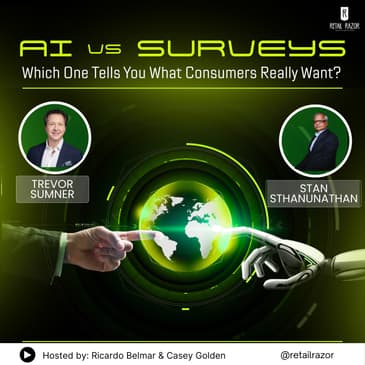




S5E13 Future of AI-Powered Consumer Insights with Trevor Sumner & Stan Sthanunathan
In Season 5, Episode 13 of The Retail Razor Show, hosts Ricardo Belmar and Casey Golden tackle one of retail’s biggest blind spots in consumer insights: the consumer sentiment gap. For decades, brands relied on surveys to understand shoppers. But what people say doesn’t always match what they do.
Enter AI-powered shopper insights!
Joining the conversation are Trevor Sumner (CEO of i-Genie AI) and Stan Sthanunathan (Executive Chairman of i-Genie AI, former EVP at Unilever and VP at Coca-Cola). Together, they reveal how billions of unfiltered signals — from searches, reviews, and social posts — can be transformed into real-time, actionable consumer insights that reshape retail decision-making.
What You’ll Learn in This Episode:
Why traditional consumer surveys are breaking down
How AI and natural language processing uncover real customer behavior
The role of empathy vs sympathy in understanding consumers
How disruptor brands are reshaping competitive landscapes
Why augmented intelligence (AI + human insight) is the future of retail strategy and consumer insights
Subscribe to the Retail Razor Podcast Network: https://retailrazor.com/
Subscribe to our Newsletter: https://retailrazor.substack.com
Subscribe to our YouTube channel: https://bit.ly/RRShowYouTube
About our Guests
Trevor Sumner, CEO, i-Genie.AI - https://www.linkedin.com/in/trevorsumner/
Trevor is a NYC-based entrepreneur, product and marketing executive and recognized startup advisor and angel. Trevor is the CEO at i-Genie.ai, the leading AI platform for consumer insights, revolutionizing an industry that had been dominated with antiquated survey methodologies by synthesizing tens of billions of searches, social and video posts, ratings and reviews and market data for industry leaders like Kenvue, Unilever, Coca-Cola, Bayer, Clorox and more.
Previously, Mr. Sumner was Head of AI and Data Platform products for Raydiant, a leading VC-backed digital experience platform that is transforming over 250,000 digital touch points across 4,500 clients with AI, computer vision and data.
Mr. Sumner came to Raydiant when it acquired Perch, a recognized leader in in-store Product Engagement Marketing, interactive retail displays and augmented reality, where Mr. SUmner served as CEO. Perch was named a Top Tech Company to Watch by Forbes, a Top 10 Retail Technology company by CIO Review and has won numerous Clio, Fast Company, Edison, Bloomberg and Digi awards.
Stan Sthanunathan, Executive Chairman, i-Genie.AI - https://www.linkedin.com/in/stan-sthanunathan-1ab4035/
Stan Sthanunathan joined Unilever in July 2013 as Executive Vice President of Consumer & Market Insights. As chief provocateur, he headed up the insights function globally based in London. He retired from Unilever on June 1, 2021.
Post retirement he has started an AI/ML enabled company called i-Genie.AI focused on delivering near real time insights and ideas to help business identify Next Big Thing. Prior to joining Unilever, he was Vice President of Marketing Strategy & Insights for The Coca-Cola Company in Atlanta, heading up the function on a global basis.
Stan co-authored a paper on Building an Insights Engine that was published in Harvard Business Review, Sept 2016. He has also co-authored a book titled AI for Marketing and Product Innovation.
He was awarded Lifetime Achievement award at TMRE 2022 event.
Chapters:
00:00 Previews
01:23 Show Intro
04:43 The Consumer Sentiment Gap
05:37 Welcome Trevor Sumner & Stan Sthanunathan
06:30 Backgrounds of Trevor and Stan
09:11 Challenges in Understanding Consumers
16:58 The Evolution of Influencers
18:32 Limitations of Surveys and the Need for AI
25:46 Augmented Intelligence: AI + Human Insight
31:46 Challenges in CPG Innovation
33:02 Innovate: A Data-Driven Product
34:42 AI and Predictive Analytics
36:21 Democratizing Data Access
38:07 Mindset Shift for Rapid Actions
40:46 Adopting AI in CPG
48:16 Retailers and Data Utilization
52:59 Future of Brand Understanding
57:23 Conclusion and Contact Information
58:15 Show Close
Meet your hosts, helping you cut through the clutter in retail & retail tech:
Ricardo Belmar is an NRF Top Retail Voices for 2025 & a RETHINK Retail Top Retail Expert from 2021 – 2025. Thinkers 360 has named him a Top 10 Retail, & AGI Thought Leader, a Top 50 Management, Transformation, & Careers Thought Leader, a Top 100 Digital Transformation & Agentic AI Thought Leader, plus a Top Digital Voice for 2024 and 2025. He is an advisory council member at George Mason University’s Center for Retail Transformation, and the Retail Cloud Alliance. He was most recently the director partner marketing for retail & consumer goods in the Americas at Microsoft.
Casey Golden, is CEO of Luxlock, a RETHINK Retail Top Retail Expert from 2023 - 2025, and a Retail Cloud Alliance advisory council member. Obsessed with the customer relationship between the brand and the consumer. After a career on the fashion and supply chain technology side of the business, now slaying franken-stacks and building retail tech! Currently, Casey is the North America Leader for Retail & Consumer Goods at CI&T.
Includes music provided by imunobeats.com, featuring Overclocked, and E-Motive from the album Beat Hype, written by Heston Mimms, published by Imuno.
Transcript
S5E13 The Consumer Sentiment Gap
[00:00:00] Previews
[00:00:01] Ricardo Belmar: For decades, consumer surveys have been the go-to tool for understanding shoppers, but here's the problem. Consumers don't always tell us the truth,
[00:00:10] Casey Golden: Instead of asking a few thousand people what they think. Imagine listening to billions of unfiltered signals
[00:00:18] And being able to turn that into real-time insights about what customers are actually doing
[00:00:24] Ricardo Belmar: to help us rethink how retail really knows its customers we've brought in two industry heavyweights who are helping reshape the consumer insights landscape.
[00:00:34] Stan Sthanunathan: I always ask this question, are you in a committed relationship?
[00:00:36] And if you say, yes, I am. I always ask you, did you administer a five point scale questionnaire to your partner before you got into a deep relationship? The answer is invariably no. So it's big life decisions are being taken based on listening to your heart.
[00:00:52] How can I listen to your heart?
[00:00:54] That is the challenge,
[00:00:55] Trevor Sumner: And so like really looking at the biggest data set possible and using [00:01:00] AI and natural language processing techniques allows us to, to see the macro market, to dig into the micro markets, and really provide actionable insights.
[00:01:08] Because the other thing is these things are changing so quickly.
[00:01:11]
[00:01:23] Show Intro
[00:01:23] Ricardo Belmar: Welcome to Season 5, Episode 13 of The Retail Razor Show, the only retail podcast in the Top 10 All Time Indie Management podcast charts on Goodpods and the highest ranked retail podcast in the Top 100 Indie Marketing podcast charts on Goodpods.
[00:01:39] I'm Ricardo Belmar.
[00:01:40] Casey Golden: And I'm Casey Golden.
[00:01:41] Welcome Retail Razor fans to retail's favorite podcast where we cut through the clutter to give you sharp insights on what's happening in retail today, tomorrow, and where we get real about what's driving the future of retail.
[00:01:54] Ricardo Belmar: Today we're tackling a question that every brand and retailer wrestles with. Do we really [00:02:00] know our customers or have we just been comforting ourselves with data that makes us feel smart? For decades, consumer surveys have been the go-to tool for understanding shoppers, but here's the problem. Consumers don't always tell us the truth, not maliciously, just humanly.
[00:02:16] That gap between what people say and what they actually do has become a real blind spot that keeps leaders up at night.
[00:02:23] Casey Golden: And that's why we're calling this episode The Consumer Sentiment Gap, because the old survey driven models are breaking down and the future of retail intelligence looks very different. Instead of asking a few thousand people what they think. Imagine listening to billions of unfiltered signals, searches, social posts, ratings, reviews, and video content. And being able to turn that into real-time insights about what customers are actually doing, feeling, buying or not buying, and yes, this means using AI to [00:03:00] get the job done and bring real insights brands can use.
[00:03:04] Ricardo Belmar: So to help us rethink how retail really knows its customers we've brought in two industry heavyweights who are helping reshape the consumer insights landscape.
[00:03:14] Casey Golden: First, someone longtime fans of the show will remember as one of our original Retail Avengers, Trevor Sumner, CEO of i-Genie AI. Trevor has spent nearly 15 years building and scaling, cutting edge technologies. He's led companies like Perch, Radiant, and Local Vox, and now he's at i-Genie. He's revolutionizing customer insights by synthesizing tens of billions of data points for global leaders like Unilever, Coca-Cola, Bayer, and Clorox.
[00:03:49] Ricardo Belmar: And joining him is Stan Sthanunathan, executive chairman of i-Genie AI. Stan's a legend in the insights world. Honestly, he spent nearly eight years [00:04:00] as the EVP of Consumer and Market Insights at Unilever. And over 10 years at the Coca-Cola Company where he ended his tenure there as the Global VP of Insights.
[00:04:09] He literally is the OG of Consumer Insights. He's co-authored a Harvard Business Review paper on building an insights engine, written a book on AI for marketing and product innovation, and was honored with a lifetime achievement award at TMRE.
[00:04:23] Casey Golden: And these days, he's channeling all that experience into i-Genie AI helping businesses identify the next big thing with AI powered insights. Together, Trevor and Stan are dismantling the old survey driven approach and showing us what the next wave of retail intelligence looks like.
[00:04:43] The Consumer Sentiment Gap
[00:04:43] Ricardo Belmar: So today we'll explore how AI is changing the game, what it means for brand leadership, and whether this is the end of market research as we know it, or just the end of pretending we knew what people wanted in the first place.
[00:04:55] But before we dive in, a really quick favor. If you're enjoying the show and we hope [00:05:00] you are, hit us with a five star rating and drop a short review on Apple Podcasts, Spotify, Goodpods, or wherever you're listening.
[00:05:06] Casey Golden: And don't forget to like and subscribe on YouTube, so you never miss an episode.
[00:05:11] Ricardo Belmar: Plus check out the other shows in the Retail Razor Podcast Network, Retail Transformers, Blade to Greatness, and Data Blades.
[00:05:17] Casey Golden: You'll find them all in your favorite podcast app or together on our YouTube channel.
[00:05:23] So now let's dive into our conversation with Trevor and Stan and learn all about the consumer sentiment gap. It might just change the way you think about knowing your customer and your product.
[00:05:37] Welcome Trevor Sumner & Stan Sthanunathan
[00:05:43] Ricardo Belmar: Trevor, welcome back to the Retail Razor Show. It's been what, like a hot minute since you've last been on here. And Stan, welcome to your first time on the show.
[00:05:51] Stan Sthanunathan: Thank you.
[00:05:51] Casey Golden: Trevor, it's been too long since we've had a fellow Retail Avenger join us on the show. So glad to have you back, and [00:06:00] with a friend. So thanks for joining us today.
[00:06:02] This is a fun topic and I can't wait to get into it.
[00:06:06] Trevor Sumner: Great! It’s good to be back. It’s good to see you all, and, you know, all the success with the Retail Razor podcast. Congrats!.
[00:06:12] Ricardo Belmar: Yeah.
[00:06:12] Thanks. Thanks. Now I'm absolutely positive our longtime fans probably know all about you, Trevor, but since it has been a while, since you were on, and since Stan's new to the show. In fact, Trevor, I think it was back in season three, believe it or not, was the last time you were, on the show with with the Retail Avenger crew. So I'm sure there's been lots of things that have happened since then.
[00:06:30] Backgrounds of Trevor and Stan
[00:06:33] Ricardo Belmar: So before we jump into today's topic, why don't you and Stan each give us a quick rundown on your backgrounds and what everyone should know about you.
[00:06:37] Trevor Sumner: Stan, do you wanna start?
[00:06:39] Stan Sthanunathan: You go first.
[00:06:40] Trevor Sumner: All right. I am a 25 year veteran of retail tech and marketing tech startups. started my career in 1998, caught the first internet boom, building e-commerce sites, and, large scaling. Pricing configuration engines have done a variety of different, startups and, solely went from, employee two 50 to 40 to [00:07:00] seven and started my first company in 2010, a company called Local Vox, which was doing local online marketing, driving people from online to in store.
[00:07:08] Grew that to about a hundred people, eight digit revenues, and sold that to the Blackstone Group. that more recently was doing computer vision and in-store retail and digital retail media. It was early on that train and sold that company. And, as I was looking around for a new gig, I was talking to some VC friends and said, Hey, you've gotta check out this company called i-Genie founded by these amazing Unilever guys who've got a big idea.
[00:07:32] And when I met Stan and Paul, I was like, oh, this is an incredible opportunity. So I joined about nine months ago and really excited to be here. Stan.
[00:07:40] Stan Sthanunathan: Yeah. Hi. I always begin my introduction by saying that I'm a one trick pony. I I spent 40 years working and the entire time I've spent in the insights industry, my before I co-founded i-Genie, along with my co-founder Paul Vangen, who was actually based in Devon, South Africa. I was with Unilever, as [00:08:00] EVP of Consumer and Market Insights based out of London. I was with them for eight years. before that I was a Global Vice President of Marketing strategy and insights at, the Coca-Cola Company based out of Atlanta. I spent a total of 18 years with Coke, working. All around the world, and then eventually finding my way to the North America business and then to head up the function globally.
[00:08:23] And before that, I was working in research agencies, in India, in the Middle East, and so on. So that's basically my background. Yep.
[00:08:30] Trevor Sumner: and no, nobody knows more about, kind of consumer insights technology than Stan. Just to give you a sense of scale, and he's too humble to talk about this, but, he managed a $350 million budget at Unilever. And one of the things he was known for is bringing new technologies in to to really experiment with what new ways to approach data and technology could do to transform the insights function. And I think that's one of the reasons he has the lifetime achievement award and consumer insights from TMRE and others. As I said, like when I met Stan, just the opportunity [00:09:00] to work with him was an incredible honor.
[00:09:02] Casey Golden: That's awesome. Thank you for adding it. We all need a cheerleader, Trevor.
[00:09:06] Trevor Sumner: Yeah. I'm Stan's hype man.
[00:09:08] Ricardo Belmar: There you go.
[00:09:11] Challenges in Understanding Consumers
[00:09:11] Casey Golden: So for decades,
[00:09:12] Trevor Sumner: Times I've been your hype man, too. Ricardo, I need need to work for ya.
[00:09:16] Casey Golden: Oh, Trevor, you've literally, like your phone calls have picked me up off the floor. You've been there, man.
[00:09:26] For decades now, like the biggest brands in the world have been spending billions asking consumers what they want and most of them were like, let's face it. it's just bullshit. Responding aspirationally versus their true actions, or at best, like guessing brands being so detached from their cons, their who, their consumer is not who they want their consumer be, but who their consumer actually is.
[00:09:54] Did we ever really know our customers? Or have we just been [00:10:00] comforting ourselves with the data that's aligned with what we think? is it just because we didn't have the data or what is your kind of thoughts on it?
[00:10:10] Stan Sthanunathan: Now, if you go back to this whole space of consumer understanding that industry is actually a hundred years old. Yeah. And it was started by procter and Gamble on this side of the pond and u around the same time Unilever started on the other side of the pond. So every company, worth it's name, is single-mindedly focused on understanding their consumer. If they don't understand, they know that they'll be, they'll be toast. So they do invest a lot of money trying to understand the consumers. the question is, do they really get to the bottom of what the consumer actually wants or not?
[00:10:46] If I have to go back to my starting days in the research industry, those days, you could get to the bottom of what consumers wanted purely because you knew who you were talking to, you knew who you were getting opinions from, and that was very [00:11:00] clear.
[00:11:00] And therefore, you could get some decent information. But the world has changed. People are really, time poor and info obese. Yeah. They have so much of information that they have that people don't have time for taking surveys. If I ask you, here is a 40 minute long questionnaire, I'll give you five bucks for it. Are you gonna jump outta yeah. You're not doing it
[00:11:22] Ricardo Belmar: No one's doing that.
[00:11:24] Stan Sthanunathan: Yeah. So there is a sec, but of course there are lots of people who still do it because five bucks is five bucks, so a lot of people who do it. So the question is, how do you actually go around getting real consumer feedback. And there are various ways in which you can go at it. A few large companies I know of have major consumer immersion programs where they force their senior leaders to actually go and meet real people. They cannot meet thousands of people, but they do certainly go and meet real people, and that's way you create human empathy. If [00:12:00] you don't do that, what you are surely going to end up with is human sympathy.
[00:12:05] And that is exactly what consumers don't need. You don't need a company to look down upon them and say, oh, poor consumer is under pressure because of inflation. Let me solve their problem. No, you cannot solve their problem, right? You need to know what are they going to do. How can you help them as opposed to solve a problem for them? That's why human empathy is very important and a lot of large companies that I know of, they all have programs to really make sure that they understand the humans at a very deep level. But at the same time, we are coming at it from a different angle the way we are coming at it saying, Hey, people do not have time to talk to us, but they certainly talk about us.
[00:12:49] Ricardo Belmar: Ah, exactly.
[00:12:50] Stan Sthanunathan: They go and talk to, in various forums where they spend a lot of time, just open your iPhone and see how many hours you have spent on looking at that screen. It'll be anywhere [00:13:00] between three to eight hours, depending on how addicted you are to that screen. But not all eight hours you're doing work, but you're also doing things like, you're looking at your insta post and you're looking at whatever you want to look at, you also engage with brands on your phone.
[00:13:14] So they do talk about us. So they, when they do talk about us, that is completely unsolicited and that's when they're expressing their opinions freely. And the moment you can get those kind of inputs into a platform to analyze it using the current date technology in terms of AI and machine learning, then you can actually get some deep insights, which otherwise you would never get because, people would never tell you, what they actually think in response to a survey questionnaire.
[00:13:44] I always ask this question, are you in a committed relationship?
[00:13:46] And if you say, yes, I am. I always ask you, did you administer a five point scale questionnaire to your partner before you got into a deep relationship? The answer is invariably no. So it's big life [00:14:00] decisions are being taken based on listening to your heart.
[00:14:02] How can I listen to your heart? That is the challenge, and that's how we actually get down to doing what we do at i-Genie to really get to the bottom of the truth.
[00:14:12] Casey Golden: I can imagine that like now we have. consumers and then we have like influencers that are talking about brands and have to account that those people are paid. and then also I bet there's a lot of bot users that might talk about lots of things, that would never buy a product.
[00:14:31] Stan Sthanunathan: Yep.
[00:14:33] Casey Golden: there's gotta be, so yeah, it's definitely takes a lot more to dig through that today than it would've.
[00:14:38] Stan Sthanunathan: Absolutely.
[00:14:39] Ricardo Belmar: Yeah.
[00:14:40] Casey Golden: even 10 years ago I'd feel
[00:14:41] Stan Sthanunathan: I think Trevor is the best person to talk about influencers, his wife is one...
[00:14:47] Trevor Sumner: yes. No, absolutely. There's also a couple different ways that you actually wanna look at this, right? one way is you want to get feedback from customers about your products, right? and what do they think about your products. But the second part is understanding how the market [00:15:00] influences consumers during the journey. You actually want, you, you both want the authentic consumer feedback. And then you also want to understand the entire market, including the bots, including the influencers, and how that, changes the perception as you, go through. So when you go through your ratings and reviews, we know there's some bots in there, right?
[00:15:18] But those do influence people. And so to, depending on our product and which use case you're looking at, are you looking at, what is brand equity in the market and how does tha influence and predict sales even, months out that you wanna look at the holistically. But then the other piece about, How we dedupe, some of the kind of bots and the other biases in the large scale data sets is really being multi source.
[00:15:41] And I think one of the challenges in the industry is they're so single source and each. Has its own set of flaws, right? Whether it's, social and influencers or review farms and things like that. One source that is really intact and has high fidelity search, right? Nobody's gaming the searches that they do.
[00:15:57] And so one of the proprietary [00:16:00] data sources we have. Where a lot of people use Google trends, which is highly derivative and very limited, right? We actually look at millions of keyword searches just in skincare, and then that represents, millions of keywords, billions of keyword searches, and that has real authenticity.
[00:16:15] And so we can triangulate between social reviews and search together to have a good understanding of what's actually happening in the world. and that level of granularity that we get to, I think is a real strength as well. We understand every ingredient. We know that vitamin C is the same as citric acid.
[00:16:30] So when you review this product over here, we know it has vitamin C in it. That affects our predictive algorithms as to what's trending, what will continue to trend. We look and for example, trends, how, search data flows into social data because typically you see trends six months earlier on search. And you wanna see that kind of translate into the social area, so there's a lot that we do with large scale data sets to be able to get to fidelity.
[00:16:55] Stan Sthanunathan: Yeah. I just wanna build on what Trevor said.
[00:16:58] The Evolution of Influencers
[00:17:03] Stan Sthanunathan: This notion of influencers is not actually a new one. Yeah. Good old days, Eve influenced Adam. To take a bite of the apple. So influencing was always happening, even from those days. and then people said no. But now we have paid influencers again, I would say, the influencers are always paid. Sometimes they were humans, sometimes they were not.
[00:17:23] In the good old days, it was television channels. To whom you pay money to influence consumers or you paid money to newspapers to put an ad to influence consumers. Now you have, you pay money to a human being to say things that you want them to say about you. So influencers have always been there from that time. Humankind was there. So it, it is a question of the tone keeps changing the way, form and shape in which they appear keeps changing. So therefore we have to adapt in terms of how we actually go with the flow, go with the times, and then see how to influence people. And that's exactly what most marketers [00:18:00] are doing. Any smart marketer knows that, influencing is what their job is now, who they use, how they do it is gonna change. It has to changed with times.
[00:18:09] Ricardo Belmar: Yeah, no, that's a great point. So you have all these different sources, whether it's influencers, search, and I guess the key is different ways of understanding each one, and we started out by this saying like, whatever, what happened to surveys? Because it feels like a lot of brands maybe were over reliant on surveys to some extent, as that mechanism to do this.
[00:18:32] Limitations of Surveys and the Need for AI
[00:18:32] Ricardo Belmar: Is the issue with those that they're being misused or maybe misinterpreted or is it that they just don't work to accomplish this kind of a goal in understanding that consumer sentiment?
[00:18:44] Stan Sthanunathan: No, I genuinely believe, there is a role for service and there are some things that you cannot do without a survey. let's let be clear about that. For example, if I've created a completely new product and I want to test the formulation of the product.
[00:18:58] Ricardo Belmar: Mm-hmm.
[00:18:58] Stan Sthanunathan: I cannot do that [00:19:00] through social listening or search or reviews, right? I need to make sure that, it delivers what it is supposed to deliver. Therefore, I will send a product sample to somebody's house and I will do a survey among them. That's the only way I can get real feedback on whether they love the product or not. And there are a few other things where, you know, you would need surveys.
[00:19:18] The question that I have in my mind is not whether survey is needed or not. Whether the data that you get is actually valid or not, that to me is a much bigger issue, right now. If you find that, a sizable proportion of people who took surveys on sanity napkins where actually teen males and you did not even know about it, to me that's a big problem.
[00:19:42] Ricardo Belmar: Yeah.
[00:19:43] Stan Sthanunathan: people can masquerade as whoever they want to be in a online survey. And if you do not have checks and balances, it is a problem. It's a problem. And by the way, that is not, an uncommon thing.
[00:19:55] Recently in the in, in Somar Congress, an apex body of [00:20:00] all the insights professionals.
[00:20:02] The innovation award that they give went to a company that actually identifies what percentage of surveys taken are fraud. It could be bought, it could be, people masquerading as somebody who they're not. Or it could be, somebody just randomly filling out the surveys.
[00:20:22] Yeah. In a, in an and in a farm somewhere in Philippines or in India, they came up with a number, 40%, four zero percent. Right. Now that is going to result in the industry actually moving mountains to actually make sure that the 40 come to readable levels. And you said that, there's a lot of people that are bought who do the reviews and so on and so forth. Yes, there is a data problem in everything, but the question is, do you have technology to be able to solve those problems or not? If you solve it, then you get nice, good information.
[00:20:54] There will always be some people who will lie. There will always be some data that will you know. We'll be filled [00:21:00] out by the bots, but as long as it is minimized to the action possible, then you can get to the real truth and that's what you know. and here, we know how to do this. Whereas if the survey industry can crack it, and also, I have a conceptual problem with five Point. Can we actually make it quite easy for people to give an answer? They'll say, read a statement, five point K four. Next one, three, next one, four. They go through the answers very quickly because. They want to be out with it so that they can actually get the money that you don't wonder, whereas in a review when you're type, when you bought a cosmetic product and you applied on your face and you felt great and you want to write a review, you write and you do that out of your own choice and then you express it passionately. And that's why I believe that when people speak their mind out on their own, you get great answers and.
[00:21:47] Trevor Sumner: Yeah.
[00:21:49] And I think that 40% fraud number is actually well accepted. I think, Stan's got a million stories where, he got feedback that Hellman's mayonnaise was doing really well in India, which, to which he [00:22:00] responded. Interesting. We don't sell Hellman's mayonnaise in India. That's the type of sur that's what realistically happens with this. I think the other thing that, that we haven't hit on is also the fact that surveys are limited. Even in that five point scale, you can ask about five to 10 competitors. Do you know how many brands there are in haircare, 1900? Over 1900 and these days, there's so many disruptor brands that are, according to Ipso, 70% of new market value is actually created by the disruptor brands.
[00:22:27] So you're not gonna be able to look at these surveys. and, you want them to be static over time so you can benchmark them. So you're looking at the same five to 10 competitors. Meanwhile, the real competitive threats are all the disruptors. And the other piece of that is, is being able to segment the market, right? So being able to look at, segments and subsegments. We had one client who was looking at, heat protectant for hair, right? Which is a, really small sub subsegment, but a big business, right, and um, they saw that, you know, looking at every review for every SKU in the category that [00:23:00]people were complaining that you couldn't put it, you couldn't, you could only put heat protector in wet hair. And so they're like, oh, we're gonna create a product to put in dry hair, immediate Amazon bestseller, immediate, 4.8 stars average instead of 4.2, which is the category average. But, you can't, really look at a microscope of a subcategory in these broad based surveys.
[00:23:19] And it's one, you're only certain audience that's gonna take these things in the first place. Then you get all this fraud, then you're limited in your view. So even when we look at some of the AI solutions that, can help you build the surveys better and analyze the data better, and there's some getting it less expensive, which actually encourages, Worse audience, sub selection and greater bias. Like that whole process of AI-ifying surveys, we think ultimately is wrong. And so like really looking at the biggest data set possible and using AI and natural language processing techniques allows us to, to see the macro market, to dig into the micro markets and really provide actionable insights.
[00:23:58] Because the other thing is these things are changing [00:24:00] so quickly.
[00:24:01] Surveys are so expensive. You can run 'em quarterly, Maybe annually we can get you near real-time data about what's happening. Think about tariffs in the us how are tariffs or price change you're making affecting the brand's, perception on premiumness and the value equation.
[00:24:15] We can show you that if you're Kenvue and Tylenol and everything that's going on in the political aspect. Don't you wanna see. how much that is being affected on a, near realtime basis. These things, surveys are, are not fast enough, they're too expensive, uh, they're scape issues, so we really need to migrate to, to more digital signaling.
[00:24:34] Ricardo Belmar: And I guess then that's, to your point, that is where you really can't do this without what I'll call the more appropriate use of AI on top of all this data to get at that analysis, right? This is something we couldn't do before.
[00:24:47] Stan Sthanunathan: Yep. That's a key thing. That's a key thing because this, the volume of data is so huge, humanly impossible for anyone to process all that data. Thank God for AI. Then it [00:25:00] actually, you, helps
[00:25:01] to. Take away bulk of the grunt work and then, you can apply your intelligence. If we expect AI to spit out all the answers I always say that, over reliance on artificial intelligence will result in exponential growth in natural stupidity.
[00:25:22] Ricardo Belmar: I have to remember that one. I may steal that one.
[00:25:25] Trevor Sumner: and,
[00:25:26] Stan Sthanunathan: So you have to be careful. You have to be careful. The most important thing is use AI to actually harness the power of all the data that you have access to, overlay your own knowledge of the business, knowledge of the com competitive landscape, and come up with a strategythat will make your business viable.
[00:25:46] Augmented Intelligence: AI + Human Insight
[00:25:46] Stan Sthanunathan: And that's what we call as augmented intelligence.
[00:25:49] So it is ai, artificial intelligence, plus human intelligence is equal to augmented intelligence, and that's what we try and enable our clients to do.
[00:25:58] Casey Golden: Yeah, I think there's this, we [00:26:00] always hear. Know your customer. Know your customer. and there's a lot of brands that have failed at really knowing their customer, but the real blind spot might not just be knowing your customer, but actually knowing your product. A lot of what you guys are talking about really comes down to product knowledge and understanding of how it lives in people's hands, homes, habits.
[00:26:24] How do great merchants and brands close the gap between what they designed and what people are experiencing?
[00:26:32] Trevor Sumner: Yeah,
[00:26:32] I, this is a part of like really understanding the language that people use around products, right? And one of the things that I think is different about us is that, we literally get reviews for every SKU in the category. And so to that heat protector and example, like, to be able to segment into that and then to see the topics that lead to either positive or negative reviews, positive or negative sentiment and to be able to cluster those things with, natural language processing, just [00:27:00] helpful kind of what deterministically leads to positive reviews, negative reviews, but also we wrap it all with an LLM and a gen, an agent that we call Presto. So you can literally start asking a questions like, what type of events do people Talk about when they use this product, what type of contexts, are in the verbatims of the reviews or the social posts, how can I segment into that and be able to ask those types of questions in a freeform
[00:27:25] kind of way, and to have a really potent way of organizing all that data. Like I talked a little bit about, the ingredients and vitamin C and citric acid. we basically read the entire category and we understand every claim, every benefit, every ingredient, every format, right? So how do people talk about serums versus cleansers versus toners, et cetera, et cetera. we can segment all that data. And so one of the key things around AI. it's this master data management of how we organize the information.
[00:27:55] So you can ask those very types of questions in very specific context [00:28:00] and have that level of understanding. And I think that's missing with, a lot of solutions out there. For example, with trending, a lot of people use social listing for trending and they give it, here are the sets of things, the trends we wanna listen to. Then you're not, if you already know what the trends are, you're just measuring it. You won't see the early things
[00:28:17] Casey Golden: It's really biased,
[00:28:18] Trevor Sumner: and coming.
[00:28:19] Casey Golden: right? Like when you're asking questions, it's like they, they surveys always ask me things. They're like, which one of these other? I'm like, I don't buy any of 'em. like, I buy something over here. Like just because this is in my, is on, is in one of my, on one of my shelves. You're the anomaly. Not The rest. The rest is more like emerging brands, maybe luxury. Maybe this, maybe that, somebody gifted it to me. I got it for a birthday, but like the anomaly is usually the person asking for the survey
[00:28:50] Stan Sthanunathan: Yeah.
[00:28:50] Casey Golden: I found. but.
[00:28:52] Trevor Sumner: and look, this made sense though, right? This made sense when there was Coke and Pepsi and maybe, three soft drinks. We work with Coca-Cola, we track [00:29:00] over 130 beverages, right? The disruption in the market, and the fragmentation is incredible. And just fundamentally, the market has changed and we need a different way of looking at
[00:29:11] Casey Golden: different seasons.
[00:29:13] Stan Sthanunathan: probably one, sorry. Go.
[00:29:15] Casey Golden: Oh, that's what I was saying. It's just it's not like one product also for an entire year, especially when you come into like haircare, we know that we need to switch it off, so we switch it up between a couple brands, different seasons. We buy different products in the winter than we do in the summer and things of that nature.
[00:29:31] Right.
[00:29:32] Stan Sthanunathan: I think you know, the, one of the big macro trend in most CPG categories is almost vanishing of barriers to entry. Yeah. Anybody with a small, garage can actually make a product now. Yeah. Or you can go to a toll packer and get it made. And that's the reason why, Trevor talked about 1900 healthcare brands, and this is not just restricted to a country like the us.
[00:29:58] I just heard last week that [00:30:00] there are in Indonesia there are 8,000, 8,000, personal care brands.
[00:30:06] That's staggering.
[00:30:08] Ricardo Belmar: Yeah.
[00:30:08] Stan Sthanunathan: That's absolutely staggering. So you, don't know who's biting your ankles.
[00:30:13] Ricardo Belmar: Yeah.
[00:30:14] Stan Sthanunathan: your legs are into the water and you're looking at all the, the usual suspects and you're competing with them.
[00:30:19] But there are a thousand ankle biters that are getting launched if you can't figure out who's gonna crawl their way up and actually swallow you early enough. You could be completely blindsided. And that's the reason why, some of the traditional survey based tools where you have reticitance number of brands that you can track becomes very challenging.
[00:30:40] But then, some of the survey based tools also pivot and say, oh, but then we have synthetic respondents. Yeah. And you can, we can administer the same questionnaire to synthetic respondents give you data in less than five minutes time. Sounds very promising.
[00:30:56] Yeah, sounds very promising. Now, would I buy [00:31:00] that logic, lock, stock and barrel? Probably no. Why? Because I know, I would say that I would surely talk to synthetic respondents the day they have credit cards and they can buy things from the shelf. Yeah. So that's my simple pushback, but then jokes apart. How did he create the synthetic respondent? You created the synthetic respondent based on past respondents whom you have surveyed. We talked about 40% fraud in the survey. So you're perpetuating that going forward.
[00:31:30] So that number one. Number two is whoever told you that the way people behaved in the past are exactly the way people are gonna behave in the futue right.
[00:31:39] So, when you, do those kind of things, you will get the kind results that you have always had.
[00:31:46] Challenges in CPG Innovation
[00:31:46] Stan Sthanunathan: So you know, companies, CPG companies you talk to, any large companies, they would say, yeah, growth is a challenge, but if you do more of the synthetic respondent, your growth will be a challenge.
[00:31:55] That is one thing you can predict with a hundred percent accuracy. because you want something [00:32:00] that is actually big and bold. And I always ask people, when was the last time you've noticed a big breakthrough innovation in the world of CPG? Ask you that question, most people will say, And they start thinking and thinking, and they would not come up with an answer.
[00:32:17] So sometimes people come back and say, this product and that product, and invariably those things are launched 15 and 20 years ago.
[00:32:24] Ricardo Belmar: Yeah.
[00:32:25] Stan Sthanunathan: Yeah, right now, if there is a disease that plagues the entire CPG industry, it is, I would say two major ones, fragrance-itis and flavor-itis. Other, yeah. So it's easy, change the fragrance, change the flavor, and then some, some pharma itis, that is the other third disease
[00:32:43] Ricardo Belmar: Just creating variations on a theme.
[00:32:45] Stan Sthanunathan: They're all variation to me. They're renovations, not innovations, no wonder 95 percent of all innovations fail in the market.
[00:32:55] Ricardo Belmar: Yeah.
[00:32:56] Trevor Sumner: Yeah, that's a crazy stat
[00:32:57] Ricardo Belmar: That's crazy
[00:32:58] Trevor Sumner: It's a crazy stat and I think it's [00:33:00] because of the human bias and surveys and panels.
[00:33:02] Innovate: A Data-Driven Product
[00:33:02] Trevor Sumner: We actually have a product that's super cool called Innovate, which takes every combination of ingredient format, claim benefit and creates hundreds of thousands of product ideas and then scores them with our predictive analytics. Basically looking at those trends on citric acid or other things. And we did this with a major cleaning product company, large, multinational, billion dollar company plus. And obviously they have a robust innovation team, and practice.
[00:33:29] And they tested 20 of their internal ideas that they were in the vetting process with against our 10 top ideas with consumers.
[00:33:36] Nine of the 10 top ideas came from us. And because it's all data-driven. and there's this great marketoonist who I love is a cartoonist. You should check him out, marketoonist. And he's got this great cartoon. He's I'm glad we got these survey results on our new product innovation ideas.
[00:33:50] We're just gonna go with what our boss's 14-year-old daughter says she likes.
[00:33:54] Right.
[00:33:54] And I actually, interestingly, I watched a Robin Williams documentary on the flight home yesterday, and the reason that Mork [00:34:00] got created for Mark and Mindy, he started on the Happy Days.
[00:34:03] It was because the director's son just had seen Star Wars and said, I don't wanna watch Happy Days. I need something with a spaceman in it. And so that's how they introduced spaceman and that's what's happening with innovation. And then you get these 90% failure rates and it takes 18 months to three years to come to market.
[00:34:22] So they're even basing the stuff. On trends they identified three years ago and have passed by.
[00:34:27] And we can compress those innovation cycles from 18 months to 36 months, to two to three months, right? And so it's all about faster data, better data that's attributable, right? And like synthetics, it's if it's garbage in, it's garbage out.
[00:34:41] You're just getting garbage faster.
[00:34:42] AI and Predictive Analytics
[00:34:45] Trevor Sumner: And this is where AI. You really need to make sure that you're in very robust data sets and predictive algorithms that actually do predict success.
[00:34:53] Casey Golden: And I think like I was I got to see a bit of a demo. I got to play with some keywords. I gotta see what it looks like, how I could ask [00:35:00] questions, and I think. I was just so impressed by one, a merchant and a product junkie is going to ask different types of questions in a different context than an analyst, right?
[00:35:14] Like I want to dig in and ask really specific questions, and I want Because I'm a user, I'm a consumer. I'm a product junkie. I know all these other products that I might also buy, and I've been researching ingredients or this or that, or skincare issues or hair issues. oh my goodness, everybody is on Nutrifol for like hair loss. What's going on? This was like not a thing.
[00:35:37] But just to be able to sit there and dig into the data and the way that you guys have it set up. It's so much more intriguing than I would've expected. And that's why I'm like, okay, let me see this, because I need to understand like, how do I engage? Can I ask anything? Can I really dig in? And you can. And it is, it has context and you can [00:36:00] shoot for extra context. And I just found it very intriguing. Like I was like, all right, I want to come play with sandbox.
[00:36:07] Trevor Sumner: Yeah. And like one of the things you can do with it is you can say, I'm in the innovation department, and then it'll give you answers tailored to, to, to your process, right? So you can create personas and things like that. But you can also like just dig. High level, down to the root.
[00:36:21] Democratizing Data Access
[00:36:21] Trevor Sumner: And one of our goals, and this is something that Stan brings from the Unilever days, and as honestly as a tech CEO, like I struggle with a little bit, is just, we really want to democratize access to this data everywhere, right? For example, we have unlimited seats. If you buy a license to your data and your application. Deploy it to as many seats in the organization at the same price and Right. not everybody wants to go to a dashboard, right? Stan says this, dashboards dash hopes. And and you need to be able to create these lighter weight, less frictiony experiences for an executive.
[00:36:53] Executives are not gonna go into a dashboard and try and figure out how to navigate, different levels of data and filters and other [00:37:00] things. And so they'll ask an analyst who then has a two to three week project to get them the data. Now you can just ask it, in Presto and get an answer right there at the right level for your question, whether you're an executive, somebody on the marketing team looking at campaign and how it affects my notion of premiums and value or pricing, tariffs, like all of that.
[00:37:20] You can just ask questions very quickly and I think that's gonna be transformative too. just, what we're seeing from how client usage is spiking because we just have better ways to interact with the data.
[00:37:31] Ricardo Belmar: All with all the access. Yeah. it makes me think I'll ask this way. So if you're knowing you have access to all the data in this way and you have. The right level of AI that can give you the intelligence and the insights you need to make these kinds of decisions. If you. Are re-architecting a CPG organization around this kind of data access, right?
[00:37:54] How are you changing the way things are done, like from, the product innovation development all the way through to [00:38:00] the marketing and to the distribution compared to the old ways of doing it. Now that you have this access.
[00:38:05] Stan Sthanunathan: that's a great, question.
[00:38:07] Mindset Shift for Rapid Actions
[00:38:07] Stan Sthanunathan: The short answer to that is these things the kind of stuff that we do, they will replace some of, the things that you've been used to in the past, and it's not as restructuring of a company, but it is reorientation of a mindset.
[00:38:25] That is required because you are used to a particular way of doing this, and it is part of your performance incentive system and so on and so forth. Therefore, you don't want to give that up. Yeah. To me that is a, it's a mindset issue much more than what, the data can do, and therefore, do we need a restructuring of the company?
[00:38:44] Probably not. I think most companies have evolved in terms of structure too. Cope with the digital world that they're walk, they're walked into.
[00:38:53] So I think the structure is pretty much there and I genuinely believe that there is no perfect structure. Every company [00:39:00] structures and restructures every three years. it doesn't, in pursuit of a perfect solution, but it doesn't exist. It's what you do that matters much more that w hat structure you are falling under.
[00:39:10] So that's point number one. point number two is the question that companies need to ask themselves is, are they geared for rapid actions? That is the thing that holds back. Most companies, having worked in large companies, sometimes it could take a month to get the stakeholders together in a room to talk about the issue right? Clearly because people are traveling. They have busy schedules, they have all kinds of things. Agility is lost because of the fact that, you're large and, you have a bit of bureaucracy to contend with, but are you ready for that? And what changes do you need to make in your workflow to make a way for, agile techniques to really, have an impact?
[00:39:55] So that's a second thing that I would surely, say that, it's a change management that [00:40:00] one, one needs to go through. The third thing is, you philosophical point of view. If you are not willing to give up the past, you can never walk into the future. Yeah. And I can keep saying that.
[00:40:17] Oh, in good old days, 40 years ago, we used to go door to door and do paper and pencil interviews. It was so much more, reliable. You can argue it are reliable, not reliable, but then don't give up that then I will be in problem.
[00:40:31] I'll have a big problem. Right? Yeah. You have to learn to do things and redo things and rewire yourself to be able to do that. That's, to me, everything's all about the mindset shift that would have to go through.
[00:40:45] Trevor Sumner: Yeah.
[00:40:46] Adopting AI in CPG
[00:40:46] Trevor Sumner: and I think, it's very, it's a very interesting time 'cause we all see the articles on AI and how people are adopting it. We talk to people who say, and I, AI is moving so quickly and at the same time. Because it's moving so quickly, [00:41:00] we're behind. But we're also afraid to make a decision because we're afraid the decision we make is gonna be obsolete, by the time we implement it. or that kind of paralysis. But you can't both say we're behind and agreed on paralysis, and that struggle is real. And I think one thing that Stan was known for at Unilever was being able to, make sure to be able to do a lot of tests, try new, a lot of new techniques, knowing that some of them are gonna fail, knowing that they're, you're gonna test things that don't make sense, but learning from them and then finding that the successes as a portfolio outweigh all the failures. and, for conservative organizations, that's really difficult.
[00:41:38] I think it's the only way in a fast moving market that you can be successful. We talked to some people who are like, oh, you have social data. we already have social listening, so we don't need that. I was like, no. Don't think of them as data sources. Think about use cases and applications and all the predictive algorithms that you put on top of it. you can't get siloed in these ways and say, what you're using for kind of monitoring customer engagement online is [00:42:00] the same as what you should be thinking about brand equity and trend spotting. So I think that's a real struggle for people and one I empathize with, but the alternative is that the organization will. We'll find a way. And so one of the things we're seeing is consumer insights budgets are under a lot of scrutiny and the departments that are depending on them, like marketing are finding their own data sources to work around it.
[00:42:21] And, that's a shame because I think consumer insights has a real role to play in the information economy where differentiation is based upon the quality and speed of information that you need.
[00:42:33] And I think having a centralized consumer insights function that can support it with rich data science, multi-data source attribution, that's gonna be absolutely critical to success.
[00:42:42] So it's, it's an exciting time. It's a very exciting time.
[00:42:46] Casey Golden: it's, always difficult when, you get pigeonholed into something that already exists. you're like, no, we're not that. nope, We're not that either. Nope. Nope. Not that either. It can be a fraction of all of these, all of them, or none of them. You sit in these rooms with [00:43:00] the retail CEOs, c-suite teams, the ones who might smile for the earnings call and panic behind closed doors.
[00:43:08] When the cameras aren't rolling, how do they really talk about AI? We, we've spoken a lot on, it's in every single conversation right now. What are you hearing? is it excitement or is it terror?
[00:43:22] Stan Sthanunathan: I don't know what the retail CEOs, but I can tell you what CPG CEOs.
[00:43:27] Casey Golden: Yeah, like let,
[00:43:27] let's talk about CPG.
[00:43:29] Stan Sthanunathan: CPG. See, I think there is.
[00:43:32] Excitement and a bit of nervousness. Uh, and so excitement because they know that, listen, this is here to stay. Yeah. This is like what, word processor was however many years ago, 30 years ago, 35 years ago.
[00:43:49] It is here to stay. It's not gonna go away. Right. It's gonna fundamentally change the way we work. Nervousness comes from the fact that can I [00:44:00] move faster than the competition? Yeah. Because that is something that people are
[00:44:06] worried about, honestly, because you go to any conference today, you show me one conference where the, word AI is not a term, and I'll give you a hundred bucks for each of them. Yeah.
[00:44:17] Ricardo Belmar: It's a.
[00:44:18] Stan Sthanunathan: I'm not saying
[00:44:20] so , It is. it is bizarre how everybody's talking about it. Everybody's talking about it. The nervousness comes from the fact that, listen, do I have the right kind of people. Do I, do I know what to do it, how to tame this beast and make it do what I want to get done?
[00:44:36] Those are concerns that they have, but there is no doubt in their mind that this is going to be something that will fundamentally change the way the business is going to be done.
[00:44:45] Casey Golden: You guys have got billions of unfiltered signals at your fingertips, posts, videos, reviews, Reddit threads. That's basically the raw subconscious of humanity at this point. does that ever freak you out a little bit?
[00:44:59] Stan Sthanunathan: It does [00:45:00] freak you out. It does freak you out, actually, believe it or not, just two days ago, our head of data center sent a small award that we got from open AI saying that we are one of the few companies who have crossed 10 billion token usage. Yeah. 10 billion tokens. And bear in mind that we are not a large multi-national company. We are multi-national, but we are not large.
[00:45:26] Casey Golden: Yeah,
[00:45:26] Stan Sthanunathan: But for company like a startup like us, to get that award, , A actually felt good. B, to your point, I really got a bit worried, we probably have more information about humanity than what we can actually cope with. Yeah. And if we are using 10 billion tokens to analyze that, imagine if we actually have an army of people and we go up to, let's say, 50 billion tokens and start asking some existential questions on the data that we have.
[00:45:56] We could be a massive powerhouse. Are we there? No. Yeah. But should [00:46:00] we get there? Yes. do we get there? Is what, the journey that we are on. Yeah. yes, we do have a lot of information. I'll give you a simple example.
[00:46:09] Let's say you are manufacturer of adult diapers. Yeah. Now, can you Imagine, yourself, sending a survey out to let's say, 60 plus year old human beings and say, I'm doing a survey on adult diapers. Let me ask you a few screener questions. Do you use them? Yeah. How many people will openly admit to the fact, even if it is an online survey, how many people will openly admit to the I use an adult diaper? Not too many. Yeah.
[00:46:41] , And then after that, you're gonna ask them a whole lot of questions. , Why, and why not? And so on and so forth. But then you go to. e-commerce website, like Amazon, and you'll find people reviewing brands like Depend and other competitors.
[00:46:54] Imagine, do you want to spend your entire life looking for a needle in a haystack, [00:47:00]or do you want to go and look where all the needles are concentrated analyze the needles what are the insight? I think the power of data that we have is unbelievable.
[00:47:10] But at the same time, it is also, a bit, what I would say overwhelming at times. Yeah.
[00:47:15] More than you need to know. But believe me, we don't ever get into personal identifiable information. we can never trace it back to individual because that is not the game in which we are in.
[00:47:25] Privacy and compliance is one of the most important things. But, both from a respondent point of view and from our client point of view, we make sure that whatever we do for our client remains private to the client and not generally accessible to the whole world.
[00:47:39] So, it is actually a evolving space. There is not a single day that passes without us sitting there and saying, oh shit. This can be done. Oh, when do we do it? How do we do it? And there the possibilities are immense.
[00:47:51] Possibilities are immense.
[00:47:53] Casey Golden: think that, really interesting. always say let brands focus on product, [00:48:00] right? If you're leader or retailer trying to innovate, you into the sentiment a way that's actionable, not just necessarily poetic?
[00:48:11] Are there certain signals that a product loved, not just bought?
[00:48:15]
[00:48:16] Retailers and Data Utilization
[00:48:16] Trevor Sumner: Yeah, I, you mentioned, and this is like a good, retailer tie in, is just if you think about your assortment in the skincare space, right? And you're looking at trends. We just posted an article about how pistachio is gonna be one of the next great skincare trends 18 months from now. and you could look at your assortment and say, Hey, do I have a new pistachio? And does the assortment that I'm picking actually lead to positive or negative sentiment? and if you're Kroger, for example, in your grocery store, you don't actually have a lot of reviews compared to, Amazon, Walmart, You probably want that data. You want the social data.
[00:48:47] You wanna know that's skewed, that is on your shelf. People actually don't like, They buy it and then they get disappointed and they think to themselves, you know what, maybe I should be going to Ulta. maybe I should be going to Sephora, because the assortment is not [00:49:00] actually pleasing. right? So You wanna be able to have real data signals and also predictive data signal. 'cause we know it takes six months from the time that you say there's a problem, I've gotta change the assortment to actually doing the changes. And so you need to get ahead of things. And we can look at sentiment based on, what your reviews, what stars you you have, what words you use, sentiment analysis.
[00:49:21] There's just so many different ways to slice and dice it these days. and be able to triangulate that kind of from a multi-source perspective is critical. And I think one of the challenges for retailers is they think of about, I've got my data and my data is my proprietary thing, that they don't actually triangulate against the greater market data and multi-source data sets.
[00:49:42] Stan Sthanunathan: I'll give you a simple use case, which I think will be incredibly powerful for retailer. So what are the three top pain points for a retailer?
[00:49:52] Pinpoint number one is how do I drive more footfall into my physical outlet? That's Pain point number one. Pain point [00:50:00] number two is I have finite shelf capacity.
[00:50:03] If something comes in, something has to go, otherwise I stock.
[00:50:06] That's a pain. Point number two. The third big pain point is I have finite capacity among buyers. Time, they can only meet so many number of people and the, I can only see now in the light of all these three here, the solution.
[00:50:22] You know what? If I can actually go and tell. These are the five brands slash SKUs you need to have in your outlet.
[00:50:32] And if you have them, it'll drive people into your outlet. And after that, you are a master in making people buy more things once they're inside the outlet. But these five will be the crowd puller that will bring you.
[00:50:45] Bring people in. That's number one. Now that automatically s, you don't have to meet every Tom, Dick and Harry who walks through the door saying, I have a new mall track. The buyer now then focuses on outbound [00:51:00] reach as opposed to inbound conversation. Inbound are dime a dozen. But if you had consciously go after these five brand, pick up the phone, talk to them and say, Hey, come over, talk to us. We would like to talk to you about how we can partner together in storing it so that takes care of the buyer's time-constrained problem. It takes care of, your shelf size problem and it also takes care of your footfall problem. Now how do we know that? To Trevor's point earlier on, we analyze the total market, whether it is Ulta, Sephora, Amazon, or, CVS or whatever it is, yeah, let's everyone, and then from there we can identify which are the brands that have, ankle biters, which are showing a phenomenal accelerated growth momentum. If you have it now, you're going to be winning tomorrow.
[00:51:43] Ricardo Belmar: yeah,
[00:51:44] Casey Golden: think I think it's interesting even for just acquisition strategy also.
[00:51:47] Ricardo Belmar: Yeah. Yeah.
[00:51:48] Stan Sthanunathan: We're doing this for clients, do. Which brand they should be acquiring.
[00:51:52] Ricardo Belmar: Right.
[00:51:53] Casey Golden: Yeah.,
[00:51:53] Stan Sthanunathan: exactly talking about a, contract that we got today, morning. That was exactly for the same thing. [00:52:00] Believe it or not. You couldn't have said it at a more opportune time
[00:52:03] Trevor Sumner: that's Right. and depending, we have this brand equity analysis that, basically reflects market share and predicts market share. And this other product which we are launching, relaunching called ACQ that you know, lets you really understand that trajectories of brands. And whether their growth is going to be lasting and those predictive insights are gonna be valuable to a lot of people we don't currently sell to, hedge funds and PE. Obviously this is really valuable data for the conglomerates to, to, understand and build a portfolio, not, don't wait for the brands to get so big that you have to spend $500 million, a billion dollars, but actually place a lot different bets in more of a portfolio strategy and
[00:52:45] Ricardo Belmar: Yeah.
[00:52:46] Trevor Sumner: 20 brands that have this trajectory that we believe will lead to the success. And so that's transformative to that data from M&A perspective.
[00:52:55] Ricardo Belmar: So I guess that leads me, maybe the one final question, just close this out here.
[00:52:59] Future of Brand Understanding
[00:52:59] Ricardo Belmar: If we look [00:53:00] ahead three years from now, and we think, maybe every brand has access to this kind of real time human sentiment and this analysis capability, does that mean that a, we every brand finally understands people better, understands their customer, and maybe does that enable every brand to be a disruptor?
[00:53:16] Stan Sthanunathan: You could have asked this question 20 years ago. You all had in insights, budgets, would you all be having the same level of understanding of consumer?
[00:53:25] Ricardo Belmar: Yeah.
[00:53:26] Stan Sthanunathan: Yeah. The answer is no then, and the answer is no, today also.
[00:53:29] Casey Golden: Every day, right? Love you for the whole month, and then, like one day I'm just like, you're dead to me.
[00:53:35] Stan Sthanunathan: Yeah. I always say, access to information is the what? Yeah. but the real joy in the so what and the now what?
[00:53:43] Ricardo Belmar: Yeah.
[00:53:45] Stan Sthanunathan: Which is the other secret sauce that we bring to the table as a company because we, while we have technology, we have, agent systems and dashboards and so on and so forth, to me that those are all means to net.
[00:53:58] But a lot of the team [00:54:00] members are people who have worked in large client side businesses. Therefore they understand what keeps people awake at night and therefore their ability to move from the what to the so what? To the now what is something that our clients usually appreciate because it's not an artifact that we produce and give it to them saying, keep admiring it.
[00:54:20] Now we actually go to them with the recommendations on, what they could potentially do. And those recommendations are not, fluffy recommendations. Those are usually grounded in realities of doing business. But at the same time, there's an element of push and stretch that makes a client sit there and take notice and say, oh, this is interesting.
[00:54:37] I would like to do it. So the that's how we structured our company. There is a bunch of technical folks who are the majority of the people, but then the other people, whom we call it the client success people, they work hand in glove with the client to our clients, to, land these insights at scale.
[00:54:54] And that's where we think, you'll create a competitive edge. And if more clients do that, then you know, you'll [00:55:00] see a transformative outcomes in the area of marketing.
[00:55:04] Trevor Sumner: Yeah, and I would also add that you, you need to fight the battles that you're uniquely suited to win, right? So if you're a large conglomerate, there, there may be trends that you. Don't wanna hop onto because they're big enough for other people, but not big enough to actually have a meaningful impact on your business. Or, you're not the type of marketing organization to make a new market, But you're really great at taking an existing trend and then marrying it to mass market, right?
[00:55:30] And like part of the challenge is how do you provide the right level of data, the right level of filters, so that you can figure out the types of challenges and type of market opportunities that are right for you as a business.
[00:55:41] And if you think about what that means in terms of how you filter the data, how you understand the data and the sub-markets, that level of granularity is also very difficult. and so that's a big part of what, what we focus about data and master data management, understanding every ingredient, understanding every claim and benefit like it's to, so that you can [00:56:00] be able to segment that about the markets that matter about how to look at your current portfolio. And where you're positioned and the trends that relate to, let's say, kind of natural ingredients or wherever your positioning is what are the natural ingredient opportunities that are adjacent to you? And really being able to personalize that is critical. So it's not just that you have access to the same data, it's access to that, the, data that is then personalized directly to your opportunities as a market maker.
[00:56:29] Ricardo Belmar: Yep.
[00:56:31] Casey Golden: Stan Trevor, it's been so much fun having you, on the show. And I love this topic. I didn't think I would, I was like, eh, survey surveys. But that's the whole point, right? Is
[00:56:41] Trevor Sumner: But you played with Presto and you started asking questions and you're like, whoa. How
[00:56:46] Casey Golden: I'm like, I wanna username and password. like now I wanna play with this. And I was very impressed. And I was very intrigued. It communicated in the way that like I wanted to engage and I think it's, I [00:57:00] think it's really compelling and I just hope that everybody can just get to know their customers, understand their product, and just make better products. The best products we should have. It's two thou coming into 2026. We, every branch should be the best version of themselves. So thank you so much for sharing today. I'm just loving this episode.
[00:57:23] Conclusion and Contact Information
[00:57:23] Casey Golden: Before we go, if there's anyone in our audience that wants to reach out to you and learn more about what you talked about today, potentially connect, what's the best way for them to do that?
[00:57:34] Trevor Sumner: obviously go to our website i-genie.ai. I'm Trevor Sumner, on LinkedIn. and then Stan Sthanunathan, is also on LinkedIn and we're pretty active there. So yeah, those are probably the best ways to come reach out to us.
[00:57:48] Stan Sthanunathan: Yeah, and our email address is also very simple.
[00:57:51] Trevor is trevor@i-genie.ai and mine is stan@i-genie.ai.[00:58:00]
[00:58:00] Ricardo Belmar: Perfect.
[00:58:00] That's easy. That makes it easy.
[00:58:03] Stan Sthanunathan: Be more than happy to.
[00:58:04] Casey Golden: this episode is a wrap, gentlemen.
[00:58:06] Stan Sthanunathan: Thank you so much
[00:58:07] Ricardo Belmar: Thanks everyone.
[00:58:08] Trevor Sumner: Thanks for having us.
[00:58:09]
[00:58:15] Show Close
[00:58:15] Casey Golden: If you enjoyed our show, please consider giving us a five star rating and review on Apple Podcasts, Spotify, or Goodpods. Remember to smash that subscribe button in your favorite podcast player, like and subscribe to our YouTube channel so you don't miss a minute.
[00:58:32] I'm Casey Golden.
[00:58:33] Ricardo Belmar: Please follow us on social and share your feedback at Retail Razor on LinkedIn, Bluesky Threads and Instagram. Subscribe to our Substack newsletter to preview the best highlights from each episode and get bonus content right in your email inbox. Visit our website at retailrazor.com for transcripts and more info about each episode and our amazing guests.
[00:58:54] The Retail Razor Show is the original show in the Retail Razor Podcast Network.
[00:58:58] I'm Ricardo Belmar.
[00:58:59] Casey Golden: [00:59:00] Thanks for joining us.
[00:59:01] Ricardo Belmar: Until next time, Stay Sharp, Stay Human ,and Stay Ahead.
[00:59:04] This is The Retail Razor Show.
[00:59:07]