
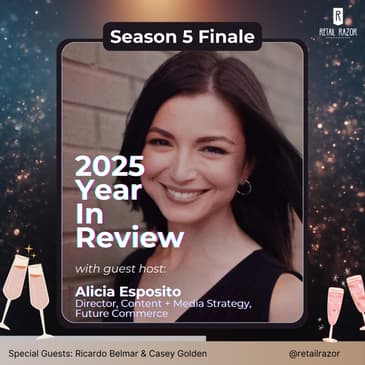



S5E14 2025 Retail Year in Review - AI, Consumer Shifts, and the Future of Retail with Guest Host, Alicia Esposito!
In this Season 5 finale of The Retail Razor Show, guest host Alicia Esposito (Future Commerce) sits down with Ricardo Belmar and Casey Golden for a deep, unfiltered 2025 retail year in review. Together, they unpack the biggest trends shaping the future of retail, from AI’s accelerating influence, to the emotional needs of today’s consumer, the rise of resale, the evolution of marketplaces, and the shifting definition of value.
Across the Retail Razor Podcast Network - The Retail Razor Show, Blade to Greatness, Data Blades, and Retail Transformers - this year’s guests revealed a powerful through‑line: retail is no longer just about convenience or price. It’s about culture, community, emotion, and the human experience.
This episode explores:
How AI is reshaping leadership, decision‑making, and personalization
Why consumers—especially Gen Z—are craving analog joy and emotional shopping
The rise of marketplaces like Temu and AliExpress
Retail media’s evolution and the coming disruption from agentic commerce
The loyalty shakeout and why brand equity matters more than ever
The explosive growth of resale and secondhand shopping
Holiday shopping behavior and the psychology behind “perpetual shopping lists”
The keywords that will define 2026 and the future of retail: velocity and joy
If you want to understand where retail is heading in 2026, this is the episode you can’t miss!
Subscribe to the Retail Razor Podcast Network: https://retailrazor.com/
Subscribe to our Newsletter: https://retailrazor.substack.com
Subscribe to our YouTube channel: https://bit.ly/RRShowYouTube
About our Guest Host
Alicia Esposito, Director, Content + Media Strategy - Future Commerce
https://www.linkedin.com/in/aliciaesposito/
Alicia is the head of content and insights for Future Commerce. At Future Commerce we are big on dissecting the intersection of culture and commerce and not just covering what's happening today, but also what are the ripple effects for tomorrow, and for the future. Future Commerce delivers consumer insights for e-commerce and retail brands. Newsletters, essays, podcasts, and research. For the risk-takers in Commerce! Future Commerce helps brands manifest vision and create goals which lead to future-altering impacts for their customers, and for the world around them.
Chapters:
00:00 Preview
01:06 Introduction and Host Introduction
03:02 Balancing Automation and Human Intuition
06:57 Consumer Behavior and AI
10:18 The Evolution of Retail Experiences
18:21 The Importance of Brand Value
24:14 Challenges in Fast Fashion and Marketplaces
28:23 The Future of Commerce
31:36 Retail Media Evolution
36:50 Consumer Behavior and Shopping Trends
41:09 The Impact of Resale and Sustainability
50:12 Personalization and AI in Retail
53:16 The Keyword That Will Represent 2026
55:45 Show Close
Meet your regular hosts, helping you cut through the clutter in retail & retail tech:
Ricardo Belmar is an NRF Top Retail Voices for 2025 & a RETHINK Retail Top Retail Expert from 2021 – 2025. Thinkers 360 has named him a Top 10 Retail, & AGI Thought Leader, a Top 50 Management, Transformation, & Careers Thought Leader, a Top 100 Digital Transformation & Agentic AI Thought Leader, plus a Top Digital Voice for 2024 and 2025. He is an advisory council member at George Mason University’s Center for Retail Transformation, and the Retail Cloud Alliance. He was most recently the director partner marketing for retail & consumer goods in the Americas at Microsoft.
Casey Golden, is CEO of Luxlock, a RETHINK Retail Top Retail Expert from 2023 - 2025, and a Retail Cloud Alliance advisory council member. Obsessed with the customer relationship between the brand and the consumer. After a career on the fashion and supply chain technology side of the business, now slaying franken-stacks and building retail tech! Currently, Casey is the North America Leader for Retail & Consumer Goods at CI&T.
Includes music provided by imunobeats.com, featuring Overclocked from the album Beat Hype, written by Heston Mimms, published by Imuno.
Transcript
S5E14 2025 Year End Review
[00:00:00]
[00:00:01] Casey Golden: We live in a mall. Everywhere you walk down the street, everything essentially is there to take money from you, something to buy
[00:00:11] Alicia Esposito: Yep.
[00:00:12] Casey Golden: Everything.
[00:00:14] Every single moment, every single ad, every single picture,
[00:00:18] Ricardo Belmar: Everything has a commerce layer
[00:00:20] Casey Golden: every visual asset, digital asset. It's all an ad. It's all shopping.
[00:00:27] Ricardo Belmar: a lot of people confuse clarity with just more, meaning, give everyone more information, more knowledge, more, more data, more everything. And sometimes more isn't better. Right? Sometimes more just creates confusion and it does the opposite of bringing clarity even when you're using AI.
[00:00:41] Casey Golden: Gen Z just reinvented coffee at home, DIY coffee, which is like just coffee at home. So I swear like we're gonna get a new
[00:00:49] Alicia Esposito: They're doing a lot of that it seems.
[00:00:51] Casey Golden: I know we're gonna be getting a new fax machine next year. I think, you know, somebody's gonna reinvent the fax machine.
[00:00:57] Yeah. I keep saying like you can't keep [00:01:00] automating. And making it so convenient and so seamless that you literally deleted shopping and all the fun.
[00:01:06] Alicia Esposito:
[00:01:18] Introduction and Host Introduction
[00:01:18] Alicia Esposito: Hello everyone and welcome to the Retail Razor Show. As you can tell, I am not Ricardo, nor am I, Casey. I am Alicia Esposito. I'm the special guest host for today's Season five finale, and I am the head of content and insights for Future Commerce. At Future Commerce we are big on dissecting the intersection of culture and commerce and not just covering what's happening today, but also what are the ripple effects for tomorrow, for the future. So I'm really excited to sit down with Ricardo and Casey to dig deep into what has happened this past year across the entire Retail Razor Podcast [00:02:00] Network, including the Retail Razor Show, the newly launched Retail Transformer show, and the beginning of season two of Blade to Greatness and Data Blades.
[00:02:09] A lot going on. So without further ado, Ricardo, Casey, thanks for inviting me to do this. I'm excited to be here.
[00:02:17] Ricardo Belmar: Yeah, thanks for doing this. We're really excited to have you on the show.
[00:02:20] Casey Golden: I love being able to steal you.
[00:02:24] Alicia Esposito: Well, and hopefully we're not gonna be all business. We're going to have some fun here talking about the high moments, the low moments, and possibly debunking some of the big predictions that were discussed earlier in the year.
[00:02:40] Casey Golden: a lot of stuff that hasn't happened.
[00:02:43] Alicia Esposito: As is usually
[00:02:44] Ricardo Belmar: usually happens. Yeah.
[00:02:46] Alicia Esposito: Sorry guys. But I do think a common through line over our conversation today is going to be AI, sadly folks. If you wanted to avoid that
[00:02:57] Ricardo Belmar: big.
[00:02:58] Alicia Esposito: around just in case, [00:03:00] but, it is, it is gonna be a talking point.
[00:03:02] Balancing Automation and Human Intuition
[00:03:04] Alicia Esposito: But I do wanna start out with, one of the shifts that I was most excited to see, and that is how we kind of got below the AI hype and unpacked the nuance of the role it plays in our professional lives.
[00:03:19] Right? How automation must work in tandem with human intuition and wonder and creativity. I think those conversations started to feel a bit more balanced and nuanced. So to start out, I would love for you both to share the aha moments that came up for you that really made this coexistence more clear and meaningful, not just for your audience, but for yourselves.
[00:03:46] Ricardo Belmar: Yeah, I would say you're, you're right, there's, it's you can't really avoid AI this year, right? So there's, you have to start with that. But I, I do think that one of the things I, I feel like we really were able to capture is just not the technology piece of it [00:04:00] alone, but like, what's impacting things even in areas like leadership.
[00:04:03] Right. So, you know, like our, our Blade to Greatness show is really all about leadership in this age of AI and I really love how we kicked that one off. We had April Sabral in as the first guest for this season, and we specifically talked about things like, how do you embrace the technology in a way that's not, doesn't actually feel artificial, right?
[00:04:21] How do you use it in a positive way to become a better leader and to really encourage your teams. And then I think, we followed that one up amazingly with Ron Thurston in the next episode. And that one, he brought up a great point on how do you make things clear enough or how do you bring clarity to your team. And to me the big aha moment in that one is, a lot of people confuse clarity with just more, meaning, give everyone more information, more knowledge, more, more data, more everything. And sometimes more isn't better. Right? Sometimes more just creates confusion and it does the opposite of bringing clarity even when you're using AI.
[00:04:53] Casey Golden: Yeah, I think that that really kind of came, shown through with Trevor and Stan, with i-Genie
[00:04:59] Ricardo Belmar: [00:05:00] Yeah.
[00:05:00] Casey Golden: we're able to, we've had so much data and there's so many different ways that we can get a hold of more and getting those real time insights. But we have been, retail has been trapped in Excel. s and there's only so much we can crunch. And sometimes you don't always know what needs to be mapped. So I think that, the way that we're able to ingest data without the context sometimes to, you know, have AI kind of just pull it all together and, and find the story. Find the narrative, find the KPIs, find opportunities, unlock problems in a fraction of the time that it would've taken to do that manually or to scour and scour the internet.
[00:05:51] Ricardo Belmar: Yeah.
[00:05:51] Casey Golden: I think we have a huge opportunity of the unlocked potential coming into the new year now that everybody's kind of been experimenting, [00:06:00] playing with it, doing pilots and kind of figuring out what I can and cannot do and what has and doesn't have value.
[00:06:08] Ricardo Belmar: Yeah.
[00:06:09] Alicia Esposito: Yeah, that's a really good point of, the role of these pilots, and again, that's where the human comes in, right? I personally really enjoy pushing these different platforms as much as I can to understand where are the flaws, where are the gaps, and what new areas of expertise do we maybe need to bring to the table to unlock the value?
[00:06:32] Of these platforms and, and I will say there are certain tools that perform better in certain scenarios, right? So I think that's part of the fun, right?
[00:06:41] Like playing a little bit and figuring out where do we tune in, where do we pivot? So hopefully there's a lot more to come and you know, it's interesting to see, how your insights almost mirror like the consumer side, like our behaviors as shoppers, right?
[00:06:57] Consumer Behavior and AI
[00:07:16] Alicia Esposito: Because on one hand AI has been an incredible tool for efficiency. We actually just did some research recently and one of the key takeaways was AI is helping me eliminate or significantly reduce all of that manual work of like having the 20 tabs open and comparing all of the products and all of the prices. But at the same time, there is a bit of a shift happening where consumers, especially younger consumers, are seeking these more simple, even analog moments, like we're kind of tracking the return to quote unquote dumb technology, right? Like flip phones
[00:07:40] Ricardo Belmar: yeah.
[00:07:40] Alicia Esposito: The Razor. Gimme a nice pink razor phone from back in the day.
[00:07:44] It's like they're looking for joy, joy in the process again. So it's an interesting dichotomy. You know, whether they're shopping for a gift or even creating something, it's like there's kind of like that pendulum is swinging back for some folks.
[00:07:56] Were there any conversations where you saw this [00:08:00] divide, taking shape. And how do you think it will continue to manifest in 2026, if at all?
[00:08:07] Ricardo Belmar: Yeah, I'll say this. I, my kind of takeaway for the year is with all the new technologies we've been giving to consumers, basically, that help in that discovery and research phase is that, it's kind of from what you're saying there, there's a portion of consumers, especially in younger demographics, that are craving more, I'm gonna say emotion in the process. And a lot of the technologies we're talking about there are kind of cold, right? So it kind of leaves you a little cold. It's very much get to the facts. know, the, there's a little bit of an emotional process, I think, in having the 20 tabs open when you're trying to figure out what, what does this mean versus this other one versus just getting the answer so the
[00:08:44] Alicia Esposito: That's when you're really
[00:08:45] Ricardo Belmar: Exactly. Right, right. So, but what I think is really interesting with that too, to kind of take a step further, and we've had people talk about this, this year, that, people are using the technology for that. They're cutting down the process and that on the discovery side, on the research, but then they still want to go to the store [00:09:00] and actually see it, touch it, feel it, experience what it is.
[00:09:03] And oftentimes they wanna do it not by themselves, but with other people, because there's still this whole desire, right, to make this an experience. And, and in some ways, like I I, I feel like we go back a few years, everything was about experience, right? How do you build a better experience in store?
[00:09:19] How do you make digital more experiential. And now we've kind of overtaken that with technology, making everything easy and convenient. And so you're right, it kind of swung the pendulum a little bit and I think there's a little bit more resistance in where, where's the middle ground, right? Where's that happy medium?
[00:09:34] That's gonna find it, where people can get all of it together in the right amounts.
[00:09:39] Casey Golden: Yeah. I keep saying like you can't keep automating. And making it so convenient and so seamless that you literally deleted shopping and all the fun.
[00:09:48] And I think that that's like one of the disconnects is how many, how much AI is being created to delete shopping. I think it's because so many [00:10:00] men hate it, but like 80% of all consumer power is run by women. We like shopping.
[00:10:07] Ricardo Belmar: yeah,
[00:10:08] Casey Golden: I would never delete it.
[00:10:09] Alicia Esposito: For certain things. Maybe there's a bit of a caveat there,
[00:10:13] Casey Golden: there's still certain things, but in general there has to be a balance.
[00:10:18] The Evolution of Retail Experiences
[00:10:25] Casey Golden: And I think this is, this really touches on just the human experience and the culture and how our culture is shifting as society. And I think Dave Finnegan touched on this during his podcast. Matt Marcotte with cultures of commitment in retail. Really being on that culture of is it nice to have versus, do we build it just because we can? Or what is the value that it's adding and does this, support the culture and how it's evolving?
[00:10:52] Ricardo Belmar: It adds to the emotion, right? It's like, what, what emotional value does the brand bring to the consumer? And if it's always presented through, an AI [00:11:00] search or an an AI chat that just gets you straight to the answer, then where was the emotional part? Where was the bonding between the brand
[00:11:06] and
[00:11:06] the consumer? All you did was deliver product.
[00:11:08] Casey Golden: all you did was deliver product and sometimes depending on the brand, we spent trillions of dollars and years building brand equity. And then to say that it doesn't matter,
[00:11:20] Ricardo Belmar: Yeah.
[00:11:21] Right.
[00:11:22] Alicia Esposito: right.
[00:11:23] Casey Golden: I think that that's not gonna prove for a very profitable retail year.
[00:11:28] Alicia Esposito: No, I, I, I agree completely. Well, and it was like that pivot where everyone was talking about growth marketing and performance marketing. And I feel like now more than ever, that conversation around brand equity and immersiveness. I love that you, you both brought up culture and community because that is very future commerce coded.
[00:11:49] That's something we talk about every day. And I think it adds a new dimension to the conversations we were having many years back around showrooming,
[00:11:58] right? Because [00:12:00] during that time it was very much a, a price and cross channel at the time experience, but now it's more about storytelling and belonging, identity formation.
[00:12:12] So it's a lot richer than I, I think in years past. So to confirm. Ai, and I guess you could argue even social search, because that is a, they, they're AI driven feeds, Right. This they're making consumers smarter.
[00:12:29] That this is not an overstatement.
[00:12:30] Ricardo Belmar: No, I totally agree. Yeah. Yeah.
[00:12:34] Alicia Esposito: Yeah, exactly.
[00:12:35] Ricardo Belmar: Yeah,
[00:12:36] Casey Golden: There's a lot of brands will def are definitely losing control of their narrative with AI and what AI is bringing back to those search results. It's, it's definitely at a cusp of, society's going, I feel like society is going through a larger tech technology culture shift then businesses
[00:12:59] Ricardo Belmar: Yeah, I,
[00:12:59] Casey Golden: [00:13:00] because there's, there is, there's so many sides and and there's so many times where I feel pro and against at the exact same
[00:13:08] Ricardo Belmar: the same time.
[00:13:09] Casey Golden: Like trying to reconcile it even as a consumer, as somebody, in business it's like, yeah, it makes sense, it saves money, but it's just like, oh my gosh. It's like against my absolute core of my belief. But. The dollar signs are, you can't really ignore that or the efficiency gains. And I think that, this year we really had a, a few guests kind of focus on this culture shift of what it means to do this at work. But then again, through all the career guidance that like Ron has spoken to and Bobby Johnson with, people first culture, like we focused, so much of these conversations have gone back to people
[00:13:52] Ricardo Belmar: Yeah.
[00:13:53] Casey Golden: at work and how to find where you fit today. There is that [00:14:00]reconciliation of, this is what I'm doing at work, but this is what I'm doing at home and I don't know where I fit in this whole culture shift. So I think that there is going to be this part that's going forward and the people who are, are picking and choosing what they're staying back on. I mean, I just heard the craziest thing this week. Gen Z just reinvented coffee at home, DIY coffee, which is like just coffee at home. So I swear like we're gonna get a new
[00:14:30] Alicia Esposito: They're doing a lot of that it seems.
[00:14:31] Casey Golden: I know we're gonna be getting a new fax machine next year. I think, you know, somebody's gonna reinvent the fax machine.
[00:14:37] Ricardo Belmar: Yeah. Well, and I think it is interesting when you go back and compare this to when we all talked about showrooming, right? With the early days of smartphones, and to me the big shift was that the the technology before didn't really reflect itself as much. In a customer facing way in all of our commerce interactions.
[00:14:54] You went right, before, even with early e-commerce, you kind of went to a place, whether that place was a [00:15:00] store or a website, you bought something and you didn't think about, there was no consideration of what, how was the experience like, how convenient was it? Where was the friction?
[00:15:08] It was just. Very transactional. And, and smartphones, I think were the first piece that changed that. And it, and in my mind, it changed it because it shifted control of the process to the consumer. Where before the retailer was pretty much always in control. And the retailer didn't need to do all these other things to remain in control.
[00:15:26] And the smartphone changed that, that put control in the hands of the consumer. And now retailers realize, well, we have to do these things in order to get back in the game and to really have some say in how this commerce process will go out. And now with AI, I think that's like massively accelerated.
[00:15:41] Because now if and we're seeing like different retailers do things and they're like, you've got right. Amazon trying to block all the AI tools out there to, to stay in their own little, little world and then every other's trying to embrace the AI and be part of it. But no one really knows, well what does that mean for me?
[00:15:56] Right? What am I controlling versus what's the consumer [00:16:00] controlling? And that's why I still think all these other things matter. I mean, I kind of look back, you know, like Casey's, I love this example, right? The, the DIY coffee and all these things, Gen Z is reinventing. But we had a really good conversation early in the season with Chris Carl from AliExpress who I think totally rewrote the playbook on how to market to Gen Z in a way that makes them feel like they're enjoying the experience and knowing that there's no store they're going to. Right. Because this is all exclusively an online marketplace. And through an app they very successfully, I, I think, mastered social commerce and using social to drive interest.
[00:16:33] Everything they have and then they gamified everything, right? And so they really made it so that it's not just I would argue like the, the Gen Z demographic that shops with them probably doesn't feel like they're shopping. They're just, accomplishing something they know they need to accomplish and having fun along the way.
[00:16:49] And I think they really mastered that. And what, to me is crazy is they mastered at selling, anything, you know, he gets even said to like, oh, you need some farm equipment, you can buy that too. So, it's not about [00:17:00] apparel, it's not about electronics, it's anything. And it really came up with a way to do that, and I think that was fascinating.
[00:17:06] Casey Golden: Yeah, retail has always been about the edit. It's always been about the edit, the edit, the edit, the edit, and then we went moved into marketplaces where there's just 48,000 skews under shoes. And then we got into like search hell
[00:17:22] Alicia Esposito: Right.
[00:17:23] Casey Golden: and so,
[00:17:23] Ricardo Belmar: Yeah.
[00:17:24] Casey Golden: and it didn't matter where something was shipping from as long as somebody could get in front of the customer. And so you just needed your products everywhere. So wherever the customer went, your product would show up. And then we're scrolling and hitting next page, next page for two and a half hours. And you're like, I'm done.
[00:17:43] Alicia Esposito: Right.
[00:17:44] Casey Golden: And so I think that AI, going after that discovery piece and replacing that Google search piece, we've needed that for, since marketplaces
[00:17:55] Alicia Esposito: Yeah,
[00:17:56] Casey Golden: kind of came about
[00:17:57] because nobody wants to scroll through [00:18:00] 48,000.
[00:18:00] It's oh my gosh. The perfect thing might be on the next page, but I have 241 more pages.
[00:18:06] Ricardo Belmar: Right,
[00:18:06] Alicia Esposito: Well, especially when all the product images look the same and they all have the same combination of keywords, so you're just like, well, what do I trust?
[00:18:15] What is the real
[00:18:16] Ricardo Belmar: Yeah, and what's really different.
[00:18:18] Alicia Esposito: is gonna gimme what I need? Yeah. Yeah.
[00:18:21] The Importance of Brand Value
[00:18:36] Alicia Esposito: And I think it ties to like this much bigger theme or story that I think has been told over this past year, which is like, defining value for your brand and really making sure it's shining through in everything. So I really like that you, you brought up Ali Express because even though they do have this breadth of assortment, they have these little components that really make it stand out and, and in turn be valuable in the eyes of the consumer, whereas ai, these platforms are destinations for the synthesis. They make things [00:19:00] easier. That's their value,
[00:19:01] Right.
[00:19:02] It makes it seamless to compare and contrast and find that exact thing you're looking for. The, so I guess the biggest question is how has this impact impacted the quote unquote loyalty shakeout that has been arguably taking place for years, right? We, we've been talking about this for a while, but I feel like especially this year when that need to convey value is stronger. Like it can't just be about price anymore, right? Because now everything's curated in a nice little list and the bot is saying, oh, do you want me to help you pick out the right one for you?
[00:19:39] So what does that
[00:19:40] Ricardo Belmar: Yeah.
[00:19:42] Alicia Esposito: Look like for you guys? And
[00:19:44] Casey Golden: We're on opposite side, so Ricardo.
[00:19:47] Alicia Esposito: okay. I love this. Bring it on. Bring on the conflict.
[00:19:50] It's getting juicy guys
[00:19:52] Ricardo Belmar: here, I mean, there's, there's like a few things. Like on the one hand, I, I really think how consumers define value has changed a lot this year. So I think we ease quickly could have [00:20:00] said before it was, it always comes down to price and oftentimes always comes down to convenience. And, and so it was those, we defined it as convenience and price.
[00:20:07] And now I kind of flip it a little bit and say I don't, I'm not sure it's price necessarily. It's really, convenience is still a part of it in some types of products, some category with some brands, but it's really all about what is the value. Sometimes value's price, but sometimes it's something else. So I like an example I, I like is we had the, chief revenue officer at Naturepedic, Arin Schultz on earlier in the season,.
[00:20:28] So Naturepedic, right? Organic Mattress brand, you know, what are they known for? Their whole brand is built on, they don't use any harmful chemicals anywhere in the process. And they can document a hundred different chemicals, right, that everybody else uses. And when you make a mattress. And they refuse to use any of them. So that's their value.
[00:20:45] So, and they're not a low price value. They are a premium and they're a well-defined premium because the value to their consumer is that I'm buying something that I know is not gonna be harmful to me. I know it's something that's safe. It's in a sense it almost conveys [00:21:00] purity. You know, they started by making baby mattresses for cribs because they thought, well, people, want to feel like they're putting their baby in the best possible thing that's not gonna hurt them, obviously. So they kind of built it on on that. And so they really are a values based brand. So in my mind, for their customer, what's the value? Well, the value are the, is the values of the brand, that is the value for them, and that's what makes their customer loyal, that they probably have bought a mattress for the, for a crib. Then later on when they needed mattresses for themselves, they said, you know what? We bought that mattress from Naturepedic. Let's go see what they have. And it may have been more expensive. That was okay because they knew what they were getting in that value.
[00:21:38] So I think, to me, those are the examples. It ends up being more about differentiated value than it is about price in that sense
[00:21:45] Casey Golden: Yeah, I mean, they say there's price, convenience, and quality, and you most likely can't have all three.
[00:21:52] Ricardo Belmar: Right.
[00:21:53] Casey Golden: Right.
[00:21:53] You can't get the lowest price, the most convenient and get the highest quality. You're gonna have [00:22:00] to have trade offs. And I think one thing that all of this AI has is contributing to, is breaking consumer trust and not sure what you're buying. There's so many options and there's so many discounted options these days. That a lot of people are also, if they have the luxury of choosing quality over price, spend $50 more just for the brand name to just not have to worry about it and not have to worry about a return. Quality is a major sticking point with the younger generations.
[00:22:36] I mean, millennials. And gen, gen X is used to products that like work. Go figure. Millennials know the difference and know that trade off of like, I'm gonna lose quality if I get a better price. But now it's like the younger generation. They want quality and the price and they expect that. And that's just, that's not how the economics [00:23:00] work.
[00:23:00] Alicia Esposito: Yeah.
[00:23:01] Casey Golden: You can't really have both, you can't have price and and quality. And I think like this is shifting for some are just so done with the search and so many options. The ChatGPT or these, or Gemini or these AI chat is able to essentially distill it to like, something more manageable and then they're able to just decide value out of that. Am I going, if I don't wanna do this anymore and I don't wanna talk about shopping anymore, I just want the thing, I'm just going to go buy the brand because I know that I can return it. I know that I'm gonna get service. I know what quality I'm getting,
[00:23:43] And I know what my expectations are when the box arrives. And I think that that is starting to matter again, quality is mattering. It's not the having or it's not necessarily the getting, it's the having, like I'm sick of buying things [00:24:00] over and over again, or returning something and having to shop for it again and having to shop for it again. And it's like, I'll just pay a premium to get it from the brand. Who's the, who are the top two brands that make this thing?
[00:24:13] Ricardo Belmar: Yeah.
[00:24:14] Alicia Esposito: right.
[00:24:14] Ricardo Belmar: Yeah.
[00:24:14] Challenges in Fast Fashion and Marketplaces
[00:24:14] Alicia Esposito: So let's unpack this a little bit more by looking deeper into the, the modes or the sectors of retail that have previously benefited severely from the the price and like the access side of things. So there's fast fashion, but then there's marketplaces, which we kind of hinted at a little bit earlier. But I wanna dig deeper into, I mean, let's start with fast fashion, because arguably they've had to deal with a lot of upheaval, not just like from a consumer behavioral side, right? Like seeing shifts in, in what consumers are actually looking for, expecting. But then there's also the reality of, of tariffs, right? And, and the expenses that have been [00:25:00] incurred as a result of some of these new, these new guardrails. So what have those players had to do in order to maybe not just keep pace, but evolve accordingly?
[00:25:12] Ricardo Belmar: Yeah. Yeah. I feel like we had a really fun conversation with George Chang from Shein when we had him on the show earlier.
[00:25:19] Casey Golden: Not that we're associating them with fast fashion.
[00:25:23] Let me Just put that on the record.
[00:25:24] Ricardo Belmar: And which was a point made on the show because they, we talked about them and what they were doing to be a much broader marketplace. And he came with, so many examples of what I kind of thought of as very specialized sellers, but keeping with, the, the feel of, of their brand and that I'm, it's made to order, it's made quickly. It's produced based on measuring what's being ordered, who's buying know, really knowing the customer. So you offer exactly what they're looking for and you're, there's less guesswork. But in more categories than just fashion.
[00:25:58] Alicia Esposito: Mm-hmm.
[00:25:59] Ricardo Belmar: I thought that was [00:26:00] fascinating. They're obviously I think they're adapting to that. And also, the tariff thing, I think they, they pretty much went with, the thing you had to do, which was to find different places to stage products, right? And so you're either have them in earlier in the US or you have them somewhere else where you don't have the heavy tariff, but whatever you need to do, they're clearly doing it to be able to keep up and do that. And it seems to be working for them from everything I see.
[00:26:25] Casey Golden: And where those products can really absorb the price margins, right? Like you can go up a little bit in price in category A, b, C, D, or by brand 1, 2, 3, because they can carry a little bit of that tariff weight and price increase. But there's some things where it's just like the price is quadrupled like cheap is no longer cheap. Now I'm getting cheap for expensive price. And so it kind of goes back into what are we producing? What are we putting in assortments? What are we going to make our bet on, [00:27:00] on how we're gonna get to our revenue goals at the end of the year? Because sometimes just that extra logistics, price, and timing. It loses the value for the end consumer, or it's just, it's just not a value, or it's not even competitive, or it's not a need, it's not a must have. It was a nice to have or it was like, eh, I could live with it or without it. And nobody wants to build their business with the product that people can live with or without. Right. Like, so you can't necessarily manufacture as broad as you, you may have. Everybody had to get a little bit more specific in what they're making, how they're making it and how they're gonna sell it.
[00:27:41] Alicia Esposito: Yeah. Great points. Well, and I know Temu is really doubling down to as being a destination for small businesses as, as well. We are, we're actually just getting ready to launch a series where we sat down with three different sellers across categories like live plants to patches that you, you can like, use to like [00:28:00] style your hats and your denim jackets and all of that.
[00:28:03] And even, frozen food, right? Like, they're getting into like very different sectors and you know, they're kind of the connecting point between consumers and small businesses. So that's gonna be an interesting rebrand, I guess, that we should all like for the entire sector, right? Like seeing like that evolution that's gonna be taking place.
[00:28:23] The Future of Commerce
[00:28:23] Alicia Esposito: Which brings me to marketplaces as a whole, because I don't know about you guys, but just like seeing the advancements in commerce capabilities, but also media, shoppable, media, I mean, it seems like everything's kind of a commerce platform more anymore. And the benefit of shopping through like an Amazon or a Walmart is you have access to all of these products and it's all in one place and it's intuitive.
[00:28:47] So what does that mean when all of these other destinations. Some of which may be a bit more engaging and compelling, especially for Gen Z and, and millennial consumers. What does that mean [00:29:00] for the evolution of marketplaces and especially retail media or commerce media, however you want to define it.
[00:29:06] Casey Golden: Yeah, I think right now we've got, I am really hoping that the word e-commerce can be just done. It's just commerce.
[00:29:15] Alicia Esposito: Just commerce.
[00:29:17] Casey Golden: I don't think we need the e in front of it anymore. I don't, it doesn't matter where, where the consumer is. There is some type of digital process happening regardless. I don't think we just have like these, like e-commerce platforms anymore. I really see like these, this, this digitized catalog that we've created, this digital digital catalog business. There will be the great aggregator where all of these catalog feeds are, are going through multiple, and we're just going to have these like API driven sales channels. Everything is just a new sales channel.
[00:29:55] Whether or not it's a marketplace, a brand, a [00:30:00] retailer, I think it's just gonna matter a lot less. Whether even tv, tv, social media we don't need these cages anymore where we need 50 product feeds. I think we're gonna get to a point where we just have one product feed that's going out and being like adjusted as it enters all these different sales channels that are all digitized, even if it's like physical stores.
[00:30:28] Alicia Esposito: Interesting. What are your thoughts on that, ricardo? Are we gonna be dropping the e.
[00:30:32] Ricardo Belmar: It'd be interesting, I mean, I don't know if I counted how many times we've said it's just commerce on the show over the years, I'd probably have, you know, if I had 20 bucks for each one of those, I'd have a lot of $20 bills. But, I don't know, I don't know if that'll happen. I mean, I think we've also had then the same thing by saying, let's just stop calling it omnichannel.
[00:30:47] Casey Golden: Yeah.
[00:30:48] Ricardo Belmar: And talk about commerce, but at the same, to me it fundamentally comes down to where's your customer, right? So why did marketplaces work? Marketplaces work? Because they attracted customers. So everybody needed to be on the marketplaces to sell because [00:31:00]that's where your customer went. So especially if you don't have stores or if you don't have a physical presence, where does your customer find you?
[00:31:05] They're most likely gonna find you in a marketplace. I do think that's one potential thing that could get more disrupted in 2026 with the AI chat tools because they almost become a new kind of marketplace without calling them a marketplace, but they
[00:31:20] Casey Golden: It's a.
[00:31:21] Ricardo Belmar: one. Yeah. Right. It it's just that it, to Casey's point earlier, I, you can get rid of the really aggravating search because the conversation means now I, I can get to what I wanna find without having to deal with really annoying keyword searches.
[00:31:35] So, so there, there's that.
[00:31:36] Retail Media Evolution
[00:31:36] Ricardo Belmar: I think what's really interesting to this is what happens to all the retail media, commerce media pieces to it, because we're already seeing and we haven't gotten to this, this is gonna be, I'm sure one of our big discussions throughout next season is where, where's the balance between the way retail media was working and the way it's going to work, and is it, or is it not getting disrupted by agentic commerce?
[00:31:56] And everybody loves to debate the terms and, and what's going on [00:32:00] with it. And, and I'm, I'm still kind of squarely in the middle of it in that I still feel like every new channel that has come up since, if stores are the OG channel, every new channel that's been created since then, none of them has ever replaced all other channels, period.
[00:32:14] Right? That's my end of, none of them ever replaced All the other channels, they all take bits and pieces and take share from other channels, but they also just grow the overall commerce space. Which at the end of the day, I think that's what a retailer wants, right? Why do you adopt a new sales channel?
[00:32:28] 'cause you want to grow your overall sales, not because you wanna replace one channel with another one, because that's doing a lot of work for no net gain. So I don't think there's a reason to look at it that way. I think it's more of a reason of what's the net gain gonna be and I feel that, with the e-commerce side, retail media proved itself out and you could argue that okay, Amazon, Walmart eat up 85% of it and everybody else has to fight for the remainder.
[00:32:53] But again, because I think the pie is always growing, right? It's not fixed, so you're not really [00:33:00] fighting for the same attention. You're just fighting for new attention, and I think that's okay because it really only matters, is for any given retailer, is a retail media successful? It's a yes or no if it draws more people to buy from them when they're on their site or when they're in their store, it's not about did you take a customer away from Amazon or Walmart? That to me is irrelevant. Right? You, you don't care. You don't have to care about that. I, I kind of go back to, one of those Jeff Bezos statements that everybody always likes to quote about how they, when they first wanted to, where they were pursuing, getting big, fast one of their tenants was, don't worry about, it's not about competitors, it's only about the customer, right? So focus on the customer
[00:33:36] Casey Golden: Yeah.
[00:33:36] Ricardo Belmar: don't focus on competitors. Focus on the customer, what you're bringing to the customer. And to me that's the same premise for retail media. So. Retail media, like everything else will evolve next year.
[00:33:46] But I don't think it goes away. I think it grows. And to me the interesting thing again with, when we try to predict what consumers do, we would all sit around a table as people who talk about retail and say, oh, it's so awful to search on Amazon because there's so many ads. [00:34:00] And and so many product placements and the keywords are all the same.
[00:34:03] And you mentioned earlier, like all the product images look the same, right? So how do you find something. But we say that. But at the end of the day, what happens, Amazon makes more revenue on retail media, so therefore it's converting. We can all argue about how good the experience is or not, but it still converts.
[00:34:20] And as long as it still converts, it'll keep growing and everyone will still do it. And
[00:34:25] Casey Golden: Yeah. I mean
[00:34:26] with retail media, this has been Ricardo's like retail, like it's been your soapbox for like it's his baby. And on my side I'm like, we literally, we used to go to the mall.
[00:34:42] Alicia Esposito: Mm-hmm.
[00:34:43] Casey Golden: I am old, so like I used to go
[00:34:46] Alicia Esposito: Listen, I love a good mall too,
[00:34:47] Casey Golden: used to go to the mall. Now I think we just live in a mall.
[00:34:53] Alicia Esposito: Mm-hmm.
[00:34:54] Casey Golden: We live in a mall. Everywhere you walk down the street, everything [00:35:00] essentially is there to take money from you, something to buy
[00:35:04] Alicia Esposito: Yep.
[00:35:05] Casey Golden: Everything.
[00:35:06] Every single moment, every single ad, every single picture,
[00:35:11] Ricardo Belmar: Everything has a commerce layer
[00:35:13] Casey Golden: every visual asset, digital asset. It's all an ad. It's all shopping.
[00:35:20] Alicia Esposito: Mm-hmm.
[00:35:21] Casey Golden: Shopping. We are, I think we're getting really close to a point of saturation of can we have things that are just not about shopping? And I see that with the younger generation, that they're building more, they want more community, they want more third spaces. And in those third spaces, they do not want ads.
[00:35:41] And so, every single social media platform has been ruined. When they added the ads, when retail was let in because they had to monetize some way. And then, you know, there's this whole drop off and then we get a new platform and then the ads come, and then we get a new platform. And [00:36:00]so now though it's embedded into everything to the point where. I think we're hitting a saturation moment where my favorite commercials are, like sponsored by. I don't know, sponsored by some tech company or some brand and it's just silent. Music playing is the ad to just give us space to not hear a commercial.
[00:36:27] Alicia Esposito: Yeah.
[00:36:28] Casey Golden: And so I think it's like the advertising is creating just like space with ad nad. To give you a break. And I think that that's really interesting right now. 'Cause yeah, I was just walking, doing Christmas shopping, right?
[00:36:42] As we all do. And I'm just like, every single thing, like I live in a mall.
[00:36:47] Alicia Esposito: Yeah, it's true. It's true.
[00:36:50] Consumer Behavior and Shopping Trends
[00:37:04] Alicia Esposito: And, And, we've, we've actually done research and about 45% of consumers said they have a perpetual shopping list in their heads of things that they want to buy. Need to buy are going to buy. So with that noise comes this continual cycle. And then when there's a moment, say Prime Day for instance, where it becomes like a moment, a cultural moment in and of itself, that leads to long-term behavioral change because it's not just prime day. It becomes Walmart's answer to the sale day.
[00:37:27] It's Target's answer, and then it's all of the D to C brands or, you know, smaller brands, I guess you could say, that want to compete by offering better or more valuable deals. So it's like the, the snowball continues to grow.
[00:37:42] And I guess the biggest question there is, what are the implications of this? Like what have you guys seen, heard from your guests over the past year in terms of like, how this ecosystem, this ever presence of commerce is impacting how consumers engage with it, how consumers [00:38:00] perceive it.
[00:38:00] I mean, what is the future for say like a Prime Day?
[00:38:03] Casey Golden: Well, I mean it's definitely impacted the way consumers pay for it.
[00:38:07] Alicia Esposito: Mm-hmm.
[00:38:08] Casey Golden: cashflow and all of these like payments.
[00:38:12] Ricardo Belmar: Mm-hmm.
[00:38:12] Casey Golden: Is definitely a massive shift to where that perpetual list is. I can just keep buying as I find it for the right price or for the right convenience or at the right time, and then I can pay for it over the next four months or six months, so I can just maintain my cash flow because I don't think I shop more now consistently than I did before.
[00:38:39] Before it was like. It wasn't an everyday thing. Now I think it's just, it's such an everyday event to, it's just a task
[00:38:50] Ricardo Belmar: Yeah.
[00:38:51] Casey Golden: You used to wait to do the shopping on the weekend, or you used to wait to do the shopping on whatnot. Now it's, with these like [00:39:00] delayed payments, you can just get it whenever.
[00:39:03] Ricardo Belmar: Well, and I think it comes down too, to where the convenience factor plays into it. Because either in, in my view if you have that eternal shopping list in your head. The ones, the items that are staying on that list that you're not buying are because nothing's created that emotional urgency that says you have to have it right now.
[00:39:22] Maybe that urgency comes because suddenly its Prime Day and the price is 40% lower than it's ever been before, and you think, fantastic. Now I'll pull the trigger in and get it. Or, you see it somewhere and whatever that product is, you see it in an environment that makes that emotional connection, that makes you think, oh yeah, if I had that, I could be doing what, I'm seeing this image right here and that would make me happy, so I'm gonna go ahead and buy that.
[00:39:44] Right? And, and that becomes the trigger that gets you to say, yes, I'm, I'm, I'm gonna buy it. To me, these things like Prime Day, a lot of it is about training consumers, right? Because the risk you always have is that you do this often enough, and too often enough, people just get used to the fact that, well, I should never buy anything unless [00:40:00] it's on a 40% off sale or better.
[00:40:02] And, and then you just wait. You just have this perpetual waiting game. I always like, like to ask and we, we, we kind of touched on on a little bit when we had Meghan Barden from Rithum on and talked about this year's Prime Day. It's like how many people waited as we were getting closer to Prime Day and didn't buy anything intentionally because they knew it would be cheaper during Prime Day, whether it was at Amazon or another retailer.
[00:40:21] And so that, is that a good thing? Is that a bad thing? Oftentimes we like to talk about it. It says, oh, maybe people moved up, purchases that they would've done later in the year that they did during Prime Day. But at the same time, are we asking did people delay purchases to prime that they would normally have done the month before?
[00:40:35] So, so in my mind, obviously, when you ask, well, why is Prime Day land when it lands on the calendar? Well, it's lands in it at time, what might not be a really big purchasing cycle anyway. For a lot of people. So
[00:40:44] Alicia Esposito: Yeah. it's filling in the gaps.
[00:40:46] Ricardo Belmar: Yeah.
[00:40:46] Yeah. But then you have the the Prime Deal Days that always comes in October that now we're thinking of is that's the kickoff for holiday season.
[00:40:53] Alicia Esposito: Mm-hmm.
[00:40:53] Ricardo Belmar: Moving things forward and so do you add more than those? I don't know that how many more can be added and [00:41:00] be
[00:41:00] Alicia Esposito: I don't know how much more it can be elongated,
[00:41:02] but it does, it does raise, I think the, the psychological nuance of what we buy, why we buy, how we buy.
[00:41:09] The Impact of Resale and Sustainability
[00:41:11] Alicia Esposito: And I'm glad, you brought up vol voluntarily, mind you the holiday season because what I found really interesting this year, obviously there, there are a lot of headlines around economic volatility and consumers perception of their economic situations are bleecker than ever, but yet.
[00:41:31] Look at the results
[00:41:32] Ricardo Belmar: the numbers.
[00:41:33] Alicia Esposito: and like even Prime Day, is it cannibalizing, Q4 spending And it, it's really interesting, right? It raises the question of like, how do consumers participate in commerce, but also how do they perceive these moments, like the holiday season as cultural customs and traditions. Like shopping is part of the equation, right?
[00:41:55] Like that that is embedded into the holiday [00:42:00] experience. So what, what did you guys notice? What, what could you distill? Especially considering all of the incredible past conversations you had that kind of led up to the moment
[00:42:11] Ricardo Belmar: Yeah, I, I, I mean, if, if you had asked me leading up to it based on everything we're hearing from folks, I would've probably been in that camp saying, oh, well I wouldn't expect to see really big sales increases because everyone's gonna hold back. And instead, it almost feels like there's a backlash of people saying, you know what?
[00:42:27] Yeah, okay, may, maybe economically, I don't think things are good, but I've decided I don't care. I'm just gonna go out and buy stuff
[00:42:33] Casey Golden: Yeah, And I think this can go back to like the conversation we had with Dave. Like at the end of the day there are these truths about being human, right? Like we will avoid pain and always chase pleasure.
[00:42:45] And like what happens when you have food insecurity you typically, we'll like overeat.
[00:42:52] When you have a full refrigerator, so much of the food goes bad. When you can't shop and you can't buy the [00:43:00] things and you have like economic pressure, sometimes you buy a lot of stupid shit.
[00:43:05] Just because you need, you need, to feel it.
[00:43:09] You need to feel it. You need to feel like things are gonna be okay, things are fine and you're gonna push through it. You're gonna move through it.
[00:43:15] Like it's not gonna impact. Things will get better, things will always get better.
[00:43:19] And we chase pleasure.
[00:43:21] So, you know, you can say that the economy's bad, so shopping's gonna be down, or the economy's bad. People are feeling pain. They're going to go chase pleasure and they're gonna go shopping
[00:43:30] Ricardo Belmar: Especially because it is the holiday season, right? So everyone wants the holiday season to be fun and enjoyable and pleasurable. So I, I, yeah. So one way to do that is, yeah, you need, you want me to go buy stuff, right? I'm gonna go buy stuff. And now there, there's, it's a drop in a little bit of reality things to that, right?
[00:43:47] And what might make sense. There's other factors that I really think are hard to consider, but some of the things we learned when we had ThredUp on the show, is the impact of resale. And there's pros and cons, I think, to this, right. But I mean, I, I, [00:44:00] I was, I think we were shocked with some of the data they had from their holiday consumer research about just how much resale impact they were predicting there to be.
[00:44:09] I don't know that I've seen yet, like any data now that says how, if that's coming true, but for the moment we just assume that what they found actually does happen. Then what does that, that tells me that there was a, if there's a lot of resale buying. That is an example of consumers being smarter, like we talked about before, and they probably used AI to help them be smarter about it and to find these, these kind of deals.
[00:44:30] It meant there was more deal searching. To find those resale items because that is a little bit more treasure hunt ish, right? Than it is, finding the new items that are on sale. Right. It's a little bit of a different process. So if that's high, then that means people did more of that. And it probably ties into, you know, we've heard a lot of economists talking about how it's the top 10% of earners that are fueling 50% of the retail economy. So you've got the other 90% fueling the bottom 50%. And if that 90% [00:45:00] is focused on resale, then I think it is exactly what, what Casey was just saying, right? It's people saying to themselves, I don't think the outlook is good, but screw it.
[00:45:08] I want to have fun. I want to have joy. I'm gonna go buy some things. I can't buy the really big like more expensive things I want if they're not on sale. So I'm gonna find something through a resale market that is just as good to me and gives me
[00:45:21] Casey Golden: Getting and where you can hack the getting the quality.
[00:45:25] Ricardo Belmar: Exactly.
[00:45:26] Alicia Esposito: Mm-hmm.
[00:45:26] Ricardo Belmar: a lot of those things and we talked about it on the show a few, in fact, even with Bobby Johnson, we talked about that, like with appliances, right?
[00:45:32] Like you used to be, we all remembered when you bought appliances, they lasted 30 years, right? We were appliances our parents had that they bought 25 years before and they still worked
[00:45:41] Casey Golden: we don't want 'em, but they
[00:45:43] Ricardo Belmar: But they still work, right? Yeah. Now you buy 'em and you can barely get them to last five years without breaking down.
[00:45:48] Right. And they're just as expensive.
[00:45:50] Casey Golden: washing machine that works it should probably be like this, like pea green, right? Or this like mustardy yellow and like that one will work.
[00:45:58] Ricardo Belmar: Yeah.
[00:45:59] Casey Golden: But [00:46:00] all the cute white ones, they're all broken.
[00:46:02] Ricardo Belmar: Yeah.
[00:46:02] Alicia Esposito: Mm-hmm.
[00:46:03] Well, and, and I think it kind of goes with like the, the cycle of trends now, right? Because it's like, oh, well it's a good thing my, you know, mixer doesn't work anymore because the aesthetic of my kitchen has changed, and now I need a gun metal colored one, not this off color, this off white color. So it's just like an, an interesting convergence of, the, the products. Quality, right? Plus the reality that consumers are sometimes looking to, hunt for products that better connect to their aesthetic or their I identity. So it's, it's interesting because resale, when we were covering it in the early days. Quote unquote. It was very much like a, oh, it's a way for us to be sustainable and be more ethical. I personally, I get this could just be my own bias showing. I don't think that's a top of [00:47:00] mind thing for most of the people that are ultimately using. Yeah, I think It's a nice secondary
[00:47:06] Ricardo Belmar: one that I think gets you over the edge, like, well, do I buy this? Well, if I buy this one, I'm doing a good job making something su sustainable because I'm not buying a new one. So it kind of helps with, maybe final step, I don't think it's your initial reason for searching it out
[00:47:19] Casey Golden: no, I either like it or I don't like it. Right.
[00:47:21] And I think a lot like on resale, like there are premium products or luxury products and I am, you don't have to be, you don't have to have a sustainability conversation like somebody wanted me to speak on sustainability.
[00:47:33] I'm like, I'm not your girl, because like I've never really had to think about sustainability because it's built in luxury. It lasts multiple generations. It lasts, it keep, the product does do its job and keeps me warm because the materials are of, are not plastic,
[00:47:51] Alicia Esposito: Mm-hmm.
[00:47:52] Casey Golden: right? Like it's doing its job.
[00:47:53] It's just I don't think about it because it's just been built into the product.
[00:47:58] And so getting that [00:48:00] product. Even if it's been pre loved, I'm still getting that value that can keep giving and giving, but I still don't think about it. I don't think about it as being , I'm being sustainable right now.
[00:48:11] I'm getting what I want faster because I don't have to save for it as much.
[00:48:15] Ricardo Belmar: Yeah.
[00:48:17] Alicia Esposito: Yeah. No, it's true. It's a great point. Well, and I think there's something too around consumers looking for products that have a bit of life in them, if that makes sense. Or they are a little quirky and even a little weird. I mean, this goes very deep into the cultural side of commerce, but i'm noticing a lot of dedicated social media accounts and creators that focus solely on thrifting and maximalism.
[00:48:46] And I know there are a lot of maximalist sub trends you know, touted by Pinterest for the top themes and trends for the next year. So I'm curious to see how this space evolves because it's not just Gen [00:49:00] Z doing this anymore. Right, It's, It's everybody. because I think everybody wants to have that little dopamine hit and they wanna find something cool and interesting and they do wanna hunt for those, those items that are, are hiding beneath the surface that sometimes there are luxury products and, they are being sold at a steep discount.
[00:49:17] So that's, it's a very fun space, I think, to unpack.
[00:49:21] Casey Golden: And a lot of new companies, you know, like I just, new products, they're, they're taking so much away that we had that before on the sizes on the materials aren't the same. The, but the price is the same. But an Oreo's half the size with half the frosting things are not weighing in. You are buying a little package of chips and there's two chips inside. It's almost like there's so little trust for some of the products today we're just like. Whether or not it's in CPG or in like apparel or footwear or anything like that, it might look the same in the picture or be normal to you in what [00:50:00] you're used to. And then when you get the product, it's just not even meeting your basic expectations anymore. And so it's almost riskier to buy something now because everybody's cutting so many corners.
[00:50:12] Personalization and AI in Retail
[00:50:12] Casey Golden: And so I think we're working on personalization, right? Like, I don't know, what is this nine years going?
[00:50:19] Alicia Esposito: We are getting there.
[00:50:21] Casey Golden: Still knows who their customer is and I think right now. Especially with the impact of AI, there are going to be so much more compelling information about how different we are, how many micro segments there are that share values, share lifestyles. They're gonna get so much more information on what it actually means to be personalized. When before personalized was like this, like great little poster [00:51:00] board that people put up that's saying she is a busy mom. She wears this, she does it.
[00:51:10] Alicia Esposito: does yoga.
[00:51:11] Casey Golden: she does yoga. She has, right? And they wanna personalize to these four personas of who she is
[00:51:22] Alicia Esposito: Mm-hmm.
[00:51:23] And usually they're arbitrary, right? Like there's no like Yeah. There's no
[00:51:26] Casey Golden: I'm like, you can be all four people on Tuesday at noon.
[00:51:30] Ricardo Belmar: Hmm.
[00:51:33] Casey Golden: And I think. What I'm seeing with AI being able to go into the data, get this data situated, is it's gonna say there is no four personas, there is no She. You couldn't get it right with four personas. I've given you 4.5 million personas that you need to provide personalized experiences to, that have shared common attributes. And I think that's the [00:52:00] moment where marketing's gonna have to change because now how do we deliver? Because personalized and personal is custom, like the customer expects it today,
[00:52:13] Ricardo Belmar: yeah.
[00:52:14] Casey Golden: And I don't think we're even scraping the surface of what personalized means yet, but I think AI has a very powerful opportunity to share who customers are today with the brands.
[00:52:30] Alicia Esposito: Hmm.
[00:52:31] Ricardo Belmar: Yeah.
[00:52:31] Casey Golden: I think it will have the best insights into who these customer, their customers are. But how they they package this to, to, to communicate and to sell and to evolve and market.
[00:52:44] Ricardo Belmar: Yeah.
[00:52:44] Casey Golden: I think it's gonna be a much more overwhelming task than it was for these four personas of she.
[00:52:51] Alicia Esposito: Yeah.
[00:52:52] Ricardo Belmar: Yeah. Yeah. I, I mean, that's gonna be a super interesting space, I think gonna the next year around consumer insights because the level of scale [00:53:00] that you can get, I mean, for exactly that reason, right? You go from four personas to 4 million you can't do that without AI. You, you can't have, humans can't do that.
[00:53:08] But it's really the only way to get to that
[00:53:09] Casey Golden: a shortage of poster board.
[00:53:13] Ricardo Belmar: Yeah, exactly.
[00:53:14] Exactly, exactly. Yeah.
[00:53:16] The Keyword That Will Represent 2026
[00:53:16] Alicia Esposito: No, this has been so fascinating. So I guess to, to close up, you know, our conversation, to put a bow on it, so to speak. We've talked a lot about some of these trends and, and how they're all kind of converging to this, this new reframing of value for the consumer, where they're finding it, what does it mean to them what brands are delivering upon it.
[00:53:36] So very clearly the key word of 2025. As we close things up, I'm curious. What do you think the keyword of 2026 is gonna be?
[00:53:45] Ricardo Belmar: I think it's velocity, it's the need for speed. Because you, things are changing so much faster. You have to keep up. And brands can't say that they're gonna wait and see what happens. Or you just get left behind and forgotten. So I, I, I think to [00:54:00] me that's, and that's one of the things that I think AI does well, it's get you to a decision faster.
[00:54:06] Whether it's, consumer insights like we were just talking about, or whether it's hopefully right to, because it'll make Casey happy, personalization, getting it right. But I think that's what next year's word will be velocity. It's how are these technologies helping you get it done faster in a way that serves your customer?
[00:54:23] Casey Golden: Yeah, I'm going with the word joy.
[00:54:25] Alicia Esposito: Oh, I
[00:54:26] Casey Golden: a
[00:54:26] Alicia Esposito: love that.
[00:54:27] Casey Golden: We live in a mall.
[00:54:29] Ricardo Belmar: Yep.
[00:54:30] Casey Golden: We, we do not have enough joy and happiness in the world right now. A lot of people are very, is not a world filled with joy at the moment and we live in a mall, so I think it's up to retail to bring a little bit of joy back into the customer's life. Because they are, whether or not they're active or passive, we are surrounded by the brands
[00:54:52] Ricardo Belmar: Mm-hmm.
[00:54:53] Casey Golden: and they have the greatest opportunity to bring people more joy.
[00:54:57] Alicia Esposito: Ugh.
[00:54:58] What a perfect way to [00:55:00] close the conversation. Ricardo, Casey, thank you both so much for giving me the chance to sit in the interviewer
[00:55:07] Ricardo Belmar: Yeah. Yeah,
[00:55:08] Alicia Esposito: on this past year with you both. Really appreciate it.
[00:55:12] Casey Golden: I'm used to keeping half of my opinions to myself.
[00:55:18] Alicia Esposito: I want more of the opinions, bring it
[00:55:21] Ricardo Belmar: That's
[00:55:21] Alicia Esposito: That's for next time. though.
[00:55:23] Ricardo Belmar: We'll do that next time. Yeah.
[00:55:24] Alicia Esposito: if you'll, if you'll have
[00:55:25] Ricardo Belmar: of that
[00:55:25] Alicia Esposito: But, but, but for now, thanks to all of you for joining us for the season finale of Retail Razor Show. And I won't see you next time, but Ricardo and Casey will.
[00:55:35] Casey Golden: Okay, we'll we'll all see each other at NRF.
[00:55:38] Ricardo Belmar: That's right.
[00:55:38] Alicia Esposito: That's right.
[00:55:40] Ricardo Belmar: We'll all be there. thanks everyone!
[00:55:43] Casey Golden: Thank you.
[00:55:45] Show Close
[00:55:51] Casey Golden: If you enjoyed our show, please consider giving us a five star rating and review on Apple Podcasts, Spotify, or Goodpods. Remember [00:56:00] to smash that subscribe button in your favorite podcast player. Like and subscribe to our YouTube channel so you don't miss a minute.
[00:56:08] I'm Casey Golden.
[00:56:09] Ricardo Belmar: Please follow us on social and share your feedback at Retail Razor on LinkedIn, Bluesky Threads and Instagram. Subscribe to our Substack newsletter to preview the best highlights from each episode and get bonus content right in your email inbox. Visit our website at retailrazor.com for transcripts and more info about each episode and our amazing guests.
[00:56:30] The Retail Razor Show is the original show in the Retail Razor Podcast Network.
[00:56:34] I'm Ricardo Belmar.
[00:56:35] Casey Golden: Thanks for joining us.
[00:56:37] Ricardo Belmar: Until next time, Stay sharp, Stay human and Stay ahead.
[00:56:40] This is The Retail Razor Show.
[00:56:43]
[00:56:43]