
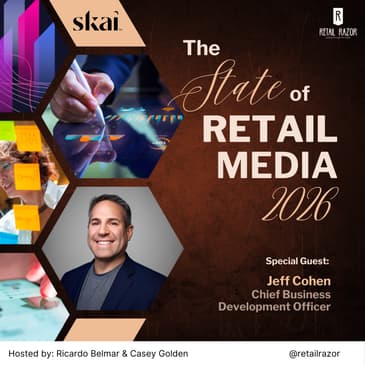



S6E1 Retail Media New Reality: DSP Shifts, Agentic Commerce & Brand Strategy for 2026
Season 6 of The Retail Razor Show kicks off with a deep dive into one of the most important topics in commerce today: retail media. Ricardo and Casey sit down with Jeff Cohen, Chief Business Development Officer at Skai, to unpack the newly released 2026 State of Retail Media Report, created in partnership with Stratably.
This episode explores how brands, versus retailers, are navigating the rapid evolution of retail media. From DSP shifts and CTV growth to AI adoption and agentic commerce, measurement challenges, and the widening gap between leaders and laggards, this conversation delivers the insights every brand marketer needs heading into 2026.
What We Cover
Why retail media now commands nearly 30% of US digital ad spend
The rise of retail media maturity and what separates leaders from laggards
Why organizational structure is now a top predictor of retail media success
The growing importance of Amazon DSP and Amazon Marketing Cloud (AMC)
How brands should evaluate incrementality, attribution, and ROI
Why CTV and sponsored brand video are accelerating
The role of AI and agentic commerce in shaping future shopping journeys
What brands must do in 2026 to stay competitive
Download the 2026 State of Retail Media Report (free):
https://skai.io/reports-and-whitepapers/2026-state-of-retail-media-report/
Subscribe
Subscribe to the Retail Razor Podcast Network: https://retailrazor.com/
Subscribe to our Newsletter: https://retailrazor.substack.com
Subscribe to our YouTube channel: https://bit.ly/RRShowYouTube
About our Guest
Jeff Cohen, Chief Business Development Officer, Skai
https://www.linkedin.com/in/jeffreycohen/
Jeff Cohen leads global business development at Skai, overseeing partnerships and innovation across the commerce media ecosystem. A recognized thought leader, he is focused on uniting brands, agencies, retailers, and publishers around the next era of growth. Previously, Jeff was Principal Evangelist at Amazon Ads.
Chapters:
00:00 Preview Teaser
00:53 Show Intro
03:45 Welcome Jeff Cohen
06:24 Retail Media Maturity and Brand Strategies
08:30 Leaders vs. Laggards in Retail Media
12:12 Organizational Structure and Retail Media Success
17:35 Amazon Ads and DSP Insights
24:36 Evaluating Performance Across Platforms
27:45 The Shift to Full Funnel Advertising
29:46 Challenges in Measurement and Attribution
30:50 The Role of AMC in Retail Media
33:01 Incrementality and Budget Constraints
35:45 AI's Impact on Retail Media
37:10 Strategies for Brands in an AI World
42:54 Key Takeaways and Final Thoughts
48:21 Show Close
Meet your hosts
Helping you cut through the clutter in retail & retail tech:
Ricardo Belmar is an NRF Top Retail Voice for 2025 and a RETHINK Retail Top Retail Expert from 2021 – 2026. Thinkers 360 has named him a Top 10 Thought Leader in Retail and AGI, a Top 50 Thought Leader in Management, Careers, and Transformation, and a Top 100 Thought Leader in Agentic AI and Digital Transformation. Thinkers 360 also named him a Top Digital Voice for 2024 and 2025. He is an advisory council member at George Mason University’s Center for Retail Transformation and the Retail Cloud Alliance. He was most recently the partner marketing leader for retail & consumer goods in the Americas at Microsoft.
Casey Golden, is the North America Leader for Retail & Consumer Goods at CI&T, and CEO of Luxlock. She is a RETHINK Retail Top Retail Expert from 2023 - 2026, and Retail Cloud Alliance advisory council member. After a career on the fashion and supply chain technology side of the business, Casey is obsessed with the customer relationship between the brand and the consumer and is slaying franken-stacks and building retail tech!
Includes music provided by imunobeats.com, featuring Overclocked, and E-Motive from the album Beat Hype, written by Heston Mimms, published by Imuno.
Transcript
S6E1 State of Retail Media 2026
[00:00:00] Preview Teaser
[00:00:00]
[00:00:01] Ricardo Belmar: If retail media is now the fastest growing part of your marketing budget, why are so many brands still struggling to make it work?
[00:00:09] Casey Golden: And what happens when AI agents start deciding which products get recommended and who disappears from the shopper's journey entirely.
[00:00:18] Ricardo Belmar: For our season six kickoff, we're breaking down Skai's new 2026 State of Retail Media Report. The clearest look yet at how brands are navigating this shift.
[00:00:29] Casey Golden: From DSPs and CTV to Agentic Commerce and the widening gap between leaders and laggards, this is the retail media conversation with all the answers you don't wanna miss.
[00:00:42]
[00:00:53] Show Intro
[00:00:53] Ricardo Belmar: Welcome to The Retail Razor Show, a top 15 Retail Management and Top 10 Retail Marketing podcast on Apple [00:01:00] Podcasts, and the only retail podcast in the Top 10 All Time Indie Management podcast charts on Goodpods. Welcome to season six. We've been hinting at this kickoff since our trailer dropped, and now we're finally here. This season we're exploring how retail enters the era of agentic commerce, how retail media becomes the operating system of discovery, and why the human experience still sits at the center of it all.
[00:01:24] I'm Ricardo Belmar.
[00:01:26] Casey Golden: And I am Casey Golden.
[00:01:27] Welcome back, Retail Razor fans to retail's favorite podcast where we cut through the clutter to give you the sharp insights on what's happening in retail today, tomorrow, and where we get real about what's driving the future of commerce. And wow, are we starting this season strong.
[00:01:46] Ricardo Belmar: Today's episode is the perfect way to open season six because we're talking about something every brand and retailer is wrestling with right now. And yes, one of my favorite topics in commerce, retail media.
[00:01:58] Casey Golden: But there's a twist. [00:02:00] We're not tackling this from the retailer lens like we've done in the past seasons, but from the brand perspective. How they're investing, what's working for them. What's not, and where the real performance gaps are emerging.
[00:02:15] Ricardo Belmar: And to help us unpack all of that, we've got the perfect guest. Joining us is Jeff Cohen, Chief Business Development Officer at Skai. Jeff leads global business development, driving partnerships and innovation across the entire commerce media ecosystem. He is a recognized thought leader who's spent his career uniting brands, agencies, retailers, and publishers around the next era of growth.
[00:02:39] And before Skai, he was principal evangelist at Amazon Ads. So he's seen this evolution from the inside.
[00:02:45] Casey Golden: Skai, together with Stratably, just released their 2026 State of Retail Media Report at NRF. And it's one of the most comprehensive looks at how brands are navigating retail media [00:03:00] today. We're digging into leaders versus laggards, DSP shifts, CTV growth, measurement challenges, AI adoption. It's all here.
[00:03:11] Ricardo Belmar: But before we dive in, a quick favor. If you're enjoying the show, hit us with a five star rating or a like, and drop a short review on Apple Podcasts. Spotify, Goodpods, YouTube or wherever you're listening or watching.
[00:03:22] Casey Golden: Plus check out the other shows in the Retail Razor Podcast Network, Retail Transformers, Blade to Greatness, and Data Blades. You'll find them all in your favorite podcast app or together on our YouTube channel.
[00:03:37] Ricardo Belmar: Now let's get into it. Here's our first conversation of season six with Jeff Cohen, Chief Business Development Officer at Skai.
[00:03:45] Welcome Jeff Cohen
[00:03:51] Ricardo Belmar: Jeff, welcome to the Retail Razor Show. We are excited to kick off our sixth season with you and talk about all things retail media, which of course one of my favorite [00:04:00] topics on the show. And highlight the findings in your State of Retail Media 2026 report that you just launched recently at the NRF show earlier this month.
[00:04:07] Jeff Cohen: Awesome. Thank you guys for having me. Really appreciate it. Super excited to talk about this content. I did not know I was kicking off the new season, so that's even, that's even more
[00:04:17] Ricardo Belmar: episode one of our new season.
[00:04:18] Casey Golden: Yes, absolute treat. I know retail media is Ricardo's absolute favorite topic on the show, and I just really love it when we can get a look at the industry from a brand perspective. Like you've done with this report. Usually we're capturing this from either the tech side of retail media or from the retailer's perspective exclusively. So we'll all be learning a little something extra from today's conversation.
[00:04:42] Before we jump in, Jeff could you give us a quick rundown on your background and some brief history about Skai and where you fit into the retail media equation?
[00:04:53] Jeff Cohen: Yeah. Oh, the markitecture question. Okay. Yeah. So, [00:05:00] I have been, I stumbled into the e-commerce space in 2005, so I've been around for a long time. Started in the textbook space built some of my own tech companies before joining Amazon. And I joined Amazon about four years ago where I spent my time as Amazon's tech evangelist. In that role I worked with our agencies and tech providers globally. To help them integrate in with Amazon Ads Technology.
[00:05:28] Recently, about six months ago, I joined Skai. Skai is an omnichannel tech solution for brands and agencies who wanna manage the, their advertising and their brands across the omnichannel landscape that exists today.
[00:05:43] Skai is not new to the e-commerce space. We've been around. 2026 is our 20 year anniversary for people who have been in this space for a long time. You may have known us by our former name, Kenshoo, where we kind of started in our roots with search. We expanded into retail [00:06:00] media and we're in, you know, we're a tech company that works with some of the largest enterprise brands, some of the largest holding companies and independent agencies to help them build scale and manage their search, social and retail media all in one solution.
[00:06:20] Ricardo Belmar: All right, fantastic. Well, thanks for that rundown.
[00:06:22] So let's dive into the report.
[00:06:24] Retail Media Maturity and Brand Strategies
[00:06:24] Ricardo Belmar: So retail media right now I think one of the stats that stood out to me commands about 22% of total media budgets. Nearly 30% of all US digital ad spend which I think is pretty impressive. So Jeff, when you look across this year's landscape, I mean, what does this tell you about where retail media now sits in the broader marketing mix for brands and what does maturity in that sense actually look like at this stage?
[00:06:47] Jeff Cohen: Yeah, it's a great question to kind of start with. And so I think what it comes down to is that one of the things that we've identified is that retail media has become infrastructure, not just experimentation, right? So we [00:07:00] really started with like category experimentation. But that's become foundational and it's commanding nearly a third of the digital spend, so it's no longer optional. The maturity isn't just about the size, it's about the sophistication of what's going on in this space. So our study found that 65%. Are reporting a maturity with Amazon ads, but only 41% are experiencing that maturity with other retail media networks.
[00:07:32] So what this means is that retail media is moving from the basic targeting to more of a, systematic optimization and even a cross platform optimization. And that maturity is growing over time. Now all of this is allocating patterns that reveal a very strategic intent. Brands are allocating 21% of their total media budget [00:08:00] to retail media, and they're treating it as a hub that's connecting other channels.
[00:08:05] This isn't just the lower funnel tactics that we used to talk about a couple years ago. They're actually using the media. To inform search, social, and even their traditional media strategies, which is a fairly big shift in, in how brands have been thinking about and, and using, retail media.
[00:08:27] Casey Golden: So that's really insightful. Big changes here happening.
[00:08:30] Leaders vs. Laggards in Retail Media
[00:08:30] Casey Golden: The report also shows that 31% of brands qualify as leaders, yet they're pulling away super fast. What are the most defining behaviors or capabilities that separate leaders from laggards? Why is this gap widening even though budgets aren't necessarily the differentiator?
[00:08:50] Jeff Cohen: Yeah. So one of the things that was really important for us to look at when we looked at this report was to create this concept of leaders and [00:09:00] laggards for for our audience to kind of understand like where do they exist compared to the rest of the, of the market, right? So when we started to look at leaders, we looked at really three criteria.
[00:09:14] They needed to be e-commerce companies that were outpacing their category average, right? So these are people who are growing faster than everybody else. They need to have a retail maturity above the average, right? So they're sophisticated to extremely sophisticated with the markets that they're in and the 2025 media results are exceeding their KPI goals, right?
[00:09:41] So that was really important that we tell people like, what are the leaders? And then when we looked at that subgroup of the data and we compared it to everybody else, then the question is, what did we start to find? Well, we found that leaders have built measurement [00:10:00] infrastructure that's really steering their decisions in real time. It's not just reports that they're scheduling, right? So 70% of the brands are meeting or exceeding goals. But leaders are the ones who can explain why and make the mid-flight adjustments, and that's really critical to think about. Now, it's not just about budget, it's about execution capabilities.
[00:10:26] So, our study found that leaders allocate almost a little more than 27% of their media budget to retail media where laggards are only around 23%. Now the gap while in that number is really in the operations. So leaders are over-indexing on incremental measurement, cross-functional alignment, platform consolidation, and these are the things that are making them grow faster.
[00:10:57] Now the last point that I think [00:11:00] is really interesting about the leaders versus the laggerds is really the compounding performance gap that's happening over time. So leaders are moving towards more sophisticated use of tools like Amazon's Marketing Cloud or expanding their DSP, right?
[00:11:19] We saw that 35% are prioritizing AMC. 52% are shifting display budget, and they're also leading in things like Gen AI, right? And so they're not stuck in these manual operations.
[00:11:36] Ricardo Belmar: So they're just always adapting and advancing and moving ahead. They're always looking for the next thing to make themselves better.
[00:11:42] Jeff Cohen: Yeah, and I think it's kind of easy to say that, and everyone goes, well, of course that's what leaders are doing. But when you see the gap in the numbers right, you start to understand like, well, wait a minute. Why am I not advancing and if I wanna grow my business faster, these are the things I need to do to [00:12:00] grow my business faster, because these are the things that are not just accelerating them individually, it's accelerating their business growth.
[00:12:06] Ricardo Belmar: Hmm.
[00:12:07] Casey Golden: Yeah, so let's talk about our beautiful Franken stacks. And where we are with that, with retail media.
[00:12:12] Organizational Structure and Retail Media Success
[00:12:25] Casey Golden: So, your report said only 12% of brands have integrated media and commerce operations despite planning to manage eight or more RMNs by the end of the year. And that's up from last year.
[00:12:27] Jeff Cohen: Yeah.
[00:12:27] Casey Golden: Why is organizational structure becoming one of the biggest predicators for success? And what are the early signs that a brand's internal model is holding them back.
[00:12:38] Jeff Cohen: Yeah, so let's just talk about this growth of retail media networks and then I'll kind of answer that question, 'cause this was, this was kind of fascinating, right? So what we found was that we have, that the average brand is managing six, and by the end of the year, they're gonna be managing eight retail media networks.
[00:12:57] Now again, leaders and laggards [00:13:00] leaders are at seven.
[00:13:02] Ricardo Belmar: Hmm.
[00:13:03] Jeff Cohen: And they're planning to manage eight. laggards are at six and planning to manage, a little bit more than seven. So they're managing more. Now, what's in even more interesting when you go into this data one step further, whether you look at it by organization, type by brand category, by brand size, by retail media allocation.
[00:13:25] Anyway, we slice and dice this data. The numbers are growing in terms of the number of retail media networks people are planning to manage, right? Every single subcategory breakout had a higher number by the end of 2026 than what they're doing today. That was a, a fascinating data point. So then the question becomes if we have all that and we don't have the organizational structure, what does that mean?
[00:13:49] You're scaling without infrastructure, and it's creating chaos for your business. It's not actually creating an advantage for your business. And so this is a, a [00:14:00] coordination crisis that you that you need to have. And so, our internal constraints, um, really ranked as the number one barrier to retail media success.
[00:14:11] 55, 54, 55% of people were saying that the internal constraints in their business were the barrier towards their success that was ahead of budgets, measurement, or even the platform complexity. So when media and consumer teams are really operating in silos. You can't coordinate pricing, promotion, inventory, campaigns, which is all required, for retail media success.
[00:14:42] And so as you're expanding into more and more retail media networks, more and more cross internal coordination is required right. Now, one, one last point here is that the full integration remains rare. But we did notice that [00:15:00] agencies are are ahead of, and agencies and leaders are over indexing for this full integration.
[00:15:08] 12% who achieve it in the report are saying that they have a clearer path to all the other things that they want, which is better incrementality. Better measurement, better inventory health, pricing. So, the brands that are doing it, that are able to get over that organizational hump that's necessary are seeing all the downstream impacts.
[00:15:32] Now it's deep problem, right? It's a deep problem in our industry because we have brand budgets, and we have retail media budgets, and we have upper funnel budgets and DUP couponing budgets, and they all sit in different silos in our organization. And one of, one of my predictions right, that's in my envelope for 2026 is that this is gonna be a big year for, organizational structural change, right?
[00:15:57] A lot of, I think we're gonna get intoAIhere in a little [00:16:00] bit, butAIis part of that. But the brands that are able to have silos where VPs own cross-functional budgets, not siloed budgets, are able to look at KPI metrics and understand how one budget is impacting the other, and they're able to more effectively spend across all of their budgets by understanding.
[00:16:22] Ricardo Belmar: And I would think that lets them shift more rapidly, right? So when they see something changing in one bucket that says, oh we should shift more spend over to that because it's converting better, or whatever the metric is, they can act on that because they have the visibility.
[00:16:35] Jeff Cohen: Yeah and listen at the end of the day, brands have joint business plans with many of the retailers that they work with, right? So there's a committed spend. You may have to have in certain buckets based on your, on your retail negotiations and, and your discount negotiations and your deal negotiations and all the other things.
[00:16:56] But you still need to be able to manage within a channel the most [00:17:00] effect effectively. And then you need to be able to manage across channels the most effectively. You need to be able to understand when you spend in one channel, what does it do for
[00:17:07] Ricardo Belmar: Mm-hmm.
[00:17:08] Jeff Cohen: And I think we used to live in this silo where it was like, well, I advertise in Walmart. I buy in Walmart. I track in Walmart. But we also know that when you advertise in Walmart's display that drives sales to Amazon. And so you have to have some way of understanding what that what that measurement, what that incremental, uh, reach can be.
[00:17:29] Ricardo Belmar: Well, let's dive in a little bit more on, on the Amazon side of things too, because I think there's some interesting, interesting findings here.
[00:17:35] Amazon Ads and DSP Insights
[00:17:39] Ricardo Belmar: So, report shows Amazon ads has 92% adoption. So clearly right, every, everybody's there. Probably is not the surprise.
[00:17:42] There's 65% maturity and AMC adoption is hit 56% respondents. So from your vantage point, where should brands be leaning in on Amazon or for 2026, and where do you see the biggest missed opportunity?
[00:17:55] Jeff Cohen: Um, yeah, sometimes I question like, who are the other 8% that aren't [00:18:00] on?
[00:18:00] Ricardo Belmar: Yeah, yeah,
[00:18:01] Jeff Cohen: Maybe those are the people that are that.
[00:18:02] Ricardo Belmar: those are Casey's luxury brands that she's buying from.
[00:18:07] Jeff Cohen: The, the other thing about maturity anecdotally our study didn't find this, but I've just found this in my time in history, is that I do believe people tend to overindex their belief of their maturity with a particular market because they're in it all the time. So they feel like they, they know it.
[00:18:24] I just remember being in some, I remember being in a session and we were holding a round table with like 20 brands around the table. And we were talking about Amazon Marketing Cloud, and I said, before we start, how old is Amazon Marketing Cloud? Everybody write it down on a piece of paper. And I had everybody hold it up and the numbers
[00:18:42] Ricardo Belmar: All over
[00:18:43] Jeff Cohen: 1, 3, 5, 7, 9, 6.
[00:18:46] Nobody knew how old this product was. And I was like, it's a 7-year-old product. And everyone's like, whoa. I thought it just came out the other
[00:18:53] Ricardo Belmar: Right.
[00:18:54] Yeah.
[00:18:55] Jeff Cohen: Yeah, but it's but it also goes to show like. AMC was one of the, one of the [00:19:00] big numbers, right? 56% underutilized the adoption of AMC. Only 25% are using AMC for actionable product level insights. Only 21% are using it to direct bids and budget decisions. So there's a big gap between, like we use it and we act on it.
[00:19:20] And I think that that's again, leaders and laggards, it's a big opportunity for growth is not just, we use it, but how do you actually act on it? The DSP is another one with Amazon that I thought was, was really interesting. It's a widening, gap that Amazon is, is making here, which is with their new with their not new, but with their closed loop attribution, right?
[00:19:45] 57% are citing that the DSP with Amazon is an advantage which means Amazon's DSP is, is pulling in display budgets from the open web and now they're giving you access to the open [00:20:00]web. Through the DSP that you're comfortable with and being able to report back on it, right? So brands are not building DSP competencies and leaving incrementality and attribution on the table, right?
[00:20:15] They're actually taking advantage of of what Amazon has to offer. The other thing that I thought was kind of fascinating was every ad format is seeing net positive investment intent, right? So whether you're looking at sponsored brand video or streaming tv, so that means where's the missed opportunity?
[00:20:35] Well, it's the missed opportunity is in treating Amazon as a search only function when video is providing both scale and performance. And I think Amazon had some releases at their, at their unboxed around like, prompt videos, which allows you to have like very detailed videos. That are more like how-to videos as opposed to like the traditional brand videos [00:21:00] that they had before.
[00:21:01] And so there's a lot of features and functionalities within Amazon that can still expand your reach and help you find new
[00:21:09] Ricardo Belmar: Mm-hmm. So kind of dig digging into this point on, on Amazon's DSP, 'cause you're also finding reasons for brands to embrace that more than open web DSPs. But one of the things that seems to me the interesting point here is, Amazon's charging a premium for that, right?
[00:21:24] Because their claim will be that you're getting better, more first party data to zero in and better targeting around that versus those open web DSPs. So are they really delivering on this promise of better measurement, more incrementality for brands?
[00:21:37] Jeff Cohen: Yeah the, I'm gonna put my old Amazon hat on from that, from the question about their charging more. And what I would say is that if you're looking at like traditional brand advertising where you're paying for reach and frequency, yes. DSPs are more expensive because they're, they're much more targeted.
[00:21:54] And so I think, again, like as a brand, you have to kind of understand what are you trying to do? Are you just trying to go out and [00:22:00] spray and, and hope you, you hit, are you trying to target. And ultimately you, you need a little of both within your strategy. And so I, I wouldn't necessarily focus on one, but, attribute the, I think one of the big thing is, is it with the DSP is that it has attribution that the open web can't match, and I think that's driving the shift. Right? So there's a closed loop attribution that is cited as one of the top advantages by brands in using the DSP. That's followed by better commerce data utilization. So being able to use the commerce data and your first party data and then the audience quality, right.
[00:22:42] So kind of what I spoke to at the beginning. So brands are, are tired of optimizing towards these, metrics when retail media can't show the actual lift. And so the biggest shift in programmatic display is happening now, and it's moving more than [00:23:00] half the advertisers to reallocate their budgets.
[00:23:03] And this isn't just incrementality, it's reflecting. Amounting, frustration or, or challenge with this measurement gap. And the audience targeting limitations that the Open web has. Now, the trade off is leaders are choosing this precision over the reach, right? So retail media DSP commands the higher CPMs that that you talked about, but only 27% of people in our study cite the stronger ROI performance and the 29% value to onsite inventory for their reasoning for doing it.
[00:23:40] So leaders are betting that the measurable incrementality is better than the cheaper impression. And so like, that's ultimately like at the end of the day. That's ultimately what you have to test.
[00:23:53] I can't tell you that it's gonna work for you, but that's ultimately what you have to test, right? Can you [00:24:00] get a, a better measurable, incremental sale, or are you just looking for cheaper impressions?
[00:24:09] Casey Golden: Yeah. I mean, I mean, I'd always bet on that, right? Like spend more money being
[00:24:13] Jeff Cohen: there are, some brands who don't wanna bet on that, right? Like if you look at, and, and I'm not throwing any shade on anybody, but like the insurance industry is about just constant brand building that's out there and it's getting impressions of what you're trying to do. I'm not saying there's no place for that within your marketing mix and shut all that down, right?
[00:24:32] It's, it's a matter of having a hybrid of those.
[00:24:36] Evaluating Performance Across Platforms
[00:24:36] Casey Golden: So how should brands be evaluating performance and even measuring an ROI across an Amazon DSP, Walmart Connect, Trade Desk, and open web display. And how, how do they win?
[00:24:51] Jeff Cohen: Yeah, so you know, Amazon's DSP wins on attribution and scale, right? It's got 92% adoption and the infrastructure [00:25:00] of AMC of Amazon Marketing Cloud, if you're not familiar, helps to show the incrementality. It's the default choice for brands who need to connect the offsite awareness to the onsite conversion and, and show whether there's a measurable lift.
[00:25:16] With Walmart and other retail media networks, it's about reach, diversification, and, and competitive intelligence. Brands can't optimize on an Amazon only strategy even though like, you know, I probably pushed that for a long time when I was at Amazon. There's a big reason why I came to Skai, because I see the cross channel.
[00:25:36] The cross channel optimization that's necessary, and you need to understand how the performance is happening across retailers. So, you know, Walmart's Trade Desk integration offers additional scale and attribution, which provides some additional clarity, and then the open web still has a role for pure reach plays and lower [00:26:00] CPMs, but our data found that only 20% say no to shifting budgets towards retail media DSPs.
[00:26:08] You know, maybe the writing's on the wall that if you can't show incrementality you're vulnerable to a reallocation of your budget.
[00:26:17] Ricardo Belmar: Yeah.
[00:26:17] Casey Golden: And we're seeing this shift toward video, obviously. But also CTV, which, I've been a big proponent for shoppable television for like, I don't know, 20
[00:26:28] Ricardo Belmar: Yeah.
[00:26:29] Casey Golden: We're still not there yet, but we're getting closer because CTV has become quite the channel lately. I think every Amazon ad type shows a net positive investment intent and sponsored brand videos and streaming TV are leading the pack right now.
[00:26:47] Jeff Cohen: Yeah.
[00:26:48] Casey Golden: How should brands think about upper funnel formats that historically weren't really part of retail media?
[00:26:56] Jeff Cohen: Yeah it's interesting that you say that. 'cause if you look west, I love to look [00:27:00] west to kind of see what's maybe it's looking east, looking west, looking over to Asia. We'll say
[00:27:04] Casey Golden: yeah. I'm like, Cali's doing anything
[00:27:08] Jeff Cohen: Look, you can look either
[00:27:09] Ricardo Belmar: either way you'll get there.
[00:27:11] Casey Golden: every either way. You'll get there. That's great.
[00:27:12] Jeff Cohen: Video shopping is like off the hook, right? Like whether you're in China, whether you're in Japan, whether you're in Korea, like it doesn't matter. Video shopping is off the hook, so you're right, like in the US it's still kind of slow and and low in its, in its overall adoption.
[00:27:28] But video formats are leading the investment intent, right? That's what our data shows. Sponsored brand video. At 56% sponsored streaming tv, sponsored TV at 46%. And that's even outpacing sponsored products.
[00:27:45] The Shift to Full Funnel Advertising
[00:27:45] Jeff Cohen: So this signals that brands are moving beyond the search only strategy and they're adopting more of a full funnel execution.
[00:27:53] Now video starts to or maybe demonstrates an alignment with our broader industry movement [00:28:00] towards CTV and video first advertising. 47% are net positive when they think of CTV streaming and the reflection of the brand allocation compared to linear tv. And it's mainly because of its addressability and it's measurement that it can have within this closed loop environment.
[00:28:23] Now in the end, upper funnel ad formats are providing performance, not just awareness. And I think this is what these closed loop systems can show. So brands are discovering that sponsored brand videos and streaming ads, they're not just building the consideration bucket, they're actually driving measurable conversion lift.
[00:28:47] And this change is allocating how we're thinking about the budget. As brands are able to really drive this understanding of the upper funnel ad down [00:29:00] to the middle and the bottom of the funnel to conversion, what they're seeing is that there is this direct correlation between running those ads and having either more, more efficient, more effective sponsored ads or, or having better, conversion rates. And at the end of the day, that's what you want and why you need a mix of how you think about your advertising.
[00:29:23] Ricardo Belmar: Yeah. I think it really shows how the, how you measure is so critical and so important here particularly now to your point with these upper funnel formats are, are helping to improve and drive conversion lift. But it still feels like at, at a lot of brands, they're really marketers, advers, they're being measured more on those lower funnel tactics, right?
[00:29:42] And that's where the KPIs sit versus these upper funnel ones where they can get that lift.
[00:29:46] Challenges in Measurement and Attribution
[00:29:50] Ricardo Belmar: So, I mean, how should brands rethink those measure frameworks, so they can recognize that the upper funnel investment is benefiting them and it's not like a penalty or an advertising penalty in a sense, right?
[00:29:58] What does the data show about this kind of [00:30:00] impact?
[00:30:00] Jeff Cohen: Yeah, so I think the data is demonstrating that retail media is working across the funnel. So brands that are allocating roughly a third of their budget to paid search and to paid social are driving traffic to their retail site or to a third party retail site. And this reveals that retail media is a hub.
[00:30:22] It's not just the conversion channel, right? I think that. Measurement is still lagging the strategy, right? Only 15% are reporting strong measurement confidence, and 75% are struggling to understand the incrementality. So until brands can really measure the upper funnel retail media contribution to the lower funnel, the investments will stay somewhat constrained.
[00:30:50] The Role of AMC in Retail Media
[00:30:50] Jeff Cohen: Now again, we talked about AMC right? As a, as a potential unlock. And the concept is becoming across a lot of [00:31:00] retailers of multi-touch attribution is coming more into play. So 38% are using AMC to understand the full customer journey. We, you know, we talked about 36% activating the the AMC strategies to build the frameworks, but brands are still stuck in a last, if we look at laggards, leaders, brands are still stuck in last click attribution on devaluing the upper funnel formats. And so when we look at the concept of performance versus perception, we gotta get over, we gotta get to a, a more of a, a standard for incrementality and for measurement and for multi-touch attribution, which are relatively new terms in the sense of retail media, not in general for marketing, right?
[00:31:52] They've been around forever. But in terms of of our industry, they're still relatively new
[00:31:57] Ricardo Belmar: Yeah. Why is it that [00:32:00] incrementality still so difficult, so elusive for everyone? What are some practical steps that brands can take to go from that, their traditional reporting to this true kind of in-flight optimization and, and really understand full funnel?
[00:32:11] Jeff Cohen: Yeah. I could probably do a whole podcast on incrementality and explaining some of the scientific method behind it versus how some people are doing it. I think that's kind of part of it. The way I like to say it is like, at the end of the day, go type incrementality into anything and you get the squiggly
[00:32:28] Ricardo Belmar: right. Yeah, that's right.
[00:32:29] Jeff Cohen: It's, it's not a, it's not a word that has, I don't even know who defines that, Webster, we'll call it Webster, since that's what I grew up with. Right. Does not have a dictionary defined terms. So it's got a squiggly line and I always think I'm misspelling it. I I, one day I'll get smart and I'll just add it into
[00:32:47] Ricardo Belmar: Yeah. into your dictionary.
[00:32:48] Casey Golden: I am working on a campaign right now to add clienteling to the Webster dictionary. So if you wanna like team
[00:32:53] Ricardo Belmar: That's another one. Yeah.
[00:32:54] Casey Golden: year of, like, getting a keyword trending here.
[00:32:57] Ricardo Belmar: Mm-hmm.
[00:32:59] Jeff Cohen: Yeah, let's, let's, [00:33:00] let's do it.
[00:33:01] Incrementality and Budget Constraints
[00:33:01] Jeff Cohen: When we look at the data, incrementality ranks number three in budget decision factors, right? This is behind retail media performance and retail, business side, but 75% cited as their top measurement challenge. This gap explains why budget conversations are are happening, but we're not necessarily seeing the, the strongest result.
[00:33:25] Now, half the brands are measuring incrementality at a, at a basic level, but only 20% are applying those insights to the decision. So at the end of the day, this isn't an awareness issue. It goes back to being an operational issue. Brands have the data, but they lack maybe the framework or the infrastructure to act on it, which keeps them stuck providing the value on a campaign by campaign basis versus optimizing more systematically. And if we go back to the leaders and the laggards the leaders are clearly investing [00:34:00] in these systems. They're not just running studies.
[00:34:03] Casey Golden: And I mean, I think this kind of pulls us right back into budget, right? And there's, there's a paradox. Budget constraints are the number one obstacle for scaling Amazon ads. But, Amazon is also the number one driver for growth retail, growth media. How are brands, like, how do they need to think about reconciling the need for this constant optimization on Amazon and opening up their pockets with the reality of just limited budgets and the rising cost of, you know, CPCs.
[00:34:32] Jeff Cohen: Yeah I think the budget constraints that were demonstrated in this study are not considered a failure of Amazon. It's more of a reflection of Amazon of retail media's success in creating this insatiable demand that budgets can't keep pace with. So Amazon requires constant optimization to stay profitable.
[00:34:55] With 50% of the respondents citing that the [00:35:00] improved ROI and efficiency of their campaign is their top priority. So brands are stuck in budget constraint mode. They're often the ones who haven't built the measurement or automated infrastructure to prove the incremental value and unlock. So the paradox really resolve, re resolves with the incrementality measurement.
[00:35:23] So brands who can prove that they're driving sales lift beyond organic demand, they can justify more budget and maybe our CFOs are getting smarter in the way they're asking questions. But those who, can't get out of this stuck cycle of of tightening budgets are gonna see further constraints.
[00:35:45] AI's Impact on Retail Media
[00:35:45] Casey Golden: So I'd like to just, remind our audience that we've managed to get this far in the conversation without talking about the impact of AI.
[00:35:55] Jeff Cohen: I may have
[00:35:55] Ricardo Belmar: a first.
[00:35:57] Jeff Cohen: a hint about it
[00:35:58] Ricardo Belmar: Just slightly. Just a little [00:36:00] one. Yeah.
[00:36:00] Casey Golden: It was, it was so quick, it didn't count
[00:36:03] Ricardo Belmar: Right. Yeah. We're gonna overlook that.
[00:36:06] Casey Golden: So, I mean, I think, and I think that's significant, right? We have a lot of opportunities, problems, challenges, and before AI, and I think a lot of that's gonna be solved because of AI, regardless if it's solved with AI. We are going to solve a lot of problems as we prepare for this and as more people clean up some of these Franken stacks and some of these databases, reorgs, architecture. And so kind of coming into this report, 63% of advertisers are using Gan AI, incredible stat, but the biggest gains, are obviously still ahead. We have a lot of brand leaders that are a little bit more skeptical about AI improving creative performance. So where do you see AI delivering real value today? And what do you think brands should be preparing for the upcoming shift towards an [00:37:00] agentic commerce or algorithmic shopping journeys that may or may not have a human involved in the purchase?
[00:37:09] Jeff Cohen: Yeah.
[00:37:10] Strategies for Brands in an AI World
[00:37:11] Jeff Cohen: So what I would say is that you need to have a strategy for your brand, and then your brand needs to have a strategy for an AI world, right? It's a, it's. That's the paradox that kind of exists today. The data, as you said, showed that 63% adoption, but what's crazy is that the impact remains completely unclear.
[00:37:34] So only 25% reported a noticeable or transformative result from AI. So the gap between using it and getting value from it is pretty large, especially in creative where Amazon's AI tools are improving, but they're, you know, they're not yet truly to the authentic level that brands are looking
[00:37:58] Casey Golden: Yeah.
[00:37:59] Jeff Cohen: [00:38:00] Now in 2026, leaders are shiftingAIinvestment from creative to campaign management, analytics, personalization, and this evolution shows that early adopters are moving past some of the novelty ofAIand trying to solve some of their problems, which are the performance driving use cases that we talked about
[00:38:22] Ricardo Belmar: Yeah.
[00:38:23] Jeff Cohen: When we look at agentic commerce, it's clear that it's going to redefine discovery. What's not clear is how, right, so AI agents are comparing prices, reading reviews, making purchases on behalf, right? There's literally a news AI announcement coming out every day, and you can create whiplash for yourself and for your brand if you try to chase it.
[00:38:50] Which is why I try to, my, my statement last year was you won't lose your job to AI, you'll lose your job to somebody who knows AI. And I still [00:39:00] think that's very true. As individuals, we need to know how to use AI to make our jobs and our lives better. But if you're a manager or a supervisor or a C-level, you need to really truly understand what role your brand, your team, and your functions have in an AI world.
[00:39:20] What tools are you using? How are you using them? How are they changing your organizational structure? How are they changing your decision making process? How are they changing your hiring process? Right. And I think a lot of this is gonna all come into play in 2026. And again, it may not be something we incrementally see impacting 2026, but it's going to lead a foundation for 2027 and beyond
[00:39:45] Ricardo Belmar: Mm-hmm. Yeah. Yeah. I always think it's interesting when, when we look at where the AI is having the impact that initially everybody gravitates to the shiny object part of it, which is around creative, right? It's all these amazing things Gen AI can create. But then when, where people measure value is [00:40:00] always the operational things where AI really delivers some form of acceleration, right?
[00:40:03] Where you can do more of something or do it faster but still requires people to actually manage that operational process. So I think that's always, to me the fascinating thing
[00:40:13] Jeff Cohen: Well, and something, and something that I think is part of this gap of understanding the value, right? Is that how do you actually measure operational efficiency? Because we don't feel like we've actually gained 30% of our time because something saved us 30% of our time. And one of the challenges ofAIis that it will take a hundred hours to get theAIto save you the time.
[00:40:39] So at the end of the day, you need to be investing inAIand things that are repeatable so that you're not spending your time working on these more mundane daily reports, weekly reports, daily analysis, cross channel analysis, and then you're actually studying the insights that come to make the strategic decisions [00:41:00] 'Cause I like to I tell this to my kids all the time. AI's job is to give you an answer. It's not to give you the right answer, right? Like your
[00:41:07] Ricardo Belmar: still gotta make a decision afterwards.
[00:41:09] Jeff Cohen: right? That's your job. Your job is to understand, is it the
[00:41:12] right
[00:41:12] Ricardo Belmar: the right one? Yeah. And should you
[00:41:14] Jeff Cohen: what I need to do? And it gets smarter, but it, it's not at that point
[00:41:18] Ricardo Belmar: Yeah. Yeah. No,
[00:41:19] Casey Golden: I, mean, I literally moved into tech because on the brand side, on the fashion side, I was like, I spent three hours doing like seven V lookups. Multiple, like getting all of this
[00:41:29] data together, do the math, get my everything set up so I can spend five minutes to look at it and make a decision because I'm outta time.
[00:41:36] Ricardo Belmar: Yeah, that's right.
[00:41:39] Jeff Cohen: Yeah. But if you can flip that
[00:41:41] Ricardo Belmar: exactly. Exactly.
[00:41:42] Jeff Cohen: have to have an inspection of what it brought you to make sure that it's, and when you get to that comfort level, then you have the operational efficiency,
[00:41:51] Casey Golden: Yeah. I'm like, what? What? What is this? I'm like, I'm doing the same exact thing every single time. I'm like, I'm moving to tech.
[00:41:57] There are better. There are better ways to be spending time. [00:42:00] There are solutions for this. And now we just have all of these types of solutions at our fingertips to really think more strategic about our business at every role and position, I think at a company, because so much of the time it's a constant fire drill on the brand side and there's no time to... you, you just don't have that mind space to really, really think and be strategic for an appropriate amount of time. Do they get it done? Are they talented? Can they shoot from their hip? Can they, can they win?
[00:42:34] Yes. But just imagine if all of that, the rest of it was just teed up. And I think that retail media networks is definitely going to be like one of those catalysts. AI is definitely gonna be a catalyst.
[00:42:49] There's money on the table.
[00:42:50] Ricardo Belmar: No ab absolutely. Absolutely. That's key. Yeah, that's key.
[00:42:54] Key Takeaways and Final Thoughts
[00:42:54] Ricardo Belmar: Alright, so Jeff, let's kind of bring, bring this home. I mean, if I think about what are some of the clear messages out, out of the [00:43:00] report I think, DSP is a battleground, right? I think that's, that's one. We just talked about AI adoption and, and where that's heading for brands. And you've mentioned, the gap right between leaders and laggards is actually wide at this point. So if you had to distill everything we've talked about into maybe the top three most important actions a brand should take this year to stay competitive, what would you tell 'em?
[00:43:22] Jeff Cohen: Number one, go download the report. Um, shameless plug go download the report. We'll make sure you have a link
[00:43:29] Ricardo Belmar: Yep. We'll have it in the
[00:43:30] Jeff Cohen: Um, we only covered a fraction of the total report. I think there was like 56 pages of, of pretty charts and, and anecdotal information. So, you know, the first thing I would say is go read the report and figure out what applies to you, right?
[00:43:44] Like, put it through your own little AI, figure out what applies to you and try to pull your own one or two main things out of here that you wanna do for your business. That's the big key. Anytime I tell people that go to trade shows, it's like you, you get inundated with information [00:44:00]at conferences and podcasts and things like that.
[00:44:02] So figure out what can actually help you drive your business. And there's a lot of data in here. So, that's the first thing I would say. The second is I would I would, you know, remind you of the, the the point that I made earlier that brand measurement infrastructure should be steering your business, not just reporting on your business.
[00:44:22] Right. The second is, is that there's a consolidation of the platforms and the integrated media and the commerce operation. That is coming, right? Brands are planning to manage eight plus retail media networks, but they only have, but only 12% have the integrated commerce ops. So you can't optimize what you can't coordinate.
[00:44:46] So, un unified the pla, unifying the platforms, normalizing the data, automating the execution. All these things will allow your business to scale and it's what's letting leaders separate themselves [00:45:00] from laggards. You talked a little bit about the shift in DSP budgets but you know, we need to master, we need to continue to master the Amazon stack and spread our mastery, if you will, to Walmart, Instacart, understand your six to eight retail media networks and then where your division of your spend comes from and where your mastery needs to be.
[00:45:26] Now, I'll, I'll throw in a bonus point here, which is to say that the gap between leaders and laggards. Is widening not because of budgets, right? It's, we talked about this at the beginning and I hit on it a few times.
[00:45:40] Leaders and laggards are separating because of infrastructure measurement, operational sophistication. So when you are thinking of how to be better in your business, it's not just going back to ask for more money. 2026 will separate brands who treat retail media as a mature [00:46:00]infrastructure from those who are running it as more of like a pilot program.
[00:46:04] And that's just, I think, you know a good point to probably end on
[00:46:08] Ricardo Belmar: Yeah. Excellent.
[00:46:09] Jeff Cohen: Mic drop.
[00:46:12] Casey Golden: So I know Ricardo loves, has loved this. I'm actually quite surprised at his restraint.
[00:46:19] Um,
[00:46:20] we really, I have no doubt. I mean, I just imagine you wiggling over in that chair.
[00:46:26] Jeff Cohen: He was, he was front row for the presentation
[00:46:29] Casey Golden: I have no
[00:46:30] Ricardo Belmar: Right.
[00:46:30] Casey Golden: I doubt and I'm sure we could sit here and talk for another few hours about retail media and there's just so much detail in this report.
[00:46:39] I think it's incredibly insightful, and I love the perspective that it's coming from. We couldn't dig into everything here, but it is pretty insightful. 2026 is going to be an exciting year for retail media, seeing what develops between brands and retailers. So Jeff, thank you very much for joining us.
[00:46:57] I recommend everybody going and [00:47:00] downloading this report and,
[00:47:02] Jeff Cohen: free. We probably never even mentioned it. The
[00:47:03] Ricardo Belmar: we should mention that. Yeah, and, and we'll, we'll link to it in the show notes too, to make it easy for
[00:47:07] Jeff Cohen: Yeah, people like to, people don't always know that, right? Because there are a lot of people that sell
[00:47:11] Casey Golden: That's true, right? yeah.
[00:47:13] Ricardo Belmar: Well, so Jeff, if a brand leader's going through the report after they download and they wanna follow up with you, maybe they have more questions, they want to dig into it some part a little bit deeper or understand how to make it actionable for themselves, what's the best way for them to reach out to you and the team?
[00:47:26] Jeff Cohen: LinkedIn is the best, is the best way. LinkedIn. LinkedIn, Jeff Cohen. I hope I come up on the top of your list. I used to tell when I was at Amazon, I used to tell people, type in Jeff, Amazon, and I'm number two behind the other guy who has more. But I, you know, I post a lot on LinkedIn. I've used LinkedIn to, to share a lot of thought leadership and, and you know, industry knowledge. So LinkedIn is a great way. I highly, highly encourage people to ask questions. I offer this all the time during podcast and [00:48:00] presentations. It's surprising how few people actually reach out.
[00:48:03] So please feel free to reach out, ask a question if you have one, give me some feedback from something you liked from the report. We'd love to hear feedback.
[00:48:11] Ricardo Belmar: Fantastic.
[00:48:12] Casey Golden: Great. Well, we'll have this all in the show notes. And with that, Ricardo, this episode is a wrap. We will see you in the comments.
[00:48:21] Show Close
[00:48:26] Casey Golden: Did you love this episode? Drop us a five star rating and review on Apple Podcasts, Spotify, or Good pods and hit subscribe so you never miss an update. If you're watching on YouTube, like and subscribe, before you go.
[00:48:40] I'm Casey Golden.
[00:48:42] Ricardo Belmar: Follow Retail Razor on LinkedIn, Bluesky, Threads, and Instagram, and subscribe to our Substack for highlights and bonus content in your inbox. For transcripts and guest info, head to retailrazor.com.
[00:48:55] The Retail Razor Show is the original show in the Retail Razor Podcast network.[00:49:00]
[00:49:00] I'm Ricardo Belmar.
[00:49:01] Casey Golden: Thanks for joining us.
[00:49:03] Ricardo Belmar: Until next time! Stay sharp. Stay human. Stay ahead.
[00:49:07] This is the Retail Razor Show.
[00:49:09]