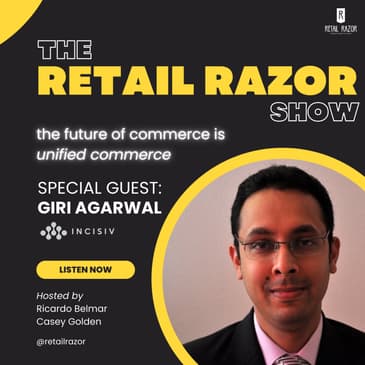


S4:E2 The Evolution from Omnichannel to Unified Commerce with Giri Agarwal
In this episode of the Retail Razor Show, hosts Ricardo Belmar and Casey Golden discuss the shift from omnichannel to unified commerce in the retail industry. Special guest Giri Agarwal, Chief Strategy Officer at Incisiv, joins to share insights on how unified commerce is transforming customer experiences and driving revenue growth. They explore the concept of unified commerce, the integration of AI, and the challenges retailers face in adopting this approach. Key highlights include the importance of customer identification, empowering frontline staff, and rethinking store experiences. Giri also addresses the financial implications, generational differences in consumer behaviors, and the need for a cultural shift towards unified commerce. Tune in for an in-depth discussion on why now is the critical moment for retailers to embrace this change.
Meet your hosts, helping you cut through the clutter in retail & retail tech:
Ricardo Belmar, a RETHINK Retail Top Retail Expert for 2024, 2023, 2022 & 2021, RIS News Top Movers and Shakers in Retail for 2021, advisory council member at George Mason University’s Center for Retail Transformation, and director partner marketing for retail & consumer goods at Microsoft.
Casey Golden, CEO of Luxlock, RETHINK Retail Top Retail Expert for 2024 and 2023, and Retail Cloud Alliance advisory council member. Obsessed with the customer relationship between the brand and the consumer. After a career on the fashion and supply chain technology side of the business, now slaying franken-stacks and building retail tech!
Includes music provided by imunobeats.com, featuring Overclocked, and E-Motive from the album Beat Hype, written by Hestron Mimms, published by Imuno.
The Retail Razor Show
Follow us on Goodpods: https://bit.ly/TRRSgoodpods
Follow us on Instagram: https://bit.ly/TRRSinsta
Follow us on Threads: https://bit.ly/TRRSthreads
Follow us on Twitter: https://bit.ly/TwRRazor
Connect with us on LinkedIn: https://bit.ly/LI-RRazor
Subscribe on YouTube: https://bit.ly/RRShowYouTube
Subscribe on Apple Podcasts: https://bit.ly/RetailRazorShow
Retail Razor Show Episode Page: https://bit.ly/RRShowPod
Host → Ricardo Belmar,
Follow on Twitter - https://bit.ly/twRBelmar
Connect on LinkedIn - https://bit.ly/LIRBelmar
Co-host → Casey Golden,
Follow on Twitter - https://bit.ly/twCasey
Connect on LinkedIn - https://bit.ly/LICasey
00:00 Show Start
00:20 Show Intro
02:35 Unified Commerce with Giri Agarwal from Incisiv
05:10 Defining Unified Commece
09:24 Challenges and Strategies for Unified Commerce
16:43 The Role of AI in Unified Commerce
23:10 The State of Unified Commerce in 2024
26:19 Generational Differences and Consumer Behavior
31:10 Key Differentiators for Unified Commerce
35:20 Financial Implications and Future Outlook
38:46 Risks of NOT Embracing Unified Commerce
44:51 Show Close
[00:00:00] Hello and welcome to season four episode two of The Retail Razor Show.
[00:00:24] I'm your host Ricardo Belmar and I'm your co-host Casey Golden.
[00:00:28] Welcome to Retail's favorite podcast where we cut through the clutter to give you sharp
[00:00:32] insights on the retail industry and commerce technology.
[00:00:36] It's the show for product junkies, supply chain technologists and everyone else in retail
[00:00:40] and retail tucalike.
[00:00:42] So Casey, we are off to a fantastic start to season four coming off of our 2024 predictions
[00:00:48] episode last time with special guest Ben Miller from Shop Talk.
[00:00:52] I feel like I can safely say with confidence that we are totally keeping the momentum
[00:00:57] going with this episode's topic.
[00:00:59] Absolutely.
[00:01:00] This is yet another episode topic that's near and dear to my heart.
[00:01:05] And frankly, we haven't truly focused on it since what?
[00:01:09] Season two when we had Brian Dove from Commerce Hub with us talking about the future of
[00:01:14] commerce.
[00:01:15] And of course Commerce Hub since merged with Channel Invisor and they go by rhythm
[00:01:21] now.
[00:01:22] That's true.
[00:01:23] True.
[00:01:24] We touched on today's topic.
[00:01:26] It wasn't quite the focus of the episode.
[00:01:28] Let's not keep the topic a secret any longer.
[00:01:31] Yes.
[00:01:32] And if listeners were about to guess that we're going to talk about Omni Channel,
[00:01:36] they would be wrong.
[00:01:38] Very wrong.
[00:01:39] And honestly, if you guess that, you haven't been listening to us rant about Omni Channel
[00:01:44] with so many guests before.
[00:01:46] That's right.
[00:01:47] And especially considering one of our predictions last episode was that we're finally calling
[00:01:51] the death of Omni Channel and moving on to Unify Commerce.
[00:01:55] So guess what?
[00:01:56] Our topic today is Unify Commerce.
[00:01:59] Listeners may be wondering how this fits into our season four theme of unlocking retail
[00:02:03] with the integration of AI, humans and media.
[00:02:06] I'd say that that will be crystal clear by the time we get to the end of this
[00:02:10] episode.
[00:02:11] Absolutely.
[00:02:12] So with that said, let's cut right to it then.
[00:02:14] Today we've invited a very special guest, Geary Agrawal, the chief strategy officer
[00:02:19] at Incisive.
[00:02:20] He's the main insights firm for consumer industries.
[00:02:22] Let's listen now to our conversation with Geary and how Unify Commerce is the future of
[00:02:28] commerce.
[00:02:30] Retailers are leveraging advanced technologies like real-time inventory visibility and AI-driven
[00:02:41] personalization to enhance customer experiences and drive revenue growth.
[00:02:46] But the conversations about Omni Channel are finally coming to an end as technology is
[00:02:50] making Unify Commerce the real reality of retailing today.
[00:02:55] Unify Commerce is about 70% of the reason I get out of bed and come to work.
[00:03:00] And unlike Omni Channel, we all know what Unify Commerce is not just technology but
[00:03:05] also a leadership role, which brings us to why we're all tuning in for this episode.
[00:03:12] Today we have a very special guest joining us to discuss how retail is shifting to a more
[00:03:17] unified approach to commerce and why the future starts here.
[00:03:21] So welcome Geary Agrawal, chief strategy officer at Incisive.
[00:03:24] Geary, it's fantastic to have you here with us today.
[00:03:27] Hey, you girls, thank you.
[00:03:28] Hi, Casey.
[00:03:29] Good morning.
[00:03:30] Yeah, my 24 moments arrived.
[00:03:31] I don't think it gets better than it's only February.
[00:03:34] So it's lovely to be on.
[00:03:36] Absolutely.
[00:03:38] And if there's a line in the sand, I'm on your side and there are no silos.
[00:03:43] The path to purchase is not linear.
[00:03:45] And I also believe it's a series of consumer touch points that trigger an array of user
[00:03:51] journeys for both internal brand ops and consumer touch points.
[00:03:54] Couldn't agree more.
[00:03:55] I think the path to purchase is long dead.
[00:03:58] We're sort of in an engagement continuum.
[00:04:02] This is one of those dystopian movies with a circle.
[00:04:05] Hopefully by the end of this, we'll solve the dystopia and people can look at this more
[00:04:08] possible.
[00:04:09] And jump out of the circle.
[00:04:11] So Geary, before we jump in any further, you and I have known each other for many years
[00:04:15] now and it's a super thrill to have you on the show finally.
[00:04:19] But why don't you start by giving our listeners a little bit about your background and
[00:04:23] tell everyone what Incisive does?
[00:04:25] Yeah, so I think the best intro has come from how we've gotten to know each
[00:04:28] other which is actually through evening spent at BXL Zoot, which is my favorite
[00:04:32] New York City bar when he's like 15, 16 for anyone that doesn't take anything else away
[00:04:37] from today.
[00:04:38] Go make sure you're taken out of that.
[00:04:40] Go to BXL Zoot and for others that we haven't had an opportunity to meet before
[00:04:44] I'm Geary Agarwal co-founder and chief strategy officer in incisive.
[00:04:48] Incisive is an independent industry insights firm.
[00:04:50] We focus really on consumer industries and focus specifically on commerce supply chain
[00:04:55] and emerging technologies.
[00:04:57] So yeah, I've been privileged to really be participating in a lot of the strategic
[00:05:01] programs that we run and unified commerce just both as an overall area is one that
[00:05:05] we've focused on quite significantly and happy to bring some of those insights
[00:05:09] into our chat today.
[00:05:10] Just to kick off, can you explain the concept of unified commerce and why
[00:05:15] it's become increasingly important in today's retail landscape?
[00:05:19] Yeah, I mean, I'll just focus on two things just to get us started.
[00:05:24] First and foremost, consumers are great at mashing their physical and their
[00:05:27] digital realities together for a second.
[00:05:29] In fact, let's just not even use the word consumers and really begin to think
[00:05:33] about how all of us just behave in these days.
[00:05:36] They just human beings as people living on this earth at this current moment.
[00:05:40] I mean, we are so comfortable mashing our physical and digital realities together,
[00:05:44] whether that's your plugging into your Spotify playlist on your Uber ride over,
[00:05:48] whether you're listening to that podcast on the subway ride in,
[00:05:51] whether it is just the sort of immersion that has become the second nature
[00:05:57] to all of us.
[00:05:58] And a lot of companies get that and are as good at it as we are as human beings,
[00:06:03] as shoppers.
[00:06:05] But most of the retail industry wasn't very designed for this level
[00:06:09] of unification, this mashing together of their physical and digital reality.
[00:06:12] They're just not good at it.
[00:06:14] Their organizational culture, their customer experience, their processes,
[00:06:17] their people incentive, their technology systems aren't built for today's
[00:06:21] reality. So over the past 20 years, I think we've basically thrown duct
[00:06:24] tape and glue to patch together systems that weren't designed to do what
[00:06:28] we're making them do. And that's great.
[00:06:30] I think it fit kudos to retailers where it's extremely difficult and hard
[00:06:34] to do that, especially through the past COVID years, where again,
[00:06:37] some of this stuff really became essential, existential to us as human beings.
[00:06:41] And I don't want to just throw bricks at something that's really
[00:06:44] been a way of survival for many of us.
[00:06:47] But I think it's time to really fundamentally rethink
[00:06:51] what the approach needs to be.
[00:06:52] And that is what to me Unified Commerce represents.
[00:06:54] It's a fundamental reset of thinking about how we should design
[00:06:58] and define a single retail experience.
[00:07:01] So that's the first thing I'd say.
[00:07:03] And for those that may roll their eyes at it and say,
[00:07:05] that's a little too fruity philosophical for their taste.
[00:07:08] Here are some hard facts.
[00:07:09] And the hard fact is that retailers have reached the end
[00:07:12] of the traffic acquisition based growth runway.
[00:07:16] If you look at a simplified growth equation,
[00:07:19] it's pretty traffic times conversion,
[00:07:23] times average order value, times purchase frequency.
[00:07:26] Those are your four key levers of growth and traffic today is dead or alive.
[00:07:32] So what you've got the meaning is the opportunity impact,
[00:07:34] conversion impact, purchase frequency, impact, average order value.
[00:07:37] And that is the domain of delivering a great customer experience,
[00:07:42] a unified customer experience and really getting more shoppers to say yes more often
[00:07:48] and build a deeper relationship with you.
[00:07:51] That's why Unified Commerce matters.
[00:07:53] That's what Unified Commerce to me is all about.
[00:07:55] I love that explanation, particularly because it speaks to the fact that
[00:07:59] when I completely agree with you that it's traffic
[00:08:02] is there's no more runway left on that because it really isn't about
[00:08:05] volume of feet coming through your doors anymore, right?
[00:08:08] Because what matters now is the quality of those visits
[00:08:11] and what those visits amount to.
[00:08:14] And then even more so, the fact that that visit isn't the only method you have
[00:08:19] to convert that customer.
[00:08:21] And to your first point, that customer doesn't necessarily always want to convert
[00:08:25] that way either. They want to convert any way they want, wherever they are,
[00:08:28] no matter what they're doing.
[00:08:29] And a retailer has to be prepared and enabled.
[00:08:33] No, 100 percent.
[00:08:34] I think the idea of understanding the intent and the engagement with the shopper,
[00:08:38] that is fundamental again.
[00:08:40] So forget the big words around unifying or whatever else.
[00:08:44] But truly it begins with the shopper and begins with understanding
[00:08:47] what it is that they want, when and where they want to engage with you
[00:08:49] and being able to serve that not in the same way across all channels,
[00:08:53] which I think was what Omni Channel all became about.
[00:08:55] Let me do everything.
[00:08:56] No, just smartly being able to utilize the natural strengths
[00:08:59] of an engagement mode versus another
[00:09:02] and then being able to really thread them together seamlessly for them
[00:09:05] so that the burden is taken away from the shopper.
[00:09:08] You're going to be like my new best friend.
[00:09:11] I had no idea, Gary.
[00:09:15] We just need to now move this to a live session next time that BXL and that.
[00:09:19] That's BXL. Yeah, that'll be the follow up.
[00:09:21] Yeah.
[00:09:22] Perfect. I'm in.
[00:09:24] How can businesses effectively transition towards a more mature unified system?
[00:09:29] What are some of the key challenges that they're going to encounter on the way?
[00:09:33] It's not going to be painless.
[00:09:34] Yeah, no, no, no at all.
[00:09:35] And I think the answer is obviously going to be
[00:09:39] depending on a retailer's current maturity.
[00:09:41] So I'd say the challenges they face may vary widely,
[00:09:44] but the most basic one I think most retailers grapple with is just
[00:09:49] how much of the store experience is driven and dependent on legacy store tech
[00:09:54] that is hardwired into their operations.
[00:09:56] Right? It's in those point of sale systems.
[00:09:59] It's in hardware.
[00:10:00] It's in camera systems.
[00:10:02] It's just embedded into their physical infrastructure.
[00:10:05] And it's extremely difficult to extract this in store functionality and digitize it.
[00:10:10] So you have the same amount of freedom and flexibility and speed
[00:10:14] in spinning up, say, a new point of sale interface.
[00:10:16] Right? I want to quickly turn my store and pop up a express store interface.
[00:10:22] It should be as easy for me to do that as it is to pop up a digital store front.
[00:10:27] So extracting that sort of hardwired retail gooness from stores,
[00:10:32] I think is a big step.
[00:10:34] Second, I think we've got a lot of duplicity and redundancy.
[00:10:38] Duplicity is that our duplication?
[00:10:39] Duplicity, whatever, pick one.
[00:10:41] And the redundancy in our core systems that make up a retailer's commerce stack today.
[00:10:47] Right? So you've got order management now that has some light
[00:10:51] point of sale capabilities.
[00:10:52] You've got point of sale that can do in store fulfillment.
[00:10:55] You've got e-commerce platform that could probably serve some of your in store needs.
[00:10:59] We know a lot of retailers are using e-com in their store.
[00:11:03] So you've got this sort of complex mesh of systems that are talking to each other
[00:11:07] the best they can.
[00:11:08] But there's a lot of redundancy.
[00:11:10] There's a lot of duplication which adds complexity.
[00:11:12] Complexity begets an opportunity to fail and remove in the opposite of simplicity,
[00:11:17] which is what we're looking for.
[00:11:18] And the third thing I'd say is this is where I think I caution
[00:11:22] both some of our technology partners as well as retailers,
[00:11:26] which is I don't think there's any single sort of technology silver spoon.
[00:11:31] It isn't a monolithic bad and microservice is good.
[00:11:36] It's really ultimately the question is what is the right technology approach
[00:11:40] for me, the most pertinent thing to determine for a retailer
[00:11:43] is who they want to be, what sort of approach fits them.
[00:11:46] Do they want to go quick in many markets and have a stable platform
[00:11:50] that can allow them to just quickly go ahead and experiment,
[00:11:53] quickly maybe go with a quarter backing sort of a technology platform
[00:11:58] and then build around it?
[00:11:59] Or do they want to be a technology giant with a team that can battle
[00:12:03] the likes of Meta and Apple and Google for the talent that they can acquire?
[00:12:07] Then sure, go ahead with a microservices based
[00:12:11] atomic composable commerce approach and go nuts.
[00:12:15] But believing that any one approach is either too good or too bad,
[00:12:18] I think is just a fool's end.
[00:12:20] Are there amongst those challenges,
[00:12:22] is there something that equivalent to a digital reset
[00:12:25] that some retailers need to think about and how they take this approach
[00:12:29] and how they're looking at doing this integration
[00:12:32] to bring those capabilities in store as much as taking those
[00:12:36] in store capabilities into other channels?
[00:12:38] Yeah, I think we have to almost rethink the overall commerce stack.
[00:12:41] And one of the things,
[00:12:43] one of the challenges would be around really three sources
[00:12:47] of the atomic level of data that really moves retail,
[00:12:52] which is really going to be around your customer.
[00:12:54] We've spent a lot of time on the channel long,
[00:12:59] long may the term live.
[00:13:00] I really don't care as much as recognizing the fact
[00:13:04] that the last 20 years have not been about the customer.
[00:13:06] They've been about inventory.
[00:13:07] They've been about items.
[00:13:08] That's what Omni Channel as in overall philosophy represented to me,
[00:13:12] which was being able to see where I have inventory available
[00:13:15] and be able to serve it up to wherever the shopper is,
[00:13:17] make it easy for them to do that.
[00:13:19] But you also got to marry customer data,
[00:13:23] inventory data, and now with context data,
[00:13:25] which is the idea that just because I have that sectional couch
[00:13:30] as Ashley furniture available on a Friday at 8 p.m.
[00:13:33] in my New York store doesn't mean that I actually serve that up
[00:13:36] to an online shopper because I were to recognize the labor
[00:13:40] I have in the store at that time,
[00:13:41] the fact that I'm going to pay them over time.
[00:13:43] I may not even be able to serve that up
[00:13:45] and bring that out curbside.
[00:13:47] Should I do that?
[00:13:49] Does it make sense for the shopper?
[00:13:50] Does it make sense for me?
[00:13:52] I think the combination of those two things
[00:13:54] is really the foundational building block of success
[00:13:58] and the challenges retailers
[00:13:59] going to go through from a digital reset perspective to me
[00:14:01] are you've spent a lot of time on the inventory systems.
[00:14:04] You just haven't on the customer side
[00:14:07] and you haven't on the business logic of codifying
[00:14:10] what a good experience means to your shopper
[00:14:14] and what is good business for you.
[00:14:17] I think that's a great point.
[00:14:18] One of my biggest proponents of a unified commerce approach
[00:14:23] is the fact that you gain,
[00:14:25] you have the ability to gain context
[00:14:28] rather than having five silos talking to each other.
[00:14:31] You can actually just see how the conversation is going.
[00:14:34] You can see front to back.
[00:14:36] You can add the context
[00:14:38] and it's a lot easier to come to those solutions
[00:14:40] of the business logic of well, just because I can
[00:14:43] does the customer want it?
[00:14:46] Is it extra?
[00:14:47] Is it good?
[00:14:48] Or am I just adding a layer of complexity
[00:14:50] that actually doesn't help the customer experience?
[00:14:54] But I think it's hard to do that
[00:14:55] without having that streaming and streamlined visibility
[00:14:59] across multiples.
[00:15:01] That's how we get to seamless.
[00:15:02] The context has been missing through digital for
[00:15:05] I just feel like it's that we've never had context
[00:15:08] on the digital side.
[00:15:09] All the context arrives in stores
[00:15:12] because there was a conversation
[00:15:13] and you understood why somebody was here online.
[00:15:16] You have no idea why somebody is there
[00:15:18] and they might be walking through the park right now
[00:15:19] talking to a friend, looking at something that
[00:15:21] has nothing to do with you.
[00:15:25] The context is different.
[00:15:27] They didn't necessarily stop what they were doing for you.
[00:15:30] Whereas traditionally, we knew people stopped
[00:15:32] what they were doing to come walk into a store
[00:15:34] and spend time with us.
[00:15:35] We knew how important we were.
[00:15:37] Absolutely.
[00:15:38] And that's where the again,
[00:15:39] that sort of multi-dimensional, non-linear
[00:15:43] complex engagement, right?
[00:15:45] People want to start and stop when they want.
[00:15:48] People want the ability to have discrete engagement.
[00:15:53] I could be engaging with you,
[00:15:54] but I don't want to be interrupted in another task
[00:15:57] that I'm forming.
[00:15:57] I could be as immersed.
[00:15:59] I could be in your store,
[00:16:02] plugged in, listening to my podcast,
[00:16:04] going through that process.
[00:16:05] And the only time I actually notice you
[00:16:08] is at that point of friction where you interrupt
[00:16:11] my seamless movement through life.
[00:16:13] I think people have to also recognize that
[00:16:15] I am not going through a shopping journey as a shopper.
[00:16:18] I'm going through life.
[00:16:19] I'm going through a wide variety of things
[00:16:21] in that current moment.
[00:16:22] I'm texting my family.
[00:16:24] I'm probably checking in my email or WhatsApp.
[00:16:27] There, I'm planning for dinner.
[00:16:29] And really, yeah, thinking about your place
[00:16:33] and their world and almost getting out of the way
[00:16:36] so that they can go through with it,
[00:16:38] I think is a fundamental thing
[00:16:40] that retailers are going to think about.
[00:16:42] Yeah, yeah, 100%.
[00:16:44] So here's a question for you, Kiri, on that note.
[00:16:46] How do you see or maybe I shouldn't,
[00:16:48] it's not how question, maybe it's a can question
[00:16:51] as retailers are immersed in all things AI this year.
[00:16:55] How is AI going to help them with that?
[00:16:58] Or is it?
[00:16:59] Yeah, I'd be careful about my response to it.
[00:17:01] There are so many creators smarter, bigger,
[00:17:04] voice and voices around AI.
[00:17:06] It's a broad question.
[00:17:08] My head really goes towards again the idea
[00:17:11] of how are you going to get to effectively utilizing
[00:17:14] artificial intelligence unless two states are progressing.
[00:17:20] Number one is the existence of accurate,
[00:17:25] unified customer data that you can actually trust
[00:17:30] upon which you might be making some AI based observations.
[00:17:35] So again, that foundational customer data platform
[00:17:37] to me is key.
[00:17:39] And the second is going to be that ability
[00:17:41] to orchestrate action based on AI across the touch points
[00:17:46] that you control your store, your mobile app,
[00:17:48] your web, your call center and your social media
[00:17:51] and those that you don't market places,
[00:17:54] physical devices of your shoppers,
[00:17:56] third party systems, et cetera, et cetera.
[00:17:58] So I think AI has a significant role to play.
[00:18:02] However, folks that are able to extract greater value
[00:18:05] from it will probably have those simpler building blocks
[00:18:08] first in place.
[00:18:09] So without that, I don't think AI is a solution for anything.
[00:18:11] It's something looking for a problem to solve for.
[00:18:14] But yeah, we're looking, as we went through,
[00:18:16] we went through one of the most ambitious
[00:18:18] sort of research exercises we've undertaken.
[00:18:20] This is in partnership with three of our friends
[00:18:22] at Manhattan, Zebra and Google.
[00:18:24] And when I say why it's ambitious is because
[00:18:27] when we looked at and identified that unified commerce
[00:18:29] would be a space that we should focus on
[00:18:30] because of the importance that we've discussed so far.
[00:18:33] What we found was a lot of people were looking
[00:18:35] at unified commerce or looking at a customer experience
[00:18:37] and saying, okay, if you do these 16 out of 20 things,
[00:18:39] you're great versus, hey, back to our point, does it matter?
[00:18:43] What matters in luxury is very different
[00:18:45] from what matters in home furnishing
[00:18:47] is very different from what matters in footwear
[00:18:49] versus fast fashion.
[00:18:50] So that nuance of what matters
[00:18:53] to a particular industry segment or particular business
[00:18:56] and then the actual going through of the experience,
[00:18:59] not just observing if you offer this,
[00:19:01] but how do you actually execute it?
[00:19:03] If I walk into that store and I try a few things
[00:19:08] in a luxury store and your associate actually helps me,
[00:19:11] they know me by name.
[00:19:13] I have a transaction that you have on file.
[00:19:15] Why is it not a standard practice
[00:19:17] that the next time I log onto your website
[00:19:20] that your search filters auto default to my size profile?
[00:19:24] Are you appending any information from that store visit
[00:19:28] right into my online experience?
[00:19:30] How is it that I can have eight items
[00:19:32] in my wish list or online cart
[00:19:34] and two weeks later I visit you
[00:19:35] and you have no freaking clue who I am?
[00:19:38] Right? That's right.
[00:19:39] So those are the sorts of things I think that hopefully AI
[00:19:42] can help smoothen, but you've got to have
[00:19:44] the building constant place.
[00:19:45] Yeah, so all those kind of,
[00:19:46] individually there are all little things
[00:19:48] but they all add up to a massive amount
[00:19:51] of positive customer experience for the shopper.
[00:19:53] I think that's maybe your spot on.
[00:19:55] It's the right way to look at it.
[00:19:57] So can you share some examples
[00:19:59] based on the research you guys have done
[00:20:01] in the benchmarking?
[00:20:02] What were some examples of retails
[00:20:04] that are successfully adopting this unified commerce approach?
[00:20:08] And do you have a sense of how that's impacted
[00:20:11] their customer experience
[00:20:13] and maybe the question there is
[00:20:14] how do you actually assess that?
[00:20:16] Are there, what are the metrics you look for?
[00:20:18] How are you assessing that quality
[00:20:20] if you will of success in implementing unified commerce?
[00:20:24] Yeah, absolutely.
[00:20:25] So the methodology we adopted,
[00:20:27] we looked at about 290 customer experience attributes.
[00:20:31] So it looked at not only whether you do something
[00:20:34] but how you do it.
[00:20:34] How, for example, I may look at the fact that an attribute is
[00:20:39] hey, you do product recommendations
[00:20:41] on your product detail page on your e-commerce site.
[00:20:44] Sure, but are those recommendations relevant?
[00:20:47] Are they personalized based on my prior history with you?
[00:20:50] We went through some examples just recently right now
[00:20:52] about let's say the store example
[00:20:54] but even could be browsing history based.
[00:20:56] So how well do you do them?
[00:20:58] The other might be previously we may have looked
[00:21:00] at an attribute that says inventory visibility is important.
[00:21:02] What we're finding to your other question about what leaders
[00:21:05] are beginning to do better than others,
[00:21:07] what's beginning to shape unified commerce leadership
[00:21:11] is not a race to the bottom by chasing parity.
[00:21:14] So it's not that hey, we're gonna go
[00:21:16] and everybody should do curbside pickup
[00:21:18] and two day delivery and next day delivery
[00:21:20] and order this way or that.
[00:21:22] It's really more that focus on identifying which,
[00:21:26] in which segment what matters most being clear on that
[00:21:29] and actually offering a much richer experience around that.
[00:21:32] For example, back to the inventory visibility issue
[00:21:34] it's not that you can see my story in memory.
[00:21:37] I think everybody can do that now in today's day.
[00:21:40] But it is what can I do with the inventory intelligence
[00:21:43] to improve your experience?
[00:21:44] Can I look at only stores that have that one item
[00:21:47] that I need by tomorrow?
[00:21:49] Can you assort your e-commerce search listing
[00:21:52] based on my intent either by store
[00:21:55] either by fulfillment type or have you
[00:21:57] can you tell me what metrics are
[00:21:58] X number of people bought this in the last two hours
[00:22:02] only six remaining.
[00:22:03] When is it gonna be back in stock?
[00:22:05] If it's out of stock,
[00:22:06] can you give me other options to fulfill?
[00:22:08] Substitutions.
[00:22:09] So it's a whole flywheel of richer experiences
[00:22:13] that companies that are committing to his approach
[00:22:15] are getting better at.
[00:22:17] So I think that that's what's emerging for us
[00:22:19] which is depth of experience is much greater
[00:22:22] than simple unification.
[00:22:24] To your other question about what are we seeing
[00:22:26] or how are we seeing some sort of measurements of success?
[00:22:29] As I said, obviously there is a direct correlation
[00:22:32] between the three metrics I had talked about previously.
[00:22:34] So there is a direct correlation
[00:22:36] between greater unified commerce maturity
[00:22:38] with average order value and with convergence specifically.
[00:22:41] There is a slightly loser correlation
[00:22:43] with customer satisfaction
[00:22:44] which can be a proxy for purchase frequency or loyalty.
[00:22:48] But the biggest thing we found was in our study
[00:22:50] we found 15 unified commerce leaders
[00:22:52] out of 124 assessed in the US
[00:22:56] and their average three year growth rate,
[00:22:59] revenue growth rate was three to six times their peers.
[00:23:03] Just let that sink in.
[00:23:04] Unified commerce is highly, highly correlated
[00:23:08] with driving revenue growth.
[00:23:11] How do you see the industry as a whole
[00:23:13] kind of coming into 2024 with this approach?
[00:23:17] In terms of where it is at on a maturity
[00:23:20] or where the investor like.
[00:23:20] Yeah, yeah.
[00:23:21] If we think of it in terms of a maturity
[00:23:22] as you mentioned, you identify
[00:23:24] and there are 15 strong leaders in those metrics
[00:23:27] that you outline out of all the ones that you looked at.
[00:23:30] If you were to say as a whole is that maturity level
[00:23:34] for the industry, if you were going to say
[00:23:35] it's on a scale of one to 10,
[00:23:37] are we still in the early stages?
[00:23:38] Is it as a four or a five
[00:23:40] or are these leaders advanced enough
[00:23:42] to the kind of pulling the industry along
[00:23:43] and if I'm a shopper,
[00:23:44] it feels like it's a seven or an eight.
[00:23:47] Great question.
[00:23:48] I'd say we're still at a five on an overall scale
[00:23:51] and the basic thing that's holding us back
[00:23:54] is ultimately there is no unified commerce
[00:23:57] without a unified cart.
[00:24:01] And we're nowhere close to the idea of a unified cart.
[00:24:06] Out of the 124 assessed,
[00:24:08] a grand total of zero have achieved a unified cart.
[00:24:14] I actually don't even think the industry is thinking
[00:24:16] or is ready to go down that route
[00:24:18] because it is a total fundamental reset
[00:24:21] of reimagining your commerce stack
[00:24:23] and maybe having one quarterbacking system.
[00:24:26] Choose one that you major on
[00:24:28] and then you build the best of breed potentially around it
[00:24:31] or whatever you wanna do, but a single cart,
[00:24:33] it's difficult.
[00:24:34] So I think unified commerce in that sense,
[00:24:37] if we look at it theoretically,
[00:24:39] gladly will forever remain further away
[00:24:42] and that is the point.
[00:24:43] I think the point should be
[00:24:44] that we go on an ongoing basis,
[00:24:45] constantly reset what a 10 is
[00:24:47] and hopefully find all of ourselves at a five or a six
[00:24:50] so that there is enough upside
[00:24:52] for people to continue to choose.
[00:24:53] Now, there are things in places
[00:24:55] that people are doing better than in other areas.
[00:24:58] So we decompose the journey
[00:25:00] or this assessment into four journey ops
[00:25:03] all interconnected and all non-linear,
[00:25:05] but we needed to give them some amount of sheep.
[00:25:07] So we've looked at maturity
[00:25:09] in what we call search and discovery,
[00:25:11] cart and checkout, promising and fulfillment
[00:25:15] and customer service.
[00:25:16] So out of these four areas,
[00:25:18] the one that we think the battleground's shifting to
[00:25:21] and which is the least mature of the four
[00:25:23] is promising and fulfillment
[00:25:25] because in a certain way what's occurred now
[00:25:28] because of post COVID is unless you can actually
[00:25:32] very quickly create confidence in me that you have it,
[00:25:36] you can get it to me
[00:25:38] and by when can you get it to me?
[00:25:40] That's sort of accurate delivery date, promising
[00:25:43] piece of it.
[00:25:44] I'm not even interested in anything else.
[00:25:47] So it's becoming the new entry point
[00:25:49] for a lot of shopping journeys
[00:25:52] because they're more intentioned.
[00:25:53] So that's the least mature out of all four,
[00:25:56] but I'd say the unified cart
[00:25:57] which belongs in the cart and checkout piece
[00:25:59] is a fundamental piece that everybody's just missing.
[00:26:03] Interesting, yeah.
[00:26:04] Yeah.
[00:26:04] And I guess a lot of that to your point
[00:26:06] from a consumer perspective,
[00:26:08] it's become all about instant gratification and convenience
[00:26:11] and as you said,
[00:26:12] if you can't deliver that
[00:26:13] then as a consumer you immediately lose interest
[00:26:15] and you want to move on to the next retailer
[00:26:18] that can deliver on that.
[00:26:19] Curious as you've been looking at this,
[00:26:22] or do you see generational differences
[00:26:24] on the consumer side of this?
[00:26:26] Or is one demographic group deeper into this sense
[00:26:29] of the instant gratification, convenience
[00:26:31] and others from what you're seeing?
[00:26:33] I think it's more to do with a technological adoption.
[00:26:37] Folks that are more digitally savvy
[00:26:39] tend to gravitate towards and know how to navigate
[00:26:42] and very quickly get to the answer that they want to get to.
[00:26:44] So especially in a need state where I know what I want,
[00:26:47] of course it will skew in the younger generation
[00:26:50] so your Gen Z Millennial,
[00:26:51] Zeniel's probably a little more.
[00:26:53] That's now becoming just basic habit
[00:26:55] of going and looking for,
[00:26:57] hey, this is how you shop.
[00:26:58] You look to see if they've got it
[00:27:00] in the store that's closest to you
[00:27:01] or the fact that it might actually be quicker
[00:27:04] for you to go pick it up versus have it delivered.
[00:27:07] You may have greater options to return it
[00:27:09] if you bought it in store, et cetera.
[00:27:10] So I think it's compressing,
[00:27:12] but what's more important right now
[00:27:14] what's occurring is I think the relationship retailers
[00:27:17] need to have to be an earlier part of the question
[00:27:18] on in the age of convenience,
[00:27:21] which is competing on convenience alone
[00:27:24] is a slippery slope to the bottom.
[00:27:27] So you've got to figure out
[00:27:29] what are the table stakes for your business
[00:27:31] and then use a unified commerce strategy
[00:27:34] to execute them better than anybody else
[00:27:36] or as well as you can.
[00:27:37] Unified commerce isn't about offering those table stakes,
[00:27:41] it is about orchestrating those table stake
[00:27:44] convenient experiences in a operationally profitable,
[00:27:49] meaningful manner, both for the shopper and for yourself.
[00:27:52] Second, I think you've got to use unified commerce
[00:27:54] to redefine convenience.
[00:27:56] I think there's this trap that we all fall into
[00:27:58] and think of convenience really only as easy
[00:28:01] and free returns, free shipping on all orders,
[00:28:04] next day delivery, blah, blah, blah.
[00:28:07] But if you think really think about maybe somebody
[00:28:08] like an apple, the fact that I know I could lose
[00:28:12] a single airport and there's a way
[00:28:13] I can solve that problem today just like
[00:28:15] I can buy a single airport,
[00:28:17] that to me is convenience, right?
[00:28:20] Within the construct of what they offer.
[00:28:22] So retailers I think are really think about
[00:28:24] what does convenience mean for their shopper
[00:28:27] and go beyond, don't just compete with the Joneses.
[00:28:30] So the third piece of it really is going to be around
[00:28:33] you've got to give the shopper reasons
[00:28:37] to want to shop with you,
[00:28:39] despite your not doing certain things that your peers do.
[00:28:42] That is the definition of loyalty.
[00:28:45] That is the definition of a strong brand
[00:28:47] which is an irrational love.
[00:28:50] I will go with you despite, not because of.
[00:28:54] Uniclo as an example has one
[00:28:55] of the most stringent return policies.
[00:28:58] You buy something from the store on 34th Street,
[00:29:00] you can only return it in the store on 34th Street.
[00:29:03] You can't take online returns or online purchases.
[00:29:07] Purchases, yeah.
[00:29:09] They've made that conscious choice
[00:29:11] but they deliver on the experience elsewhere.
[00:29:14] So those are just, I just go back and say
[00:29:16] you gotta really fight the convenience piece of it
[00:29:19] because if that's what your strategy is
[00:29:21] I don't think you're long for this world.
[00:29:24] No, I mean, I always say that
[00:29:25] Amazon scaled the active trade
[00:29:28] and like bartering price to price, right?
[00:29:31] I'll give you this for that.
[00:29:33] And I believe Selfridges created shopping
[00:29:35] where I'm gonna go for no reason.
[00:29:38] I'm gonna spend half a day there.
[00:29:39] I'm gonna look at things, I'm gonna leave
[00:29:41] and I'm gonna tell everybody I had great time.
[00:29:43] I had so much fun, right?
[00:29:45] No transaction happened
[00:29:46] but if those experiences are wonderful
[00:29:49] transactions are inevitable.
[00:29:51] And I keep seeing everyone chasing that convenience
[00:29:54] and I'm like you guys are deleting shopping.
[00:29:57] We like shopping.
[00:29:58] Shopping's fun.
[00:29:59] Shopping's supposed to be an enjoyable moment
[00:30:02] and it keeps getting deleted in these digital journeys
[00:30:07] and everybody's trying to get you through the cart
[00:30:09] really quick.
[00:30:10] And I'm like, it's not always the point.
[00:30:15] If I'm buying a charger for my phone out of state
[00:30:20] or out of country, yeah that's the point.
[00:30:24] But for most other things that I engage with
[00:30:27] you could deliver it to me in six months.
[00:30:29] I really don't care.
[00:30:30] It's just the fact that I wanted this thing.
[00:30:32] I got this thing, I had a great experience
[00:30:34] getting this thing and I love this brand
[00:30:38] despite everything and I'll be with you for another 30 years.
[00:30:43] And I think that that's not necessarily
[00:30:45] a lot of retailers DNA.
[00:30:47] Coming from luxury that is the DNA
[00:30:49] is just like all way two years for this.
[00:30:51] Love you.
[00:30:52] It's building that lifetime value.
[00:30:54] Building that long lifetime emotional connection
[00:30:57] with your shop or with your consumer.
[00:30:59] Yeah and so I think that there is this distinction
[00:31:02] of seamless to deletion
[00:31:07] and deleting that shopping experience
[00:31:09] isn't always the best thing.
[00:31:10] What would you say are key points of differentiation
[00:31:14] for a great unified commerce experience in general?
[00:31:19] When a brand's thinking right now
[00:31:20] like one of our listeners is saying
[00:31:22] we have a great unified or seamless shopping experience
[00:31:26] what would be some areas that you can call out
[00:31:29] that make you think, you know what maybe I don't?
[00:31:33] Quick question.
[00:31:34] So again to your question about making it slightly general
[00:31:36] I may be focused on a few things.
[00:31:38] Number one is just customer identification.
[00:31:40] How are you orchestrating a way in which
[00:31:42] your variety of customer touch points
[00:31:44] you can very quickly get to a opted
[00:31:47] in non creepy customer identification
[00:31:50] so that you can then have a conversation
[00:31:53] with that shopper.
[00:31:53] I'll give you a great example.
[00:31:54] We visited the Birchbox store
[00:31:55] when it first launched in New York
[00:31:57] and Birchbox is still a thing.
[00:31:59] And everybody's walking into the store
[00:32:01] and this is a subscription based service
[00:32:03] and you've got a bunch of retailers
[00:32:04] with 20 people in there
[00:32:05] and we were so excited.
[00:32:06] The only question everybody was asking Birchbox was
[00:32:08] hey, where is the camera?
[00:32:09] How do you guys know?
[00:32:10] Like is it app based?
[00:32:11] You know I mean when I walk in the store
[00:32:13] do you know a subscribers in the store
[00:32:15] because your store associate app has a notification
[00:32:17] that they've just walked in
[00:32:18] or they gotta come in
[00:32:20] where is the beacons or their cameras?
[00:32:21] How do you know?
[00:32:23] And the store manager said, you know what?
[00:32:27] You walk into the store based on where you head to
[00:32:32] what you pick up
[00:32:33] how you're interfacing and interacting with me.
[00:32:35] I know my subscribers.
[00:32:37] That's what we're trained on.
[00:32:38] When you walk in here
[00:32:39] and you go to the special edit
[00:32:41] of the thing that only launched for a subscriber
[00:32:43] I know you're a subscriber.
[00:32:45] I don't need some
[00:32:46] this is the dystopian conversation we're having early
[00:32:49] that sometimes the solution sort of simpler in your face.
[00:32:51] So that's big one for me is quick identification
[00:32:55] of a customer cross channel.
[00:32:57] And the second is again related is
[00:33:00] arming and empowering your people.
[00:33:02] Great experiences are delivered by great people.
[00:33:04] If it were delivered by great tech alone
[00:33:07] I think Sears would be the greatest retailer in the world.
[00:33:11] And if you look at again
[00:33:12] you look at Costco, you look at Apple
[00:33:14] you look at a wide variety of retailers
[00:33:16] that again I'm going beyond the remit
[00:33:18] of who and what we benchmark
[00:33:20] again we've also observed through our benchmark
[00:33:22] the leaders have great augmentation
[00:33:25] of their frontline workforce.
[00:33:27] This is client telling, assisted selling
[00:33:29] making sure that they can identify
[00:33:31] they can help a shopper with exception handling
[00:33:35] that they can look into order histories
[00:33:36] that they can access their endless aisle
[00:33:38] and be able to split orders.
[00:33:40] I want this shift.
[00:33:41] I want this gift wrapped
[00:33:42] I want all on a single sort of transaction
[00:33:45] I wanna add something
[00:33:46] while I'm picking something up
[00:33:47] empower your people to solve problems for you
[00:33:50] I think that will be a huge piece.
[00:33:51] So those two stand out for me as things
[00:33:54] that leaders are doing really well
[00:33:56] or what defines unified commerce leadership
[00:33:58] that is also tough to do.
[00:33:59] And the third I think I'll just throw in there
[00:34:01] which is just totally rethinking your store experience.
[00:34:05] So back to the point you were making
[00:34:07] around deleting shopping.
[00:34:09] I think stores are one of foreign for a omnichannel retailer
[00:34:13] which in this case I'm using the idea
[00:34:14] that you operate both stores and Unicom.
[00:34:17] The store, the physical asset
[00:34:18] is one of your biggest assets from a media perspective.
[00:34:22] Imagine the amount of money you have paid
[00:34:25] to have that customer like Julia Roberts
[00:34:27] standing in front of a store associate
[00:34:30] and I'm just a shopper asking to be romanced.
[00:34:34] How much money you've paid to acquire that impression
[00:34:38] when they're maybe coming into the store
[00:34:40] to return an item and all you're doing
[00:34:42] is making it easy for them to just simply return it
[00:34:44] and making it difficult for them to buy more stuff
[00:34:47] or engage with you.
[00:34:49] You know imagine, I mean I had it all
[00:34:51] maybe Kanye can get away with paying $36 million
[00:34:54] or whatever and putting up a self shot video
[00:34:57] but most retailers they paid top dollar
[00:34:59] for their top ranking search keyword
[00:35:00] and pointed that to a 404 page note found
[00:35:03] I think that person's getting five
[00:35:04] but across the board in retail
[00:35:07] we don't think of our stores as media
[00:35:10] as customer engagement we have paid for
[00:35:13] now they're here what do we do with it?
[00:35:15] So those are three things that I'd say you do well.
[00:35:18] I think that's a great takeaway.
[00:35:20] So how much is all of this gonna cost them right?
[00:35:22] Yeah.
[00:35:23] We're trying to go into the financials
[00:35:26] of what are some of the financial implications
[00:35:29] of making the shift to taking a unified approach
[00:35:34] to commerce how do businesses measure
[00:35:37] that return on investment?
[00:35:39] Is it a direct ROI for like revenue
[00:35:43] and do you see it taking it's not just a project
[00:35:47] that's gonna cost X dollars it's
[00:35:50] you're gonna ship your budgets this direction
[00:35:53] for the life of your company now.
[00:35:56] Yeah, it's a tough one
[00:35:57] and maybe we can think about it in a few different ways.
[00:36:00] Number one is you're already spending money
[00:36:03] on trying to achieve unification.
[00:36:06] I think unified commerce again must represent
[00:36:08] more than just a technology approach
[00:36:11] it must represent a cultural change
[00:36:12] which actually costs way lesser
[00:36:15] but is much harder than throwing dollars
[00:36:17] at a piece of software or enterprise app
[00:36:19] or hardware whatever.
[00:36:20] I think it's gonna cost them their leadership attention
[00:36:23] it's gonna cost them a few bumps on the road
[00:36:26] in terms of the way in which people teams are organized
[00:36:29] so that's first and foremost that
[00:36:31] now depending on the technology approach they take
[00:36:35] the initial financial implications can range
[00:36:37] from actually being a net positive
[00:36:40] because you're gonna rationalize some tech
[00:36:42] or it could be hey you're gonna require
[00:36:43] some capital outlays because you're gonna get
[00:36:45] a new platform and you're gonna make it
[00:36:47] the quarterback and build around it
[00:36:49] either way I think you are spending already
[00:36:52] now you're gonna make a roadmap off
[00:36:54] over the next five years which direction
[00:36:57] do I want to choose again?
[00:36:58] It's more a approach conversation
[00:37:00] than a investment conversation as such
[00:37:03] you are going to continue to invest
[00:37:05] maybe you're gonna invest more in integrating systems
[00:37:07] then you are going to fundamentally replace them
[00:37:10] or build new systems.
[00:37:11] The big investments I'd say if they haven't already made
[00:37:15] are gonna be the platform modernization
[00:37:17] across your key stacks of e-com store
[00:37:19] order management those are three key big ones
[00:37:22] and then underlying that it's gonna be
[00:37:23] that something that threads that customer data together
[00:37:26] so that customer data platform
[00:37:27] if you haven't done these
[00:37:29] I think these are gonna be fundamentals
[00:37:31] they're gonna cost some money
[00:37:32] and you can look at in terms of what it means
[00:37:35] I'd say look at someone like a tapestry
[00:37:37] quite complex in terms of the fact that it's multi-brand
[00:37:41] luxury retail, multi-region international
[00:37:45] but they started many moons ago
[00:37:47] with the overall sort of ERP type transformation
[00:37:50] then they've gone on to
[00:37:51] having their unified customer engagement platform
[00:37:54] they're building on that
[00:37:55] so now that they're finding
[00:37:57] that you can actually sweat that asset
[00:38:00] so what it does to me is not necessarily
[00:38:02] put you behind it actually gives you
[00:38:04] the ability to green light that next thing
[00:38:06] quicker and quicker and quicker
[00:38:08] and gives you the ability
[00:38:10] to go at the speed of your consumer
[00:38:12] go at the speed that your business needs
[00:38:14] and deserves now
[00:38:15] and that's what it's about
[00:38:17] which is the ability to pivot quickly
[00:38:19] the ability to experiment rapidly
[00:38:21] iterate at a moment's notice
[00:38:22] and get you in a position to do that
[00:38:24] if you're not on this path
[00:38:26] I think you will still do it
[00:38:27] you will just do it slower
[00:38:28] you will fail slower
[00:38:30] and that's it
[00:38:31] that's what people need to watch out for
[00:38:32] that you're gonna go through a six-nine month program
[00:38:35] and fail rather than a one, two, three week experiment
[00:38:39] and fail and learn
[00:38:41] and then go again
[00:38:42] and fail and learn
[00:38:43] and then go again and get it right
[00:38:45] and move on
[00:38:46] So looking at it that way
[00:38:48] if we've touched on the what
[00:38:50] the how and the ROI on Unified
[00:38:54] maybe let's look at it another way
[00:38:56] it's 2024 right so why now
[00:38:58] why is this the moment
[00:39:00] that we're saying retailers really
[00:39:01] if they're not already doing this to your point
[00:39:03] if they're doing it too slowly
[00:39:05] what's the consequence
[00:39:06] why now
[00:39:08] what are the risks of not doing it
[00:39:09] So let's start with maybe the idea
[00:39:11] like three fundamental things are happening in our world right now
[00:39:14] so its immersion moment has arrived
[00:39:18] so if we think Unified commerce
[00:39:20] and people are over all their eyes
[00:39:21] Mark Zuckerberg just did a very authentic review
[00:39:25] of the Apple Vision Pro
[00:39:27] that was shot on a Quest device
[00:39:29] and he's one of the biggest tech entrepreneurs
[00:39:33] of our generation
[00:39:34] is fully all in on even virtual commerce
[00:39:39] so that ship is sailing that way with Meta
[00:39:42] and Apple and the big tech giants behind it
[00:39:44] so immersion and the collision
[00:39:47] of our physical and digital worlds is a reality
[00:39:50] and it is only going to get more and more crazier
[00:39:53] so embracing the fact
[00:39:54] that the physical and digital need to unify
[00:39:56] I think we should just agree that
[00:39:59] that ship is sailing you should get there
[00:40:01] the we're in a slightly wonky economic reality
[00:40:05] what tends to occur is that
[00:40:07] you don't shape engagement strategies
[00:40:10] because of a certain economic reality
[00:40:12] actually you act from a position of strength
[00:40:14] so you need to be ahead of
[00:40:17] when the next wave of either spending uptrend occurs
[00:40:20] that you are the brand that people choose
[00:40:22] because they love you
[00:40:23] or when wallets are tight
[00:40:25] that they are the ones that they spend their limited dollars with
[00:40:28] and that's going to again be incumbent on
[00:40:30] whether you've got a great brand ethos
[00:40:31] but also have you respected the time they've spent with you
[00:40:34] by making it easy for them to engage with you
[00:40:37] making it delightful for them to engage with you
[00:40:39] that's a unified commerce strategy
[00:40:41] playhouse, playwheel as well
[00:40:43] the third I put out there is
[00:40:44] sustainability is going to be
[00:40:47] the only viable business model going forward
[00:40:50] and therefore not Omni channel
[00:40:53] let me give you 20 different ways to get the same item
[00:40:56] in eight different boxes seven days a week
[00:40:59] versus let me actually combine the context of my shopper
[00:41:03] combine the context of my inventory
[00:41:06] combine the context of what makes sense for my business
[00:41:08] what makes sense for the world
[00:41:10] and give you a variety of options
[00:41:13] that maximize for those outcomes
[00:41:16] including let me tell you sustainable stories
[00:41:18] let me be an all words that can actually design a store
[00:41:21] that is now about sustainable storytelling
[00:41:24] and let me unify all of my experiences
[00:41:26] so when you go to my website, when you go to my app
[00:41:28] when you look at my product
[00:41:30] it has one ethos
[00:41:31] that is what unified commerce is about
[00:41:33] so I think that's to me sort of why
[00:41:36] and then what you're going to forego
[00:41:37] I simply you're going to forego
[00:41:39] the opportunity to maximize conversion
[00:41:41] you're going to forego the opportunity
[00:41:42] to have a shot at improving your average overall value
[00:41:44] those three sort of things that we talked about
[00:41:46] and believe that you can drive growth without an active ally
[00:41:51] which is an excellent unified customer experience
[00:41:56] Yeah, I completely agree
[00:41:58] this has just been a fascinating deep discussion
[00:42:00] on just everything unified commerce
[00:42:02] that is I know very near and dear to Casey's heart for sure
[00:42:07] but before we wrap up Gary
[00:42:09] any final thoughts or advice for retailers
[00:42:13] particularly for example
[00:42:14] we didn't the one thing I can think of
[00:42:16] we didn't touch on variations by segment
[00:42:19] or product category that are reached out as in right
[00:42:21] any final thoughts there on a unified commerce approach
[00:42:26] So great observation there
[00:42:27] because again back to do these 20 things you've made
[00:42:29] it's not like that
[00:42:30] there are significant nuances by industry segment
[00:42:33] customer reviews is an example
[00:42:35] don't matter largely
[00:42:37] they may matter quite significantly
[00:42:38] in consumer electronics
[00:42:39] They're not even listed
[00:42:41] Yeah, exactly
[00:42:42] It does not even an option
[00:42:44] So but there are so many studies out there
[00:42:47] if you engage the third party
[00:42:49] to go and assess your customer experience today
[00:42:51] if you're a retailer
[00:42:53] there are very few approaches
[00:42:54] that take that nuance into account
[00:42:56] So making sure that when you're going out there
[00:42:59] and having yourself assessed
[00:43:01] do it against
[00:43:02] number one certainly do it in your industry segment
[00:43:04] The other thing I'd say is while that is true
[00:43:07] do it against cross category experienced leaders
[00:43:10] what I mean by that is
[00:43:11] if you're gonna benchmark your checkout experience
[00:43:13] and if you are target
[00:43:16] let's pick don't benchmark it against Walmart
[00:43:18] benchmark it against Uber
[00:43:20] that is the benchmark of a checkout experience
[00:43:24] right
[00:43:25] personalization benchmark it against Netflix
[00:43:27] and how they can build revenue screens around it
[00:43:30] So I think this sort of idea of
[00:43:32] just resetting
[00:43:33] what specific experiences
[00:43:36] can mean to people if you get them right
[00:43:38] they can spawn multi-billion dollar businesses
[00:43:41] by solving for
[00:43:42] what is in your retail value chain a simple sort of step
[00:43:45] So might as well at least elevate
[00:43:47] the way in which you think about it
[00:43:48] so elevate your benchmark
[00:43:51] find the nuance of what your shopper needs
[00:43:52] and go and commit
[00:43:54] to a few things that you think are gonna move the needle for you
[00:43:57] and commit to them and make that experience really best in class
[00:44:00] amongst your people
[00:44:02] wise words
[00:44:03] never been accused of a product
[00:44:08] Gary thank you for joining us today
[00:44:10] and sharing your insights with all of our listeners
[00:44:13] I'm betting on Unified Commerce this year is one of our
[00:44:16] top trends
[00:44:17] and most important aspects
[00:44:19] we'll see how I do at the end of the year
[00:44:20] and see how much momentum we get
[00:44:23] but thank you so much for joining us
[00:44:25] Thank you Gary
[00:44:26] Absolutely phenomenal, lovely to have been on
[00:44:29] and I appreciate you allowing me to go in my sub box there
[00:44:32] for what seemed like an alternative for you I'm sure
[00:44:35] it went by quickly
[00:44:37] Gary
[00:44:38] Oh no, absolute pleasure
[00:44:41] and
[00:44:42] say this episode is a wrap Ricardo
[00:44:45] If you enjoyed our show please consider giving us a 5 star rating and review
[00:44:55] on Apple Podcasts or Good Pods
[00:44:58] Remember to smash that subscribe button in your favorite podcast player
[00:45:01] and tune in on YouTube so you don't miss a minute
[00:45:04] A big thank you to our Good Pods listeners
[00:45:06] for helping us stay in the top three spots of the charts
[00:45:09] I'm your co-host Casey Golder
[00:45:11] Please connect with us and share your feedback on Twitter at
[00:45:14] KCCGolden, Ricardo underscore Belmar and at RetailRazor
[00:45:17] or find us on LinkedIn, Threads and Instagram
[00:45:20] And if you want all the highlights from each episode shipped straight to your inbox
[00:45:25] subscribe to our sub-stack newsletter for full episode transcripts and bonus content
[00:45:29] I'm your host Ricardo Belmar
[00:45:31] Thanks for joining us
[00:45:32] Until next time
[00:45:33] keep cutting through the clutter and stay sharp
[00:45:35] This is the RetailRazor Show