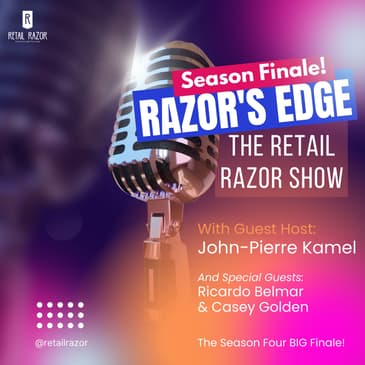



S4:E10 On the Razor's Edge: The Season Four Final Cut
In the season four grand finale of the Retail Razor Show, guest host J.P. Kamel, managing director of RFID Sherpas, takes over to interview our regular hosts, Ricardo Belmar and Casey Golden. This episode first reviews the top 10 retail predictions the team had for 2024, evaluating which ones hit the mark and which ones were a total miss! Then the discussion spans a range of topics from throughout Season 4 including the rise of retail media, the evolution from omni-channel to unified commerce, and the transformative potential of AI in retail. Key takeaways include the importance of unified commerce strategies, the necessity for retail media, and the enduring need for human connection in the retail experience. The episode also reflects on memorable moments from the season, the future of department stores, and evolving career paths in retail. Both insightful and entertaining, this grand finale offers an in-depth look into the current and future trends shaping the retail industry, and gives you a behind the scenes view of how our two hosts think about retail and the show!
Subscribe to the Retail Razor Podcast Network: https://retailrazor.com/
Subscribe to our Newsletter: https://retailrazor.substack.com
Subscribe to our YouTube channel: https://bit.ly/RRShowYouTube
Chapters:
00:00 Show Intro
02:52 2024 Top 10 Check-in
03:03 Prediction No 1
05:00 Prediction No 2
06:31 Prediction No 3
10:31 Prediction No 4
12:45 Prediction No 5
16:33 Prediction No 6
18:43 Prediction No 7
21:19 Prediction No 8
23:12 Prediction No 9
30:41 Prediction No 10
33:13 Season 4 Recap
33:43 Favorite Moment
35:34 Most Surprising Moment
38:07 The Big Retail Avengers Reunion Episode
45:04 Smart Fitting Rooms
48:39 Unified Commerce & Everything Shoppable
52:39 Immersive Commerce & Livestreaming
59:47 Retail Media 3.0
01:02:08 Responsible AI
01:08:56 Retail Career Paths
01:15:21 Generative AI Transformation
01:17:43 Relay Race vs Rugby Approach
01:21:48 Data-Driven Decision Making
01:22:36 Key Takeaways from Season 4
01:24:56 Any hints for Season 5 and beyond?
01:28:33 Show Close
Meet your hosts, helping you cut through the clutter in retail & retail tech:
Ricardo Belmar is an NRF Top Retail Voices for 2025 and a RETHINK Retail Top Retail Expert from 2021 – 2025. Thinkers 360has named him a Top 10 Retail Thought Leader, Top 50 Management Thought Leader, Top 100 Digital Transformation Thought Leader, and a Top Digital Voice for 2024. He is an advisory council member at George Mason University’s Center for Retail Transformation, and is the director partner marketing for retail & consumer goods at Microsoft.
Casey Golden, is the CEO of Luxlock, a RETHINK Retail Top Retail Expert from 2023 - 2025, and Retail Cloud Alliance advisory council member. Obsessed with the customer relationship between the brand and the consumer. After a career on the fashion and supply chain technology side of the business, now slaying franken-stacks and building retail tech!
Includes music provided by imunobeats.com, featuring Overclocked, and E-Motive from the album Beat Hype, written by Heston Mimms, published by Imuno.
Transcript
[00:00:07] You're listening to The Retail Razor Show, where your expert hosts and their guests cut through the clutter in retail and retail tech to shape the future of retail. Hello, Retail Razor listeners. Welcome to the Season Four grand finale episode. As you might have guessed by now, I am not one of your usual hosts. My name is JP Kamel and I'm the Managing Director of RFID Sherpas, a boutique management consulting firm focused on helping our clients get the most out of their RFID investments.
[00:00:36] And a long time listener and first time guest host of this awesome podcast. Today, I'll be turning the tables on our usual dynamic duo and interviewing them. So let's bring in this week's guests, Ricardo Belmar and Casey Golden. Welcome, welcome. Casey, Ricardo, thank you so much for having me as your guest host for the season finale. I'm super excited to be here. Hey, JP, it is fantastic having you here. I know we have one of our show's fans here to guest host. Super cool.
[00:01:01] How lucky are we? Thank you for making this happen. A lot of work goes into being able to host this episode. So how does it feel to be on the other side of the mic now, even on your own show? I mean, I have to admit, I'm still getting used to being in front of the camera, period. But I'm excited to be answering some of these questions since I'm usually coming up with them. And I try to keep my personal opinion in check.
[00:01:31] So here's to not getting canceled since I can't be fired. Okay. Yeah, I guess I could argue I feel kind of the same way. It is always a little odd not being the one asking the questions on our own show. But this is always a fun thing to do. So I'm really looking forward to it. I'm hoping you have some tough questions for us today. I will do my best. I can't really wait to dive in here. So here's how we'll let here's how we'll have this thing roll today. First, I want to check in with both of you on your top 10 predictions from earlier in the year.
[00:01:59] Let's have some fun highlighting what you nailed and maybe what you didn't nail. Yeah. And I guess I'll also say given we had Ben Miller from Shop Talk join us for those predictions originally, does that mean we get to take credit for the ones he got right? Because if so, I am definitely calling dims on those. And because I generously let Casey take the ones he got wrong. No, I don't know. I mean, I'm trying to make friends here, but I'm not gonna let you off that easy. All right. I can tell this is going to be pretty competitive. All right. Let's have some fun.
[00:02:27] So after we wrap up with the predictions, we'll dive into the second part of the show, the interview, where I'll finally get to ask you guys the questions. So I'll be asking you, you know, some softball questions, some nice little layups, like your favorite moments of the season. And then I'll have a few surprises for you that hopefully will delve into some of the real details of what I thought were the best parts in the season. Super. Let's do it. I'm ready. All right, then let's get this started. On the Razor's Edge, the season four finale.
[00:02:58] All right. So let's start with our top 10 list. We'll jump into number one. We'll see how we did. Number one was a prediction made by Ben, the Timofication of retail accelerates. Really what this is all about was changing retail to be more like Timo adding, you know, with the technology, with the capabilities, with the chat bots, with the shoppable video. How did that come out? What do you guys think? I think it's a clear winner. I think it's a clear winner. And, you know, it was one of Ben, so I'm happy to take credit for it.
[00:03:26] I mean, I think we all saw the writing on the wall when analysts are predicting Timo to do $54 billion in sales. Yeah. There's got to be like, how are they doing it? Why are they doing it? What strategies are they using that make sense to implement or what products people are going for? There's a lot of insights into the Timofication.
[00:03:52] Yeah. And you could argue, you know, the best maybe example of this is how Amazon decided to open their own Timo like shop right now. What do they have? They have the special Amazon under $20 deals. That's clearly a copy of doing that. So obviously they think that there's a lot of risk even to their business. So absolutely. Absolutely. I think that's absolutely a clear winner. So that's one for a card. There you go. All right. I'm pretty sure we both agreed on that.
[00:04:21] Considering I can't even tell what's real anymore. Whether it's an Amazon product from Tiktok, from a scammer, from Timo. I don't know how to shop and get a deal. So I'll leave it to you experts. I overpay for everything. Well, we'll see how it goes from in 2025 because expecting those de minimis rules are going to change that they obviously take advantage of to keep the cost down. We'll see what they do.
[00:04:49] I know they've been staging product in other countries and to kind of get around these rules or at least in the hopes of getting around them. But we'll see how that takes shape in 2025. Absolutely. All right. Prediction number two. Casey, this was yours. The evolution of retail media will drive the digitization of the physical store. Winners will be winners will come from those who drive customer service use cases to gain customer adoption. I personally think this is a kind to happen, but I'll throw it back to you guys. What do you guys think?
[00:05:17] Don't fault me for being overly optimistic. I still think that this is a huge opportunity. I think we've seen it in some cases, but I think that there's still a huge opportunity here for growth and really to be able to like a lot of opportunity for just general disruption. Pretty soon, I think everybody's databases for customer information is just going to be completely centralized. Everybody adds everybody else's stuff.
[00:05:48] Yeah. Yeah. I think it might be a push. I think, you know, maybe 2024 wasn't the year for it, but 2025 might be. So I think kind of with a little bit of a push there. Yeah, I kind of agree. I think you could argue that maybe the largest retail media players like, okay, let's go ahead and name Walmart is making good progress on this. Maybe it's a little bit in fairness, right? It's more expensive to do this in store.
[00:06:14] I would argue right then on your e-commerce because you've got a lot of physical capital that's got to be invested to do it. Right. But now I think it's just a matter of time. So I agree. I think this is maybe it's half credit for this one because it's definitely happening. Maybe not as big as we expected, but it's still going to grow. Absolutely. All right. Prediction number three. And what a surprise. Another retail media prediction. All right. Retail media plus streaming TV, connected TV will disrupt traditional advertising. What do you guys think?
[00:06:43] I think this is also a kind of happened here. I'm going to say that it's a totally has happened. Hmm. I know my TV experiences have changed quite a bit over this year. I went from barcode or QR codes on my screen, which I think is just asinine. Right. How do you really feel about those? Yeah.
[00:07:06] I mean, anytime you interrupt, I have to go get my, pick up my phone, open the camera scan and then the commercial's over. Come on. Yeah. But now almost every commercial I'm seeing on multiple live streaming channels is integrated to push a button to add to like your Amazon cart or a button to link you to a web browser or some type of embedded cart. So I see this a dramatic change.
[00:07:35] I don't know the last time I saw a QR code on my TV screen. Yeah. It's definitely gotten more advanced. And I think there's lots of evidence in this one. You've got like Walmart acquiring Vizio. You've got the basic stuff like on, on Hulu streaming, right? Anytime there's a commercial, there's, you know, they sell a surround to it, which maybe some, I think I still see a few QR codes on there, but it's totally true that it's integrated in some way. And the streamers all have the advantage that they can measure everything. Unlike traditional TV, they can't really measure anything. Yes. No.
[00:08:05] So it's like you integrate that. I mean, it totally makes sense. Walmart acquiring Vizio to grow Walmart connects. And there, and we just see more and more of these partnerships. I think when we had Andrew Lipsman on early in the season, he talked about this too. The, this adding these offsite capabilities with your, through connected TV streaming channels and stuff, just makes the retail media story so much stronger and brings it that much closer to being full funnel. Yeah. Which is something traditional advertising has never been able to do.
[00:08:35] No. And I mean, YouTube is, I have to say, it's probably one of the best TV streaming services to have because it's just, it's so robust, but they've been also partnering with, you know, like the Instacart. And so whether or not these, these companies are coming direct in their own platforms, making the acquisitions or connecting other marketplaces, I am all for shoppable television. I think that this shouldn't have been 10 years ago. Like this is. Yeah.
[00:09:04] I'm still very optimistic on this. I think this is a much better way to kind of mix. If I'm going to have to watch a commercial, at least let me be able to buy it. Yeah. Yeah. And I think, I mean, if there's anything that you could argue holds us back and it's maybe a small argument, but I know part of this prediction, I think related to this, it's also what I know eMarketer was forecasting that the overall spend across all these retail media was going to overtake traditional TV advertising. And it was on track to do that this year. I don't think it has.
[00:09:34] I mean, we still got a couple of weeks left in the year and holiday seasons, but it doesn't look like it will, but it's going to be darn close. So if it doesn't, if the numbers don't show it overtaking this year, I feel confident that next year we're going to see this is like the top spend of an advertising category. And with good reason.
[00:09:51] Yeah. I mean, I'm a 100% for integrated product placement. So I want to see everything shoppable in the show and we can pay for skipping the ads, but we are at the baby steps. And I've seen like a lot of like further development into this to be a much better experience over this year. So I'm going to call this one.
[00:10:13] So really what you've just done is argued the Ricardo to get an extra point. Just like I'll take it. I'll take that. I'll take that. Thank you. Yeah. You just, you know, Merry Christmas. All right. So leading into prediction number four, TikTok specifically in social commerce in general will be a major disruption to retail media leading for the intersection of retail media networks and social commerce.
[00:10:43] What do you guys think? I think this is a, I think this is, you know, really not a fair one because of all of what's happening with TikTok this past year. Is it going to shut down? Is it not going to shut down? That's really caused, I think a lot of trepidation and investment to TikTok as a form of commerce by a lot of brands and retailers. What do you guys think? Yeah, I think I'd probably agree with you that it got held back a little bit. Maybe it's sort of a partial kind of happen, not total blowout kind of thing.
[00:11:10] Yeah. I mean, I think it's really hard to measure because at the same time, every social channel is ruined when commerce and advertising comes in. And so there's this natural aversion to everything's an ad and it does impact users. And then they figure out, you know, what that nice balance is and the algorithm to make sure that every single thing in your feed is not an ad.
[00:11:38] So, I mean, I think, I don't know where this might necessarily be going, but I think we know that this works and that there's an opportunity for it. Where it lives and how brands start connecting with it is going to be something different. It's definitely caused a lot of returns with influencers buying things and doing a haul and then just returning it.
[00:12:05] So I think, you know, we have this data, I think, after this year. And I think that there is a lot of different ways that it can be dug into to kind of figure out, like, what is the right way? But will we get the opportunity to execute against it or are we getting a new social channel here coming? I really would give this a kind of happen. I think definitely it started. You know, I think we've seen TikTok really come into the commerce side. We see them make partnerships on the social side, you know, sorry, with retail.
[00:12:35] I think they may be starting to disrupt retail media networks, but I don't think it's there yet. I think this is a maybe push and see what happens next year. Yeah, I'd agree. All right. So that was, that was one of yours, Ricardo. This one here is Ben's. So I guess this also is yours, Ricardo. I have to disagree. Was I like sleeping on this podcast, previous podcast? This is so me. I am heritage brand girl. I would have to agree with that one. All right.
[00:13:05] So this one was heritage brands will continue to have a moment. And I think this is absolutely true. I think this is, and there's no, for me, this is no debating this. I think heritage brands continues to knock it out of the ballpark. You know, they continue to embrace e-commerce while opening new stores and really kind of leading the way on that side. But I'll, I'll throw it back to you guys. And what do you guys think? Yeah, I think so too. I think it's definitely a nailed it kind of moment. I think heritage brands continue to do the right things.
[00:13:34] And if anything, the pendulum has sort of swung in the other direction away from all, well, everyone, how everyone used to love direct to consumer brands and digital native brands. And suddenly they're all realizing, you know what? Maybe there's a limit. It's not what you can do in that, in those channels without actually embracing all of the other channels. So yeah. Which the heritage brands know exactly how to do. Yeah, I mean, this is an absolute true. And you know, I'll stand on this soapbox all day long. Bring it.
[00:14:03] There is an amount of being able to control the brand and have that direct access to your customer that is only going to get larger and larger. As brands are able to kind of transition their business from this wholesale mentality and business model to moving billion dollar businesses over to planning on a direct to consumer basis.
[00:14:26] And I think that that's the biggest thing we need to think about is in order to plan these businesses, so many of heritage and even luxury brands, like they're all cut to order businesses. They get these orders from retailers and from all these wholesale partners months and months in advance.
[00:14:42] If you don't have that much customer data or you have just a fragmented database of this information, it's really hard to shift an $8 billion business or $2 billion business in a matter of 12 months. But this is the direction that I continue to see it going. I have rarely seen bad customer experiences coming from directly from the brands.
[00:15:08] It's the retailers that have been put on blast by more and more consumers. And they are going direct to the brand now, not just because it was it's easier now to have access, but they need to have some type of like reasonable post purchase support and make sure that they're getting the product that they ordered.
[00:15:29] The amount of fake product that has infiltrated these retailers, DCs, and they're shipping it is insane. We're just not getting the right items in your box, but you're starting off with, well, you're lying. And the customers are not really, you know, going out for that. It's taking anywhere from three to six months to try and get some of these just getting shipped the wrong item resolved.
[00:15:58] And so this we're going to go ahead and I'm going full throttle that it's going to continue to happen. But I think we've seen some really big plays just by seeing how much department stores are struggling. It's also because brands are going direct and customers are following them. Absolutely. All right. So that one is a surefire. Yes. Another point over for Ricardo. Maybe we'll share that one. How's that? That might be fair. I don't share very well.
[00:16:31] Never have. All right. Prediction number six. And this is a great one. AI isn't just everywhere in retail. It's demonstrating tangible value in both consumer facing use cases as well as operations use cases. And I would say this is true. I think 2023 was definitely the year of AI hype. I don't think there could have been any more hype than we had last year. Yeah. But I think, I think this one definitely hit the mark in 2024. What do you guys think? I totally agree.
[00:17:00] I think there's so many examples now. I mean, we, we just published at Microsoft a blog post a couple of weeks ago with 200 customer examples of real ROI from AI and Gen AI and what they've been doing. So I think it's absolutely happening. There's plenty of examples. We've gone past the hype and now we're into real value. Mm-hmm . And it's just more a matter of where do you keep extracting the value? Because I would claim now there's no aspect of the business that doesn't have a use case that could benefit.
[00:17:30] It's a matter of just figuring out the right way to apply it. Yeah. And I think that it's just essentially eating the world and retail is not going to not be impact, continue to be impacted by it. But I think it's, it's a huge opportunity for every level of every organization to become fluent. I mean, it just the information flow in general is a fire hose. Yeah. And so being able to react, implement, decide which directions you're going.
[00:17:59] I really want to see a lot of these generative AI use cases really provide the value that we expect from them. But it is something that takes time and it takes continuous nurturing and iterations. Yeah. We're seeing some great things. I mean, you know, beyond the forecasting and marketing and personalization that have been happening, we're seeing incredible use cases operationally. Things like loss prevention, fraud detection, in store operation work. Where are you, what is happening in your store?
[00:18:29] Where is product being purchased? Where do you throw more resources to, to make sure that you can optimize customer support? I mean, there's so many different ways of leveraging this data. I think we're just started to scratch the surface and it's really exciting as to what the future holds here. Yeah. All right. Prediction number seven, the engineered influencer evolution of the frontline store teams will be augmented by AI. What do you guys think? I, I, I don't know if this actually happened this year. Maybe this is something that's coming.
[00:18:57] I think there's a real opportunity for it to happen in the future, but I think right now, this is not, I would not give this a full throttle. Yes, but I'll throw it back to you guys. What do you guys think? Yeah. I think that this was a big old false. There's such an opportunity to, for human augmentation. Mm hmm. Yeah. But those are not the people that are building any of this. Yeah. Yeah.
[00:19:23] And so I felt that a lot of the human touch and the human connection and the emphasis on sales enablement and turning these frontline workers into upskilling them and turning them into more like an engineered influencer went by the wayside. And we just skipped bypassed the entire human element and went to like full AI models, regardless of whether or not there are great customers experience or not.
[00:19:50] So I'm hoping that, you know, I do believe that this will change. I think the most interesting thing that I found this year on this topic is that every single trade show I went to or conference, regardless if it was large, like global conference, or if it was a very small curated dinner, every single booth and every single piece of press and narrative was about AI.
[00:20:19] Every single conversation and panel discussion was about enabling the sales associate and clienteling and preserving the human touch because that's what converts. And it was a complete dichotomy of what we see versus what people are asking for and where the industry feels the importance is. And essentially, I didn't really see much get done. Yeah. Yeah. I agree.
[00:20:44] I think this is, you know, going back, Casey, to your earlier point about, you know, no excuses for being optimistic, overly optimistic. This to me is one of those that should happen, needs to happen, but hasn't happened yet. Yeah. And maybe it has a lot to do with some of the other things we talked about with the social commerce disruption. I'm a big believer that there's a huge opportunity to use your store teams as those engineered influencers, particularly when you talk about social commerce and live streaming. But it hasn't taken shape yet. I think the opportunity is still out there.
[00:21:14] All right, Casey, I tried to give you a point, but or at least a half point. But I think this one here is definitely at no point. All right, let's jump into prediction number eight. Ricardo, this is one of yours. Retailers will jump into Apple Vision Pro. I would have to say no. You mean laughing a little bit, Ricardo? So in my defense for this one, I did caveat it a little bit by saying that it wasn't about everyone jumping in to actually sell something.
[00:21:42] It was just about, you know, showcasing what's possible with an expectation that there'd be some kind of first mover advantage that ultimately Apple would get to a version two or a version three. And that's when people might actually care. But it didn't happen yet this year, so I don't think there's any way I can salvage this one. No, I mean, the cost of eggs went up, Ricardo. Yeah, I know. Nobody was going to spend $3,500 on a version pro. I get it. I mean, this might be a great candidate for 25 or even 26.
[00:22:12] Yeah, yeah. Yeah. And so that price point probably needs to come down a little. It is not a cheap accessory to have. No, no. And I think even even for I mean, I suppose what was interesting is like one of the first brands that said they were building a virtual store for it was J. Crew. And you would have thought it would be some really high end luxury brand that would do it because somebody who spends $3,500 for this is not going to shop for $50 sweaters. Right.
[00:22:37] You know, they might be shopping for that, you know, $15,000 bag, but not for a $50 sweater. So, yeah. Yeah. But I kind of want to buy the $15,000 bag like in person. But somehow I suspect you're not shopping for it on a Vision Pro. No. It's got some product market fit here to find the right use case. Yeah. It's too early. It's too early. I get it. I get it. I can't salvage this one. I don't know. There's a lot of use cases. Maybe just, you know, a little bit of refinement.
[00:23:07] This one was a reach. It didn't work out. The commerce aspect. Reach is a thought. Yeah. All right, Casey. This one is yours. Prediction number nine. The modern consumer will become more demanding from the brands they shop from and expect them to do better. And consumers are in a position to hold the brands accountable. The risk is real. But will they? So I think this is definitely true. I think consumers definitely asked for a lot more. But I think the dichotomy is that their behavior didn't actually do it.
[00:23:37] They actually jumped onto the Sheen and Timu bandwagons even more this year than the past. Perhaps. But customers have impacted the price of Kellogg's cereal. We completely canceled a backpack last week. Somebody's rain jacket was getting them sopping wet and a brand flew a helicopter over to a different country to deliver one.
[00:24:03] We are getting consumers are making brands do better and they are calling them out. There's been like the whole Stanley Cup moment. And it is an opportunity for brand awareness. When somebody does something really great. I am seeing consumers, especially on TikTok, talk about amazing experiences that they've had as well as terrible experiences.
[00:24:31] And I'm seeing the brands not just fix the problem and customer support, but make a movement or a moment of it to really go above and beyond and be creative and to come out from behind the curtain of the brand and be human. And say, oh my gosh, that's embarrassing. Like, even if it was like a mac and cheese debacle, people are invested. It's entertainment.
[00:25:00] It's, you know, but everybody wants to see the brand come back and do better and then reward them for doing better. So this is one of my biggest reasons that I hope, you know, TikTok is protected. Because it's very difficult to find emerging brands and real products. It's gotten very easy to be deceived while shopping online and Google ads is not helping.
[00:25:28] There are ads for scam sites more so than for real sites. And thankfully, like just shop with your credit card so you can have some level of protection. But I'm loving seeing these brands, these consumers speak up and brands do better. They are doing better. And I think they're being more transparent on their sustainability initiatives.
[00:25:53] They're telling customers like what they believe in and turning it more into a narrative than they have in the past. So I think we have opportunity here and I've been seeing it and I'm a cheerleader. Even if you did something bad, I just want to see you come back to the customer and do something great. Yeah. I agree. I think it's a definite true and I agree with everything you just said. Sorry, Ricardo, you're going to say something. Yeah, no, I was going to agree too.
[00:26:21] I mean, I think this one is a total, I can't disagree with any of that. I think it's absolutely true. I think consumers have figured this out. Yet that there is a collective power there to get brands to try and do the right thing. I think if anything, brands are taking notice. I think we've seen clear examples of missteps where brands misread what consumers wanted, mostly on things like on marketing activities. But there's plenty of examples both ways.
[00:26:48] So I think brands still have some learning to do to know how to read what consumers are actually telling them. And I think it's interesting that, you know, if anything, there's multiple ways consumers are telling them. There's what they hear from consumers via things like TikTok and other social media. And then there's what they see consumers buying. And I think to what you said, JP, sometimes the two don't say exactly the same thing. And so brands have to figure out how to interpret that. I think the consumer's voice has never been as powerful as it is today. Yeah. That is very true.
[00:27:17] And I think what they need to do is put their money behind it to really reinforce that message. Yeah. Yeah. Yeah. Well, and I think in some ways, I think it's playing to some extremes, right? So, you know, like we pointed out before, if we're going to focus on sustainability, are consumers putting their dollars there? In some cases, clearly not because of the overwhelming sales in a place like Shein and Timu. But you look at the higher end brands that favor sustainability, right? Brands like Patagonia, right? That are all doing well.
[00:27:47] So clearly their customers still believe in that brand value and are putting their money there. I would not be surprised if those same consumers are buying things on Timu and Shein because every consumer looks at the value of an individual item differently. And so if anything, it'll get harder to read, I think, for the brands. But the need to really pay attention has never been stronger. You know, one of the things I love about Patagonia is that it's truly a lifestyle brand.
[00:28:13] If you believe in their core, you will invest with them. Yeah. Much more so than you see in a lot of other places. Yeah, absolutely. A hundred percent. And I think that this is one of the areas where all brands can really differentiate themselves
[00:28:31] and move away from these discounted strategies that we've had for so long because there is no inspiring story behind Shein or Timu. Frankly, I mean, I'm fine to do Shein shaming. You should be ashamed of yourself. Just save your money. Nothing should cost $3 to make unless it's maybe a retail holder, but I don't know.
[00:28:59] But I think that it will continue to divide. And it really comes into, like, lifetime value of a customer. How much are you willing to invest to keep that customer engaged into your brand to where, like, they don't need a discount. It doesn't need to be cheaper. Know what people come to you for. Because you're right. We do spend a lot of money on certain items and merchandise categories and less in others.
[00:29:25] Or there is some type of brand value that I'm not going to buy. I'm not going to even attempt to experiment. I'm not changing. And so if you can get that customer in and just, you know, keep them hooked and provide those great products. Shopping is getting complicated and it's overwhelming. And half the time I'm adding to cart, I'm not sure if I can trust it. Right.
[00:29:50] And I'm like, am I going to, I would just rather spend, like, maybe another $10 or wait three months and just buy the one that I want. That I know is going to be great. I'm just going to wait. You know, because I can't tell. I don't want to go to the post office. I don't want to deal with a return. Right. Yeah.
[00:30:10] One of my clients to that point was saying just a few weeks ago, I need to be in stock with the products that my customers come for because that's why they buy all the other stuff I have in my store. And so I can't get them to buy everything else if I don't have the items that they trust me to carry. And so, you know, that's so true. Trust is not just about your messaging, but it's about what you have in your store. But how you deal with your customers is how you are responsible with the environment. And it's your entire messaging.
[00:30:38] And that's really what you need to look at. Yeah. A hundred percent. All right. Prediction number 10. Dearly beloved, we are gathered here today in season four and the final episode to discuss whether Omnichannel finally has died. What do you guys think? We're calling it. Yeah. Dead. It's unified commerce. That's the way forward.
[00:31:04] And if you're still having conversations about Omnichannel this or Omnichannel that, I think we should just take this as a moment of like personal reflection. And I wouldn't suggest going into the year 2025 thinking about Omnichannel for your business. All of the cool stuff is going to be fueled by a unified commerce strategy. And you're just not going to have the coolest toys in the new year. Well said.
[00:31:35] Absolutely. So if I just summarize what we just talked about here of our top 10 predictions or our 10 predictions, we've got Ben got three. He was three for three. And, you know, well, I don't want to get in trouble with Casey. So maybe I won't hand all those points to Ricardo. We've got Ricardo at two and a half and we've got Casey at two. We actually did change in real time, Casey. You convinced him to move one of ours from a no to a yes. Yeah. If anybody wants. Yeah. I'll take that.
[00:32:04] But, you know, this is why, you know, Ben makes the big bucks. He's winning. That's right. That's right. We're going to have to have him come back for more predictions and make us look good. Fantastic. Well, that's still, you know, that's actually really good for as far as prediction goes. A seven and a half out of 10 is pretty fantastic, actually. Yeah. Congratulations. I mean, I have to say getting 10 initiatives out the door in a single organization is not going to happen.
[00:32:34] There's plenty here for people to be leveraging in the new year in 2025. I'd like to be able to see coming in that even three of these predictions were true for a single retail company. Yeah. You also got these predictions right because that's how we get more solutions put into production and get to move this business forward.
[00:33:00] I think we saw a lot of a lot more movement this year, thanks to AI, potentially, to get these conversations shifting to more technology first. Absolutely. Absolutely. Well, well done. Well done. All right. So let's move on to the next part of our show here. And this is we're going to be moving away from our predictions and over to where I get to put you guys on the hot seat. You guys some questions. So before I start, I'll just say I really enjoyed this season. I thought the season was fantastic.
[00:33:27] So thank you for bringing us this incredible content. And after going through all the episodes and going back through all the episodes, I want to ask you guys a couple of questions. Generic wants to start off. So what was your favorite episode of the season? What did you guys just like the most? What was your favorite moment of the season so far this year?
[00:33:45] I have to go with like season four, episode two, the evolution from Omnichannel to Unified Commerce with Gary. He said everything that we wanted to hear that I want to hear. I was just like, preach. Say loud or throw everyone in the back. You know, let me share this like a hundred more times.
[00:34:11] But the way that he really was bringing it about the value structure was just key for me is it is not a shopper journey. It is your customer is just going through life until they're interrupted by friction. And I think that that's something that we can all take something away from is when we go into these shopper journeys or we're going into traffic patterns.
[00:34:39] Remember the human element when we clock out and what our own personal experiences and frustrations are. So I thought it was really great. Yeah, I think for me, and this may come as a huge shock, JP, that I'm going to say this, but it was probably our retail or big retail media episode with Andrew Lipsman and James Bauer, where we went through the detailed discussion on measurement around retail media, which has kind of been one of the weak spots that we thought needed to be highlighted.
[00:35:05] Especially as things move more in-store and outside the store even and beyond e-commerce. I think that had to be my favorite just because of all the different new things that we surfaced in that that weren't getting as much attention as they probably should be in the retail media space. Yeah, I mean, at least somebody was being able to validate these KPIs and measurement advancements. Exactly, yeah. This black hole that you just can't seem to let go of. This retail media, Ricardo. At least we can measure it now. That's right. Big moment. Those are great.
[00:35:35] Thank you. Next question. What was your most surprising moment of the season? I think the AI conversation that we started with in the beginning of this year of where we were versus where we are now is essentially just like mind-blowing. The development that has gone on in the last 12 months is just leaps and bounds from where I really thought we'd get. And I think that we highlighted that really well with Peter Cohen in season four, episode six.
[00:36:05] I thought he just had really great takeaways for people who are in the business and discussing like the adoption and really just kind of being on the counter that LLMs are the primary conversation when we're talking about AI. But how retail should really be nearing the focus into a small language learning model to get the biggest bang for their buck.
[00:36:31] So I think I wouldn't have expected us ending 2024 with the level of conversations we're having in AI and seeing it in use than we did in January. Yeah, I even go a step further. I'm thinking that maybe it's more than just a moment, but the way things are so deeply woven throughout the season across those three themes that we started out with. So to Casey's point, the AI piece, I'll bring it back into even the retail media piece.
[00:36:57] And then, I mean, the most important part was that we emphasize at the beginning of the season that the human connection and how that has to tie all these things together because that's what this industry is about, people. And it's so easy to get lost in the glitter of the technology. But almost everyone in the show kept bringing it back to people. And I think that was, for me, maybe the most surprising moment that no matter what technology we were talking about, pretty much every guest brought it back to people and that human connection.
[00:37:25] And, you know, again, I'll mention Casey's great example and quote from Gary in that episode about how people aren't on. People don't think of themselves as on a shopper journey, right? They're on a journey through life and you as the retailer are interrupting that life in some fashion through some point of friction. And that's such a different perspective to take when everyone talks about the shopper journey or the customer journey. I think that, again, is probably the best way to sum up why you have to bring it back to that human element no matter what the technology is.
[00:37:55] But I think that was so well surfaced across all the guests and all the conversations we have this season. I love that. Thank you. All right. Those are the first two softballs. Now we'll get into our trouble. All right. So one of my favorite episodes this season, without a doubt, was the Retail Avengers Clubhouse reunion episode. It was really nostalgic. You know, thinking back to 2020. And maybe one of my favorite memories of 2020. There wasn't a lot of great that happened that year. Right. That's so true. Yeah.
[00:38:23] So what would you say was your biggest takeaway from that episode? And do you believe the department store channel can survive in the long term? And if they fail, what will happen to the concept of a ball anchor? Ricardo, you can go first. Okay. Thank you so much. Well, I'll start by saying that I really, truly think that department stores as a concept, they have to be saved. I don't think retail can not have department stores. They have to exist.
[00:38:51] But clearly, the whole experience of what makes a department store a department store has to change. I think that's probably the most common theme across that whole discussion in that episode is that once upon a time, department stores were the destination. And today, they're no one's destination. They're just there. Right. No one makes a trip to the department store just because they're the anchor at the mall. So, you know, department stores, they have to upscale the experience somehow.
[00:39:18] They can't just be about a collection of apparel products. They can't. They have to think about what's the service they're offering. They have to realize what I think all of us brought up in that episode, that pretty much every single item they sell. And yeah, okay, I'll make an exception for private label, but put that aside for the moment. Because even the private label is not driving people through those doors at these department stores, right? That's not making them a destination yet. But for the most part, everything they sell can be found inside the mall at another store.
[00:39:48] And people know this and recognize that. So part of it may be that there's too many department stores. I'll accept that as an argument, although I personally don't accept the argument that we have too many stores in the U.S. My personal belief is that the stores are just in the wrong places. The density of where stores are showing up is excessive when mapped against population, and they should be more spread out. But the overall quantity is not too many in my mind. I think malls also will survive.
[00:40:16] But like department stores, the malls also have to realize that they can't be providing cookie cutter experiences. There are so many malls. And I don't think it's fair to say that all the B and C malls are going to disappear because I think that's way too much commercial real estate and the world would come to an end. It's just they're not going to disappear. More than we need some of the A level, you know? Right, right. So, you know, they don't all need to be.
[00:40:40] I think this maybe is the misconception mall owners have is that their goal shouldn't be to transform those B and C malls into a cookie cutter version of another A mall. They need to differentiate. This has still always been about differentiation, and it still is. And it's about being a destination. And you asked JP, what will happen to the concept of a mall anchor? I think that too has to totally change. The idea that the mall anchor just has to be the biggest store in the mall is totally unnecessary now.
[00:41:08] That's not going to drive people to go to that mall because there's a department store there. That's not the point. So you have to rethink completely what is an anchor experience at a mall. Maybe it's a movie theater. Maybe it's a bookstore. I don't know. It can be. And it also has to depend on where it is and who lives there. Absolutely. Right. So I think those are the things that have been overlooked in all these discussions. And I think that's a lot of what we talked about is that these are the things that these leaders have to think about.
[00:41:37] And it's what everyone is overlooking. And it is this controversy of, well, who's going to pay for it? Right. Because you can only do so much to your own store when you're in the mall. Right. You have to coordinate so many things with the mall.
[00:41:52] And then what is the mall actually doing to allow all the vendors to be able to have buy online, pick up in store, making, changing the parking lot situation, being able to create more community events and coordinating that with the rest of the brands. And I think that this is something that has just kind of kept on kicking the ball down the road, essentially.
[00:42:21] And it's no longer able to be ignored. And I'm seeing a lot of mall owners and the real estate side getting more involved with designing community as their primary strategy of who's going to be in the mall. What is that primary strategy for the mall? I think one of the use cases I really enjoy, which I don't know how much I can actually say.
[00:42:48] But if you look at the evolution of the meatpacking district in New York, I guess most of all of meatpacking is essentially owned by one company, a family-owned company. And they've taken community and designing culture as like the top priority for bringing back the meatpacking district and aligning with all of those vendors and being in direct contact with them. So I think that the real estate and the experience is going to be driving that. And I think, you know, those anchors, exactly.
[00:43:18] Why can't it be like, why can't we go have a wave maker and go wakeboarding or have a paintball or, you know, things that are just more on the fun side? And I think like Dubai has done a great job at setting an example of what a successful mall looks like. Somebody just needs to pay for it in the U.S. And it probably says it's just a change in business models, right? Everybody needs to not be so siloed in their thinking that mall owners think that there are certain things in their box that they have to do and invest in.
[00:43:48] The retailer invests in this. The mall owner is over here. They have to figure out how to team up, right? And share in this and share the way. Technology, like I'm in a lot of conversations with a lot of mall owners over technology to encompass all the customers of the mall and then how to engage with digital experiences, invites so that they can drive those conversations.
[00:44:14] But it gets to a point like every vendor and every mall can't have the same amount of communication going out. Otherwise, it's just a bunch of noise. So I'm seeing a lot more tools kind of coming into this direction where whether or not it's strategy or technology, malls are getting involved. All is not lost. It wasn't that long ago that Best Buy really needed to reinvent itself because everything that they sold was available online. Right. And they found the new model of engagement.
[00:44:44] They found service and membership and really changed it from buying boxes to an experience of walking in. And they turned themselves around. So it's not like this is bleak for the department stores. This is something they can really do. Exactly. Yeah. A hundred percent. Yep. All right. That was great, guys. Let's move on to my next question. As a passionate advocate for RFID, I've always been a fan of the Crave solution and their smart fitting room solutions.
[00:45:09] In the episode that they had, the statistic that blew me out of the water was that 50% of all in-store revenue was driven to the fitting room. That really caught me off guard. What do you guys think is the most important takeaway from that smart fitting room episode? Well, I think you nailed it. I mean, that stat was a true eye opener, even for me, too. And I think that should really cause any, any apparel retailer, right, to really think about their perspective on not just the fitting room.
[00:45:36] But I think to me, it demonstrates that every aspect of that in-store experience matters. And I think oftentimes it's easy for a retailer to lose sight of all the different touch points in the store that you might overlook and maybe only focus on, okay, I'm focusing on the merchandising and where people stand in front of the fixture, right, and they pick something up. I'm focused on my store associates and the experience they deliver. But when did you last think about the fitting room experience?
[00:46:06] And it's not just the fitting room. I mean, you also have to think about the checkout experience. To me, it's just a testament that every single element matters. And the idea that you can finally measure these things, I think, is unbelievably significant. Because who measured the fitting room experience before this technology was around? Well, 100%. I mean, every single sales associate or anybody that's ever worked on the floor knows how important the fitting rooms are. And that is where the sale happens. That is where you reduce your returns.
[00:46:36] But nobody was sitting there with a little tally. Right. And I thought that that was just like, it was so nice to see what we've inherently known in some numbers to really guide that. Because it's the biggest thing that we lack in e-com is a fitting room. And that fitting room experience or even the editing process, like the editing floor. I think it gets confused a lot with abandoned shopping cart.
[00:47:03] That is not, that is the editing floor. Leave me alone. I didn't forget about it. It's been 10 minutes. No, I didn't forget about it. It was on purpose. But that's how we get like these difference of conversion rates where that's how you get 30% in-store conversion rates is that fitting room process and apparel. It's so incredibly important.
[00:47:27] So I, I would just thrilled to see a solution that doesn't just include some type of smart mirror. Because I think that gets lost in translation from what we've seen in the past to where we think, oh, it's anything digital in a fitting room must just be like a mirror. Right. Yeah. And it's not. It's not. That's not what it's about. It's like all the other important things that we need. It's very important, important piece that I think gets forgotten about a lot.
[00:47:57] Well, one thing I like to talk to my customers about is this concept of brick to click or how do you get the analytics that we get in, in online, in physical store. And this is a perfect example of being able to automatically capture that information and, and really do something with it that that's meaningful. And I'm going to give RFID a plug for a second is I like to say that when you have an RFID enabled solution in your store, it's like shining a spotlight on all the operations in the store. You can actually see what's actually happening in the store. Things that you could, you had no chance of measuring before.
[00:48:27] Like you said, unless you had someone sitting there with a clipboard, walking behind all the associates, figuring out what was going on. So that's a, that's a huge point in terms of the analytics piece that really is promising for the future. Yeah. A hundred percent. Awesome. Here is this one here was interesting because I think it was called out a little bit in our, in one of your favorite, one of your favorite episodes.
[00:48:50] So the unified commerce episode with Gary Agrawal was packed with fascinating insights about the future of retail, including his re I thought was a really bold prediction that retailers need to transition to a unified cart and that no one actually in the marketplace today was there. And that was kind of like an aha moment from that conversation. And so from your perspective, what do you think was your big aha moment in that conversation? And what would you love people to walk away with from that, from that episode?
[00:49:16] You know, I think he just broke it down really well on how to get to a unified, like taking a unified approach, whether or not that's your customer data, your inventory management, whether or not that's re-platforming. I just think it's infrastructure, but also it's a way of thinking and it's like change management.
[00:49:37] And I, I just really thought that he broke it down to be able to say this is doable and you can start breaking off pieces to do it without having to do like this whole entire, like heart transplant of your business. Yeah, I agree. I mean, I think that that's probably the most important takeaway and as you know, it may be a challenge, but I agree with what Gary said that this at the end of the day, right? That's really that true manifestation of unified commerce. Yeah.
[00:50:04] And it's what consumers, I think instinctively, they wouldn't know to ask for it, right? Because why would consumers have, you know, need to know any understanding of the intricacies of these technologies? But if you actually explain to them what it is, I would be most consumers will say, well, yeah, why can't I have that? But I always say like everything should be shoppable at any time, anywhere. And so, you know, I'm a big believer of just like on demand data and everything should be shoppable. Everything should be interconnected.
[00:50:34] And I think we'll get there. I have so many, so many exciting things are on the horizon with activated like IOT. Yeah. We really need a unified platforms and these companies running off of this different type of infrastructure. So we can just start like turning customer touch points into points of sale, right?
[00:50:57] And this is just like a foundational thing where can't really do much if everything is just such a heavy lift. And I thought he just broke it down really well. Yeah. And if you think about what's, I guess, is going to become our quote of the season, which we've already mentioned a few times when Gary points out that your customers are not on a shopper journey. They're on a journey through life. Yeah. And if you put it in that context, you know what, everything you just described, Casey, right?
[00:51:25] About just having everything be shoppable in the moment. And that's the true seamless way from the consumer's point of view to not be interrupted, right? Yeah. I want to buy the lamp in the lobby. I want to buy the dress that I see on TV. Right. You know, I want, I liked the woman's shoes that was sitting in first class one seat ahead of me. Thankfully, I was not afraid to ask her and made the purchase while we were on the tarmac.
[00:51:53] You know, but those first questions of like, when I asked, where did you get your shoes? She said, Nike. Well, no kidding. But that they're not regular Nike shoes. So I had to take a picture of them and start and do a visual. And then I found it over at a special store. But, but I think like everything should be shoppable anywhere. I like anywhere commerce.
[00:52:22] It's like wherever your customer is, they should just be able to transact. Should they choose to without having to talk to a chat bot? Nobody should have a question where their order is. Why are we having, why do people not know where their order is? Next, next episode. Next question. Your episode with Michael Zakura offered incredible insights in the transformative potential of unified commerce and immersive commerce.
[00:52:49] Specifically, he went into live streaming and talked about the commercial success in Asia and offered it as a compelling case study for us here in North America. Do you think live streaming has the ability to do what it's done in Europe here in North America? Sorry, hear what it's done in Asia. And what do you believe the most important or significant promise of unified and immersive commerce are? Well, I think I can, we can say if firework can't do it, then it can't be done.
[00:53:16] They have all the resources to be able to make this happen. I've watched some of the biggest influencers of this live streaming in China from them being in the stores, in their own little cubby area, to just like watching what, how fast this happens and what the shopping experience is like. Psychologically, I just don't think Americans can get on board. It's not the same.
[00:53:44] It's such a different, I think we have to remember that the internet's different. Yeah. And so there's less choices. We're used to going, we're used to having all of these stores and all of these shops. It's not as centralized. But as Americans, like I'm not going to stop what I'm doing to tune in. I'm definitely not adding anything on my calendar to tune in to drop something.
[00:54:10] We just kind of expect service like no other country, I think in the world, where we just really, no matter at what price point or what type of location, I don't care if I'm at the grocery store. I expect to be served. And when I'm here, you should all show up. Right? And I just think that we're innately more pull than push. I don't know if I could get people to like RSVP and like tune into a live.
[00:54:38] Definitely not at any of those numbers like that. Yeah, I think it's just going to be different. I think that, and that's the reason why. It's that I don't think it has to work exactly the same way. I mean, I'm still really pro live streaming as a method, as a sales channel, but not in the same way it works in Asia. Because I think, Casey, you're absolutely right. People are not going to say, oh, it's 1117, so I need to tune into my favorite influencers live stream. No, no, that's not going to happen. But there could be special events at a brand.
[00:55:07] We're in TV shows because we were going to show up on time. Yeah, exactly. We're all used to everything being on demand. But that doesn't mean that on demand video can't be used in the same way. And I think that's where folks like Firework do such a good job at it. I think that there's sort of an equalization where, think of retailers who are big, but they don't have 2,000 stores. My textbook example is like B&H Photo Video in New York, right? They're one location.
[00:55:33] But if they do a live stream where it's more educational than sales to help you identify 10 different lenses that you might be interested in. And you watch that. Sure, you could have watched it as a video and not a live stream. And I'm sure for every person that would see that live stream, there's probably 10 more that are going to watch it on demand afterwards. So that doesn't mean that you don't do live streaming because they're not going to see it live in that sense. It still helps you create relevant content.
[00:56:00] And I think there's also the idea of more of a one-to-one kind of live stream where you just are basically getting access to a remote store associate. I think there's use cases for that that work well, especially when it's more of a high consideration purchase where you've got to think about product variations and types and features and things. So for things like that or because it's really expensive, right, for a luxury item.
[00:56:25] I think there are unique use cases and enough brands, retailers and situations where it can work. And I think it will work. It just won't be the same. It's not going to be the same thing because I don't think we need that pure live stream channel where it's the only way to buy something in that moment. I don't think that's necessary. I don't think it's necessarily either, but I would like to see a newer version of QVC.
[00:56:49] I do think that that's a huge opportunity and I'd like to see QVC lead it rather than being a different player. I think they have a huge opportunity to reinvent themselves in this space and remain that channel that everybody goes to for the content plus the curation.
[00:57:08] I felt like Beekman 1802 did a great job kind of having a morning show that they like produced where it was talked about products and different associates and different people at corporate rotated in to like beyond the morning show type of thing. And I really enjoyed that. I thought they did a great job at building brand with it, getting people tuned in, talking about the products, having guests. I thought it was a great way of doing it.
[00:57:37] I just can't get around. We won't have, I don't believe we'll ever have something like China at that level and speed. And I look at what you were talking about, Ricardo, on that one-to-one curated shopping piece. I think that there's, I think there's a ton of promise or potential for that. Oh, for sure. Yeah. And what shocks me is that if we couldn't make it work during COVID when the stores were closed,
[00:58:03] that would be the only way for a retailer to potentially sell, you know, that means that there's a really heavy lift to make this work. Well, there's, I think it's very important to note that we couldn't make it work during COVID because everybody furloughed faster than they bought software. Yeah. Yeah. Right. Right. Nobody enabled themselves to do it easily. To go back, they had to, they would have had to unfurlough people to bring them back to work, to go digital.
[00:58:33] And I think. And there were a few examples, like I know REI did this in that one-to-one mode where they let their store employees do this and you could schedule one-to-one sessions with an REI employee. And they would actually be in the store and they would walk around and on the, on the video, they show you the product you were looking for and tell you about it. And then they could make a transaction that way. So. Yeah. There are examples that can do it. But I think you're right. I mean, people went so fast to shutting down that they didn't enable themselves technology-wise or people-wise to be able to do any of these things.
[00:59:03] And, and the other thing I think too is at that moment, this was still a new concept for consumers. And so there's always, when you do these new things, you got to train consumers to get used to it. Right. It took, it took some amount of time for consumers to get used to e-commerce. At first there was a lot of hesitation. Everybody got over it. Mm-hmm. And, you know, the world moved on. It's no different. I mean, everybody has to get used to whatever format this takes. Yeah. I mean, I, if we want to go ahead and separate clienteling and, and, and digital clienteling. Right. Right.
[00:59:33] I approve. I'm very for that. I'm completely biased. I'd bet my entire future on it. But I think that's where the perfect example where it could, it could work magically. Yeah. Awesome. I'll jump to our next question. Tim. So after four seasons of faithfully watching your podcast, I think one thing is abundantly clear. And that's that Ricardo is not a fan of retail media networks at all. No. Okay.
[01:00:01] All jokes aside, you know, that the retail media 3.0 episode was, was full of insights about the next generation of retail media. And so what do you think are the key takeaways from that episode that every retailer must know? And next question to that is what are the key metrics that retailers should focus on to gauge the success in their retail media strategies? Yeah. Well, I would go back to kind of like that prediction I had.
[01:00:27] And when I referenced the e-marketer forecasting that these RMNs are on a path to overtake traditional TV ad spend. Whether it happens this year or not, it'll surely happen next year. I think it's clearly on that path. So that means that it's something that you have to pay attention to. Now, at the same time, right, it's not true that every retailer can have an RMN. That's not going to happen either. You have to be the right type of retailer for this to make sense. If you're a totally vertically integrated retail, you only sell your own product.
[01:00:57] This probably doesn't make a lot of sense to do because they're not going to find advertisers who are going to think it's a compelling enough story behind how you're going to target their customers. They would all have to be non-endemic advertisers. And so it's questionable. But for the ones that exist, right, and from the brand side of it, it's definitely going to be a key part of ad spend. And I think to your question about the metrics, this is all about conversion, right? It's all about getting people to convert with the right message at the right time in the right place.
[01:01:22] And the fact is, when you are actually planning to buy something, when you get to the store and you're looking at the product, it's probably the best time to try to tell that person something about it to really sell them on it when they're that close to making that purchase decision. So between that, between doing it online and product pages, the things we talked about earlier with connected TV and streaming TV, you string all of these things together and
[01:01:49] you actually do have a way to really follow the customer's shopping journey, if you will, right? And get the right message to them to influence their purchase decision. So I think that it comes down to conversion and it delivers on that promise in a way that no other ad medium has been able to before. Absolutely. That's great. Next question. The follow-up episode on AI and AI ethics was just as compelling as the first. So as retailers continue to explore innovative ways to adopt AI, what are the most critical
[01:02:18] ethical considerations they should keep in mind? And how can they ensure that they maintain authenticity and trust with their customers? Yeah. I mean, I think we covered a lot of that in the podcast. I think we have to have transparency. And I do really think that a code of AI ethics for the company is really important. I'd like to see that as like a top header section on every single brand's corporate website.
[01:02:47] I think that it should be visible for everyone who works at the company and all consumers, because I think it's going to change on a regular basis. But I also think this isn't a department. AI is not a department. Right now, it might be a couple people, but it's not. I really don't think it's a department. I think the success is a cumulative sum of the entire staff's AI familiarity and understanding.
[01:03:16] So everybody's got holiday coming up, got some free time, maybe skip some podcasts, not retail razor. But take some free classes. Vanderbilt University, IBM. There are courses on Coursera and some other places that are literally going to take you through the entire 101 to get to even catch up to where we are.
[01:03:44] And I think this is one space where a solid foundation is going to allow everyone to keep stay up to date. This is moving faster than the Web3 metaverse NFT, where that flipped so fast that like the knowledge coming in, trying to figure it out was just a fire hose. This fire hose is not stopping. So I would I would definitely recommend Lunch and Learns. Say let's bring them back.
[01:04:12] It's very common in tech and software companies to have Lunch and Learns. It's it's very odd to have one in retail. So I think it would be a really good opportunity to kind of do Lunch and Learns and bring in like how the company is using AI and what's trending to kind of bring every single person from all the different divisions into the conversation.
[01:04:34] A few years ago, we introduced this concept for our RFID clients called RFIQ, which we came in to say, well, what's your organizational RFIQ and what is your employees level of RFIQ? And we said how they can use this and maybe something like an AI can be raised. And we found it made a huge difference when people started to understand how it can be used to then take ideas to apply to their own job. So maybe that's something we really need to do. Yeah, no, I think you're right.
[01:05:02] I mean, I'll do a shout out to my colleagues here in my day job at Microsoft in the field who are having these customer conversations every day. They all come back and say there's probably not one conversation they have where these questions about how to use AI responsibly come up. And so it's exactly the same story, just like Casey pointing out, right? The resources are out there if you look for them and take advantage of them. And there's almost no excuse for any retailer right not to at this point. And I think you're right.
[01:05:31] It's like the idea of a lunch and learn is so well known in the tech space. I'm seeing more and more retailers kind of seek these things out. And maybe what the advantage there is that they're happening. I don't think any of us on the tech side of it are doing this targeting a particular industry because these are all common things across industry. So you get retailers, you get people from banking, you get people from health care, and they're all there for the same education on how do I, you know, what are the ethical questions? How do I responsibly use this?
[01:06:00] What are the benefits I can expect? And they all learn together. So it's a matter of seeking it out and then have, you know, working with the right partners that can help you with that guidance. Yeah. And I think it goes back to what, you know, Peter Cohen had said during his episode is we need C-suite to lead. Yeah. And it means that, you know, we really need C-suite exacts on the brand side without being the CTO or the CIA. Yeah.
[01:06:30] Just hand it off to the one person. Go ahead and take a five-week course to get that foundational base to be able to kind of like navigate through and leverage it. You know, I just, I've seen a lot of projects die because of that, not having that top-down strategy of saying, no, this is happening.
[01:06:51] And they're going to push it over to make sure that the projects are done, they're implemented, the budgets are out there for it, and that it gets the resources that it needs to roll out. So let's everybody pick up like one course between like now and the end of January. I mean, God knows, nobody works in January. So we'll start work like February 2nd.
[01:07:18] So this was 30 days to take some classes and switch it up. So from an ethics perspective, obviously we had this whole privacy issue come up before even, which led to laws like HIPAA, for instance. Do you think we need something like a HIPAA for an AI code of ethics? Do you think it needs to be regulated or do you think it could be something that responsible retailers and companies can do on their own?
[01:07:43] No, it needs to be regulated because nobody's been responsible with everything, with all of the customer data previously. We've seen how self-enforcement works in some of these areas. So I think that answers that. I think that there should be very clear guardrails to make sure you know what, if you're talking to an AI or if you're talking to a human,
[01:08:09] if your conversation is or your activity or your data is going to be used into an open, like a large language model network. Like where is the sense of privacy? I need, as a consumer, I want to know because I didn't have to question my conversation was between you and I. Right. And what may be reviewed for training purposes.
[01:08:35] But I think that there's, I think, I think the only warning is making sure that we don't create a digital artificial world or experience that is better than the real experience. I think that's one of the biggest downfalls is when fake life is more enjoyable than real life. Absolutely. No, that's awesome. But let's go on to our next question. So Ron Thurston, you know, love, love his episodes that he does with you guys. He emphasizes the importance of a clear career path in retail.
[01:09:05] So what strategies can retailers employ to develop better career paths for their employees? Well, Ron's definitely the master on this topic. So we love having him on the show to talk about this. And I have to say the key honestly has to be realizing that being part of that store team isn't just one single kind of flatly defined role. Right. There's a lot of variation. There are different roles, different jobs.
[01:09:30] And what Ron keeps emphasizing, it has to be considered part of a career path, not just a single job. And the fact is that means investing in training is important. Investing in the technology tools that your store teams need to make that job more efficient, more enjoyable. That's equally critical. I don't think this is new information for retailers. I think this maybe is one of the points that Ron makes as well, that one part, yes, is recognizing this needs to be done. But the other part is actually acting on it.
[01:09:59] And we've heard for so many years, year after year, that there's going to be an industry movement to do more in this area. And then it often just fizzles away and doesn't happen until retailers turn around and realize that those high turnover rates and stores are not getting any better. And even since the pandemic, people have woken up to the realization that they can do more than what that basic store level role that a retailer wants to kind of shoehorn people into.
[01:10:27] Sometimes they realize that that's that isn't the end all. There is more things that even being in this field can offer, right? They know and recognize there are other roles and it is possible to grow into those roles. You just need someone to put that path in front of you. And these are things that ultimately would result in lower turnover rates, higher employee satisfaction. And I think there's been enough evidence that shows when you have that, there's a tangible impact on sales and that overall customer experience in the store.
[01:10:54] Some brands get it more easily and readily than others. And I think it often takes having retail executives like someone like Ron who recognizes that and understands how to leverage this experience and create that environment that allows people to grow in those roles. It's no different than any other, right? I mean, is there any employee role thinking even outside of retail that anyone would say, oh, I just want that job and I never want it to go anywhere? I mean, nobody ever says that, right? So why should this be any different?
[01:11:23] That one job at the tanning salon when we were like in high school, I just wanted free tanning. Except for that one. Except for that. Except for that one. I think the only one that counts. I think we all, the entire industry owes it to itself to take pride in investing in our own futures like as a whole. And that does start with people. The retail floor is like where passion for this business is cultivated.
[01:11:52] And this is our funnel for the future leaders and operators of corporate. Or to get that 20-year store manager that you have these well-oiled machines. I think that, I mean, I don't know if there's any other industry that really uses the term lifer like retail does. We have lifers. Once you get sucked in, like you're not going anywhere for better or for worse, you're here.
[01:12:18] And I think that some brands do a great job with upskilling and making you feel part of something bigger. Even when you're on the store level, you want to feel connected to corporate. You could work at any store in the mall. Your people who go to work at certain brands or certain companies already have a brand affinity. These are some of your biggest advocates, your real influencers, the people that have the word of mouth.
[01:12:46] And I think that there could be a huge opportunity for more polo universities, I could say, where you do take classes. You leave work to go to a class, to learn your retail math, to do other types of skill training or upskilling that make you do a better job at your own job.
[01:13:10] Or to be able to upskill to be able to be promoted to shift from like physical stores to corporate. It's a very hard shift. It always has been. I think Ron, with the creation of Aussie, can really amplify that shift because we get all this concentrated talent and recruiting so that these skills can really shine.
[01:13:34] But even when you think of Target, I think one of the biggest benefits there is everybody in management is Six Sigma at Target. Abercrombie & Fitch, everybody had to be a store manager before you could get a job at HQ. You had to go through the MIT program. And you needed a bachelor's degree to start it. And I think that more of those types of programs are only going to benefit retailers and brands in general.
[01:14:01] So I have a question for you because I look at, I think that service is going to be a competitive advantage and distinguishing brand, distinguish, you know, between retailers and brands. And we talked before about the department store side and that they need to reinvent themselves and maybe reinventing themselves through service and through customer service as an example, which means investing in their people is actually investing in competitive advantage. It is. And I really believe that it is. They used to be great at this.
[01:14:31] They used to be so good at this that hundreds of brands opted in to leverage them over opening up their own stores. Yeah. Because they were so great at the customer service, customer experience. Yeah, absolutely. They were so great at it. And it's kind of disappearing on the department store side. That was one of the biggest competitive advantages. I mean, how long has the Nordstrom promise?
[01:14:59] Like even people who've never shopped at Nordstrom, they don't even have one in their town. Right. They know that Nordstrom promise. You know, I think it's a huge competitive advantage. And maybe if that budget seeped into lifetime value, it would be helpful. I agree. A hundred percent. All right. I'm going to move on. We've referenced the conversation with Peter Cohen and a few of the answers we've done so far. So I've actually got two questions about that particular episode.
[01:15:29] So from your conversation with Peter Cohen, the transformative potential of Gen AI and retail was explored. What are the immediate opportunities that retailers need to start leveraging immediately? If you had to give them just a couple of ideas, what do they need to start doing today if they're not doing it already? I think that could be another podcast episode. It's almost never ending. I mean, honestly, there's almost no area in the retail business that isn't going to benefit.
[01:15:56] But if you think about what's the most immediate, what's the best short-term win, I think it comes from where you can apply Gen AI to enhance marketing campaigns. Not just, I mean, a lot of people talk about personalization, but I think it's maybe more immediate in the whole creative asset generation and overall speed to market with new campaigns where you can get the most benefit. I think the biggest benefits we see in all these short-term use cases center around time saving.
[01:16:23] And it's time saving for the employees that are using the tools because they can get things done that could have taken them weeks, can be done in days, things that took days, get done in hours. And that's overall speed to market can make a difference across the board to the business, right? Because now you can do more. It's literally doing more with less, but still getting and achieving the same outcome that you wanted. So I think that those are the best places to start.
[01:16:47] And the same thing would apply, I think, in potentially merchandising and also in any product development areas where a lot of those development phases where it could take you weeks on a spreadsheet, right? Now with Gen AI, it's a few hours and a spreadsheet and some kind of, you know, chatbot or copilot-like tool that just simplifies it. And it's not about replacing people. I think it's about making those people faster at what they're already good at doing. Absolutely. It's an example that we're doing at Rabble.
[01:17:17] We're using MidJourney to take design process for patches for our kids' clothing from weeks to days. There you go. You know, we take a design, feed it in, come back with 40 different choices, have someone work on that, feed it back in, come out with another five choices, and really get to our finished product in days rather than weeks. And it's been a huge game changer for us, just even on the product design side. That's amazing. Yeah, amazing. That's amazing.
[01:17:43] So one other thing that Peter Cohen talked about, which I actually really liked in the episode, was that concept of relay versus rugby approach to AI transformation. Mm-hmm. So which approach do you advocate for and why? Well, for me, it's a no-brainer when it's the rugby approach. Retailers have functioned within silos for too long. And look where that gets them most of the time, right? So it's time for retail leaders to really drive that true team approach.
[01:18:09] And Casey pointed this out earlier about how the C-suite CEO leaders need to consider this isn't just about assigning this as a project to a CTO or a CDO or a CIO. It's about how does the business take advantage of it as a group? And that's, I think, what Peter was really getting at with the rugby versus relay approach. You might feel more instinctive taking that relay approach because people are used to handing things off in a process to other teams.
[01:18:36] But that's not what this is about because it is so transformational. Even your example, JP, right? In that product design, right? If you just hand things off to team members, okay, maybe you'll get a little bit of time savings. But if everybody works on it as that group team and uses the tools and gets the benefit, now you've really done something that takes you from weeks to days. If you tried to do that in this relay mode, I don't think you ever get there. Absolutely. No. No.
[01:19:03] And I mean, we've been doing the relay mode for a long time and we haven't gotten there. I think this is probably moving from like retail to tech. It's one of the biggest differences is this team environment where on the retail side, it was like essentially like enough rope to hang yourself. And like you could be replaced in two hours and you're in it. You're not allowed to say, I don't know. Like that's not an option.
[01:19:32] Failure is not an option in retail compared to tech where it's like hurry up and fail fast. Ask a zillion people. Everybody's in the room. I would love to see just like more whiteboards on the retail side of the businesses and inviting people from different divisions to brainstorm and whiteboard a problem of all the different points of a supply chain that it's touching. Bring in a few key people to have the discussion.
[01:20:00] And I think that this is so normal on the tech side, you know, where you've got front end, you've got back end, you've got UI UX, you've got, you know, database, you've got your customer success, you've got sale. So everybody's in a room for two hours, three hours, maybe trying to solve a problem and talk about a problem using a rugby approach.
[01:20:22] And then it has to be sold individually and walked through on all individual teams once it goes back over to the retail side. You know, there's, there's a term that is thrown out there and I think is used all the time. It's creating a cross-functional team. Yeah.
[01:20:39] But yeah, more than a cross-functional team, I think we need a cross-functional governance model where you have cross-functional stakeholders and the governance model for approval is truly cross-functional because that way you can actually get the input across the board from creation to implementation and being able to push it back down the chain. Yeah. Yeah. Yeah. I think it's just so important. Everything that Peter was saying, these are basic, what, change management, ops. These are very basic theories.
[01:21:06] But when it comes to the use of AI, okay, this is, you forget one person. This could have very large scale effects. I mean, when we're in retail, you know, a penny not rounding properly can be millions of dollars. And so I think that a little lift can make a very large revenue change and build their own budgets to be able to implement more things and a lot faster.
[01:21:33] I hope this is what we needed to get to transformational change and turn the page so we can enter a new chapter in retail tech and like commerce in general. Absolutely. Absolutely. All right. We're down to our final two questions. Uh-oh. Throughout season four, the importance of data-driven decision making was a recurring theme. How can retailers ensure they're effectively collecting and utilizing that data to stay competitive?
[01:22:01] So I'm going to distill this one down to just two simple points. You need a customer data platform. So if you don't have a CDP, get on that. And number two, this is one of those ideal use cases for AI. So if you have the customer data platform, this is one of those target use cases you need to be applying AI to to help you with. I concur. Full stop. Yeah. If I recall correctly, CDPs was your prediction from last year. Yes.
[01:22:31] That is true. Yes. That's- I told you- We are pro CDPs. So as we conclude season four, I want to throw it out to you guys and ask, what are the three key messages or takeaways that you hope all of your listeners will walk away with to share with their colleagues and go forward? Well, for me, this is all about the three themes we had for the season, right?
[01:22:54] So we started out saying the biggest two technologies driving change in retail this year that nearly every retailer needs to be working with in some capacity are AI and retail media. And even with that, though it's on the technology side, but the real key is how you leverage those technologies while still remembering and staying true to the fact that this is a people business. And I know every time someone throws out the phrase, oh, retail is turning into a data business.
[01:23:23] Yes, and yes, and it's also still because it always was a people business where that human connection is the most important thing above all to the business, because that's what keeps customers coming back to you. And all the technology in the world can either make that better or if you do it badly, make it worse. So you want to be in the good column with that one. It doesn't mean you stay away from the technology. It means you identify the right way to do it. You work with the right people that can help you do that.
[01:23:53] And you make sure that the overall impact of that technology isn't just positive for your customers, but also for the employees. And then it all comes together. I think if I'm going to distill it down, that's what our themes were about this season. That's what the takeaway should be for everybody. That was awesome. Thanks, Ricardo. Or the scraps here. If I didn't know any better, I'd assume that you did a cute little, you know, chat GPT summary there. I'll be part of my upcoming AI avatar.
[01:24:25] I know. We'll soon find out how important are we. Yeah, I mean, I'd just like to leave with, you know, again, invest in people. And take the time to learn and invest in your own understanding of AI. And when you're making decisions, make moves that turn your customers' likes into love. And I think if you're always chasing the big old capital L-O-V-E, you'd be A-OK. You know?
[01:24:55] That's awesome. Well, I told you I only had two questions left, but I lied. I have a couple more. All right. So. It's the pilot cast that never explodes. I'd like to ask. Are there any new series or segments that you're introducing? Last year, you brought in the Retail Razor Blade to Greatness, which was awesome. I remember you've had at least one other mini segment on the show. And so anything that's in the works that you can share with us? Yeah. Yeah.
[01:25:25] So, in fact, shortly after this episode is released, you should be seeing us launch season one of the Retail Razor Data Blades show. That was another one of our segments. So that'll be coming out on our Retail Razor channel on Apple Podcasts and wherever you get your podcasts. Plus, of course, the YouTube channel. So that'll bring the show count up to three. And for those wondering and keeping track, yes, that does mean there will be a season two of both Blade to Greatness and Data Blades. We've talked with all the guests we had on season one.
[01:25:53] They've all agreed to come back for another season. And don't be surprised if we have some additional folks join us in season two of those shows to be on the lookout for that. That's awesome. Oh, OK. I'm going to I'm going to push it a little bit further and see how much I can get. All right. Not to give away too much. We have at least one more coming soon in 2025. We are going to take our previous series of Retail Transformers and spin that off to a new show.
[01:26:23] So watch for announcement for that. We may bring back some of the folks that were our original Retail Transformers in past seasons, but we'll also have others coming up for now. And you may remember from past episodes that we talked about another segment around academics coming on the show and answering retail questions from an academic point of view. That one's still on the horizon for 2025. So stay tuned. That's awesome. All right. And since you're in a giving mood here, let me ask another question. Oh, come on.
[01:26:56] So do you have any hints or any any information you want to give us on the season five and what's coming? Season five. Goodness. Don't you want us to just give everything away, JP? Season five. Let's just say we'll be continuing the theme of AI. I don't foresee a year that we won't be talking about it.
[01:27:22] Retail media will definitely be remaining in the conversation and a bit of a focus of the human connection in retail because that is what brands and leadership want to talk about. But I think you'll find that we have a little bit of a twist. So you'll have to wait for the trailer to come out and learn more about that one. That is that is awesome. That's more more than I expected you to tell me.
[01:27:48] So with that, I want to thank you both so much for inviting me onto the show as your guest host. This was great. And for putting up with my questions, because I think I peppered you with quite a few here. No, we love you. Thank you so much for being part of this and going through and tuning in for every single podcast this season and taking notes. Like you are the superhero for the Retail Razor this year. Yep. Absolutely. The super fan. This was fantastic.
[01:28:16] We absolutely want to have you back and we'll have to do this again. I would love that. Well, thanks, Ricardo. Thanks, Casey. And thanks to all the Retail Razor Show fans this season. Fantastic having you all aboard. This episode is this episode. And actually, this season is now a wrap. Thank you so much, everyone.
[01:28:39] If you enjoyed our show and this season, please consider giving us a five star rating and review on Apple Podcasts, Spotify and GoodPods. Remember to smash that subscribe button in your favorite podcast player. Like and subscribe to our YouTube so you don't miss a minute. I'm your co-host, Casey Golden. Please connect with us and share your feedback on LinkedIn, Retail Razor or find us on Blue Sky Threads, Instagram and Facebook.
[01:29:04] And if you want to preview each episode right in your email inbox, subscribe to our Substack newsletter for highlights, full episode transcripts and bonus content. I'm your host, Ricardo Belmar. Thanks for joining us. Until next season, keep cutting through the clutter and stay sharp. This is the Retail Razor Show. Thank you.