
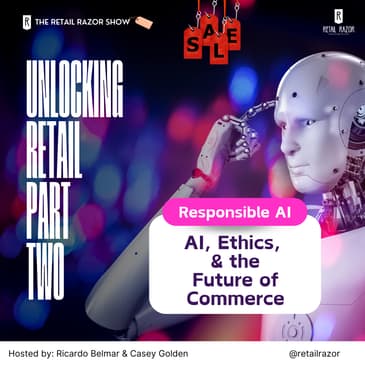


S4:E8 Navigating Responsible AI in Retail: Trust in a Digital World
In this episode of the Retail Razor Show, hosts Ricardo Belmar and Casey Golden dive deep into the ethical implications of AI and commerce technology in the retail industry. They reflect on past discussions about AI innovations and the necessity of critical groundwork before deploying new technologies. They cover the balance between leveraging synthetic media for marketing and maintaining brand trust, highlighting examples like Levi's virtual AI models. The conversation touches on the potential of generative AI, virtual influencers, and the risk of losing authenticity. They stress the importance of building an ethical framework for technology initiatives and the long-standing questions of deception in advertising, emphasizing transparency and responsible AI use. Ricardo and Casey also explore how brands can balance cost-saving measures with realistic, authentic representations and the impact of these decisions on sustainability and customer trust.
Subscribe to our Newsletter: https://retailrazor.substack.com
Subscribe to our YouTube channel: https://bit.ly/RRShowYouTube
00:00 Show Intro
00:43 Reflecting on Past Discussions
01:27 The Role of AI in Retail
02:49 Ethical Considerations in AI
03:50 Building Brand Trust
04:52 Listener Engagement and Feedback
06:31 AI and Virtual Influencers
07:07 The Future of Influencer Marketing
10:51 Cost and Authenticity in AI Marketing
11:45 Engineered Influencers
15:57 Transparency in AI Content
17:35 Aspirational vs. Unrealistic Marketing
22:10 The Evolution of Body Diversity in Fashion
23:36 Balancing Real and Virtual Models
25:44 Ethical Implications of AI in Fashion
29:35 Sustainability and AI in the Fashion Industry
30:48 The Impact of AI on Marketing and Operations
33:02 Navigating Ethical AI Deployment
36:52 The Future of AI in Retail and Fashion
42:20 Final Thoughts and Call to Action
Meet your hosts, helping you cut through the clutter in retail & retail tech:
Ricardo Belmar is an NRF Top Retail Voices for 2025 and a RETHINK Retail Top Retail Expert from 2021 – 2024. Thinkers 360has named him a Top 10 Retail Thought Leader, Top 50 Management Thought Leader, Top 100 Digital Transformation Thought Leader, and a Top Digital Voice for 2024. He is an advisory council member at George Mason University’s Center for Retail Transformation, and is the director partner marketing for retail & consumer goods at Microsoft.
Casey Golden, is the CEO of Luxlock, a RETHINK Retail Top Retail Expert for 2023 and 2024, and Retail Cloud Alliance advisory council member. Obsessed with the customer relationship between the brand and the consumer. After a career on the fashion and supply chain technology side of the business, now slaying franken-stacks and building retail tech!
Includes music provided by imunobeats.com, featuring Overclocked, and E-Motive from the album Beat Hype, written by Heston Mimms, published by Imuno.
[00:00:07] You're listening to The Retail Razor Show, where your expert hosts and their guests cut through the clutter in retail and retail tech to shape the future of retail.
[00:00:19] Hello and welcome to The Retail Razor Show. I'm your host, Ricardo Belmar.
[00:00:24] And I'm your co-host, Kasey Golden.
[00:00:26] Welcome to Retail's favorite podcast where we cut through the clutter to give you sharp insights on the retail industry and the latest in commerce technology.
[00:00:35] It's a show for customer experience leaders, marketing executives, store leaders, and everyone else in retail and retail tech alike.
[00:00:43] So this is an episode that has been well over a year in the making.
[00:00:47] Back in season three, episode eight, we recorded a solo episode, Sans guest just ourselves, where we talked about what was happening in retail and which technologies could lead to the next big retail unlock in the industry.
[00:01:00] That was part one of what we knew was going to be a long series of discussions.
[00:01:05] Wow. Has it really been that long?
[00:01:08] This year has flown by.
[00:01:09] It's been a busy year for sure.
[00:01:11] I have to give you props.
[00:01:12] Just goes to show how organized we are.
[00:01:14] It was exactly the last time we did this.
[00:01:18] Yeah, I think it's pretty amazing.
[00:01:20] It's funny because there's this thing where you can have these things written down and look them up that makes that a lot easier.
[00:01:27] Oh, we've had many discussions about new innovations, AI, and the importance of retaining a human touch when it comes to commerce.
[00:01:37] However, what often gets overlooked is the critical groundwork companies need to establish before deploying new technology to avoid some short term and long term risks despite the quick box.
[00:01:51] Yeah, and in the end, I think it's clear, hopefully clear to most retailers, brands.
[00:01:57] The goal is really making the business more productive and efficient by leveraging all this new AI based tech that's out there now.
[00:02:04] But there are, we recognize a lot of temptations to go maybe a few steps further and do things like embracing a virtual everything pretty much along the way when that might or might not be the best thing to do and might not be what your customers are looking for.
[00:02:18] I think we've mentioned it on a lot of, we've had a lot of conversations over the last couple of years that specifically addresses how much commerce technology and retail innovation ends up in marketing as like a PR stunt rather than really being adopted company wide and going into the technology and operation side for a full door rollout.
[00:02:44] And I think that this is one of those moments where synthetic media is a phenomenon right now that leave will permeate all of our feeds and seep into everyone's growth strategies and narratives and be on that marketing side where I think every business owner should be really building an ethical framework, maybe over the holiday season.
[00:03:10] If they haven't already to align their technology initiatives, specifically the use of AI that is aligned with their brand values and their promise to customers.
[00:03:22] It really is about deciding where you draw that line.
[00:03:26] Where do you set the boundaries?
[00:03:28] What's what's fair game?
[00:03:30] And we've seen examples, I think both good and bad throughout this year where maybe some brands have gone a little bit past that line and kind of not been totally transparent about how they're using these technologies in ways that could influence people's buying decisions.
[00:03:45] And you could argue that maybe that's fine because your goal is to get people to buy products.
[00:03:50] But I think there is something to be said for building brand trust.
[00:03:54] And I think most consumers want to see that trust from the brands that they buy from.
[00:03:59] I think there have been plenty of evidence where marketing missteps have caused a loss of that trust.
[00:04:04] I'm going to talk later, but like the immediate example I think of is when Levi's did a lot of those virtual AI based models and didn't necessarily disclose that, right?
[00:04:13] That they built all these things in an effort to make their product lines look like they were representing more diversity and inclusivity, which not that that's a bad thing in any way.
[00:04:23] And I think people want that.
[00:04:24] But if you're not going to use real people as models for products, then you probably want to tell your customers that these are AI based models that are there to just reflect what's possible and recognize that what you're looking at isn't even a real product and a real person in that particular instance.
[00:04:42] Definitely.
[00:04:42] And this is exactly the conversations that everyone seems to be avoiding that needs to be had.
[00:04:51] True, true, very true.
[00:04:52] So before we jump into that, I want to take a moment to give a quick reminder to all our listeners that if you like this episode and our show to please give us a five star rating and review on Apple Podcasts, Spotify or GoodPods.
[00:05:05] Plus, this may come as a surprise to you, Casey and our listeners, but it turns out there's no limit to the number of five star ratings a podcast can have.
[00:05:14] Is that so?
[00:05:15] It is.
[00:05:16] Yes.
[00:05:17] Somehow I suspected that that would be true, but I do have to say.
[00:05:22] Yes.
[00:05:23] Please give us a five star review.
[00:05:25] Make a comment.
[00:05:26] Tell us what you like.
[00:05:27] Tell us what you want to hear about.
[00:05:29] As much as Ricardo and I enjoy listening to ourselves talk and have these conversations, I'm sure we'd have some other hobbies.
[00:05:36] So we really do.
[00:05:38] We want to hear from you.
[00:05:39] Yeah, we want to hear from you.
[00:05:40] We're really doing this for to have these conversations for the betterment of the entire industry.
[00:05:45] That's right.
[00:05:47] It's our goal to just raise all the topics that people want to know more about and dig into.
[00:05:51] And equally shocking, just like there's no limit to the number of ratings.
[00:05:54] There's no limit to the number of reviews and comments you can have.
[00:05:57] So please do take advantage of that and leave us some comments.
[00:06:00] Give us some feedback on what you like, what you don't like and what you want to hear more about in the future.
[00:06:04] Yep.
[00:06:05] I mean, I'll always tune in to listen to you, Ricardo.
[00:06:07] You have three risks.
[00:06:09] But come on, you guys.
[00:06:10] We can take it.
[00:06:11] That's right.
[00:06:12] That's right.
[00:06:13] And a special shout out to our YouTube viewers.
[00:06:16] Remember to like this video and subscribe to the channel so you don't miss out.
[00:06:19] All right.
[00:06:20] It is just us this time.
[00:06:22] So there's no need to go into guest intros or anything like that.
[00:06:25] I suppose we could introduce each other, but I think by now, hopefully all our listeners know who we are.
[00:06:30] So we can just get into it.
[00:06:31] So let's talk about all these different implications of AI and commerce.
[00:06:36] We raised some interesting ethical points and responsible points about how you're using virtual content that's built from AI is one interesting topic.
[00:06:46] There are some brand strategy components to that.
[00:06:48] There's some legalities around that potentially.
[00:06:51] I think a lot of the points we're going to go through in some ways may just be playing devil's advocate, but there's still important conversations that we think every retail and every brand should be having now.
[00:07:00] It's not something that you can wait to do later and just embrace the technology and see what happens.
[00:07:05] It has to be part of your strategy.
[00:07:07] I agree.
[00:07:07] I really am drawn by the generative AI virtual influencers right now.
[00:07:14] Yeah.
[00:07:14] I was like an OG influencer back when all we had were blogs.
[00:07:20] The good old days.
[00:07:21] Figure out a way for everybody to enter a coupon code at checkout because affiliate marketing wasn't there.
[00:07:28] Definitely was a little bit too early.
[00:07:33] But, you know, influencers were the solution to address the rise of e-commerce and the lack of consumer trust when shopping online.
[00:07:43] People were still a little nervous making those purchases or large purchases online.
[00:07:49] But consumers now, it's normal.
[00:07:53] That authenticity has drawn through over a decade.
[00:07:57] But consumers know now that authenticity can be bought.
[00:08:04] And we're seeing them begin to now be replaced with generative AI and CGI with completely fictitious entities representing brands or lifestyle.
[00:08:16] Being able to determine what's real and what's not is becoming more and more difficult.
[00:08:25] And I think that these are some of the conversations of where is that trust in influencer marketing with the rise of virtual influencers and advertising and marketing in general.
[00:08:37] I'm terrible with names.
[00:08:40] That's why I always have you introduce the guests.
[00:08:43] Yeah.
[00:08:43] Our script is like hooked on phonics and print.
[00:08:46] But there are these virtual influencers like Ludo Magla.
[00:08:53] It's terrible.
[00:08:54] See, I'm going to butcher these things.
[00:08:56] 7.3 million followers.
[00:08:58] Wow.
[00:08:59] Lili virtual influencer.
[00:09:01] And then Lil Miquela.
[00:09:05] See, like, I'm terrible at this.
[00:09:07] 2.5 million followers.
[00:09:09] They're raking in the cash.
[00:09:10] And they are, they've had successful brand collaborations with Dior, Prada, Givenchy.
[00:09:19] And it's really blurring these lines between entertainment, marketing, and authenticity.
[00:09:26] Yeah.
[00:09:27] I think that we get into this as we go from entertainment to commerce.
[00:09:32] There's an expectation that has to be met for a consumer on an ethical level, but also on a legal level.
[00:09:43] Yeah.
[00:09:44] What are you representing?
[00:09:46] What are you representing?
[00:09:46] We're just trying to buy something that we can't touch a lot of times.
[00:09:50] Right.
[00:09:50] And when it comes to commerce, how are we developing these characters?
[00:09:56] I mean, it's nothing new.
[00:09:58] I love the Geico Gacko, right?
[00:10:00] Right.
[00:10:01] Yeah.
[00:10:01] Which is, I mean, we've seen this.
[00:10:02] We've been through this before with obviously CGI created characters and brand representative.
[00:10:09] From that perspective, it's not really new.
[00:10:11] I think what you're pointing out is now we can create these totally realistic lifelike that if someone didn't tell you they were virtual or fake, you would think it was a real person.
[00:10:21] Right.
[00:10:21] And so what does that do to the authenticity of the brand relationship?
[00:10:26] If you don't know as a consumer, I guess those examples you gave, I mean, is every 7 million followers.
[00:10:31] Do all 7 million of those followers know this is a virtual influencer that's not a real person?
[00:10:35] Or are they just following because they like what this influencer is doing and they like the products?
[00:10:40] I don't know.
[00:10:41] I don't know.
[00:10:42] I don't know.
[00:10:43] You know.
[00:10:44] Yeah.
[00:10:44] So in my mind, there's pros and cons to doing it, right?
[00:10:51] I mean, obvious pro, I think, to doing this is that it's going to cost you less if you're just creating this virtual influencer and all of it is virtual.
[00:10:59] Even in fact, the products that they're showing in a video, right, are obviously generative AI created.
[00:11:04] Even if they're representing a real product, that's going to cost a lot less than actually hiring real people, staging products, the video shoots, the production, et cetera, et cetera, and all of that.
[00:11:15] So we know there's a cost savings.
[00:11:17] So there's obviously a motivation to do that.
[00:11:20] And of course, it's not easy to build 7 million followers.
[00:11:22] So if you want to hire an influencer with 7 million followers, you're going to pay for that, right?
[00:11:26] That's going to cost you as a brand versus just building it up yourself.
[00:11:30] Now, my counter to that is if you're going to take the trouble of building that influence and building that following, sure, you could do it virtual.
[00:11:40] It's not free, right?
[00:11:42] There's still a cost.
[00:11:43] It's just significantly less than doing it for real.
[00:11:45] But we've talked about another alternative on the show before where I think we've called them engineered influencers, where a retailer, for example, could use their own store associates who are natural experts in the products that they sell because they live and breathe them every day in the store.
[00:12:02] So why not create your own influencer that way?
[00:12:06] And so I would call them engineered influencers using people who are already employees.
[00:12:10] employees, I would absolutely believe that for any given retailer, they look across their store teams, they will find people who already know how to do this, who already have their own TikTok channel, their own Instagram following and know how to do this.
[00:12:24] So it's not that much of a stretch to make them professionally do it for the brand.
[00:12:29] Right.
[00:12:30] And you can build a following that way.
[00:12:31] And then it's real.
[00:12:32] Yeah, it's real.
[00:12:33] It's authentic.
[00:12:34] And it's it is a long term benefit to go into upskilling your staff, reskilling your staff.
[00:12:43] Right.
[00:12:44] This directly impacts word of mouth is I don't think it's really mentioned anymore, but it's still the number one.
[00:12:53] Yeah.
[00:12:54] Lead generation or like how to get somebody to switch.
[00:12:56] Right.
[00:12:57] Right.
[00:12:57] Right.
[00:12:58] It is word of mouth is is gold if you can capture that.
[00:13:03] Yeah.
[00:13:03] And that is everybody who is friends with is family with lives nearby on a sports team at a birthday party or school with any of that brand's employees.
[00:13:18] Yeah.
[00:13:19] And it is word of mouth and it is developing that word of mouth.
[00:13:24] Right.
[00:13:24] And them being able to have that localized impact where they are real.
[00:13:31] Yeah.
[00:13:33] Authentic influencers, not just in their own community, but being able to facilitate that so that there is opportunities for more of the staff and new people coming into retail.
[00:13:45] There's so many advantages.
[00:13:47] Pipeline into executive management over time.
[00:13:49] And even if even if you think of it from a measurability point of view, right, because you're in this case, you're using existing staff or existing store teams.
[00:13:58] They're already part of your retail brand.
[00:14:01] So as you build their following, you're in essence building the brands following.
[00:14:06] So when you're measuring the impact of this, you're not just looking at how many followers does the brand page have on Instagram.
[00:14:13] Right.
[00:14:13] It's all it's that plus any of these engineered influencers you created because they're going to be known by local communities.
[00:14:21] You've automatically built in a local element to that following that you otherwise don't have on a brand page or brand pages are not local.
[00:14:28] No matter what you think you're doing, you're creating something that's completely detached from local community when it's at that top brand level until you put people into it.
[00:14:37] It can't be localized from that perspective when you're talking about influence and to fall into your point about word of mouth.
[00:14:43] It's got to have people involved, real humans.
[00:14:45] Now, I would add there's another benefit here that maybe borders the lines a little bit, but I think is more of the happy medium between the purely virtual made up fake influencer to Gen.
[00:14:56] AI. But once you've done this with a number of your engineered influencers and you've got a lot of footage, I'm going to borrow from some of the discussion we have with Peter Cohen about using your own enterprise data, right?
[00:15:08] And small language models to build out your own AI base.
[00:15:11] You could then leverage Gen. AI to take that footage to create new things that are still, you know, they're AI representative models of real people, though, not people that you made up.
[00:15:22] They're representatives of actual influencers that you've already have in place and that people are already following.
[00:15:28] And you could just use this to increase the volume of material and content that you're presenting for those.
[00:15:34] Or you could do things like, you know, make them if they're based in your New York City store and you want it to look like they're doing something out of your L.A. store, right?
[00:15:43] You could do that with Gen.
[00:15:44] And it's still the same person.
[00:15:46] It's still more legitimate in my mind than creating a completely fake person that has no basis in reality in that sense.
[00:15:54] And it still maintains some level of authenticity.
[00:15:57] And when you disclaim these things, I think this is the other thing that gets left out that I don't hear retailers talk or brands talk as much about is where are you disclaiming that this is AI generated?
[00:16:07] I think consumers don't like to be tricked, right?
[00:16:10] There's no maintain trust.
[00:16:12] You have to tell them and be transparent that if some portion or some element of this is AI generated, just say so.
[00:16:18] And I would go in a step further that if you're presenting this on a product page on your e-commerce site, there's where you have that disclaimer that says may contain AI generated content.
[00:16:28] It's a clickable link.
[00:16:29] And when the consumer clicks on that, you give them a detailed description of how you're doing this.
[00:16:34] Where are you generating fake things?
[00:16:36] You can mention the person is real, but some of the products are holding and some of the backgrounds are maybe generated by AI.
[00:16:43] Yeah.
[00:16:44] And that's OK because now you've told consumers what you're doing.
[00:16:46] Yeah, I think transparency is key, right?
[00:16:48] Just as much as we want to know how the products are made and maybe where the raw materials are coming from and the manufacturing process.
[00:16:57] We also want to know how it's being served up to us because we are in our headline era.
[00:17:04] And these tags are at the very bottom.
[00:17:06] After you click expand, the rest of the text is at the very bottom.
[00:17:10] AI generated.
[00:17:11] I can't tell you how many homes I've fallen in love with that do not exist.
[00:17:16] How many Nike jackets that I want to buy that I don't exist.
[00:17:21] They do not exist.
[00:17:22] And the manufacturing and cost would be ridiculous.
[00:17:25] And so that kind of comes into so much of this discussion has been around AI and generative AI for inspiration.
[00:17:36] But we're getting to the point of for 2025 and beyond.
[00:17:42] Should we be inspiring the unachievable and the unattainable?
[00:17:48] Yeah.
[00:17:48] When the virtual world looks a hell of a lot more inviting than the real world.
[00:17:54] At what point is your aspirational brand?
[00:17:57] And it's just like, oh, I've been looking at the coolest stuff online that doesn't exist.
[00:18:02] Right, right.
[00:18:02] Everything I can buy or touch or see is just uninteresting.
[00:18:08] I think it's, I don't know what this is called.
[00:18:11] Maybe you might have know the name of it.
[00:18:13] But, you know, we used to wait a decent amount of time for a black car to pick us up.
[00:18:19] I mean, I'd schedule that stuff like 45 minutes.
[00:18:22] Uber got us down to like under two minutes.
[00:18:24] And then as soon as it went back up to eight, I'm over it.
[00:18:29] I'm not waiting eight minutes.
[00:18:30] Where are you?
[00:18:31] And I think that this setting, these expectations of what things could be like, but nobody makes it.
[00:18:39] Because it's completely not a profitable for anybody to be making these things.
[00:18:44] Where is, how would that hurt these businesses in the long run?
[00:18:49] And the risk of that.
[00:18:51] Yeah.
[00:18:51] So, I mean, I think that there's.
[00:18:53] Well, there's a line somewhere between aspiration and unrealistic.
[00:18:56] Right.
[00:18:57] So, I'm thinking of like an example.
[00:18:58] I see a lot of unrealistic in my.
[00:19:00] Yeah.
[00:19:00] I don't know what you're seeing.
[00:19:02] So, here's my example.
[00:19:02] So, let's think of supercars, right?
[00:19:04] And million dollar sports cars, right?
[00:19:07] When you.
[00:19:07] When you visit websites for these brands, you always find collections of amazing photographs.
[00:19:12] Yeah.
[00:19:13] Of the car in the most amazing places.
[00:19:15] A lot of those are real.
[00:19:17] But I know that a lot of them are also rendered through CGI.
[00:19:19] Where they started with a photo of the car, but everything in that background, that scene
[00:19:23] is completely fake.
[00:19:24] And that's not new.
[00:19:25] Car manufacturers have been doing this for a while to create that aspiration of, oh, I
[00:19:31] want to be in that place with that car in that background, in that scene.
[00:19:35] And that's made easier with this technology.
[00:19:38] So, I would expect to see even more of that because usually those were done with CGI as
[00:19:42] photographs, not necessarily as videos because it's a lot harder to do that before Gen AI
[00:19:47] as a video.
[00:19:49] But now, a car brand, you could easily see like an Aston Martin or a Ferrari or a Bugatti
[00:19:54] in some amazing, unrealistic lead way up to this amazing fairy tale castle that doesn't
[00:20:01] exist.
[00:20:02] Yeah, I mean, you should see the CGI video that was created by Automobile Pin and Freena
[00:20:07] on like the Bukin X.
[00:20:09] It was in awe.
[00:20:11] Like, we loved it, right?
[00:20:13] Every single person on team was ready for that unveiling and we're just like, oh my God.
[00:20:18] Yeah.
[00:20:19] So good.
[00:20:19] Yeah.
[00:20:20] So the difference though is where's the line, right?
[00:20:23] When you're dealing with a product like that, I think you have a lot more flexibility and
[00:20:27] leeway to push that aspirational line out further and not hit the boundary of what's so unrealistic
[00:20:34] that it's just totally fake and unauthentic in any way whatsoever.
[00:20:38] Yeah.
[00:20:39] But it depends on the product.
[00:20:40] If you're dealing with handbags and you're putting them, you're showing them with a model
[00:20:44] and some totally unrealistic venue that's completely fake and made up that looks like sci-fi
[00:20:48] and futuristic, are you really doing yourself a favor to sell that or not?
[00:20:51] So those are the questions that brands have to look at because you cannot create any of
[00:20:55] these things, right?
[00:20:55] So your creativity, your designer's creativity for these things isn't limited anymore with
[00:21:01] what they can actually shoot, which used to be the case.
[00:21:04] Now they can create anything.
[00:21:06] I had a very big problem with the fact that when a major retailer would do a photo shoot
[00:21:12] of new products for e-commerce and if you turned all the models around, they've got all the binder,
[00:21:21] they've got all the clips on the back of the shirts and dresses.
[00:21:25] Yeah.
[00:21:26] And that was one of my biggest pet peeves is that it's not what the customer is going to get.
[00:21:32] That's not how it fits.
[00:21:34] Yeah.
[00:21:34] You guys, like we're selling.
[00:21:35] Right.
[00:21:36] It doesn't really fit like that.
[00:21:37] Yeah.
[00:21:37] This is not a representation of what the customer is buying.
[00:21:40] This is going to impact return rates, unhappy customers.
[00:21:44] And again, we're going to lose trust buying online sight unseen.
[00:21:49] What worries me more is having these virtual influencers have clothing that fits perfectly
[00:21:57] to an unrealistic body shape and it has zero representation or expectation of what's going
[00:22:06] to show up on your doorstep.
[00:22:07] Yeah.
[00:22:07] Yeah.
[00:22:08] Well, what's interesting with your example, right, is that the possibility of doing that
[00:22:12] already existed in a physical space.
[00:22:15] With your example, like you could stage the photo shoot to show as unrealistic a fit as
[00:22:19] you want by hiding all the clips and things that are holding these outfits together and
[00:22:24] just not show that part in what you see in the photograph.
[00:22:27] So sure, the technology has made that, it hasn't created a new scenario.
[00:22:31] It's just made it easier to do that.
[00:22:33] But we worked like a good solid eight years at least working on more diversity, body
[00:22:40] diversity, fit for more sizes.
[00:22:44] Being able to have multiple size models.
[00:22:48] Right.
[00:22:49] Trying the clothes on, showing it online to get this representation closer to being accurate
[00:22:58] and representative.
[00:22:59] Right.
[00:23:00] This AI, these virtual influencers and or models definitely makes it more inexpensive to have
[00:23:08] more ethnic, diverse representation, body representations, but not real bodies.
[00:23:15] And we're now on the line of you hire one model and can immediately change it into 30 ethnicities.
[00:23:25] Yeah.
[00:23:25] And body types.
[00:23:26] Well, and so I, and I think that we're on the, yeah.
[00:23:29] And the counterpoint I have to that though is that you can do that.
[00:23:33] Sure.
[00:23:34] That's the easy way out of doing it.
[00:23:36] But the better way that a brand should think of is, okay, I can do that.
[00:23:40] But now if, if my choices were, I had to have 30 different models to do this shoot with,
[00:23:45] with all the variations I have to include all that diversity, instead of doing it with
[00:23:49] one or two, which at the extreme, you're right, you could choose to do it with one or two and
[00:23:53] then rely on Gen AI to create all the other ones.
[00:23:56] But, you know, Gen AI's ability to do that is only as good as what was fed into the model
[00:24:00] you're working with.
[00:24:01] So if you only feed it the one or two real models as your examples, it's just making everything
[00:24:06] else up.
[00:24:06] We know that from all the answers anybody sees with any of these models today.
[00:24:10] If you, what you really want to do is instead of hiring 30 models, maybe you're going to
[00:24:14] hire 12 and then feed that into the model to create the rest of them.
[00:24:19] Then you're going to get more accurate results.
[00:24:22] You're still getting creating things that don't exist.
[00:24:24] Sure.
[00:24:24] Yeah.
[00:24:25] But your, your, your win is that you're getting the opportunity to create more representation
[00:24:31] than you could otherwise afford to do for a particular product launch, for example, or
[00:24:35] a new, a new design release.
[00:24:37] So I think there's advantages to do that, but you have to find the balance.
[00:24:40] So that's the conversation I think brands have to have between their own designers and their
[00:24:44] own marketing people is you don't have to go to the extremes, right?
[00:24:47] Your extreme is everything is physical.
[00:24:50] I need 30, 40 models to do it with 50 different variations of the product already manufactured.
[00:24:55] That has a high cost.
[00:24:56] Your other extreme is I've got one or two models, three versions of the products, and then I
[00:25:01] rely on the AI to create the other 50 variations I need.
[00:25:04] Or you go somewhere in the middle and say, okay, I'm going to have 12 to 15 models and I'm going
[00:25:09] to have 10 to 12 variations of the product.
[00:25:12] And probably during the design phase, I, when I built some, created some of these prototypes,
[00:25:17] I leveraged a lot of AI with the designers to speed that process up to get those 12.
[00:25:22] Now, instead of it being that a hundred percent, super expensive costs, maybe it's only 50% of
[00:25:26] the cost.
[00:25:26] So your extreme is I'm trying to get for 15% of the cost, but you, that 15% gives you something
[00:25:32] totally unrealistic that people aren't going to believe when they see it.
[00:25:36] But if you go halfway, you should have enough input to the model that you're going to get
[00:25:41] things that really are much more realistic.
[00:25:44] Yeah.
[00:25:44] I mean, I, I mean, this is why I really see this, this ethical framework being truly a competitive
[00:25:50] advantage for a brand going in is really having that understanding and clarity of what's represented
[00:25:59] to me and, and how the consumer understands and is able to be a part of that and understand
[00:26:06] it because it, it's a huge opportunity for bias, misinformation, and just the perpetuation
[00:26:12] of, of stereotypes.
[00:26:14] And we got, I think TikTok brought us textured skin and real skin for the first time or a list
[00:26:24] of the filters.
[00:26:26] The filters got so crazy that everybody was okay with actual skin.
[00:26:35] Yeah.
[00:26:35] Right.
[00:26:36] Right.
[00:26:37] That was not a thing for my generation.
[00:26:40] Never, never, ever would I get on a video and put it in the universe with no makeup on.
[00:26:46] That's just.
[00:26:47] Yeah.
[00:26:48] I'm still living in the past.
[00:26:50] Right.
[00:26:51] But having these beauty standards now with AI and virtual, they don't even have pores.
[00:26:58] Yeah.
[00:26:59] They have skin texture.
[00:27:01] And so we're getting into, again, these, we have this cosmetic surgery and the amount of
[00:27:08] teenagers and young children being exposed to just non-human.
[00:27:15] Yeah.
[00:27:15] These are just things that you're, you're not going to be born this way.
[00:27:18] Right.
[00:27:19] And it should be okay.
[00:27:20] And I thought we made such a great.
[00:27:23] So much progress.
[00:27:24] Yeah.
[00:27:25] To where we are.
[00:27:26] Well, this is what I think the opportunity for, take a brand like Aerie, right?
[00:27:29] That has built its entire brand on real people.
[00:27:33] That they're not.
[00:27:34] Everyone, we used to talk about in beauty related and fashion products, how much photoshopping
[00:27:38] has been done in the photographs to make everyone look like they have the absolute perfect complexion
[00:27:43] that doesn't exist.
[00:27:44] That used to be the conversation.
[00:27:46] So now it shifts to, are they using a real person?
[00:27:48] Did they create this fake person that has this perfect, perfect skin, perfect complexion
[00:27:53] that doesn't exist?
[00:27:54] And then you have brands like Aerie that went intentionally the other way and said, we're
[00:27:58] not doing that anymore.
[00:27:58] Right.
[00:27:59] We're going to show you real people and how real people look with real clothing.
[00:28:02] How would a brand like that use this technology, for example?
[00:28:05] So I, I, I'm of the belief that if you're a brand of that type, you're going to say, I'm
[00:28:11] not going to create 50 different diverse models from nothing and expect that the model is good
[00:28:16] enough to give me realistic people.
[00:28:19] I'm going to take the same 50 models I'm already working with.
[00:28:22] And we're going to take the entire collection of everything we've ever shot with them, put
[00:28:26] that into a dedicated model, and then use that to have it create variations based on
[00:28:31] products we actually have.
[00:28:32] 50X the content, right?
[00:28:33] 50X the content.
[00:28:35] Exactly.
[00:28:35] Be able to get these, these models or influencers.
[00:28:39] Right.
[00:28:39] And it's speed.
[00:28:40] It helps you get this out there faster.
[00:28:41] No licensing for all of these different types of like versions that can be created.
[00:28:46] I definitely think that there's this middle ground that each brand is going to have to
[00:28:51] decide where, where are our lines?
[00:28:55] Where are our values?
[00:28:56] Right.
[00:28:56] I think.
[00:28:57] They've got to define for themselves what's their responsible use of AI that's going to
[00:29:01] do things that's still on brand for them and doesn't turn them in a different direction
[00:29:06] they don't need to be in.
[00:29:07] We're already seeing a lot of bad players come in to take advantage or scam customers because
[00:29:14] AI is so accessible, which it should be.
[00:29:18] I do believe it should be the great equalizer of like opportunity, but we do have to be
[00:29:24] much more vigilant as a consumer or in just society in general to make sure everybody's
[00:29:30] being protected and has that security.
[00:29:33] Right.
[00:29:33] As well, but you know, on this flip side, the apparel industry is, isn't it like the number
[00:29:39] one polluter in the world?
[00:29:41] I think so.
[00:29:43] Is it number one?
[00:29:45] It may be because of a waste product created, right?
[00:29:48] Yeah.
[00:29:48] I think it's number one.
[00:29:50] I swear, since I have like a bestie that's like sustainability queen, it's like I was able
[00:29:54] to exit all of that knowledge because I can like, ah, just call me and see.
[00:29:59] I don't need to know it anymore.
[00:30:01] I've got my own like extra brace here.
[00:30:04] Now we're looking at all of these sustainability goals and initiatives that we've gotten in
[00:30:09] the industry about the carbon footprint, about the waste.
[00:30:14] Right.
[00:30:15] The amount of water, like 50 prompts on chat GPT is like 500 milliliters of water per interaction,
[00:30:23] right?
[00:30:23] Yeah.
[00:30:23] I don't even think the fashion industry should be allowed to use AI for anything other than
[00:30:30] streamlining the supply chain and making it sustainable to counteract that.
[00:30:35] But when you put the amount of just 50 prompts and you put that into what we already do to
[00:30:43] the environment, how's it?
[00:30:48] I think a lot of that has to do too with for a lot of these businesses, there's a choice and I can
[00:30:53] apply these technologies to internal processes and operational processes, right? Like my supply
[00:31:00] chain and gaining where my goal is typically lower costs, increased efficiency. Or I could apply it to
[00:31:07] customer facing things or my goal is to lower up some sort of marketing or production costs that
[00:31:14] results in higher top line revenue.
[00:31:15] Well, it's the low hanging fruit, right? It's a lot easier to develop these marketing assets and
[00:31:20] these marketing use cases.
[00:31:21] I would go further. Whether it's easy or not, it's more a matter of it's more visible. So if you're
[00:31:27] a C-suite executive in these brands and you're trying to promote something to your board of how
[00:31:32] you're using AI, that's going to produce a short term result. I think this is once again, one of
[00:31:36] these things where we're saddling public companies with this need to prove something short term when
[00:31:43] it's really supposed to be a long-term benefit and you're forcing it, a square peg in a round hole to
[00:31:49] get, create a short-term benefit in a way that your board understands. And typically, and I think we
[00:31:54] even heard this again in our conversation with Peter Kohler, a lot of boards just don't understand what the
[00:31:59] benefits are. But when you show them, here's a possible benefit I can do in the supply chain.
[00:32:04] And because the supply chain is going to take nine, 12 months before I start to see a lot of these
[00:32:08] benefits, maybe six months. Or yeah, I do this other stuff over here where next month I'm going to see
[00:32:13] increased sales. Well, which one do you think your board is going to be happier with? They're going
[00:32:16] to want the one that has that 30-day impact. But it might not be the right thing to do.
[00:32:20] And the sparkly gem that's out in the public, right?
[00:32:24] Exactly.
[00:32:24] To show that.
[00:32:26] Yeah. And then the other thing, I think it doesn't take into account, and we're maybe only
[00:32:29] just seeing this. So for years, especially in this industry, like the example you gave before,
[00:32:34] where you're showing in a photo shoot a fit that doesn't really exist. There's a fine line in false
[00:32:40] advertising and misleading marketing with these products that in general, the whole ad industry in
[00:32:45] general has plenty of self-imposed regulations. There are lots of government regulations around
[00:32:50] the world that to comply with around how they advertise and promote things. Most of that has not
[00:32:56] been updated in any way to account for all of these things you can do with AI. I think you found an
[00:33:03] interesting point. I think, is it India that has actually introduced something to regulate virtual
[00:33:08] influencers?
[00:33:08] It is the only virtual influencer specific guidelines in advertising for commerce.
[00:33:16] There you go. Yeah.
[00:33:17] Now there are, there is some framework that's being built out for ethical codes. Like it's an,
[00:33:25] it's, it's their own code of ethics for virtual influencers and AI transparency. And this is something
[00:33:32] that I think every single brand should have on their website communicated in their social media
[00:33:38] on how they're looking at this. Because I mean, we just got, we just went through how the detrimental
[00:33:48] side effects of social media are for young people in our society. And no, that, that was just,
[00:33:57] that was just access. Right. It didn't even have any of this virtual influencer content. Yeah. Yeah.
[00:34:05] You know, and that's why you have Australia, right? Australia just banned social media for anyone under
[00:34:09] 16.
[00:34:10] Yep. A hundred percent. And so where are we on this like mental health implications?
[00:34:18] Right.
[00:34:18] We already have multiple generations that just fail at cold calls or just talking on the general.
[00:34:25] Right.
[00:34:26] In some of the most outlandish relationships in my life from people who have been dating for six months,
[00:34:33] but I can't call him. Why you're you've been dating for six months. Yeah.
[00:34:41] Just call. Why am I reading your text message? Just call him and he means. And you're like, no,
[00:34:46] I just can't do that. And I'm like, okay.
[00:34:48] And you can't underrepresent the influence that brands have in this whole equation too,
[00:34:54] because that whole, as much as we all in this industry talk about brand relationships between
[00:35:00] the brand and consumer, that relationship is, has been over time inserting itself deeper and
[00:35:06] deeper into everyone's lives.
[00:35:08] We've learned that emotional attachment to the brand.
[00:35:11] Right. All these things have impact.
[00:35:13] We don't really want this emotional attachment to a non-existent entity.
[00:35:18] Right.
[00:35:19] What is the impact on that when we already have a friendship epidemic? Nobody has any best friends
[00:35:26] these days or friends where there's, there's already so much that we're dealing with here
[00:35:31] when it comes to digital lives and physical lives coming together just for skill sets and exposure
[00:35:41] and practice. Right.
[00:35:43] You need some practice talking to real people. Right.
[00:35:45] I don't think I want to watch the very first podcast we ever did. I was scared half of that
[00:35:49] to get on video and I'm still not cozy on video, but I'm working on it. It's, it's a long,
[00:35:56] Just wait until we release the blooper reel or past episodes.
[00:36:01] Won't need a virtual version of you to do that.
[00:36:03] No, I think these are just a lot of things I struggle with myself as I see a lot of opportunities
[00:36:09] to scale content, clone myself, get all this content out there to be the face of the brand,
[00:36:17] to be able to do more with all of our customers. But then I fall back on my personal value structure
[00:36:27] of why I started these things in the first place. And it's, it's a conflict.
[00:36:33] Yeah. Well, and what I think is interesting is I believe in real people and talent and skills.
[00:36:38] Right. Right.
[00:36:39] But I can't, but the cost keeps me away from it. So is it better not to do it? Well, no.
[00:36:46] So what I, what I think is really interesting, I think that this will going to be the final point
[00:36:49] I make on this one for today. So all of these things we brought up that have surfaced to the
[00:36:55] top of the conversation or hopefully are surfacing at the top of the conversation for retailers and
[00:36:59] brands because of new technology, new AI technologies available. At the end of the day, when we really
[00:37:04] quantify what are all these questions, they're actually the same questions we've been asking for
[00:37:09] decades. Every time there's a new technology that impacts advertising, marketing, product design,
[00:37:16] and what we collectively call that brand relationship. Because the fact is where you can go as far back
[00:37:23] as the 1950s and sixties and look at deceptive advertising techniques that people now study as
[00:37:28] hidden in marketing history classes.
[00:37:30] I still think Snickers is the most healthy choice of a candy bar because of them sponsoring the Olympics.
[00:37:36] There you go.
[00:37:37] You've drained in me.
[00:37:38] At the end of the day, right? These are the same questions. The only thing that's changed
[00:37:42] is that we've made it easier. The technology has made it easier, faster, in some ways more efficient
[00:37:49] to do more of those things. But the question is still the same. Should you be doing those things?
[00:37:55] Sometimes the answer is yes, but then it matters how you do it and how much you do it. Those are the
[00:38:01] same questions you've had to ask before in all of your brands' marketing initiatives and all of your
[00:38:06] advertising. The only thing that's new is the scale at which you can do it because of this technology.
[00:38:11] So it just makes the conversation that much more important to have within your leadership,
[00:38:16] within your C-suite and with your board to understand how are you as a brand going to
[00:38:20] leverage this so that it doesn't negatively impact. Because the opportunity to make it
[00:38:25] a positive impact is massive with this if you do it right. And we've said it when we've done shows
[00:38:33] where we've talked about the data point of view around all and how you need that data. This is very
[00:38:37] similar, right? So if you don't have the data foundation to build the models, you get garbage
[00:38:41] out. If you don't have the right mentality and thought process behind how you're going to use it
[00:38:47] and you're building those models, assuming you already had the data, you're still not going to
[00:38:51] get good results. You're still going to get garbage out if you're not thinking through
[00:38:53] how you're going to use it. So my last comment on this one for today is you have to have these
[00:39:00] conversations or the same conversations you've been having as a retail, as a brand for decades.
[00:39:05] It's a matter of scale and speed. That's what's changed with AI and your ability to have more
[00:39:12] people do these things where before you had to do that, you had to spend significantly more money
[00:39:18] to get that expertise. You can do it faster now and easier, but you still have the responsibility
[00:39:24] component. Yeah, because success is scaled, but so is that error. Right. Mistake is also scaled.
[00:39:31] It's all about balance. Very difficult to get, to win a customer back. Right. Once you've lost that
[00:39:37] trust. Yeah. It's 10 times harder to win them back. It's so much harder. Absolutely. We have been
[00:39:42] having these same conversations. I just haven't seen strong manifestos, I guess, on beliefs and
[00:39:51] strategy that I think needs to come from top executives. Right. That these guardrails to explain
[00:39:59] where they want to explore and why and how that can impact the carbon footprint or their sustainability
[00:40:06] goals or being able to upskill or reskill talent by leveraging this. And I think it's just really
[00:40:15] important that we start seeing the brand show up in a meaningful way to really talk about what are these
[00:40:23] best practices for this ethical AI deployment, you could say. Right. Right. But it involves so many
[00:40:30] players in the organization and they often aren't in the same offices. They aren't in the same state.
[00:40:38] Yeah. Well, just like we've said in everything else in regional, you got to break the silos.
[00:40:42] If you're a tool, you can go ahead and take one campaign and AI can localize it across 50 countries
[00:40:49] in two seconds. Yeah. And so these divisions didn't usually talk at that level, at that speed,
[00:40:57] or at that scale. Right. So I just think that this is a, I really wanted to have this topic because
[00:41:02] I'm seeing it. I'm struggling with it personally because I want to try out all of these cool things.
[00:41:09] Right. I love scaling. Yeah. I'm having ethical conflicts and having to sit down with just a pen
[00:41:15] and a paper and a book. Right. And just have a hard think. Yeah. On what do I believe? Right.
[00:41:22] What do I stand for? What is the greatest opportunity and where are the risks? Yeah. And I think
[00:41:29] every brand just, we all just, and every division of a brand or a retail tech company,
[00:41:35] we all need to be thinking about this at every, every different managerial level to educate,
[00:41:43] to challenge ourselves for our own beliefs because whether or not we're doing it at work,
[00:41:49] we're going to be exposed so much over the 24 months in ways that we never imagined.
[00:41:59] Right. Well, on the plus side, I think you've probably just outlined at least 10 different
[00:42:03] topics we could talk about in future episodes. So there's that going for us there.
[00:42:06] I think it's just one entire worksheet, right? I mean, part of this was like,
[00:42:11] felt like I'm working on my own manifesto and I'm making my own worksheet.
[00:42:17] Right. Right. Right. Right. Well, on that note, I think we probably found a great spot to end
[00:42:24] this episode, Casey. I think so. So I'm just going to leave it with accountability and trust
[00:42:29] and go out there and make, make cool stuff that matters. Make responsible choices. Yeah.
[00:42:35] So if you've enjoyed our show, please consider giving us that five-star rating and review on
[00:42:40] Apple Podcasts, Spotify, or GoodPods. Ricardo mentioned it when we, when we started our conversation
[00:42:46] and smash that subscribe button on your favorite podcast player or like, and subscribe to our
[00:42:52] YouTube channel. So you don't miss a minute. That is where the bloopers are going to end up.
[00:42:57] A big thank you to our amazing GoodPods listeners for helping us consistently stay in the top three
[00:43:03] spots of the indie management and indie marketing charts. I'm your co-host, Casey Golden.
[00:43:10] And please connect with us and share your feedback on LinkedIn at Retail Razor or find us on Blue Sky,
[00:43:16] Threads, Instagram, or Facebook. And if you want to preview the best highlights from each episode
[00:43:21] right in your email inbox, subscribe to our Substack newsletter for full episode transcripts
[00:43:26] and occasional bonus content. I'm your host, Ricardo Belmar. Thanks for joining us.
[00:43:32] Until next time, keep cutting through the clutter and stay sharp. This is the Retail Razor Show.