


Every retailer says they’re investing in AI in retail with shelf intelligence. Cameras, smart shelves, electronic shelf labels, computer vision. Walk a trade show floor in 2026 and you’d swear the entire industry went full sci-fi.
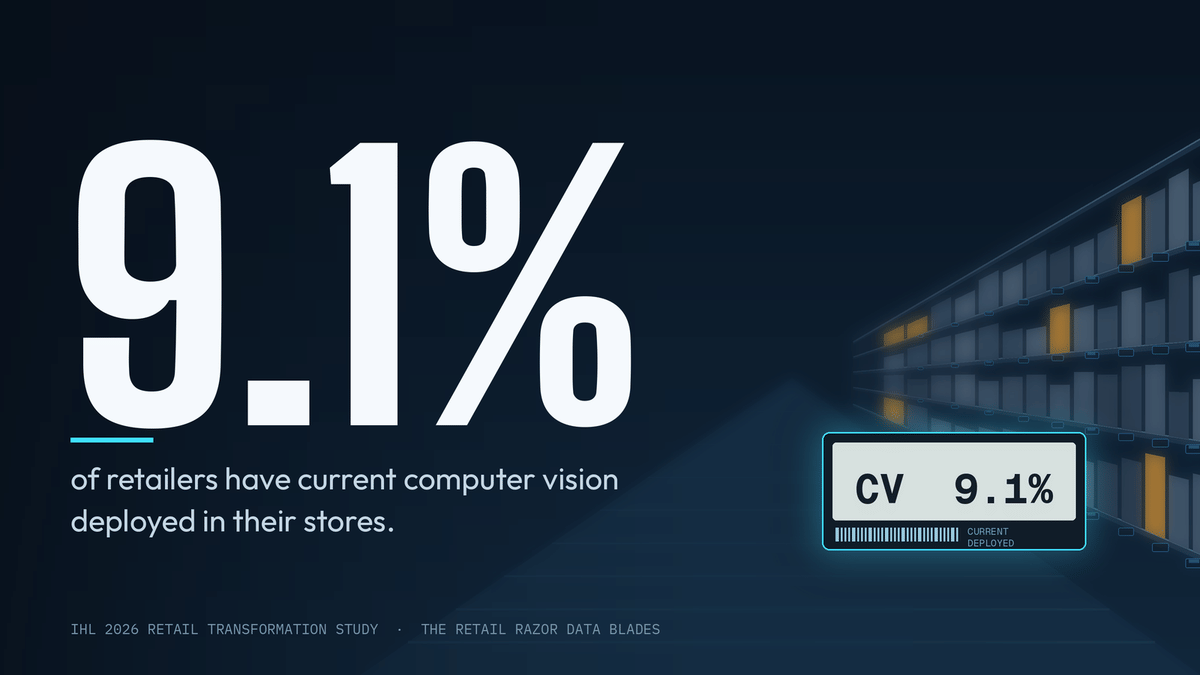
Then you look at the data. 9.1% of retailers have current computer vision deployed in their stores. That’s the whole list. The hardware went in. The intelligence never showed up.
That number comes from IHL Group's 2026 Retail Transformation Study, "How Retail Leaders Outperform," the largest annual survey of retail technology leaders in the industry, built on interviews with more than 400 brands. Casey Golden and I spent three episodes of the Retail Razor Data Blades podcast going through it with Greg Buzek, IHL’s president and founder, who has watched every retail tech wave since RFID was a science project.
Three episodes later, I have a new hill to die on:
the least glamorous line items in the budget, the network and the data, are deciding who wins the next decade of retail.
Here’s where I make the case, with Greg’s numbers to back it up.
What is shelf intelligence, exactly?
Shelf intelligence is the combination of RFID, computer vision, electronic shelf labels, and sometimes autonomous robots that tells a retailer what’s on the shelf, where it is, and what it should cost, in near real time. It replaces the oldest inventory system in retail: a manager walking the aisles, squinting at empty pegs.
Why it suddenly matters: the store quietly became a warehouse. IHL’s data shows roughly 89% of retail orders are fulfilled from a store, and only 48% of transactions are the classic walk in, grab it, walk out. Everything else is BOPIS, click and collect, local delivery, or ship from store.
Every one of those journeys collapses if you don’t know exactly what you have and where it is. AI in retail anyone?
Greg’s example stuck with me. A size 8 dress shows "in stock" but it’s sitting in a fitting room. An associate spends an hour hunting for it. The order misses, the margin’s gone, and you paid an hour of labor for a 3-minute job. Multiply by every store, every day.
And my favorite horror stat of the series: 80% of the SKUs in a grocery store sell less than one unit a week. Casey’s on-air response was, roughly, "you’re all fired." Hard to argue.
Why do so few retailers have real computer vision?
Because they skipped the boring part.
Cameras, RFID readers, ESLs, and robots all generate torrents of data that has to be processed somewhere. On the device, at the edge of the store, or in the cloud. Greg made a point about AI in retail I haven’t stopped repeating since we recorded:
the typical retail store is now more complex than headquarters, because of the sheer number of connected devices on the floor.
If the store network and edge compute can’t carry that load, your computer vision pilot is a very expensive screensaver.
This is my AI in retail soapbox moment.
Retailers keep funding the visible layer because robots demo well in a boardroom and switches don’t. Nobody ever won an innovation award for upgrading a WAN. But 9.1% is what happens when demo-driven budgets meet real bandwidth.
Fund the foundation first and the sci-fi stuff actually works.
Does AI reduce retail jobs?
No. And in case that wasn't loud enough for the people in the back... NO.
The executives deploying AI in retail most aggressively are hiring the most. IHL found that retailers with current AI and edge infrastructure plan to add store associates at nearly double the rate of everyone else: 70% versus 36%.
And sales winners, the retailers growing 10% or more a year, are 115% more likely to be adding people.
Greg’s history lesson here should be taught in retail school. Twenty-five years ago, Kroger rolled out self-checkout by having its best employees teach customers how to use it. Then they moved that labor into profit centers like hot food. Kmart installed the machines, cut the labor, and watched the whole thing fail. Same movie, new technology.
Today the winning version is the augmented associate.
Walmart is training 2.1 million associates on AI tools. Voice assistants answer questions in an associate’s native language, which matters enormously when English is a worker’s second or third language. Restaurant servers with handhelds turn tables twice as fast.
So when a conference keynote tells you AI will gut retail headcount, remember what the data shows:
the retailers cutting people to pay for AI are the laggards.
The winners are arming their people with better tools than the ones the customer walks in carrying. Anything less, as Greg put it, is embarrassing.
What separates winners from laggards on fulfillment?
One number:
profit winners are 555% more likely than laggards to have buy online pickup in store fully optimized.
That’s the single biggest capability gap in the entire study, and only 18.2% of retailers have solved it.
RFID tells the same story.
Sales winners are 6.5 times more likely to use RFID, and on fulfillment specifically, leaders are 1,600% more likely than laggards. Only about 20% of the market uses RFID at all, which means the winners’ circle is small and the moat is real.
Now hold that against the 48% stat. Most retailers spent decades perfecting an experience that covers less than half their transactions, while the majority of their business runs through fulfillment models they never got around to fixing.
That’s the quiet crisis in this study.
Why are returns the next AI battleground?
Because 18 to 20% of everything sold comes back, and in fashion it’s worse.
Much worse.
Women’s dresses bought online carry a return rate above 90%. Ninety.
Greg has a name for the root cause that deserves a permanent spot in the industry vocabulary: aspirational sizing. Brands spent years flattering shoppers into smaller label sizes, shoppers learned to buy three and return two, and now everyone acts shocked at the reverse logistics bill. We did this to ourselves.
The math is brutal.
Getting a product back through the supply chain costs about five times what it cost to ship it out. Which is why smart retailers now run the under-$25 rule:
if an item sells for less than $25, it’s often cheaper to tell the customer to keep it than to pay $8 in freight to recover a $7 product.
The leaders have moved past new point-of-sale and manager handhelds. They’re using AI in retail at the returns counter to make an instant call on every item: back on the shelf, tested first, back to the manufacturer, or keep it with our blessing.
That’s where the recoverable margin lives in 2026.
Where should a retailer start?
Greg’s order of operations, which I would print out and tape to the CIO’s monitor:
1. Clean data first. Get to a single version of the truth for inventory, orders, and pricing. Greg’s line of the series: "Without clean data, all you’re doing is making faster decisions that are wrong."
2. Network and edge compute second. Everything else in this article runs on top of it.
3. Then the visible tech, in ROI order for most retailers: electronic shelf labels, then RFID, then computer vision. Adjust if theft is an existential problem in your stores, because in some regions it genuinely is.
And the warning label: IHL’s data shows sales laggards trying to use generative AI to leapfrog all of this on top of dirty data. Greg’s assessment is blunt: it will hasten their demise. I agree, and I’d add that skipping foundations to buy outcomes with AI in retail is the same mistake behind the 9.1% problem. Just a more expensive version of it.
The bottom line.
Around 2018, the retailers who now lead decoupled IT spend from revenue growth.
They watched Amazon turn a profit in retail, realized they were in a technology race, and doubled or tripled IT budgets while everyone else kept handing IT 2% more because sales grew 2%. The 2026 study mostly measures the compounding effect of that one decision.
The lesson from three episodes and 400 brands:
fund the network, clean the data, arm the associates.
Do that and the AI in retail part turns out to be the easy bit.
Frequently asked questions.
What is the IHL 2026 Retail Transformation Study?
"How Retail Leaders Outperform" is IHL Group’s annual survey of retail technology leaders, the largest in the industry, built on interviews with more than 400 retail brands. It measures which technologies and practices separate sales and profit winners (10%+ annual growth) from everyone else.
Do retailers using AI hire more or fewer store associates?
More. Retailers with current AI and edge infrastructure plan to add store associates at nearly double the rate of other retailers, 70% versus 36%, and sales winners are 115% more likely to be adding staff, according to IHL’s 2026 data.
What retail technologies deliver the strongest ROI?
Per IHL’s research, tablets for store managers had the highest measured ROI of any store technology, with RFID second. Shelf intelligence deployments typically pay back in 3 to 14 months depending on segment and pricing model.
What percentage of retailers use computer vision and RFID today?
Only 9.1% of retailers have current computer vision deployed and 12.2% have current electronic shelf labels. About 20% use RFID, yet retailers growing sales 10%+ a year are 6.5 times more likely to be RFID users.
Hear the whole story.
These three episodes are the best data-backed conversation about AI in retail you’ll hear this year, and I say that as one of the two people asking the questions.
Catch season 2, episodes 7, 8, and 9 of the Retail Razor Data Blades: shelf intelligence, the augmented associate, and supply chain and returns, all with Greg Buzek of IHL Group.
Follow the show on Apple Podcasts, Spotify, or Goodpods, or watch on YouTube, so you never miss an episode. If you feel the series earns it, leave us a 5-star rating and a short review. It genuinely grows the show. Then explore the rest of the Retail Razor Podcast Network: The Retail Razor Show, Retail Transformers, and Blade to Greatness.
Stay sharp, be data-driven, and harness AI.
ABOUT THE AUTHOR
Ricardo Belmar is a retail tech analyst, top industry influencer and host of the Retail Transformers podcast, part of the Retail Razor Podcast Network, the #1 indie podcast network for retail. He writes and speaks on retail technology, AI in retail, retail media, and the leadership behind real retail transformation.
ABOUT THE PODCAST GUEST
Greg Buzek is the Founder, President and Principal Analyst of IHL Group, one of the most respected retail technology research firms in the world. IHL's annual Retail Transformation Study is the largest survey of retail technology leaders in the industry, covering more than 400 brands across every retail segment. Greg is also the founder of Retail Orphan Initiative (Retail ROI), which has surpassed $6 million in total grants to help children around the world through the industry's Super Saturday campaign.