

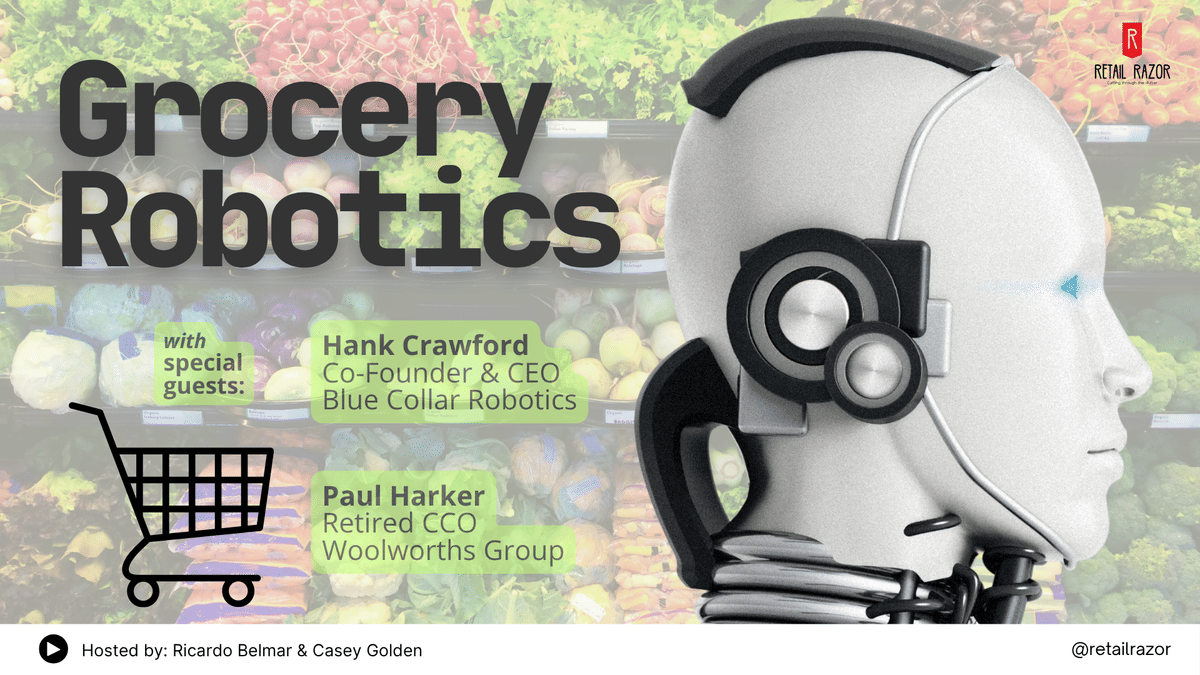
Grocery retailers compete with Amazon on eGrocery fulfillment by fulfilling online orders from the stores they already own. Retailers can use purpose-built robots supervised by remote operators to pick packaged center-aisle items at a fixed cost per pick. That approach avoids the capital expense of a central fulfillment center, keeps inventory closest to the customer, and leaves fresh in human hands. That's the argument Hank Crawford, Co-Founder and CEO of Blue Collar Robotics, and Paul Harker, retired Chief Commercial Officer of Woolworths Group, made on Season 6 Episode 10 of The Retail Razor Show. Here's the reasoning behind it. How many people pick groceries in US stores today ?About 280,000, according to Hank. Online grocery, or eGrocery, has grown into a large business, and the picking work that supports it has grown with it.
Why did centralized fulfillment centers fail for eGrocery fulfillment ?Four reasons, according to Hank. The economics are volume dependent, so a central fulfillment center only works where order density is high. The facility moves inventory away from the customer, which raises last-mile delivery cost. Fresh categories resist automation. And the capital expense is significant, spent to build a facility that duplicates a store network the grocer already owns.
What's the difference between a CFC, an MFC, and in-store picking ?
How much of a grocery order can a robot pick ?Blue Collar Robotics targets packaged goods with uniform surfaces. Its robot handles these goods using vacuum suction rather than a hand or specialized manipulator. Hank says that category represents roughly 65% or more of a typical eGrocery fulfillment order. Items behind glass doors, such as frozen, are outside the current scope, as is fresh. Why do these robots still need a human operator ?Because a grocery store is an unstructured environment. Warehouse robots work because the environment is controlled and every item's location is known. In a store, an item may be stocked slightly off. A customer may step into the aisle, and the robot has to make a judgment call. Hank says a remote operator behind the robot is now standard practice for real-world deployments. Everything from sidewalk delivery robots to autonomous rideshare operates similarly, and the robot learns from what the operator does. Paul adds that this level of human supervision is also what makes the deployment defensible to a risk-averse retailer. Not to mention, to any regulator who takes an interest. What does robot etiquette mean in a store aisle ?Hank uses the term for how the robot behaves around customers. The robot hangs back and lets the shopper shop rather than expecting the shopper to move. He contrasts this with delivery robots in Chinese hotels. People routinely step aside for the machine.
Does grocery store robotics eliminate jobs ?Hank argues the opposite constraint applies. Grocers cannot currently fill the picking roles they have. eGrocery sits at roughly 15% of the business, and it could double within two to five years. Automation lets associates move to higher-value work, particularly fresh, where quality is visible to the customer. Paul adds a second effect. Store picking today requires physically getting to a specific store during specific hours. Remote operation removes both constraints, which opens the work to people who cannot travel to a store or work overnight, including people with mobility limitations. What does the buying conversation look like ?Blue Collar sells the picking as a service. A grocer pays a cost per pick, which puts the spend in operating expense instead of capital expense. The company signs up to a contracted pick rate and quality standard. Hank's point is that a grocer has no reason to employ robotics engineers. Paul adds that a retailer can also buy the device and take the service separately. That capital outlay is significantly lower than any comparable automation. What is actually slowing adoption ?Urgency, according to Hank. National retailers are approaching Blue Collar because they recognize the problem, but they run their businesses the way they run their businesses. Paul frames the caution as rational:
Frequently asked questionsHow many people pick groceries in US grocery stores?Approximately 280,000, per Hank Crawford of Blue Collar Robotics, with demand growing faster than retailers can hire. What percentage of an eGrocery fulfillment order can a picking robot handle?Roughly 65% or more of a typical e-commerce grocery order, covering packaged center-aisle goods with uniform surfaces. How much can store robotics reduce eGrocery fulfillment cost?Blue Collar Robotics reports reductions of as much as 50% compared with current in-store picking labor. Is a micro fulfillment center cheaper than store robotics?No. Paul notes that an MFC still requires significant capital, physical space adjacent to the store, and duplicated inventory, while a service-model robot deployment sits in operating expense. Do grocery picking robots work overnight?Yes. Paul points to a 24-hour picking clock as one of the clearest benefits for eGrocery fulfillment since retailers struggle to staff overnight picking shifts. |
Hear (or watch) the whole story.
🎧 Hear the full conversation on eGrocery fulfillment with Hank Crawford and Paul Harker on The Retail Razor Show podcast. To learn more about Blue Collar Robotics, visit their website.
Follow the show on Apple Podcasts, Spotify, or Goodpods, or watch on YouTube, so you never miss an episode. If you feel the series earns it, leave us a 5-star rating and a short review. It genuinely grows the show. Then explore the rest of the Retail Razor Podcast Network: Retail Transformers, Data Blades, and Blade to Greatness.
Stay sharp, stay human, and stay ahead.
ABOUT THE AUTHOR
Ricardo Belmar is a retail tech analyst, top industry influencer and founder of The Retail Razor Show podcast, part of the Retail Razor Podcast Network, the #1 indie podcast network for retail. He writes and speaks on retail technology, AI in retail, retail media, and the leadership behind real retail transformation.
ABOUT THE PODCAST GUESTS
Hank Crawford is Co-Founder & CEO of Blue Collar Robotics, where he leads the company's mission to make in-store grocery picking affordable for retailers through purpose-built robots delivered as a service, pairing AI-driven autonomy with human-assisted teleoperation. A technology entrepreneur and commercial leader with more than 35 years of experience in advanced composites, global manufacturing, and robotics, Crawford has founded companies in the United States and China including PURE Material Science, a Guangzhou-based pioneer of continuous fiber-reinforced thermoplastic composites and has helped scale advanced technology businesses in senior engineering and commercial roles at Performance Materials Corporation (acquired by Toray), Daimler Trucks in both North America and China, TRB Lightweight Structures, and Avient. He holds multiple patents in composite materials and manufacturing.
Paul Harker has more than three decades of senior leadership experience across Australia’s retail and FMCG sectors, including 33 years with Woolworths Group. Most recently, Paul served as Chief Commercial Officer for Woolworths Group, where he was accountable for the $51 billion Australian Food commercial portfolio. In this role, he oversaw commercial practices across more than 1,000 stores and helped lead large-scale enterprise transformation initiatives, including the modernization of digital systems and the integration of data-led analytics across complex supply chain networks. Paul’s earlier executive roles at Woolworths included leadership across Replenishment, Supply Chain, and Store Operations, giving him a broad understanding of the full retail operating model – from store execution to enterprise-level commercial strategy.