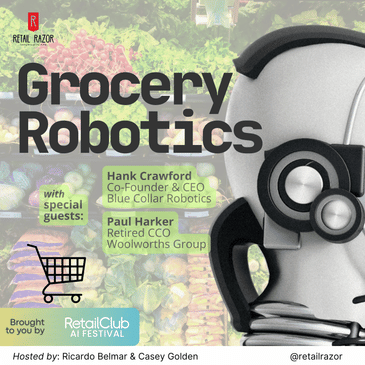




Hank Crawford of Blue Collar Robotics and Paul Harker, retired CCO of Woolworths Group, on eGrocery fulfillment robotics a retailer can deploy today.
There are 280,000 people walking the aisles of US grocery stores right now picking somebody else's order. Grocers cannot hire fast enough to keep up with the eGrocery fulfillment growth.
That number comes from Hank Crawford, Co-Founder and CEO of Blue Collar Robotics. It frames the whole conversation. Online grocery keeps growing. Labor keeps getting harder to find. And the two big swings the industry took at eGrocery fulfillment, the centralized fulfillment center and the micro fulfillment center, both left grocers with high CapEx, duplicated inventory, and people still picking most of the order.
Hank is joined by Paul Harker, retired Chief Commercial Officer of Woolworths Group, Australia's largest retailer, who joined Blue Collar Robotics as a strategic advisor. Together with Ricardo Belmar and Casey Golden they work through the economics of eGrocery fulfillment from the operator's side of the table. Together they answer why the warehouse solution collapsed, what grocery store robotics has been getting wrong, and why a purpose-built robot with a remote operator behind it can drop into a supermarket that already exists.
The mechanism is the interesting part. Blue Collar Robotics sells the picking as a service. A grocer pays a cost per pick, which moves the spend from CapEx into OpEx. The robot handles packaged center-aisle goods using vacuum suction, which is roughly 65% of a typical order. Store associates get redeployed to fresh, where care actually shows up in the customer's bag. Blue Collar reports eGrocery fulfillment cost reductions of as much as 50% thanks to their version of grocery store robotics. This is Season 6, Episode 10.
In This Episode, You'll Learn.
Why centralized fulfillment centers failed for grocery on four separate counts: volume density, distance from the customer, fresh, and CapEx.
What Paul Harker says micro fulfillment centers still cannot solve, including duplicated inventory and picking "the uglies".
Why over 80% of a grocer's business is still the in-store customer, and how eGrocery growth quietly degrades that experience.
The case for a human behind every robot, and why it is now standard practice for anything operating in an unstructured environment.
What robot etiquette means in a store aisle, and what China's hotel delivery robots taught Hank about how not to do it.
How the grocery store robotics buying conversation changes when the customer has no robotics team of its own.
Why grocery store robotics took this long to find product-market fit in a supermarket, and what changed.
Why the labor argument runs backwards here: there is no line of people waiting for picking jobs.
How remote operation opens picking work to people who could never physically do it, and opens a 24 hour picking clock for the store.
What Hank says is actually slowing adoption, and it is not the technology.
Support our sponsors.
This episode was brought to you by RetailClub.
Retail and brand leaders can attend RetailClub AI Festival completely budget-free, plus get $1,750 toward travel and hotel. From the founders of Shoptalk and Groceryshop, it's three days fully outdoors in Huntington Beach, September 22 to 24. Spend time with 2,000 senior leaders working through how AI is transforming retail. Register by August 28 at retailclub.com/retail-razor-podcast.
W. P. Carey School of Business, Arizona State University.
Arizona State University is a leading public research university known for innovation, access, and impact. Its W. P. Carey School of Business is the largest in the United States, with more than 25,000 students. AI-Enabled Supply Chain Strategy is a three-day executive program running October 5-7. It's built by W. P. Carey's #2-ranked Supply Chain Management department. The program is designed for senior leaders setting AI strategy across procurement, logistics, and operations. Register at https://specialevents.asu.edu/878064 with ID Code retailrazorasu for $1,500 off. Preview it in our three-part Data Blades podcast mini-series this September with Professor Brett Duarte.
Subscribe & Follow.
How much did you love this episode? Drop us a 5‑star rating and review on Apple Podcasts, Spotify, or Goodpods. Subscribe on YouTube so you never miss an episode and check out the other shows in the Retail Razor Podcast Network: Retail Transformers, Blade to Greatness, and Data Blades.
Subscribe to the Retail Razor Podcast Network: https://retailrazor.com/
Subscribe to our Newsletter: https://retailrazor.substack.com
Subscribe to our YouTube channel: https://go.retailrazor.com/utube
Featured guests.
Hank Crawford. https://www.linkedin.com/in/hank-crawford-a4a9755/
Co-Founder & CEO of Blue Collar Robotics. https://bluecollarrobotics.ai
Hank Crawford is Co-Founder & CEO of Blue Collar Robotics. He leads the company's mission to make in-store grocery picking affordable for retailers through purpose-built robots delivered as a service, pairing AI-driven autonomy with human-assisted teleoperation. A technology entrepreneur and commercial leader with more than 35 years of experience in advanced composites, global manufacturing, and robotics. Crawford has founded companies in the United States and China including PURE Material Science, a Guangzhou-based pioneer of continuous fiber-reinforced thermoplastic composites. He has helped scale advanced technology businesses in senior engineering and commercial roles at Performance Materials Corporation (acquired by Toray), Daimler Trucks in both North America and China, TRB Lightweight Structures, and Avient. He holds multiple patents in composite materials and manufacturing.
Paul Harker. https://www.linkedin.com/in/paul-s-harker/
Retired Chief Commercial Officer, Woolworths Group.
Strategic Advisor. Blue Collar Robotics.
Paul Harker has more than three decades of senior leadership experience across Australia’s retail and FMCG sectors, including 33 years with Woolworths Group. Most recently, Paul served as Chief Commercial Officer for Woolworths Group, where he was accountable for the $51 billion Australian Food commercial portfolio. In this role, he oversaw commercial practices across more than 1,000 stores and helped lead large-scale enterprise transformation initiatives, including the modernization of digital systems and the integration of data-led analytics across complex supply chain networks. Paul’s earlier executive roles at Woolworths included leadership across Replenishment, Supply Chain, and Store Operations, giving him a broad understanding of the full retail operating model – from store execution to enterprise-level commercial strategy.
Chapters.
00:00 Teaser
00:48 Show Intro
05:34 Welcome Hank and Paul!
06:37 Why Warehouses Failed
09:02 Store Picking Tensions
10:28 Amazon Threat Reality
14:47 Robotics Hype vs Reality
16:34 Human in the Loop
18:34 Blue Collar Robotics Intro
19:46 Service Model Economics
22:35 How Store Deployment Works
25:48 Comparing Other Models
30:50 Automation and Jobs
32:35 Scaling Labor With Robots
33:43 24 Hour Store Operations
35:09 Accuracy And Quality Standards
36:48 AI Regulation And Safety
40:18 Robot Etiquette In Aisles
41:36 China Robotics Lessons
45:19 Selling To Risk Averse Grocers
49:36 Five Year Outlook And Jobs
52:19 Wrap Up And Where To Learn More
53:40 Show Close
Meet your hosts.
Helping you cut through the clutter in retail & retail tech:
Ricardo Belmar is an NRF Top Retail Voice for 2025 and a RETHINK Retail Top Retail Expert from 2021 – 2026. Thinkers 360 has named him a Top 10 Thought Leader in Retail, a Top 25 Thought Leader in AGI and Careers, a Top 50 Thought Leader in Agentic AIand Management, and a Top 100 Thought Leader in Digital Transformation and Transformation. Thinkers 360 also named him a Top Digital Voice for 2024 and 2025. He is an advisory council member at George Mason University’s Center for Retail Transformationand the Retail Cloud Alliance. He was most recently the partner marketing leader for retail & consumer goods in the Americas at Microsoft.
Casey Golden, is the North America Leader for Retail & Consumer Goods at CI&T, and CEO of Luxlock. She is a RETHINK Retail Top Retail Expert from 2023 - 2026, and Retail Cloud Alliance advisory council member. After a career on the fashion and supply chain technology side of the business, Casey is obsessed with the customer relationship between the brand and the consumer and is slaying franken-stacks and building retail tech!
Music.
Includes music provided by imunobeats.com, featuring Overclocked, and E-Motive from the album Beat Hype, written by Heston Mimms, published by Imuno.
Transcript.
S6E10 Grocery Store Robotics & eGrocery Fulfillment
[00:00:00] Teaser
[00:00:00]
[00:00:01] Casey Golden: Amazon is coming for grocery.
[00:00:03] Ricardo Belmar: And according to today's guests, most retailers are trying to fight that battle the wrong way.
[00:00:10] Casey Golden: They've spent billions on fulfillment centers, delivery programs, and technology that still doesn't solve the biggest problem.
[00:00:17] Ricardo Belmar: Labor.
[00:00:18] Casey Golden: There are nearly 300,000 people picking groceries in stores today, and the demand is growing faster than retailers can hire.
[00:00:26] Ricardo Belmar: So what if the answer is a robot in the aisle of your local grocery store?
[00:00:30] Casey Golden: Not a science project.
[00:00:32] Ricardo Belmar: Not a humanoid, a real business deployed in stores solving a real problem.
[00:00:37] Casey Golden: This isn't a conversation about robots.
[00:00:39] Ricardo Belmar: It's a conversation about whether grocery retailers can compete with Amazon.
[00:00:44] Casey Golden: Stay with us and learn how grocers compete with Amazon.
[00:00:48]
[00:00:48] Show Intro
[00:00:59] Ricardo Belmar: [00:01:00] Welcome back to season six of The Retail Razor Show, the top-ranked indie business management and marketing podcast on Goodpods and the original show in the number one indie podcast network for retail.
[00:01:10] I'm Ricardo Belmar.
[00:01:12] Casey Golden: And I'm Casey Golden.
[00:01:13] Welcome back, Retail Razor fans, to retail's favorite podcast where we cut through the clutter to bring you the sharpest insights from the leaders redefining retail, technology, and the future of business.
[00:01:25] Ricardo Belmar: Casey, I don't know about you, but I feel like we've been promised robots for most of our lives.
[00:01:31] Casey Golden: Right? Like, I thought I'd be in the era of the Jetsons by now.
[00:01:36] Ricardo Belmar: That's right, right? Right?
[00:01:38] Casey Golden: And somehow none of them have folded my laundry. I have to do my dishes,
[00:01:44] Ricardo Belmar: Yeah
[00:01:46] Casey Golden: why can't somebody else do my Amazon returns? You know, something that actually gives me my time back.
[00:01:54] Ricardo Belmar: Yeah. Yet.
[00:01:55] Casey Golden: Yet. But in all seriousness, robotics has [00:02:00] spent years living somewhere between science fiction and PowerPoint presentations.
[00:02:05] Meanwhile, retailers are dealing with very real problems today.
[00:02:11] Ricardo Belmar: And, you know, grocery may have the biggest one of all. Online grocery continues to grow. I know I'm a user right here. Labor costs keep rising, and retailers are being squeezed between customer expectations and some very difficult unit economics around e-grocery.
[00:02:27] Casey Golden: And you know, I'm always one to say, like, shopping's fun. However, when it comes to grocery.
[00:02:34] Ricardo Belmar: Eh, not so much.
[00:02:35] Casey Golden: It's not enjoyable every single time. It's kind of a chore most of the time. Which brings us to today's guest. Hank Crawford has spent his career building autonomous systems, first in trucking and now in retail. Alongside his co-founder, Yagmur Han Saglam. He founded Blue Collar Robotics with a simple belief. [00:03:00] Retailers don't need another billion-dollar fulfillment center.
[00:03:03] They need a solution they can deploy today.
[00:03:06] Ricardo Belmar: Yeah, so Blue Collar Robotics has taken a very different approach. If you frequent LinkedIn, you've probably seen a glowing recommendation, or possibly many, from Brittain Ladd on multiple posts for grocery brand leaders to meet with Hank and his team and learn more about what they're doing. And you'll see why as we get into it today.
[00:03:23] We're not talking about humanoid robots. There's no massive CapEx investment, no five-year implementation timelines. Instead, they're, they're putting purpose-built robots directly into existing grocery environments, into their existing workflows, and combining them with remote operators a-around the world to lower the fulfillment cost by as much as 50%.
[00:03:43] Casey Golden: And perhaps the mo- most importantly, they're betting on something that doesn't even make sense for Amazon to replicate, your local grocery store, in fact. Our second guest, Paul Harker, retired chief commercial officer at Woolworths Group, Australia's largest [00:04:00]retailer, recently joined as a strategic advisor because of his strong belief in the solution for the future of grocery.
[00:04:08] Ricardo Belmar: Today, we're gonna talk about the economics of eGrocery, why centralized fulfillment, pretty much failed, what robotics generally gets wrong, in this, scenario, and whether retailers already actually have everything they need to compete
[00:04:23] Casey Golden: Yeah. I mean, if you're in grocery, retail, logistics, or kinda like me, just simply curious about where robotics is finally finding product market fit, you're gonna wanna stay for this one.
[00:04:37] Ricardo Belmar: Yeah. But before we get started, we'd like to give a quick thanks to our sponsor, RetailClub. Join 2,000 retail leaders at the RetailClub AI Festival, September 22nd to 24th in Huntington Beach, where you'll dive deep into how AI is reshaping retail while soaking up some sun at a fully outdoor beachside venue. Decision-makers from retailers and brands can attend with [00:05:00]free tickets and up to $1,250 in travel reimbursement. Head to retailclub.com to learn more today.
[00:05:07] Thank you to RetailClub for helping us bring you this podcast and the other shows in our podcast network.
[00:05:13] Casey Golden: I'm already booked, and everybody is welcome to join me on my 6:00 AM walk in the morning. So all right, Retail Razor fans, let's go. Let's meet Hank Crawford and Paul Harker from Blue Collar Robotics.
[00:05:34] Welcome Hank and Paul!
[00:05:34] Ricardo Belmar: All right, let's dive in. Hank, Paul, thanks for being with us today
[00:05:38] Hank Crawford: Glad to be here
[00:05:39] Paul Harker: good to be here
[00:05:40] Ricardo Belmar: Excellent. So Hank, think it makes sense we just start right in with the problem we're, we're talking about here, because I think most people probably have no idea how big the problem actually is. and I know you've said it before that there are nearly 280,000 people just picking groceries in stores across the [00:06:00] US today, which is a pretty staggering number of people just doing picking, 280,000 in grocery stores.
[00:06:06] So why is grocery fulfillment still a challenge? Why, why do, why do we think this is still broken?
[00:06:12] Hank Crawford: well, it is a problem. 280,000 is a staggering number because eGrocery is a big business today. People enjoy that convenience of, you know, ordering the groceries online. And so right now, you have all of these people picking the groceries, and the industry was faced with, "How do we handle this e-commerce business that's growing, and we ha- that we have to deliver orders?"
[00:06:37] Why Warehouses Failed
[00:06:37] Hank Crawford: So the first approach, or the main approach that they, they would look at was like, "Well, let's just do what the e-commerce people do and fulfill. Let's set up a big warehouse somewhere and fulfill all the groceries there." Well, the problem was, is that failed because groceries are different than normal e-commerce products. So you have the location. In order to have, [00:07:00] um, to be able to really fulfill this, you would, you would have to have... It's volume dependent. So if you have, if you have to fulfill a lot of orders, it's very volume dependent, so you'd have to set up a facility, they call them these central, fulfillment centers, somewhere away from the store, so they're very volume dependent.
[00:07:16] And then what the problem was is they're now moving the inventory away from the customer, and so now you're actually further away from the customer to deliver it. And then finally, it's you have fresh. In grocery, you have fresh, so how do you handle, you know, meats and bakery items and all of those sort of things?
[00:07:34] And then finally, you, they have a big CapEx. They would have to, the stores would have to spend a lot of money on basically building these facilities where they already have these facilities. So, so they went through this, trying to automate it like the e-commerce people would do it. So today they're back basically in the store.
[00:07:52] It didn't work out, and they're back in the store with people, with those 280,000 people fulfilling groceries. And what's interesting [00:08:00] is because they, they have this volume, they're actually now trying to automate those people. So they're trying to give them tools to make the people basically work faster or more efficient in the store. But the reality is that humans, you can't automate humans, so they're back kind of with this big problem of the high volume for e-commerce, but they're really stuck with having people, those 280,000 people fulfilling in the store. And maybe Paul would have some comments on, on this.
[00:08:28] Paul Harker: Yeah, I think, yeah, there's a, there's a sort of ecosystem of solutions, and as Hank spoke about, you've got sort of CFCs, which are, you know, hi-highly automated, but you need density, and you need a lot of CapEx to do them. You've got MFCs or where they've actually taken a physical store and created a space adjacent to it to automate some the orders. But to do that, you require high CapEx. You need the space, you need the space next to the store,
[00:08:58] Ricardo Belmar: Yeah
[00:08:58] Paul Harker: only solving [00:09:00] of the problem.
[00:09:02] Store Picking Tensions
[00:09:02] Paul Harker: So you're left with retailers wanting to utilize the major asset they have, which is their already existent physical store footprint, which is actually closest to the customer, doesn't require duplicate inventory, but they have to somehow integrate that into their standard store process and also the fact that they have physical customers into the store, which is why, you know, you've got this tension of people running up and down the aisle with carts picking somebody else's order whilst you're also trying to shop.
[00:09:32] Ricardo Belmar: Right
[00:09:33] Paul Harker: you know, trying to find people to pick the orders you know, those people don't wanna work unsociable hours through the night, you know, early hours of the morning and stuff. So you have this sort of convergence happening with everyone wanting to do something in the physical store at the same time.
[00:09:48] It's the most practical solution, but you're just getting this tension between the online customer and the in-store customer
[00:09:55] Ricardo Belmar: Yeah, that, that's true. I mean, I've seen that myself at the, at grocery stores when, and seen so many other [00:10:00] people who are visibly irritated, right? That are just your regular consumer shopping and they're, they feel like they're getting in the way of the ones picking groceries for somebody else
[00:10:09] Casey Golden: Yeah, it's like in New York, I want New Yorkers to have their own, like, part of the sidewalk, where all the tourists have to be in their own, like, lane, and they can hold hands over there. Going down a grocery aisle with, like, two missions, um, yeah.
[00:10:28] Amazon Threat Reality
[00:10:28] Casey Golden: So, let's talk about, like, the elephant in the room. You've been very direct about this, Hank.
[00:10:34] You've said Amazon is coming after grocery. might, but is.
[00:10:40] Why do you think, are, like, traditional retailers, like, are they, are they underestimating this, this threat?
[00:10:47] Hank Crawford: Yeah, I don't think they are. I think everybody understands how powerful Amazon is. I mean, Amazon is, um, experts at e-commerce, and they're getting into every [00:11:00]different segments. They're going after 'em. But you have grocery, which is this massive segment of products, and they definitely are going after it.
[00:11:09] but the problem is, is that it's difficult, as we mentioned earlier, it's groceries are difficult to automate. So even though they're coming after it, they, they've had a challenge, so they just kind of are chipping away at it. And now the... It's hard, difficult, I think, for the grocer because if they try to just like go back to the CFC or they try to say, "Oh, it's an automated solution," they're trying to compete with Amazon, what Amazon is an expert at. So they're sitting there, they're saying, "Okay, Amazon's coming with our business and we know they're coming. What can we do? And we know we can't really compete on Amazon's turf, so we need a different solution." And that's really where, because the advantage they have, the, the, the grocer really, is they have the footprint. They have all these locations in every local market, and [00:12:00] that's really the strength of the, of the grocery store. But the problem they have is they just really need a good solution to be able to automate and really, you know, automate these orders and really use their existing asset, and that's why we really started this business, is really to provide a good solution or allow them to help them compete against Amazon and really maintain their competitive advantage.
[00:12:25] Casey Golden: imagine they are, they can't wait another five years.
[00:12:28] Paul Harker: I think, I think retailers... Sorry, Hank.
[00:12:32] I think y- y- retailers have been wrestling, w- with this, as, as Hank said, because they're, they, they operate in all channels and their core customer is still the in-store You know, over eighty percent of retailers' business is people physically shopping in their store.
[00:12:49] So they have this tension of trying to go, "Well, we need to grow and protect our online business, but not at the expense what our core business is." And at the moment, A- [00:13:00] Amazon has tried not very well to move into the space of a core retailer. Yeah, they've acquired Whole Foods. They've had a couple of independent goes themselves, and, and they just-- I think they're learning that actually physical grocery retailing is not the same as, you know, retailing o- online.
[00:13:17] So you sort of got these two areas sort of coming together, wrestling with the fact that it's very difficult to do both well, and of course, there's an economic challenge that you need to wrestle with as well in terms of your P&L. It is more expensive to service an online customer than it is someone who comes into your, your store.
[00:13:39] And so you've got that tension as a retailer where, you know, you don't really wanna have your physical customer subsidizing your online customer. Whereas Amazon's business, you know, their web services business is far bigger. Like, they've got cross-subsidization going on and being able to p- being able to prepare to take poor economics on online [00:14:00] groceries whilst they figure stuff out, and retailers are trying to wrestle with that.
[00:14:04] So I think what Hank and the team are trying to do is actually come up with a practical solution to help retailers, if you like, manage the fact that they have to operate in these two worlds where, you know, physical retailing is still gonna be the largest part of their business for quite some time, whilst e-com steadily, steadily grows
[00:14:24] Ricardo Belmar: Yeah, that's a great, that's a great point. I guess that that way, they, in a sense what we really wanna do is find the best solution that helps the retailer leverage the store as the primary asset here in, in their way to put up a wall or put up a moat around what, what Amazon hasn't successfully done, right?
[00:14:40] Versus trying to make the battleground, the e-commerce sign that Amazon is the pr- pretty much you can call the hands down expert at.
[00:14:47] Robotics Hype vs Reality
[00:14:47] Ricardo Belmar: So I guess that brings us into, why we're even talking today, right? Which is, how does something like robotics help here? And, you know, I've always seem, feel like it, it seems like, we [00:15:00] always hear reports about fancy robotics demos.
[00:15:02] I mean, it's been all the rage this, these last few months to see videos all over YouTube of humanoid robots doing dances and and doing all kinds of acrobatics and, and things as if that's supposed to prove to us that that's, you know, gonna be the answer. That's what's gonna help solve the problem.
[00:15:17] Casey Golden: fold a towel.
[00:15:18] Ricardo Belmar: Yeah, right.
[00:15:19] Right. You still have-- I have not seen one successfully fold towels yet. That's true. That's true. so, so, so Hank, I mean, what, what's really prevented the industry from delivering the outcomes that retailers need in grocery w- with given where robotics stands?
[00:15:35] Hank Crawford: Yeah, so robotics, again, as a, as an industry is, is very healthy and very large. But the robotics that are out there today are kind of in the warehouse. So even Amazon, millions of robots they're deploying,
[00:15:51] Ricardo Belmar: That's right
[00:15:51] Hank Crawford: the reason why they can do it is because they're in a very structured environment. So in a warehouse, they know exactly where the item is, they know where to get it. The [00:16:00] difficulty, and what you're alluding to, is how do you put a robot into the real world? it's, it's this real world where you have this unstructured environment. One, you have a lot of moving parts, but also the item or the task the robot has to do, usually a specific task to be effective. And so what is that task?
[00:16:20] And so even like in grocery, was that item exactly where it was supposed to be or was it a little bit off? Did they stock it in the right location? So that's very difficult, um, to do as you're trying to move these robots into the real world.
[00:16:34] Human in the Loop
[00:17:06] Hank Crawford: And where people have failed in the past is they really try to-- a mindset because if you're coming from a robotics industry, it's like, oh, everything is structured. So they try to have this fully automated solution. And then the second is, is they try to then pick everything. It's like, "Oh, we're gonna go into a grocery store, and we're gonna have to then pick all the items." And so what we're doing-- So that's how it's failed, is because they really try to think about it as a robotics problem, and they try to automate everything, and they've tried to do that. And so what we're doing with Blue Collar is we're saying, "Okay, let's-- What we're gonna do is we're gonna have actually a person behind the robot," which you find is actually the best practice now for any deployment in the real world because the robot's out there, but you need somebody observing that robot. You need them to, where in difficult situations, making those decisions, and that's so for if you have delivery robots or even the shared, uh, rideshare now. They still have people that are watching those cars. If there's a problem, they can help get them out of the problem. So you really have to have a person behind it, and we've designed that into our robotic solution.
[00:17:44] And then the second thing we're doing is that because e-commerce now is so evolved, and they have their processes right now, is that we're saying we're only gonna pick a certain percent of the items in the store. So we can do packaged goods, which are, which are [00:18:00] easier for us to do because they have a very uniform surface, and so you don't have to worry, and we can use a vacuum suction rather than a hand or a special manipulator.
[00:18:10] So it really allows us then to be effective in picking items that we can, and we find that packaged goods is what we're focused on, actually represents a large percentage of the basket. So even if we don't go after everything, we can still pick about sixty-five percent or more of what a traditional e-commerce order would be.
[00:18:29] So it really allows us to deploy now today into the store where others have failed
[00:18:34] Blue Collar Robotics Intro
[00:18:34] Casey Golden: It feels like a great time to just bring it full circle. Can you introduce Blue -Collar Robotics for us? And just tell us, like, what you're building, why you decided to sell labor instead of hardware, because that's, that's a pretty unconventional call. And we'll just break it down on what's your why.
[00:18:58] Hank Crawford: so, [00:19:00] yeah, so Blue Collar, I mean, what we're doing is, uh, as I mentioned, we discussed, we design and build a purpose-built robot. So instead of having this humanoid,
[00:19:09] Ricardo Belmar: Mm-hmm.
[00:19:09] Hank Crawford: we say, "What is the problem, and what type of device do you need to attack that problem?" And so we've designed a robot very specifically to be able to deploy directly into a supermarket and pick groceries just like a human would pick the groceries.
[00:19:27] And so able to do that because we have a, you know, very unique device that can kinda do that task. And so that's really what our purpose is. And then also we're doing it in a way that we can really deploy it into the store so the store doesn't have to change in their store. It really works as a person.
[00:19:46] Service Model Economics
[00:19:46] Hank Crawford: And then where traditionally maybe in robotics you would sell that robot or that machine, but then you have to have this big kind of organization behind it. But when you're selling it to an industrial customer, a lot of times they have that resource. For a grocer, they're not robotics people. It's not an
[00:20:04] Ricardo Belmar: They don't have any of that
[00:20:04] Hank Crawford: so you need to be able to drop it directly in, and we're really just selling that service because we're just saying, "We can pick an item in your store for this cost per pick." And so they don't have to worry about being, you know, hiring robotics experts or other things. And then as I mentioned earlier, we also have people behind it. So it's, it's part of the deployment, is you have this person that's actually providing some control, and then over time the device is learning. So we're really just selling a service which is e- much easier for the customer to adopt and, and Paul probably can speak a little bit to the difference between what we're selling, because we're selling, it's really a cost per pick, so it's more of an operational expense or an hourly expense rather than a big CapEx expense.
[00:20:56] Paul Harker: Yeah, one hundred percent. So I think, you know, the, the team are looking at it in [00:21:00] a, in a flexible way in terms of a, a retailer could, uh, buy the device and then have the service, or it could just be a fully loaded, uh, s-service model. E-either way, the capital outlay is significantly lower any other type of automation that's out there, and it just gives you more flexibility to choose to do more or do less in various markets, in various stores.
[00:21:24] So it's highly flexible as opposed to being quite rigid. I've now invested, I've built a thing over here, that thing I can't move if the customers move, if volume moves, if markets move, if I wanna open a new store, but it means it's gonna take volume from that store. I, I, I'm-- I've locked myself into a, into a grid, a very expensive grid, whereas this is obviously highly flexible and easy and quick deploy and actually integrate quite seamlessly with the existing processes that most retailers have invested in [00:22:00] that they've invested in.
[00:22:02] You know, whether it's the, the, the, the, totes that they put orders in, the way they've managed the room where they consolidate the orders before it goes onto the truck. Is it-- The team have done a, a lot of work to sort of go, you can really drop this in without significantly disrupting the operating model of the store around how it's been built around it, but just maximizing all sorts of flexibility, uh, in, in that box or outside of that box if you wanna move the volume to, to somewhere else because customer, demand changes.
[00:22:33] Casey Golden: seems super smart.
[00:22:35] How Store Deployment Works
[00:22:35] Casey Golden: I'm still trying to picture this. So for some of our listeners. Paint us this picture. I'm a customer. I order groceries online. Then what would happen next? Like, what is like a live deployment actually look like from the moment I hit checkout to the bag showing up and what's going on in the store?
[00:22:58] Hank Crawford: Yeah, it's, it's very [00:23:00] good, so we can be very clear on how our, our solution fits into the store. So, is very popular because people like, we call it, you know, it's the curbside pickup is really what we're talking about, where somebody wants that convenience of being able to just place an order online, and when they're driving home, they can stop by the store and they can pick up their grocery.
[00:23:20] They're all bagged for them. They can pick them up. So the consumer goes online, they place their order. It's no, no change, absolutely no change the way they do it now. And all we're doing is we're providing, as we mentioned earlier, a labor solution. So a store will deploy our robot into the, into the store that really takes the place of maybe, some staff doing these center aisles, the very kind of, uh, very routine items. And so they place their order. The order goes to the store. The store collects, you know, lots of orders from that before. Then they hand out all those orders to the [00:24:00] employees, basically to go pick those orders, and then they pick all the orders. They take them to the back room. They basically then, um, organize them according to different customers, and they're basically waiting for them when the customer comes to pick them up. Our robot works just like a person, so there is no change as far as the process from a traditional e-commerce order, and there's no change for the store or anything. And the beauty of what we're doing is that the store is already set up because they have to segment the orders 'cause they're getting all these orders in and they have to break them down into fresh, into frozen, into ambient, and now they can actually assign a robot category.
[00:24:42] And so these would be items that we would pick versus then what other associates... And then what we see, too, is that then they can redeploy their associates to focus on higher value activities, such as picking the fresh items. So now they have people that can really take care and do a good job on [00:25:00] fresh, and then we pick the va- the ones that it just take a lot of time and are very, you know, you have to run around the center aisles and all of that. So that's why we see it. It's nice because we're not really replacing everything. We're just focused on a certain part of the order which it would be segmented already to their associates. So I hope that explains
[00:25:20] Casey Golden: Think about Frozen.
[00:25:22] Ricardo Belmar: Yeah
[00:25:23] Casey Golden: to add like a whole wrench into the whole system. Interesting.
[00:25:28] Hank Crawford: and, and that's what we don't do because right now our robot... And that's why we're, we can deploy today because we're just focused on items that we can reach. So anything behind a glass door, like a frozen item,
[00:25:40] Ricardo Belmar: not trying to open a case.
[00:25:41] Hank Crawford: do that
[00:25:41] Ricardo Belmar: Yeah.
[00:25:42] Hank Crawford: So, so anything that we can actually
[00:25:44] Ricardo Belmar: Mm-hmm.
[00:25:44] Hank Crawford: access is what we can pick
[00:25:47] Ricardo Belmar: Yeah.
[00:25:48] Comparing Other Models
[00:25:48] Ricardo Belmar: So I, I guess between, between that and because you're moving the cost to be more of an operational cost in this model versus a CapEx outlay for the, for the grocery retailer, I, I would think [00:26:00] that that's must be where, the conversation probably starts out with, a-and brings in the advantage.
[00:26:05] 'Cause I imagine in any conversation you would have with the retailer, maybe Paul, you could speak to this as well, when you look at other types of solutions out there, like we've seen Ocado, right, had their centralized, fulfillment centers. We've seen micro-fulfillment centers, and you mentioned earlier about how you have to find the space to set aside for that, and there's still a capital outlay for getting that built out.
[00:26:26] We've seen dark store concepts where it's just, you know, not a, a customer-accessible store, but it's set up like a store for this kind of picking. And then you have an Instacart model where you're just kind of outsourcing the whole thing, right, the en- basically the entire process, and then hoping that you still can retain that customer as your customer and along, along with that process.
[00:26:45] And I, I know there are lots of other startups trying to, to solve this. Um, is that really the, the focus? I mean, is that what everyone else is essentially getting wrong, that by approaching this the way you are, it's the, you know, it's the approach [00:27:00] of how you integrate into their existing process, plus it being more of an operational cost than a CapEx cost?
[00:27:07] Paul Harker: I think, well, all, all of the models have, have OpEx associated with them, and then they can be high CapEx. If you think of a, a highly automated, CFC, you have to have a, a large block. You have to build a very large facility. You can automate a chunk of it. But w-when we talk about automation, we're talking about, effectively goods to man. So you've still got people doing the final piece of putting it into a shopping basket for a customer. That's just automated, bringing the product to a person to put it into, to put it into, a- an order and you don't have high degrees of automation with fresh either. You've still got people needing to go and pick the, the stalk of broccoli, pick the right apples, those types of things.
[00:27:51] So you, you have got this huge CapEx expense to highly automate the percentage of the store that Hank's pretty much talking about [00:28:00] now, other than probably chilled and frozen can be automated, a little more being, being brought to, to a person. And so the next step down from that is, well, that's very expensive, and you have to have, high density in terms of orders to make the economics work,
[00:28:16] Ricardo Belmar: Right
[00:28:17] Paul Harker: you're sort of moving the order further away from potentially where the customer is in terms of having to be, delivered.
[00:28:23] So, you know, you, you might be now doing lots of delivery routing to try and get that volume out. So you sort of step back to an MFC, which is saying, "Well, let's, let's put in some degree of automation adjacent to the store," but, but you're limiting yourself again to what you would be doing a large CFC. you have to, have the space next to the store or cut back your store footprint to fit, to fit the unit in. You still have people involved. You've still got people picking, you know, fresh. You've still got people picking what we'd call the uglies. You can't really [00:29:00] automate someone ordering a broom or a mop. It's very hard to, you know, have that done. Someone still has to go and, and get, get those things. You've still got goods to man. You've got people inducting the product. You've got people finishing the order, and you're having to duplicate inventory because you've got the inventory in the store over there for your regular in-store customer, and then you've got to have here to fill, you know, the MF- the mFC box.
[00:29:25] So again, if you, you know, economics may work in a store that you really want to push, uh, online volume into to, to service a catchment, but then you're, again, slightly further away from the customer. What Hank and the team have done here is, is recognize the fact that even with those two things, a large proportion of eGrocery fulfillment is still gonna happen in a physical store which is closest to the customer. How do we bring automation to the areas that you're trying to automate in a really CapEx-heavy way? you're significantly reducing the CapEx- [00:30:00] And you're replacing the OpEx component that you were saving over in the high CapEx deployment over here by not having the person pick sixty-five percent, you know, o-o-of the store.
[00:30:12] So, i-i-in that sense, it becomes really a no-brainer. And I think what Hank and the team need to do is focus on making that... I'd say it's more than a dream because they've made significant progress just bringing that, um, to a reality and being able to demonstrate that in a practical way to go CapEx, you'll get the same saving that you're gonna get by high CapEx, uh, automation. You're closer to the customer. Um, you know, it just, it just makes logical sense for this to be a significant part of any level of automation of eGrocery fulfillment on the go forward.
[00:30:50] Automation and Jobs
[00:30:50] Ricardo Belmar: Yeah, and I'm thinking more too about on, you know, on the labor point because I know so many people when they hear robotics in this scenario, they immediately think, "Oh, because we're [00:31:00] eliminating jobs," right? We want to-- The goal is to eliminate the labor. But that's not really the message you're, you're bringing to this, is it?
[00:31:07] It's not really about that.
[00:31:08] Hank Crawford: It, it's not, because this is an age-old question, for automation. I
[00:31:14] Ricardo Belmar: Yeah.
[00:31:14] Hank Crawford: to the 19- 1900s when maybe four people worked on a farm, you know, that were... And, and then you bring in automation to farming, and now, you know, maybe it's l- 2% of people work on a farm. But you have, you know, a, a, a lot of, of food out there,
[00:31:31] Ricardo Belmar: Right
[00:31:32] Hank Crawford: greatly.
[00:31:32] So every time you have a new technology, that's always kind of the thing that you're really trying to unlock the growth
[00:31:38] Ricardo Belmar: Mm-hmm.
[00:31:39] Hank Crawford: that industry. And also, and so for our case, we're really, when, when, when we deploy, we allow then people to kind of be deployed to those higher value activities. That's normal- normally the case. So I think when they said, like, when ATMs were introduced, they thought, "Okay, you're gonna eliminate all the tellers."
[00:31:57] Ricardo Belmar: that's
[00:31:57] Hank Crawford: now, you know, the, what the tell- tellers do, [00:32:00] they don't, you don't have to stand in long lines waiting for them to count out money. When you get up there, they can actually focus on customer service. So the nature of their role changes, and it's a higher value, and that's, and that's traditionally through any technology change. But the main thing for grocery that we see is there's not... It's, it's growing. So now it's a certain percent, say it's 15%, maybe in the next two to five years it could double. So there's not a long line of people waiting to have picking jobs. They're trying to find people today for those picking jobs.
[00:32:35] Scaling Labor With Robots
[00:32:35] Hank Crawford: What are they gonna do next year or the following year?
[00:32:37] Ricardo Belmar: Yeah
[00:32:37] Hank Crawford: we're providing them a labor resource that can allow them to scale what they're doing today. 'Cause right now, the, is the human labor doesn't scale. And so you're really providing them a scalable solution so that they, they can, um, grow their business, be effective, you know, and ha- and run a profitable business.
[00:32:57] So that's the way we, we view it
[00:32:59] Paul Harker: I think [00:33:00] my, my, my build on that would be, y-you're absolutely right, is it, it's a growth area, so it's probably redistributing the existing people to more higher value. Like, you know, you wanna differentiate on fresh, you wanna do these, these other things here. You want great, great curbside service for people who pick up the orders and those types of things.
[00:33:18] So it's, it's tapping into being able to have the growth
[00:33:23] Ricardo Belmar: Mm-hmm.
[00:33:23] Paul Harker: associated with this and that problem I spoke about before. So e-either it's a cost problem in some markets around having people work overnight, it's a safety problem as well, but actually it's fundamentally a problem of finding people that would
[00:33:38] Ricardo Belmar: Finding it, yeah
[00:33:39] Paul Harker: work at two and three o'clock i-in the morning.
[00:33:43] 24 Hour Store Operations
[00:33:43] Paul Harker: And if you go back to the start, I said one of the fundamental problems that is gonna be hitting grocers as this continues to grow is, how do I make sure that my in-store customer is not getting a terrible experience? So if you think if e-com is gonna continue to grow and [00:34:00]nothing changes, and you can only get people to work during the day, y-it becomes a battleground of people who wanna do their own shopping versus people running around with carts trying to do somebody else's shopping.
[00:34:11] So this actually also helps retailers open up a twenty-four-hour operating clock. 'Cause they can have robots working, you know, over-overnight with some level of supervision where people don't really wanna do that work, uh, to help me manage the growth, because otherwise it's gonna tap out because the in-store customer is just gonna get a woeful experience. And then you'll start losing in-store customers, so you actually don't get growth. Y-you effectively find yourself becoming a dark store by design because no one wants to come and shop in your store because of all these people running around with, uh, with, with carts. So, you know, this is just maximum flexibility for retailers to make really good, informed decisions around managing their business.
[00:34:54] Low c- low CapEx, it starts playing more in the OpEx space, so they're making OpEx decisions [00:35:00] around saving here to invest here or finding people to work where I couldn't find people to work before to manage growth and the overall customer experience.
[00:35:09] Accuracy And Quality Standards
[00:35:09] Casey Golden: You know, and I think we've already started, the consumers already started experiencing frustrations with human pickers when they order online. You know, like, not getting the right product, different, not getting the right size, saying that it's out, it's not available when they can just walk in the store and go get it off the shelf. Um, I think, I don't know about you guys, but I know I've gotten some really bad deliveries.
[00:35:38] Ricardo Belmar: Yeah, and that's true.
[00:35:41] Casey Golden: Um, but, um, so I'm sure, like, just improving accuracy, even, So
[00:35:49] Hank Crawford: It's that consistency because when they hire me, they're hiring a corporation to do the picking, and so we're signing up for a quality standard. When they [00:36:00] hire a person, either in high school or whatever age they may be picking, they don't know what they're getting, and then they have to train that person.
[00:36:09] So you have so much variation in people, and then the turnover is so high. So then, you know, you're always struggling with, "How do I train that person?" So even when they maybe get to an expert stage of picking, they go and find a better job somewhere. So you always are fighting that turnover. So it's that quality standard is once you hire a corporation, we sign up for a pick rate.
[00:36:32] So we're gonna pick so many items per hour, and we're gonna do it a certain quality standard that you can count on. If not, they don't pay their bill. So that's really... It's, it's contractual
[00:36:43] Ricardo Belmar: Yeah. Yeah. Yeah, I think this is a, a fascinating approach to doing that.
[00:36:48] AI Regulation And Safety
[00:36:48] Ricardo Belmar: you know, I guess one of the things I wanna bring up because we've gone this far in the conversation, we're talking about retail technology and, and no one has brought up AI and how AI is being used, which, uh, I think is a...
[00:36:58] We probably should all get a gold star for that, for [00:37:00] having gone this long without bringing it up. Um, I'm, I'm kind of wondering if there are gonna-- we're gonna see parallels to, you know... One, one of the things we're starting to see out there now, even from a regulatory perspective, is a little bit of, I'll, I'll use the word backlash, even though I, I personally don't think it's justified, to electronic shelf labels.
[00:37:17] partly from a labor displacement argument that much like what we're talking about here isn't really, you know, isn't really the argument, right? Um, because that's not what we're trying to accomplish, and I don't think that's what ESLs do either. But it's causing regulations to be talked about and that.
[00:37:31] And I'm wondering if-- do, do you... This is sort of a prediction, but, like, do you see something happening in that direction that if, if this mode becomes more and more used by grocers, do you think there's gonna be a moment where there'll be regulators wanting to insert themselves into this process in some way because of a fear, whether it's around labor or something else?
[00:37:50] And, and, you know, i-in my mind, it's not taking into account the positives. You know, and I think you brought up a great one just now about the consistency, which is fairly all over the place when we talk about different [00:38:00] human pickers because you just don't know if the quality of the training is, is, you know, really up to the bar or not.
[00:38:05] but, but do you think that that's, an-- something that's gonna, gonna show up s-at some point here?
[00:38:09] Hank Crawford: Well, you probably have more experience in this
[00:38:12] Paul Harker: I, I think, regulators always wanna take a look at things where there is change in an industry and, how things work. So I dare say it will capture, regulator, uh, interest. You've now got, robots interacting with, with people. I don't think in the way it'd be designed that you're gonna have any safety issues or anything that comes, comes from that.
[00:38:33] But the fact that that is the case is gonna mean that people, um, look at it. And y-you see it with any new, new technology and, there are, pluses and minuses. You sp- you speak about electronic shelf labels. Yeah, like sure, there's a small saving with people not having to change tickets, but in the grand scheme of a supermarket that, that, that... it's easy to absorb. But what are customers getting? They're getting accuracy in pricing. [00:39:00] They're not having someone forgot to change a, a
[00:39:02] Ricardo Belmar: Yeah, I
[00:39:02] Paul Harker: and so they've got to the-- So, you know, I'm sure it'll be, I'm sure it'll be looked at, as with all these things, but balance, I just-- it's a, it's a, it's a no-brainer.
[00:39:12] And, you know, I hope that, people don't try to interfere too much. But yeah, people need to be sure that, when you change something in a, in a business, particularly where you're interacting with customers, people have safety concerns and those types of things that you might be able to demonstrate that you've put good controls over things to, to manage that.
[00:39:31] And I think that's why Hank and the team are-- really got the right approach here, where the level of human supervision early on is quite high. And yes,
[00:39:41] Ricardo Belmar: Mm-hmm.
[00:39:42] Paul Harker: as the-- as you learn more, as the robots learn more, as the people supervising the robots learn more, whatever else, you know, you may not need as many people supervising, the, the robots, but it's always gonna be there.
[00:39:55] There needs to be this level of oversight. It's just, you know, how does technology [00:40:00]help someone have oversight over multiple robots as opposed to a one-to-one relationship? But the team are approaching this absolutely the right way, where it's effectively a remote person starting this journey, uh, not...
[00:40:15] Hank Crawford: On purpose. And I, and I'd like
[00:40:16] Paul Harker: Yeah.
[00:40:16] Hank Crawford: purpose
[00:40:17] Paul Harker: Yeah
[00:40:18] Robot Etiquette In Aisles
[00:40:18] Hank Crawford: that reason, because we want... You see online, maybe you have the delivery carts now, and they're kinda getting in the way of people, and they're trying to automate them more. That we're, when we're in a store, we wanna have an etiquette. So for us, there's, there needs to be a robot etiquette, where you let the person do their shopping, you're hanging back. And that's part, you mentioned AI, that's part of the training. So when our person is actually navigating that, they're, the robot is learning, but the robot's learning directly on then how it should interact and how it should navigate within a store. So that's part of our training actually, and it's for that specific reason, is we don't [00:41:00] want... It's easy to navigate right now in a store without, with hands off. The robot can go down the thing. The problem is they're always getting in the way of people. And I see it when, if you're like in a five-star, uh, hotel now in, in China, is you'll be, you know, you'll be walking down the hall and here comes this delivery robot coming at you, and it's like you have to jump out of the way. I don't want that. I want to
[00:41:22] Ricardo Belmar: Yeah, who wants that? Yeah
[00:41:23] Hank Crawford: That's why I'm paying.
[00:41:24] Nobody wants that. so we really are trying to design in an etiquette, and that's one of the reasons we have a person, um, behind it to start
[00:41:31] Casey Golden: I think that's a really good point that we haven't really brought up.
[00:41:36] China Robotics Lessons
[00:41:36] Casey Golden: Hank, tell us a little bit about what's normal in China?
[00:41:39] Hank Crawford: What's normal in China?
[00:41:41] Casey Golden: When it comes to like robots and like, I mean, it's
[00:41:45] Hank Crawford: it's definitely evolving quickly.
[00:41:48] Ricardo Belmar: Mm-hmm.
[00:41:48] Hank Crawford: Yeah, as far as, as, as far as robotics, and that's why we, you mentioned earlier, you see a lot of the dancing robots
[00:41:55] Ricardo Belmar: Yeah
[00:41:55] Hank Crawford: The problem is, is that they can evolve them, but they're still [00:42:00]looking for kind of a use case because they have these general purpose devices. So they can make a lot of great technology, but it's really now it's really trying to find the applications. Where we flip it really more, what is the problem? What do you, what type of device do you need? So that's why we're focused really on these purpose-built robots. But the early deployments in China that you see are the delivery robots, I think in the hotels, because you have a big delivery business, so when the delivery driver gets there, they will hand it off to the concierge.
[00:42:32] The concierge will put it in the robot, and then the robot will deliver it to the
[00:42:35] Ricardo Belmar: To the rooms now
[00:42:36] Hank Crawford: very common now. You'll have robots in these things. Also in, um, in food areas where the, they'll just... the servers can stack the plates on a robot, and then the robot will take the plates. So it's, it's really around this navigation.
[00:42:51] That's why I say navigation is fairly mature today. But in, in China, maybe they're willing to tolerate, um, some inconvenience, [00:43:00] where for where we're trying to deploy, we don't want people to be inconvenienced because it's, you want to have a good customer experience in a store, and that's what we, we pay a lot of attention to that.
[00:43:12] Paul Harker: I, I think there's a, there's a weird higher order philosophical question here around if you look at his-historically how robotics has been implemented and has worked is I build a special world the robots to operate in.
[00:43:28] Ricardo Belmar: Mm-hmm.
[00:43:28] Paul Harker: What, what and the team are trying to do is say, "No, no, no, we need to build robotics that works in the real world it is today."
[00:43:38] Ricardo Belmar: Mm-hmm.
[00:43:38] Paul Harker: So the middle with some of these things is are you gonna f-- are, are you gonna try and robotics and forcibly change the real world to make it
[00:43:50] Ricardo Belmar: Yeah.
[00:43:50] Paul Harker: your robotics? Is
[00:43:51] Ricardo Belmar: Yeah
[00:43:52] Paul Harker: of like, "Sorry, the robots always win, so get out of their way," because the world has to accommodate the robot versus the
[00:43:59] Ricardo Belmar: Right
[00:43:59] Paul Harker: is [00:44:00] being built in a way with a task that actually fits into people's existing world.
[00:44:05] I think it's gonna be a really interesting thing to
[00:44:07] Ricardo Belmar: Yeah. Yeah
[00:44:09] Paul Harker: uh, a-actually unfolds and how different countries and cultures might think about this differently. But I think what Hank and the team are doing here is going, "No, no, no. You know, we need the robot to work in a very unstructured world where we're not gonna suddenly come in and have a long list of rules and etiquette at the front of the store for physical customers so that the robots
[00:44:32] Ricardo Belmar: All right
[00:44:32] Paul Harker: perfectly in that environment," um, which is why they're putting the resource and the focus behind the scenes to make that not happen, and I think that's the, the right approach. Who knows where it'll all end up in, you know, fifty years' time? But, you know, I think that's the really interesting thing about how robotics have historically worked, the approach the team's taking versus how various markets and cultures might actually try and compromise in the middle and start going, "Well, actually, people need to change for [00:45:00] these robots to work effectively, so therefore you must change."
[00:45:02] Robot wins.
[00:45:03] Ricardo Belmar: right.
[00:45:04] Casey Golden: are
[00:45:04] Paul Harker: it'll be really cool place to see what happens
[00:45:07] Casey Golden: Yeah,
[00:45:09] Ricardo Belmar: That's a great way to frame it
[00:45:10] Casey Golden: exactly right. People are so great at changing. we're like masters of
[00:45:15] Ricardo Belmar: Yeah, exactly
[00:45:16] Casey Golden: you know, I feel like building the tech is one thing.
[00:45:19] Selling To Risk Averse Grocers
[00:45:19] Casey Golden: I can imagine selling it as, like, a whole other animal. I don't come from the grocery space, but, I can't imagine that they're exactly known for like moving quickly. I haven't seen that on the con as a consumer of grocery. Um, what are these conversations like when you walk into a room? I imagine, is, is there a difference between like a risk -averse grocer or a more forward grocer or are they all pretty much starting at the same spot
[00:46:03] Hank Crawford: Yeah, well, what, what we have, we have seen is that there's a problem, like we talk- we've been talking this whole conversation, and it's a real problem. So as we're out there and more people learn about our solution, the big, you know, national retailers, they're, they're finding us and approaching us because they understand there's a problem.
[00:46:23] They're looking for a real solution. So they're leaning in to try to understand it and wanna do it. I would say what we're finding though right now is that it's still maybe a little business as usual. Even they're-- they see, okay, here's a great technology, and we know we have this, a big competitor over here trying to get...
[00:46:42] It's, it's getting though, you know, people run their business the way they run their business, and to get that urgency is still a challenge. So I would say it's not necessarily on the sales side, but it's more on the urgency side. Because this is coming. It's coming, and Amazon, as we had talked about, [00:47:00] is also looking at this business.
[00:47:02] So it's, it's, it's not necessarily business as usual, but, but Paul may, may have a little more experience on that as well
[00:47:09] Paul Harker: Yeah. I, I wouldn't say retailers are as slow as you might think as a customer. There's lots of things that happens behind the scenes that customers would never see that they work on very quickly. And I think that's the difference. you have a large franchise business that is operating with customers, when it comes to something that customers will see, touch and interact with, you naturally go, "Hang on, I wanna be really sure that this is the right thing to do and start deploying."
[00:47:38] It has some team impacts we've spoken about, and it will have big customer impact. So when you move into that space, you know, it, it-- there's a brave person that wants to be bleeding edge versus le-leading edge. And so the team are doing the right approach, talking to the right retailers around how do I de-risk way we interact [00:48:00] and the way we deploy and the way we test this thing so that we're not exposing you to those issues for you to get the confidence that this is now worth the squeeze.
[00:48:10] It, you know, does what it says on the tin. It's delivering what it says it should do. So now I'm happy to move it into, you know, the real world where once I start this journey, everyone knows, our team know, our customers know we're gonna have to be confident that, you know, it interacts with customers well.
[00:48:24] So I think, I think the team are in that sort of space now around how do you carve out the right environment to really prove that this is the future. I think once they move through that point, at some point, they're gonna be at a problem where they're gonna have more people coming at them than potentially they, they're, they're able to deal with if they, if they get this right and they, and they, and they prove it out.
[00:48:48] So it, it is, is a sensitive thing to try and manage e-early on, and the team are approaching it the right way with the right and thinking about how they can [00:49:00] prove it out, yeah, um, without disrupting someone's business model or exposing their customers to risk or, you know, and, and those types of things.
[00:49:09] A-and that's where you typically see a divergence in retailers around behind the scenes stuff that doesn't interact customers. They're actually really quick, and they're doing some really cool and wonderful things that just customers don't see but is transforming retail. When it comes to something that customers interact with, yes, they tend to be a little bit more risk-averse to dot their I's and cross their T's before it gets sort of out into the, into the great, retail, environment.
[00:49:35] So yeah.
[00:49:36] Five Year Outlook And Jobs
[00:49:36] Casey Golden: This has been a really great conversation you guys. Five years from now when we look back at this exact moment in retail and robotics, do you think we'll realize that maybe we under, we all underestimate?
[00:49:50] Hank Crawford: As, as Paul just stated, I think once they kinda get through this and understand that they can introduce into the store, it [00:50:00] will move quickly. So if I have to look out five years, this is gonna happen a lot faster than we can imagine. It's, it's gonna just catch on, and people are gonna say, "That is the right solution." the second thing I would say is this interaction between the robot and the people, that I think that five years from now you'll probably have a pretty good acceptance where people interact just daily.
[00:50:26] When we go out and do some of our demos now with our robot, it's always interesting to me. We'll be in a crowded environment, and we're doing a demo over here, and people are just carrying on and with their conversations, other... It's like, "Oh, yeah, there's just a robot over there doing its thing." So I think for me also, the acceptance,
[00:50:42] Ricardo Belmar: Yeah.
[00:50:42] Hank Crawford: It's really accepted into society, um, will be a little bit different, um, than, than what we're thinking right now.
[00:50:48] ' Cause right now it seems like they're pretty far apart, but I think they'll come together a lot quicker. That
[00:50:53] Casey Golden: managing a robot seems like a lot more fun job than packing groceries.[00:51:00]
[00:51:01] Ricardo Belmar: Yeah.
[00:51:01] Hank Crawford: Well, it's a... Y- yeah, I mean, and also just for as the operator too, is that if you can do the work of 5 or 10 people sitting at a desk rather than running around. When I got into this business, I worked as a picker for a month. It was one of the hardest jobs that I had
[00:51:19] Ricardo Belmar: Yeah
[00:51:20] Hank Crawford: it's very demanding. Yeah
[00:51:22] Paul Harker: there's a democratization of a piece of work. At the moment, you can only do that work if you can physically turn up to a particular store in particular hours to do that job. Now you can do that job from anywhere
[00:51:35] Ricardo Belmar: Hmm. At any time
[00:51:36] Paul Harker: and, and, and also i-if, you know, different abilities. Y-y-you know, i-if you for some reason couldn't walk, there's no way you could currently go and pick orders.
[00:51:47] But, know, if you're unfortunately confined to a real chair-- a wheelchair, you can now be picking orders from anywhere,
[00:51:54] Ricardo Belmar: Right
[00:51:55] Paul Harker: Like it, it actually is democratizing a significant, uh, piece of, [00:52:00] o-of work to be done it-- from anywhere by anyone, as opposed to in that location, in these hours physically doing that
[00:52:09] Casey Golden: makes sense.
[00:52:10] Ricardo Belmar: Yeah
[00:52:10] Hank Crawford: of the company, Blue Collar Robotics. We're trying to define
[00:52:14] Ricardo Belmar: Oh.
[00:52:14] Hank Crawford: of work
[00:52:15] Ricardo Belmar: Yeah. Yeah.
[00:52:16] Hank Crawford: So
[00:52:16] Ricardo Belmar: That makes sense. Yeah.
[00:52:18] Casey Golden: think it's great.
[00:52:19] Ricardo Belmar: Yep.
[00:52:19] Wrap Up And Where To Learn More
[00:52:19] Ricardo Belmar: Well, Hank, Paul, this has been a really fascinating discussion. I've got so many takeaways on robotics and grocery, but from the unique approach that you're taking to it. I can see why our friend Brittain on LinkedIn is always giving such high praise to the work that you all are doing, and why he recommends that grocers really need to be talking to you.
[00:52:37] It all really paints a, a much, I'm gonna say brighter picture to this kind of solution to really advancing eGrocery, than, than other options that are out there. So I really wanna thank you both for joining us today.
[00:52:48] Hank Crawford: Yeah. Well, thank you, and we appreciate the time to be able to talk about it and let more people know about this solution that's available to them
[00:52:56] Casey Golden: I mean, I had no idea we've, we've, we, we were here yet. [00:53:00] So, I mean, just very enlightening. I've, I will have a zillion questions. I know how to reach you, but if anyone in our audience or listeners want to learn more and reach out to you, what's the best way for them to do that?
[00:53:14] Hank Crawford: Yeah, we're on LinkedIn, so it's Blue Collar Robotics, so it's very easy to find. And also our website, bluecollarrobotics.ai. You can find just our website, and there we also put our blogs every month trying to talk about a new topic, things that are very pertinent to retail and what we're doing in grocery
[00:53:34] Casey Golden: Great, thank you so much. Well, this episode is a wrap, Ricardo.
[00:53:40] Show Close
[00:53:45] Casey Golden: How much did you love this episode? Drop us a five-star rating and review on Apple Podcasts, Spotify, or Goodpods. And if you're watching us on YouTube, like and subscribe before you go.
[00:53:57] I'm Casey Golden.
[00:53:58] Ricardo Belmar: Follow us on [00:54:00] LinkedIn, Bluesky, Threads, and Instagram and subscribe to our Substack newsletter for highlights and bonus content. For transcripts and guest info, visit retailrazor.com.
[00:54:09] I'm Ricardo Belmar.
[00:54:10] Casey Golden: Thanks for joining us on the Retail Razor Show, part of the Retail Razor Podcast Network.
[00:54:16] Ricardo Belmar: Until next time, stay sharp, stay human, and stay ahead.
[00:54:19] This is the Retail Razor Show.
[00:54:22]