

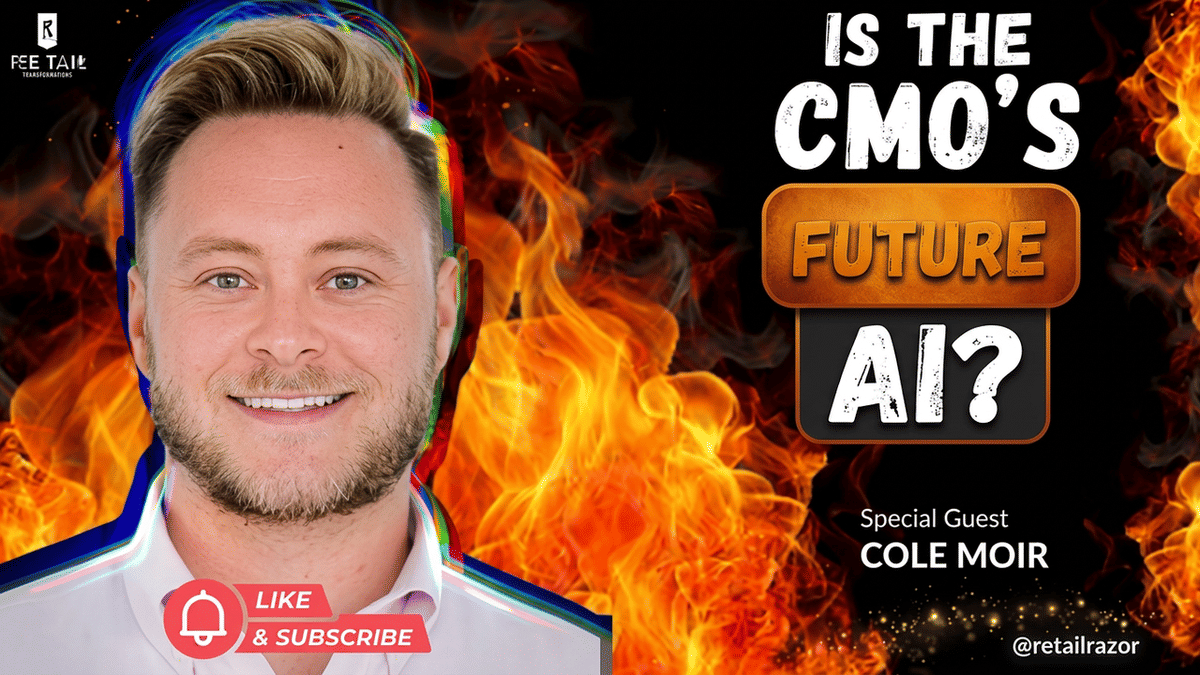
About 31% of Fortune 500 companies currently operate without a CMO role , according to Cole Moir, who most recently led brand marketing at TCL. Starbucks, Walgreens, and General Motors are among them. The CMO role's responsibilities moved to chief growth and chief revenue officers, and the work shifted from owning the calendar to owning measurable business impact.
Cole said that number about four minutes into Season 2, Episode 8 of Retail Transformers, and Casey Golden and I spent the next 45 minutes on what sits behind it.
He has worked both sides of the table for close to two decades. Agency years at Ogilvy, 360i, and Edelman, then Samsung, Sony Entertainment, Motorola, and most recently TCL, where the company became the fastest-growing consumer electronics brand for two consecutive years. He has owned the NFL brand relationship. He partnered with Olympic athletes. He has run Call of Duty campaigns. He is also at a transition point in his career, which is why this went places most CMO interviews don't.
Here is the argument, organized around the questions people are actually asking: what's happened to the CMO role, what an AI marketing organization looks like when it is staffed properly, and where the money goes.
Why do 31% of Fortune 500 companies have no CMO Role ?
The job got harder and the title stopped describing it. Cole's summary:
CMOs are asked to deliver more measurable impact with fewer resources, on shorter timelines, in markets that keep compounding.
Boards respond by renaming the CMO role, splitting its pieces across other titles, or leaving the seat open.
Twenty years ago, Cole says, the CMO role owned the marketing calendar and the budgets and carried 100% of the accountability for both. That's a contained job. That job fits in a sentence. You can staff against it.
Then the surface area expanded. Social media. Programmatic. Retail media networks. Creator economies. Each one arrived with its own measurement problem and none replaced what came before. Cole's word for those markets was dynamic, and he meant it as a warning: nothing settles long enough to build a repeatable playbook.
Meanwhile, the resourcing went the other way. Same expectations, faster clock, smaller team.
So boards rename it. Chief growth officer. Chief revenue officer. Sometimes the CMO role gets split across a chief digital officer, a chief customer officer, and a head of brand. Sometimes a CMO leaves and nobody gets hired to replace them. Cole named Starbucks, Walgreens, and General Motors.
His 2027 forecast: more complex modeling as channels multiply, new ways of measuring those models so a chief growth officer can be held to impact rather than activity, and AI built into systems rather than added to a stack that already existed. That last part doesn't mean replacing roles. It means reskilling people.
Where are CEOs on all of this?
The tell is how the CEO personally uses AI. Almost everyone is dipping a toe in, but few have worked out its full capability. CEOs using it to draft emails still picture the CMO role as it worked five years ago, and their org chart shows it.
The CEOs who have genuinely unpacked what AI can do already see marketing the way Cole describes it, as a growth and transformation function.
He expects a lot of movement here over the next couple of years, which is a polite way of saying the gap between those two groups is about to become visible in the numbers.
Will the next CEO come from marketing?
Cole thinks so, and said he would put money on it. His reasoning is visibility. As marketing budgets carry more responsibility for driving sales, the person running marketing develops a view of how the entire organization works, which is the traditional argument for promoting from sales.
Casey framed it well. The path to CEO used to run through revenue: sales leadership, a P&L, then the corner office. Marketing sat off to the side of that ladder.
Cole's argument is that the ladder moved.
When marketing owns growth, digital, loyalty, customer experience, and increasingly a P&L, the person at the top of that function is already doing a general management job.
His words : "It's not really about marketing anymore. It's really about transformation, and growth."
He framed this as a bet, not a trend line, and the sales-to-CEO path is still dominant in most industries. The logic holds anyway. Whoever is accountable for growth ends up with the broadest view of the business.
If you are building a succession bench, look at who in marketing can already read a P&L and defend a number to a board. That person is doing the modern CMO role whatever the business card says.
What does an AI marketing organization look like?
Cole describes an AI marketing organization built around capabilities rather than reporting lines. Small always-on strategy teams translate business problems into briefs. Cohorts of roughly five to twenty agents handle optimization and production. Humans hold taste and measurement. Silos collapse, and speed becomes the advantage.
Cole's premise is that the org chart of the future is less about who reports to whom and more about which capabilities leadership can activate, combine, and scale on demand. Teams get assembled around business problems rather than around whatever the marketing calendar says is due.
An AI marketing organization has three layers.
At the top, a small always-on strategic group. Their job is translation. They take a business objective and turn it into something an agentic system can act on. That's a scarce skill. Most briefs today are written for humans who already share the context. A brief written for an agent has to carry it explicitly, which will expose a lot of vague briefs.
In the middle, the agents. Cole put the number at five to fifteen, maybe twenty per team, optimizing existing work and creating new work.
Around all of it, humans managing taste and impact. Someone judges whether the output is good. Someone knows whether it worked.
The second-order effects matter more than the structure. An AI marketing organization runs with fewer people and less bureaucracy, so Cole expects speed to become the biggest available advantage, and he thinks smaller companies can finally take on enterprise incumbents. What leaves are the siloed social media person and PR person, replaced by cohorts organized around the problem.
Which four roles does every marketing team need?
Cole named four roles that have to exist:
head of brand
head of performance and lifestyle
head of content
head of marketing technology and AI
Each owns an outcome rather than a channel. He also named two hiring habits to stop, beginning with hiring people to own platforms.
If the CMO role is being redistributed, the next question is which jobs pick up the pieces. Cole read on current hiring is blunt. Most companies are still hiring the 2023 and 2024 org chart. They're hoping those people reskill.
Here's what the team needs instead.
Head of brand. Owns the vision and the budget. That means deciding what the brand stands for and what gets funded against it.
Head of performance and lifestyle. Covers who the consumer is, how that is evolving, and how the work drives impact. The pairing is deliberate. The behavior you optimize against and the culture the consumer lives inside are no longer separable.
Head of content. Responsible for scale and storytelling. When production capacity is effectively unlimited, this role decides what gets made. This is where taste, a human-only skill, comes into play.
Head of marketing technology and AI. Integrates process, data, and creative. Most companies don't have it yet, and Cole treats it as load-bearing in any AI marketing organization.
Then two things to stop.
Stop chasing platforms. Platform-shaped roles have a shelf life and whoever holds one gets stranded when the platform dies. And stop waiting for permission to use AI.
How should a brand split a $200 million marketing budget?
Cole's allocation on $200 million is in three parts. His floor is 25% across upper and mid funnel, and he believes brands under it lose out within two years. Budget allocation is the part of the CMO role that survives every rename, so Casey put the number on the table directly. Cole answered without hedging.
30% to 50% goes to upper funnel and consideration, adjusting for existing brand equity. A brand with weak awareness needs more here than one people already know.
20% to 30% goes to consideration and conversion, which Cole framed as driving sellout.
The remainder goes to testing. Emerging platforms. Creators at different tiers. Experiences, events, and partnerships.
At a billion dollars the answer changes shape rather than percentages. Cole starts owning major partnerships outright, using the NFL as his example, and reaching audiences at the TAM level rather than SAM and SOM. The question shifts from how do I convert the people already in the funnel to who should I be connecting with at all.
The floor is the part worth writing down.
Under 25% in the upper and mid funnel and Cole thinks you lose out within two years. His reasoning is the buying cycle. In technology he has worked with cycles running six months to seven years.
The people converting in 2028 enter consideration now. Starve the upper funnel and there is nobody to drop into the bottom of it when the cycle turns.
How do you prove brand investment works before the return shows up?
Cole runs two plays. Educate the organization on the methodology, including halo effect and the timeframes involved. Then run multi-touch attribution for a closer to real-time view that justifies part of the spend while the long-term case builds. Isolate with geo tests wherever the data allows.
I brought Cole a problem I keep hearing from brands.
A brand grows its presence on TikTok. Then its Amazon marketplace numbers move. Then Walmart moves. The TikTok Shop revenue is measurable and small. The spillover into three other channels is large and hard to attribute. Everyone in retail knows the effect is real. Almost nobody can prove it on a spreadsheet by Friday.
First, bring in the people who can teach the organization the methodology. Not a defense of the spend, an explanation of how the calculation works, including halo effect and the timeframes it pays out over. Once finance understands the model, the conversation stops being adversarial.
Second, set up multi-touch attribution for a closer to real-time read. It will not be complete. It will be enough to allocate a portion of spend while the long-term case builds.
Then isolate. Cole has been exploring geo-targeting and geo-fencing to hold markets out and measure lift. He was honest that isolation is the hard part, and the most convincing evidence available.
He has proof from his own numbers, if not the permission to share them. In a category where competitors were declining, TCL was growing, and Cole traces that to investments made earlier in the upper funnel.
One line stayed with me. Once you can define a tactic in terms of the strategy, you've earned the ability to run it long term. Before that, you're defending a line item every quarter. That shift is most of what the modern CMO role involves.
How do NFL and Olympic partnerships get justified?
Cole applies three tests to any partnership:
can it create credibility the brand has not earned,
give access to audiences it cannot otherwise reach,
produce content it cannot make at scale.
Then he finds the intersection where the brand authentically meets the property's audience.
Most brands start with the property. We want the NFL, what can it do for us. Cole starts elsewhere. What intersection am I sitting at, and how do I cross paths with something authentic to both my brand and my audience. That intersection creates a cultural moment instead of a logo placement.
Then three tests:
Can this partner create credibility I haven't earned?
Do they have access to audiences I can't reach?
Can they create content I couldn't produce at scale?
Most brands need one. At TCL, Cole needed all three, which he says is rare.
The numbers behind that decision are the best material in the episode.
Only about 5% of true NFL fans have ever been to a game. The other 95% watch at home, on their own TV or a friend's. And of the 100 most-watched TV shows over the last ten years, 96 are football.
For a television company, that is a category argument. The product is the surface the entire fandom already uses.
The Olympics shows the other half. TCL's platform was "inspire greatness," so the intersection was athletes rather than broadcast. The company partnered with Jack and Quinn Hughes four or five months before the Games to build the relationship first. Then Jack scored the gold medal goal. Cole quoted his old coach:
Success is when preparation meets opportunity.
How do you plan a partnership for business impact?
Casey asked exactly that and got the line the episode will be remembered for:
"measurement is my love language."
Cole runs the numbers before signing, modeling scale, scope, where his audience sits, and where additional reach comes from. Afterward he tracks lift in sales, shifts in traffic, and signups, with marketing mix modeling underneath to capture halo effect. The point of MMM is tracing how someone got introduced to the brand and converted months later.
How do you measure influencer marketing without last-click?
Cole's stack is brand lift studies run with the platforms, messaging pull-through to confirm the seeded message landed, and marketing mix modeling to capture halo effect and diminishing returns. Multi-touch attribution provides a faster read. Last-click alone will never prove a creator's value.
I asked whether we've hit peak influencer, and whether consumers catching on to paid deals has cost the channel its authenticity. Cole said no to both, and expects it to keep growing in new forms. The pressure he sees is on justification. Heads of marketing are asked to defend creator cost against an e-commerce scorecard, forcing a discovery and trust tactic to compete on direct response terms it was never designed to hit.
He splits the channel into two groups worth funding.
Always-on micro-influencers and UGC, more functional, supporting reach and frequency modeling. And affinity and community creators, whose audience is organized around a shared passion rather than a follower count. The first is tactical. The second builds trust.
Performance metrics still have a place, and Cole doesn't stop there.
Brand lift studies run with the platforms tell him how a creator is creating impact and who their audience actually is.
Messaging pull-through confirms the seeded message is what comes through.
Marketing mix modeling credits the work properly, capturing halo effect and diminishing returns, showing how someone building trust four or five months ago contributes to a conversion today.
Multi-touch attribution fills the gap in between.
His warning on last-click is direct. Use it alone and you will never prove the value of who influencers are and how they build brands.
How has AI changed creator discovery?
Selection moved from follower count to audience composition, location, and context, and Cole says tools like Creator IQ paired with AI now produce a more robust list.
His example is if you're partnering with the NFL, a tech reviewer talking about product specs is the wrong creator. You need someone who lives inside NFL fandom and can say why watching a game on your TV beats any other.
He still tests first, structuring contracts in two parts. A testing phase to find out whether a creator can carry the message authentically. Then, if it works, a longer-term partnership with consistent communication or activation around the specific brand moments that matter.
What skills should marketers build over the next five years?
Cole names three. Learn data, including how to turn it into a story that moves the business. Build taste, so you can judge AI-generated creative. Keep talking to real customers. He also names two things to stop. Chasing platforms, and waiting for permission to use AI.
Learn data. Cole started his career here, and his framing goes past managing and governing it. The skill is assembling the pieces into a story that produces the insight that moves the business. Data literacy without narrative ability stops at the dashboard.
Build taste. This is the one I hadn't heard a marketing leader say out loud. AI can produce infinite creative, which makes judgment the scarce input. Cole wants people who can tell good from bad, who know the difference between trendy and stylish, and who can articulate it well enough to evaluate incoming work against a brand identity. He pairs it with measurement, because the goal is knowing whether work will land before it ships.
Talk to real customers. He is a heavy AI proponent and won't give this up. What he tells his teams: we have all experienced life through different lenses, and he wants all of those points of view, because that is what decides what good looks like.
Taken together, these are the skills that carry someone into the CMO role as it now exists, whatever it ends up being called.
How do you know if your company has really integrated AI?
Cole's test is one question.
Remove AI from the company tomorrow. If the system breaks, AI is integrated. If everyone goes back to doing what they were already doing, it was attached to a marketing plan that ran fine without it, and nothing structural has changed.
This is the most portable idea in the episode.
Most companies use AI to write copy or resize creative. Useful work, and nothing depends on it. Take the tools away and the plan continues unchanged, because it was built before the tools arrived and never restructured around them.
So Cole proposes the removal test. If you took AI away from everyone tomorrow, would it break the system, or would everyone go back to what they were already doing? If they would go back, AI is attached to an existing marketing plan. If it breaks, the structure has changed and you have an AI marketing organization.
I've asked several people since recording. Every one would go back, including two who talk about AI constantly.
Cole put taste and integration side by side as the two things separating companies that adapt quickly from the ones that struggle. Taste decides whether the output is good. Integration decides whether it arrives at all.
What Cole is excited about.
Two things.
What AI is doing to creative and video production, because work now scales at a quality that was previously unaffordable. And, unusually, coming legislation, because guardrails force creative people to work inside a smaller box and still deliver impact.
Casey's version was sharper. There's now a level of production quality most companies could never afford, available to a solo founder willing to use the tools. Cole's framing is that it levels the playing field and puts the emphasis on good ideas rather than the biggest budget. Which is where I landed. We have solved the how. What's left is knowing what's worth making.
FAQs
How many Fortune 500 companies don't have a CMO Role ?
Roughly 31%, per Cole Moir on Retail Transformers S2E8. Starbucks, Walgreens, and General Motors are examples of companies without a traditional CMO role .
What is replacing the CMO role ?
Chief growth officer and chief revenue officer titles, with responsibility shifted toward measurable growth, transformation, and P&L outcomes. Some organizations split the CMO role across a chief digital officer, a chief customer officer, and a head of brand.
Can a CMO become a CEO ?
Cole expects it to become more common, because marketing budgets now carry more of the responsibility for driving sales and the CMO role sees how the whole organization runs. He framed it as a bet; the sales-to-CEO path is still dominant.
How much of a marketing budget should go to upper funnel ?
Cole's floor is 25% across upper and mid funnel. On a $200 million budget he'd put 30% to 50% into upper funnel and consideration, 20% to 30% into conversion, and the rest into testing.
What roles does a modern marketing team need ?
Four, per Cole. Head of brand, head of performance and lifestyle, head of content, and head of marketing technology and AI. Each owns an outcome rather than a channel.
What is an AI marketing organization ?
A structure where small always-on strategy teams translate business problems into briefs an agentic system can act on, cohorts of roughly five to twenty AI agents handle production, and humans own taste and measurement. Silos collapse and speed becomes the advantage.
How do brands measure influencer marketing ROI ?
Brand lift studies with the platforms, messaging pull-through, marketing mix modeling for halo effect and diminishing returns, and multi-touch attribution for a faster read. Last-click alone will never prove an upper-funnel creator's value.
How do brands evaluate partnerships with the NFL or the Olympics ?
Three tests: can the partner create credibility the brand hasn't earned, give access to audiences it can't reach, and produce content it can't make at scale. For TCL and the NFL the intersection was the television: 95% of fans watch at home, and 96 of the 100 most-watched shows of the decade are football.
How do you know if a company has really integrated AI ?
Cole's test: remove AI tomorrow. If the system breaks, AI is integrated. If everyone goes back to what they were already doing, it was attached to a existing marketing plan that ran fine without it.
What skills should marketers build for the next five years ?
Learn data, including how to turn it into a story that moves the business. Build taste, so you can judge which of AI's infinite options is right. Keep talking to real customers. Stop chasing platforms, and stop waiting for permission to use AI.
Hear the whole story.
The 31% number is the headline. The org chart underneath it is the story.
Three things to take from this for Monday morning.
Check your upper and mid-funnel share of spend, and if it's under 25%, put a number on what that costs you in two years.
Read your org chart for titles that are platform names, because those roles get stranded first and replacing them is the first structural step toward an AI marketing organization.
Ask Cole's AI question in your next leadership meeting, then ask it again about one specific team.
🎧 Hear the full conversation about the modern CMO role with Cole Moir on the Retail Transformers podcast.
Follow the show on Apple Podcasts, Spotify, or Goodpods, or watch on YouTube, so you never miss an episode. If you feel the series earns it, leave us a 5-star rating and a short review. It genuinely grows the show. Then explore the rest of the Retail Razor Podcast Network: The Retail Razor Show, Data Blades, and Blade to Greatness.
Stay sharp. Be bold. Keep transforming retail.
ABOUT THE AUTHOR
Ricardo Belmar is a retail tech analyst, top industry influencer and host of the Retail Transformers podcast, part of the Retail Razor Podcast Network, the #1 indie podcast network for retail, where he and Casey Golden interview the leaders shaping retail, consumer brands, and the future of commerce. He writes and speaks on retail technology, AI in retail, retail media, marketing, commerce strategy, and the leadership behind real retail transformation. He has spent his career working with retailers and the technology companies that serve them.
ABOUT THE PODCAST GUEST
Cole Moir is a growth architect who turns culture into commerce. Over nearly two decades at Ogilvy, 360i, and Edelman, and with brands like Samsung and Motorola, he's helped companies compete in crowded categories and win. Most recently, as VP of Brand and Digital Marketing at TCL North America, he led brand, digital, eCommerce, and performance strategy for the fastest-growing TV brand in the US for two consecutive years, backed by partnerships with the NFL and the International Olympic Committee. From the Oscar Mayer bacon dating app to the Motorola Razr relaunch and next-generation SQD-Mini LED innovation, his focus has never changed: helping brands punch above their weight and take outsized market share. Today, he's deep-diving into AI and advising growth-stage brands.
.