


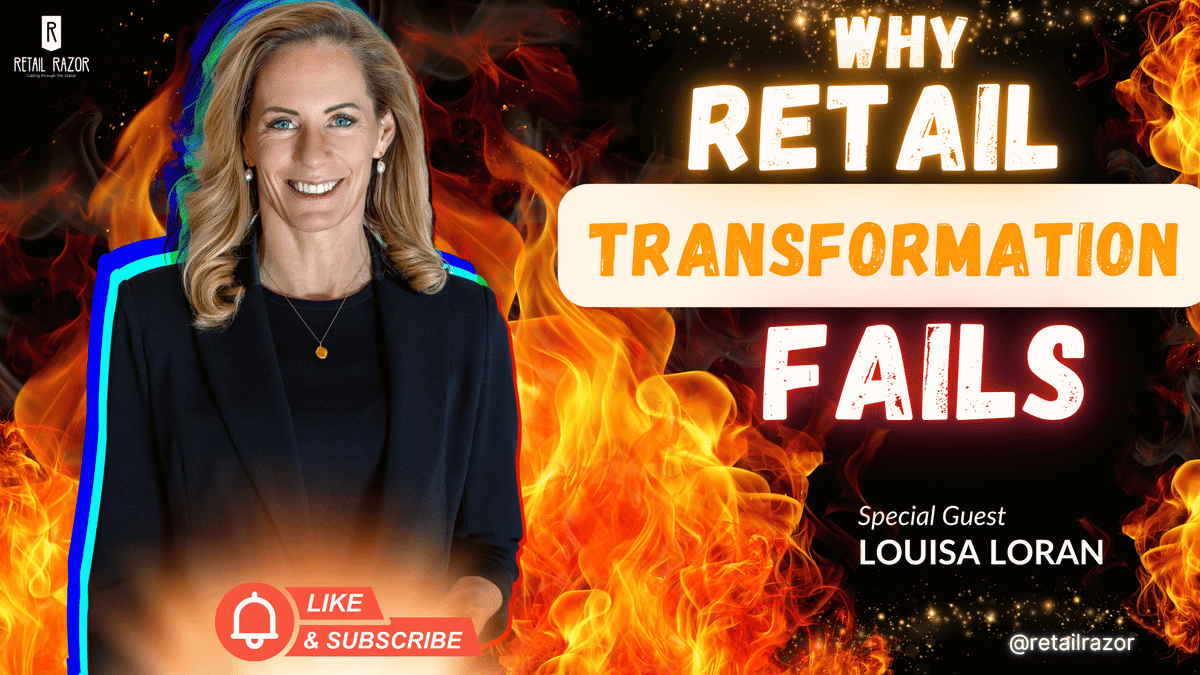
A new leader takes over a struggling retail brand. Within a few months there's a new logo, a fresh color palette, maybe a trendier font. The press release calls it transformation. Anyone who has spent real time in this industry knows better. It's a true leadership capacity gap.
I've been analyzing retail technology and leadership for years, and I keep landing on the same pattern.
The companies that stall rarely stall because they picked the wrong software or technology. They stall because of a leadership capacity gap that no tool can close. That was the throughline of my conversation with Louisa Loran on the latest episode of Retail Transformers. It reframed how I think about why retail transformation keeps failing to deliver.
Retail's Real Constraint Is the Leadership Capacity Gap.
Louisa's central argument is one every retail leader should sit with. The constraint holding retail back right now is leadership capacity. The tools exist. The budgets exist. The market keeps moving. What's missing is the willingness of the people at the top to unlearn what made them successful and become the change they keep asking their organizations to make.
I find this framing far more useful than the AI-will-save-us or AI-will-replace-us narratives flooding the industry.
Technology has become close to a commodity. The real differentiator now is leadership capacity, and most retail organizations are badly underinvested in it.
You Are a Chapter, Not the Book.
One line from Louisa has stuck with me since we recorded.
“You are a chapter in a book. You are not the book yourself.”
She said it about leaders who treat their tenure like a personal monument. Someone new arrives, changes the logo, rearranges the org chart, and calls it progress. Leadership tenures keep shrinking, so the cycle repeats before anyone builds anything that lasts. It's part of the leadership capacity gap.
Her point lands hard for retail specifically.
Brand equity in this industry gets built over decades and diluted in a single quarter of careless decisions. A new font is not going to fix your business. Respecting what a business already is, and understanding what legacy you're responsible for, is where real retail transformation starts.
Why Companies Keep Using AI to Automate Broken Experiences.
Here's the part of our conversation I've quoted most since.
Most companies are using AI to automate broken experiences faster than ever before.
Hand a team a powerful new tool and tell them to do their job better, and they will. They'll optimize their own narrow slice of the customer journey, blind to the four other teams touching that same customer.
Louisa gave a sharp example.
Customer service is measured on closing cases fast. Sales is measured on the upsell. One cancels what the other just booked, again and again, because nobody owns the actual outcome.
Layer AI on top of that and you fix nothing. You make the dysfunction more efficient.
This is the most important warning for anyone deploying AI in retail right now. The technology amplifies whatever structure it lands on. If the customer journey is broken and the incentives are siloed, AI in retail will scale the mess at speed.
The organizational work has to come first, and future-back thinking, starting from where the business creates real value and building toward it, is how the strongest leaders get there.
Luxury Became the New Baseline for Customer Experience.
Casey steered us into luxury, and it turned out to be the perfect lens for the whole conversation. Louisa's view is that luxury stopped being a category and quietly became a baseline expectation. Everyone wants to be treated like they matter now, whether they're buying a handbag or a value meal.
Social media created the illusion. Filters, staged Michelin-plated breakfasts, nightclubs most people will never enter.
Seeing luxury is not the same as living it.
The scent, the detail, the genuine hospitality, that's the part you can't screenshot, and it's the part that earns the margin.
My take, sharpened by this episode, is blunt.
Plenty of brands want luxury retail margins without investing in the customer experience that justifies them. Customers read that gap instantly. You can rebrand yourself as premium all you like. If the experience doesn't back it up, trust erodes, and trust is already scarce across the developed world.
Customer experience in retail is the product now, not a layer you add at the end.
The Four Leadership Behaviors That Separate Transformers From the Ones That Stall.
The framework underneath Louisa's book, Leadership Anatomy in Motion, is what she calls the four leadership behaviors:
envisioning ambitiously,
expanding with curiosity,
steering decisively, and
embodying change with presence.
She maps them cleanly onto the industry. Legacy retailers tend to be strong at steering decisively. They've optimized, scrutinized costs, and refined processes for years. Tech companies tend to be strong at envisioning ambitiously and expanding with curiosity, because they entered the market with a dream and a platform mindset.
The whole point of the four leadership behaviors is that each side can learn the ones it's missing from the other.
The fourth behavior is the one you cannot delegate. You can staff wingmen for the first three. You cannot hire someone to embody the change for you, because people don't follow a memo. They follow a person who is visibly becoming what the organization needs to become.
For retail leaders, that's the uncomfortable truth.
A transformation you won't model yourself simply will not happen. It's where leadership capacity fall short.
The Green Dashboard Trap: Mistaking Measurement for Progress.
My favorite exchange was about dashboards. Louisa's line is one I'll be repeating for a long time.
The problem isn't measurement, it's mistaking measurement for progress.
We've all felt the small hit of satisfaction when a number turns green on a dashboard. She'll ask what that the green number actually did for the business, and turns out half the time a red number would have been the better outcome.
Her deeper point is that measuring your objectives is measuring the past.
The leaders who pull ahead watch the leading indicators of the future they're trying to build and reward the small proof points that show the new direction works. That's a very different discipline from chasing a spreadsheet full of green, and most retail organizations have not built it yet. It's another example of why there is a leadership capacity gap.
The First Uncomfortable Shift Every Retail Leader Should Make.
I asked Louisa what the first uncomfortable shift is for a leader feeling the pressure to evolve this quarter. Her answer was almost suspiciously simple.
Know what you're great at, and bring more of that.
Stop hitting yourself over the head with everything you're not.
Then get curious, because the hardest shift for any senior leader is admitting they no longer have all the answers. For a career built on being the smartest person in the room, that's a genuine identity shift. That's the unlearning.
In an AI era where the floor is rising for everyone, curiosity and a real willingness to be challenged are what keep the ceiling from dropping.
Why Louisa Loran Is a True Retail Transformer.
Every guest on Retail Transformers has done something genuinely transformational in retail, and Louisa's record speaks for itself. At Google she launched a billion-dollar supply chain solutions business. At Maersk she helped co-author the strategy that doubled the company's share price and pivoted it from traditional shipping to integrated logistics. Before that she built iconic luxury brands at Moët Hennessy and Diageo.
Today she advises CEOs through their highest-stakes decisions. She's been recognized by the Thinkers50 Radar 2026 list of thinkers with the ideas most likely to shape the future..
What makes her a true retail transformer is not just the resume. She has led the change from the inside, repeatedly, across luxury, logistics, and technology, and distilled what worked into a framework other leaders can use.
That combination is rare, and it's exactly why this episode is worth your time.
Listen to the Full Episode.
This is one of those conversations that leaves you looking in the mirror, which is exactly what a good Retail Transformers episode should do. If you're a retail leader feeling the pressure to evolve, put this one near the top of your list. Louisa manages to be uncomfortable and hopeful in the same breath.
Listen to or watch the full episode with Louisa Loran here on our website, then ask yourself the question Louisa asks every leader she works with:
what would it take to change your mind?
ABOUT THE AUTHOR
Ricardo Belmar is a retail tech analyst, top industry influencer and host of the Retail Transformers podcast, part of the Retail Razor Podcast Network, the #1 indie podcast network for retail. He writes and speaks on retail technology, AI in retail, retail media, and the leadership behind real retail transformation.
ABOUT THE PODCAST GUEST
Louisa Loran advises CEOs and senior leadership teams through high-stakes decisions and structural change. Named to the Thinkers50 Radar 2026, she has led transformation at Google, Maersk, Diageo, and Moët Hennessy, and is the author of Leadership Anatomy in Motion (Fast Company Press). Connect at louisaloran.com and linkedin.com/in/louisa-loran.
Stay sharp. Be bold. Keep transforming retail.