

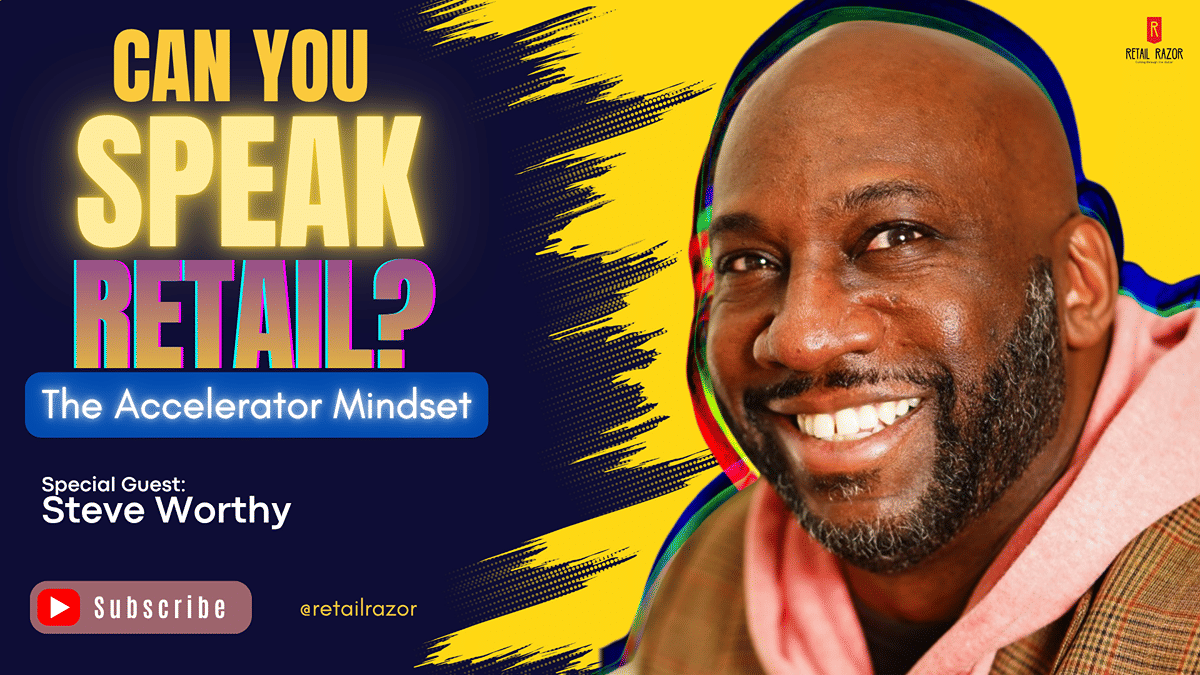
Good products fail in retail because they solve non-systemic problems, the surface issues a retailer can fix on its own. Retail buyers fund systemic problems that repeat across many stores. Steve Worthy, Founder of Worthy Global Retail, calls the discipline of telling those two apart the accelerator mindset . Steve joins us on the Blade to Greatness podcast to discuss.
What is the accelerator mindset for retail?
The accelerator mindset is Steve Worthy's framework for how growth actually happens in a retail business.
It has three parts:
founder fit,
product market fit as the retail buyer defines it,
and the ability to tell a systemic retail problem from a non-systemic one.
Steve teaches it through The Forge Accelerator and The Campus, the membership community he runs at Worthy Global Retail. He built it after conversations with sponsor companies in one of his studies showed a pattern: the companies could describe their product in detail and could not define the retail problem it solved.
Why do good products fail when they enter retail?
Because the product was good at solving something retail didn't need solved. Steve's answer on the podcast episode is to ask whether it was truly a great product for retail, or a temporary fix for a surface issue.
Products that address surface issues have short lifespans inside a retailer.
Products that address systemic issues stay, and adoption grows.
What is the difference between a systemic and a non-systemic retail problem?
A non-systemic problem can be fixed quickly, usually inside one team or one store. A systemic problem takes time, crosses departments, and repeats across the store fleet.
Steve used this split as an operator, walking markets: non-systemic issues got handled on the spot, systemic ones went up the chain.
The test he uses came from Gregg Steinhafel, then CEO of Target, during an interview years ago. If one store has the problem, it isn't an issue, and it's probably a leadership question at that store. If many stores have the same problem, there's something to solve and a conversation to have.
Why won't retailers tell vendors what their real problem is?
Because naming it makes them look bad. Steve was direct about this. Admitting a logistics failure, an in-stock problem, a bad buy, or weak training means putting a mistake on record. So the problem stays in-house.
That creates the trap.
A vendor is selling a solution to a problem the buyer has decided nobody outside the building gets to see.
As Steve put it, if I can't tell you I truly have a problem, I don't want your solution identifying the issue I don't want anybody else to know about.
What is founder fit, and why does it come before product-market fit?
Founder fit is the connection between the founder's own story and the retail space they're entering. Retail buyers are standoffish with outsiders, and the working assumption is that if you haven't worked the front end, you don't know retail.
A founder who can explain why they're in retail at all gets further into the conversation than one who leads with features.
Product-market fit comes next, and Steve's warning is that founders define it for themselves rather than for the buyer. It also moves. Fit is measured against what the retail buyer needs from the category now, not what the category looked like when the product was designed.
Are AI retail products repeating the .com era?
Steve thinks so. In the .com era, a website was enough to start making money, and most of those businesses didn't last, because they hadn't solved a real problem. He sees the same pattern in AI: real winners, real losers, and a lot of products that won't survive contact with a retailer's actual problem list.
The number he cites from Product School is that 80 to 85% of AI projects fail inside the companies that run them.
His answer for founders is the five whys. Push past the first answer until the real problem shows up. He says most founders have never run the exercise, and some finish it deciding to pivot.
What do retailers have to fix on their own side?
Their internal wiring. Steve's closing point is that retail problems are rarely contained in one department. One team isn't talking to another. Someone withholds information because of a personal issue with the department head. Those human problems are why decisions stall, and no vendor product fixes them.
Companies have to sort out their culture and how they solve problems internally before they can buy anyone's solution.
Frequently asked questions
Q: What is the accelerator mindset in retail?
A: The accelerator mindset is Steve Worthy's framework for retail growth: founder fit, product market fit as the retail buyer defines it, and the ability to separate systemic retail problems from non-systemic ones. He teaches it through The Forge Accelerator and The Campus at Worthy Global Retail.
Q: What percentage of AI projects fail inside companies?
A: Steve Worthy cites a figure from Product School of roughly 80 to 85% of AI projects failing within the company that runs them.
Q: Why do retail tech startups struggle to sell to retailers?
A: They pitch in their own language rather than the retailer's, and they often solve a surface problem. Retailers fund problems that repeat across many stores, and they rarely admit their real problems out loud.
Q: What is the multi-store test for a retail problem?
A: Gregg Steinhafel, then CEO of Target, described it to Steve Worthy this way: one store with a problem is not an issue, but the same problem across multiple stores is worth a conversation.
Q: What is founder fit?
A: The connection between a founder's own background and story and the market they're entering. In retail, buyers listen for it before they evaluate the product.
Q: Who is Steve Worthy?
A: Steve Worthy is the Founder of Worthy Global Retail, a former retail executive, a leadership coach, and the founder of The Forge Accelerator and The Campus. He also partners with Competitor IQ on mystery shopping and research programs.
Hear the whole story.
🎧 The full conversation with Steve Worthy on the accelerator mindset runs about 20 minutes on the Blade to Greatness podcast, season 2 episode 12, and is worth every one of them.
Subscribe to Blade to Greatness for a new retail leadership skill every episode, and if this one was useful, leave a comment with the question you're going to open your next huddle with.
Follow the show on Apple Podcasts, Spotify, or Goodpods, or watch on YouTube, so you never miss an episode. If you feel the series earns it, leave us a 5-star rating and a short review. It genuinely grows the show. Then explore the rest of the Retail Razor Podcast Network: The Retail Razor Show, Retail Transformers, and Data Blades.
Stay sharp, lead boldly, and stay human.
ABOUT THE AUTHOR
Ricardo Belmar is a retail tech analyst, top industry influencer and host of the Blade to Greatness podcast, part of the Retail Razor Podcast Network, the #1 indie podcast network for retail, where he and Casey Golden level up your retail career with the key leadership skills you need in the age of AI from industry experts & retail leaders. Ricardo writes and speaks on retail technology, AI in retail, retail media, marketing, commerce strategy, and the leadership behind real retail transformation. He has spent his career working with retailers and the technology companies that serve them.
ABOUT THE PODCAST GUEST
Retail is moving faster than most leaders can process. Steve Worthy teaches them how to slow down their thinking so they can speed up their results because clarity always beats chaos. Steve is the Founder and CEO of Worthy Retail Global, where he helps senior retail leaders simplify growth by focusing on clarity before action and purpose before performance. Through The Campus and The Forge Accelerator, Steve puts his leadership philosophy into practice. He helps retail leaders and founders define reality, lead with confidence, and build cultures where clarity drives results.
He also partners with Competitor IQ to add a human intelligence lens to retail and banking insights. He uses mystery shopping and research programs to connect data to how people actually behave. Steve believes leadership is not about doing more. It is about seeing more clearly and moving people forward with confidence.