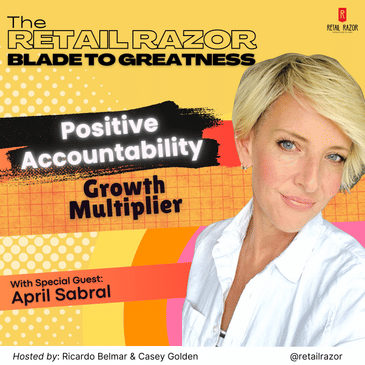



S2E5 - April Sabral Explains Why Positive Accountability Is the Growth Multiplier Every Retail Leader Needs
Positive accountability is more than a leadership tactic. It’s the growth multiplier that separates average teams from high‑performing ones. In this episode of Blade to Greatness, Ricardo Belmar and Casey Golden sit down with bestselling author and leadership coach April Sabral. April breaks down why positive accountability is the foundation of effective retail leadership. She explains how clarity, ownership, and fearless feedback transform execution.
April also shares why strategy without positive accountability is just hope. She talks about how leaders unintentionally create confusion, and the rituals that turn expectations into consistent results. From reducing burnout to building self‑managing teams, this conversation gives retail leaders a practical playbook for embedding positive accountability into everyday operations.
What You’ll Learn
Why positive accountability is freedom, not punishment
How to operationalize accountability without micromanaging
The nine‑step accountability framework April teaches retail leaders
How clarity and ownership reduce burnout and increase engagement
How fearless feedback and peer‑to‑peer coaching strengthen team performance
Why retail leadership must shift from “holding people accountable” to “you own this outcome”
How leaders create scalable systems that eliminate excuses and accelerate problem‑solving
Key Takeaways
Positive accountability creates clarity, ownership, and faster execution
Leaders must validate understanding, not assume it
Accountability rituals prevent micromanagement and build trust
Clear outcomes reduce burnout and help teams stay in their lane
Retail leadership succeeds when teams coach each other, not rely on the leader for every answer
Subscribe & Follow
Subscribe to the Retail Razor Podcast Network: https://retailrazor.com/
Subscribe to our Newsletter: https://retailrazor.substack.com
Subscribe to our YouTube channel: https://go.retailrazor.com/utube
Guest Spotlight
April Sabral — Leadership coach and author of Positive Accountability for Teams, founder of April Sabral Leadership & Ask April AI, Executive Director of the Miami Business Council. https://www.linkedin.com/in/aprilsabral/
April Sabral is a leadership and mindset expert, bestselling author, and founder of April Sabral Leadership and Ask April AI, an AI-powered coaching and training platform designed to support retail, hospitality, and service-based business owners. With over 30 years of experience leading teams at iconic global brands such as Starbucks, Gap, Banana Republic, and DAVIDsTEA, April has trained thousands of managers to become confident, people-focused leaders. Her proven leadership system, The Positive Effect, has been embraced by top brands including Jimmy Choo, Tory Burch, Sunglass Hut, Victoria’s Secret, and Psycho Bunny. Her bestselling book by the same name was named a Top Global Retail Book by the National Retail Federation in 2025 and is featured in the Forbes Leadership Library.
April has the only coaching certification in the retail industry that certifies leaders and coaches to train and license her proven methods.
April is also the Executive Director of the Miami Business Council, where she combines her passion for retail with community leadership. She has been named a Rethink Retail Top Global Retail Expert for four consecutive years (2022–2026) and is on a mission to positively impact one million leaders worldwide through practical business tools and mindset transformation.
Guest Resources
Positive Accountability for Teams, available on Amazon. https://a.co/d/0eX42X19
April Sabral Leadership. https://www.aprilsabral.com
Ask April AI. https://www.askaprilai.com
Music
Includes music provided by imunobeats.com, featuring Swag, Tag and Brag from the album Beat Hype, written by Heston Mimms, published by Imuno.
Transcript
S2E5 April - Positive Accountability is a Growth Multiplier
[00:00:00]
[00:00:00] Previews
[00:00:01] April Sabral: And so I always think of strategy without accountability is just hope. I had a leader a long time ago that said, hope is not a plan.
[00:00:08] And it followed through. Right. That's really important because I've taken on so many teams where everybody's like, the whole team's gotta go. You've gotta replace them all. And the first thing I always find out in that step really, that that situation is usually people just weren't clear on what was expected of them.
[00:00:22] So fewer excuses, faster problem solving and more peer-to-peer feedback. When you have a transparent culture of accountability, everybody will give. I learned this at Apple, actually. Fearless feedback. So we were trained to give fearless feedback, to give peer-to-peer feedback. We weren't scared of providing it, it was enabling us as a team to achieve our goals.
[00:00:46] So your goal should always be like, how do I get more time back in my schedule so that I can coach and develop people to be successful at what they're doing?
[00:00:58] Show Intro
[00:00:58] Ricardo Belmar: Welcome to Blade [00:01:00] to Greatness, the podcast where retail leaders sharpen their edge, one essential skill at a time.
[00:01:05] I'm Ricardo Belmar.
[00:01:06] Casey Golden: And I am Casey Golden.
[00:01:08] This episode dives into the leadership truth that changes everything. Accountability is not punishment. It's freedom. When expectations are clear and leaders hold steady, teams feel safer, move faster, and own outcomes.
[00:01:24] Ricardo Belmar: That's right. Today's guest is April Sabral, a leadership coach and bestselling author who transforms retail cultures into engines of ownership. April explains why strategy without accountability is just hope. How consistent follow through turns plans into results, and why a culture of ownership is the new competitive advantage that cuts turnover, lifts productivity, and builds self-managing teams.
[00:01:49] Casey Golden: Yeah. If you want practical ways to make accountability, feel empowering instead of punitive, ready to use rituals that drive execution and hiring and [00:02:00] coaching moves that create lasting ownership. This is the episode that will give you the playbook.
[00:02:06] Now before we jump in, I have one quick ask for our listeners and viewers. If you like our show, please consider giving us a five star rating and drop a quick review on Apple Podcasts, Spotify, YouTube, or Good pods. We appreciate your support.
[00:02:22] Ricardo Belmar: That's right, and we would be remiss if we didn't drop a quick plug for the other shows in the Retail Razor Podcast Network. So please do yourself a favor, go check 'em out. There's the Retail Razor Show, Retail Transformers and Data Blades. If you're on Apple Podcasts, just search for the Retail Razor Channel to find them or visit our YouTube channel and see all of us in our wonder and glory on video and watch them all.
[00:02:45] Casey Golden: All right. With that said, let's start the show.
[00:02:47]
[00:02:53] Welcome April Sabral
[00:02:53] Casey Golden: April, welcome back to another Blade of Greatness. Always enjoy having you on the show.
[00:02:58] April Sabral: Thank you so much. I'm so excited to [00:03:00] be here.
[00:03:00] Ricardo Belmar: So today you're gonna talk about a, another very important skill every retail leader needs to master. Positive accountability. Now, many leaders may have a misconception about what accountability really means. I think you've spoken often about how accountability is really a growth multiplier and truly a positive characteristic of good leadership.
[00:03:20] And this is really, I think, fundamental in your new book, right? So tell us more about this.
[00:03:24] Redefining Accountability
[00:03:24] April Sabral: Yeah. I always think about accountability as a step-by-step process. Most leaders, when I ask them what accountability is, they actually tell me it's a performance conversation or an icky conversation, and it's when somebody's not doing their job well, and that's how they view it. So it's associated very negatively.
[00:03:42] It's always oh, I wanna hold them accountable, but what does that actually mean? And how can you actually create that across your whole organization. If you have a hundred people, 50 people to 5,000 people and upwards, right?
[00:03:53] Hope Is Not a Plan
[00:03:59] April Sabral: And so I always think of strategy without accountability is just hope. I had a leader a long time ago that said, hope is not a [00:04:00] plan.
[00:04:00] You can hope. You hold people accountable. You can hope they do what you want them to do. And so, that was really an eye-opening conversation I had with her. And then I realized, yeah, it actually isn't just an idea. It's actually a step-by-step process. I don't know. Retail people, we love acronyms, we love processes, we love following things.
[00:04:18] And so I think breaking it down into a clear step-by-step process is really important for everybody to know what accountability is. If you ask and try this, if you're at a meeting or a dinner table, maybe not a dinner table, maybe a morning meeting with your team and you ask them, what is accountability?
[00:04:39] Everybody watching this? Just go and ask your team this, this week. You'll get 25 different answers. That in itself creates a problem, because the whole thing around accountability is about creating clarity and ownership. So if you don't know what it is. You actually can't have clarity and ownership, right?
[00:04:57] So it has to be, it has to be a clear [00:05:00] step process. And I think accountability works best that way and when it's in visible steps that everybody can articulate.
[00:05:07] Ricardo Belmar: Yeah, I think that's so true. So one of the things that you said before that always stands out to me and you just touched on it, that, a strategy without accountability is really just hope. And like you said, hope is not really a strategy. So what's a measurable cadence or maybe a metric set that a retail leader should use to really ensure that consistent execution, like you were just talking about, without resorting to micromanagement.
[00:05:30] Nine Steps Framework
[00:05:30] April Sabral: Yeah, because micromanaging is when you're not actually setting up the team within a clear accountability framework because now everything's going wrong and you're jumping in and you're having to correct everything and fix everything, and that doesn't feel good for anybody. So I'm gonna go back to the, the nine steps because I think that is something you can measure.
[00:05:48] There is nine clear steps in it, and the first one being just setting people up with clear expectations and ownership. And instead of saying to somebody, I'm holding you accountable to this, say, you own this [00:06:00] outcome. It's a shift, it's a differentiator because it's okay, I've just clarified what I'm actually holding them.
[00:06:07] What accountability is, you own this outcome. You know what that means, right? When I say that to you. So within the nine steps there is. These very specific ways of making sure that they're in place. And I think then you can measure that because you can now measure. You own this outcome. If you don't get the outcome we want, you actually owned it, whatever that is.
[00:06:27] Whether that be when I was in stores as a sales goal, leading a company, a sales goal, a payroll goal, my CFO said, I'm holding you accountable for this. I'd be like, okay, but if he says, you own this outcome, this is what you are being measured on your performance. I'm like, oh, right, okay. I own the comp goal that you're asking me to do.
[00:06:45] So that's it. It's the same KPIs. But it's applying the accountability framework to those KPIs so everybody's really clear.
[00:06:56] Casey Golden: That also allows us to operationalize accountability [00:07:00] so teams can. And experiences of freedom rather than a punishment, because it is, somebody says I'm gonna hold you accountable. It's just ah, like I didn't do anything wrong yet. Or, having the freedom of, if this is my outcome and I'm responsible for it, then I understand that I also have some leeway and some freedom to solve problems without having to ask permission can just go ahead and say I'm accountable for that end result.
[00:07:25] This is happening. I need to do some recon here and just have the feel like you have the freedom and ownership to fix things along the way without having to tap into management again.
[00:07:39] April Sabral: Yeah, a hundred percent.
[00:07:40] Rituals Without Micromanaging
[00:07:41] April Sabral: I think that's so key, right? Because I don't know how many times you've been in a meeting both of you, where you've sat there and somebody says something and you nod your head and you walk away and you're like, oh my God, what did they say? What do I have to do? And you try to find five other people to figure that out, right?
[00:07:55] And so that doesn't create ownership and freedom, what you just said, Casey, [00:08:00]around having the freedom to go and take ownership and without being babysat or micromanaged. And that's the thing, you want everybody walking out that meeting being very, very clear, very clear on what's expected. And that is then operationalizing it.
[00:08:15] It's just not this idea. Right. It becomes practical, it becomes executionable if that's even a word, but, but I think that's, that's really important and, and I see that time and time again. And you need to build in rituals, like using different language, validating for understanding putting follow up in your week having a standing meeting where you're just talking about, where you're at in the process.
[00:08:40] And it followed through. Right. That's really important because I've taken on so many teams where everybody's like, the whole team's gotta go. You've gotta replace them all. And the first thing I always find out in that step really, that that situation is usually people just weren't clear on what was expected of them.
[00:08:54] Ricardo Belmar: Hmm.
[00:08:55] April Sabral: You can just clarify it and get them moving forwards to execute what you want. [00:09:00] That's how the operationalization becomes part of the results. And people walk around with 10 different expectations in the head not knowing really what the company wants of them. 'cause the leader hasn't been able to communicate that.
[00:09:12] Ricardo Belmar: Right. Yeah.
[00:09:12] Signals It’s Working
[00:09:16] Ricardo Belmar: It really is about creating that culture of positive accountability. And I suppose now if we look at that, once you have that culture I'm sure it must really change those day-to-day employee engagement and job satisfaction, just general attitudes about what they're doing, because they're getting that added clarity. Are there any short term signals that leaders should watch for that tell them that yes, this is working, that we really have improved and shifted the mindset?
[00:09:39] April Sabral: Yeah, I think looking for fewer excuses,
[00:09:43] Ricardo Belmar: Hmm
[00:09:43] April Sabral: right? Blame game, like, oh, the company hasn't given me everything I need. There's no traffic in the store. Like that sale wasn't good enough. Look for fewer excuses. ' cause when people own something and they're positive and they wanna go and reach that result, they're not gonna blame things [00:10:00] externally to them.
[00:10:00] So fewer excuses, faster problem solving and more peer-to-peer feedback. When you have a transparent culture of accountability, everybody will give. I learned this at Apple, actually. Fearless feedback. So we were trained to give fearless feedback, to give peer-to-peer feedback. We weren't scared of providing it, it was enabling us as a team to achieve our goals.
[00:10:24] So that's really important and, when team members actually start coaching each other without you stepping in as a leader. Accountability has now shifted from being top down to actually cultural. I'm gonna hold my team member accountable and coach that person and help that person solve that problem.
[00:10:43] And we don't always need to go and ask, the leader. A lot of times when I'm talking to leaders, they're like, I feel like I'm Google of my department. Like I'm getting questions all day.
[00:10:54] Right.
[00:10:54] Ricardo Belmar: comes to them on everything.
[00:10:56] April Sabral: Everybody comes to them, and that's because they have not set up [00:11:00] a culture of accountability. So if that's happening to you, you really need to reflect and think about that and then ask yourself like, how do I shift this to ownership?
[00:11:10] You should not be getting the questions all day. I remember having a regional director that said to me. If you can't shift from answering the phone all day when you're off, you're never gonna get more stores. You just can't. You can, you can't manage one and, and delegate that. You're not gonna be able to do it tomorrow.
[00:11:25] So how do you scale your leadership? Right.
[00:11:27] Reducing Burnout With Clarity
[00:11:27] Casey Golden: If an organization is, is starting to make these changes and starting to implement accountability practices. What would directly improve, like employee satisfaction or reduce burnout, or what should they be looking at as I'm starting, this is where I'm gonna start. This is the goal and this is how I'm gonna measure it.
[00:11:52] April Sabral: Yeah, I think about this a lot 'cause I had a retail client where burnout was super duper high because no one knew who owned what. [00:12:00] Like literally. So we had to start there. We implemented like accountability maps for each role, and each role had three clear outcomes that they needed to deliver within 90 days.
[00:12:14] And just making sure that people were clear on what needed to be done. Literally stopped people stepping on each other's toes. Because when things aren't clear and you don't know what your lane is, then you start stepping into other people's roles. I dunno, I've had that happen to me a lot, right? When clarity wasn't there.
[00:12:34] What do you own? What do I own? And that causes a problem. And I think everybody wants to know what's expected of them. If, if you ask any employee on your team, are you clear of what's expected? And they say no, then you need to really sit down with that person and make sure that they understand what's clear so they're not doing 20 more things than they should be, and that they can feel like they can achieve success.
[00:12:57] What does it look like for you to be [00:13:00] successful? And when we did that with this specific client within 90 days, people stopped stepping on each other's toes like. The engagement ha rose. People were really happy about what they were doing and managers finally had the time to coach instead of just firefight.
[00:13:18] And I think that's the big one because why should you care about this as a leader? Because if you get more time back in your schedule, it's not about you going and having another day off or like, skipping out. It's about you having more time to coach people. People wanna be coached, they wanna be developed.
[00:13:33] So your goal should always be like, how do I get more time back in my schedule so that I can coach and develop people to be successful at what they're doing? And just keep coming back to that. And if people aren't doing all of what they need to be doing, you have to reflective, I've been clear, is there a clear outcome, is there measurements?
[00:13:48] Is there objective set? All of that. And it sounds really obvious, but I can't tell you how many times. People are just not clear on what they need to do. And that is step number, like [00:14:00]literally.
[00:14:00] Trust and Repeat Back
[00:14:01] April Sabral: And that's because repeat back to me. Tell me what you understood about what success looked like. Nobody ever asked that question.
[00:14:07] I had a leader tell me the other day. That means I have to spend more time then clarifying and teaching. Yeah.
[00:14:14] Casey Golden: Yes.
[00:14:14] Ricardo Belmar: But it's time well invested.
[00:14:17] Casey Golden: comes with building trust to get a no,
[00:14:21] Ricardo Belmar: Yeah.
[00:14:21] Casey Golden: because if, if you don't have that trust as a leader and you're not present and your senior leadership comes to you and asks you that question. You're just gonna be like, well, of course, even though you may not,
[00:14:35] April Sabral: Yeah,
[00:14:36] Casey Golden: you have that trust there, you're just gonna say, of course.
[00:14:39] And they're gonna walk away
[00:14:40] Ricardo Belmar: exactly. and then nothing happens.
[00:14:42] Casey Golden: here
[00:14:42] Ricardo Belmar: right? Yeah.
[00:14:43] Leadership Ownership and Costs
[00:14:43] Ricardo Belmar: And then the outcomes don't happen the way you want them and
[00:14:45] April Sabral: and then everybody's like, oh, change the team.
[00:14:47] Ricardo Belmar: Right. Change the team. When it really, it had to do with the leadership. Yeah.
[00:14:50] April Sabral: Right, and that's not the answer. Because that is so costly. It's so costly to keep replacing team members, and then you just end up in the same cycle, so you have to fix that problem.[00:15:00]
[00:15:00] Ricardo Belmar: And break the cycle. Yeah. Yeah.
[00:15:01] Wrap Up and Takeaways
[00:15:03] Ricardo Belmar: No, it's a great, great point as to why, this idea of positive accountability is so, so critical and so important. So April, this has been another enlightening discussion. Thank you so much for highlighting that the significance of positive accountability and really it's almost like where leadership begins.
[00:15:16] April Sabral: It does.
[00:15:17] Casey Golden: You are an incredible model for positivity. And I've said it before on the show, we need more retailers to think and act this way.
[00:15:24] Well, Ricardo, I'd say that this episode is a wrap.
[00:15:27]
[00:15:27] Show Close
[00:15:33] Casey Golden: If you enjoyed our show, we have a simple ask. Please consider giving us a five star rating and review on Apple Podcast, Spotify, or Good pods. Remember to smash that subscribe button in your favorite podcast player and like, and subscribe to our YouTube channel so you don't miss an episode.
[00:15:50] I'm Casey Golden.
[00:15:52] Ricardo Belmar: Please follow us and share your feedback at Retail Razor on LinkedIn, Bluesky, Threads and Instagram. Subscribe to [00:16:00] our Substack newsletter to preview the best highlights from each episode writing your email inbox. Visit our website at retailrazor.com for transcripts and more info about each episode and our amazing guests.
[00:16:13] Blade to Greatness is part of the Retail Razor Podcast Network.
[00:16:17] I'm Ricardo Belmar.
[00:16:18] Casey Golden: Thanks for joining us.
[00:16:20] Ricardo Belmar: Until next time, stay sharp, lead boldly, and stay human.
[00:16:23] This is the Retail Razor Blade to Greatness.
[00:16:26]