
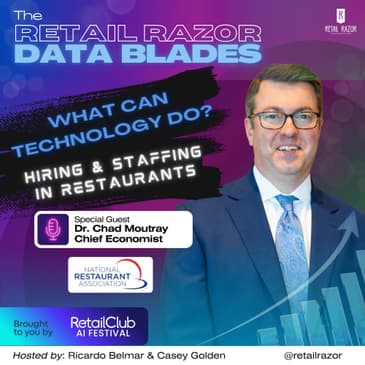


Everyone assumes restaurant automation means fewer jobs. The National Restaurant Association’s data says 94% of operators cut zero: their technology investments over the past two to three years did not permanently eliminate a single role.
In the finale of our three-part hiring and staffing series, Dr. Chad Moutray, Chief Economist and SVP of Industry Research and Knowledge at the National Restaurant Association, joins Ricardo Belmar and Casey Golden to close the loop on restaurant technology and restaurant staffing. We started our 3-part mini-series with a cooling labor market, moved through the cost of being short-staffed, and covered how to keep your best people. This episode answers the question every operator is asking: where does technology fit?
Chad walks through where restaurant technology delivers the clearest wins, from cutting hiring time from weeks to a few days, to chatbots that screen and schedule interviews at 2 a.m. while a manager sleeps, to onboarding and retention tools that keep new hires on the floor faster. He is candid about the tradeoffs too: new tools usually add work before they save it, and teams often need reskilling, so the human touch stays at the center.
What you'll learn in this episode:
- Why 94% of operators kept every role after investing in restaurant technology
- How the 2.8% full-service profit margin drives every restaurant staffing decision
- Where technology cuts restaurant hiring from weeks to days
- How chatbots and self-scheduling meet applicants where they are
- Why the human touch is the one thing automation can’t replace in hospitality
Resource Links
HIRING & STAFFING How Onboarding, Managers, & Technology Drive Restaurant ROI.https://www.restaurant.org/research-and-media/research/research-reports/research-insight-workforce-hiring-staffing/
State of the Restaurant Industry 2026. https://restaurant.org/research-and-media/research/research-reports/state-of-the-industry/
Support Our Sponsor
This Episode is Brought to You By RetailClub.
Retail Club AI Festival, September 22–24 in Huntington Beach. Join 2,000 retail leaders for a fully outdoor, beachside deep dive into how AI is reshaping retail. Qualified retailers and brands can attend with free tickets and up to $1,250 in travel reimbursement. Head to retailclub.com to learn more. https://retailclub.com/retail-razor-podcast
Subscribe & Follow
Don't forget to like and subscribe to The Retail Razor: Data Blades for more episodes on customer experience, retail marketing, AI in retail, and data‑driven transformation!
Subscribe to the Retail Razor Podcast Network: https://retailrazor.com/
Subscribe to our Newsletter: https://retailrazor.substack.com
Subscribe to our YouTube channel: https://go.retailrazor.com/utube
About Our Guest
Dr Chad Moutray, Ph.D., CBE, https://www.linkedin.com/in/chadmoutray/
Chief Economist & Sr Vice President of Industry Research & Knowledge
National Restaurant Association, https://www.restaurant.org/
Chad Moutray is senior vice president for research & knowledge and chief economist at the National Restaurant Association, where he leads economic analysis, data-driven insights, and thought leadership for business leaders in the restaurant and foodservice industry. A recognized expert on economic trends, he frequently shares his perspectives through professional presentations, media interviews, and industry reports.
Dr. Moutray is an adjunct professor at George Washington University, where he teaches econometrics in the M.S. in the applied economics program. He has held leadership roles in several professional organizations, including serving as chair of the Conference of Business Economists and as a board member of the National Association for Business Economics. He is also a past president and chairman of the National Economists Club, the Washington, D.C. chapter of NABE. In 2026, he will begin serving on the board of trustees of the John Leland Center for Theological Studies in Arlington, VA.
Chapters
(00:00) Teaser
(00:40) Show Intro
(02:48) Welcome Back Chad Moutray!
(03:38) Robots Taking Jobs
(04:11) Tech Boosts Efficiency
(06:20) Hiring Process Wins
(08:18) Chatbots and Scheduling
(09:29) Onboarding and Retention
(10:53) Hospitality vs Automation
(12:34) Employee Buy In
(14:24) Big Takeaways 2026
(16:58) Where to Find Report
(17:48) Show Close
About your Hosts
Helping you cut through the clutter in retail data insights:
Ricardo Belmar is an NRF Top Retail Voice for 2025 and a RETHINK Retail Top Retail Expert from 2021 – 2026. Thinkers 360 has named him a Top 10 Thought Leader in Retail, a Top 25 Thought Leader in AGI and Careers, a Top 50 Thought Leader in Agentic AIand Management, and a Top 100 Thought Leader in Digital Transformation and Transformation. Thinkers 360 also named him a Top Digital Voice for 2024 and 2025. He is an advisory council member at George Mason University’s Center for Retail Transformationand the Retail Cloud Alliance. He was most recently the partner marketing leader for retail & consumer goods in the Americas at Microsoft.
Casey Golden, is the North America Leader for Retail & Consumer Goods at CI&T, and CEO of Luxlock. She is a RETHINK Retail Top Retail Expert from 2023 - 2026, and Retail Cloud Alliance advisory council member. After a career on the fashion and supply chain technology side of the business, Casey is obsessed with the customer relationship between the brand and the consumer and is slaying franken-stacks and building retail tech!
Music
Includes music provided by imunobeats.com, featuring Tech Lore from the album Beat Hype, written by Heston Mimms, published by Imuno.
- [00:08:30] - There's not normally a manager processing that, but you could have using technology some type of a chatbot or something that…
- [00:05:22] - Yeah. And I think just to throw a stat out there from the paper that kinda solidifies that and validates that is 94% of…
- [00:03:55] - Well, think there's always been scary scary stories about how technology, the robots were taking our jobs away. If you go back…
Everyone says restaurant tech means fewer jobs.
The data says 94% of operators actually cut zero.
Casey Golden:We talked with the National Restaurant Association's chief
economist, Dr. Chad Moutray, about where technology actually helps restaurants
hire and train faster, and the one thing automation still can't replace.
Ricardo Belmar:Here's a hint.
Every person who walks into a restaurant, they came in to have a good time.
Casey Golden:Hmm.
Stick around and watch the full episode and you'll understand.
Ricardo Belmar:Welcome back to season two of the Data Blades Podcast, part of
the Retail Razor Podcast Network, where we cut through the noise and get to the
numbers that move your business forward.
I'm Ricardo Belmar.
Casey Golden:And I'm Casey Golden.
Welcome to episode 12, the finale of our three-part hiring and staffing miniseries.
We've covered the labor market, the cost of being short-staffed,
and how to keep your best people.
Today, we tackle the big question we're all asking: Where does technology fit?
Ricardo Belmar:That's right.
So once again, we are joined by Dr. Chad Moutray, chief economist and senior
vice president of Industry Research and Knowledge at the National Restaurant
Association for all the answers
Casey Golden:This one's about using technology to hire and train
faster without losing the human touch that makes hospitality work.
Ricardo Belmar:Now, before we dive in with Chad, a quick word about the folks
who make this show and the Retail Razor Podcast Network possible, RetailClub.
Join 2,000 retail leaders at the Retail Club AI Festival, September 22nd to
24th in Huntington Beach, where you'll dive deep into how AI is reshaping
retail, all while soaking up the sun at a fully outdoor beachside venue.
Decision-makers from retailers and brands can attend with free tickets and
up to $1,250 in travel reimbursement.
Head to retailclub.com/retail-razor-podcast to
learn more and get your ticket today.
Casey and I will be there for the best conversations on how AI impacts
customer experience and pretty much every operational part of your business.
I hope you'll join us.
Casey Golden:If this series has been useful, hit like, subscribe, and leave us
a five-star rating and review on YouTube, Apple Podcasts, Spotify, and Goodpods
so more opportu- operators can find it.
It'll only take you a fraction of a second.
Ricardo Belmar:All right.
With that out of the way, let's close out this miniseries.
Here's part three of our deep dive into how technology helps with hiring
and retaining staff with Dr. Chad Moutray, chief economist and SVP of
Industry Research and Knowledge at the National Restaurant Association.
Dr. Chad Moutray, welcome back to the Data Blades Podcast.
We're excited to have you back with us today to close out this fantastic
three-part series on hiring and staffing in restaurants based on your recent
research insight report, Hiring and Staffing: How Onboarding, Managers,
and Technology Drive Restaurant ROI
Dr Chad Moutray:Great to be back.
Looking forward to the third segment here.
Casey Golden:Today we're tackling the big question for restaurant operators.
It's all about technology, what it can and what it can't do for your
business and customer experience.
So Chad, you previously gave us the rundown on your role at the National
Restaurant Association as chief economist and head of industry research.
So everybody will have to tune back in to catch the background, and we're gonna
go ahead and dive into today's topic.
Ricardo Belmar:All right
Dr Chad Moutray:That works.
Casey Golden:So this is the big one, what we've been waiting for.
there is a real fear that automation in restaurants means fewer jobs and robots.
Ricardo Belmar:Yeah
What
Casey Golden:does the data actually say?
Dr Chad Moutray:Well, I think there's always been scary, scary
stories about how technology, the robots were taking our jobs away.
if you go back thirty-plus years, there was worries that spreadsheets
were gonna take accountants' jobs away, and it didn't, right?
And, and, back in again when I was in the manufacturing world,
there was worries about that.
I think one of the things that we typically find is that technology,
rather than displacing people, makes workers more productive, right?
and, and we, we live in a world where the math is very
difficult for restaurants, right?
The profit margins continue to get squeezed.
We know the typical full-service restaurant makes just two
point eight percent, right?
Now, that's, that's the typical profit margin.
Ricardo Belmar:That is tight.
Dr Chad Moutray:limited service, it's four.
Casey Golden:worse than beauty
Dr Chad Moutray:number's probably continuing to shrink, right?
And so restaurants are looking at technology as, "How can I make my
workers more efficient? How can I make my operations more efficient?" So
whether that's using smarter purchasing power, whether it's improving overall
throughput in the kitchen, right?
Making sure that customer experience is improved through, through
technology, or the purpose of this paper, speeding up the hiring process.
I think all of that makes operations more efficient, helps the bottom line, but
it also hopefully helps improve both the customer and the employee experience.
And yes, there's a lot of scary stories out there about robots, but I think
what we have typically seen, and most, most restaurants tell us this, they,
they-- it simply makes the workers more, productive and efficient, right?
More than anything else.
Casey Golden:Yeah, and I think just to, throw a stat out there from the paper
that kind of solidifies that and validates that is 94% of operators said their tech
investments over the past two to three years did not permanently eliminate jobs.
Dr Chad Moutray:Yeah.
Ricardo Belmar:There you
go
Dr Chad Moutray:you, you, you give the number from, my paper, which is great.
Which is not, which is not, yeah.
Casey Golden:I took some notes because
Ricardo Belmar:There's a lot of information in
Casey Golden:this paper is very impressive.
like I said, like the stats are so interesting and compelling
because you can take-- you can go down multiple rabbit holes.
You can look at what the take is on how the economy's doing, how, what's
gonna happen in commerce, what's happening in retail, what's happening,
in a lot of different aspects.
Yeah, if, if I had printed the report, it would've been
filled with yellow highlighter.
Ricardo Belmar:Exactly.
Exactly.
So in part one when we-- of the series when we talked about that hiring process
and what's happening there, we hinted at this, but w- Chad, w-where would you
say is technology delivering the, the clearest wins for restaurants right now?
Is it in that hiring process, or are there other areas around
staffing, retention, so forth, where there's a lot of wins to be had?
Dr Chad Moutray:We've, we talked in earlier segments about the turnover rate, right?
A hundred and twenty-two percent is the average.
We-- But what we didn't talk about is just how many people, how easy
it is to apply for jobs, right?
Not only is it easier, technology make it easier for, for employers to
hire, it's also very easy to apply for just a ton of positions, right?
And so there's a lot of competition out there when it comes to finding
workers and speeding up that process.
There was a stat that we did in, in the first paper we wrote that the,
that the typical person applies to at least fifteen jobs, right?
And that, that's pro- again, very easy to apply for jobs using technology.
And you want to get that person fast, right?
Because the last thing you want is, uh, I, I take my time and, and
they're already across the street
Ricardo Belmar:yeah, exactly.
Yeah, they take somebody else's offer
Dr Chad Moutray:you want to speed that process up, but you're also
dealing with the sheer, the sheer volume of resumes coming your way
and applications coming your way.
And so that could take hours or days of time for managers, right?
And so what, I think what technology has done is it's sped
up that process, but it's also made it easier for, for managers.
And that the bottom line is you hired managers to run the restaurant, right?
and it-- the more time they're taking in processing resumes, interviewing,
that's less time that they're doing to running their restaurant.
So I think technology has sped that up.
So I think in the first or second segment, we talked about how, manually processing
all of this could take weeks, right?
And we've seen examples for where operators, from the time you post that
position to actually hiring them is, is a matter of just a few days, right?
And so that speeds up.
You eliminate some of that understaffing.
But it also, I think, think of how people apply for jobs, right?
I, You might be applying and maybe you're working all day long, and you're
applying after the kids go to bed, right?
So you're applying at one, two, three in the morning or whenever you go to bed.
There's not normally a a manager processing that.
But you could have, using technology, some type of a chatbot
or something that would s- maybe ask you a set of questions, right?
that again, they're not really doing major screening, but maybe just
making sure that you really are up-- qualified to apply for this role.
And then, it, it might even set up, a-an interview for you, right?
So you're already, already knows the manager's schedule, and you sim-simply can
place yourself on that person's calendar.
And you, you still have the human touch, right?
A manager is still looking at the application.
A manager is still doing the hiring, but you've… using technology to
help that process along to, to meet, possible employees where they are.
And I think that's a large part of why that has helped
Ricardo Belmar:Yeah.
Yeah.
What, what about in areas like, 'cause you, you mentioned, we keep coming
back to this theme that, hospitality, it's fundamentally high touch.
So yes, you, you can benefit from technology and things like the
hiring process, and that's amazing.
You can cut the time down from weeks to a few days.
What about in areas like, once you've hired someone, you're onboarding
them, there's training, 'cause ultimately you want that person
out on the restaurant floor, right?
So are, is, is technology helping you do those processes
faster, get more efficiency without losing this human touch?
Dr Chad Moutray:You still have a little bit of human touch in the interview
process, and I think at the end of the day, you also wanna make sure that
that person that's interviewing for your job fits into the culture, right?
And they're a great fit, right?
And you've c- you've clearly sold them on what are the expectations,
and they're gonna match.
Once, once that has… That decision's been made, right?
you can have your… And I did this even for this job, right?
You, you do a lot of the paperwork using technology before you ever start, right?
You might have some additional resources about the company or,
about the overall operations that can, can give you some guides.
So that orientation or onboarding process, some of that uses
a little bit of technology.
And I think even after the hire, even after that, I think you're seeing a
lot of, of communication tools that, can, maybe do some surveying or ask
you after a few weeks, "How's it going? Is there things we can improve
on?" So there's ways that you can use technology to make sure that you can
help that retention conversation as well.
so I think all of those things matter.
Maybe there's videos, right?
that they can watch, right?
To show them some of the operations.
And so there's a lot of th- a lot of ways that you can use
technology in that process from interview to actually starting.
Ricardo Belmar:Yeah.
Yeah
Casey Golden:We-- in, in retail we talk a lot about customer
service, customer support.
They g- often are used, interchangeably, and I don't believe customer
support and customer service are the very thing, th- very same thing.
And customer experience can be good or bad.
Dr Chad Moutray:Oh, yeah.
yeah
Casey Golden:I think it is interesting, like 80% of people who like open up
a chat company or a business, they're not coming there to have a good time.
They're frustrated already.
Where in the restaurant industry, everybody's walking through
that door to have a good time.
Dr Chad Moutray:Yeah.
Ricardo Belmar:Yeah
Casey Golden:And that's something that, not necessarily gonna be that,
that, that welcome that, that keeps them on the, the journey to have a good
time, to get that customer experience at the end that your, your goal is.
Dr Chad Moutray:There's that push and pull between we're in the hospitality
business, but we wanna have some technology that makes us more efficient
and productive and hopefully people happy.
And so you have to find what is, what is that line for you, right?
If you're a high-touch, fancy restaurant, you wanna make sure that
y- yes, you can use some technology maybe to help with throughput and
maybe some other a- aspects, but you can't forget why people are coming in.
Other occasions, again, I, I gave an example I think in the first, in the
first segment where I, I'm going to lunch, I'm ordering on the app, I'm going in.
It's a ghost kitchen essentially, right?
I don't really need as much, high touch, in that moment.
And so finding what kind of an occasion, why are people coming to you, and what
kind of technology do they need, right?
And so there is that push and pull I think sometimes, in how much technology
is the right amount of technology that you don't lose that overall experience.
Casey Golden:Yeah.
The report flags that leaders have to watch how employees receive these tools.
so technology complements the work rather than diminishes it or displaces it.
What separates the operators who get that balance right?
Dr Chad Moutray:They listen to their-- They-- You have to
listen to your employees, right?
I, I think I s- I talked a lot about this in the retention segment.
Communication is key, right?
Knowing, knowing your employees, knowing what, what their strengths and
weaknesses are, and making sure that there's buy-in is, is, is key to that.
I think the other part of it is communicating, going back
to your very first question, why are you doing this, right?
Because there is gonna be that fear that, "Hey, they're just doing
this so they can eliminate my job," or they're doing whatever else.
And if you-- when you explain it in the right way to say, "We're
implementing this technology to hopefully make you more productive," right?
To help you, right?
To, to make the overall customer experience more pleasant, right?
That I think it-- when you see that rationale and it's communicated in the
right way, it's not something that's a negative, it can be a positive.
And so I think it all comes down to how are you communicating it
and making sure the employees get that buy-in, as much as possible.
Casey Golden:new technology is more, is adding more work initially
to reduce work in the long run.
And with quick turnovers, I'm sure that that, that narrative is, is a challenge.
Dr Chad Moutray:Yeah.
Yeah.
And I think, the other part of it is when you have a lot of
technology, that also might change how you're orienting people, right?
And so that training process might be for the new technology, or you
might need to be reskilling some of your current workers, o-on it.
So training and development might change as well as part
of that, that overall process.
Ricardo Belmar:Yeah.
No, that's true.
That's true.
So if we tie the whole series together, all, all three parts here, we started
out with a, a cooling labor market.
we, we talked about the cost of being short-staffed, and then there's the,
the challenge of keeping the people.
I, I keep sticking, coming back in my head, and you mentioned
the 122% annual turnover.
It's just amazing.
And, and now we've looked at, the, the technology aspect and how are the
right ways to lean on the technology to help enhance, make things more
efficient and productive, but not from a perspective of replacing anyone.
what would you say is the big takeaway for operators heading
into the back half of 2026 from everything that we've talked about?
Dr Chad Moutray:The good news that I think, we, and we talked a little bit about
this in the first segment, the labor market has been pretty resilient, right?
And so that doesn't mean we aren't facing economic challenges, but
that, that's a good sign, right?
If you're a restaurant operator, you, you, you want a labor
market that's solid, right?
Because people who have jobs, who are getting solid wages
are going out to eat , right?
and, and it, and it also, quite frankly, when the job market is
good, you might start seeing people starting to look around, right?
So it also might help, maybe not good for you if you're losing a worker, but
it's good that means you've increased the overall pool of people who are applying.
And so that, that, those are all positives of things that could happen,
at, at, at, at the end of this year.
As we learned earlier, understaffing is gonna be a challenge regardless, right?
And so finding some ways that you can, whatever that overall economic environment
the second half of this year ends up being, that you can staff, appropriately
and, and quickly and, and, and make sure you get the right people in the
door is gonna be, is gonna be key.
Casey Golden:Thank you, Chad, for an incredible series.
I'm loving these discussions.
We went from labor market challenges to all the cost operators
need to think about, for short staffing, hiring, retention, and
how tech can help or hurt you.
I hope our audience has been enjoying the conversation as much
as I am, but I loved the stats.
You guys got to download the report.
Ricardo Belmar:Oh, there is so
Casey Golden:be in there for half the afternoon
Ricardo Belmar:Yeah.
Oh,
absolutely
Dr Chad Moutray:you are, you are an economist and, and maybe
you didn't know it, I guess.
Casey Golden:Maybe
Ricardo Belmar:There you go.
There you go.
Yeah, and I, I keep coming back to, what, what I'm gonna, think of it
as one of our big takeaways that, hospitality is a people business, right?
That, that human side is what drives success for every operator, and
technology, automation, all these things are great at augmenting
capabilities, but they're not really designed to replace that human touch.
It's still a people-first industry, and I think that's
what, that's what makes it work.
Dr Chad Moutray:Well said
Ricardo Belmar:Yeah.
So Chet, if anyone wants to get, more information, I think, like Casey's
super enthusiastic about the data in the report because she's our resident
data junkie, an economist at heart.
Where, where would you tell people to go if they wanna really dig
into the report and learn more?
Dr Chad Moutray:You can go to the National Restaurant Association's website,
which is www.restaurant.org, or you can always go to LinkedIn and Twitter,
either on the NRA's page or myself
Ricardo Belmar:All right, great
Casey Golden:Amazing.
And we'll also include it to our show notes, and have links to that report.
such a pleasure, and we'll be looking forward to having
you back in the near future.
Dr Chad Moutray:That sounds fun.
I've enjoyed it
Casey Golden:We're a wrap
Ricardo Belmar:All right
Dr Chad Moutray:Great
Casey Golden:Loved this episode?
Drop us a five-star rating and review on Apple Podcasts, Spotify, or Goodpods.
And if you're watching on YouTube, like and subscribe before you go.
I'm Casey Golden.
Ricardo Belmar:Follow us on LinkedIn, Bluesky, Threads, and Instagram
and subscribe to our Substack for highlights and bonus content.
For transcripts and guest info, visit retailrazor.com.
I'm Ricardo Belmar.
Casey Golden:Thanks for joining us on the Retail Razor Data Blades, part
of the Retail Razor Podcast Network.
Ricardo Belmar:Until next time, stay sharp, be data-driven, and harness AI.
This is the Retail Razor Data Blades!