
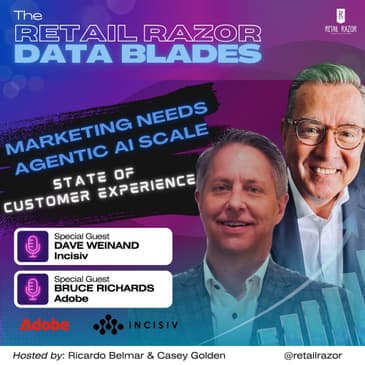




S2E6 Scaling Agentic AI, GenAI, & redefining roles while building governance for the autonomous marketing era
Agentic AI isn’t coming — agentic AI is already here, and it’s reshaping how retail and CPG marketing teams operate. In this final episode of our three‑part series with Incisiv and Adobe, we break down how agentic workflows, autonomous decisioning, and Gen AI driven content systems are transforming marketing roles, governance models, and customer experience strategies.
Ricardo Belmar and Casey Golden sit down with Dave Weinand, Chief Customer Officer at Incisiv, and with Bruce Richards, Global Industry Strategy & Marketing Lead at Adobe. Together, they unpack the research behind the State of Customer Experience in Retail & Consumer Goods. They explain what marketers must do now to prepare for the autonomous era.
Key Topics Covered
Why most brands are stuck in GenAI pilot mode — and how to finally scale
The difference between content‑generation AI and decision‑driving AI
How agentic workflows automate micro‑decisions across channels
Where agentic AI delivers low‑risk, high‑value wins today
Why AI governance is now a marketing imperative
The rise of new roles: journey owners, AI operators, content system leads
How AI‑powered discovery is rewriting SEO and customer acquisition
What retailers and CPG brands must do to prepare for autonomous marketing systems
Why This Episode Matters
Retail and CPG leaders are facing a seismic shift: agentic AI is moving from assistive tools to autonomous systems that optimize budgets, personalize journeys, and manage content at massive scale. This episode gives marketers the blueprint to evolve their teams, redesign workflows, and build governance frameworks that unlock safe, scalable innovation.
Resource Links
State of Personalized Experience in Consumer Goods in an AI-Driven World - Report
https://business.adobe.com/resources/sdk/state-of-cx-consumer-goods.html
State of Customer Experience in Retail in an AI-Driven World - Report
https://business.adobe.com/resources/sdk/state-of-cx-retail.html
Subscribe & Follow
Don't forget to like and subscribe to The Retail Razor: Data Blades for more episodes on customer experience, retail marketing, AI in retail, and data‑driven transformation!
Subscribe to the Retail Razor Podcast Network: https://retailrazor.com/
Subscribe to our Newsletter: https://retailrazor.substack.com
Subscribe to our YouTube channel: https://go.retailrazor.com/utube
About Our Guests
Bruce Richards. https://www.linkedin.com/in/brucefrichards/
Global Industry Strategy & Marketing Lead – Retail & Consumer Goods, Adobe. https://business.adobe.com/
Bruce Richards joined Adobe in 2018 and today leads Global Industry Strategy for Retail & Consumer Goods with a bold, future-forward vision. With more than 25 years of executive experience across Retail and Consumer Goods, Bruce is a driving force behind Adobe’s industry direction—helping brands innovate, adapt, and win in an environment where consumer expectations evolve by the minute.
Dave Weinand, https://www.linkedin.com/in/david-weinand-a62538/
Chief Customer Officer, Incisiv, https://www.incisiv.com
David Weinand is the Co-Founder and Chief Customer Officer of Incisiv, Inc. – a research and insights firm focused on helping retailers and brands navigate digital transformation across online, store, and supply chain functions. Weinand leads customer success for the firm and manages research and benchmarking projects with its largest clients. In addition, he manages relationships with the retail community.
Chapters
(00:00) Teaser
(00:32) Show Intro
(02:48) Welcome Back Dave Weinand and Bruce Richards!
(03:49) Why GenAI Stays in Pilot
(05:49) Content vs Decisioning AI
(07:07) Quality Control and Trust
(08:48) Assistive to Autonomous Agents
(12:11) Low Risk Agentic Wins
(14:12) AI Governance Urgency
(16:50) AI Search and Discovery Shift
(19:54) New Marketing Roles Emerging
(22:58) Key Takeaways and Thanks
(24:41) Show Close
About your Hosts
Helping you cut through the clutter in retail data insights:
Ricardo Belmar is an NRF Top Retail Voice for 2025 and a RETHINK Retail Top Retail Expert from 2021 – 2026. Thinkers 360 has named him a Top 10 Thought Leader in Retail, a Top 25 Thought Leader in AGI and Careers, a Top 50 Thought Leader in Agentic AIand Management, and a Top 100 Thought Leader in Digital Transformation and Transformation. Thinkers 360 also named him a Top Digital Voice for 2024 and 2025. He is an advisory council member at George Mason University’s Center for Retail Transformationand the Retail Cloud Alliance. He was most recently the partner marketing leader for retail & consumer goods in the Americas at Microsoft.
Casey Golden, is the North America Leader for Retail & Consumer Goods at CI&T, and CEO of Luxlock. She is a RETHINK Retail Top Retail Expert from 2023 - 2026, and Retail Cloud Alliance advisory council member. After a career on the fashion and supply chain technology side of the business, Casey is obsessed with the customer relationship between the brand and the consumer and is slaying franken-stacks and building retail tech!
Music
Includes music provided by imunobeats.com, featuring Tech Lore from the album Beat Hype, written by Heston Mimms, published by Imuno.
Highlight Clips
[00:05:58] - Two kinds of AI in marketing, content only kind of answers what could we say. It helps write emails, develop product…
[00:07:24] - Well, I mean, ultimately, the study showed that cost can be saved on the generation content generation and all those kind of…
[00:14:35] - Very. Very. Very. Period. That's head. The answer's done. Very. Very. I dropped it. What lets you move fast and stay safe. So…
Transcript
S2E6 Incisiv-Adobe, Scaling Agentic AI, GenAI, & redefining roles
[00:00:00] Teaser
[00:00:01] Ricardo Belmar: What happens when AI stops assisting marketers and starts making decisions on its own?
[00:00:07] Casey Golden: Incisiv and Adobe's State of Customer Experience research shows that while brands are experimenting with gen ai, scaling it and trusting it will be the next frontier.
[00:00:18] Ricardo Belmar: Today we explore the rise of agentic workflows and what they mean for the future of marketing.
[00:00:32] Show Intro
[00:00:32] Ricardo Belmar: Welcome retail and data junkies to Season Two, Episode Six of the Retail Razor Data Blades Show, the podcast that slices through complex retail research to deliver sharp, actionable insights you can use today.
[00:00:44] I'm Ricardo Belmar.
[00:00:46] Casey Golden: And I'm Casey Golden.
[00:00:47] Ricardo Belmar: Casey, thanks to our friends at Incisiv and Adobe, in this mini series we have covered the pressures facing CMOs today and the age of AI and the data challenge that creates. So now it's time to look ahead because [00:01:00] AI is changing the game faster than any of us expected, especially after 2025's holiday shopping season.
[00:01:05] Casey Golden: Yeah, and it's not just about generating marketing and product content anymore. Gen AI is evolving into agent workflows, autonomous systems that optimize, allocate, and learn. That's a big shift for marketing teams.
[00:01:21] Ricardo Belmar: Exactly. So in this episode, the final installment in our three-part series on Incisiv and Adobe's research on the State of Customer Experience in Retail and Consumer Goods, we are exploring how brands can prepare for the agentic future that honestly is already here and what governance and new roles are needed.
[00:01:41] And we've got both Bruce Richards from Adobe and Dave Weinand and from Incisiv here to help us break it down.
[00:01:46] Casey Golden: You can tell that this is a heavy hitting episode since we needed to bring back both Bruce and Dave to tie it all together. This is the first for a Data Blades episode, two [00:02:00]guests?
[00:02:00] Ricardo Belmar: Yeah, that's right. But before we dive in, we have one simple ask for our audience. If you enjoy this show, please hit us with a five star rating and drop a short review on Apple Podcasts, Spotify, Good pods, or wherever you're listening,
[00:02:13] Casey Golden: Don't forget to like and subscribe on our YouTube channel, so you never miss an episode. It really helps the show grow.
[00:02:19] Ricardo Belmar: And remember to check out the other shows in the Retail Razor Podcast Network, The Retail Razor Show, Retail Transformers and Blade to Greatness, if you haven't already. You'll find them all in your favorite podcast app, and of course on our YouTube channel.
[00:02:33] Casey Golden: Now let's raise our data blades and welcome back both Dave Weinand, Co-founder and Chief Customer Officer of Incisiv, and Bruce Richards, Global Industry Strategy and Marketing Lead for Retail and Consumer Goods at Adobe, to the show.
[00:02:48] Welcome Back Dave Weinand and Bruce Richards!
[00:02:55] Ricardo Belmar: Welcome back to the Retail Razor Data Blades Show, Dave, Bruce. We're all here for the [00:03:00] exciting conclusion to this three-part series on evolving the role of marketing in the age of ai. And you practically can't have an AI discussion these days without talking about Agentic AI, and autonomous workflows with AI, and all of those good things.
[00:03:13] So this is really where the big payoff comes in from the research, isn't it?
[00:03:17] Bruce Richards: It is, it definitely is. It's, you know, we've done a lot of work to understand the setups and the foundations and how we get to the AI and the Gen AI story. So yeah, this is the big payoff.
[00:03:26] Casey Golden: So it's kind of all been leading up to this moment. Diving into part three of the series, we'll learn how Gen AI, agentic systems and autonomous workflows, come together to magically solve every marketer's dream. Right?
[00:03:42] Ricardo Belmar: Of course. No, of course.
[00:03:44] Dave Weinand: It's, just a button you push. It's perfect. You just go.
[00:03:49] Why GenAI Stays in Pilot
[00:03:49] Ricardo Belmar: All right, so diving in, the studies and research show that while Gen AI boost content production by nearly 50% with higher conversion rates, adoption maturity is still [00:04:00] limited. So why are most brands still experimenting, but so few scaling with this?
[00:04:05] Bruce Richards: Well, I mean, it's true. Most brands are stuck in Gen AI pilot mode, you know, lives in isolated pockets, a a copy test in an email, social experiment. A few internal tools, but the problem is that it's not wired into core workflows and governance and measurements. So retailers and consumer goods companies are seeing real gains in content speed and conversion.
[00:04:27] To scale it, they have to do a few things. They have to treat it as part of the main content and data system. They have to embed it into processes and templates, and they have to hold it to the same governance and performance standards as the rest of marketing. And until they can do that, it's going to remain what I call a side gadget, not a core capability.
[00:04:47] Dave Weinand: Yeah, and I know, and that's absolutely right. And, and, and, and what's kind of the basis of all of that? Change management. I mean, 'cause this is a different way of doing things. So, you know, there's organizational change. There's, as Bruce [00:05:00] pointed out, there's change in processes, all those kinds of things.
[00:05:02] So, pilots are great and I think that, we've seen that there has been some early gains and some productivity enhancements, but, but to, to use it as a tool versus a form of, organizational transformation. It takes a, it takes a lot.
[00:05:15] Bruce Richards: Yeah. I think most organizations think of it as a fun thing to play with, but they're not giving enough thought to what does this mean to my overall organization? So, you're right, process is part of it, but process an organization go hand in hand.
[00:05:26] Casey Golden: Yeah. Finding where to implement. Definitely. Like that's been one of the challenges, right? Replace something we already do or rethink the entire premise of what we do and create something different. That's, we built in 2026, right? I love replacing things that we built in 1996.
[00:05:49] Content vs Decisioning AI
[00:05:49] Casey Golden: What's the difference between AI that produces content and the AI that drives decisions and helps in decision making?
[00:05:57] Bruce Richards: Uh, Two kinds of AI [00:06:00] in marketing, content only, kind of answers, what could we say? It helps write emails, develop product descriptions, social posts, images, translations, things like that. On the flip side, we have decision driving ai, and that's kind of. What should we do next? For who, for which person, for which channel?
[00:06:21] For which offer or budget? And the second type that, what should we do next? That's plugged into profiles and context and outcomes. And it's not just a blank page, which is kind of like the content one as you're starting with a blank page and you're developing from there. This is not starting with a blank page.
[00:06:37] You've got a lot behind it. It uses data about the customer and performance to decide actions and not just generate words or visuals.
[00:06:46] Dave Weinand: Yeah. And, and we talked about it, or first did, I should say, talked about it in the second podcast, which is in order to do all of all of kind of the decisioning based ai, you do have to have kind of the unified data, [00:07:00] ideally have the unified data aspect of it. So, um, so, so jump back to the last podcast and learn all about
[00:07:05] Ricardo Belmar: Yeah, that's right. That's right.
[00:07:07] Quality Control and Trust
[00:07:07] Ricardo Belmar: So, so one of the I think concerns or questions maybe that get that comes up a lot in these discussions at retailers and brands is about quality control, right? And in the cost associated with that and with that kind of AI adoption. So how should organizations balance between speed, scale, and trust of the output?
[00:07:23] Dave Weinand: Well, I mean, ultimately the study showed, the costs can be saved on the, generation, content generation and all those kinds of things, but QC costs, actually are up as high as 30% higher. So, but, so really companies, should kind of look at, their output in a couple different buckets. One being, what is, the low, what are the low risk applications? You know, things like, FAQ responses or order confirmation or size and fit, those types of things. They can get spot checks from, from humans.
[00:07:53] But the high, the regulated stuff, the very important type of content, say, you know, hero messaging or press release, those [00:08:00] types of things really gets full review. So, we, I think all of us, have all come to the conclusion and we're all in agreement that, that the human in the loop is, is critical to all of this.
[00:08:10] So we don't need to kind of beat that drum anymore. But, but you have to do incorporate things like brand voice, quality scoring, those types of things to really you know, really get the maximum out of out of these gen, this gen AI and agentic adoption.
[00:08:23] Bruce Richards: Yeah, I love that. Risk-based review idea, Dave. It's, it's, you know, heavy human review for high risk content. And the alternate for lower risk. But then coming out of that is sort of this system level inst instrumentation. It's how do you track errors and approvals and issues so you can fix the system, not just the individual pieces or pieces of work.
[00:08:44] So yeah, that, the, and the humans play a critical role there as well.
[00:08:48] Assistive to Autonomous Agents
[00:08:48] Casey Golden: With that human in the loop and we begin to take POCs and scale them, and content starts generating 50,000 to a million pieces of content [00:09:00] to regionalize and personalize locally. How are we gonna keep that human in the loop to review each thing before it can be published?
[00:09:10] Bruce Richards: Well, I mean, I think that as this, we're kind of in a state of evolution versus jumping deep into the pool, right? So today, AI is mostly assistive. It's bringing to the forefront insights and summarizing performance and suggesting audiences in certain pieces of content. But we're starting to see agents acting in a bigger way.
[00:09:33] But the thing is, you've gotta have the guardrails in place. So things like, budgets within limits, preapprovals of journeys and optimizing replenishment programs for ccp, CPG brands. And that's where the humans have to set the goals and the boundaries. Agents can handle the day-to-day micro decisions, but the humans have to play that critical role.
[00:09:51] So what are the guardrails and how are they monitored on a regular basis? And that's a human role.
[00:09:55] Casey Golden: How do you see the shift, um, from assistive AI [00:10:00] to, autonomous agents playing out?
[00:10:02] Bruce Richards: Well, what I just said. We're kind of in this assistive mode right now, right? So as we as it starts to shift, it becomes this. Although I said evolution, but it seems to me that the speed with which this is happening is more of a revolution than an evolution happening. It's happening so fast, but it's that move from assistive to agents playing a much bigger role. And then over time, agents will take on more narrow, well-defined domains from an end-to-end perspective, from an end-to-end perspective. So while humans are focusing on strategy rules and exceptions, and setting the goals and boundaries, agents are gonna handle those day-to-day micro decisions.
[00:10:42] So there's sort of a over, there's gonna be a balancing right, over time. And, and like I said, that's time it seems to be compressing as we speak. So.
[00:10:52] Dave Weinand: exactly.
[00:10:53] Bruce Richards: So the future isn't that AI replaces marketers, it's marketers manage systems of agents [00:11:00] that handle the operational load. So that becomes, and that's actually, what I just said is a scenario that's going to continue to evolve as people see how this works within the context of their organizations.
[00:11:12] Dave Weinand: And think about, think about the things that, that take a lot of time, but don't add a ton of value. Spend time optimization you know, bid management, things like that, that, marketers are responsible for, but it's I guess it could be deemed strategic, but overall, those are the kinds of things that agents should be able to really step in because as Bruce pointed out there, very narrow type of applications. And so from that perspective those types of things can take time give marketers time back while those those types of tools are, are being allocated as from an agent perspective at some point, will it all kind of come together? Anybody's guess? I mean, the assumption is yes, but you know, time will tell.
[00:11:55] Bruce Richards: Yeah, and who on a mar in a more marketing organization, isn't going to want to remove some of those [00:12:00] mundane tasks from their day to day so they can focus on strategic work. That's where some of the excitement comes in from a human perspective is like, wait a minute, I get to do this instead of that.
[00:12:09] That's really exciting to marketers.
[00:12:11] Low Risk Agentic Wins
[00:12:11] Casey Golden: So for our audience and our listeners, can you give like a couple examples of where you've seen agentic workflows offer the highest value and still have the lowest risk? Does this exist? It
[00:12:26] Dave Weinand: Well, you know, we, we, you know, we just, there are a couple examples like, like I said, but budget, automated budget, reallocation based on performance or lack thereof. Um, that personally emails and optimization, like REI does that. REI has has set it up so they, they know their, their shopper's habits.
[00:12:43] They can a adjust send time based on, weather or even if they know like a person's an early riser, then they can send the 6:00 AM email to, to that person. So those types of things are happening. Home Depot is doing that with bid management, automated bid management with [00:13:00] Google Ads and Meta and things like that.
[00:13:01] So, so again, low risk optimization type things that that, you know, that are being used right now. There are specific applications but they are they're not, I mean, they're making an impact, but they're not like, they're not integral to the whole organizational, fabric of marketing in, in, in these companies. So.
[00:13:18] Bruce Richards: It's a great retail example, Dave. I think some others, without giving brand examples is replenishment nudges for consumer goods or CPG brands specific specifically in the cosmetic space. You know, timed reminders based on usage patterns based on product shelf life, things like that, respecting frequency, caps and consent and all of those things.
[00:13:38] That works really well for CPG brands and other places is product tagging and cleaning up data, you know, keeping those digital shelves up to date with information that's relevant to consumers. Those tend to be pretty low risk and high reward because when you think about the overall experience, if the product information isn't correct and up to date, the customer gets annoyed and they walk away.
[00:13:59] [00:14:00] So, risk versus reward there is obvious.
[00:14:02] Ricardo Belmar: Yes. These are great, great examples of the, these kinda low risk scenarios where you can quickly get some value out of implementing these agentic and autonomous workflows.
[00:14:12] AI Governance Urgency
[00:14:12] Ricardo Belmar: So if we think forward a little bit more as to, where, where we can see more integration in into more strategic marketing type activities this way. You also, I think, start to ask some questions around governance. And in the research, I think you shown that 63% of organizations don't really have any formal AI governance measures today. So how urgent do you think it is to close that gap?
[00:14:35] Bruce Richards: Very, Very,
[00:14:36] Ricardo Belmar: a leading question.
[00:14:41] Bruce Richards: It's what lets you, it's what lets you move fast and stay safe. So without it, organizations are gonna end up in one of two bad places. Either they take too much risk because anybody can spin up AI use cases. Right. Or they move too slowly because every single [00:15:00] idea triggers a long legal and compliance debate.
[00:15:02] So neither one of those is a good place for organizations to be. So for retail and consumer goods AI governance, which covers use cases and data consent and quality and accountability, is what's gonna allow them to be really confident and say yes to stronger ai. And, and agentic scenarios instead of getting stuck in the pilots that they're already stuck in, right, this is how they're gonna move forward.
[00:15:26] So governance, while a lot of people go, that's not the fun part of this, it's the required
[00:15:32] Ricardo Belmar: Yeah, exactly. Yeah,
[00:15:34] Dave Weinand: Yeah, it's yeah, I know we get, how do we get into, we're in marketing, how do we get into governance? And it's so warm.
[00:15:40] Ricardo Belmar: Yeah.
[00:15:40] Dave Weinand: No, but it, it's, it's obviously very important and, and the, as I like to say, just because our government doesn't believe in putting any guardrails around ai, I think companies should, um,
[00:15:52] Casey Golden: A lot of times it's a hot potato, right? Nobody wants to be the one that like, well, I'm. I don't wanna get in trouble. And so it's like the [00:16:00] hot potato and then like something didn't get done because nobody really wanted the accountability for it.
[00:16:05] Bruce Richards: Yep.
[00:16:06] Dave Weinand: Yeah. Yeah. I mean, and and, and not, like, not like organizations need more committees, but, AI ethics committee or something, some sort of governing board that, that can, that looks at it from a lot of different perspectives. It would be a, good thing to think about.
[00:16:18] Casey Golden: get rid of two current committees to get this one.
[00:16:22] Bruce Richards: Yeah, and it's interesting, when we first started talk at Adobe, when we first started talking about these solutions, that was one of the first questions that always came up from any part of the organization. How do we know this is safe? Why is it governed? And things like that. So it's definitely a topic of conversation, but you're right, it's a hot potato.
[00:16:37] It's like, well, we'll talk about it, but I don't wanna hold it in my hands too long
[00:16:40] Casey Golden: Right. I don't wanna hold my hands,
[00:16:42] Bruce Richards: get burned.
[00:16:44] Casey Golden: but it's inevitable. They're gonna, at some point, somebody's gonna have to sit there and, and deal with it. Right?
[00:16:50] AI Search and Discovery Shift
[00:16:50] Casey Golden: I mean, your guys' research already showed that retailers expect a 58% increase in organic search volume to shift to AI [00:17:00] powered platforms and like in the next 24 months, right?
[00:17:04] But just this past holiday season, we saw the future arrive a little early. AI driven traffic was up 693%.
[00:17:13] Bruce Richards: Yeah. Just during the holiday. Yeah, and that's Adobe data just, and that's just looking at the peak periods of Black Friday, cyber Monday, and it's the holiday period. That's incredible amount of growth. And we started saying how, evolution versus revolution and the speed with which this is happening.
[00:17:31] That's proof, right? So I mean, what's happening is. Marketers have to treat AI powered platforms as the new discovery layer. It's not just a feature, it's something they have to start focusing on now. And that means, they have to create content that answers real questions and problems that consumers have.
[00:17:50] They have to structure. Labeling content. So AI systems can parse through it and trust and reuse it. They have to think in terms of [00:18:00] use cases and intent, right? Not just the question that's put forward. It has to dig deeper and understand what do you, in, what is your intent in asking this question, not just a single word.
[00:18:09] So it's really about setting up ways to capture and tag AI referred traffic so you can learn what's working and optimize those journeys. And marketers just historically are not set up to think that way. It's fact-based, move on, fact-based, move on. This is a whole, we talked about culture before. This is a major shift.
[00:18:29] Casey Golden: I think it's really interesting how many decisions and how much strategy was around how the consumer views something and really like where their mouse is, what their like, what their heat maps, things of that nature. Like how are consumers engaging with this content, this site, these products, the customer journey. And now it's like you have to put yourself in the shoes of a customer. Why are you asking this question? What are you thinking [00:19:00] about? And I think that that's really, this is a very compelling shift is like even with ai, it's based off of what, 5% of our consciousness I've, I've heard something where so much of what we do in our decision making gain and how we feel about something isn't even vocalized. It's like going on in our heads and now we have to kind of put ourselves in the shoes of our customer to say, what do I think you might ask so that I can prepare all of these answers and this content and narrative around things that you, you may inquire about or other things you might be searching for that I need to show up. Like we need to understand how people are thinking, not necessarily just
[00:19:43] Dave Weinand: Yeah. And that's, no, that's no small
[00:19:45] shift.
[00:19:45] Ricardo Belmar: yeah, yeah,
[00:19:46] Casey Golden: Yeah, it's
[00:19:47] Dave Weinand: I mean, we we're talking about it, but I don't know if we're talking about it enough.
[00:19:50] Ricardo Belmar: yeah.
[00:19:51] Casey Golden: More psych. We need more psychologists and Uh. Psychologists
[00:19:54] New Marketing Roles Emerging
[00:19:54] Ricardo Belmar: It, it's almost like new, it's a new role for marketers, right? I mean, so we kind of started out with this series talking about [00:20:00] what's the change right? To the role of the marketer. But this is what that big shift really implies. 'cause these are things that we're talking about that marketers didn't think about before, right. So now you know, we had things like persona mapping, right? But now we're really going a little bit beyond that, I think, in this approach. And you have to think in terms of like, how are you an AI operator or owning the whole journey. And that how discovery, journey architect. There you go. Yeah.
[00:20:23] So what are these, are these just new roles that we're gonna see pop up in, in a defined manner in marketing organizations?
[00:20:31] Bruce Richards: Maybe we're gonna start adding therapists to marketing organizations who can analyze, what did, what did you really mean by that question. But, um,
[00:20:37] Ricardo Belmar: Right, right.
[00:20:39] Bruce Richards: you know, I joke. But yeah, I think that there are definitely going to be new roles coming into organizations. When we talk about, what the, what this looks like, it's a completely different journey for the consumer.
[00:20:49] They're entering the brand from a different place and from a different emotional level. So, things like journey owners, people who are gonna res be responsible for the end-to-end journey across every channel. [00:21:00] You've usually got email marketers and social marketers, you know, who owns that journey in total.
[00:21:05] That's, that could be a new role. AI operators and AI product owners, like how does that manifest in an organization once they start to be able to scale efficiently? It can't just be this one-off and, bolted onto a particular project. It's got to be something that's owned throughout the org.
[00:21:20] Dave, any other ideas on what some roles might look like?
[00:21:23] Dave Weinand: Yeah, I mean, I think I, I mean, to your point, it. We talked a lot about multiple different agents. So if you think about there could be a role where there's someone actually just man managing that portfolio of agents. At some point as we talked about it, it, they may all be unified, but right now, it's like, okay, someone has to oversee, you know, the, the management of, of multiple agents inside of an organization.
[00:21:45] So that, that could be, and whether that's a, whether that's a marketing role or an IT role, I guess that's be determined. But, um.
[00:21:51] Casey Golden: Like very fun job marketing's usually fun.
[00:21:55] Bruce Richards: A fun one could be content system leads. You know, I mean, as one of the [00:22:00] biggest conversations we're having particularly in consumer goods is these, this enormous increase in content and the need to need because you're now speaking, you're providing content to agents, not just consumers and to retail media networks and all of those places.
[00:22:14] So, a couple of years ago we were talking about, in 2024 and 2025, we were looking at like a five x multiplier on content. Now it's 10 to 20 x because everybody's going, how am I going to do this? But, and but then when we talked about, these silos in these different areas of where content lives, who owns all of that and making sure that the right piece of content gets to the right consumer in the right time, and that it's, it's part of that overall message that AI is spitting out, saying, you know, here's your answer and here's what this should look like. So, that's probably another critical role, is going beyond just a template to owning the entire content content supply chain
[00:22:52] Ricardo Belmar: Yeah. Yeah, I like that, like the content supply chain. Content has its own journey now
[00:22:56] Bruce Richards: Yep.
[00:22:57] Ricardo Belmar: In this New Order of marketing.
[00:22:58] Key Takeaways and Thanks
[00:22:58] Ricardo Belmar: So I love where this is going and [00:23:00] we've covered a lot in this three-part series and I think we've painted a very different picture of what the future looks like. I think for CMOs, for marketers, and one where AI's helping 'em succeed more often than not, to convert better, tell better stories.
[00:23:13] And I think maybe the most important takeaway I have from this whole series is that it's allowing marketers to do things with a much higher velocity than they could before at a much bigger scale. And, and I think that brings with it a, a good strong potential for business growth for that. So I'm, I'm really, really pleased that we've covered so much ground.
[00:23:31] I, I wanna thank you both for sharing so many details from the research that you guys put together on the state of customer experience, both for retail and consumer goods. I wanna thank you for helping us really understand the value behind everything that you uncovered in that research. And of course we'll be sure and have links to all these things throughout the show so everybody can download them and digest it for themselves.
[00:23:51] Dave Weinand: And we're about to hit the field with the 2026 version, so
[00:23:54] Ricardo Belmar: Excellent.
[00:23:55] Dave Weinand: it's yeah, it's continuing on.
[00:23:57] Bruce Richards: Yeah. The, yeah, [00:24:00] I talked about speed, right? We just, we're just we're talking about it.
[00:24:04] Ricardo Belmar: Yeah. You're already into it. Yeah.
[00:24:06] Dave Weinand: Yeah.
[00:24:07] Bruce Richards: More exciting insights to come. It's been really eye-opening to understand kind of where the industries are, the differences between retailers and consumer goods brands. There are a lot of similarities, but a lot of differences. So, yeah. Read into the reports because you'll start to uncover some great insights.
[00:24:23] Casey Golden: Well, we'll certainly have the links to both reports in the show notes, and we encourage our audience to make use of what we've learned in this series and go a little deeper and review those full reports. Thank you!
[00:24:36] Ricardo. I'd say this
[00:24:38] Dave Weinand: so
[00:24:38] Casey Golden: I and miniseries is a wrap.
[00:24:41] Ricardo Belmar: It is.
[00:24:41] Show Close
[00:24:48] Casey Golden: Loved this episode. Drop us a five star rating and review on Apple Podcasts, Spotify, or Good pods and hit subscribe so you never miss an update. If you're watching on YouTube, like and [00:25:00] subscribe before you go.
[00:25:01] I'm Casey Golden.
[00:25:02] Ricardo Belmar: Follow Retail Razor on LinkedIn, Blue Sky, Threads, and Instagram, and subscribe to our Substack for highlights and bonus content in your inbox. For transcripts and guest info, head to retailrazor.com. Data Blades is part of the Retail Razor Podcast Network, the number one indie podcast network for retail.
[00:25:20] I'm Ricardo Belmar.
[00:25:21] Casey Golden: Thanks for joining us.
[00:25:22] Ricardo Belmar: Until next time, Stay Sharp, Be data-driven and Harness AI!
[00:25:25] This is The Retail Razor: Data Blades.