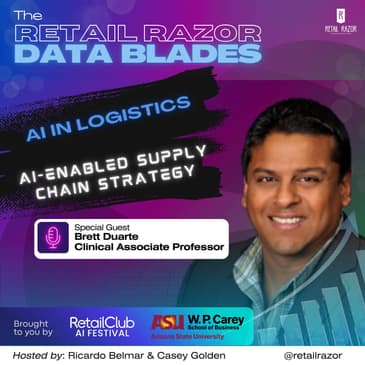



Arizona State University’s Brett Duarte on AI supply chain strategy, part 3: AI in logistics, control towers, network design, and supply chain governance.
Logistics is a $10 trillion industry once you add up freight, transportation, warehousing, 3PL and 4PL. Brett Duarte puts that number on the table in the first four minutes, and it reframes every AI conversation that follows. This is how AI in logistics either earns its budget or quietly doesn't.
This is part three, the final episode of our AI supply chain strategy series with Clinical Associate Professor Brett Duarte of Arizona State University's W. P. Carey School of Business. We covered procurement in part one and operations in part two. Here we finish with AI in logistics, then widen the lens to the infrastructure and supply chain governance that everything else sits on.
Brett splits AI in logistics into tactical and strategic work. Tactical includes route optimization and ETA prediction, capacity and load optimization so containers and trailers run full, and disruption management through control towers that sense a problem and act on it. Strategic means network design: where distribution centers go, how big their footprint needs to be, where the coverage gaps are, and whether carbon emissions can come down at the same time to address sustainability.
Then Casey pushes him on the part executives keep asking about. Trusted data sources. Platform choices. Agent-to-agent protocolsand model context protocol. Managing a growing population of agents and their lifecycle. And the ROI roadmap with KPIs that leadership will accept. Brett's line on supply chain governance is the one worth writing down: it's a business capability, and companies that treat it as an IT project pay for it later.
What you'll learn in this episode.
Why the $10 trillion logistics number changes how you size an AI in logistics business case.
Where AI in logistics pays off first, and which use case to build before all the others.
The four tactical AI use cases Brett teaches first, and why disruption management is the one to start with.
How a control tower agent pulls outside signals on weather, earthquakes and disruption events, then decides which orders are affected.
What "citizen developers" can build inside operations, and the guardrails they need.
The network design questions AI answers: DC placement, footprint, service versus cost, coverage gaps, consolidation.
Why sustainability documentation is turning into a competitive edge instead of a spreadsheet chore.
Brett's case that supply chain governance is a business capability, not an IT project.
How to build an AI ROI roadmap, pick operational and financial KPIs, and benchmark against your market.
The AI-native platform versus bolt-on-to-legacy decision, with the tradeoffs on both sides.
The program behind the series.
Each episode in this series follows one day of ASU's AI-Enabled Supply Chain Strategy Executive Program, October 5 to 7 in Tempe. This episode is day three. Seats are limited for the fall session. Register with the link below and ID code RETAILRAZORASU for $1,500 off.
Register at https://specialevents.asu.edu/878064 with ID Code retailrazorasu for $1,500 off
Listen to all three parts in the series.
The series is built to be heard together. Part 1 covers procurement, part 2 covers operations, part 3 covers logistics plus infrastructure and supply chain governance. Start at part one if you're arriving late.
• Part 1, Procurement (S2E13): https://go.retailrazor.com/DBs2e13
• Part 2, Operations (S2E14): https://go.retailrazor.com/DBs2e14
Support Our Sponsors.
There’s still time to join us at RetailClub AI Festival.
From the founders of Shoptalk and Groceryshop, RetailClub AI Festival brings together 2,000 industry leaders from September 22 to 24 for three days fully outdoors in Huntington Beach focused entirely on how AI is transforming retail. Hear from 150 leaders shaping how AI is being used across the industry, explore the technologies changing how retail works, and connect with senior leaders from across retail, brands, technology and investment. Late registration is now available at retailclub.com/retail-razor-podcast. We’ll see you in Huntington Beach!
W. P. Carey School of Business, Arizona State University.
ASU is a leading public research university and its W. P. Carey School of Business is the largest in the United States. AI-Enabled Supply Chain Strategy is a 3-day executive program running October 5-7, built by the #2-ranked Supply Chain Management department. The program is designed for senior leaders setting AI strategy across procurement, logistics, and operations.
Register at https://specialevents.asu.edu/878064 with ID Code retailrazorasu for $1,500 off.
Subscribe & Follow.
Love this episode? Drop us a five-star rating and review on Apple Podcasts, Spotify, or Goodpods. Don't forget to like and subscribe to The Retail Razor: Data Blades for more episodes on customer experience, retail marketing, AI in retail, and data‑driven transformation!
Subscribe to the Retail Razor Podcast Network: https://retailrazor.com/
Subscribe to our Newsletter: https://retailrazor.substack.com
Subscribe to our YouTube channel: https://go.retailrazor.com/utube
About Our Guest.
Brett Duarte, Ph.D. https://www.linkedin.com/in/brettduarte/
Arizona State University | W. P. Carey School of Business
NASPO Department of Supply Chain Management
Clinical Associate Professor
Senior Faculty Co-Director – MSBA
wpcarey.asu.edu | research.wpcarey.asu.edu
Brett Duarte is a Clinical Associate Professor in the NASPO Department of Supply Chain Management at Arizona State University's W. P. Carey School of Business, the largest business school in the United States with more than 25,000 students. He is senior faculty co-director of the school's Master of Science in Business Analytics program and assistant chair for graduate programs in supply chain. ASU's supply chain management program is ranked #2 in the country by U.S. News and World Report. Brett is on the faculty teaching the AI-Enabled Supply Chain Strategy Executive Program this October.
Chapters.
(00:00) Teaser
(00:35) Show Intro
(03:31) The $10 Trillion Logistics Problem AI Is About to Solve
(04:42) Inside Amazon & DHL's AI Playbook
(05:55) How AI Agents Catch Supply Chain Disasters Before They Happen
(08:20) The Network Design Mistake Costing You Millions
(09:49) Why Sustainability Data Is Your Next Competitive Edge
(11:27) The Governance Mistake That Could Sink Your AI Strategy
(13:54) How to Actually Measure AI's ROI in Your Supply Chain
(16:36) Show Close
About your Hosts.
Helping you cut through the clutter in retail data insights:
Ricardo Belmar is an NRF Top Retail Voice for 2025 and a RETHINK Retail Top Retail Expert from 2021 – 2026. Thinkers 360 has named him a Top 10 Thought Leader in Retail and eCommerce, a Top 25 Thought Leader in Careers, a Top 50 Thought Leader in Agentic AI, AGI and Management, and a Top 100 Thought Leader in AI Ethics, Marketing, Digital Transformation andTransformation. Thinkers 360 also named him a Top Digital Voice for 2024 and 2025. He is an advisory council member at George Mason University’s Center for Retail Transformation and the Retail Cloud Alliance. He was most recently the partner marketing leader for retail & consumer goods in the Americas at Microsoft.
Casey Golden, is the North America Leader for Retail & Consumer Goods at CI&T, and CEO of Luxlock. She is a RETHINK Retail Top Retail Expert from 2023 - 2026, and Retail Cloud Alliance advisory council member. After a career on the fashion and supply chain technology side of the business, Casey is obsessed with the customer relationship between the brand and the consumer and is slaying franken-stacks and building retail tech!
Episode Music.
Includes music provided by imunobeats.com, featuring Tech Lore from the album Beat Hype, written by Heston Mimms, published by Imuno.
Highlight Clips.
[00:05:26] - And so one would be, you know, looking at, like, route optimization and ETA prediction, right, predicting time of delivery, but…
[00:07:42] - This whole notion of creating what we would call citizen developers. Right? These are people that are are looking. They're…
[00:11:46] - How do you benchmark against other organizations, which a lot of executives are really looking for? And so when it comes to the…
Transcript.
S2E15 ASU Part 3 - AI in Logistics
[00:00:00] Teaser
[00:00:00]
[00:00:01] Casey Golden: Your shipment is late, your customers are calling, and your network is three time zones deep into disruption.
[00:00:10] Ricardo Belmar: That's logistics. It's where AI either earns its budget or it doesn't
[00:00:14] Casey Golden: Part three of our AI strategy series with Professor Brett Duarte of ASU's W. P. Carey School of Business is here.
[00:00:23] Ricardo Belmar: Routing, network design, control towers, last mile. Then the question every executive eventually asks, what infrastructure and governance does all of this require?
[00:00:34] Casey Golden: Let's finish this
[00:00:35] Show Intro
[00:00:40] Ricardo Belmar: Welcome back to the Data Blades Podcast, part of the Retail Razor Podcast Network, where we cut through the clutter and the noise and get to the data-driven insights that move your business forward.
[00:00:50] I'm Ricardo Belmar.
[00:00:51] Casey Golden: And I'm Casey Golden.
[00:00:53] This is part three, the final episode in our series on AI strategy for the supply chain with Professor Brett [00:01:00] Duarte of ASU's W. P. Carey School of Business
[00:01:03] Ricardo Belmar: We've covered procurement and operations. Today we finish with logistics and then we widen the lens.
[00:01:08] Casey Golden: Logistics is the operational engine. It moves raw materials, components, and finished goods from origin to customer, and it's where disruption shows up first
[00:01:18] Ricardo Belmar: So we'll get into routing decisions, network design, control towers, last mile optimization, and how AI helps a team respond when shipping goes sideways.
[00:01:27] Casey Golden: And then the part every executive in our audience has been waiting for, what has to be the true underneath for all of this.
[00:01:35] Ricardo Belmar: Right. IT infrastructure, governance, maturity assessments, and the ROI question that leadership keeps asking. Brett also walks us through how procurement operations and logistics come together with agentic AI, which is the whole point of doing all three as one strategy.
[00:01:52] Casey Golden: All of this coming from ASU's AI-enabled Supply Chain Strategy Executive Program in October from the 5th to the 7th. [00:02:00] And this is the episode that shows you what the third day feels like. Link and listen for the discount codes. They're in the show notes.
[00:02:10] Ricardo Belmar: That's right. If you're a supply chain leader in your org, it's the perfect opportunity to come away with new frameworks for evaluating AI opportunities and get a clear read on where companies are getting real competitive advantage from AI. Plus, spend time in a room full of your peers working on the same problems.
[00:02:26] Seats are going fast, so don't wait. Register using the link and ID code in the show notes and on screen right now to get $1,500 off the cost to register.
[00:02:35] Now, before we jump into today's final topic, let me tell you about the Retail Razor Podcast Network sponsor, RetailClub!
[00:02:42] There is still time to join us at the RetailClub AI Festival. From the founders of Shop Talk and Grocery Shop, RetailClub AI Festival brings together 2,000 industry leaders from September 22nd to 24th for three days fully outdoors in Huntington Beach, focused entirely on how AI is transforming retail.
[00:02:59] Hear from [00:03:00] 150 leaders shaping how AI is being used across the industry, explore the technologies changing how retail works, and connect with senior leaders from across retail, brands, technology, and investment. Late registration is now available at retailclub.com/retail-razor-podcast. We'll see you in Huntington Beach!
[00:03:17] Okay, now here's part three of our AI strategy for supply chain series with ASU professor Brett Duarte. Let's finish this series.
[00:03:31] The $10 Trillion Logistics Problem AI Is About to Solve
[00:03:31] Ricardo Belmar: Brett, Welcome back to our final episode in this series
[00:03:34] Brett Duarte: Awesome. Thanks for having me again, Ricardo
[00:03:37] Ricardo Belmar: Yeah, this has been a, a fantastic roundup of, of AI in supply chain. We've covered procurement and supply chain operations. So this episode, we are bringing it home with logistics. And then I wanna come back to something too that you raised early on in the series about infrastructure and governance.
[00:03:52] I wanna make sure we hit on those too. But, logistics sits at the core, right, of supply chain management. It's, that operational engine that moves all your raw [00:04:00] materials, components, finished goods efficiently from an o- origin point to that end customer. So what will a logistics professional gain from coming to the executive program and, and understanding how to use AI?
[00:04:12] Brett Duarte: Yeah, I mean, I think, logistics is a huge piece of it. I think there was a, a report out of Statista a couple of years back that said, it's a ten trillion dollar industry when you look at freight spanning transportation, warehousing, 3PL, 4PL. That's, that's a huge chunk of change, right?
[00:04:30] Ricardo Belmar: Yeah
[00:04:30] Brett Duarte: course, that, that, that number, goes up and down in line with, with global trade. But, I think, there are so many use cases, again, where companies are using AI in the logistics space.
[00:04:42] Inside Amazon & DHL's AI Playbook
[00:04:42] Brett Duarte: Of course, Amazon, you know, looking at robotics in warehouses, deciding on where to place inventory. Walmart, you know, scanning, shelf scanning. DHL looking at predictive maintenance, computer vision, you know, AI routing and planning, and UPS as well.
[00:04:57] So lots of different applications. Again, I like [00:05:00] to, to break it down into, into really two elements of it, right? One being more of the tactical, applications of AI and then, some more strategic, applications as well. So, let's talk about tactical applications. I think, of course, again, I should preface this by saying, Ricardo, that there's many and many of them, right?
[00:05:19] But, again, given a limited amount of time, I think we've picked a couple of them that are probably very pertinent, as a starting point. And so, one would be, you know, looking at like route optimization and, ETA prediction, right? Predicting, time of delivery, but also, capacity load optimization.
[00:05:36] You know, LTL, TL, making sure containers are full. and then finally, disruption management. I think this is a, a great space looking at sensing and responding. You know, if there's a disruption, how do you, how do you react to that disruption? Kind of leaning towards this whole notion of, you know, control towers as you mentioned,
[00:05:55] Ricardo Belmar: Mm-hmm.
[00:05:55] How AI Agents Catch Supply Chain Disasters Before They Happen
[00:05:55] Brett Duarte: Where you have this ability to, to sense a [00:06:00] disruption, and then-- the agent senses a disruption, now you have the ability to kind of, look at the forecast, but also look at which locations within your supply chain are going to be, impacted by disruption. And by the way, disruption could be, it could be a weather pattern or a hurricane, an earthquake, that im- you know, pretty prevalent in the news these
[00:06:19] Casey Golden: Container falls off the ship
[00:06:22] Ricardo Belmar: That happens too
[00:06:23] Brett Duarte: right. and then how do you, how do you react to that, right? How do you reroute stuff or how do you move, inventory, from a different location? and so then making that decision and automatically acting on that decision, is really important. Now, in order to do that you know, you can leverage various external sources, and, and there are many of them. you know, creating APIs to, to plug into systems like Everbridge and, you know, USGS and, EMDAT. These are all, websites that kinda give you up-to-date information along with like GPS coordinates, if you [00:07:00] will, on where things go. And now we-we're, we're looking at agents kind of pulling that information in, and then deciding on, wait a second, which orders are gonna be impacted by that disruption?
[00:07:11] Can we route, inventory from a different location in? And how do we mitigate some of that risk? Okay. Now, I, I will say there's plenty of tools that are out there, you know, tools like Resilinc, which already do some of this risk, management and rerouting. But the, the idea here is, again, you know, we wanna be able to communicate that you can still create a small application with agents, to solve certain problems.
[00:07:36] And, if you're able to do that, then you can think of other use cases, that could be very pertinent. This whole notion of, creating what we would call citizen developers, right? These are
[00:07:47] Ricardo Belmar: Mm-hmm.
[00:07:47] Brett Duarte: that, are, are looking, they're, they're working, they're running their business, they're in operations and saying, "Wait a second. if I had certain skills, I might be able to create an agent to do certain things." and of course, you know, what are the [00:08:00] guardrails and the governance around some of that? So I think, And so what we do, on day three is, really to help build these agents to, to look at data, make some, you know, glean some insight from the data, look at load optimization, look at, disruption management.
[00:08:17] And again, these are all tactical.
[00:08:20] The Network Design Mistake Costing You Millions
[00:08:27] Brett Duarte: Remember I also said strategic applications, right? And, and part of those strategic applications are more, on, i-in tune with network design, if you will. this is, well, where should I be placing warehouses or my distribution centers, right? And oh, by the way, how big should they be?
[00:08:38] What's that footprint need to look
[00:08:39] Ricardo Belmar: Mm-hmm.
[00:08:39] Brett Duarte: course, there's this whole, balance between service and cost, right? and then, oh, by the way, depending on where I locate them, what is my coverage gap and, is there opportunity to consolidate, with, you know, across these different, distribution centers and warehouses? And of course, I think the other element, that's becoming really, really important [00:09:00] is the whole sustainability side of, of logistics and transportation, right? It's not only getting things quick, but, you know, is there an opportunity to optimize your carbon footprint?
[00:09:11] Ricardo Belmar: Mm-hmm.
[00:09:11] Brett Duarte: you
[00:09:12] Ricardo Belmar: Right
[00:09:12] Brett Duarte: of those emissions look like? and companies are getting, you know, more and more into that, that space of, of sustainability.
[00:09:18] Casey Golden: The documentation alone by leveraging AI to just do-- just document and timestamp everything without having that person trying to blow out all this on an Excel file, right? Like, that has been a huge struggle over decades when it comes to traceability, sustainability. Your measurement, tracking, is just documenting.
[00:09:47] Brett Duarte: Yeah. And, and you, you know,
[00:09:49] Why Sustainability Data Is Your Next Competitive Edge
[00:09:51] Brett Duarte: you're absolutely right, Casey. I think, you know, I think the opportunity here is, with AI, really looking, to, to make logistics [00:10:00] more of a competitive advantage than just a service, if you will, right?
[00:10:03] Casey Golden: Yeah
[00:10:04] Brett Duarte: can do that a lot with, with, with AI
[00:10:07] Casey Golden: I think that this is-- Supply chain, I think, is one of the most impactful applications for AI. And I think it can deliver the m- the biggest impact, whether or not that's in productivity, it's in revenue, margins. I think it-- across the board, this is the biggest impact to any business, is supply chain. And I find it very frustrating that it's, everything is about customer experience and the customer and engaging with it.
[00:10:41] I'm like, "We got bigger problems than that, that we have been waiting our entire careers to solve, and it's not the customer experience right now."
[00:10:51] Ricardo Belmar: Right.
[00:10:52] Casey Golden: So I find...
[00:10:52] Ricardo Belmar: on an Excel spreadsheet for decades.
[00:10:55] Casey Golden: Right. Like I, I, I feel like I, I, I really feel that this is so important. You know, when, [00:11:00] when we started the series talking about some of the challenges that supply chain leaders are facing, you mentioned IT infrastructure and governance.
[00:11:09] Can you expand a little bit on that? Because that also is, so incredibly important and, like, it's critical right now, on what needs to be done to just even, you know, support this, right? What do some of these leaders need to be aware of?
[00:11:26] Brett Duarte: Yeah. I mean, absolutely.
[00:11:27] The Governance Mistake That Could Sink Your AI Strategy
[00:11:32] Brett Duarte: I think this is what kind of wraps up day three. You know, we've talked about, creating agents. You know, I talked about how agents can communicate with each other. but this is the whole discussion now on infrastructure, technology stacks, deployment strategies, roadmap, governance, maturity models, how do you benchmark against, other organizations, which a lot of executives are really looking for. and so when it comes to the whole, enterprise AI stack, I think it kind of starts off with discussions around data sources, you know. [00:12:00] and, and making sure that, you know, how important really it is to have a trusted data source, especially when you're using AI tools, right? And from there on, we kind of get into, discussions on different platforms that are out there. You know, Fabric, Databricks, SAP, comparing and contrasting them. what are the, the pros and cons, some advantages, good discussion. but then to your point, governance, right? I think, really important for companies to take governance seriously because it's, it's really a business capability.
[00:12:29] It's, it's not just, an IT project, if you will, right? and, moving on with the whole, infrastructure, you know, now looking at things like, cloud and AGI and hybrid and, and looking at, you know, agent-to-agent protocol, model context protocol. How does it work? how do you work with, a large group of agents, right?
[00:12:49] Because now I'm, I'm assuming you, you're getting more and more agents. How do you manage them? What's their life cycle look like? and then kind of wrapping up with, discussions on, different technologies, [00:13:00] right? ' Cause many, many companies, you know, have to invariably make this decision on, you know, do I go with, an AI native platform, you know, the Cursors, hobby Perplexities, if you will, or do I use AI, as an add-on and kind of bolt it onto some of my legacy tools? And, you know, there's, there's pros and cons to both, and it's, it's really a discussion. And this is where I think the value of bringing people from different industries, right? Ricardo, you talked about, different industry segments
[00:13:28] Ricardo Belmar: Right. Right
[00:13:30] Brett Duarte: different this isn't about, you know, a boring professor ex- you know, explaining to a classroom. This is about, kinda, y- you know, getting insight from, from different practitioners on what worked for them, and what didn't. So I think those, those elements of engaging conversation, is, is what's really what will kind of pull everything together. Okay? And then, know... And so that's the whole architecture piece. you know,
[00:13:54] How to Actually Measure AI's ROI in Your Supply Chain
[00:13:54] Brett Duarte: the other element that we talked about was kind of return on investment, right? What's that roadmap
[00:13:59] Ricardo Belmar: Right.
[00:13:59] Brett Duarte: the [00:14:00] strategy
[00:14:00] Ricardo Belmar: Right
[00:14:01] Brett Duarte: of the key, the, the key performance indicators that you need to look at? Is it operational? Is it financial? Is it a combination of everything? And, and how do you manage your entire, you know, AI deployment strategy? and then finally, some discussion on benchmarking, 'cause I think that's really valuable to get a sense of, you know, where you stand relative to, to either competitors or, or other players in, in the market.
[00:14:24] Ricardo Belmar: Yeah, and I think you're, you're right. You know, the, like we mentioned before, the, the ability to have people from different industries in the room and that you're bringing in industry speakers. so it-- So to your point, it's not just the academic professor telling you some things about how to use AI.
[00:14:38] You've also got some practitioners and people who have lived it coming in and also speaking so that everyone can collectively learn from that. I think that really kind of differentiates, how you're running the program, in that sense to really help these supply chain leaders really, best understand how to integrate AI into that strategy.
[00:14:55] Are, are there any kind-- any highlights or anything you want to mention from that, before [00:15:00] we close out part three, just around, you know, some of the industry speakers or other industry pieces that are, are-- you're pulling into this?
[00:15:06] Brett Duarte: Yeah, I think, you know, this, this time round, I think you mentioned a couple. We've got some really exciting speakers that are coming in. I, I don't think this will be the, the last, offering of this particular program. I'm
[00:15:17] Ricardo Belmar: Mm-hmm.
[00:15:18] Brett Duarte: one that's, probably planned for the spring,
[00:15:21] Ricardo Belmar: Mm-hmm.
[00:15:21] Brett Duarte: with, with maybe different speakers.
[00:15:23] So, you know, if, if the October one is not, gonna work for you, there's, there's gonna be plenty of offerings to, to come, in the future as well.
[00:15:31] Ricardo Belmar: Fantastic. Fantastic. Well, Brett, thank you! I mean, these have been three really informative episodes. We covered all, all three different functional areas across an overall AI strategy, and this is just what we were hoping to, to really learn and understand from what your Department of Supply Chain Management is doing
[00:15:47] Brett Duarte: Well, thanks again, Ricardo, for giving me the opportunity. I appreciate having this conversation with you. It was, it was great. I enjoyed it
[00:15:54] Casey Golden: And if you want the full version of this, register. That's what the [00:16:00]three-day program is for AI-enabled supply chain strategy at ASU's W. P. Carey School of Business, October fifth through October seventh in Tempe
[00:16:12] Ricardo Belmar: Register at the link in our show notes, and be sure to use the ID code RETAILRAZORASU for $1,500 off. just be sure to go check it out quickly. Seats are limited, for the fall session
[00:16:24] Casey Golden: Go back and listen to all three episodes if you arrived a little tardy. They're built to be heard together.
[00:16:31] Ricardo, this episode, I mean this miniseries, is a wrap
[00:16:35] Ricardo Belmar: It is!
[00:16:36] Show Close
[00:16:42] Casey Golden: Love this episode? Drop us a five-star rating and review on Apple Podcasts, Spotify, or Goodpods. And if you're watching on YouTube, like and subscribe before you go.
[00:16:51] I'm Casey Golden.
[00:16:53] Ricardo Belmar: Follow us on LinkedIn, Bluesky, Threads, and Instagram, and subscribe to our Substack for highlights and bonus content. For [00:17:00] transcripts and guest info, visit retailrazor.com.
[00:17:03] I'm Ricardo Belmar.
[00:17:04] Casey Golden: Thanks for joining us on the Retail Razor: Data Blades, part of the Retail Razor Podcast Network.
[00:17:09] Ricardo Belmar: Until next time, stay sharp, be data-driven, and harness AI.
[00:17:13] This is the Retail Razor Data Blades!