
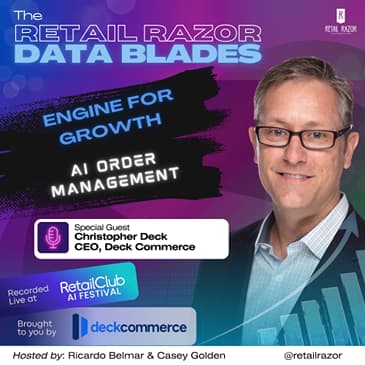



AI order management - Deck Commerce CEO Chris Deck on the missing execution layer, and why order orchestration drives growth.
One online order. Five boxes. One customer. Chris Deck, Founder and CEO of Deck Commerce, ran a couple weeks of an apparel brand's inventory and sales data through an AI order management simulation and found that order could ship in two boxes. Split shipments dropped by 3X, and four zones came off the shipping distance.
Recorded live and in-person at RetailClub AI Festival in Huntington Beach, this episode of Data Blades points AI at the part of retail that rarely makes the keynote: AI order management . Ricardo Belmar and Casey Golden talk with Chris about how AI order orchestration starts with a human in the middle, why B2B and DTC teams now share the same meetings, where brands get stuck when they ask an ERP to run modern commerce, and what Black Friday scale requires from every system around the order.
What you'll learn in this episode.
• How an AI simulation on a couple weeks of order data found 3X fewer split shipments and four fewer shipping zones, with results in about a week.
• Why Chris calls that tool version one of agentic order orchestration, and why a person still approves the changes.
• Why B2B teams still working in EDI, spreadsheets, and fax are studying how DTC AI order management works.
• What the "execution layer" is, and why systems of record like ERP and WMS make a poor stand-in.
• What Black Friday scale demands: finance close, loyalty updates, payment capture, and real-time order status, all in sync.
• Why a "where's my order?" chatbot treats the symptom only.
• The four-part case Chris makes for AI order management as "the engine of growth for the next wave of commerce" (jump to 18:18).
Support Our Sponsor.
Deck Commerce. https://www.deckcommerce.com/
Deck Commerce helps growing brands solve what happens after the buy button.
As order volume, channels, inventory, and fulfillment networks get more complex, Deck provides the intelligent orchestration layer that connects it all, helping brands make smarter order and fulfillment decisions, automate operations, and deliver a better customer experience at scale.
Subscribe & Follow.
Love this episode? Drop us a five-star rating and review on Apple Podcasts, Spotify, or Goodpods. Don't forget to like and subscribe to The Retail Razor: Data Blades for more episodes on customer experience, retail marketing, AI in retail, and data‑driven transformation!
Subscribe to the Retail Razor Podcast Network: https://retailrazor.com/
Subscribe to our Newsletter: https://retailrazor.substack.com
Subscribe to our YouTube channel: https://go.retailrazor.com/utube
About Our Guest.
Christopher Deck. https://www.linkedin.com/in/christopher-deck/
Founder and CEO, Deck Commerce. https://www.deckcommerce.com/
Chris Deck is the Founder and CEO of Deck Commerce, an enterprise order management platform built to help modern brands manage the complexity of digital commerce, omnichannel fulfillment, inventory visibility, and customer service.
With more than 20 years of experience across eCommerce, retail operations, and enterprise technology, Chris has spent his career helping brands connect the front-end customer experience with the operational systems required to deliver on that promise. His work sits at the intersection of commerce platforms, ERP, warehouse and fulfillment networks, stores, marketplaces, and customer service systems.
Under Chris’s leadership, Deck Commerce has become a trusted OMS partner for leading retail and consumer brands navigating growth, modernization, and operational scale. The platform supports high-volume order orchestration, complex fulfillment logic, distributed inventory, customer service workflows, and integration across the broader commerce technology ecosystem.
Chris speaks frequently about the future of commerce infrastructure, including omnichannel operations, inventory optimization, AI-enabled order management, and the emerging role of intelligent systems in helping brands make faster, more accurate operational decisions. His perspective is grounded in the belief that the next era of commerce will be defined not only by better digital experiences, but by the operational intelligence required to fulfill them profitably and reliably.
Chapters.
(00:00) One Order, Five Boxes: How AI Cut It to Two
(00:37) The Unglamorous AI Play Retailers Are Overlooking
(03:45) The AI Simulation That Cut 4 Shipping Zones and 3X the Splits
(07:10) B2B and D2C Stopped Fighting. Here's Why
(10:54) Why Brands Get Stuck: The Missing Execution Layer
(14:36) Black Friday Scale Is About More Than Order Volume
(16:09) Stop Building Chatbots for "Where's My Order?"
(18:00) Order Management Is the Engine of Growth
(20:27) Stay Sharp: Follow Data Blades
About your Hosts.
Helping you cut through the clutter in retail data insights:
Ricardo Belmar is an NRF Top Retail Voice for 2025 and a RETHINK Retail Top Retail Expert from 2021 – 2026. Thinkers 360 has named him a Top 10 Thought Leader in Retail and eCommerce, a Top 25 Thought Leader in Careers, a Top 50 Thought Leader in Agentic AI, AGI and Management, and a Top 100 Thought Leader in AI Ethics, Marketing, Digital Transformation andTransformation. Thinkers 360 also named him a Top Digital Voice for 2024 and 2025. He is an advisory council member at George Mason University’s Center for Retail Transformation and the Retail Cloud Alliance. He was most recently the partner marketing leader for retail & consumer goods in the Americas at Microsoft.
Casey Golden, is the North America Leader for Retail & Consumer Goods at CI&T, and CEO of Luxlock. She is a RETHINK Retail Top Retail Expert from 2023 - 2026, and Retail Cloud Alliance advisory council member. After a career on the fashion and supply chain technology side of the business, Casey is obsessed with the customer relationship between the brand and the consumer and is slaying franken-stacks and building retail tech!
Music.
Includes music provided by imunobeats.com, featuring Tech Lore from the album Beat Hype, written by Heston Mimms, published by Imuno.
Highlight Clips.
[00:04:13] - Yeah. Great great question. So order management system is what DeckCommerce is. So we have always been the back end, kind of…
[00:05:24] - With AI, within a week, we were able to turn around to them rather meaningful diagnosis of what their current situation was…
[00:18:18] - I think order management is the engine of growth for the next wave of commerce. Okay. Let me break that down. Yeah. What's…
Transcript.
DB S2E16 Deck Commerce - Chris Deck
[00:00:00] One Order, Five Boxes: How AI Cut It to Two
[00:00:00]
[00:00:01] Casey Golden: One online order, five boxes, all headed to the same customer's front door.
[00:00:07] Ricardo Belmar: Chris Deck ran a couple weeks of an apparel brand's order data through an AI simulation. They cut four zones off the shipping distance and cut split shipments by 3X. That five-box order, it now ships in two.
[00:00:20] Casey Golden: This episode of Data Blades recorded live from RetailClub AI Festival. Chris shows us why order management is the engine of growth for the next wave of commerce
[00:00:32] Ricardo Belmar: And why your customers should never have to ask where their order is
[00:00:36] Casey Golden: Preach!
[00:00:37]
[00:00:37] The Unglamorous AI Play Retailers Are Overlooking
[00:00:42] Ricardo Belmar: Welcome to season two, episode 16 of the Data Blades Podcast, Retail Data Junkies. is the podcast that slices through complex retail research to bring you sharp, actionable insights you can use today.
[00:00:55] I'm Ricardo Belmar
[00:00:57] Casey Golden: And I'm Casey Golden.
[00:00:58] This one comes to you live [00:01:00] and in person from the RetailClub AI Festival in Huntington Beach, where we spoke with Chris Deck, CEO of Deck Commerce.
[00:01:09] Ricardo Belmar: So many conversations at Retail Club were about AI pointed at the customer, agentic shopping, conversational search, personalization, because who knows when we're ever gonna get that one right?
[00:01:23] Casey Golden: Preach.
[00:01:24] Ricardo Belmar: Exactly. So Chris has been pointing AI somewhere a lot less glamorous, the order management layer that holds the whole commerce stack together. That layer is sitting on a treasure trove of first-party data that AI can finally put to work.
[00:01:41] Casey Golden: We get into why B2B and D2C teams are finally in the same meetings, why scaling for Black Friday takes a lot more than pushing more orders through, and one of my favorites, why your customer should never need a chatbot to find out where their order is.[00:02:00]
[00:02:00] Ricardo Belmar: No kidding. Chris lays out his case for order management as the engine of growth, reach, convert, deliver, and delight.
[00:02:08] But before we dive in, let me tell you a bit about our sponsor . Deck Commerce helps growing brands solve what happens after the buy button. As order volume, channels, inventory, and fulfillment networks get more complex, Deck provides the intelligent orchestration layer that connects it all, helping brands make smarter order and fulfillment decisions, automate operations, and deliver a better customer experience at scale. Thank you, Deck Commerce, for making this episode possible.
[00:02:38] Casey Golden: Now let's raise our Data Blades and welcome Chris Deck, CEO of Deck Commerce to the show
[00:02:49] Ricardo Belmar: And welcome back to the show. Right now, we are with here with Chris Deck from Deck Commerce. Thanks, Chris, for joining us today.
[00:02:57] Chris Deck: Glad to be here.
[00:02:58] Ricardo Belmar: Fantastic conversation [00:03:00] coming up. I'm looking forward to this one.
[00:03:01] We'll talk about all kinds of things around order management, B2B, DTC. We've got the... We're packing a lot into this one, I think, into this conversation. so-
[00:03:10] Casey Golden: All the acronyms.
[00:03:10] Ricardo Belmar: I know, right? We're gonna hit on pretty much every single one, so everybody try to keep up here. So Chris, I think, you know, obviously we're shooting this live in person at RetailClub AI Festival, so of course, everything is talking AI here, right?
[00:03:22] Everything is about AI. but you know, most of the conversations seem to be around agentic AI, consumer agents, conversational search, all these kind of customer facing, AI applications, personalization. There's been a lot about, about that. But you've really been pointing AI at something I think a little more operational, a little bit more foundational, I think, to retailers' business, to, to a brand's business.
[00:03:45] The AI Simulation That Cut 4 Shipping Zones and 3X the Splits
[00:03:45] Ricardo Belmar: Sometimes it's a little less glamorous, but I think the outcome maybe is even more important than some of these more, more, glamorous customer facing things we're hearing about. So why don't we start by you telling us a little bit about some of the work you've done. I think when you and I talked before, that was about [00:04:00] a leading apparel brand that you work with.
[00:04:02] there's an interesting story there, I think, where you, enabled some unique things on their order routing and, and things like that. So what did you find? What did it... How... What was the impact? Did it affect margin and so on? Give us a little bit of the details.
[00:04:13] Chris Deck: Yeah, great, great question. So order management system is what Deck Commerce is.
[00:04:17] So we have always been the back end, kind of the plumbing, if you will, of the e-commerce tech stack. And while the front end consumer experiences are getting a lot of the oxygen right now- Mm-hmm ... we tried to ask ourselves, "Well, how can AI enable us to deliver better value to our customers at more of an infrastructure level?"
[00:04:38] And you know, you hit the nail on the head. We had a, we had a prospect that was considering, whether an order management system would help them, do a couple things. Number one, deliver customers their products faster.
[00:04:49] Ricardo Belmar: Mm-hmm.
[00:04:50] Chris Deck: and number two, potentially save them money, from bad orchestration and fulfillment processes.
[00:04:55] Mm-hmm. And so with AI, we were able to do a simulation for them.
[00:04:59] Ricardo Belmar: [00:05:00] Mm-hmm. Okay.
[00:05:00] Chris Deck: So we were able to take, a couple weeks worth of data, both in terms of inventory data from an update perspective and actual sales data from their website, and we were ra- able to run it through a simulator to analyze, on different scenarios how the order could have been fulfilled and orchestrated.
[00:05:16] Mm-hmm. and without AI, this would've been a bit of a cumbersome, labor intensive process. Yeah, I can imagine. Yeah. Yeah. And with AI, within a week, we were able to turn around to them rather meaningful diagnosis of what their current situation was compared to what it could be. Mm-hmm. we were able to save them, Four zones of shipping distance.
[00:05:37] So if you think about the cost of shipping-
[00:05:39] Ricardo Belmar: Yeah ...
[00:05:39] Chris Deck: every zone you go over increases
[00:05:41] Ricardo Belmar: your cost. Right, increases
[00:05:42] Chris Deck: the cost. That's right. Right. So they were not being efficient with the zones.
[00:05:45] Ricardo Belmar: Mm-hmm.
[00:05:45] Chris Deck: and they were, we were able to show them that you could reduce the amount of splits by a factor of 3X. Hmm. So instead of taking an order and shipping it in five boxes- Yeah
[00:05:55] you could ship it in two boxes.
[00:05:57] Ricardo Belmar: Oh,
[00:05:57] Chris Deck: okay. again-
[00:05:57] Ricardo Belmar: All
[00:05:58] Chris Deck: right ... two things.
[00:05:58] Ricardo Belmar: Okay.
[00:05:58] Chris Deck: Major savings- Yeah ... from a [00:06:00] cost perspective. Yeah. But even more important, in my opinion, the customer's getting their products faster- Faster, yeah ... and fewer boxes.
[00:06:06] Ricardo Belmar: I was gonna say that would just increase the speed of delivery with that, right?
[00:06:08] That's right. That's right. Yeah, yeah. So you get a happier customer.
[00:06:10] Chris Deck: It, it, it's a great example of how AI is enabling some deeper level analytics across a big data set-
[00:06:16] Ricardo Belmar: Mm-hmm ...
[00:06:16] Chris Deck: on an operational level- Yeah ... that is really unlocking value for our customers, and that we're excited to be- Yeah ... to be leveraging.
[00:06:22] Ricardo Belmar: Yeah. And it, it sounds like, the key there is that you really unlocked this insight that was hidden in the data somewhere, that if they didn't even know to look for it.
[00:06:31] Chris Deck: That's right. Yeah, they didn't know to look for it. It would've been difficult for them to run scenarios and simulations to figure out-
[00:06:38] Mm-hmm
[00:06:38] how to optimize it the best way.
[00:06:40] Ricardo Belmar: Mm-hmm.
[00:06:40] Chris Deck: The, the underlying tool we've built for the simulation is kinda like version one of, agentic-driven orchestration.
[00:06:47] Ricardo Belmar: Okay.
[00:06:48] Chris Deck: And- Okay ... before we give the AI agents carte blanche control to do, their own orchestration- Mm-hmm ... it's the human in the middle component.
[00:06:56] Yeah. So this is gonna give our businesses insights to [00:07:00] evaluate and analyze and say- Yeah ... "We wanna make this change. This makes sense." Yeah. that's all not possible within the la- only possible because of AI in the last- Right ... year, year to two years. Yeah.
[00:07:09] Ricardo Belmar: Wow.
[00:07:09] Chris Deck: Yeah.
[00:07:10] B2B and D2C Stopped Fighting. Here's Why
[00:07:10] Casey Golden: For years, B2B and D2C have lived in separate systems, separate teams. they played by different rules, and frankly, they didn't even like each other.
[00:07:20] And, most often they just fought over inventory. Mm-hmm. that's starting to change. Now they're friends. They're in a lot of meetings together. they're kind of starting to play by some of the same rules, but what does that really look like today? What are you seeing? And if somebody thinks of themselves as a D2C first brand, what should, why should they be paying attention to this shift?
[00:07:40] Chris Deck: Yeah.
[00:07:41] Great question. I think every brand needs to be D2C first at this point in their career. if we wind back 10, 15 years ago, brands were dealing with this, phrase called channel conflict. they had these B2B partnerships, these, these relationships that represented their go-to-market with their consumers.
[00:07:59] But they realized [00:08:00] that they had to develop relationships directly with their customers. Their customers wanted it. They had better opportunity to market and, and develop a long-term relationship with their customers. So a lot of brands started testing and learning. Yeah. They started doing their own website, figuring out how to, how to operate at scale, and there was no technology stack in play, so they were building it along the way.
[00:08:21] And that's where a company like Deck Commerce came in. We were the order management system in their commerce tech layer. And what's happened over the last 10 years is direct-to-consumer has reached a level of materiality where, it's now operating at scale. They're friends because they're strategically important to each other now.
[00:08:39] Right.
[00:08:40] And the people on the B2B side have, have pretty much been living, in the Stone Ages. They're still operating largely under EDI-based systems, a lot more spreadsheet and even, fax work that, that goes on in that world. and they started poking their heads over the cubicle wall and saying, "Hey, how are you processing so many orders so [00:09:00] efficiently?"
[00:09:00] And they're starting to realize that there's some real synergies. Hope
[00:09:03] some synergy.
[00:09:04] That's... exactly.
[00:09:04] Casey Golden: Yeah.
[00:09:06] Chris Deck: you know-
[00:09:06] Casey Golden: I've had to hand key all the wholesale orders at LA Market,
[00:09:09] like,
[00:09:10] Ricardo Belmar: ah.
[00:09:10] Chris Deck: right.
[00:09:11] you know-
[00:09:12] Casey Golden: 2:00 AM.
[00:09:13] Chris Deck: D2C has, has graduated from a test and learn, oh, this is cute, to a viable part of the business.
[00:09:18] And the scale that they're operating under, is really gathering the attention of the B2B folks.
[00:09:23] Casey Golden: No, it's great. It's great.
[00:09:25] If you're not taking care of your customer, building a relationship with your customer, then, like, you're leaving your, your whole future on, on the line. I mean, I really feel like people, like, skip a meal, save, stand in line for hours because they love the brand- more so than a retailer. You know? And so you have to build those relationships.
[00:09:47] But you can't have all your... These days, you just can't have all your eggs in one basket. You have to have a strong wholesale business, you have to have a strong direct-to-consumer business, good storefront, footprint, and make sure that, you know, you're more [00:10:00] 50/50 than, 80/20, which has been- the way that it's been for, like, you know,
[00:10:06] Chris Deck: and, and And, at, the end... I mean, you hit the nail on the head, Casey. At the end of the day, these are customers, whether it's a consumer or a trading partner. Yes, orders have different dynamics.
[00:10:16] They, they have different structure, they have different, you know, ways of processing them. But a wholesale partner, a B2B partner still needs to know the status of their order. still need to be able to make adjustments to it. they're a customer with needs, just like a consumer does. And the more you can up your, your game on supporting them, the more you're gonna have a happy ecosystem, whether customer prefers to shop with you direct or one of your trading partners.
[00:10:40] Ricardo Belmar: So yeah.
[00:10:41] Well, and I think it's interesting how you pointed out all these similarities between whether you have a consumer- ... a customer, or a wholesale partner. There's a lot of underlying infrastructure, it sounds like, that's pretty common, that, that you can help, deliver for, for a brand to work with.
[00:10:54] Why Brands Get Stuck: The Missing Execution Layer
[00:10:54] Ricardo Belmar: But I'm, I guess my question then is, where do brands get stuck when they try to do this? I'm sure you've come across [00:11:00] this where someone's either increasing or adding a D2C strategy on top of what their traditional consumer sales. Where do they... where do you see them get stuck
[00:11:09] Chris Deck: Yeah. I, I think they get stuck... So, so we talk a lot about the commerce tech stack.
[00:11:14] Mm-hmm. And, the, the, the wholesale business was really built around ERP systems, WMS systems, supply chain systems, and they've been around for 20, 30 years. And they would be, more of what I would call system of records. So they're really good at doing something specific, like, "Hey, we're gonna be able to post the financials and, and call it a day."
[00:11:35] What's happened in the last 10, 15 years, and it's gonna be accelerated by AI even more, is, real-time data capabilities, flexibility in a, in a tech stack. And the modern commerce tech stack has, has to have an execution layer that sits between the demand and the consumer channels, whether it's a customer or a wholesale trading partner, and the systems of record.
[00:11:57] Mm-hmm. And what we're starting to see now is [00:12:00] that, those system of records have been, they've been tried to be frankensteined into a system of execution. and that's where you get a lot of the spreadsheet work, a lot of these manual ...
[00:12:10] Ricardo Belmar: a lot of these manual
[00:12:10] Chris Deck: processes.
[00:12:11] Ricardo Belmar: Ca- Casey's favorite pastime is, is busting Frankenstacks.
[00:12:14] Chris Deck: Yeah.
[00:12:16] So,
[00:12:17] so what they're missing is an execution layer, a, a layer that can sit in the middle, kind of like, you know, the- plumbing, if you will, Mm-hmm ...that we- talked about earlier. and take the information from the system of records on the back end, surface it to the, demand channels on the front end- and then when the demand converts to customers or orders, coordinate that across all the system of records- ...on the back end. So- order management, I think, is uniquely positioned, for, for this next wave of commerce, modernization and, innovation to be that layer of
[00:12:45] Ricardo Belmar: Yeah.
[00:12:45] Chris Deck: Yeah.
[00:12:46] Ricardo Belmar: And and I would imagine that when you're adding AI functionality into this, what you're really doing is probably enhancing the, the speed at which this capability is enabled and delivered,
[00:12:56] Chris Deck: Yeah. right?
[00:12:57] Speed, insights, we've got a couple [00:13:00] agents that were, that we recently launched for our customers where, if a customer calls into a call center, as an example, you can hit the little, star, if you will-
[00:13:08] and you
[00:13:09] see all the information about that customer. Okay. What's their order history- Yeah ... what's their return history. Right. within, you know, a, a snap of a finger, you can understand what kind of a customer I'm working with, a VIP customer, those types of things. Same thing with inventory. Yeah. Like where is your inventory placed right now, and could you have it, either different quantities in different locations?
[00:13:28] AI gives such operational insight that we're leveraging, that is really gonna change businesses to help them, you know, be more efficient and ultimately grow.
[00:13:36] Ricardo Belmar: Yeah. Yeah, it's definitely one of the areas I'm starting to see more where there's a bigger potential impact for benefits from AI in these areas you just listed- versus... And it's not that the, the, the customer-facing things that make all the news stories are, are, aren't interesting or practical, but I think from a pure business operational perspective, you know, if you're pitching this to your board- right ... And where, where you're telling your board where you're gonna get the most value [00:14:00] from investment dollars in AI, I feel like this is gonna be much more beneficial.
[00:14:04] Chris Deck: You know, you, you you talked about it earlier as well. They already have access to all this data. They already have the information. Order management, as an example, has a treasure trove of first-party transactional data that now is mineable by an AI agent to either make autonomous decisions or, at the very least, provide insights to the business- Yeah where with what they already have, without even investing in new, new channels or, or new go-to-market motions with consumers, new shopping journeys, they can already oper-op- operationalize this today.
[00:14:34] Ricardo Belmar: Okay.
[00:14:34] Casey Golden: Yeah. No, it's Great. and it's, you know,
[00:14:36] Black Friday Scale Is About More Than Order Volume
[00:14:39] Casey Golden: it's one thing to launch something new once. it's a, it's a different animal when you need to run it thousands and thousands of times on a Black Friday, a Cyber Monday. You know, we don't have even traffic throughout the year, right?
[00:14:52] Like, we make a lot of money at the end of the year. you've said that scale isn't just about handling more [00:15:00] orders. What does it mean to you and, what are some of those strategic capabilities and, and concerns that you see?
[00:15:06] Chris Deck: Yeah. So I think you hit the nail on the head. It's not just about more orders, cause we
[00:15:12] No,
[00:15:12] Casey Golden: I quoted you.
[00:15:13] Chris Deck: Yeah.
[00:15:14] Casey Golden: You hitting it the nail on the head.
[00:15:16] Chris Deck: so why is it, why is it more than that, right? '
[00:15:20] Casey Golden: cause you think scale is just like volume.
[00:15:22] Chris Deck: It's just volume. It, it, it is volume. I mean, let, let's, you know, let's call the spade a spade. You are trying to scale, you are trying to do more volume. But why is it more than just getting, instead of 1,000 orders through the system, getting, you know, 5,000 orders through the system?
[00:15:34] It's 'cause of the complexity of the tech stack. so you gotta keep all the other systems in your organization up to speed. You gotta make sure your finances can close on a monthly basis. your consumer touchpoints, how are the loyalty programs getting updated? How is payment being captured? How is the consumer being updated in real time with the status of their order?
[00:15:53] Right. So it's not just about getting an order to the fulfillment center, it's about keeping all the systems in [00:16:00] sync, so that you're not only scaling in volume, but you're scaling in the overall experience. And, and that's, it's, it's harder and harder in this more- ...integrated world that we're living in.
[00:16:09] Stop Building Chatbots for "Where's My Order?"
[00:16:09] Casey Golden: big pet peeve of mine is, you know, so many people wanting to have a chatbot on their website so that customers can a- you know, get their order tracking number and ask where their order is and take care of these customer service calls that they have call centers for. And I'm like, "Why doesn't your customer know where their order is?
[00:16:25] Why are they asking? Why do they need to ask?"
[00:16:27] Chris Deck: isn't that, like solving the symptom and not the problem? Or something
[00:16:30] Ricardo Belmar: Yeah. Right.
[00:16:31] Casey Golden: like-
[00:16:31] Chris Deck: right.
[00:16:33] Casey Golden: There's a that's a different solution
[00:16:36] Chris Deck: And where
[00:16:36] i-if you're getting it to the customer fast, on time, when they expect it, and you're keeping them informed along the way, guess what? They don't need to call. They don't need to cancel their order. Yeah. I mean, it's like seamless. Like- have, you, have you ever tried to call amazon?
[00:16:51] Ricardo Belmar: No, you don't need to. You don't
[00:16:51] Casey Golden: Don't need to.
[00:16:52] Chris Deck: Don't need to.
[00:16:53] Casey Golden: Don't need to. No reason to. No reason to. Yeah. And that's-- I-- So I love that you bring that up, and, I think having [00:17:00] real-time visibility is so important.
[00:17:02] Being able to do that supply and demand balancing and look at sell-throughs. It became so un-cost effective to transfer inventory from store to store, but now there's enough data to validate, actually, we can increase sell-through. It will be ef-effectively make us more money, and this is feasible.
[00:17:29] And so we can do some of these things now, where it was just by the time you got done with the pivot tables and the math, it's too fucking late. It's got another markdown coming next week.
[00:17:37] I know.
[00:17:37] Chris Deck: Leave
[00:17:37] Casey Golden: it alone.
[00:17:39] Chris Deck: Nobody likes markdowns when you're in retail.
[00:17:41] Stores have been underleveraged for years. When you activate them, guess what? You're turning inventory more efficiently, you're using your store resources more efficiently, you're getting products to your customers faster and at a lower cost 'cause you're leveraging a, a wider distribution of, of, network capabilities.
[00:17:57] Ricardo Belmar: Yeah, absolutely. Absolutely. [00:18:00] So, Chris,
[00:18:00] Order Management Is the Engine of Growth
[00:18:02] Ricardo Belmar: if we kind of bring this all together here, and I think m- most brands will probably think of when they're looking at their commerce stack, they'll think of order management as kind of that plumbing that holds all the different pieces together.
[00:18:10] So if, if a retail leader were to ask you, you know, what, what's the number one takeaway from what we've been talking about here today, what would you say?
[00:18:18] Chris Deck: I think order management is the engine of growth for the next wave of commerce.
[00:18:24] Okay. Let me break that down. Yeah. Um, what's what's one thing that we've talked about here at this conference quite a lot. It's discoverability. So one of the first things that anybody trying to sell, whether to a consumer or to a B2B, is reach.
[00:18:37] How do you reach your customers wherever they are, whatever channel they are, whether it's a marketplace, whether it's your website, whether it's through a large language model with the promise of agentic commerce. Well, order management se- serves one of the most important pieces of extending reach, which is your inventory.
[00:18:53] What inventory do you have available? When can you promise it to be delivered? and how do you help a customer [00:19:00] ............convert that, which is convert.
[00:19:01] Yeah. So that's the second thing. You expand reach- then you help them convert. We've got the inventory on, on hand. We can get it to you in a day, an hour, whatever that might be.
[00:19:10] Oh, and by the way, we can also support, you know, complex discounts and loyalty and whatnot. So first is reach, second is convert.
[00:19:17] Ricardo Belmar: Hmm.
[00:19:17] Chris Deck: Third, which is what most people think order management does, and it should not be minimized, is deliver.
[00:19:23] Hmm.
[00:19:23] How do you get that customer their product efficiently, .........correctly- and with full knowledge of what's going on so that they're happy and they don't- have to call transparency?
[00:19:34] Yeah.
[00:19:35] Yeah. When you get Amazon-like delivery for consumers- ......they like you. They want to- be a
[00:19:42] Ricardo Belmar: Yes. That's right. Absolutely. Right. Yeah.
[00:19:46] Chris Deck: And guess what? Those customers buy more. They buy more often. That's driving growth. And then the long tail is delight. So, you know, sure, customers are gonna occasionally have to return something. You got to make that streamlined.
[00:19:59] You [00:20:00] got to make that efficient. But when you do all that, you create a flywheel effect where you're expanding your reach, you're converting more, you're delivering great value to your customers, and ultimately you're having a loyal customer.
[00:20:10] Order management is the linchpin to drive that growth. Yeah. And it's not just the plumbing to take an order
[00:20:16] one system Right.
[00:20:16] to
[00:20:17] Ricardo Belmar: to
[00:20:17] Chris Deck: another.
[00:20:17] Right.
[00:20:17] Ricardo Belmar: No, that is, that's a great way to put it. I love that. That's a great way to put it.
[00:20:20] Casey Golden: Well, thank you so much for joining us today and popping into the tent.
[00:20:23] Chris Deck: Yeah. It's Great to be here.
[00:20:25] Ricardo Belmar: All right. Thanks again.
[00:20:26] Chris Deck: All right. Thank you.
[00:20:27] Stay Sharp: Follow Data Blades
[00:20:33] Casey Golden: Love this episode? Subscribe and drop us a five-star rating and review on Apple Podcasts, Spotify, or Goodpods. And if you're watching us on YouTube, like and subscribe before you go.
[00:20:44] I'm Casey Golden
[00:20:45] Ricardo Belmar: Follow us on LinkedIn, Bluesky Threads, and Instagram, and subscribe to our Substack for highlights and bonus content. For transcripts and guest info, visit retailrazor.com.
[00:20:55] I'm Ricardo Belmar
[00:20:57] Casey Golden: Thanks for joining us on the Retail Razor Data [00:21:00] Blades, part of the Retail Razor podcast network
[00:21:02] Ricardo Belmar: Until next time, stay sharp, be data-driven, and AI-enabled.
[00:21:06] This is the Retail Razor Data Blades!