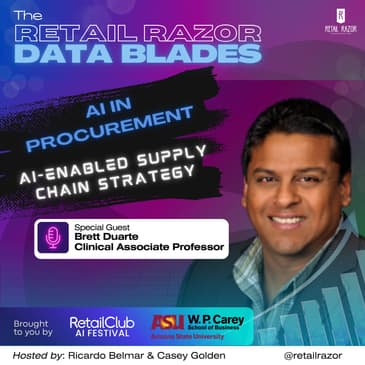



Arizona State University’s Brett Duarte on AI supply chain strategy - part 1: procurement, supplier risk, and contract intelligence
Boston Consulting Group found AI leaders doubling revenue on specific projects and cutting costs 40 to 50%. McKinsey found that under 1% of organizations that adopted AI have seen enterprise-wide impact. The distance between those two numbers is the whole job of an AI supply chain strategy and we dig into it.
Season 2, Episode 13 of Data Blades opens a 3-part mini-series with Professor Brett Duarte of Arizona State University's W. P. Carey School of Business, home to the #2 ranked supply chain program in the country. The series follows ASU's AI-Enabled Supply Chain Strategy executive program running October 5 to 7 on the Tempe campus: procurement in part 1, operations in part 2, logistics in part 3.
Today we start where the money starts. Brett names the two things supply chain leaders keep hitting. First, infrastructure: siloed systems, data quality problems, fragmentation, and AI "slapped on the legacy systems" so nobody can see the supply chain end to end. Second, adoption, which is just whether employees pick the tools up and use them.
How to build an AI supply chain strategy today.
Expanding on an AI supply chain strategy he gets specific about agentic AI in procurement. Agents are a digital workforce that can plan, reason, act, and learn. A procurement agent pulls structured and unstructured data, reads a new tariff into a pricing picture, runs sentiment analysis on news about a supplier or a region, and automates the supplier back-and-forth that used to live in email threads and manual ERP lookups. A contract agent reads the whole contract portfolio, flags what has expired or is up for renewal, checks terms against real purchase orders and delivery performance, and schedules the renegotiation conversation with evidence attached.
Casey and Ricardo also get into what supplier scorecards and Kraljic matrix segmentation look like when an agent maintains them, and why ASU built an AI lab with a supply chain digital twin to watch how agents behave when a disruption hits.
What you'll learn in this episode.
Why AI supply chain strategy pilots keep working while enterprise-wide impact stalls. And the two blockers Brett hears most from supply chain leaders. [00:04:59]
How ASU's three-part mission shows up as an AI lab and a supply chain digital twin for testing agents against simulated disruptions. [00:07:21]
What the 3-day AI supply chain strategy executive program covers, day by day, and who it's built for. [00:09:15]
Agentic AI explained: plan, reason, act, learn, and the maturity curve from AI assistant to automated workflows to a frontier firm. [00:12:16]
Why executives build their own agent in the room, then watch three agents talk to each other through a simulated disruption. [00:14:08]
Where agentic AI in procurement lands first: tactical work like supplier identification and purchase orders, strategic work like spend analytics, category management, and supplier risk. [00:15:22]
How a contract agent handles renewals, terms violations, delivery misses, and supplier scorecards, and where the Kraljic matrix fits. [00:17:12]
Next Episode.
Part 2 moves downstream into operations: forecasting, inventory, and the gap between a model that predicts well and a business that acts on it. If procurement is where you decide what to buy, operations is where you find out whether you got it right. Taken together, the three parts cover a full AI supply chain strategy from the front end to the back. Follow Data Blades so you don't miss it.
Support Our Sponsors.
There’s still time to join us at RetailClub AI Festival.
From the founders of Shoptalk and Groceryshop, RetailClub AI Festival brings together 2,000 industry leaders from September 22 to 24. It's three days fully outdoors in Huntington Beach focused entirely on how AI is transforming retail. Hear from 150 leaders shaping how AI is being used across the industry. Explore the technologies changing how retail works. And connect with senior leaders from across retail, brands, technology and investment. Late registration is now available at retailclub.com/retail-razor-podcast. We’ll see you in Huntington Beach!
W. P. Carey School of Business, Arizona State University.
ASU is a leading public research university and its W. P. Carey School of Business is the largest in the United States. AI-Enabled Supply Chain Strategy is a 3-day executive program running October 5-7, built by the #2-ranked Supply Chain Management department. The program is designed for senior leaders setting AI supply chain strategy across procurement, logistics, and operations. Register at https://specialevents.asu.edu/878064 with ID Code retailrazorasu for $1,500 off.
Subscribe & Follow.
Love this episode? Drop us a five-star rating and review on Apple Podcasts, Spotify, or Goodpods. Don't forget to like and subscribe to The Retail Razor: Data Blades for more episodes on customer experience, retail marketing, AI in retail, and data‑driven transformation!
Subscribe to the Retail Razor Podcast Network: https://retailrazor.com/
Subscribe to our Newsletter: https://retailrazor.substack.com
Subscribe to our YouTube channel: https://go.retailrazor.com/utube
About Our Guest.
Brett Duarte, Ph.D. https://www.linkedin.com/in/brettduarte/
Arizona State University | W. P. Carey School of Business
NASPO Department of Supply Chain Management
Clinical Associate Professor
Senior Faculty Co-Director – MSBA
wpcarey.asu.edu | research.wpcarey.asu.edu
Brett Duarte is a Clinical Associate Professor in the NASPO Department of Supply Chain Management at Arizona State University's W. P. Carey School of Business, the largest business school in the United States with more than 25,000 students. He is senior faculty co-director of the school's Master of Science in Business Analytics program and assistant chair for graduate programs in supply chain. ASU's supply chain management program is ranked #2 in the country by U.S. News and World Report. Brett is on the faculty teaching the AI-Enabled Supply Chain Strategy Executive Program this October.
Chapters.
(00:00) Teaser
(00:29) Show Intro
(04:18) Welcome & Introductions
(04:59) AI Adoption Challenges
(07:21) ASU's Three-Part Mission
(09:15) AI Enablement Program Overview
(12:14) Understanding Agentic AI
(14:08) Building Agents Hands-On
(15:22) Procurement & Sourcing Use Cases
(17:12) Contract Management & Supplier Risk
(19:57) Wrapping Up Part One
(20:44) Show Close
About your Hosts.
Helping you cut through the clutter in retail data insights:
Ricardo Belmar is an NRF Top Retail Voice for 2025 and a RETHINK Retail Top Retail Expert from 2021 – 2026. Thinkers 360 has named him a Top 10 Thought Leader in Retail and eCommerce, a Top 25 Thought Leader in Careers, a Top 50 Thought Leader in Agentic AI, AGI and Management, and a Top 100 Thought Leader in AI Ethics, Marketing, Digital Transformation andTransformation. Thinkers 360 also named him a Top Digital Voice for 2024 and 2025. He is an advisory council member at George Mason University’s Center for Retail Transformation and the Retail Cloud Alliance. He was most recently the partner marketing leader for retail & consumer goods in the Americas at Microsoft.
Casey Golden, is the North America Leader for Retail & Consumer Goods at CI&T, and CEO of Luxlock. She is a RETHINK Retail Top Retail Expert from 2023 - 2026, and Retail Cloud Alliance advisory council member. After a career on the fashion and supply chain technology side of the business, Casey is obsessed with the customer relationship between the brand and the consumer and is slaying franken-stacks and building retail tech!
Music.
Includes music provided by imunobeats.com, featuring Tech Lore from the album Beat Hype, written by Heston Mimms, published by Imuno.
Highlight Clips.
[00:05:20] - That's a it's an interesting question because many companies have invested a lot of money in AI, and there were definitely a…
[00:17:19] - And I think smart contracts is really a space where there's so much of efficiencies to be gained. Right? Because what a…
[00:12:12] - Agents, really, the best way to describe them is the digital workforce. Okay? They have this ability to work autonomously.…
Transcript.
S2E13 ASU Part 1 - Procurement
[00:00:00] Teaser
[00:00:00]
[00:00:01] Ricardo Belmar: Every supply chain team has run an AI pilot by now. Very few of them have an AI strategy
[00:00:07] Casey Golden: There's a difference between those two things, and it costs some real money
[00:00:11] Ricardo Belmar: So over the next three episodes, we're gonna fix that with help from Professor Brett Duarte from Arizona State University's W. P. Carey School of Business, ranked number two in the country for supply chain
[00:00:20] Casey Golden: Today, procurement, supplier risk, contract intelligence, and what happens when an AI agent joins your sourcing decisions
[00:00:28] Ricardo Belmar: Let's get into it
[00:00:29]
[00:00:29] Show Intro
[00:00:34] Ricardo Belmar: Welcome to the Data Blades Podcast, part of the Retail Razor Podcast Network, where we cut through the noise and get to the data-driven insights that move your business forward.
[00:00:43] I'm Ricardo Belmar
[00:00:44] Casey Golden: I'm Casey Golden.
[00:00:46] Welcome to season two, episode 13
[00:00:48] Ricardo Belmar: Casey, we're doing something a little different over the next three episodes
[00:00:52] Casey Golden: We are. We've got one guest, one theme, three conversations, and our theme is AI strategy [00:01:00] for supply chain, one of my favorites
[00:01:03] Ricardo Belmar: And here's why we're spending three episodes on this. Most supply chain teams have likely run AI pilots by now, and plenty of them work. The harder part is the layer above the pilots, the strategy that decides where AI belongs, who owns it, and what it adds, what it's actually worth. What's the transformational outcome you're trying to achieve?
[00:01:22] Casey Golden: So we split it up the way the supply chain operates. This episode is procurement. Next one is operations, and the third, logistics.
[00:01:31] Ricardo Belmar: Our guide on this magical supply chain journey for all three is Professor Brett Duarte. Brett is a Clinical Associate Professor in the NASPO Department of Supply Chain Management at the W. P. Carey School of Business at Arizona State University.
[00:01:46] Casey Golden: A little context on that because who doesn't appreciate a little extra context when you're getting fresh insights? Arizona State is a leading public research university known for innovation, access, and impact. [00:02:00] The W. P. Carey School of Business is the largest business school in the United States with more than 25,000 students
[00:02:06] Ricardo Belmar: Its supply chain management program is ranked number two in the country by US News and World Report. Brett also serves as senior faculty co-director of the school's Master of Science in Business Analytics program, and he's one of the faculty teaching the school's AI-enabled Supply Chain Strategy Executive Program this October 5th to 7th in the main campus in Tempe
[00:02:28] Casey Golden: Which is where the series came from. Three days, three functional areas, and we get to preview all of it just for you, our listeners and viewers.
[00:02:37] Ricardo Belmar: And today we start where the money starts, procurement. Supplier evaluation, supplier risk, contract management, and what changes when agentic AI starts participating in decisions people used to make in spreadsheets and meetings.
[00:02:51] But before we jump in, let me tell you about the Retail Razor Podcast Network sponsor, RetailClub.
[00:02:56] There is still time to join us at the RetailClub AI Festival. From the founders of [00:03:00]Shop Talk and Grocery Shop, RetailClub AI Festival brings together 2,000 industry leaders from September 22nd to 24th for three days fully outdoors in Huntington Beach, focused entirely on how AI is transforming retail.
[00:03:12] Hear from 150 leaders shaping how AI is being used across the industry, explore the technologies changing how retail works, and connect with senior leaders from across retail, brands, technology, and investment. Late registration is now available at retailclub.com/retail-razor-podcast. We'll see you in Huntington Beach!
[00:03:31] Casey Golden: Now, if you're interested in registering for ASU's AI-Enabled Supply Chain Strategy Executive Program this October, we have the details in the show notes, including a nifty discount code for DataBlade listeners.
[00:03:43] Ricardo Belmar: That's right. If you're a supply chain leader in your org, this is a great opportunity to get ahead with frameworks for evaluating AI opportunities, get a clear read on where companies are getting genuine competitive advantage from AI, and be in a room full of peers working the same problems. Seats are going fast, so don't wait.[00:04:00]
[00:04:00] Register using the link and ID Code in the show notes and currently on screen right here for $1,500 off the cost to register.
[00:04:07] Now let's get into it for today's topic, procurement, and welcome Professor Brett Duarte
[00:04:18] Welcome & Introductions
[00:04:18] Ricardo Belmar: Professor Brett Duarte, welcome to the Data Blades podcast. It is great to have you with us
[00:04:23] Brett Duarte: Thank you. Good to be here
[00:04:24] Ricardo Belmar: We've got three episodes to work through together, so why don't we use this one to kinda set the stage, set the table a little bit before we get deep into our procurement topic today. And, let's just start w- with you. Tell our listeners, who you are and the role you play at ASU
[00:04:38] Brett Duarte: yeah. my name is Brett Duart. I'm a clinical associate professor in the NASPO Department of Supply Chain Management. I'm also the co-director for our business analytics program, and more recently, I'm the assistant chair for graduate programs in the supply chain department
[00:04:53] Casey Golden: It's a good thing you got lots of time on your hands.
[00:04:59] AI Adoption Challenges
[00:04:59] Casey Golden: Over the [00:05:00] past couple of years, we've seen organizations across nearly every industry make significant investments in AI. The success stories are many, but some are quite not so much. What are you hearing about the biggest challenges that supply chain leaders are facing?
[00:05:19] Brett Duarte: Yeah, that's a, that's an interesting question because many companies have invested a lot of money in AI, and there are definitely a lot of success stories. In fact, I think there's a couple of articles from the Boston Consulting Group, somewhere in the middle of last year, and in terms of AI, last year is already a long way back. But, they talk about how many AI leaders seeing two X revenue growth, in specific projects and also seeing, forty to fifty percent cost reduction. so lots of value in pilots, but what's really interesting is there was another article out of the McKinsey Group, later that year, which essentially said that, while these companies have [00:06:00] adopted AI, still less than one percent of organizations that have really seen enterprise-wide impact. and so the question is, where's the gap, right? And, is it really an execution thing? Is it a technology piece? and so what we've done is we've spent a lot of time speaking to supply chain leaders to get a sense of, "Hey, where can you help?" "Where are some of the challenges?" And the, the messages that we're hearing are somewhat the same, right? One is infrastructure and readiness of infrastructure. typical infrastructure tends to be very siloed, data quality issues, fragmentation. in many cases, AI technology is slapped on the legacy systems, which really makes that end-to-end view of supply chains really hard to see. Okay? The other thing is really, adoption, right? employees leaning in and, taking advantage of some of these tools and technologies. and so if companies can really focus on these two critical [00:07:00] things, the IT infrastructure, really deploying, having a good deployment strategy and getting their employees to learn how to use AI, think they can move that needle from hype to value.
[00:07:11] Ricardo Belmar: Yeah. what are some of the things that, the Department of Supply Chain Management is doing to really support and kind of partner with the industry around all of these challenges you just listed?
[00:07:20] Brett Duarte: Yeah, so
[00:07:21] ASU's Three-Part Mission
[00:07:21] Brett Duarte: like any education institute, ASU really has, a mission of three critical things, and that's also pertinent to the NASPO Department of Supply Chain Management. The first being, education, right? How do we train the next generation of leaders? How do we infuse AI into our classes? how do we, provide executive education? We have some of these work sessions that we'll talk about. How do we provide certificates for people that have not been in school for a while but can quickly learn some of the tools and technologies? But there's also an element of research, right? and part of what we have done is we've recently created [00:08:00] a AI lab with the vision of being a leading hub for AI-driven supply chain research.
[00:08:06] In AI world, there's this notion of creating a digital twin, and that's what we're hoping to do, is to build a digital twin, which is essentially, provides us, if you will, with this capability of having a living laboratory for AI experimentation. So we can come in, we can test agents, we can test different algorithms. it really provides a great platform for experiential learning, because what we can do is we can simulate a disruption, and then get a sense how, how-- of how AI, especially AI agents, react to some of those disruptions, and also hopefully train some of our students to work with these agents, to manage some of those disruptions. So I think this is, something that's really key from a research perspective. And of course, we wanna be able to partner with the industry. Ithere's the education piece, there's the research piece, but of course, we wanna [00:09:00] partner with industry, partner with companies, partner with the community, to be able to hopefully utilize AI, to improve overall efficiency, effectiveness, just quality of life.
[00:09:10]
[00:09:10] Casey Golden: that's great. can you share a little bit more about the three-day AI enablement
[00:09:15] AI Enablement Program Overview
[00:09:15] Casey Golden: supply chain strategy program that's scheduled for what? October 5th through 7th.
[00:09:21] Brett Duarte: That's correct,
[00:09:22] Casey Golden: What should we expect?
[00:09:24] Brett Duarte: Yes, it's a three-day intensive, October 5th to the 7th. it really is for senior leaders, executives, strategists, anyone in the supply chain space, that's really looking to explore how AI can transform a supply chain, like operations, procurement, logistics. and quite honestly, the way it's designed is there's really a little something for everyone. So if you're completely new to AI, and you've never used it in your organization, this is an awesome, [00:10:00] opportunity to kinda get in some hands-on exercises on how to build agents, how to use them to assist, to automate certain activities. On the other hand, if you've spent quite a bit of time in AI, there's something there for you as well.
[00:10:13] We'll talk about infrastructure, deployment strategies, return on investment, bringing in industry experts so you don't have to spend three days listening to boring faculty. we wanna be able to kinda pull in some industry experts, get a sense of what they're seeing, and really provide this forum for dialogue, right? what is your company doing? what is our company doing? what are the differences? What can we share? So it's really meant to be very interactive. The three-day intensive is essentially divided into, three components, okay? The first one focuses on the front end of the supply chain, essentially procurement and sourcing. lot of use cases on how AI can help play a role in that space. Day two is on operations. [00:11:00] And so we'll talk about things like forecasting and inventory management. And then leading into day three, we'll wrap up the back end of the supply chain, focus on logistics, but then also bring in, topics like, AI infrastructure, governance, business cases, how do you benchmark critical success factors, deployment strategies.
[00:11:20] So kinda rounding it all up together. So quite honestly, a little bit of something for everyone.
[00:11:26] Ricardo Belmar: Definitely does sound like it. you've got really a lot of great material packed into that. and then I think you even have some, some of the industry folks that you have coming, if I understand the agenda, have actually been on our show before. As I know Dave Finnigan is one of the folks who's coming in, so a quick shout-out to Dave. so you've mentioned a couple of times, you talked about agentic AI and AI agents, and how that's a core piece of what you're gonna be covering in the executive program. And we've talked about agentic AI before on, on our show and h- a number of topics related to that. But just in case for anybody listening who's not as familiar as, maybe they'd like to be with agentic [00:12:00] AI in general, can you explain agents for us and how that's s- such a relevant topic, how they might be used in supply chain management, or how a practitioner would engage with agents?
[00:12:11] Brett Duarte: Oh, yeah, absolutely. agents, really
[00:12:14] Understanding Agentic AI
[00:12:16] Brett Duarte: the best way to describe them is, the digital workforce. Okay? They have, this ability to work, autonomously. they can plan, they can reason, they can act, they can learn. they can pull data out of different systems. They can, evaluate it. They can find ways to make decisions and learn from their mistakes. from a supply chain standpoint, that really opens a whole spectrum of use cases because now you can have these digital workers place orders, they can reroute shipments, they can flag certain suppliers. and of course, they do come with different levels of capability, right? From the most basic ones, which perhaps can, really support you as far as informing and assisting you with day-to-day [00:13:00] activities, to, uh, to, uh,moving up that maturity curve, if you will, with automation, where agents can really automate workflows. Essentially what would happen is you give this agent a goal, and it's able to go through some multi-step reasoning. It's got some memory and context, it's got some self-correction, and it's able to execute on certain tasks, on its own. So the whole idea is to kinda evolve from having a human with an AI as an assistant, to this notion of becoming what we would call a frontier firm, where you now have a hu- that sets the goal, but the agent essentially goes in there, works the processes, creates the workflows, and then comes back and reports to you. So this work session is really geared towards, focusing on agentic AI. Uh,we wanna be able to, reach people that have never created an agent, so there's a lot of hands-on [00:14:00] experience on building an agent. it's gonna be great because everyone's agent may be a little bit different, and so we can kinda learn as we move along.
[00:14:08] Building Agents Hands-On
[00:14:08] Brett Duarte: but then there's also the element of how do you now bring all these agents together? part of
[00:14:15] Casey Golden: Right
[00:14:15] Brett Duarte: done, we've come up with this, curated end-to-end case of a supply chain. So we've essentially built data, that repre- represents a company, and you've got, purchase orders and sales orders and, you've got demand, and you've got logistics and distribution. and what we're hoping to do is use this case as a foundation for learning. So on day one, you build an agent to help you with procurement and sourcing and contract management. on day two, you build a agent to help with forecasting and inventory management. And I'll talk a little bit more about what each of those do. and then on day three, you build an agent to help you with logistics, right? So you've got this small army of agents, and essentially what we then do is, we simulate a disruption, [00:15:00] and we're hoping that these agents can kindcommunicate with each other, and solve some... or make some decisions that impact end-to-end supply chain, operations, right? the notion is if an executive is able to build an agent in three days if he's never done before, then hopefully they're inspired to take some of these learnings back to their company
[00:15:18] Ricardo Belmar: Back with them,
[00:15:18] Brett Duarte: exactly,
[00:15:19] Ricardo Belmar: of the team, yeah.
[00:15:20] Brett Duarte: it, there's no reason why you
[00:15:21] Ricardo Belmar: Mm-hmm
[00:15:21] Brett Duarte: be able to do it."
[00:15:22] Procurement & Sourcing Use Cases
[00:15:22] Casey Golden: So on the p- procurement side, what would a specialist expect? Do you have any use cases for that?
[00:15:33] Brett Duarte: yeah, absolutely. Quite honestly, Casey, each of these verticals we could probably spend month, you
[00:15:39] know,
[00:15:39] Casey Golden: Right
[00:15:39] Brett Duarte: different topics- Yeah right?
[00:15:41] Ricardo Belmar: Yeah.
[00:15:41] Brett Duarte: The supply chain is so
[00:15:42] Ricardo Belmar: Right
[00:15:43] Brett Duarte: Uh, to try and squeeze all that information, into a, a couple of hours is, definitely a challenge. So what we've tried to do is, we're kinda looking at the procurement and sourcing, will. Think, typically someone in procurement or sourcing [00:16:00] has certain tasks that are very tactical in nature, looking at identifying suppliers, creating purchase orders, looking at supplier performance. But then there's also strategic elements that they get involved in, spend analytics, category management, contract management, supplier risk management. and so what we've done is, through our case, we will build a procurement agent, that will be able to pull data out of this case that we've created and come up with industry insight, maybe create some predictions, look at external markers. maybe there's a tariff that's, imposed on a particular location, particular count.
[00:16:38] How does that impact pricing? Looking at both structured and unstructured data, pulling in sentiment analysis because that's very important to get a read from maybe news articles, on what's going on in the space and how does that impact, purchasing. and then also looking at automating some of that communication between suppliers.
[00:16:59] Instead [00:17:00] of, pulling out an email and into your ERP system, pulling information, we wanna find ways to automate that communication, really make it more efficient for the user, right?
[00:17:12] Contract Management & Supplier Risk
[00:17:12] Brett Duarte: Now- The second piece of the whole procurement, space, centered around contract management. And I think smart contracts, is really a space where there's so much of efficiencies to be gained, right? because what a contract manager does essentially is reading through multiple contracts. You're looking at terms and conditions. You're extracting performance. You're looking at risk. You're notifying suppliers. you're updating the contract. Lots of manual work. And what we're hoping to do is to demonstrate how a contract agent can really automate a lot of that functionality, right? essentially looking at your contracts, pulling up ones, which are, have expired or perhaps which are ready for renewal. Evaluating those [00:18:00] contracts against sales data or, purchase orders to get a sense of which contracts are violating some of the terms and conditions. things like, on time delivery, lead time, quality related issues. and then setting up, meetings with your suppliers to say, "Hey, guys, it's time to renegotiate contract based on here is
[00:18:21] Ricardo Belmar: right?
[00:18:22] Brett Duarte: over the years. we might need to talk about renegotiating contracts." And then finally, I think what's really cool is, this, this notion of looking at your suppliers, and then coming up with ways to kinda mitigate risk.
[00:18:36] So we'll talk about things like the Kraljic, matrix evaluation, how you come up with supplier scorecards. and then really automating that communication, between the suppliers and, and the company.
[00:18:47]
[00:18:48] Ricardo Belmar: It sounds like quite a lot to pack into that one day in the class. I think for most procurement specialists, that's gonna be an exciting, amount of material to cover to really help them optimize their day-to-day.
[00:18:59] Brett Duarte: Uh,[00:19:00] absolutely. It's, it's a packed session, but, we're really looking at making it very interactive, right? and
[00:19:07] Ricardo Belmar: Right
[00:19:08] Brett Duarte: y- engaging with small teams, having people work together, is the way to go about it. We find that, learning from each other and kinda getting a sense of, what are some of the best practices the way to go.
[00:19:19] But day one is super exciting because it really sets the stage, for what's to come, down the road.
[00:19:25] Ricardo Belmar: Yeah, and I think there's really a good lot of benefit to be had because you'll have people from different industries, so there should be a lot of kind of car- cross-industry thought, I think, that everyone would learn from as well, even though they're probably experiencing similar problems, just maybe attacking them a little bit differently within each industry
[00:19:41] Brett Duarte: a- absolutely. and then there's different levels of, maturity of AI within their organization, right?
[00:19:47] Ricardo Belmar: Right.
[00:19:47] Brett Duarte: are just getting started and don't know where to start. and others have, as I've mentioned, been on that path for a while, but are looking at ways to fine-tune their strategy, and their roadmap
[00:19:57] Wrapping Up Part One
[00:19:57] Ricardo Belmar: Well, I think that's it for part one [00:20:00] today. Brett, thanks for sharing with us, covering day one of the program. we're not done with you yet, though.
[00:20:05] Casey Golden: Yeah, not even close. Next episode, we move downstream into operations, forecasting inventory, and the gap between a model that predicts well and a business that acts on it
[00:20:18] Ricardo Belmar: If procurement is where you decide what to buy, operations is where you find out whether you got it right. So that'll be part two, and that is coming up next week
[00:20:25] Casey Golden: Follow Data Blades so you don't miss it.
[00:20:28] And if this series has you curious about the full three-day program at ASU, a quick reminder that the registration link and our listener discount code is in the show notes.
[00:20:41] Ricardo, this episode is a wrap
[00:20:43] Ricardo Belmar: See you next episode
[00:20:44] Show Close
[00:20:50] Casey Golden: Love this episode? Drop us a five-star rating and review on Apple Podcasts, Spotify, or Goodpods. And if you're watching on YouTube, like and subscribe before you go.
[00:20:59] [00:21:00] I'm Casey Golden.
[00:21:01] Ricardo Belmar: Follow us on LinkedIn, Bluesky, Threads, and Instagram, and subscribe to our Substack for highlights and bonus content. For transcripts and guest info, visit retailrazor.com.
[00:21:11] I'm Ricardo Belmar.
[00:21:12] Casey Golden: Thanks for joining us on the Retail Razor Data Blades, part of the Retail Razor podcast network.
[00:21:18] Ricardo Belmar: Until next time, stay sharp, be data-driven, and harness AI.
[00:21:21] This is the Retail Razor Data Blades!