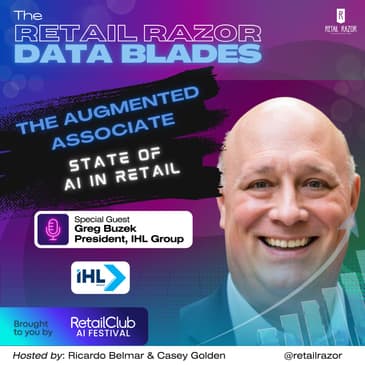



Greg Buzek of IHL Group on the AI Hiring Gap and the Augmented Associate the Retail Industry Got Backwards.
For two years, every conference stage and every headline has told you the same thing. AI is coming for retail jobs. The robots are taking over. Store headcount is doomed. The data tells a completely different story, and it is not close. Cue the augmented associate! This is Season 2, Episode 8.
In part two of our three-part AI in Retail series, Ricardo Belmar and Casey Golden sit back down with Greg Buzek, President and Chief AI Orchestrator at IHL Group, to take apart the doom narrative with hard numbers from IHL’s 2026 Retail Transformation Study. The retailers deploying the most AI in their stores are adding store associates at nearly double the rate of everyone else. Edge-current retailers plan to grow store headcount at 70% versus 36% for their peers. The fastest-growing retailers are 115% more likely to be adding people, not cutting them.
This is the augmented associate model, and it’s the through-line of the whole episode. The winning retailers treat AI as a tool to augment store associates rather than replace them. Greg traces it all the way back to self-checkout 25 years ago, when Kroger trained its best people to teach customers and then moved staff to fresh-food profit centers, while Kmart simply bolted in machines, cut labor, and flamed out. Same technology, opposite outcomes.
In This Episode, You’ll Learn.
The self-checkout history that predicts who wins and loses with AI in retail.
Why store associates blame every staffing change on AI, and the over-communication fix that works.
The augmented associate toolkit: voice in an associate’s native language, mobile devices, assisted selling, and instant order history.
Why edge computing, not the cloud, is quietly deciding which retailers can scale AI in the store.
The two things AI needs more than anything else: the network and clean data.
How buy online pickup in store, returns, and last mile delivery are all adding store associates instead of removing them.
Why roughly 18% of retail sales now run through reverse logistics, and where the margin recovery hides.
The restaurant handheld lesson Greg has tracked for 15 years, and why turning tables twice as fast drops straight to the bottom line.
Greg’s bottom line lands hard. The retailers cutting store associates to look efficient on a spreadsheet are the ones falling behind. The winners are connecting store associates to data, handing them better tools than the customer walks in with, and getting the store network right before anything else. If you make one retail workforce decision this year, this episode is the one to hear first.
Resource Links.
How Retail Leaders Outperform - https://www.ihlservices.com/product/how-retail-leaders-outperform/
Shelf Intelligence Report - https://www.ihlservices.com/product/shelf-intelligence-report-rebuilding-retail-relationships-through-automation/
Adapt or Be Outpaced - https://www.ihlservices.com/product/adapt-or-be-outpaced-tech-imperative-for-retails-midmarket/
Fixing Inventory Distortion - https://www.ihlservices.com/product/fixing-inventory-distortion-whos-winning-whos-failing-whats-working/
Closing the Execution Gap - https://www.ihlservices.com/product/closing-the-execution-gap/
Support Our Sponsors.
This Episode is Brought to You By RetailClub.
Retail Club AI Festival, September 22–24 in Huntington Beach. Join 2,000 retail leaders for a fully outdoor, beachside deep dive into how AI is reshaping retail. Qualified retailers and brands can attend with free tickets and up to $1,250 in travel reimbursement. Head to retailclub.com to learn more. https://retailclub.com/retail-razor-podcast
Subscribe & Follow.
Don't forget to like and subscribe to The Retail Razor: Data Blades for more episodes on customer experience, retail marketing, AI in retail, and data‑driven transformation!
Subscribe to the Retail Razor Podcast Network: https://retailrazor.com/
Subscribe to our Newsletter: https://retailrazor.substack.com
Subscribe to our YouTube channel: https://go.retailrazor.com/utube
About Our Guests.
Greg Buzek. https://www.linkedin.com/in/gregbuzek/
IHL Group. https://www.ihlservices.com/
RetailROI. https://www.retailroi.org
Greg Buzek is the Founder, President and Principal Analyst of IHL Group, one of the most respected retail technology research firms in the world. IHL's annual Retail Transformation Study is the largest survey of retail technology leaders in the industry, covering more than 400 brands across every retail segment. Greg is also the founder of Retail Orphan Initiative (Retail ROI), which this week surpassed $6 million in total grants to help children around the world through the industry's Super Saturday campaign.
Noted by RIS News as one of the Top 10 Influentials in Retail and the National Retail Federation as one of “The List of People Shaping Retail’s Future“, he has a Masters Degree in Business Administration (MBA) from The Ohio State University, and 30 years of experience in retail market analysis, business planning, product development, and consulting with Fortune 500 companies. He is also a member of the Top 100 Retail Influencers from RETHINK Retail.
Chapters.
(00:00) Teaser
(00:40) Show Intro
(03:32) Welcome back, Greg Buzek!
(04:22) Self Checkout Lessons
(08:11) Augmented Associate Tools
(10:17) Voice and Language Support
(11:54) Edge Computing Advantage
(13:18) Network and Clean Data
(14:31) Enabling Tech and IT Spend
(16:25) Mobile Tools and Pickup Wins
(18:25) Last Mile Delivery Staffing
(21:24) Making the Investment Case
(23:16) Returns and Fulfillment Focus
(25:42) Restaurant Speed Example
(29:15) Key Takeaways and Wrap
(31:27) Show Close
About your Hosts.
Helping you cut through the clutter in retail data insights:
Ricardo Belmar is an NRF Top Retail Voice for 2025 and a RETHINK Retail Top Retail Expert from 2021 – 2026. Thinkers 360 has named him a Top 10 Thought Leader in Retail, a Top 25 Thought Leader in AGI and Careers, a Top 50 Thought Leader in Agentic AIand Management, and a Top 100 Thought Leader in Digital Transformation and Transformation. Thinkers 360 also named him a Top Digital Voice for 2024 and 2025. He is an advisory council member at George Mason University’s Center for Retail Transformationand the Retail Cloud Alliance. He was most recently the partner marketing leader for retail & consumer goods in the Americas at Microsoft.
Casey Golden, is the North America Leader for Retail & Consumer Goods at CI&T, and CEO of Luxlock. She is a RETHINK Retail Top Retail Expert from 2023 - 2026, and Retail Cloud Alliance advisory council member. After a career on the fashion and supply chain technology side of the business, Casey is obsessed with the customer relationship between the brand and the consumer and is slaying franken-stacks and building retail tech!
Episode Music.
Includes music provided by imunobeats.com, featuring Tech Lore from the album Beat Hype, written by Heston Mimms, published by Imuno.
Highlights.
[00:13:43] - It is. What a lot of retailers are doing is they're using AI to clean the data to get it to that consistency. And really,…
[00:05:24] - So we're seeing the same thing when it comes to AI at the stores. The retailers that are really succeeding here are augmenting…
[00:12:11] - Yeah. It's right now, most of it is cloud related that is AI, but it's being driven down to the edge, quite frankly, very fast.…
Transcript.
S2E8 IHL Part 2 - The Augmented Associate
[00:00:00] Teaser
[00:00:00]
[00:00:00]
[00:00:01] Casey Golden: You've been told AI is coming for retail jobs.
[00:00:05] Ricardo Belmar: But the data says the opposite. Retailers with up-to-date AI infrastructure are adding store associates at nearly double the rate of everyone else. It's 70% versus 36%.
[00:00:16] Casey Golden: This episode of Data Blades, Greg Buzek of IHL Group shows us the augmented associate, why the store network is the unlock, and why the retailers cutting headcount are the ones falling behind.
[00:00:40] Show Intro
[00:00:40] Ricardo Belmar: Welcome to season two, episode eight, retail data junkies. This is The Retail Razor Data Blades, the podcast that slices through complex retail research to bring you sharp, actionable insights you can use today.
[00:00:53] I'm Ricardo Belmar.
[00:00:54] Casey Golden: And I'm Casey Golden. We're in part two of our three-part AI in Retail series with [00:01:00] Greg Buzek of IHL Group. Last episode, we got into shelf intelligence. Today, we're going somewhere a little more contentious. We're talking about AI and the retail workforce.
[00:01:14] Ricardo Belmar: And we're going to challenge a narrative that's been pretty much everywhere for the last two years. You've heard it all before. AI is going to absolutely gut retail headcount. Robots are gonna replace workers. Doom and gloom from pretty much every conference stage.
[00:01:29] Casey Golden: But the data says something completely different. The retailers most aggressively deploying AI in stores, they're the ones hiring the most, despite the technology, because of it.
[00:01:41] Ricardo Belmar: Edge current retailers plan to add store personnel at nearly double the rate of non-current peers. It's 70% versus 36%, according to IHL's latest research report. So we're gonna spend this episode unpacking why that is. What's actually happening with store [00:02:00] associate tools. What the store network has to do with it, and what it means for any retail leader trying to make a workforce decision right now.
[00:02:08] But before we dive in, let me tell you about our sponsor, Retail Club. Join 2,000 retail leaders at the Retail Club AI Festival, September 22nd and 24th in Huntington Beach. Dive deep into how AI is reshaping retail while soaking up the sun at a fully outdoor beachside venue. Decision-makers from retailers and brands can attend with free tickets and up to $1,250 in travel reimbursement.
[00:02:32] Head to retailclub.com/retail-razor-podcast to learn more and get your ticket today.
[00:02:39] Thank you, Retail Club, for helping us bring you this podcast and all the shows in the Retail Razor Podcast Network.
[00:02:46] Casey Golden: We have one quick ask for you, our audience. If you enjoy the show, hit us with a five-star rating and drop a short review on Apple Podcasts, Spotify, Goodpods, or wherever you're listening. And don't forget to like and subscribe [00:03:00] on our YouTube channel so you never miss an episode. It really helps grow the show.
[00:03:04] Ricardo Belmar: And check out the other shows in the Retail Razor Podcast Network if you haven't already. There's the Retail Razor Show, Retail Transformers, and Blade to Greatness. You'll find them all on your favorite podcast app and, of course, on our YouTube channel.
[00:03:17] Casey Golden: Now let's raise our data blades and welcome back Greg, president and chief AI orchestrator at IHL Group to the show.
[00:03:26]
[00:03:32] Welcome back, Greg Buzek!
[00:03:32] Ricardo Belmar: Welcome back to the Retail Razor Data Blades Show, Greg. Excited to continue this three-part series with you and surface even more insights from all the studies in AI and retail that you and IHL Group have been putting together for so long now. It's really great to have you back, as we've been dying to do this, continue this episode ever since the first one.
[00:03:51] Greg Buzek: Yeah, it's great to be back for episode two.
[00:03:54] Casey Golden: And today we're tackling something that is just so jarring for so many of us that [00:04:00] have been in the retail trenches.
[00:04:02] This narrative that AI is going to reduce retail headcount. We're going to challenge that narrative today, aren't we?
[00:04:09] Greg Buzek: Yeah, we're gonna talk all kinds of things regarding the augmented associate and what that means for retailers.
[00:04:14] Ricardo Belmar: in fact, I think the research and all your recent work is telling a really different story, right? So let's just go ahead and jump in.
[00:04:22]
[00:04:22] Self Checkout Lessons
[00:04:22] Greg Buzek: Yeah, so first of all I think the easiest way to explain this is there's the narrative that we get with the press, and there's the narrative that w- really is what's going on and what's best practice out there. I have to go back to really 20, 25 years ago when self-checkout was initially introduced into the retail environment.
[00:04:43] Kroger was the first one to do it in mass scale. They actually recruited their best employers or employees to to literally recruit customers and teach them how to use self-checkout. As a result, they got about 60% of their orders and about 40% of their order [00:05:00] volume go through self-checkout, reducing their expenses, and they moved the personnel over to what we would call profit centers.
[00:05:06] So, things like pre-cooked chicken meals and hot bread and all those things that became impulse items to increase the sales in a Kroger store. Kmart, on the other hand, just put self-checkout in and reduced labor, and the end result was it was a dismal failure, and they were quickly out of it.
[00:05:24] So we're seeing the same thing when it comes to AI at the stores. The retailers that are really succeeding here are augmenting their associates with AI tools, not looking to replace labor. That being said, retailers have been having to deal with doing more for, with less because they can't get enough people to work in their stores. So this is really more about giving the associates enough tools so that they can fulfill the requirements of the customer without them having to hiring more people because they generally cannot get those people to work in the stores. And it's really [00:06:00] fascinating to look at the data that is coming into play here because the sales winners, the people that are growing their sales the fastest, are 115% more likely to be adding people to the process as well.
[00:06:14] And that's it's really fascinating because you think, "Oh let's just reduce people, and we'll increase sales, and we'll do all that stuff." It doesn't work that way. You do have a minimum level of staffing that is required, but you've got to give them the tools to be the most effective, and that's what we're seeing. And there are enabling technologies that come into play as well.
[00:06:32] Ricardo Belmar: So from what you're seeing would you say that it's the same retailers are the ones that kind of expect AI to have a big impact on their workers? Is-- This is like a total contradiction to what we kind of hear from the press and the media, right? That
[00:06:44] Greg Buzek: Yeah.
[00:06:45] Ricardo Belmar: this narrative o- of job loss.
[00:06:47] Greg Buzek: Well, and this gets to the point that retailers need to over-communicate anything related to AI. Because when we did our research, what we found is everybody at the store level thinks any change that's [00:07:00] happening is AI-driven. So if they're increasing headcount or decreasing headcount in particular areas, it's all AI's fault. it's not been that way. Ever since COVID, in particular, retailers at the executive levels have ha- had to sit there and say, how do we operate? How do we increase our sales? How do we grow operations when we can't get enough people to work in our stores?" as a result, they've been implementing processes and procedures far above just using AI to do things.
[00:07:32] So if there is a change that is happening, it's, it's-- AI's only a part of that. It's not the primary reason. But in the minds of the associate, it is the big reason. And it's literally about a three-to-one ratio because of the narrative of the press. And you're never going to see the press say positive things about AI because they're like the ones most affected by the technology, 'cause AI can write better and faster [00:08:00] than most of them.
[00:08:00] So they're gonna just continually put out negative stories around that. But the power of these tools to augment the associate is really incredible.
[00:08:11] Augmented Associate Tools
[00:08:15] Greg Buzek: We've seen no more than a hundred-- or no less than 150 different stories this year alone on AI case studies of where AI tools are being deployed by retailers, and a lot of that is at the store, whether it's voice like th- or my blog coming up this week around restaurants, and it's about all those calls that don't get answered because they're too busy, and they lose customers as a result of that.
[00:08:35] Ricardo Belmar: Mm-hmm. Right.
[00:08:37] Greg Buzek: tools to take those calls, to get those orders in place and maintaining that revenue. But as well, using those tools to connect the systems in the back. So
[00:08:46] You get orders that come in all these different ways, but do they get to the kitchen display system? I think we've all dealt with we do an Uber Eats order or something, and the driver shows up and the the order's not ready
[00:08:59] Ricardo Belmar: Right[00:09:00]
[00:09:00] Greg Buzek: like, while that order from over here never got into the production system to help the associates. So all of those things, all those connectors and then the AI systems to prioritize those orders based on location, where people are, where the driver's coming in, all that sort of stuff so that the customer gets their order hot and ready, so to speak is all, is all a big deal.
[00:09:22] But I mean, we're seeing, we're seeing all kinds of different tools being used. If you're in the Dallas area or in the Atlanta area, you can have your food delivered by drone by flying drone now, I think. C- Little Caesars now has a deal with, I think it's Flytrex type thing, and it can handle two large pizzas and a two-liter coming flying over your house and then gets dropped down.
[00:09:44] Yeah. There's all these different tools. And like I said the retailers that are performing best, that are the-- they're growing their sales 10% or more are augmenting their associates with AI, not replacing.
[00:09:57] Ricardo Belmar: We hear a lot on from the technology vendor side that are [00:10:00]bringing the these tools and a lot of the core technology for that about how the narrative should be things like the augmenting comes from removing a lot of the tedious tasks
[00:10:10] Greg Buzek: Yep.
[00:10:10] Ricardo Belmar: teams have to do because now AI can help do it or make it easier or faster or just completely take over that part.
[00:10:17] Voice and Language Support
[00:10:17] Ricardo Belmar: There have been audio technologies where for larger stores where the teams are using two-way radios. Instead of calling another person they can basically call into the AI to get questions answered right when they're standing there with a customer instead of having to wait and figure things out. So are you seeing a lot of this
[00:10:34] Greg Buzek: Yeah, we are s- we are seeing this. A lot happening with voice, and particularly voice in the native language of the speaker. So not only does the speaker of the consumer coming into the store,
[00:10:45] But also the associates in their native language. And where this plays out a lot is order picking.
[00:10:50] Ricardo Belmar: Hmm
[00:10:51] Greg Buzek: you know, or anything related to inventory control where they're getting instructions on the next things to stock where a lot of [00:11:00] times the worker's English is a second language for them or maybe even a third language for them, and they can get the orders in their preferred language. And that opens up the door for more employees but also allowing them to be more effective.
[00:11:13] But it could be something as, as crazy as, "Hey, I gotta change the paper on the printer, here. How do I do that?" And being able to get those instructions in your native language is pretty powerful. And we've seen that in dramatic ways at the largest retailers like Walmart, where they've now trained two point one million associates on AI tools, not only internal, but they're endeavoring to teach them on general purpose AI tools as well at the same time.
[00:11:40] Casey Golden: Mm-hmm.
[00:11:40] Greg Buzek: But it, it ranges all the way up and down the revenue and segments everybody from specialty stores and, smaller retailers and then the restaurants, drive-throughs, delivery, food production, you name it.
[00:11:54] Edge Computing Advantage
[00:11:54] Ricardo Belmar: And are you seeing, differences in outcomes and results for [00:12:00]retailers when they're doing You know a lot of this technology requires a lot of compute, right. So are they relying on cloud processing power and cloud connectivity to do it. Are they relying on edge compute?
[00:12:09] Greg Buzek: Yeah.
[00:12:10] Ricardo Belmar: better than the other?
[00:12:11] Greg Buzek: Yeah, it's right now most of it is cloud related that is AI, but it's being driven down to the edge quite frankly, very fast. In fact, the edge current retailers, the people that are using edge computers are not only more likely to be using AI, they're also more likely to be adding personnel to their stores at really at a two-to-one margin that we're seeing. Edge is so enabling for so many different things, is the complexity of the typical retail store is it's now more complex than the headquarters because the number of IoT devices. And whether it's RFID or computer vision, et cetera you can't m-manage all that processing in the cloud. You have to have edge devices gonna be able to do that. And so we're seeing a major thing. I mean, your former life, the speed at which the [00:13:00] LAN and the WAN and the networks need to be upgraded, but also the edge computing needs to be updated there to support the data collection processes required for the AI processing. And i-increasingly, we're starting to see that AI come down to the store level for processing itself.
[00:13:18] Network and Clean Data
[00:13:18] Casey Golden: What are the specific tools that are making this associate augmentation model work? And does the network have anything really to do with that?
[00:13:28] Greg Buzek: network's critical for retailers. You gotta start with the network. There's two things that AI needs more than anything else. They need the network, and they need clean data. Those two things are most important for...
[00:13:41] Casey Golden: The network sounds easier than clean data.
[00:13:43] Greg Buzek: It is. And what a lot of retailers are doing is they're using AI to clean the data to get it to that consistency.
[00:13:50] And really, that's the first thing that any retailer should be doing on the on the A- AI front is get the data in order and figure out which AI or which data [00:14:00] that you can get in order fastest because that's where you're gonna get the AI leverage. Without that, all you're doing is making faster decisions that are wrong, and that can be devastating.
[00:14:10] A- and that is one of the things that we're seeing that is most concerning in the data is how many poor performing retailers, or what we would call sales laggards, are trying to use generative AI as an end around to catch up. And it's really gonna hasten their demise, that data's not clean underneath.
[00:14:27] Ricardo Belmar: Yeah getting bad output faster isn't going to help anyone
[00:14:31] Enabling Tech and IT Spend
[00:14:31] Greg Buzek: So when you're asking about tools specifically or technology specifically it's more around the enabling technologies, RFID, computer vision those sort of things. One, one of the things that is never a surprise that the sales leaders and the profit leaders do is they get the new payment terminals as fast as they come out, not so much because they want the new terminals, because they wanna be in the front of the line for any PCI compliance audit requirements.
[00:14:59] Ricardo Belmar: [00:15:00] Oh
[00:15:00] Greg Buzek: More things get slowed down due to just not being first in line to get approved. And we... I mean, we're seeing this with technology overall right now and just delays at getting systems. The people that got their Windows 11 upgrades done are golden compared to those people that are trying to do it now because we've got memory and s- and storage shortages that are massive. And and so there's this race and this fight, and the costs are three to four X what they were if you just would've done it in the first place. And so these enabling technologies are the things that are driving things forward. And that's one of the things that we see with early adopters and technologies and the sales leaders is these guys in about 2018, they decoupled their IT spend from revenue growth. They realized when Amazon went profitable for retail, that was a light bulb moment and says, "Hey, we're in an IT race."
[00:15:54] And they decoupled that, and they basically doubled, in some cases tripled their IT spend [00:16:00] for a couple years to catch up and to build these systems. Those people are light years ahead of those people that have been sitting there going, "Well, it's a two percent sales increase, so you get two percent more budget for for what you're going." That, that worked for years and years and years, but in the world of AI, if you're behind, you are woefully behind and likely to be completely left behind as a result.
[00:16:25] Mobile Tools and Pickup Wins
[00:16:25] Ricardo Belmar: Yeah So when you mentioned enabling technologies obviously you said that the network level is
[00:16:30] Greg Buzek: Mm-hmm.
[00:16:30] Ricardo Belmar: a big part of that Do you consider things like putting mobile devices in
[00:16:34] Greg Buzek: Yes.
[00:16:34] Ricardo Belmar: enabling technology
[00:16:36] Greg Buzek: Yeah, yeah. in fact, we're starting to see it again in the sense of empowering associates with better tools, and that, that could be as simple as having walkie-talkies and being able to communicate with buy online pickup in store and somebody saying, "Oh, the order just came in. This is the order that's here, and let's get the product out."
[00:16:55] That, that increases ... the net promoter score for a customer for that function about [00:17:00] twenty-five percent if the associate is not having to leave the site of the customer to get the order. If they're able to radio somebody or give an indication that somebody else is gonna bring that order out, it shows efficiency.
[00:17:12] It shows that you know that I'm here, et cetera, and that I'm not gonna be lost and waiting here forever. That, that has a major impact psychologically on consumers. And yeah, we saw at Walmart twenty-five percent change in things that we saw in terms of customer satisfaction levels for online orders picked up at the store. There's also a, a- an art to this as well for some types of retailers, where it's like, where is the pickup station? Is it at the front of the store, or is it midway through the store? Is it at the back of the store? found is the most profitable customers it's not at the very front of the store.
[00:17:51] It's inside the store a little bit, so they... you have to go through all those impulse items
[00:17:57] Ricardo Belmar: Mm-hmm
[00:17:59] Greg Buzek: that you picked up, [00:18:00] and that, that drives additional sales when somebody comes to the store to pick up. And so, but now that you see with supermarket chains and the click and collect type thing is you're eliminating a lot of those impulse orders, so you have to get a lot of efficiency in that process to make sure you're not losing your margin and just ha- being able to be more convenient for the customer.
[00:18:24] Ricardo Belmar: Yeah.
[00:18:25] Last Mile Delivery Staffing
[00:18:25] Ricardo Belmar: What about AI's impact on delivery? What's happening at that last mile level, and how is that fitting this augmentation story?
[00:18:32] Greg Buzek: Yeah, this is where that 5G technology really comes into play in being able to create a delivery structure or a Waze structure. There's two ways of doing it. It's helping the driver do their route better, but it's also those tools on the back end that are communicating with the consumer that, "Hey, the order's on its way.
[00:18:50] Here's where it is." I don't know. When you're waiting for something from Amazon, know, and it... Sometimes it has it, sometimes it doesn't, but you're sh- you're three more stops till it's there. It's [00:19:00] like, "Ooh, I'm excited," you know? But it's like the pizza trackers as well, as you can see the thing just like the Find My on your phone.
[00:19:08] You can see, oh, they're almost home type of thing.
[00:19:11] Casey Golden: I would like to have a dashboard with visibility of all my packages.
[00:19:15] Greg Buzek: would love, you'd love...
[00:19:17] Casey Golden: I wanna see where
[00:19:19] Greg Buzek: Yeah. I think
[00:19:19] Casey Golden: Mm-hmm.
[00:19:20] Greg Buzek: just for Casey just to aggregate all her orders to, to come in there, and there's the dash- there's the dashboard, uh, that says, "Oh, look at this. We can just stage these here and get one driver. We could save a lot of money." As there's that, particularly when it's furniture, you know?
[00:19:41] Casey Golden: Don't even get me started on my furniture horror story of lo-
[00:19:45] Greg Buzek: you shared the propensity of returns there on those furniture orders.
[00:19:50] Casey Golden: Oh my goodness. Thank goodness for Home Depot and trolleys that you can borrow.
[00:19:56] Greg Buzek: Exactly.
[00:19:59] Ricardo Belmar: So, so [00:20:00] Greg, how did-- what did you find on... there, there's the 5G part, there, there's the, all the, the e- extra information on delivery, which is great for the consumer.
[00:20:08] Greg Buzek: Yeah.
[00:20:08] Ricardo Belmar: is that impacting the store teams and the staffing?
[00:20:12] Greg Buzek: Yeah. Well, be- believe it or not,
[00:20:14] Ricardo Belmar: more staff?
[00:20:15] Greg Buzek: yeah the, Yeah, the number of delivery headcount that's being used is going up because they have more effective tools to make them more profitable to be able to be able to do that. I think that is the big thing. The consumer is getting busier and busier. I thought we were gonna have all these technologies that are gonna make life easy, but everybody's life is getting crazier and crazier. And the ability to have these tools that don't leave the delivery people like, out on an island, that they can see what's going on, they can see the opportunity, they can get ratings, they can get tips, they can get all those sort of things through systems there. That's actually adding to the volume.
[00:20:53] And there's just a huge portion society right now that just likes the flexibility of being able to[00:21:00] turn on the phone when it's time to, to work and turn it off when I don't, and have that flexibility because they have to pick up the kids, they gotta go to a game, et cetera. And then they may trade stocks on the side, so to speak.
[00:21:12] It's, that's how they live. And there's a lot of people in that situation right now, and it... so it opens the doors to more personnel, delivery personnel because of that flexibility that's available.
[00:21:24] Making the Investment Case
[00:21:24] Casey Golden: You share some practical advice for a retail leader trying to build a case internally for associate technology investment right now?
[00:21:32] Greg Buzek: It, the associate technology I think the practical use case is get that input from the front lines as to what you're doing first. Get that buy-in as to what that technology is going to be and do. Understand what they really are asking for, and match that up with what you're really trying to provide out there. What you don't wanna do is say, "Hey, we're gonna put an iPad in here," and you think it's gonna be approved, and you realize that, the [00:22:00] iPad's just sitting in a drawer at the store level because it's too complex or you made the assumption that somebody would know how to use it type thing.
[00:22:08] So you've gotta get that buy-in, and you've gotta over-communicate. If it, f- particularly if there's AI involved, you have to over-communicate that this is not to take their job. It is to augment what they're doing. If there's any advice, that is the number one thing I would say is over-communicate, over-communicate, over-communicate that fact because you're dealing with a bias that is negative to start with in most of your associates. the flip side of that is there are gonna be no-brainer types of things where your customer is coming in with more tools in their hands than the associates have. That's really embarrassing. And so your tools that you have for your associates have to be at- At least at the level of the consumer, but also much greater than what it is.
[00:22:57] And a lot of times that's things like [00:23:00] configuration options, assisted selling options, as well as order history and quick access to processes. It's how do... When you deal with problems, how do you make it easy for them to deal with the problems that might come up in a situation, a transaction?
[00:23:16] Returns and Fulfillment Focus
[00:23:16] Greg Buzek: We're seeing it quite a bit with returns in terms of people coming in and somebody wants to make a return, and maybe you don't want that return back in the supply chain. You may just wanna tell the consumer, "Hey, just keep it. Keep the item," rather than, bringing that back in. But if an item does come in, alerting the associate immediately as to which bucket does it go in.
[00:23:38] Does it go back to to a manufacturer? Does it have to be tested at a central location or can you put that right back in stock, type of thing? And then if you put it back in stock and it's something you don't normally carry, do you have the tools that now allow you to deliver that as a first out when the next e-commerce order comes in? That is happening a lot [00:24:00] with items like fashion or even hardware items where it comes back to one store, but they don't normally sell it, and it's well, can you ship that to the next customer that orders? Is it in a condition to be able to do that? We're seeing those enhancements and this is where the leaders really are.
[00:24:18] The leaders have moved past this remedial stuff. I need to have new point of sale and new handhelds for managers and a new network and, RFID and computer vision, and they're focused heavily on about the eighteen percent of retail sales that are in a reverse logistics process because of returns, and they're optimizing those pieces. And there's a lot of margin recovery when you optimize that side of it. So the other area is optimizing all those journeys that aren't pickup in store, journeys for which the store is doing fulfillment. Still about eighty-five percent of all transactions are fulfilled from the store, there. But they're not fulfilled by the customer [00:25:00] just walking in and picking it off the shelf and leaving. It's click and collect, buy online, pick up a store, local delivery, ship from store. To the degree that you can optimize those secondary use cases, you're preserving margin in that case as well.
[00:25:14] So how do you make it easier for somebody to find... Say it's a s- a specialty store and you've got a size eight black cocktail dress. What is it that would allow you to find that item faster? Well, RFID helps that dramatically in understanding that you have it. Oh, it's not on the shelf. It's in the dressing room.
[00:25:33] It's over here. It's, oh, it was in the return category. Just to not waste that associate's time is a big enhancement.
[00:25:42] Restaurant Speed Example
[00:25:42] Casey Golden: I can imagine that hospitality can really lead in building some great use cases out-- even outside of hospitality, like into retail, because everything has to happen so quickly because people are there for a limited time, or food is [00:26:00] hot, or food is cold or food goes bad. That time is such a, an urgency, and if you can get it done with that short amount of time, then it could be expanded in so-- the use case could be expanded in so many other ways
[00:26:14] Greg Buzek: I'm most excited about is having s- researched this for 10 to 15 years, is the handhelds for the waiters and waitresses that come to the table, and they're able to take your order on the handheld. Which means they're not going somewhere to type it in and put it in in the back, and your drinks are already on the way, et cetera.
[00:26:33] So you, you're actually turning the tables twice as fast. And you wanna talk about peak times. We are conditioned to eat at certain times, so you have peak times in restaurants there. So if you can turn those tables faster as a result, that just drops to the bottom line, and we've known it for 15 years.
[00:26:52] So I'm just thrilled when we go to a restaurant and they say, "Oh, yes, they've got the handheld
[00:26:57] Ricardo Belmar: Finally.
[00:26:58] Greg Buzek: I'm out of here in an hour. [00:27:00] I'm good." You know, of thing, rather than being stuck, you know? It's usually, it's usually after church on Sunday when I'm gonna take that long winter's nap, you know?
[00:27:09] It's like, I know I'm gonna eat this and I'm gonna sleep for an hour. I can get to my nap quicker as I get going
[00:27:17] Casey Golden: Oh my God, I'm terrible. I, like, judge servers if they are, like, writing it down and not memorizing it.
[00:27:25] Greg Buzek: Yeah. Yeah, I could count on it being wrong if they're trying to...
[00:27:29] Casey Golden: I'm like, "Are
[00:27:30] Ricardo Belmar: Yeah.
[00:27:30] Casey Golden: you new?"
[00:27:31] Greg Buzek: know how it is. You've got, "Okay, I've got it, I've got it, I've got it." And you go start to leave and somebody interrupts you and you're like,
[00:27:36] Ricardo Belmar: Yeah.
[00:27:37] Greg Buzek: "Oh, what was that order aga- what was that again?"
[00:27:40] Ricardo Belmar: Mm-hmm.
[00:27:41] Greg Buzek: know.
[00:27:42] Ricardo Belmar: Yeah. Yeah
[00:27:43] Greg Buzek: we're all dealing with so many inputs, so much more inputs and our kids are dealing with so many more inputs than we ever had to deal with growing up. Whether it's TikTok videos or text or, just people walking in and different [00:28:00] aspects of a retail or s- a restaurant environment. And these tools help get the order right, which at the end of the day is what's most important, not whether or not, I can memorize it or not. Yeah. Except for Casey. tip is,
[00:28:15] Ricardo Belmar: casey's always good at finding the edge cases and
[00:28:18] Greg Buzek: Yeah.
[00:28:19] Ricardo Belmar: out the extremes to test everyone to see if their
[00:28:21] Greg Buzek: No, I'm just giving
[00:28:22] Casey Golden: I know. I
[00:28:25] Greg Buzek: Yeah, I
[00:28:26] Ricardo Belmar: That's
[00:28:26] Greg Buzek: at a high-end restaurant, you expect, the waiter and waitress to get it, get it correct, and it's part of the ambiance type of thing. But know, at the end of the day, I, I want that sucker... I want it, pshh, order in there, you know.
[00:28:40] Ricardo Belmar: Yeah. Yeah.
[00:28:41] Greg Buzek: That's my approach anyway.
[00:28:42] Ricardo Belmar: Yep.
[00:28:44] Greg Buzek: always-- Somebody else
[00:28:45] Casey Golden: feel like...
[00:28:45] Greg Buzek: for those high-end dinners that I go to.
[00:28:47] Casey Golden: Right? I always feel like, you know, there are certain things where it's just like, well, if I've done the job, then I can judge.
[00:28:55] Ricardo Belmar: Right. Right. Yeah.
[00:28:56] Greg Buzek: y- you know what they say the worst people are the [00:29:00] used-to-bes.
[00:29:02] Casey Golden: Yeah, right.
[00:29:03] Ricardo Belmar: to judge.
[00:29:04] Greg Buzek: exactly. We're, we're the, we're the worst. When we used to do that job, we are the
[00:29:09] Casey Golden: Yeah.
[00:29:10] Greg Buzek: Yeah.
[00:29:10] Ricardo Belmar: It's when you know too
[00:29:11] Casey Golden: We've heard an opinion.
[00:29:12] Ricardo Belmar: That's right. That's right.
[00:29:15] Key Takeaways and Wrap
[00:29:15] Ricardo Belmar: Well, Greg I guess the, so the clear message I, I'm hearing from all the research data you have is that the winning retailers especially the ones who are gonna win over the next, let's call it the next decade, right?
[00:29:25] They're not the ones who are quick to cut the number of store associates. In fact, it's the opposite, right? It's more specifically the ones who are connecting their associates to the data, to the information they have, and the retailers doing that now, being first to do it, are the ones that are already on the winning streak.
[00:29:44] Greg Buzek: We are seeing when re- when associates have the right tools, it improves the turnover ratio those employees, but it also just general satisfaction in what they're doing at the store level. And if you can get any kind of [00:30:00] consistency in a retail environment that relus- reduces the turnover that's a big win because that translates almost directly into customer satisfaction,
[00:30:09] Ricardo Belmar: Yeah.
[00:30:09] Greg Buzek: is at the end of the day what drives everything.
[00:30:12] Ricardo Belmar: Yeah. And amazingly I'm hearing that once again, one of the key enabling technologies for this is to get the store network right.
[00:30:18] Greg Buzek: Yeah. Yep, absolutely. And in having that backup technology and just the land WAN. I had a retailer tell me there's two things that you never have to worry about have... if you put it in, they'll fill it up, and that's the network capacity and the storage capacity.
[00:30:35] Ricardo Belmar: That's so true. Yeah, 100%, absolutely. Absolutely. Well, Greg, thank you for joining us today. This was a fantastic topic on connecting store associates for the win.
[00:30:46] Greg Buzek: My pleasure. Thanks for having me.
[00:30:48] Casey Golden: Yeah, thanks again, Greg. And we'll be looking forward to part three on the supply chain and returns, magical returns, a topic that definitely doesn't get enough attention these [00:31:00] days. I think we all just kind of block them out at some point over the last, like, five years. As we wrap up here, part two, if anyone would like to follow you and dig a little deeper with IHL's help, what's the best way for them to reach out?
[00:31:13] Greg Buzek: Yeah, you can find me on LinkedIn at just @GregBuzek or IHL might be easier, IHL Services on LinkedIn or you can go to our website at ihlservices.com.
[00:31:23] Casey Golden: Great. Well, Ricardo, this episode is a wrap.
[00:31:27]
[00:31:27] Show Close
[00:31:32] Casey Golden: Loved this episode? Drop us a five-star rating and review on Apple Podcasts, Spotify, or Goodpods. And if you're watching on YouTube, like and subscribe before you go.
[00:31:43] I'm Casey Golden.
[00:31:44] Ricardo Belmar: Follow us on LinkedIn, Bluesky, Threads, and Instagram, and subscribe to our Substack for highlights and bonus content. For transcripts and guest info, visit retailrazor.com.
[00:31:55] I'm Ricardo Belmar.
[00:31:56] Casey Golden: Thanks for joining us on The Retail Razor Data [00:32:00] Blades. Part of the Retail Razor Podcast Network.
[00:32:03] Ricardo Belmar: Until next time, stay sharp, be data-driven, and harness AI.
[00:32:06] This is the Retail Razor Data Blades!